Introduction
Polycarbonate (PC) masterbatch production presents unique challenges due to the material’s high melting temperature, sensitivity to moisture, and tendency to degrade under high shear conditions. Energy saving twin screw extruders have emerged as the optimal solution for PC masterbatch manufacturing, offering precise control, reduced energy consumption, and exceptional product quality. This comprehensive guide explores the key aspects of using energy saving twin screw extruders for PC masterbatch production, with a focus on the advanced KTE Series from Nanjing Kerke Extrusion Equipment.
Nanjing Kerke Extrusion Equipment has established itself as a leading provider of energy-efficient extrusion solutions since 2009. The company’s KTE Series energy saving twin screw extruders combine innovative design with advanced control systems to deliver exceptional results in PC masterbatch production while minimizing energy consumption.
Formulation Ratios for PC Masterbatch
The formulation of PC masterbatch varies depending on the specific application requirements. Here are the most common types of PC masterbatch formulations:
Color Masterbatch
- PC carrier resin: 75-90%
- Pigment: 8-20%
- Dispersant: 1-3%
- Processing aids: 0.5-2%
UV Stabilized Masterbatch
- PC carrier resin: 80-95%
- UV stabilizers: 3-10%
- Antioxidants: 1-3%
- Processing aids: 0.5-2%
Flame Retardant Masterbatch
- PC carrier resin: 60-80%
- Flame retardants: 15-35%
- Synergists: 2-5%
- Processing aids: 1-3%
Glass Fiber Reinforced Masterbatch
- PC carrier resin: 50-70%
- Glass fiber: 25-45%
- Coupling agent: 1-3%
- Processing aids: 0.5-2%
Production Process for PC Masterbatch
The production of PC masterbatch requires careful control over processing parameters to avoid material degradation and ensure consistent quality:
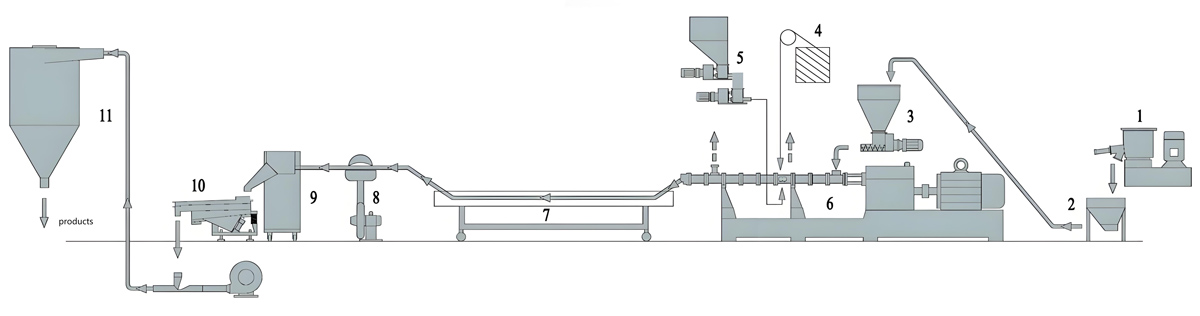
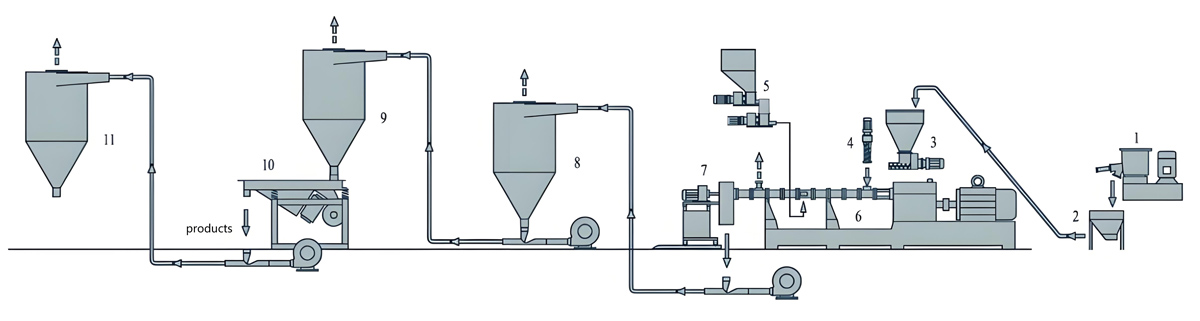
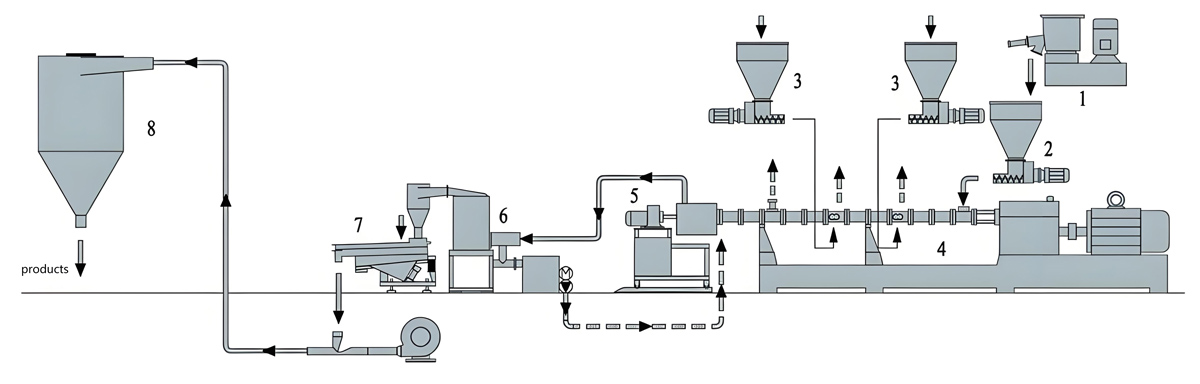
1. Raw Material Preparation
PC resin is highly hygroscopic and requires thorough drying before processing. Typically, PC resin is dried at 120-140°C for 4-6 hours to achieve moisture content below 0.02%. Pigments and additives should also be dried if necessary to prevent moisture-related defects.
2. Weighing and Pre-blending
Precision weighing is essential to maintain consistent formulation ratios. High-precision loss-in-weight feeders ensure accurate dosing of all components. Pre-mixing is typically done in low-shear mixers to avoid premature pigment agglomeration and material degradation.
3. Extrusion and Compounding
The pre-blended mixture is fed into the energy saving twin screw extruder. Inside the extruder, temperatures ranging from 260-320°C melt the resin while carefully controlled shear forces disperse pigments at the microscopic level. The energy saving design minimizes energy consumption while maintaining optimal processing conditions.
4. Vacuum Degassing
PC masterbatch production requires effective vacuum degassing to remove volatile compounds and moisture. A high-performance vacuum system maintains vacuum levels between 0.08-0.1 MPa, ensuring high-quality masterbatch with minimal porosity.
5. Cooling
The molten masterbatch exits the extruder as hot strands and is cooled using either a water bath or air cooling system. Water bath cooling is the most common method, providing rapid and uniform cooling to solidify the strands without causing thermal stress.
6. Pelletization
After cooling, the hardened strands are cut into small, uniform pellets using strand pelletizers. The resulting pellets typically measure 2-5 mm in diameter, making them easy to handle and dose during subsequent processing.
7. Quality Control and Testing
Rigorous quality control measures ensure consistent product quality:
- Color measurement using spectrophotometers to verify shade accuracy
- Dispersion analysis under microscopes to check pigment particle size distribution
- Melt Volume Rate (MVR) testing to ensure consistent processing behavior
- Thermogravimetric Analysis (TGA) to assess thermal stability
- Impact strength testing to verify mechanical properties
Production Equipment Introduction
Kerke KTE Series Energy Saving Twin Screw Extruder
The KTE Series from Nanjing Kerke Extrusion Equipment represents the latest in energy-efficient twin screw extrusion technology for PC masterbatch production:
- Energy Efficient Design: The KTE Series incorporates advanced energy-saving technologies, including optimized screw geometry, high-efficiency motors, and intelligent control systems, reducing energy consumption by up to 30% compared to conventional extruders.
- Precision Temperature Control: Multi-zone temperature control with advanced heating elements ensures uniform heating throughout the extrusion process, preventing overheating and material degradation.
- Low Shear Processing: Specialized screw elements are designed to minimize shear stress on PC materials, reducing the risk of material degradation while maintaining excellent dispersion.
- Advanced Control System: The extruder is equipped with a Siemens PLC control system that provides precise control over all processing parameters, including screw speed, temperature, and feed rate. The system also includes energy monitoring and optimization features.
- Wear-Resistant Components: Screw elements and barrels are manufactured using high-quality materials with wear-resistant coatings to withstand the abrasive nature of PC masterbatch production.
- Modular Construction: The KTE Series features a modular design that allows for easy customization of screw configurations and barrel lengths to suit specific production requirements.
Key Energy Saving Features
- High-Efficiency Motor: IE3 or IE4 premium efficiency motors reduce energy consumption during operation.
- Optimized Screw Geometry: Advanced screw design improves material conveying efficiency and reduces energy loss.
- Intelligent Heating System: Ceramic heating elements provide rapid, uniform heating with minimal energy loss.
- Heat Recovery System: Waste heat from the extrusion process is recovered and used to preheat raw materials, further reducing energy consumption.
- Energy Monitoring Software: The control system includes real-time energy monitoring and optimization features to identify energy-saving opportunities.
Supporting Equipment
Additional equipment required for PC masterbatch production includes:
- High-performance drying systems for PC resin and additives
- Precision loss-in-weight feeders for accurate ingredient measurement
- Low-shear mixers for gentle pre-blending of raw materials
- Advanced vacuum degassing systems for moisture and volatile removal
- Water bath cooling systems with temperature control
- High-precision pelletizers for uniform pellet production
- Quality control testing equipment
Parameter Settings
Optimal parameter settings for PC masterbatch production on the Kerke KTE Series extruder include:
Temperature Profile
- Feeding zone: 240-260°C
- Compression zone: 280-300°C
- Mixing zone: 290-310°C
- Die zone: 280-300°C
Screw Speed
Energy saving operation typically involves lower screw speeds to minimize shear stress on PC materials. Typical screw speeds range from 150-350 rpm, with lower speeds used for sensitive formulations and higher speeds for color masterbatches.
Feed Rate
Feed rates are typically set between 30-200 kg/h, depending on the specific extruder model and formulation. The energy saving design allows for efficient processing at lower feed rates without compromising product quality.
Vacuum Degassing
A high-performance vacuum system is used to remove volatile compounds and moisture from the melt. Vacuum levels are typically maintained between 0.09-0.1 MPa to ensure thorough degassing.
Shear Control
PC materials are sensitive to high shear conditions, which can cause molecular weight reduction and material degradation. The KTE Series extruder allows for precise control over shear rates through optimized screw design and variable speed operation.
Equipment Pricing
The Kerke KTE Series energy saving twin screw extruders offer exceptional value for PC masterbatch production. Pricing varies depending on the specific model and configuration:
- KTE-36: $22,000 – $32,000
- KTE-50: $38,000 – $52,000
- KTE-75: $48,000 – $68,000
- KTE-95: $62,000 – $88,000
- KTE-135: $82,000 – $122,000
These prices include the extruder, control system, and basic accessories. Complete turnkey systems with supporting equipment range from $55,000 to $210,000 depending on production capacity and specific requirements.
While the initial investment may be slightly higher than conventional extruders, the energy saving features of the KTE Series result in significant long-term cost savings. With energy consumption reduced by up to 30%, the payback period for the investment is typically 1-2 years.
Common Production Issues and Solutions
PC masterbatch production can encounter various challenges due to the material’s unique properties. Here are common issues, their causes, and effective solutions:
Issue 1: Material Degradation
Cause: Excessive processing temperature, high shear stress, or moisture contamination.
Solution: Reduce processing temperatures, optimize screw speed to minimize shear stress, and ensure thorough drying of raw materials. Consider using specialized screw elements designed for low-shear processing.
Issue 2: Poor Pigment Dispersion
Cause: Insufficient shear force during extrusion, improper pre-blending, or incompatible dispersants.
Solution: Optimize screw configuration to enhance shear mixing, improve pre-blending parameters, or switch to a more compatible dispersant. Consider using a split-feed process for better pigment dispersion.
Issue 3: High Energy Consumption
Cause: Inefficient equipment, improper parameter settings, or poor maintenance.
Solution: Upgrade to an energy saving extruder like the KTE Series, optimize processing parameters for energy efficiency, and implement regular maintenance to ensure optimal equipment performance.
Issue 4: Bubble Formation
Cause: Inadequate drying, insufficient vacuum degassing, or volatile compounds in raw materials.
Solution: Increase drying time and temperature, improve vacuum degassing system performance, and use high-quality raw materials with low volatile content.
Issue 5: Die Buildup
Cause: Material degradation at the die exit, incompatible additives, or improper processing conditions.
Solution: Reduce die temperature, optimize formulation to eliminate incompatible components, and implement regular purging procedures to maintain die cleanliness.
Issue 6: Inconsistent Pellet Quality
Cause: Uneven cooling, inconsistent strand thickness, or worn pelletizer blades.
Solution: Optimize cooling system parameters, adjust die opening to ensure uniform strand thickness, and regularly inspect and replace worn pelletizer blades.
Maintenance and Care
Proper maintenance is essential to ensure long-term performance and reliability of energy saving twin screw extruders:
Daily Maintenance
- Check oil levels in gearbox and lubrication systems
- Inspect heating elements and temperature sensors
- Clean feed hopper and remove any residual material
- Verify proper functioning of cooling systems
- Check for unusual noises or vibrations during operation
- Review energy consumption data to identify potential issues
Weekly Maintenance
- Inspect screw elements for signs of wear or damage
- Check alignment of drive belts and adjust tension if necessary
- Clean filters in hydraulic and lubrication systems
- Verify calibration of temperature and pressure sensors
- Inspect vacuum degassing system components
Monthly Maintenance
- Inspect gearbox for signs of wear or oil contamination
- Check electrical connections and control system components
- Clean and inspect die assembly
- Perform comprehensive safety checks
- Review energy consumption trends and optimize settings
Annual Maintenance
- Complete disassembly and inspection of screw elements and barrel
- Replace worn or damaged components
- Perform gearbox oil change and filter replacement
- Calibrate all sensors and control systems
- Conduct performance testing and optimization
- Inspect and clean heat recovery system components
Frequently Asked Questions (FAQ)
Q: What is the ideal processing temperature for PC masterbatch?
A: The ideal processing temperature range for PC masterbatch is typically 260-320°C, depending on the specific formulation and PC grade. It’s important to maintain precise temperature control to avoid material degradation.
Q: How does the energy saving feature of the KTE Series work?
A: The KTE Series incorporates multiple energy saving technologies, including high-efficiency motors, optimized screw geometry, intelligent heating systems, and heat recovery systems. These features work together to reduce energy consumption by up to 30% compared to conventional extruders.
Q: Can the KTE Series handle recycled PC materials?
A: Yes, the KTE Series is designed to handle both virgin and recycled PC materials. The energy saving design allows for efficient processing of recycled materials while maintaining product quality.
Q: What is the typical energy consumption of the KTE Series extruders for PC masterbatch production?
A: The specific energy consumption of the KTE Series for PC masterbatch production typically ranges from 0.25-0.45 kWh/kg of processed material, depending on the specific model and production parameters. This represents a significant reduction compared to conventional extruders, which typically consume 0.35-0.6 kWh/kg.
Q: Does Kerke provide training and technical support for PC masterbatch production?
A: Yes, Nanjing Kerke Extrusion Equipment provides comprehensive training programs for operators and technical support to ensure optimal equipment performance. The company offers both on-site and remote support options, including process optimization assistance for PC masterbatch production.
Conclusion
Energy saving twin screw extruders have become the preferred equipment for PC masterbatch production due to their ability to provide precise control, reduce energy consumption, and maintain exceptional product quality. The KTE Series from Nanjing Kerke Extrusion Equipment stands out as an exceptional choice, offering advanced technology, robust construction, and significant energy savings.
By understanding the key aspects of PC masterbatch production, including formulation ratios, production processes, equipment selection, and maintenance requirements, manufacturers can optimize their operations and produce high-quality PC masterbatch consistently while minimizing energy consumption.
Investing in a high-performance energy saving twin screw extruder like the Kerke KTE Series can significantly improve production efficiency, reduce operating costs, and enhance product quality in PC masterbatch manufacturing. The energy saving features not only reduce environmental impact but also provide a rapid return on investment through lower energy bills.