Introduction
Fast heating twin screw extruders have revolutionized PA11 masterbatch production by significantly reducing startup times, improving energy efficiency, and enhancing overall operational flexibility. Polyamide 11, derived from renewable castor oil sources, represents an advanced engineering plastic requiring precise temperature control and efficient thermal management during compounding. The rapid heating capability enables quick changeovers between different formulations, reduces thermal degradation risks, and optimizes energy consumption throughout the production cycle. This comprehensive guide explores all aspects of fast heating twin screw extruders specifically for PA11 masterbatch applications, from heating system technology through production optimization strategies.
Modern fast heating twin screw extruders incorporate advanced heating technologies including ceramic band heaters, induction heating systems, and optimized thermal management designs. The rapid heating capability reduces typical startup times from 60-90 minutes to 15-30 minutes, significantly improving production flexibility and reducing energy waste during idle periods. The enhanced thermal control enables precise temperature management critical for PA11 processing, which requires specific temperature profiles to maintain polymer molecular weight and achieve optimal pigment dispersion. Understanding the complete heating system design and operational parameters enables manufacturers to maximize production efficiency while maintaining PA11 material properties.
The selection of fast heating twin screw extruders for PA11 masterbatch production depends on multiple factors including required heating speed, production volume, energy consumption targets, and formulation complexity. Different heating technologies offer varying benefits in terms of heating rate, energy efficiency, and temperature control precision. The renewable nature of PA11 as a bio-based polymer adds sustainability considerations to equipment selection and operational practices. Proper matching of heating system capabilities with PA11 processing requirements ensures optimal performance and material quality.
Formulation Ratios (Different Types)
PA11 masterbatch formulation requires careful consideration of pigment loading, carrier properties, and thermal stabilizer requirements. The formulation affects heating requirements, processing behavior, and final product characteristics. Different PA11 masterbatch types require specific formulation approaches based on pigment characteristics, intended application, and processing conditions.
Pigment Loading Levels
Pigment loading in PA11 masterbatch varies significantly based on pigment type and application requirements. Standard organic pigment masterbatches for PA11 typically contain 25-40% pigment loading depending on pigment strength and dispersion requirements. Inorganic pigments including titanium dioxide for white masterbatches typically contain 30-50% loading due to higher hiding power but greater dispersion challenges. Carbon black masterbatches for conductive or UV protection applications typically load 15-30% depending on conductivity requirements. Special effect pigments including pearlescent and metallic types typically load 5-15% to preserve effect characteristics.
Higher pigment loadings provide economic advantages through reduced material handling and lower dilution ratios in final applications. However, high pigment loading increases processing difficulty requiring more intensive mixing and longer residence times. PA11’s sensitivity to thermal degradation requires careful balance between processing intensity needed for dispersion and thermal exposure. Lower pigment loadings provide easier processing and better dispersion but increase material costs and require higher let-down ratios in end products. Optimal loading balances processing efficiency with economic considerations for specific applications.
Carrier Properties and Selection
PA11 carrier selection significantly affects heating requirements and processing behavior. Commercial PA11 grades vary in melt flow index typically 2-25 g/10min affecting processing temperature and screw speed requirements. Low MFI grades below 5 g/10min require higher processing temperatures 220-250°C and lower screw speeds for adequate melting and mixing. High MFI grades above 15 g/10min process at lower temperatures 200-230°C allowing higher screw speeds for increased throughput.
PA11 carrier moisture sensitivity requires attention to drying requirements before processing. Typical moisture content specifications for PA11 granules range 0.1-0.3% but must be dried below 0.02% before processing to prevent hydrolytic degradation. Moisture content affects heating requirements with wetter materials requiring additional heating energy for moisture evaporation. The hygroscopic nature of PA11 necessitates proper material handling and storage to minimize moisture absorption before processing.
Thermal Stabilizer Formulations
Thermal stabilizers in PA11 masterbatch formulations protect against thermal degradation during processing. PA11 processing temperatures 200-250°C create thermal stress requiring stabilization to prevent molecular weight loss and color changes. Typical thermal stabilizer loadings range 0.5-3% depending on processing severity and application requirements. Copper-based stabilizers provide excellent thermal protection for PA11 but may affect color in light-colored masterbatches.
Stabilizer selection must consider compatibility with final applications. Food contact applications require FDA-compliant stabilizers. Outdoor applications require UV stabilizers in addition to thermal stabilizers. Automotive applications require stabilizers meeting specific automotive specifications. The stabilizer package must be balanced to provide thermal protection without affecting pigment color development or final application properties. PA11’s bio-based nature may influence stabilizer selection for sustainability-focused applications.
Specialized PA11 Masterbatch Types
Specialized PA11 masterbatch types require unique formulation approaches based on specific application requirements. Flame retardant masterbatches incorporate flame retardant additives at 15-30% loading levels requiring careful thermal management due to thermal sensitivity of many flame retardant additives. Electrically conductive masterbatches incorporate carbon black or metallic conductors at 10-30% loading requiring specialized screw configurations for proper dispersion without excessive shear heating.
Lubricant masterbatches incorporate processing aids at 2-10% loading improving flow properties of PA11 in downstream processing. These formulations typically use lower pigment loadings to preserve additive functionality. Reinforced masterbatches incorporate fillers such as glass fibers or mineral fillers at 10-40% loading requiring specialized processing considerations due to abrasive filler characteristics. Each specialized type requires formulation optimization balancing additive functionality with processability in PA11 matrix.
Rapid Changeover Formulations
Rapid changeover capabilities of fast heating extruders enable efficient production of multiple PA11 masterbatch types with minimal downtime. Formulation planning for frequent changeovers considers compatibility between different formulations to reduce cleaning requirements. Color sequence planning typically moves from light to dark colors minimizing cleaning between runs. Similar pigment types grouped together reducing cleaning requirements when switching between different shades of similar pigment chemistry.
Formulation standardization where possible reduces changeover complexity. Using consistent carrier grades across different formulations simplifies thermal profile transitions. Similar stabilizer packages across formulations reduce need for stabilizer system adjustments. Standardized additive concentrations where possible reduce feeding system adjustments between formulations. Effective formulation planning combined with fast heating capabilities enables production flexibility with minimal changeover time.
Production Process
PA11 masterbatch production on fast heating twin screw extruders leverages rapid thermal response for efficient operation and quick changeovers. The production process takes advantage of fast heating capabilities to minimize startup times and reduce energy consumption. Understanding each process stage and its thermal requirements enables optimization of heating system operation.
Rapid Startup Procedure
Rapid startup procedures take advantage of fast heating capabilities to minimize downtime between production runs. Initial preheating brings barrel to target temperature profile in 15-30 minutes compared to 60-90 minutes for conventional extruders. Temperature ramping rates for fast heating systems typically 8-15°C/minute depending on heating system capacity and thermal mass. Gradual temperature ramping prevents thermal shock to equipment and ensures uniform heating throughout barrel length.
Startup temperature profiles for PA11 processing typically begin with feed zone at 50-60°C to prevent premature melting and bridging. Compression zones ramp to 180-200°C for initial melting. Mixing zones reach 220-240°C for optimal processing conditions. Die zones match mixing zone temperature 220-240°C for consistent melt flow. The rapid heating capability allows reaching target temperatures throughout all zones simultaneously minimizing thermal gradients in the extruder.
Material Feeding and Preheating
Material feeding systems for PA11 masterbatch benefit from fast heating capabilities through reduced purge material requirements. Material preheating in feed hoppers using integrated heating elements reduces thermal load on extruder barrel. Feed zone heating maintains material temperature 60-80°C preventing moisture condensation while preventing premature melting. Moisture management critical for PA11 processing requires heated feed hoppers to prevent moisture absorption during processing.
Gravimetric feeding systems provide accurate material delivery enabling consistent formulation control. Multiple feeders allow separate introduction of carrier, pigments, and additives for optimal processing. Side feeding of pigments after carrier melting reduces thermal exposure for heat-sensitive pigments. The fast heating capability allows quick adaptation of feed zones when switching between formulations with different thermal requirements.
Melting Zone Operation
The melting zone in fast heating twin screw extruders achieves efficient PA11 melting with minimal thermal exposure. Screw configuration in melting zone includes conveying elements followed by kneading blocks for gradual melting. The fast heating capability enables precise temperature control preventing local overheating that could degrade PA11. Temperature uniformity across barrel width and length ensures consistent melting without hot spots.
Melting zone residence time optimization balances complete melting against thermal degradation. Fast heating reduces residence time requirements by achieving target temperatures more quickly. Screw speed adjustment controls residence time with typical speeds 150-300 rpm for PA11 masterbatch production. The rapid thermal response allows quick adjustment of processing conditions when changing between different PA11 grades or pigment types.
High-Speed Mixing Zone
Mixing zone operation in fast heating extruders leverages precise temperature control for optimal PA11 masterbatch quality. High shear mixing elements distribute pigments throughout PA11 carrier ensuring uniform color development. The fast heating capability enables tight temperature control within mixing zone preventing thermal gradients that could affect dispersion quality. Temperature control within ±2°C throughout mixing zone ensures consistent processing conditions.
Mixing zone temperature typically maintained 220-240°C for PA11 masterbatch production. Screw configuration includes kneading blocks with stagger angles optimized for PA11 rheology. The rapid thermal response allows quick compensation for exothermic or endothermic reactions from pigment wetting or additive reactions. Precise temperature control minimizes PA11 thermal degradation while ensuring adequate melt viscosity for pigment dispersion.
Efficient Degassing Zone
Degassing zone operation removes volatiles and moisture from PA11 melt ensuring product quality. Fast heating capability enables rapid achievement of vacuum venting temperatures typically 230-250°C. Vacuum ports positioned after mixing zone remove moisture, volatiles, and any decomposition products. Multiple venting stages may be employed for formulations with high moisture content or volatile components.
Vacuum levels for PA11 masterbatch typically 50-200 mbar depending on formulation and moisture content. The fast heating capability reduces time to achieve stable vacuum conditions as volatiles are released more quickly from properly heated melt. Condensate collection systems capture moisture and volatiles preventing environmental release. Efficient degassing prevents voids and bubbles in final pellets ensuring quality in downstream applications.
Optimized Granulation
Granulation operation for PA11 masterbatch benefits from fast heating through reduced purge material and rapid changeovers. Die temperature matched to final mixing zone temperature 220-240°C ensures proper melt flow. Strand die designs produce uniform strands for subsequent cutting. Water bath cooling 40-60°C ensures proper solidification of PA11 strands preventing deformation.
Underwater pelletizing alternatives offer advantages for PA11 including better heat transfer and more uniform pellets. Die face temperature control 230-250°C ensures proper pellet formation. Cutting blade speed 2500-4000 rpm produces uniform pellets. The fast heating capability enables quick adjustment of die temperature when switching between different formulations, reducing changeover time and purge material waste.
Production Equipment Introduction
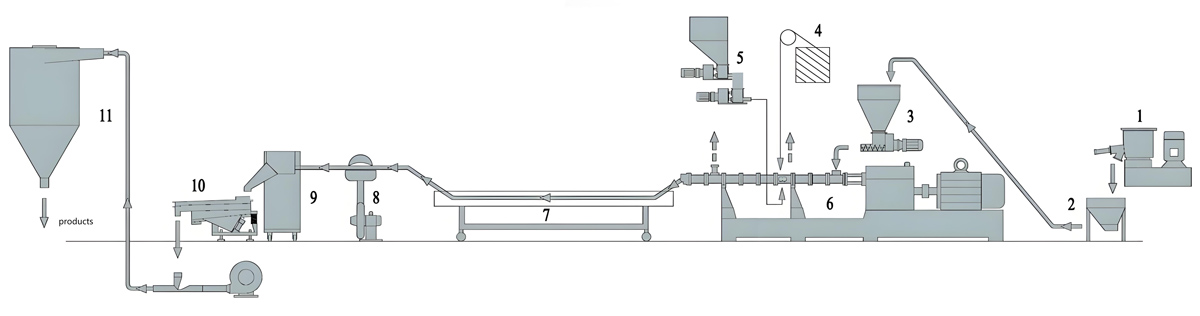
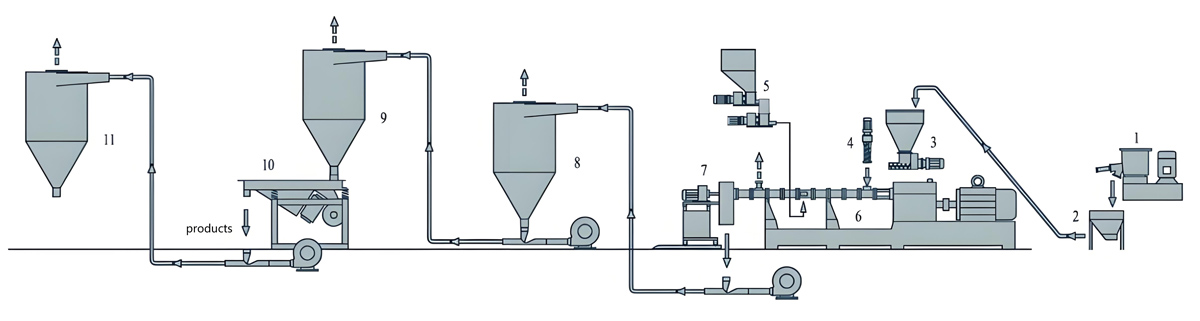
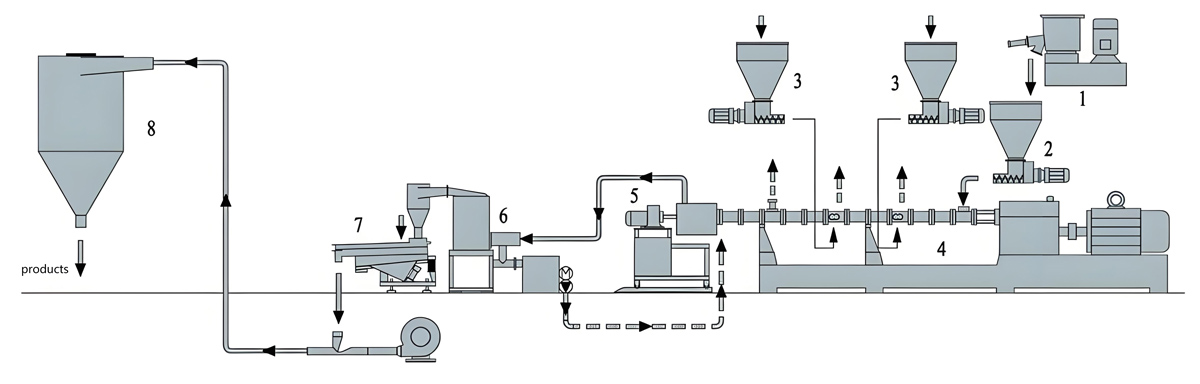
Modern fast heating twin screw extruders for PA11 masterbatch incorporate advanced heating technologies and thermal management systems. The KTE Series twin screw extruder from Nanjing Kerke Extrusion Equipment Company offers excellent fast heating capabilities specifically designed for engineering plastic masterbatch production. These extruders feature ceramic band heaters providing rapid heating rates while maintaining excellent temperature uniformity.
Equipment specifications for PA11 masterbatch production include barrel L/D ratio typically 40:1 to 48:1 providing sufficient mixing length while enabling rapid thermal response. Screw diameters range from 35mm to 90mm accommodating production capacities from 100 kg/hr to 1500 kg/hr. Heating system capacity typically 0.8-1.5 kW per barrel zone depending on zone size and heating rate requirements. Temperature control accuracy within ±1°C across all zones ensures precise PA11 processing conditions.
Specialized features for PA11 processing include moisture-resistant barrel construction to prevent corrosion from PA11 hydrolysis products. Advanced control systems with thermal learning algorithms optimize heating profiles for different formulations. Quick-change screw designs enable rapid configuration changes between different masterbatch types. Complete production lines integrate fast heating extruders with auxiliary equipment including gravimetric feeding, vacuum venting, and automated pelletizing systems.
Parameter Settings
Optimal parameter settings for fast heating twin screw extruders in PA11 masterbatch production leverage rapid thermal response capabilities. Temperature profiles, heating rates, and processing speeds require optimization to balance quality requirements with production efficiency. Understanding parameter effects on heating system performance enables proper utilization of fast heating capabilities.
Temperature Profile Configuration
Temperature profile configuration for fast heating PA11 processing leverages rapid thermal response for efficient operation. Feed zone temperature 50-60°C prevents premature melting while maintaining material above dew point preventing moisture condensation. Compression zone temperature progression 120-150°C initially then 180-200°C for melting initiation. Melting zone temperature 200-220°C ensures complete PA11 melting. Mixing zone temperature 220-240°C provides optimal conditions for pigment dispersion.
Die zone temperature matched to mixing zone 220-240°C ensures consistent melt flow. Temperature ramping rates for startup 8-15°C/minute depending on heating system capacity. The fast heating capability enables simultaneous heating of all zones reducing startup time. Temperature overshoot prevention built into control systems prevents thermal degradation during rapid heating phases. Uniform temperature distribution across barrel width and length ensures consistent processing conditions.
Heating Rate Optimization
Heating rate optimization balances fast startup with equipment protection and temperature uniformity. Maximum heating rates 10-15°C/minute for initial barrel heating from ambient. Reduced heating rates 5-8°C/minute as target temperature approaches to prevent overshoot. Zone temperature synchronization ensures all zones reach target simultaneously minimizing thermal gradients. Heating rate adjustment based on ambient temperature and equipment thermal mass optimizes energy efficiency.
Energy consumption during heating depends on heating rate and thermal mass. Fast heating systems typically consume 15-25% more energy during startup but overall energy consumption similar due to reduced idle heating time. Energy recovery systems capture waste heat from cooling water or exhaust for preheating feed materials. Intelligent heating algorithms optimize heating sequences based on production schedules minimizing total energy consumption.
Screw Speed and Residence Time
Screw speed settings for PA11 masterbatch consider heating system response time and thermal requirements. Typical screw speeds 150-300 rpm provide adequate residence time for PA11 melting and pigment dispersion. Lower speeds 150-200 rpm for high pigment loading formulations requiring longer mixing. Higher speeds 250-300 rpm for lower loading formulations where thermal exposure must be minimized.
Residence time typically 1.5-3.0 minutes depending on formulation and screw configuration. The fast heating capability reduces residence time requirements as target temperatures achieved more quickly. Residence time measurement using tracer methods verifies actual time for process optimization. Excessive residence time increases PA11 thermal degradation risk requiring monitoring through molecular weight measurements of processed material.
Feed Rate and Throughput
Feed rate settings for PA11 masterbatch production consider heating system capacity and thermal management. Specific feed rates typically 2.5-4.0 kg/hr/rpm depending on PA11 grade and formulation. Higher feed rates require increased heating capacity to maintain temperature stability. Feed rate synchronization with screw speed ensures consistent channel fill and thermal conditions.
Throughput calculations for fast heating extruders consider actual production time after startup. Fast heating 15-30 minutes startup enables more production cycles per shift compared to conventional extruders requiring 60-90 minutes. Production capacity typically 80% of theoretical capacity due to changeovers and purging. Throughput optimization balances heating system response with formulation requirements.
Changeover Parameter Optimization
Changeover parameter optimization leverages fast heating capability for efficient formulation transitions. Temperature profile adjustment between formulations typically 5-10 minutes due to rapid heating response. Purge material quantity reduced 40-60% compared to conventional extruders due to faster temperature transitions. Sequential color change planning from light to dark reduces purge requirements further.
Parameter presets for common formulations enable rapid changeover with minimal adjustment. Temperature profile pre-loading based on production schedule enables heating to begin before previous run completion. Screw configuration changes simplified through quick-change designs. Formulation parameters stored in control system reduce setup time for repeated production runs.
Temperature Control Precision
Temperature control precision critical for PA11 processing to prevent thermal degradation. Fast heating systems typically achieve ±1°C control accuracy across all barrel zones. Response time to temperature variations typically 30-60 seconds enabling quick correction of thermal disturbances. Zone interaction management prevents temperature cross-talk between adjacent zones.
Temperature monitoring includes multiple sensors per zone for redundancy and accuracy. Control algorithms include feedforward and feedback control for optimal response. Thermal modeling capabilities predict temperature changes enabling proactive control. Advanced systems include thermal learning optimizing control parameters over time based on actual processing conditions.
Equipment Price
Fast heating twin screw extruder pricing for PA11 masterbatch production reflects advanced heating technology and thermal management systems. Understanding cost factors enables proper budgeting and investment analysis. Total system cost includes extruder, heating systems, and auxiliary equipment.
Fast Heating Extruder Pricing
Fast heating twin screw extruder pricing varies based on capacity and heating system sophistication. Medium capacity extruders 35-50mm screw diameter for PA11 masterbatch 200-800 kg/hr cost $55,000-140,000 with fast heating capabilities. Large capacity extruders 65-90mm screw diameter for 1000-1500 kg/hr cost $140,000-380,000. Fast heating systems add 15-25% premium compared to conventional heating systems.
Heating system options affect pricing significantly. Standard ceramic band heaters provide good fast heating performance at reasonable cost. Induction heating systems offer fastest heating rates but cost 25-35% more than ceramic systems. Hybrid heating systems combining ceramic and induction provide intermediate performance and cost. Thermal management systems including insulation and heat recovery add 8-15% to base cost.
Complete Production Line Pricing
Complete production line pricing for fast heating PA11 masterbatch includes extruder, feeding systems, vacuum venting, and pelletizing. Medium capacity complete lines 200-800 kg/hr cost $100,000-250,000. Large capacity lines 1000-1500 kg/hr cost $250,000-600,000. Fast heating capabilities typically add 12-20% to complete line cost compared to conventional systems.
Auxiliary equipment costs include gravimetric feeding systems $12,000-30,000, vacuum venting systems $18,000-45,000, and advanced pelletizing systems $20,000-55,000. Material handling systems for PA11 including moisture control $15,000-35,000. Complete line integration and automation add $25,000-60,000 depending on complexity.
Installation and Commissioning
Installation costs for fast heating extruders typically $10,000-35,000 depending on equipment size and facility requirements. Electrical installation including upgraded power supply for heating systems $15,000-40,000. Thermal management installation including insulation and heat recovery systems $8,000-22,000. Commissioning for fast heating systems includes additional calibration and optimization $5,000-15,000.
Training for fast heating system operation typically $3,000-8,000 including thermal management optimization. Startup optimization to achieve target heating rates $4,000-12,000. Total installation and commissioning typically 20-30% of equipment cost for fast heating systems compared to 15-25% for conventional systems.
Operating Cost Analysis
Operating costs for fast heating PA11 masterbatch production include energy consumption, maintenance, and efficiency factors. Energy consumption during production similar to conventional systems 0.9-1.3 kWh/kg. Startup energy consumption higher 15-25% but offset by reduced idle heating time. Overall energy consumption typically 5-10% lower due to efficient heating and reduced purge waste.
Maintenance costs for fast heating systems 2.5-4.5% of equipment cost annually including heater replacement and control system maintenance. Ceramic band heaters typically last 3-5 years in PA11 applications. Induction heating systems 5-8 years life expectancy. Control system maintenance typically 1.5-3% of equipment cost annually. Reduced changeover time and purge waste provide additional cost savings not reflected in direct operating costs.
ROI and Payback Analysis
ROI analysis for fast heating systems considers production flexibility, energy savings, and quality improvements. Payback period typically 2.5-4.5 years for fast heating upgrade over conventional systems. Production flexibility value from reduced changeover time typically $15,000-40,000 annually for multi-product operations. Energy savings typically $8,000-25,000 annually depending on production volume.
Quality improvements from better temperature control reduce waste typically 1-3% of production value. Production capacity increase from faster startups and changeovers typically 5-15% improvement in effective capacity. Combined value of improvements typically justifies fast heating investment for operations with frequent changeovers or high-value PA11 masterbatch products.
Production Problems and Solutions
Production problems in fast heating PA11 masterbatch production require specialized understanding of heating system behavior. Problems related to rapid heating, thermal management, and PA11 material characteristics need specific solutions leveraging fast heating capabilities.
Thermal Degradation During Rapid Heating
Thermal degradation of PA11 during rapid heating manifests as yellowing, molecular weight loss, or viscosity reduction. Causes include excessive heating rates causing local overheating, poor temperature uniformity creating hot spots, or prolonged exposure to high temperatures. The fast heating capability while beneficial can create thermal gradients if not properly managed.
Solutions include reducing heating rates to 5-8°C/minute near target temperature to prevent overshoot. Temperature uniformity verification using multiple sensors per zone ensures even heating. Control system tuning prevents temperature oscillations during rapid heating phases. Implementation of soft landing algorithms slows heating rate approaching target preventing thermal shock. Temperature monitoring of melt using melt temperature sensors provides direct feedback on actual material temperature.
Preventive measures include regular calibration of temperature sensors ensuring accurate readings. Heating system maintenance prevents hot spots from degraded heater performance. Process validation for each formulation establishes safe heating rate limits. Operator training on thermal degradation recognition enables early intervention. PA11 molecular weight monitoring during production catches degradation before quality problems.
Inconsistent Temperature Control
Inconsistent temperature control in fast heating systems causes processing variations affecting PA11 masterbatch quality. Causes include heater element degradation, control system tuning issues, or thermal cross-talk between zones. Rapid heating requirements stress control systems potentially causing instability.
Solutions include heater element testing and replacement of degraded elements. Control system tuning optimization for fast heating response including proper PID parameters. Thermal isolation between zones reduces cross-talk improving independent zone control. Advanced control algorithms including model predictive control improve response without instability. Regular temperature mapping of barrel identifies areas of poor temperature uniformity.
Preventive measures include scheduled heater element replacement before complete failure. Control system maintenance including sensor calibration and parameter verification. Thermal management system inspection ensures proper insulation and heat transfer. Operator monitoring of temperature trends catches developing issues before quality impact. Spare heater inventory enables quick replacement minimizing downtime.
Moisture Control Problems
Moisture control problems in PA11 processing cause hydrolytic degradation, bubbles, and processing issues. Causes include inadequate pre-drying, moisture ingress during processing, or condensation in feed system. The fast heating capability can increase moisture volatility causing condensation if not properly managed.
Solutions include improved pre-drying of PA11 material to below 0.02% moisture using desiccant dryers at 80-90°C for 4-6 hours. Heated feed hoppers maintained at 60-80°C prevent moisture condensation. Vacuum venting enhanced to 50-100 mbar removes moisture effectively. Moisture barrier materials for storage and handling prevent moisture absorption. Dehumidified air supply to feed area reduces moisture ingress.
Preventive measures include moisture monitoring using Karl Fischer titration or moisture analyzers. Material handling procedures ensure proper drying and storage. Feed system design minimizes open exposure to ambient air. Regular inspection of seals and gaskets prevents air leaks into processing system. PA11 moisture content specification enforcement prevents wet material from entering process.
Pigment Dispersion Issues
Pigment dispersion issues in fast heating systems result from insufficient mixing time or inappropriate temperature profile. Rapid heating can reduce residence time potentially compromising dispersion if not compensated by screw configuration. Temperature profile variations affect melt viscosity influencing pigment wetting.
Solutions include screw configuration optimization with additional kneading blocks in mixing zone. Temperature profile adjustment ensures optimal viscosity for pigment dispersion. Screw speed optimization balances residence time with thermal exposure. Side feeding of pigments after initial melting reduces thermal exposure while improving dispersion. Dispersion quality monitoring using microscopy or color strength measurement verifies effectiveness.
Preventive measures include screw configuration validation for specific formulations. Process parameter documentation ensures consistent settings between runs. Regular screw inspection for wear that affects mixing performance. Pigment pre-dispersion in small carrier amounts improves wetting. Training on dispersion quality assessment enables early problem identification.
Changeover Quality Problems
Changeover quality problems in fast heating operations result from incomplete purge or thermal profile transitions causing contamination or off-spec material. Rapid changeover capability can tempt insufficient purge time leading to cross-contamination between formulations.
Solutions include establishing minimum purge quantities based on color strength differences. Color sequence planning from light to dark reduces purge requirements. Purge material analysis verifies complete removal of previous color. Thermal profile transition monitoring ensures zones reach target temperatures before production. Automated changeover procedures enforce minimum purge times and temperature verification.
Preventive measures include documented purge procedures for different formulation combinations. Color tracking system prevents incompatible color transitions. Purge material management includes separate storage for different color families. Regular cleaning verification prevents accumulation of material over multiple changeovers. Training on purge quality assessment ensures proper changeover execution.
Equipment Overload During Heating
Equipment overload during heating phases results from excessive heating rate demands exceeding system capacity. Causes include attempting too rapid heating from cold start, simultaneous heating of all zones exceeding power supply capacity, or degraded heater performance requiring more power.
Solutions include staged heating sequences preventing simultaneous high-demand heating of all zones. Power supply verification ensures adequate capacity for heating requirements. Heater performance testing identifies degraded elements before complete failure. Load management systems prevent simultaneous high-power demand from multiple systems. Startup procedures include gradual ramping of heating rate rather than maximum from start.
Preventive measures include electrical system capacity analysis ensuring adequate supply for heating requirements. Regular heater maintenance prevents degradation leading to overload. Monitoring of power consumption during heating identifies developing issues. Backup power supply sizing prevents overload during voltage sags. Operator training on heating system limits prevents operation beyond capabilities.
Maintenance
Maintenance of fast heating twin screw extruders for PA11 requires attention to heating systems, thermal management, and PA11-specific concerns. Preventive maintenance schedules must address heating element wear, control system accuracy, and moisture protection systems.
Daily Maintenance
Daily maintenance tasks ensure fast heating systems operate at peak performance. Temperature verification across all zones confirms control accuracy. Heater operation monitoring identifies any zones not heating properly. Feed system inspection ensures moisture control systems functioning properly. Visual inspection for leaks or unusual sounds identifies developing problems.
Daily cleaning procedures remove PA11 residue from surfaces. Feed hopper and feeder cleaning prevents material accumulation and moisture issues. Vent port cleaning removes any condensation or material buildup. Die cleaning ensures proper pellet formation. Proper cleaning maintains thermal transfer efficiency and prevents cross-contamination.
Weekly Maintenance
Weekly maintenance includes detailed inspection of heating systems and thermal management. Heater element inspection for degradation or failure signs. Temperature sensor calibration verification ensures accurate readings. Insulation inspection for damage affecting thermal efficiency. Control system performance verification ensures proper response times.
Thermal management system inspection including heat recovery components. Electrical connections inspection for signs of overheating or looseness. Cooling system verification ensures proper operation for PA11 processing. Documentation review ensures maintenance tasks completed and recorded. Weekly maintenance prevents minor heating issues from developing into major problems.
Monthly Maintenance
Monthly maintenance addresses components requiring periodic service. Heater element testing identifies elements needing replacement before complete failure. Temperature mapping of barrel identifies uniformity problems. Control system tuning optimization ensures optimal response. Screw inspection for wear affecting mixing performance and thermal transfer.
Moisture control system service including dryer calibration and leak detection. Venting system cleaning and inspection ensures proper operation. Electrical system testing detects developing issues. Calibration verification of all sensors ensures accurate control. Monthly maintenance provides detailed assessment of heating system condition.
Quarterly Maintenance
Quarterly maintenance provides comprehensive heating system evaluation. Complete heater element testing and replacement of degraded units. Barrel inspection for thermal damage or wear. Control system software updates and parameter optimization. Thermal management system overhaul including cleaning and performance verification.
Screw and barrel inspection for PA11-specific wear patterns. Complete electrical system inspection and connection tightening. Safety system testing ensures all protective devices function properly. Documentation update includes maintenance records and system modifications. Quarterly maintenance provides opportunity for major component service.
Annual Maintenance
Annual maintenance provides complete system evaluation and major service. Complete teardown for thorough inspection of heating systems. Heater element replacement based on testing results. Control system upgrade and calibration ensures optimal performance. Thermal management system overhaul or replacement based on condition.
Screw and barrel replacement based on wear and performance. Complete electrical system service including control panel overhaul. Safety system overhaul ensures proper function. Documentation update includes complete system history and modifications. Annual maintenance provides opportunity for system upgrades and capacity expansion planning.
FAQ
Frequently asked questions address common concerns about fast heating twin screw extruders for PA11 masterbatch production.
How fast can the extruder heat up from cold start?
Fast heating twin screw extruders typically heat from ambient to PA11 processing temperatures of 220-240°C in 15-30 minutes depending on system capacity and thermal mass. This represents 3-5 times faster than conventional extruders requiring 60-90 minutes. Actual heating time depends on ambient temperature, equipment size, and heating system configuration. Proper startup procedures with staged heating typically achieve the fastest reliable heating. Maintenance of heating systems ensures consistent heating performance over equipment life.
Does fast heating reduce PA11 quality?
Fast heating when properly controlled does not reduce PA11 quality and may improve quality through better temperature control. Rapid heating combined with proper control algorithms prevents thermal degradation by avoiding prolonged exposure to intermediate temperatures. The improved temperature uniformity reduces hot spots that can cause localized degradation. However, improper heating rates or control system issues can cause thermal damage. Proper parameter settings and regular maintenance ensure fast heating benefits without quality compromise.
How much energy does fast heating save?
Fast heating systems typically save 5-10% overall energy consumption despite higher peak power during heating. Energy savings come from reduced idle heating time during changeovers and startups. Reduced purge material waste also contributes to energy savings per unit of good product. Energy recovery systems can capture additional waste heat from cooling systems or exhaust. Actual savings depend on production patterns with operations having frequent changeovers realizing greater savings.
Can I retrofit fast heating to existing extruder?
Retrofitting fast heating capabilities to existing extruders is possible but cost-effectiveness depends on equipment condition and requirements. Basic retrofit including ceramic band heaters and upgraded controls typically costs 40-60% of new fast heating extruder cost. Complete retrofit including thermal management systems may approach 70-80% of new equipment cost. Retrofit feasibility depends on extruder barrel condition, control system compatibility, and available electrical capacity. Economic analysis should compare retrofit cost to new equipment benefits.
How does fast heating affect changeover time?
Fast heating capabilities can reduce total changeover time by 50-70% compared to conventional systems. Temperature profile adjustment between formulations takes 5-10 minutes versus 20-30 minutes for conventional heating. Purge material requirements typically reduced 40-60% as temperatures stabilize more quickly. Overall changeover time including cleaning, purging, and parameter adjustment can be reduced from 45-90 minutes to 15-30 minutes. Actual savings depend on formulation differences and cleaning requirements.
Summary
Fast heating twin screw extruders represent significant advancement for PA11 masterbatch production offering improved efficiency, flexibility, and quality. The rapid thermal response enables quick startups and changeovers reducing downtime and purge waste. Advanced heating technologies including ceramic band heaters and induction systems provide precise temperature control critical for PA11 processing. Proper utilization of fast heating capabilities requires understanding of heating system behavior and PA11 material characteristics.
Key success factors include proper parameter settings balancing heating speed with temperature control, regular maintenance of heating systems, and operator training on fast heating operation. The KTE Series twin screw extruders from Nanjing Kerke Extrusion Equipment Company provide excellent fast heating capabilities specifically designed for PA11 and other engineering plastic applications. Investment in fast heating technology typically provides payback in 2.5-4.5 years through efficiency gains and quality improvements.
PA11 masterbatch production with fast heating extruders enables manufacturers to improve competitiveness through reduced production costs, improved flexibility, and enhanced product quality. The renewable nature of PA11 as bio-based material combined with energy-efficient fast heating creates sustainable production solutions. Continuous improvement through monitoring and optimization of heating system performance maximizes benefits over equipment lifetime.