Introduction
Conductive polyethylene masterbatch production represents a specialized and technically demanding segment of the polymer additives industry, serving critical needs for materials with electrical conductivity properties across diverse applications including electronic packaging, antistatic flooring, EMI shielding components, and automotive electrostatic discharge protection. The heavy-duty twin screw extruder serves as the essential manufacturing equipment for producing these specialized conductive concentrates, providing the robust construction, powerful drive systems, and intensive mixing capabilities necessary to process high-loading conductive filler formulations while maintaining consistent product quality and production reliability.
Conductive polyethylene masterbatches are concentrated formulations containing conductive fillers dispersed in polyethylene carrier resins, designed to provide electrical conductivity when incorporated into final PE products. These additives function through the formation of conductive networks within the polymer matrix, enabling electron flow through percolation pathways formed by conductive particles. Common conductive fillers include carbon black, carbon fibers, carbon nanotubes, graphene, and metallic particles such as silver-coated particles or metal powders. The conductivity level achieved depends on filler type, loading level, dispersion quality, and network formation within the polymer matrix.
The production of conductive PE masterbatch presents unique and challenging technical requirements that distinguish it from conventional additive manufacturing. The high filler loading levels required to achieve percolation thresholds, often exceeding 20-30% and reaching up to 50% for some applications, create extremely abrasive processing conditions that demand heavy-duty equipment construction. The formation of conductive networks requires exceptional dispersion quality to ensure uniform conductivity throughout the material. The abrasive nature of many conductive fillers, particularly carbon-based materials, accelerates equipment wear and requires robust construction and wear-resistant materials throughout the processing system.
This comprehensive guide examines the critical aspects of heavy-duty twin screw extruder applications in conductive PE masterbatch manufacturing, covering formulation considerations, robust production processes, heavy-duty equipment specifications, parameter optimization strategies, maintenance requirements, and technical approaches to achieving the consistent conductivity and quality demanded by performance-critical applications.
Formulation Ratios for Different Types
Conductive PE masterbatch formulations encompass diverse conductive filler types and loading levels, each requiring specific formulation approaches to achieve target conductivity levels while maintaining processability and physical properties in final applications. The heavy-duty twin screw extruder must accommodate varied formulation requirements while ensuring uniform dispersion and consistent conductivity across different conductive systems.
Carbon black-based conductive masterbatches typically contain 15-35% conductive carbon black dispersed in polyethylene carrier resins. These formulations provide cost-effective conductivity through the formation of carbon black networks within the polymer matrix. Standard formulations for antistatic applications might include 20% conductive carbon black, 5% processing aids, and 75% polyethylene carrier resin. The high surface area of carbon black creates significant dispersion challenges requiring intensive mixing to break down agglomerates and ensure uniform distribution. Carbon black formulations generally offer good thermal stability but are highly abrasive, requiring wear-resistant screw and barrel components.
Carbon fiber-based conductive masterbatches incorporate 10-30% carbon fibers dispersed in polyethylene. These formulations provide anisotropic conductivity with directionally-dependent properties, along with enhanced mechanical reinforcement. Typical compositions for EMI shielding applications might include 25% carbon fibers, 5% coupling agents, and 70% polyethylene carrier resin. The fibrous nature of carbon fibers presents unique dispersion challenges, as excessive shear can break fibers reducing aspect ratio and conductivity. Carbon fiber formulations require specialized screw configurations that provide distributive mixing without excessive fiber damage while achieving uniform orientation for consistent conductivity properties.
Carbon nanotube-based conductive masterbatches utilize 5-15% multi-walled or single-walled carbon nanotubes dispersed in polyethylene carriers. These formulations provide exceptional conductivity at very low loading levels due to the high aspect ratio and excellent conductivity of carbon nanotubes. A typical formulation might include 8% carbon nanotubes, 7% dispersing agents, and 85% polyethylene carrier resin. The nano-scale particle size and tendency to form bundles presents significant dispersion challenges requiring specialized high-shear mixing and potentially surface treatment of nanotubes to prevent agglomeration. The low loading levels maintain good processability while achieving excellent conductivity.
Metallic particle-based conductive masterbatches contain 20-40% metal particles such as silver-coated particles, copper powders, or nickel particles dispersed in polyethylene. These formulations provide high conductivity through direct metallic contact between particles. A typical metallic particle formulation might include 30% silver-coated particles, 5% compatibility enhancers, and 65% polyethylene carrier resin. The high density and abrasiveness of metallic particles create processing challenges including potential settling in hoppers and increased equipment wear. These formulations often require specialized feeding systems and wear-resistant components throughout the processing equipment.
Hybrid conductive masterbatches incorporate multiple conductive filler types to achieve synergistic effects and enhanced conductivity at lower total loading levels. These sophisticated formulations typically contain 15-35% total conductive content with carefully balanced ratios of different filler types. For example, a hybrid formulation might include 12% carbon black, 8% carbon fibers, and 80% polyethylene carrier resin to provide both isotropic and anisotropic conductivity characteristics. The complexity of these formulations demands advanced screw configurations and careful processing parameter optimization to achieve uniform distribution of all conductive components while maintaining the unique dispersion requirements of each filler type.
Production Process
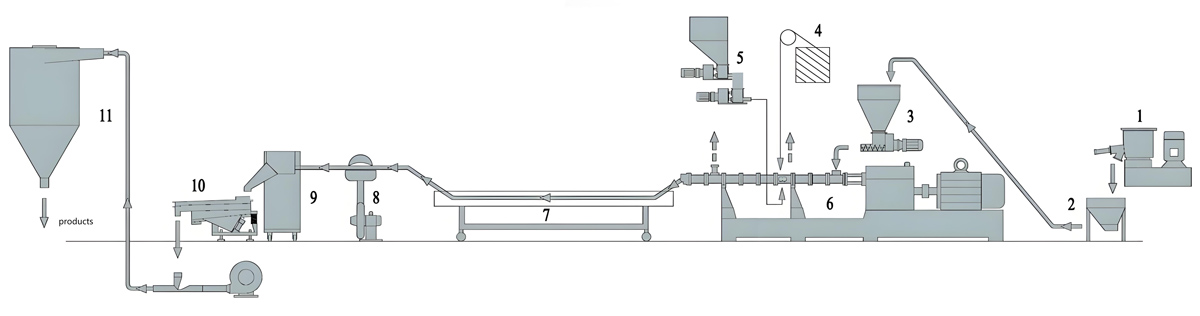
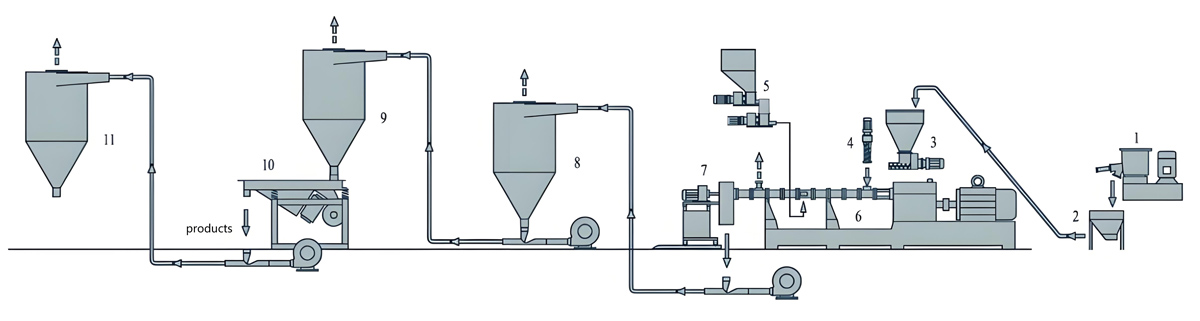
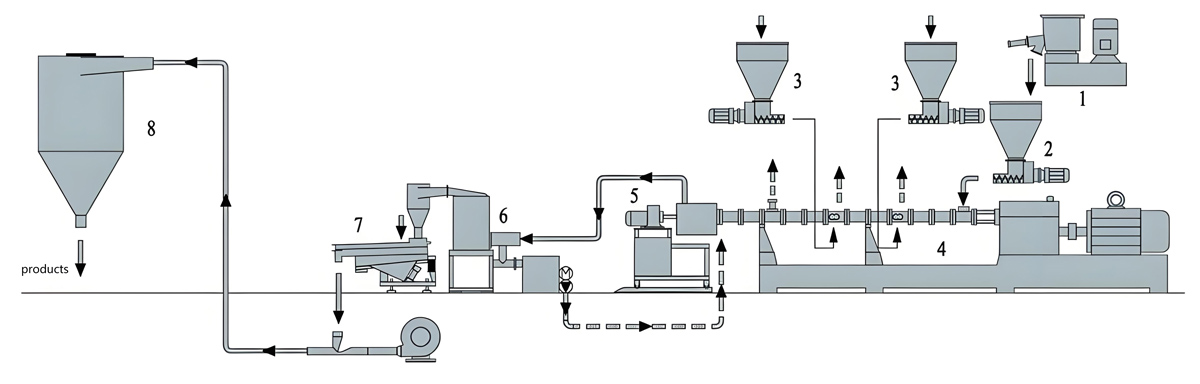
The heavy-duty production process for conductive PE masterbatch using twin screw extruders incorporates robust equipment design and intensive mixing capabilities to handle the challenging characteristics of conductive filler formulations. The abrasive nature of high-loading conductive fillers demands specialized equipment construction, while the requirement for uniform dispersion to achieve consistent conductivity necessitates powerful mixing systems and optimized processing parameters.
Rugged raw material handling and dosing systems establish the foundation for reliable conductive PE masterbatch production. Heavy-duty gravimetric dosing systems with reinforced construction provide continuous feeding of abrasive conductive fillers without equipment degradation. These systems incorporate wear-resistant feeder screws, hardened hopper surfaces, and reinforced load cells designed to withstand abrasive material handling. For high-density metallic fillers, specialized feeding systems with agitation or vibration prevent bridging and ensure consistent flow. Multi-component dosing systems operate in coordinated control, maintaining precise ratios between conductive fillers, processing aids, and polyethylene carrier resin despite the challenging flow characteristics of abrasive conductive materials.
Material feeding and introduction to the extruder barrel benefit from heavy-duty construction designed to handle abrasive conductive fillers. Main feeders introduce bulk polyethylene carrier and conductive filler premixes through reinforced feed throats with wear-resistant liners. Side feeders may be employed for conductive components with different processing requirements, with reinforced construction throughout to prevent abrasive wear. The heavy-duty control system coordinates all feeding operations with extruder operating conditions, adjusting feed rates based on screw speed, barrel fill level, and process conditions while monitoring equipment condition to detect excessive wear or impending failures before they affect production.
Rugged plasticization and melting operations in heavy-duty twin screw extruders utilize reinforced barrel and screw construction designed to withstand abrasive conductive filler processing. Temperature profiles are established based on formulation thermal characteristics, with barrel zones featuring robust heating elements and cooling systems capable of maintaining precise temperatures despite the abrasive environment. The heavy-duty barrel construction includes hardened surfaces or wear-resistant liners in high-wear areas, particularly in feed zones and mixing sections where abrasive fillers create maximum wear. For polyethylene-based formulations, typical temperature settings range from 160-180°C in feed zones, gradually increasing through transition zones to reach 190-210°C in mixing zones, with the heavy-duty heating systems maintaining precise control despite thermal conductivity variations from conductive fillers.
Heavy-duty mixing and dispersion operations utilize powerful screw designs and robust drive systems to achieve uniform distribution of conductive fillers while withstanding abrasive conditions. Screw configurations for conductive formulations typically include multiple intensive mixing zones featuring dispersive elements such as kneading blocks and specialized mixing screws designed to break down conductive filler agglomerates. The heavy-duty drive system provides high torque output necessary for processing high-loading abrasive formulations, with torque ratings typically exceeding 1000 Nm for heavy-duty extruders. The system monitors mixing parameters including torque and energy consumption, automatically adjusting processing parameters to maintain optimal mixing while protecting equipment from overload conditions that could accelerate wear or cause failure.
Venting and devolatilization may be necessary for some conductive formulations to remove entrapped air, moisture, or volatile components. Heavy-duty vented barrel sections with reinforced construction provide volatile removal capability while withstanding abrasive conditions. Vent zones are typically positioned downstream of the primary mixing sections and maintained at temperatures 10-20°C above the melt temperature to facilitate volatile removal. The heavy-duty construction includes wear-resistant vent port liners and reinforced vent covers designed to handle abrasive conductive fillers without excessive wear or equipment failure. Vacuum systems for vented sections must be protected from conductive filler ingress through appropriate filtration systems.
Heavy-duty pelletizing and finishing operations complete the production process with equipment designed to handle abrasive conductive materials. Strand dies feature wear-resistant materials and hardened surfaces to withstand abrasive flow. Water bath systems include reinforced construction and filtration to remove conductive particles from cooling water, preventing recirculation of abrasive particles that could damage equipment. Pelletizing systems incorporate hardened cutting knives and wear-resistant components designed to maintain cutting performance despite abrasive conditions. Automated inspection systems verify pellet quality while being protected from conductive material contamination through appropriate shielding and cleaning systems.
Production Equipment Introduction
Modern heavy-duty twin screw extruders for conductive PE masterbatch production incorporate robust construction features specifically designed to handle the abrasive characteristics and high loading levels of conductive fillers while maintaining consistent product quality and production reliability. The integration of heavy-duty components, wear-resistant materials, and powerful drive systems enables consistent production of conductive masterbatches with uniform dispersion and consistent conductivity.
Nanjing Kerke Extrusion Equipment Company KTE Series heavy-duty twin screw extruders provide comprehensive solutions for conductive PE masterbatch production, combining proven twin screw extruder technology with rugged construction specifically designed for abrasive filler processing. These systems feature co-rotating screw designs with L/D ratios ranging from 40:1 to 48:1, providing the extended residence time necessary for achieving uniform dispersion of conductive fillers while withstanding the abrasive processing environment. The heavy-duty construction includes hardened tool steel screws, wear-resistant barrel liners in critical areas, reinforced bearing assemblies, and powerful drive systems specifically sized for processing high-loading abrasive formulations.
Heavy-duty screw and barrel construction represents critical components for conductive PE masterbatch production, where abrasive wear represents a significant operational challenge. The KTE Series heavy-duty extruders feature screws manufactured from hardened tool steels with surface treatments enhancing wear resistance. Barrel construction includes bimetallic liners or hardened coatings in high-wear areas including feed zones, transition sections, and mixing zones. The heavy-duty design incorporates increased wall thickness in wear areas, providing material for multiple refurbishment cycles to extend service life. Screw elements are designed for easy replacement of individual wear sections, allowing selective replacement of worn components without complete screw replacement.
Powerful drive systems provide the torque necessary for processing high-loading conductive formulations while maintaining production efficiency. The KTE Series heavy-duty extruders are equipped with heavy-duty AC or DC drive motors with power ratings from 75-300 kW depending on extruder size and production requirements. Torque capabilities typically range from 800-2000 Nm, providing sufficient power for intensive mixing operations required to disperse conductive fillers while maintaining reasonable production throughput. The drive systems incorporate robust gear units designed for high-torque applications, reinforced shafts and couplings to withstand abrasive conditions, and heavy-duty bearings with extended lubrication systems to ensure reliable operation under high-load conditions.
Heavy-duty feeding and dosing systems are essential for reliable processing of abrasive conductive fillers. The KTE Series extruders can be equipped with reinforced gravimetric dosing systems featuring wear-resistant feeder screws, hardened hopper surfaces, and reinforced load cells designed to withstand abrasive material handling. For high-density metallic fillers, specialized feeding systems with vibration or agitation prevent bridging and ensure consistent flow. Side feeding systems with reinforced construction allow introduction of conductive components at optimal locations along the extruder barrel. The heavy-duty design of all feeding components ensures reliable operation despite the abrasive nature of conductive fillers.
Robust temperature control systems provide precise thermal management necessary for conductive formulations while withstanding abrasive conditions. The KTE Series heavy-duty extruders feature electrically heated barrels with 8-12 independent temperature control zones, each equipped with reinforced heating elements and durable temperature sensors designed for abrasive environments. Barrel cooling systems with reinforced construction provide rapid response to temperature variations and prevent thermal runaway during high-shear mixing operations. The heavy-duty design includes protection of heating elements and sensors from abrasive material ingress, ensuring reliable operation and extended service life in abrasive processing conditions.
Heavy-duty process monitoring and control systems provide comprehensive oversight of all production parameters while withstanding the harsh operating environment. The KTE Series extruders feature robust HMI interfaces with protective enclosures, real-time display of critical parameters including temperatures, screw speed, torque, pressure, and motor load, and advanced control algorithms implementing automatic regulation of temperature, pressure, and throughput. Data logging with ruggedized storage devices records all process parameters with timestamps, providing comprehensive production history despite the abrasive operating environment. Remote monitoring capabilities enable supervisory oversight while protecting control systems from conductive material contamination.
Heavy-duty downstream equipment for conductive PE masterbatch production includes wear-resistant strand dies, reinforced water bath systems, robust pelletizing equipment, and material handling systems designed to handle abrasive conductive materials. Strand dies feature hardened materials and reinforced construction to withstand abrasive flow while maintaining precise strand dimensions. Water bath systems include reinforced construction, filtration systems to remove conductive particles, and materials resistant to abrasion. Pelletizing systems incorporate hardened cutting knives and wear-resistant components designed to maintain cutting performance despite abrasive conditions. Material handling systems including reinforced conveying, storage, and packaging equipment complete the heavy-duty production line.
Parameter Settings
Optimization of process parameters for heavy-duty twin screw extruder production of conductive PE masterbatch requires systematic evaluation of multiple variables while considering the abrasive nature of conductive fillers and the need to balance mixing intensity with equipment wear considerations. The heavy-duty control system enables precise management of temperature profiles, screw speed, feed rates, and mixing intensity to achieve optimal balance between dispersion quality, conductivity consistency, equipment protection, and production efficiency.
Temperature profile optimization represents a critical aspect of conductive PE masterbatch production, particularly considering the thermal conductivity effects of conductive fillers. For polyethylene-based formulations containing carbon black, a typical temperature profile might include feed zone at 160-170°C, first transition zone at 170-180°C, second transition zone at 180-190°C, mixing zone 1 at 190-200°C, mixing zone 2 at 200-210°C, metering zone at 210-220°C, and die zone at 220-230°C. The high thermal conductivity of conductive fillers can cause temperature variations that require careful monitoring and adjustment. For formulations containing metallic particles, temperatures may need to be reduced to prevent polymer degradation at metal-polymer interfaces. The heavy-duty temperature control systems maintain precise control despite the thermal characteristics of conductive formulations.
Screw speed selection impacts mixing intensity, residence time, fiber breakage in fiber-filled formulations, and equipment wear. Higher screw speeds generate increased shear forces that improve dispersion but may increase equipment wear and break conductive fibers reducing aspect ratio and conductivity. Typical operating speeds for conductive PE masterbatch range from 80-250 RPM, with lower speeds (80-120 RPM) appropriate for carbon fiber formulations where preserving fiber length is critical, and higher speeds (180-250 RPM) suitable for carbon black formulations where dispersion is the primary concern. The heavy-duty drive system maintains consistent speed despite load variations from abrasive formulations, while the control system monitors torque to detect excessive wear conditions that may require speed adjustment.
Feed rate and throughput optimization directly impacts production efficiency and equipment wear. The heavy-duty dosing systems automatically adjust feed rates to maintain precise concentration control, but the overall throughput must be optimized based on formulation characteristics and equipment wear considerations. For conductive PE masterbatch production, throughput rates typically range from 80-400 kg/hour depending on extruder size and formulation complexity. The control system maintains optimal fill level in the extruder barrel, typically 70-85% of maximum volumetric capacity, by coordinating feed rates with screw speed and processing conditions. This coordinated control ensures consistent residence time and mixing efficiency while managing equipment wear through appropriate fill levels.
Mixing element configuration significantly affects dispersion quality and equipment wear. For conductive PE masterbatch production, screw configurations typically include multiple mixing zones with different mixing element types. Initial mixing zones may include mild distributive mixing elements to begin dispersing conductive fillers without excessive fiber damage. Subsequent mixing zones may include more intensive dispersive elements such as kneading blocks to break down agglomerates and achieve uniform distribution. The heavy-duty construction of mixing elements provides extended wear life despite abrasive conditions. The control system monitors mixing efficiency through torque and energy consumption measurements, automatically adjusting processing parameters to maintain optimal mixing while monitoring wear indicators to protect equipment.
Conductivity control parameters are critical for ensuring consistent electrical properties in the final masterbatch. The gravimetric dosing systems provide continuous concentration monitoring and automatic adjustment to maintain target conductive filler concentrations within tight tolerances, typically ±1-2% of target concentration. The control system coordinates multiple dosing systems for multi-component formulations, maintaining proper ratios between conductive components. Real-time monitoring of process parameters that affect conductivity, including dispersion quality and filler distribution, enables adjustments to maintain consistent conductivity. Periodic conductivity testing of production samples provides verification of electrical properties and feedback for process adjustments.
Die temperature and pressure control parameters directly impact strand formation and pellet quality while affecting equipment wear. Die temperature should be maintained 5-10°C above the melt temperature to ensure smooth flow, with the heavy-duty control system automatically adjusting die heating with wear-resistant heating elements. Die pressure typically ranges from 3-6 MPa for conductive PE masterbatch production, with higher pressures required for high-loading formulations. The control system monitors pressure with heavy-duty pressure transducers designed for abrasive environments, implementing automatic adjustments to feed rate or screw speed to maintain stable pressure. Pressure monitoring also serves as an indicator of potential equipment wear or blockage issues.
Cooling and solidification parameters significantly affect pellet quality and dimensional stability while managing conductive particle behavior. Water bath temperature should be maintained between 40-60°C for most conductive PE masterbatch formulations, with the heavy-duty cooling system implementing precise temperature control with filtration to remove conductive particles. Bath immersion length must be optimized to ensure complete solidification, typically 4-6 meters depending on line speed and formulation characteristics. The heavy-duty water bath system includes reinforced construction and materials resistant to abrasion from conductive particles. For formulations containing metallic particles, appropriate water treatment prevents corrosion and maintains cooling efficiency.
Equipment Price
Investment in heavy-duty twin screw extruder equipment for conductive PE masterbatch production encompasses multiple cost categories including the base heavy-duty extruder system with wear-resistant construction, robust dosing components, wear-resistant downstream equipment, and maintenance considerations for accelerated wear. Understanding the cost structure and value propositions of different heavy-duty equipment options enables informed investment decisions aligned with production requirements and total cost of ownership considerations.
Standard twin screw extruder systems for conductive PE masterbatch production with moderate heavy-duty features typically range from 200,000-350,000 USD. These systems include the base extruder with some wear-resistant components including hardened screws in critical areas, basic wear-resistant barrel liners, reinforced drive components, and dosing systems with some abrasion resistance. While these systems provide some protection against abrasive wear, they may have limitations regarding service life and maintenance requirements for high-loading abrasive formulations. These systems are suitable for producers with moderate production volumes or formulations with lower abrasive characteristics.
Heavy-duty systems such as the Nanjing Kerke KTE Series with comprehensive wear protection typically represent investments of 350,000-600,000 USD. These systems include extensive wear-resistant features including fully hardened screws, bimetallic barrel liners throughout critical zones, heavy-duty drive systems designed for abrasive applications, reinforced dosing systems with extensive wear protection, and wear-resistant downstream equipment. These systems provide the durability necessary for commercial-scale production of conductive PE masterbatches with high-loading abrasive formulations. The enhanced wear protection extends service life and reduces maintenance costs despite the abrasive processing environment.
Ultra-heavy-duty production systems for large-scale conductive PE masterbatch manufacturing with extremely abrasive formulations typically range from 650,000-1,200,000 USD or more depending on specifications and wear protection level. These systems feature the highest level of wear protection including ceramic-coated components, advanced wear-resistant materials throughout, specialized screw and barrel materials designed for extreme abrasion, heavy-duty drive systems with oversized components, and comprehensive wear monitoring and protection systems. These systems provide maximum service life and minimum downtime for formulations that would rapidly degrade standard equipment, justifying their higher cost through reduced replacement parts costs and production interruptions.
Wear-resistant components and protective equipment significantly impact total investment and ongoing operating costs. Hardened screw elements cost 15-30% more than standard elements but provide 3-5 times extended service life. Bimetallic barrel liners add 25,000-50,000 USD to equipment cost but can extend barrel service life 5-10 times. Reinforced dosing systems with wear protection typically cost 40,000-80,000 USD more than standard systems. Wear-resistant downstream equipment including dies and pelletizers adds 30,000-60,000 USD. These investments in wear protection typically provide excellent return on investment through extended service life and reduced maintenance downtime.
Operational cost considerations for heavy-duty systems include energy consumption, maintenance costs, replacement parts costs, and equipment downtime costs. Energy consumption varies based on system size and operating parameters, with heavy-duty systems often consuming more energy due to increased drive power requirements. Maintenance costs for abrasive formulations are significant, with regular replacement of wear parts including screw elements, barrel liners, feeder components, and cutting knives. Replacement parts costs represent a major ongoing expense, with hardened and wear-resistant components typically costing 2-3 times more than standard components but lasting 3-5 times longer. Equipment downtime costs from unexpected wear failures can be substantial, making preventive maintenance and wear monitoring critical.
Total cost of ownership analysis should consider factors beyond initial investment including production capacity, formulation abrasiveness, expected wear rates, maintenance capabilities, and expected equipment service life with protective measures. Higher levels of wear protection may justify their increased cost through extended service life, reduced maintenance costs, fewer production interruptions, and more consistent product quality. Financing options including equipment leasing, vendor financing programs, and maintenance contracts can help manage capital requirements and ongoing maintenance costs. The analysis should quantify the total cost of ownership over the expected service life, including replacement parts costs, maintenance labor costs, and downtime costs.
Production Problems and Solutions
Problem 1: Accelerated Equipment Wear from Abrasive Fillers
Problem Analysis: Accelerated equipment wear from abrasive conductive fillers represents the most significant operational challenge in conductive PE masterbatch production. This issue manifests as rapid degradation of screw elements, barrel surfaces, feeder components, and downstream equipment, leading to increased maintenance costs, production interruptions, and potential quality issues. The abrasive nature of carbon black, carbon fibers, and metallic fillers creates wear throughout the processing system, with the rate of wear directly related to filler hardness, particle size, shape, and loading level.
Causes: Use of standard materials without wear protection; insufficient hardening or surface treatment of wear surfaces; excessive screw speed increasing abrasive wear; high filler loading levels increasing abrasive contact; improper screw design creating high abrasive wear zones; lack of wear monitoring allowing wear to progress undetected; inadequate maintenance intervals allowing wear to exceed acceptable limits.
Solutions: Implement wear-resistant materials throughout the processing system; use hardened or coated screw elements in all wear zones; install bimetallic or ceramic-coated barrel liners in critical areas; optimize screw speed to balance mixing requirements with wear considerations; select appropriate screw designs minimizing abrasive wear patterns; implement wear monitoring through torque and dimensional measurements; establish preventive maintenance schedules based on wear rate predictions.
Prevention Methods: Select appropriate materials and coatings for each application; implement regular wear monitoring and measurement programs; establish replacement criteria based on wear measurements rather than time-based intervals; use predictive maintenance based on wear trend analysis; design screw configurations to minimize abrasive wear; implement appropriate lubrication and cooling to reduce wear; train operators on recognizing wear symptoms and equipment protection.
Problem 2: Incomplete Dispersion of Conductive Fillers
Problem Analysis: Incomplete dispersion of conductive fillers results in non-uniform distribution throughout the polyethylene matrix, causing inconsistent conductivity and potential failure to meet electrical specifications. This issue manifests as variable conductivity across material, localized areas with insufficient conductivity, and inconsistent performance in final applications. Root causes include insufficient mixing intensity, inadequate residence time, inappropriate screw configuration for the specific filler type, or processing conditions that prevent proper wetting and distribution of conductive particles.
Causes: Screw speed insufficient for adequate dispersion; mixing zones inadequate for filler type and loading; residence time too short for complete dispersion; screw configuration not optimized for specific conductive filler characteristics; feed rate too high for mixing capacity; particle agglomeration requiring additional mixing energy; worn mixing elements reducing efficiency.
Solutions: Optimize screw speed balancing dispersion requirements with wear considerations; modify screw configuration to include mixing elements appropriate for filler type; reduce throughput to increase residence time; optimize mixing element types and placement for specific filler characteristics; implement pre-dispersion of fillers when feasible; replace worn mixing elements; implement conductivity testing to verify dispersion adequacy.
Prevention Methods: Develop filler-specific screw configurations; establish minimum mixing criteria for each formulation; implement regular conductivity testing to verify dispersion; monitor mixing efficiency through torque and energy consumption; maintain screw elements in optimal condition; use pre-dispersed conductive filler concentrates when available.
Problem 3: Inconsistent Conductivity Properties
Problem Analysis: Inconsistent conductivity properties between production batches or within batches compromise reliability and performance, potentially causing customer dissatisfaction and application failures. Variations can occur in surface resistivity, volume resistivity, or directional conductivity for anisotropic formulations. Root causes include conductive filler concentration variations, dispersion quality differences, filler orientation variations, processing condition differences, or raw material property variations. For conductive applications where electrical properties are critical, consistency is essential for reliable performance.
Causes: Inaccurate dosing causing concentration variations; dispersion quality variations; processing parameter differences affecting filler orientation and network formation; raw material property variations between lots; equipment wear affecting mixing performance; inadequate process control allowing parameter drift.
Solutions: Implement precise dosing systems with gravimetric control; optimize and maintain consistent processing parameters; establish dispersion quality control procedures; implement raw material quality control with tight specifications; maintain equipment condition through regular maintenance; implement statistical process control to detect parameter variations; conduct regular conductivity testing on production samples.
Prevention Methods: Implement comprehensive process control with tight parameter limits; develop and implement detailed standard operating procedures; use statistical process control to monitor critical parameters; maintain detailed production records for correlation with conductivity; implement regular equipment maintenance and wear monitoring; train operators on factors affecting conductivity consistency.
Problem 4: Fiber Breakage in Carbon Fiber Formulations
Problem Analysis: Fiber breakage in carbon fiber-based conductive formulations reduces the aspect ratio of fibers, diminishing both conductivity and mechanical reinforcement properties. This issue results from excessive shear forces during processing, inappropriate screw configurations, or processing parameters that generate excessive mechanical stress on fibers. Maintaining fiber length is critical for achieving optimal conductivity and reinforcement properties in carbon fiber formulations, making fiber breakage a significant quality concern.
Causes: Excessive screw speed generating high shear; inappropriate mixing elements causing fiber damage; sharp transitions in screw geometry; high fill levels increasing fiber-fiber interaction; inadequate melt lubrication increasing shear stress on fibers; multiple passes through high-shear zones.
Solutions: Reduce screw speed to minimize shear forces; implement screw configurations with gentle distributive mixing elements; avoid sharp transitions and aggressive kneading blocks; optimize melt viscosity through temperature or processing aid additives; minimize fiber residence time in high-shear zones; consider side feeding fibers downstream of initial melting.
Prevention Methods: Develop fiber-specific screw configurations with gentle mixing; establish maximum shear limits for fiber preservation; implement regular fiber length analysis; use processing aids to reduce melt viscosity and fiber stress; optimize processing temperature to reduce melt viscosity without degradation.
Problem 5: Equipment Blockage from Filler Agglomeration
Problem Analysis: Equipment blockage from conductive filler agglomeration occurs when conductive particles form large agglomerates that cannot flow through equipment passages, causing production interruptions, equipment damage, and quality problems. This issue is particularly problematic with nano-scale fillers like carbon nanotubes that tend to form tight bundles, and with high-loading formulations where particle interactions promote agglomeration. Blockages can occur in hoppers, feed throats, barrel sections, and downstream equipment, requiring production shutdowns for cleaning.
Causes: Insufficient dispersion allowing agglomerate formation; inadequate pre-mixing of fillers with carrier resin; moisture or contamination causing particle sticking; equipment design creating dead zones where material accumulates; process conditions promoting particle interaction and agglomeration; improper feeding sequences.
Solutions: Implement adequate pre-dispersion of nano-scale fillers; optimize premixing of fillers with carrier resin; maintain proper drying and material quality; design equipment to eliminate dead zones; optimize process conditions to minimize particle interaction; implement appropriate feeding sequences and locations.
Prevention Methods: Develop and implement pre-dispersion procedures for nano-fillers; design equipment with smooth flow paths and no dead zones; implement regular equipment inspection and cleaning schedules; monitor process parameters indicating potential blockage; use appropriate coupling agents to improve filler-matrix interaction.
Maintenance and Care
Comprehensive maintenance programs for heavy-duty twin screw extruders used in conductive PE masterbatch production are essential for managing accelerated wear from abrasive conductive fillers, ensuring consistent product quality, and maximizing equipment service life. The maintenance program must address the unique challenges of abrasive material processing, including more frequent component replacement, wear monitoring, and preventive maintenance schedules optimized for abrasive operating conditions.
Daily maintenance procedures should be performed at the start of each production shift to identify potential wear issues before they cause production interruptions. These procedures include detailed visual inspection of all wear components for signs of excessive wear or damage; verification of all safety interlocks and emergency stop functionality; checking heavy-duty control system status; verification of proper operation of all temperature control zones; inspecting reinforced dosing systems for signs of wear or material buildup; monitoring drive system operation for changes in torque or power consumption indicating wear; and verification of proper operation of all wear monitoring systems. Documenting these daily inspections creates a wear history that helps predict component replacement needs.
Weekly maintenance tasks address wear components that require frequent attention in abrasive processing environments. These tasks include detailed inspection of screw elements for wear patterns and measurement of critical dimensions; inspection and measurement of barrel bore for wear; checking and cleaning vent ports to prevent material buildup; inspecting dosing system components for wear including feeder screws and hoppers; checking and tightening all electrical connections; lubricating all bearings and moving parts according to heavy-duty specifications; inspecting and cleaning pelletizer cutting knives and wear components; and verifying proper operation of all wear monitoring sensors. Weekly maintenance enables early detection of wear progression and prevents unexpected failures.
Monthly maintenance procedures include detailed wear measurement and component condition assessment. These tasks include comprehensive measurement of screw element dimensions with detailed wear mapping; measurement of barrel bore diameter at multiple locations to quantify wear patterns; inspection of drive system components including gear wear analysis and bearing condition assessment; detailed inspection of electrical systems including testing of motor controls and safety circuits; calibration of process instruments with consideration for abrasive environment effects; inspection of structural components for wear or damage; and detailed review of maintenance records to identify wear trends and predict future component replacement needs. Monthly maintenance provides quantitative wear data for predictive maintenance planning.
Quarterly maintenance encompasses comprehensive component inspection and selective replacement based on wear measurements. These tasks include detailed screw assembly inspection with replacement of elements exceeding wear limits; barrel inspection with potential replacement of liners or refurbishment of worn areas; comprehensive inspection of gear drive system including oil analysis and component replacement as indicated; detailed inspection of electrical systems including testing of all motor controls and heavy-duty components; inspection and potential replacement of worn dosing system components; and detailed review of wear measurement data to update wear rate predictions and maintenance schedules. Quarterly maintenance ensures that components are replaced before failure, preventing production interruptions.
Annual maintenance represents the most comprehensive maintenance activities and should include complete equipment assessment and major component replacements as indicated by wear measurements. These tasks include complete disassembly and detailed inspection of screw configuration with replacement of worn elements; complete barrel assessment with potential liner replacement or refurbishment; complete overhaul of gear drive system including bearing replacement and oil changes; comprehensive electrical system inspection and testing of all heavy-duty components; calibration and testing of all process instruments; structural inspection of all equipment supports and foundations; and detailed review of all maintenance records to identify wear trends and optimize maintenance intervals. Annual maintenance provides the opportunity for major overhauls and equipment updates.
Wear monitoring and analysis represents a critical maintenance activity that directly impacts equipment service life and maintenance costs. Regular measurements of screw element dimensions, barrel bore diameter, flight clearances, and surface finish should be recorded and tracked over time to identify wear trends and predict replacement needs. Key wear indicators include increased screw-to-barrel clearances, reduced flight heights, changes in surface finish, and dimensional changes in critical areas. Establishing replacement criteria based on quantitative wear measurements ensures proactive component replacement rather than reactive repairs after failures. Wear rate analysis enables optimization of maintenance intervals and prediction of future maintenance requirements.
Maintenance record-keeping and analysis with detailed wear data provides valuable information for optimizing maintenance intervals, predicting failures, and identifying opportunities for equipment improvements. Comprehensive records should include dates and details of all maintenance activities, detailed wear measurements with before/after values, component replacement history with part numbers and service life, laboratory analysis results from used lubricants or wear particles, and any operational problems experienced. Analysis of these records enables predictive maintenance strategies and provides data for optimizing equipment design and material selection for future equipment purchases or upgrades.
FAQ
What are the key wear considerations for processing conductive fillers in twin screw extruders?
Key wear considerations for processing conductive fillers include the abrasive nature of carbon-based materials like carbon black and carbon fibers, the high hardness of metallic particles, the high loading levels required for conductivity that increase abrasive contact, and the effect of particle size and shape on wear characteristics. Carbon black is particularly abrasive due to its fine particle size and high hardness, causing accelerated wear in feed zones and mixing areas. Metallic particles can cause abrasive wear while also potentially causing galvanic corrosion issues. The high loading levels mean that conductive particles are in constant contact with processing surfaces, accelerating wear compared to low-loading formulations. Particle shape affects wear characteristics, with sharp or angular particles causing more rapid wear than spherical particles.
How do I select appropriate screw materials for conductive filler processing?
Screw material selection for conductive filler processing requires balancing wear resistance against toughness and cost. For moderate abrasive conditions, hardened tool steels with surface treatments like nitriding provide good wear resistance at reasonable cost. For highly abrasive conditions like carbon black at high loadings, bimetallic screws with wear-resistant alloys in critical zones offer extended service life. For extreme abrasion, ceramic-coated screws or solid ceramic elements provide maximum wear resistance but at significantly higher cost and with reduced toughness requiring careful handling. The selection should consider the specific abrasive characteristics of the formulation, required service life intervals, replacement costs, and the economic trade-off between initial cost and maintenance expenses.
What are the advantages of bimetallic barrel liners for conductive masterbatch production?
Bimetallic barrel liners offer several significant advantages for conductive masterbatch production including enhanced wear resistance extending barrel service life 5-10 times compared to standard barrels, cost-effective wear protection since only the bore surface requires expensive wear-resistant materials, ability to refurbish worn liners multiple times further extending service life, reduced replacement costs compared to replacing complete barrels, and availability of specialized liner materials optimized for specific abrasive conditions. The initial investment in bimetallic liners is typically 25-50% higher than standard barrels, but the extended service life and refurbishment capability typically provides excellent return on investment in abrasive processing applications.
How can I minimize fiber breakage in carbon fiber-based conductive formulations?
Minimizing fiber breakage requires multiple strategies including reducing screw speed to lower shear forces, implementing screw configurations with gentle distributive mixing elements rather than aggressive kneading blocks, avoiding sharp transitions in screw geometry that can damage fibers, optimizing melt viscosity through temperature control or processing aids to reduce shear stress on fibers, minimizing the number of times fibers pass through high-shear zones, and potentially side-feeding fibers downstream of initial melting where they experience less residence time and shear. The screw configuration should prioritize distributive mixing that orients fibers without breaking them, and processing parameters should balance dispersion requirements with fiber preservation. Regular analysis of fiber length distribution helps identify processing conditions that cause excessive breakage.
What maintenance intervals are appropriate for conductive filler processing?
Maintenance intervals for conductive filler processing should be significantly more frequent than for non-abrasive formulations. Daily visual inspections of wear components are essential to catch developing issues. Weekly detailed inspections and measurements of screw elements and barrel bores help track wear progression. Monthly comprehensive wear measurements enable quantitative tracking of wear rates and prediction of component replacement needs. Quarterly selective component replacement based on wear measurements prevents failures. Annual major overhauls address accumulated wear across all systems. The specific intervals should be adjusted based on the abrasiveness of the specific formulation, with more abrasive formulations requiring more frequent monitoring and replacement. Wear rate analysis from maintenance records enables optimization of intervals for each formulation and equipment configuration.
How do I monitor equipment wear in conductive masterbatch production?
Equipment wear monitoring in conductive masterbatch production involves multiple approaches including regular dimensional measurements of screw elements and barrel bores, monitoring of torque and power consumption trends that can indicate wear, visual inspection during maintenance for wear patterns, analysis of wear particles in lubricants or process streams, and use of wear sensors in critical areas where available. Dimensional measurements with precision instruments provide quantitative wear data that can be tracked over time. Torque and power consumption trends often increase as wear progresses due to decreased efficiency. Visual inspection during maintenance can identify wear patterns and locations requiring attention. Analysis of wear particles in lubricants or captured from process streams provides information on wear sources. Combining these monitoring approaches provides comprehensive wear assessment and enables predictive maintenance.
What are the signs that equipment wear is affecting product quality?
Signs that equipment wear is affecting product quality include increasing conductivity variability between batches, decreased conductivity levels indicating incomplete dispersion, visual defects in pellets from poor mixing, changes in melt pressure or torque patterns, increased frequency of mixing problems, and visual signs of wear in processed material. Wear-related quality degradation typically progresses gradually, making trend monitoring important. Increasing variability in conductivity measurements often indicates that wear is affecting mixing consistency. Decreased average conductivity may indicate that wear has reduced mixing efficiency. Visual defects such as specks or streaks suggest incomplete dispersion from worn mixing elements. Process parameter changes such as increasing torque for constant throughput can indicate progressive wear affecting mixing performance.
How do I balance wear protection against initial equipment cost for conductive masterbatch production?
Balancing wear protection against initial equipment cost requires total cost of ownership analysis that considers initial investment, expected wear rates, maintenance costs, replacement part costs, downtime costs, and service life expectations. Higher initial costs for enhanced wear protection typically provide lower total cost over the equipment service life through extended component life, fewer maintenance interventions, and reduced downtime costs. The analysis should quantify expected wear rates based on formulation abrasiveness, estimate component service lives with different protection levels, calculate maintenance and replacement costs over expected equipment service life, and include costs of production interruptions from unexpected failures. For high-abrasion formulations, enhanced wear protection typically provides excellent return on investment despite higher initial cost.
Conclusion
The production of conductive PE masterbatch using heavy-duty twin screw extruder technology represents a technically demanding manufacturing process that requires robust equipment construction, comprehensive wear management, and advanced mixing capabilities to achieve consistent electrical properties. The growing demand for conductive materials across diverse applications creates significant opportunities for producers who can deliver consistent quality while managing the challenging processing characteristics of high-loading abrasive conductive formulations.
Heavy-duty twin screw extruders provide the technological foundation for successful conductive PE masterbatch production, offering the wear-resistant construction, powerful drive systems, and robust mixing capabilities necessary to handle abrasive conductive fillers while maintaining product quality. Equipment such as the Nanjing Kerke KTE Series with hardened components, wear-resistant liners, and heavy-duty drive systems enables consistent production of conductive masterbatches with uniform dispersion and consistent electrical properties essential for demanding applications.
The complexity of conductive PE masterbatch production extends beyond simple dispersion to include managing accelerated equipment wear from abrasive fillers, maintaining fiber integrity in fiber-based formulations, achieving consistent conductivity across production batches, and protecting equipment from the harsh processing environment. Achieving these requirements demands comprehensive wear management programs, robust equipment construction, and maintenance practices optimized for abrasive processing conditions. The most successful producers implement proactive wear monitoring and preventive maintenance strategies to maximize equipment service life and minimize production interruptions.
Looking forward, the conductive masterbatch market will continue evolving with new conductive filler technologies, enhanced performance requirements, and growing demand for materials with specific electrical characteristics. Successful producers will continue investing in heavy-duty extrusion technology with advanced wear protection, improved monitoring capabilities, and maintenance optimization to maintain competitive advantage. The fundamental principles of robust construction, wear management, and consistent dispersion will remain essential, but their application will evolve with new materials and market requirements.
By implementing the technical principles and best practices outlined in this comprehensive guide, producers can optimize their heavy-duty twin screw extruder operations for conductive PE masterbatch manufacturing, achieve superior product quality and consistency, manage equipment wear effectively, and establish strong positions in this technically challenging and valuable market segment. The integration of appropriate heavy-duty equipment, wear management practices, and quality assurance creates the foundation for sustainable success in conductive masterbatch production.