Introduction
High capacity twin screw extruders have revolutionized the masterbatch compounding granulation industry by enabling manufacturers to produce large volumes of high-quality masterbatch while maintaining precise control over formulation and process parameters. As global demand for plastic products continues to grow, the need for efficient and reliable masterbatch production solutions has become increasingly important. This article explores the key features of high capacity twin screw extruders and their role in modern masterbatch manufacturing.
Nanjing Kerke Extrusion Equipment’s KTE Series twin screw extruders are particularly well-suited for high capacity masterbatch production, offering exceptional throughput rates while maintaining excellent mixing quality. With advanced PLC control systems and robust mechanical design, these machines provide manufacturers with the reliability and performance needed to meet the demands of today’s competitive market.
Formula Ratios (Different Types)
High capacity masterbatch production requires careful consideration of formulation ratios to ensure both economic efficiency and product performance. Different types of masterbatches require different ratios of pigments, additives, and carrier resins:
Color Masterbatch Formulations
Color masterbatches typically contain between 20-60% pigment, depending on the desired color intensity and application. For high capacity production, formulations often balance pigment concentration with processing ease. For example, a standard black color masterbatch might contain 50% carbon black, 45% PE carrier resin, and 5% dispersant package to ensure good dispersion and high throughput rates.
Functional Additive Masterbatch Formulations
Functional additive masterbatches contain specialized additives that enhance specific properties of the final plastic product. Ratios can vary widely depending on the additive type and desired effect. For example, a UV stabilizer masterbatch might contain 20-30% UV absorber, 70-75% PP carrier resin, and 2-5% processing aids to improve dispersion and processing efficiency.
High-Fill Masterbatch Formulations
High-fill masterbatches contain large amounts of fillers such as calcium carbonate or talc to reduce cost or improve mechanical properties. These formulations can contain up to 85% filler content, with the remaining portion consisting of carrier resin and processing aids. For example, a high-fill calcium carbonate masterbatch might contain 80% CaCO3, 15% PE carrier resin, and 5% processing aids to ensure good flow and dispersion.
Production Process
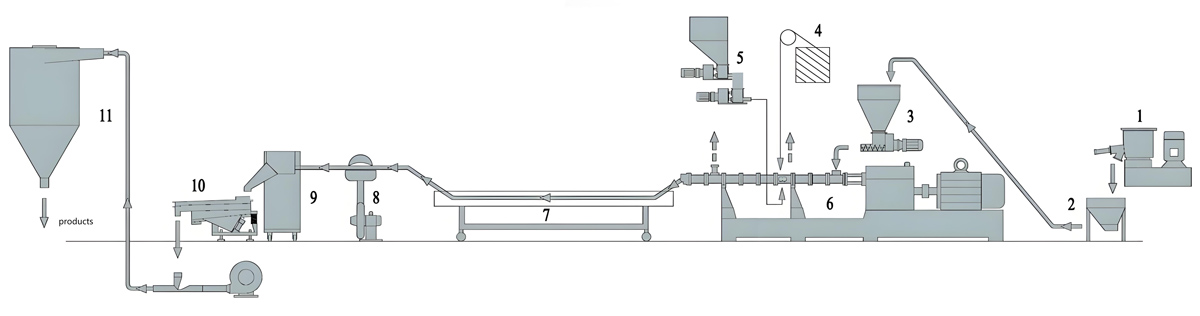
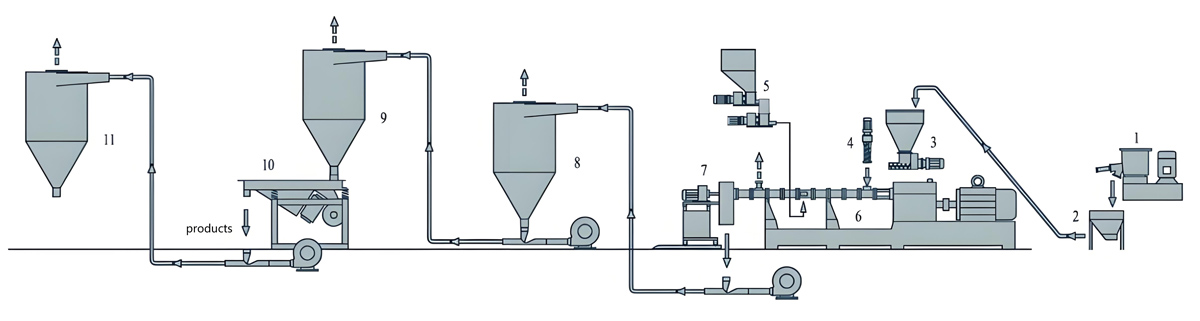
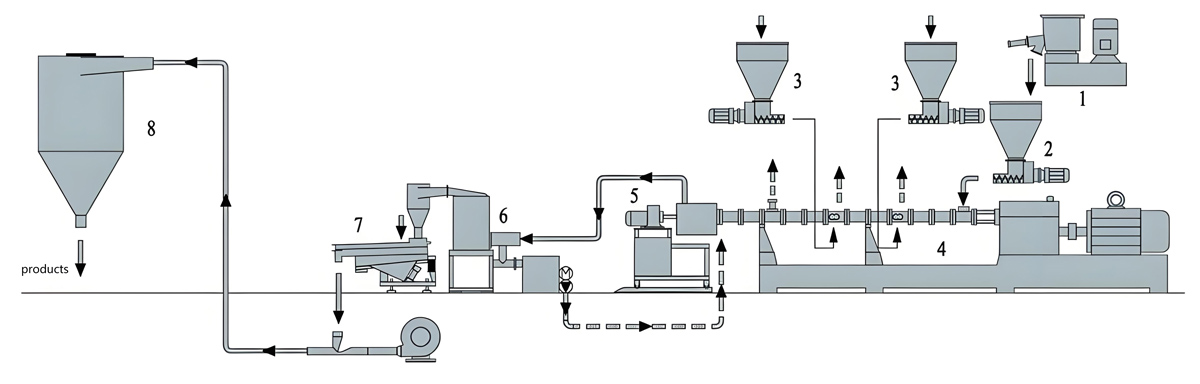
High capacity masterbatch compounding granulation using twin screw extruders involves several key stages, each optimized for maximum efficiency and product quality:
Raw Material Preparation
Raw materials including pigments, carrier resins, additives, and processing aids are carefully measured and pre-mixed to ensure uniform distribution. In high capacity production, automated material handling systems are often used to minimize manual labor and reduce the risk of contamination.
Continuous Feeding
Pre-mixed materials are fed into the twin screw extruder using precise gravimetric feeding systems that ensure consistent material flow rates. This is critical for maintaining uniform product quality in high capacity production runs.
Melt Extrusion and Mixing
The twin screw extruder melts the raw materials and thoroughly mixes them to ensure uniform dispersion of pigments and additives throughout the carrier resin. The counter-rotating screws provide excellent shear mixing while minimizing material degradation, making them ideal for masterbatch production.
Pelletizing
After extrusion and mixing, the molten polymer is cut into uniform pellets using a high-capacity pelletizer. Water ring or underwater pelletizing systems are commonly used in high capacity production to ensure consistent pellet size and shape.
Cooling and Drying
Freshly cut pellets are cooled using water baths or air cooling systems to solidify them. They are then dried to remove excess moisture before being packaged for shipment.
Quality Control and Packaging
Finished masterbatch pellets undergo rigorous quality control testing to ensure they meet all specifications. This includes testing for color consistency, dispersion quality, and mechanical properties. Approved product is then packaged in bulk bags or drums for shipment to customers.
Production Equipment Introduction
High capacity masterbatch compounding granulation requires specialized equipment designed to handle large volumes of material while maintaining precise control over process parameters. Key components include:
Twin Screw Extruder
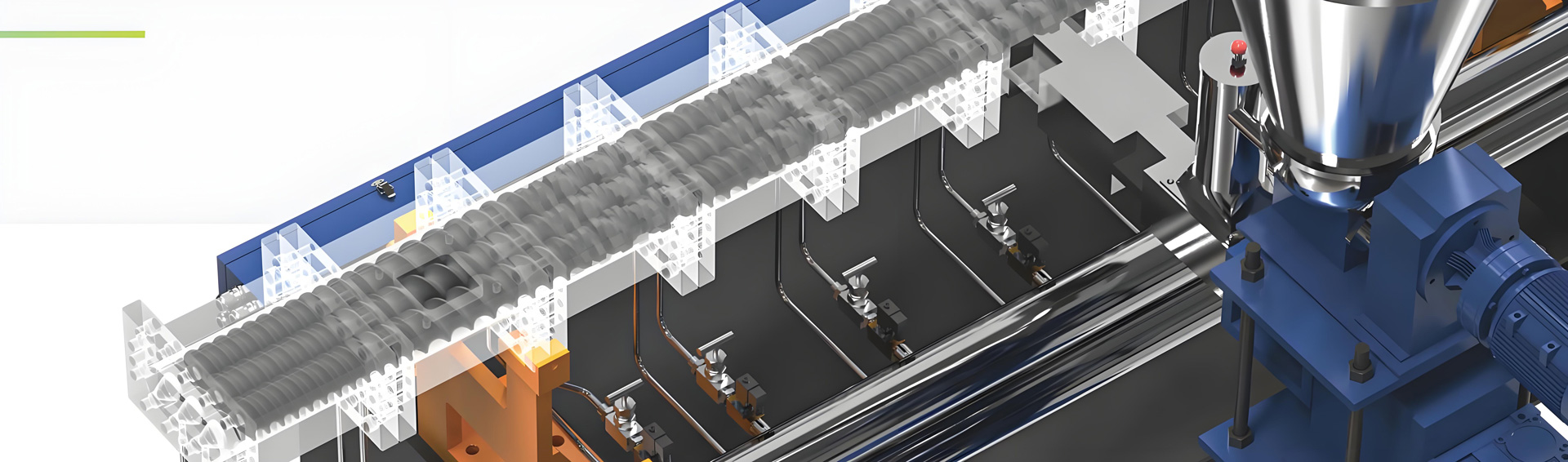
The heart of the masterbatch production line is the twin screw extruder, which melts and mixes the raw materials. Nanjing Kerke Extrusion Equipment’s KTE Series twin screw extruders are particularly well-suited for high capacity production, offering throughput rates of up to 4,000 kg/h depending on the model and formulation.
Feeding System
Automated feeding systems are essential for maintaining consistent material flow rates in high capacity production. Gravimetric feeders ensure precise dosing of each component, minimizing batch-to-batch variation.
Pelletizing System
High capacity pelletizing systems are designed to handle large volumes of molten polymer while producing uniform pellets. Water ring and underwater pelletizing systems are commonly used for their ability to produce high-quality pellets with minimal dust and fines.
Material Handling and Storage
Automated material handling systems are used to transport raw materials from storage to the extruder and finished product from the pelletizer to packaging. This helps to minimize manual labor and reduce the risk of contamination.
Control System
Advanced PLC control systems provide precise control over all aspects of the production process, including temperature, pressure, screw speed, and feed rates. Real-time data monitoring and process optimization features help to maximize efficiency and product quality.
Parameter Settings
Proper parameter setting is critical for achieving optimal results in high capacity masterbatch compounding granulation. Key parameters include:
Temperature Profile
The temperature profile along the extruder barrel must be carefully set to ensure proper melting of the carrier resin while minimizing degradation of sensitive additives. For high capacity production, the temperature profile is typically set to increase gradually from the feed zone to the die head, with temperatures ranging from 150-250°C depending on the polymer type.
Screw Speed
Screw speed affects both the throughput rate and the degree of mixing in the extruder. Higher screw speeds generally result in higher throughput rates but may reduce mixing quality if not properly balanced. For high capacity masterbatch production, screw speeds typically range from 300-800 rpm depending on the extruder model and formulation.
Feed Rate
The feed rate must be matched to the extruder’s capacity and screw speed to ensure proper melting and mixing of the raw materials. In high capacity production, automated feeding systems are used to maintain consistent feed rates throughout the production run.
Vacuum Degassing
Vacuum degassing is often used in masterbatch production to remove volatile gases and moisture from the molten polymer, improving product quality and reducing the risk of defects. Vacuum levels are typically set to between 0.05-0.1 MPa depending on the formulation.
Die Head Temperature
The die head temperature must be carefully controlled to ensure uniform flow of the molten polymer and consistent pellet quality. In high capacity production, die head temperatures are typically set slightly higher than the final barrel temperature to ensure smooth extrusion.
Equipment Price
The cost of high capacity twin screw extruders for masterbatch compounding granulation varies depending on factors such as model size, features, and configuration. Nanjing Kerke Extrusion Equipment’s KTE Series twin screw extruders offer excellent value for money, with prices ranging from $15,000 to $200,000 USD depending on the specific model and configuration.
| Model | Screw Diameter (mm) | Maximum Speed (rpm) | Motor Power (kW) | Output (Kg/h) | Approximate Price (USD) |
|---|---|---|---|---|---|
| KTE-36B | 35.6 | 500-600 | 18.5-22 | 20-100 | $20,000-$25,000 |
| KTE-50B | 50.5 | 500-600 | 55-75 | 80-200 | $40,000-$50,000 |
| KTE-65B | 62.4 | 500-600 | 90-110 | 200-450 | $60,000-$75,000 |
| KTE-75B | 71 | 500-600 | 132-160 | 300-800 | $80,000-$100,000 |
| KTE-95B | 93 | 500-600 | 250-315 | 800-1500 | $120,000-$150,000 |
| KTE-135B | 135 | 500-600 | 315-500 | 1500-3000 | $150,000-$200,000 |
These prices are for the extruder only and do not include additional equipment such as feeding systems, pelletizers, or material handling systems. The total cost of a complete high capacity masterbatch production line can range from $50,000 to $500,000 USD depending on the specific requirements.
Production Process Issues and Solutions
High capacity masterbatch compounding granulation can present several challenges, including maintaining consistent quality at high throughput rates, managing material flow, and minimizing downtime. Common issues and their solutions include:
Issue: Poor Dispersion of Pigments/Additives
Poor dispersion can lead to inconsistent product color and performance. This can be caused by insufficient mixing, improper temperature profile, or low-quality raw materials.
Solution: Ensure proper screw configuration for adequate mixing, optimize temperature profile to ensure complete melting of carrier resin, and use high-quality raw materials with good dispersibility. In some cases, increasing screw speed or adjusting formulation ratios may also help improve dispersion.
Issue: Material Degradation
High temperatures and excessive shear can cause degradation of sensitive additives or carrier resins, leading to reduced product quality.
Solution: Optimize temperature profile to minimize heat exposure, reduce screw speed or adjust screw configuration to minimize shear, and use thermal stabilizers or processing aids where necessary. Regular maintenance and cleaning of the extruder can also help prevent degradation caused by contamination.
Issue: Inconsistent Pellet Quality
Inconsistent pellet size or shape can cause problems in downstream processing and reduce product value. This can be caused by improper die temperature, feed rate fluctuations, or worn pelletizer blades.
Solution: Ensure consistent die temperature, use automated feeding systems to maintain constant feed rates, and regularly inspect and replace worn pelletizer blades. Proper cooling and drying of pellets can also help improve consistency.
Issue: High Energy Consumption
High capacity production can result in significant energy costs. Inefficient equipment or improper process settings can increase energy consumption unnecessarily.
Solution: Use energy-efficient equipment with modern motor and drive systems, optimize process parameters to minimize energy waste, and implement regular maintenance to keep equipment operating at peak efficiency. Investing in high-quality, well-engineered equipment like Kerke’s KTE Series extruders can also help reduce long-term energy costs.
Maintenance and Care
Regular maintenance is essential for ensuring the long-term performance and reliability of high capacity twin screw extruders. Proper maintenance helps to minimize downtime, reduce operating costs, and extend the equipment’s service life.
Daily Maintenance
Daily maintenance tasks include checking oil levels, inspecting cooling systems, and cleaning equipment surfaces. Operators should also monitor key process parameters and record any abnormalities for further investigation.
Weekly Maintenance
Weekly maintenance tasks include checking for loose connections, inspecting electrical systems, and cleaning filters and screens. Operators should also perform a visual inspection of screw elements and barrel surfaces for signs of wear or damage.
Monthly Maintenance
Monthly maintenance tasks include lubricating moving parts, inspecting safety devices, and verifying calibration of sensors and instruments. Operators should also perform a more detailed inspection of screw elements and barrel surfaces to identify any signs of wear or damage that may require repair or replacement.
Annual Maintenance
Annual maintenance tasks include a complete overhaul of the extruder, including disassembly, cleaning, and inspection of all components. This is also a good time to replace worn parts and perform any necessary upgrades or modifications to improve performance.
Troubleshooting Guide
Having a comprehensive troubleshooting guide on hand can help operators quickly identify and resolve common issues that may arise during production. This guide should include information on common symptoms, possible causes, and recommended solutions for each issue.
FAQ
Frequently asked questions about high capacity twin screw extruders for masterbatch compounding granulation:
What is the maximum throughput rate of Kerke’s KTE Series twin screw extruders?
The maximum throughput rate varies depending on the specific model and formulation. The KTE-135D model, for example, can produce up to 4,000 kg/h of masterbatch under optimal conditions.
What types of masterbatch can be produced with high capacity twin screw extruders?
High capacity twin screw extruders can be used to produce a wide range of masterbatch types, including color masterbatch, additive masterbatch, high-fill masterbatch, and functional masterbatch.
What is the typical payback period for a high capacity twin screw extruder?
The payback period depends on factors such as initial cost, operating costs, and production volume. In many cases, manufacturers can expect to see a return on their investment within 1-2 years of purchase.
How often should a high capacity twin screw extruder be serviced?
The frequency of servicing depends on factors such as usage intensity, operating conditions, and maintenance practices. As a general guideline, daily, weekly, and monthly maintenance should be performed as outlined in the equipment manual, with a complete overhaul every 1-2 years.
Can existing production lines be upgraded to high capacity?
In many cases, existing production lines can be upgraded to increase capacity by adding new components or modifying existing equipment. However, this depends on factors such as the age and condition of the existing equipment, as well as specific production requirements. It is often more cost-effective to invest in new high capacity equipment for significant increases in production volume.
Summary
High capacity twin screw extruders are essential tools for modern masterbatch compounding granulation, enabling manufacturers to produce large volumes of high-quality masterbatch while maintaining precise control over formulation and process parameters. Nanjing Kerke Extrusion Equipment’s KTE Series twin screw extruders offer exceptional performance and reliability, making them an excellent choice for high capacity masterbatch production.
By understanding the key features of high capacity twin screw extruders and implementing proper maintenance and operation practices, manufacturers can achieve significant improvements in production efficiency, product quality, and profitability. As global demand for plastic products continues to grow, investing in advanced masterbatch production technology will become increasingly important for staying competitive in the marketplace.