Introduction
Thermoplastic starch TPS masterbatch production requires specialized equipment to achieve consistent quality and high output rates. The high speed counter rotating twin screw extruder represents a significant advancement in biopolymer processing technology. This sophisticated equipment enables manufacturers to produce TPS masterbatches with exceptional dispersion characteristics while maintaining the thermal sensitivity of starch-based materials. The counter rotating mechanism provides superior mixing efficiency compared to traditional co-rotating systems particularly for starch-based formulations that demand gentle yet thorough processing conditions.
The growing demand for sustainable packaging materials has driven innovation in TPS masterbatch manufacturing. Biodegradable plastics based on starch require precise temperature control and uniform distribution of additives to achieve optimal performance properties. High speed counter rotating twin screw extruders from leading manufacturers like Kerke offer the necessary processing capabilities to meet these demanding requirements while ensuring production efficiency and cost-effectiveness.
Formulation Ratios for TPS Masterbatch
The formulation of TPS masterbatch varies depending on the intended application and desired final product properties. Different types of starch and plasticizers require specific ratio adjustments to achieve optimal processing characteristics. The counter rotating twin screw extruder accommodates various formulation ranges while maintaining consistent quality output.
Standard TPS Formulation
A typical TPS masterbatch formulation consists of native starch at 60-75 percent by weight combined with plasticizers ranging from 20-35 percent. The most common plasticizers include glycerol sorbitol and water which modify the thermoplastic properties of starch. Additives such as compatibilizers fillers and processing aids comprise the remaining 5-10 percent of the formulation. The counter rotating mechanism ensures homogeneous distribution of these components throughout the matrix.
Potato Starch-Based TPS
Potato starch formulations typically require higher plasticizer content between 25-35 percent due to the lower amylose content. The recommended starch concentration ranges from 55-70 percent with the balance consisting of plasticizers and additives. This formulation produces TPS masterbatch with excellent film-forming properties suitable for packaging applications. The gentle mixing action of counter rotating screws prevents starch degradation during processing.
Corn Starch-Based TPS
Corn starch formulations contain 60-75 percent starch with plasticizer content adjusted to 20-30 percent. The higher amylose content in corn starch requires careful temperature control to prevent excessive viscosity. Counter rotating twin screw extruders provide the necessary shear control for processing corn starch-based TPS effectively. Additive levels typically remain at 5-10 percent for performance enhancement.
Cassava Starch-Based TPS
Cassava starch formulations require plasticizer levels of 22-32 percent with starch content between 58-72 percent. This formulation offers good mechanical properties and biodegradability characteristics. The counter rotating screw design ensures adequate mixing while preserving the starch structure. Processing temperatures typically range from 120-150°C depending on the specific formulation.
Modified Starch TPS
Chemically modified starches enable formulation flexibility with starch content ranging from 50-70 percent. Plasticizer requirements vary between 25-40 percent depending on the degree of modification. These formulations often include compatibilizers to improve interface bonding with synthetic polymers. The counter rotating twin screw extruder accommodates the varied viscosity profiles of modified starch formulations.
Production Process
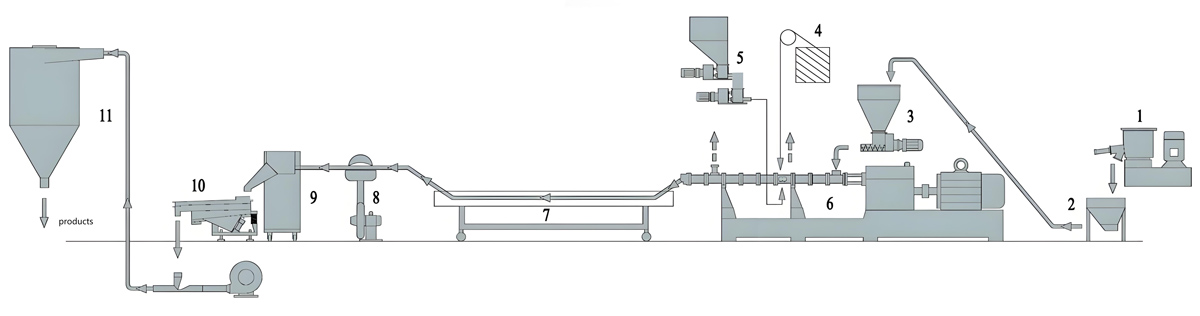
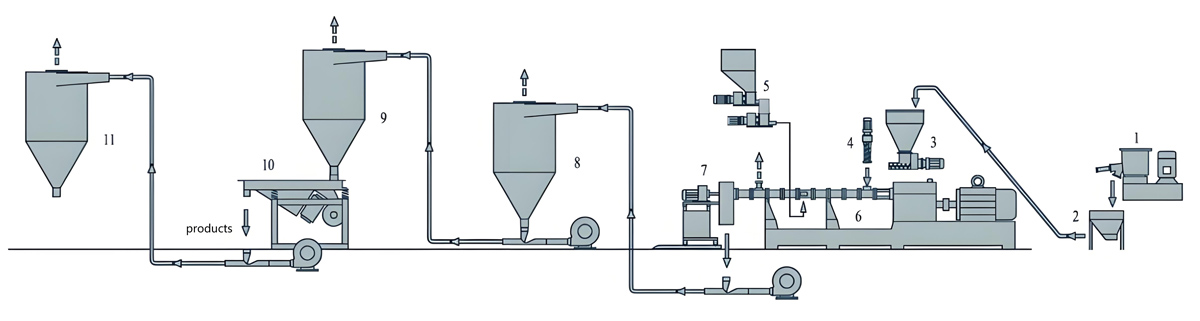
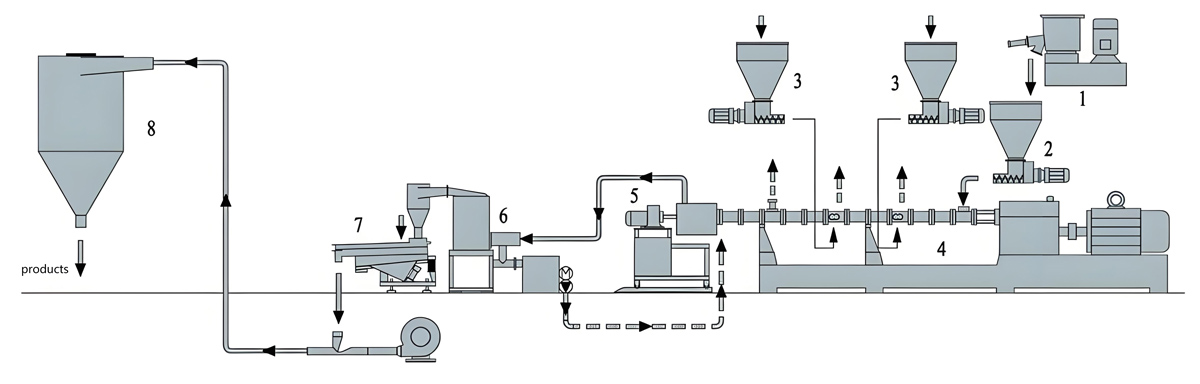
The TPS masterbatch production process involves multiple stages that must be carefully controlled to ensure consistent quality. High speed counter rotating twin screw extruders streamline this process through integrated feeding systems and precise temperature control zones.
Raw Material Preparation
Raw materials must be thoroughly dried before processing to prevent moisture-related defects. Starch typically requires drying at 80-100°C for 4-6 hours to reduce moisture content below 1 percent. Plasticizers should be filtered to remove any impurities that could affect processing. Solid additives are pre-mixed in appropriate ratios before feeding to ensure uniform distribution. The counter rotating extruder feeding system handles both powdered and liquid components efficiently.
Feeding Stage
The feeding stage introduces raw materials into the extruder barrel through gravimetric or volumetric feeders. Starch and solid additives enter through the main hopper while liquid plasticizers are injected downstream through precise metering pumps. Counter rotating twin screw extruders feature multiple feeding ports allowing staged addition of components. The screw configuration in the feeding zone ensures positive displacement and consistent material transport.
Melting and Plasticization
The melting zone applies heat and mechanical energy to transform starch into a thermoplastic state. Temperature gradients along the barrel length typically progress from 100°C at the feed zone to 150-160°C at the melting zone. The counter rotating screws generate dispersive and distributive mixing that promotes starch gelatinization and plasticizer absorption. Screw speed and temperature profile are adjusted based on formulation to achieve optimal melt viscosity.
Dispersion and Homogenization
The mixing zone ensures uniform distribution of all components throughout the TPS matrix. Counter rotating screws create intensive mixing action through their intermeshing design and differential rotation speeds. This zone typically features kneading blocks and special mixing elements that break up agglomerates and promote additive dispersion. The mixing intensity must balance dispersion requirements with the thermal sensitivity of starch components.
Devolarization
The devolarization zone removes residual moisture and volatile byproducts generated during processing. Vacuum venting ports in this zone extract water vapor and other volatiles to prevent bubble formation in the final product. Temperature in this zone is maintained at 140-150°C to facilitate moisture removal without starch degradation. Counter rotating screw designs provide sufficient residence time for effective devolarization.
Pelletizing
The extruded TPS masterbatch strand is cooled through a water bath or air cooling system before pelletizing. Strand diameter is controlled by the die design and take-up speed. Pelletizing systems include strand cutters water ring pelletizers or underwater pelletizers depending on production requirements. Counter rotating extruders deliver consistent strand quality essential for uniform pellet size and shape.
Production Equipment Introduction
High speed counter rotating twin screw extruders from Kerke feature the KTE Series designed specifically for demanding biopolymer applications. These machines offer advanced capabilities for TPS masterbatch production with emphasis on mixing efficiency and thermal control.
KTE Series Counter Rotating Extruder
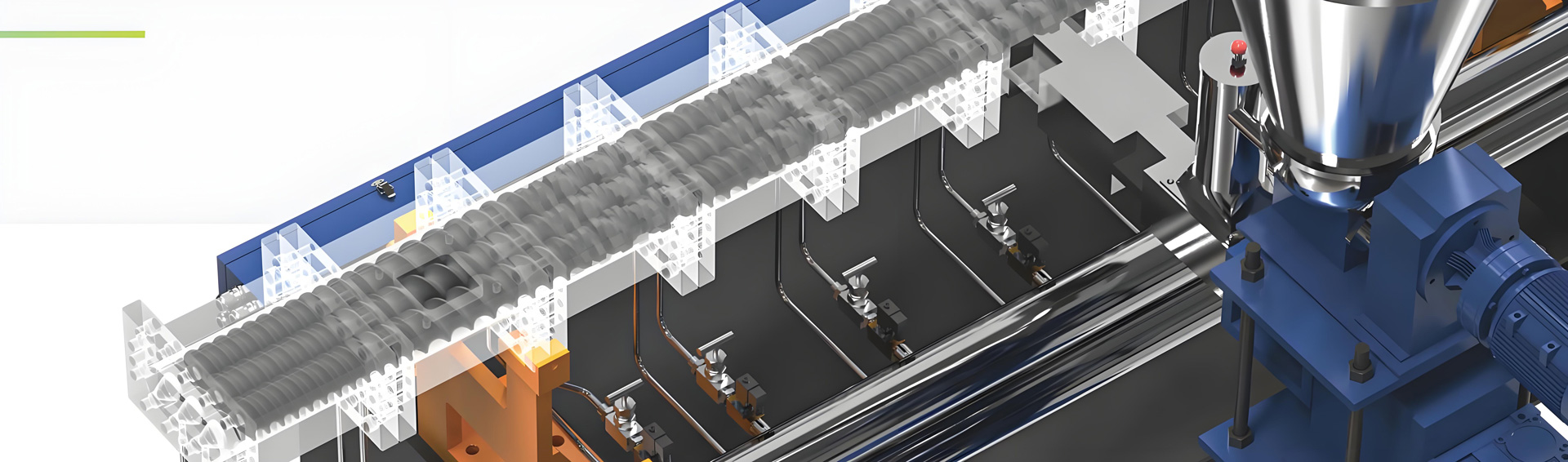
The KTE Series represents Kerke’s advanced counter rotating twin screw extruder line optimized for starch-based materials processing. Key features include modular screw elements allowing customized configuration for different formulations. The barrel sections are precisely machined with interchangeable liners for easy maintenance. High torque transmission enables processing of high viscosity TPS formulations at reduced screw speeds. Temperature control zones employ both electric heating and water cooling for precise thermal management.
Counter Rotating Mechanism
The counter rotating design features two screws rotating in opposite directions creating a positive displacement pumping action. This mechanism provides superior feeding capability compared to co-rotating systems which is crucial for processing low bulk density starch powders. The intermeshing screws create calendering gaps that enhance dispersive mixing of additives. Counter rotation reduces shear heating which helps maintain starch properties during processing.
Feeding System
KTE Series extruders feature multiple feeding options including gravimetric feeders for precise ingredient control. Liquid injection systems are integrated for plasticizers and other liquid additives. Starve feeding configuration allows independent control of feed rate and screw speed for optimal processing flexibility. The feeding zone is designed to prevent material bridging common with starch powders.
Degassing System
Vent ports along the barrel enable removal of moisture and volatiles during processing. Atmospheric vents remove air introduced during feeding while vacuum vents extract water vapor generated from starch gelatinization. The counter rotating screw design provides necessary residence time for effective devolarization. Optional foaming capabilities allow introduction of blowing agents for expanded TPS products.
Die and Pelletizing System
Multiple die configurations are available including strand dies sheet dies and annular dies. The die design is optimized for TPS viscosity characteristics to ensure uniform flow distribution. Integrated pelletizing systems produce uniform pellets ranging from 2-5mm diameter. Strand cooling systems maintain consistent product temperature before cutting to prevent pellet deformation.
Control System
PLC-based control systems with touch screen interfaces provide comprehensive process monitoring and control. Temperature zones are individually controlled with precision of plus or minus 1°C. Screw speed and feeder rates are synchronized to maintain consistent throughput. Real-time monitoring of motor torque and pressure enables process optimization. Data logging capabilities support quality control and traceability requirements.
Parameter Settings
Optimal parameter settings depend on specific formulation and production requirements. The counter rotating twin screw extruder offers wide adjustment ranges to accommodate various TPS formulations while maintaining product quality.
Temperature Profile
The barrel temperature profile typically progresses from 100-110°C in the feed zone to 140-160°C in the melting and mixing zones. The die temperature is maintained at 130-150°C to prevent degradation while ensuring proper flow. Temperature zones must be individually adjusted based on formulation to achieve optimal starch gelatinization without excessive thermal degradation. Precise temperature control is critical for maintaining consistent TPS properties.
Screw Speed
Screw speeds between 200-400 RPM are typical for TPS masterbatch production depending on formulation viscosity. Higher speeds increase throughput but may reduce residence time affecting dispersion quality. The counter rotating mechanism enables efficient mixing even at moderate speeds. Screw speed should be adjusted in conjunction with feed rate to maintain optimal filling degree in the extruder.
Feed Rate
Feed rates are determined by desired production capacity and extruder specifications. Typical throughput ranges from 50-500 kg per hour depending on machine size and formulation. Starve feeding is commonly employed to allow independent control of screw speed and feed rate. The feeding system should be calibrated for each material to ensure accurate ingredient ratios.
Vent Pressure
Atmospheric vents operate at ambient pressure while vacuum vents maintain pressures between 20-100 mbar. Lower vent pressures improve moisture removal but may increase volatile losses from plasticizers. The vent pressure must be optimized based on formulation to achieve adequate devolarization without excessive plasticizer loss. Counter rotating screw configurations provide the necessary residence time for effective venting.
Die Pressure
Die pressures typically range from 30-80 bar depending on formulation viscosity and die geometry. Higher pressures may be required for high viscosity formulations or small die openings. Pressure monitoring helps identify processing issues such as screen blockage or formulation changes. The counter rotating extruder generates sufficient pressure to overcome die resistance while maintaining melt quality.
Back Pressure
Back pressure is controlled through die restriction or breaker plates to enhance mixing and devolarization. Typical back pressure settings range from 20-60 bar. Increased back pressure improves dispersion quality but may reduce throughput. The optimal setting balances mixing requirements with production efficiency.
Equipment Price
High speed counter rotating twin screw extruder prices vary based on configuration and capacity. Investment considerations include initial equipment cost as well as operating expenses and maintenance requirements.
KTE Series Extruder Pricing
Entry-level KTE Series counter rotating extruders with 25mm screw diameter start at approximately 45000 to 65000 US dollars. Mid-range models with 40-50mm screw diameter range from 80000 to 120000 US dollars. High capacity systems with 75mm or larger screw diameters can exceed 200000 US dollars. These prices typically include the extruder barrel screws and basic control system.
Optional Equipment Costs
Advanced feeding systems including gravimetric feeders add 15000 to 30000 US dollars to the total investment. Vacuum degassing systems with condensation units cost between 20000 and 40000 US dollars. Pelletizing systems including strand cutters or water ring pelletizers range from 25000 to 60000 US dollars. Complete auxiliary systems including material handling and drying can add 50000 to 100000 US dollars depending on configuration.
Installation and Commissioning
Installation services typically cost 8-12 percent of equipment price. Commissioning and process optimization services range from 10000 to 30000 US dollars depending on complexity. Training programs for operators and maintenance personnel cost 3000 to 8000 US dollars. These services ensure proper equipment operation and optimal performance for TPS masterbatch production.
Operating Costs
Energy consumption represents a significant operating cost ranging from 0.10 to 0.30 US dollars per kilogram of TPS masterbatch produced. Labor costs vary based on automation level and local wage rates. Maintenance costs typically average 2-5 percent of equipment value annually. Spare parts inventory should be budgeted at 1-2 percent of equipment cost per year.
Total Investment Considerations
A complete TPS masterbatch production line including all auxiliary systems typically requires investment between 250000 and 500000 US dollars for medium capacity production. Larger capacity systems may exceed 1000000 US dollars. Production capacity equipment quality and automation level are primary factors affecting total investment. Financing options including equipment leasing can help manage cash flow requirements.
Production Problems and Solutions
TPS masterbatch production may encounter various processing challenges that affect product quality and production efficiency. Understanding these problems and implementing appropriate solutions ensures consistent production performance.
Inadequate Plasticizer Distribution
Problem Analysis: Non-uniform plasticizer distribution results in inconsistent TPS properties and poor processing performance. This issue manifests as variations in melt viscosity mechanical strength and biodegradation rates. Causes include insufficient mixing time improper screw configuration or inappropriate feeding sequence. The counter rotating extruder must be properly configured to achieve distributive mixing of liquid plasticizers within the starch matrix.
Solutions: Optimize screw configuration by adding kneading blocks and mixing elements in the appropriate zones. Increase screw speed to enhance distributive mixing while monitoring starch degradation. Implement staged liquid injection at multiple points along the barrel to improve distribution. Use liquid addition systems that provide fine atomization for better dispersion. Adjust temperature profile to reduce viscosity differences between starch and plasticizer.
Prevention Methods: Develop standard operating procedures for screw configuration based on formulation requirements. Regularly clean and maintain liquid injection nozzles to prevent clogging. Monitor plasticizer viscosity and temperature to ensure consistent flow characteristics. Implement process analytical technology to detect distribution issues early. Train operators to recognize symptoms of poor plasticizer distribution.
Starch Degradation
Problem Analysis: Excessive thermal or mechanical degradation of starch reduces molecular weight and impairs mechanical properties. Symptoms include darkening of product reduced tensile strength and increased brittleness. Causes include excessive barrel temperatures prolonged residence time high shear rates or acidic conditions. Counter rotating extruders must balance mixing intensity with thermal sensitivity of starch components.
Solutions: Reduce barrel temperatures particularly in the melting and mixing zones to minimum required levels. Decrease screw speed to lower shear stress while maintaining adequate mixing. Optimize screw configuration to minimize high shear zones. Increase feed rate to reduce residence time. Add thermal stabilizers to the formulation if compatible with end use requirements. Ensure proper cooling of extrudate to prevent post-extrusion degradation.
Prevention Methods: Implement strict temperature control protocols with regular calibration of sensors. Monitor residence time distribution and maintain optimal filling degree. Use starch grades with appropriate thermal stability for the intended processing conditions. Establish preventive maintenance schedules to ensure consistent equipment performance. Conduct regular quality testing to detect degradation early.
Vent Port Blockage
Problem Analysis: Vent ports can become blocked by material carryover or foaming reducing moisture removal efficiency. This leads to excessive moisture content in the final product causing bubbles and reduced mechanical properties. Causes include excessive feed rate insufficient vent port diameter or material bridging in the vent zone. Counter rotating extruder vent zones require proper design and operation.
Solutions: Increase vent port diameter or add multiple vent ports to improve capacity. Adjust feed rate to reduce material carryover into vent zones. Implement vent stuffer screws to prevent material blockage. Use atmospheric vents before vacuum vents to remove bulk material. Optimize vent zone temperature to prevent material solidification. Apply vacuum to atmospheric vents to improve material removal.
Prevention Methods: Establish regular vent port cleaning schedules. Monitor vent pressure to detect blockage early. Implement automated vent cleaning systems for continuous operation. Design screw configuration to minimize material carryover into vent zones. Train operators to recognize symptoms of vent blockage such as increased die pressure.
Inconsistent Pellet Size
Problem Analysis: Non-uniform pellet size affects downstream processing and product performance. Causes include variations in strand diameter cutter speed fluctuations or temperature variations affecting strand strength. The counter rotating extruder must deliver consistent strand quality for uniform pelletizing. Inconsistent pellets may cause feeding problems in subsequent processing steps.
Solutions: Implement closed-loop control of take-up speed to maintain constant strand diameter. Install automatic strand diameter monitoring with feedback control. Ensure uniform die temperature to prevent flow variations. Use strand cooling systems with consistent temperature control. Calibrate cutter speed and knife sharpness regularly. Implement automatic cut length control systems.
Prevention Methods: Establish standard operating procedures for pelletizing equipment. Regularly maintain cutting knives and replace as needed. Monitor strand diameter and cutter performance continuously. Implement quality control sampling to detect size variations early. Train operators on proper pelletizing equipment adjustment.
Excessive Moisture Content
Problem Analysis: Inadequate moisture removal results in product with water content above specifications causing degradation during storage and processing. Symptoms include bubbles poor mechanical properties and reduced shelf life. Causes include insufficient devolarization inadequate venting or high initial moisture content in raw materials. Counter rotating extruders must provide adequate venting and residence time for moisture removal.
Solutions: Increase vacuum level in vent zones to improve moisture removal. Add additional vent ports or increase vent zone length. Optimize temperature profile to facilitate moisture evaporation without starch degradation. Pre-dry raw materials to reduce moisture load. Increase barrel length or reduce throughput to increase residence time. Use vent stuffer screws to improve devolarization efficiency.
Prevention Methods: Implement strict raw material moisture specifications and testing procedures. Establish regular vent system maintenance to ensure optimal performance. Monitor product moisture content continuously with appropriate sensors. Develop formulations with appropriate moisture tolerance for end use requirements. Train operators on moisture control procedures.
Maintenance and Care
Proper maintenance ensures consistent equipment performance and extends service life. Counter rotating twin screw extruders require regular attention to maintain optimal operation for TPS masterbatch production.
Daily Maintenance
Daily maintenance tasks include checking oil levels in gearboxes and lubrication points. Inspect all temperature sensors for proper operation and calibrate as needed. Clean vent ports and strainers to prevent blockage. Monitor motor current and torque for abnormal readings. Check all cooling water flows and temperatures. Document any unusual observations or process deviations.
Weekly Maintenance
Weekly maintenance involves inspecting screw and barrel surfaces for wear or damage. Check all seals and gaskets for leaks. Test safety interlocks and emergency stop systems. Clean or replace air filters on control cabinets. Verify accuracy of feeder calibrations. Inspect pelletizing equipment for wear. Tighten all electrical connections as needed.
Monthly Maintenance
Monthly maintenance includes changing gearbox oil according to manufacturer recommendations. Inspect heater bands and thermocouples for proper function. Check alignment of drive system components. Test all alarm and safety systems. Review process logs and maintenance records to identify trends. Inspect die and adapter surfaces for wear or damage. Calibrate all instruments and sensors.
Quarterly Maintenance
Quarterly maintenance involves removing and inspecting screw elements for wear patterns. Measure screw and barrel dimensions to monitor wear rates. Inspect bearing seals and replace if necessary. Check motor and drive couplings for wear. Test emergency stop circuits and safety systems thoroughly. Review preventive maintenance schedule and adjust based on equipment condition.
Annual Maintenance
Annual maintenance includes comprehensive inspection of all major components. Replace worn parts according to manufacturer recommendations. Realign drive system if necessary. Test and calibrate all control systems. Review and update maintenance procedures based on operating experience. Conduct thorough safety inspection and testing. Plan for any needed upgrades or modifications based on production requirements.
Preventive Measures
Implement scheduled maintenance based on operating hours and manufacturer recommendations. Maintain detailed maintenance logs to track equipment condition and identify trends. Train maintenance personnel on specific equipment requirements. Keep spare parts inventory for critical components. Regularly review process conditions to identify potential issues before they cause failures. Establish relationships with equipment suppliers for technical support and parts availability.
FAQ
What are the advantages of counter rotating twin screw extruders for TPS processing?
Counter rotating twin screw extruders offer several advantages for TPS masterbatch production. The positive displacement pumping action provides superior feeding capability for low bulk density starch powders. Counter rotation reduces shear heating which helps preserve starch molecular weight and properties. The intermeshing design creates intense dispersive mixing for excellent additive distribution. These extruders typically operate at lower speeds than co-rotating systems reducing mechanical degradation of starch components.
How do I select the appropriate screw configuration for TPS masterbatch?
Screw configuration selection depends on specific formulation and processing requirements. Start with a standard configuration from the equipment manufacturer and adjust based on trial results. Include conveying elements in the feed zone to ensure positive material transport. Use kneading blocks and mixing elements in the melting and mixing zones to promote starch gelatinization and plasticizer distribution. Adjust the number and positioning of mixing elements based on desired dispersion quality. Consider using vent stuffer screws before vent zones to prevent material blockage.
What is the optimal moisture content for TPS masterbatch production?
Optimal moisture content depends on formulation and end use requirements but typically ranges from 0.5 to 1.5 percent for finished TPS masterbatch. Raw starch moisture should be reduced below 1 percent before processing through proper drying. Excessive moisture can cause bubbles and reduced mechanical properties while too little moisture may impair starch gelatinization. The moisture content must be controlled through appropriate venting and devolarization during processing.
How can I improve the mechanical properties of TPS masterbatch?
Mechanical properties can be improved through several approaches. Optimize plasticizer type and concentration to balance flexibility and strength. Add reinforcing fillers such as nanoclay or cellulose fibers to increase tensile strength. Include compatibilizers to improve interface bonding between starch and other components. Optimize processing parameters to achieve complete starch gelatinization without degradation. Consider blending with other biodegradable polymers to enhance performance properties.
What is the typical production capacity of counter rotating twin screw extruders?
Production capacity varies based on extruder size and formulation. Small laboratory extruders with 25mm screw diameter typically produce 10-50 kg per hour. Medium production extruders with 40-50mm screw diameter range from 100-300 kg per hour. Large production systems with 75mm or larger screw diameters can exceed 500 kg per hour. The counter rotating mechanism provides efficient processing at various scales while maintaining product quality.
How do I troubleshoot uneven color distribution in TPS masterbatch?
Uneven color distribution indicates insufficient mixing of pigments or additives. Check screw configuration to ensure adequate mixing elements are present in appropriate zones. Increase screw speed to enhance distributive mixing while monitoring for starch degradation. Verify that pigments are properly pre-dispersed before addition to the extruder. Consider adding colorants through liquid injection systems for better distribution. Monitor product color regularly to detect variations early.
What safety precautions should be followed when operating counter rotating extruders?
Safety precautions include proper training of all personnel on equipment operation and hazards. Ensure all safety guards are in place before operation. Use lockout tagout procedures during maintenance activities. Never reach into moving parts or attempt to clear blockages while equipment is running. Follow proper start-up and shutdown procedures to prevent equipment damage. Regularly inspect and test all safety devices and emergency stop systems.
How do I optimize energy efficiency in TPS masterbatch production?
Energy efficiency can be optimized through several strategies. Use variable frequency drives on main motors to match energy consumption to processing requirements. Implement insulation on barrel sections to reduce heat loss. Optimize temperature profile to minimize heating requirements. Recover waste heat from cooling systems when possible. Maintain equipment properly to ensure efficient operation. Consider using energy-efficient motors and drives when replacing components.
Conclusion
High speed counter rotating twin screw extruders represent the ideal solution for TPS masterbatch production offering advanced processing capabilities for starch-based materials. The KTE Series from Kerke provides specialized features designed to meet the unique challenges of biopolymer processing including gentle mixing precise temperature control and efficient moisture removal. Proper equipment selection parameter optimization and maintenance ensure consistent production of high quality TPS masterbatches.
The growing demand for sustainable packaging materials continues to drive innovation in TPS technology. Counter rotating extruders enable manufacturers to meet these demands with efficient production processes that deliver consistent product quality. By understanding formulation requirements processing parameters and maintenance needs producers can optimize their operations for maximum performance and profitability in the expanding biodegradable plastics market.