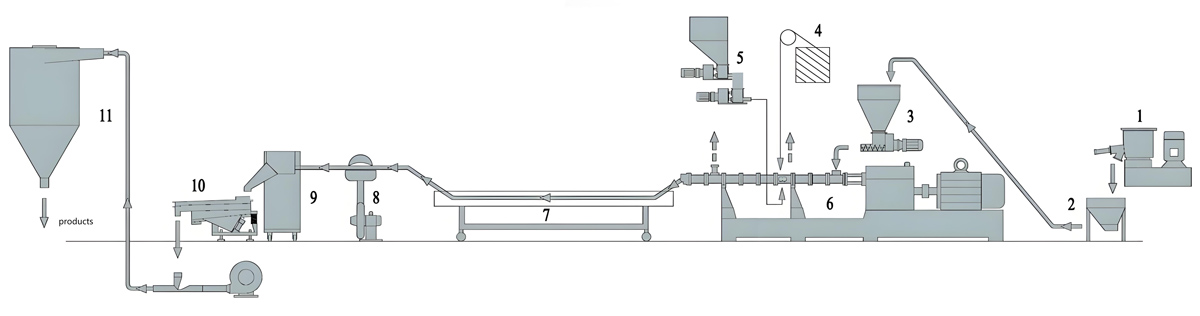
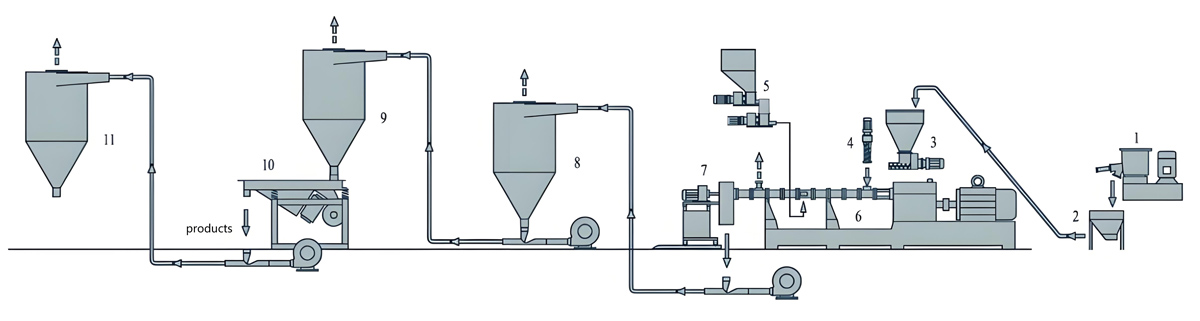
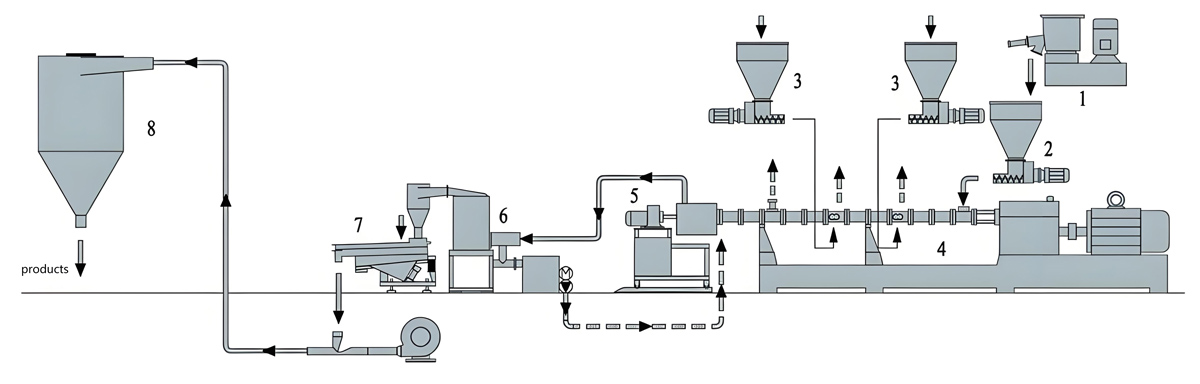
Glossy masterbatch represents one of the most specialized and technically demanding segments in the color concentrates industry, requiring precise control over dispersion quality, particle size distribution, and surface finish characteristics. The selection and optimization of industrial twin screw extruder equipment plays a critical role in achieving consistent product quality that meets the stringent requirements of applications ranging from automotive interior components to high-end packaging materials and consumer goods. This comprehensive guide delves into the technical aspects of glossy masterbatch production, providing detailed insights into formulation strategies, processing parameters, equipment specifications, and operational best practices that enable manufacturers to produce superior glossy masterbatch products with excellent surface gloss, color consistency, and dispersion stability.
The production of glossy masterbatch demands a deep understanding of how processing conditions affect the final optical properties of the pigment dispersion in the polymer matrix. Unlike standard color concentrates, glossy masterbatch requires exceptionally fine pigment dispersion, typically with particle sizes below 1 micron, combined with carefully selected carrier resins and specialized gloss-enhancing additives that work synergistically to produce high surface gloss values while maintaining excellent thermal stability and processing characteristics. The industrial twin screw extruder serves as the heart of this manufacturing process, providing the mechanical energy and residence time necessary to achieve the level of dispersion and distribution required for premium glossy masterbatch production.
Formulation Ratios for Glossy Masterbatch (Different Types)
Glossy Masterbatch for Polyethylene Applications (PE-GL-150)
For polyethylene-based applications requiring high gloss, the recommended formulation ratio consists of 70% low-density polyethylene (LDPE) or linear low-density polyethylene (LLDPE) as the carrier resin, 25% pigment concentration (typically organic pigments for brighter colors and better gloss development), 3% gloss enhancer (typically modified polyethylene wax with low molecular weight), and 2% processing aid (typically maleic anhydride grafted polyethylene). The pigment-to-carrier ratio of 1:2.8 provides optimal dispersion while maintaining good flow characteristics during processing. This formulation yields masterbatch with gloss values of 85-90 gloss units at 60° geometry, suitable for packaging films, injection molded containers, and extrusion coating applications where high surface appearance is critical.
For premium applications requiring gloss values above 90 gloss units, the formulation can be modified to include 65% carrier resin, 28% pigment concentration, 4% gloss enhancer, and 3% processing aid. The increased pigment loading requires higher shear mixing capability from the twin screw extruder and may necessitate adjustments to screw configuration and processing temperatures to achieve adequate dispersion without degrading the pigment or polymer. The gloss enhancer in these formulations typically consists of a blend of low molecular weight polyethylene wax (60%) and polypropylene wax (40%) to optimize surface migration and gloss development during the cooling phase of the end-user’s processing.
Glossy Masterbatch for Polypropylene Applications (PP-GL-120)
Polypropylene-based glossy masterbatch formulations typically require different carrier resin characteristics and gloss enhancer systems compared to polyethylene formulations due to the different crystalline structure and surface energy of polypropylene. The standard formulation ratio for general-purpose PP glossy masterbatch comprises 72% isotactic polypropylene homopolymer with melt flow index of 10-15 g/10min, 23% pigment concentration (inorganic pigments with high lightfastness for outdoor applications), 3% gloss enhancer (modified polypropylene wax with narrow molecular weight distribution), and 2% dispersing aid (typically polypropylene grafted with maleic anhydride). This formulation achieves gloss values of 80-85 gloss units at 60° geometry, suitable for automotive interior trim, appliance housings, and consumer product applications requiring moderate to high gloss levels.
For high-gloss polypropylene applications targeting gloss values of 90+ gloss units, the formulation ratio is adjusted to 68% carrier resin, 27% pigment concentration, 4% gloss enhancer, and 1% dispersing aid. The higher pigment loading demands more aggressive screw configuration with multiple kneading blocks to ensure proper deagglomeration and distribution of pigment particles throughout the polymer matrix. The gloss enhancer system in this formulation incorporates a proprietary blend of polypropylene wax (50%), hydrogenated hydrocarbon resin (30%), and silicone-based flow modifier (20%) to enhance surface smoothness and gloss development during processing. The reduced dispersing aid concentration minimizes potential interference with gloss development while still maintaining adequate dispersion stability during compounding.
Glossy Masterbatch for Polystyrene Applications (PS-GL-200)
Polystyrene-based glossy masterbatch presents unique formulation challenges due to the amorphous nature and relatively low melt viscosity of polystyrene. The recommended formulation ratio consists of 75% general purpose polystyrene (GPPS) or high-impact polystyrene (HIPS) depending on application requirements, 20% pigment concentration (primarily organic pigments for vibrant colors and good gloss development), 3% gloss enhancer (polystyrene-compatible low molecular weight wax), and 2% processing aid (polystyrene grafted with styrene-maleic anhydride copolymer). The lower pigment concentration compared to polyolefin formulations reflects the different pigment wetting characteristics and dispersion requirements in the polystyrene matrix. This formulation achieves gloss values of 88-92 gloss units at 60° geometry, suitable for transparent and translucent applications, food packaging, and consumer electronics housings where high clarity and gloss are essential.
For specialized applications requiring maximum gloss and transparency, the formulation can be modified to 78% carrier resin, 18% pigment concentration, 3% gloss enhancer, and 1% processing aid. The reduced pigment loading and processing aid concentration minimize light scattering and maintain excellent optical clarity while still achieving deep coloration. The gloss enhancer in this formulation typically consists of hydrogenated hydrocarbon resin with refractive index matching that of polystyrene to minimize internal light scattering and maximize surface gloss. This premium formulation achieves gloss values of 94-98 gloss units and is used in high-end applications such as cosmetic packaging, premium consumer electronics, and luxury product packaging where exceptional surface appearance is non-negotiable.
Glossy Masterbatch for PVC Applications (PVC-GL-180)
Polyvinyl chloride glossy masterbatch formulations must account for the complex plasticizer system and the potential impact of stabilizers on gloss development. The standard formulation ratio for flexible PVC glossy masterbatch includes 65% PVC suspension resin (K-value 60-65), 28% pigment concentration (primarily inorganic pigments with good heat stability), 4% gloss enhancer (PVC-compatible ester wax with low volatility), and 3% processing aid (chlorinated polyethylene). The gloss enhancer concentration is higher than in other polymer systems due to the interference of plasticizers with surface migration of gloss-enhancing additives. This formulation achieves gloss values of 75-80 gloss units at 60° geometry, suitable for vinyl flooring, wall coverings, and synthetic leather applications where moderate gloss levels are acceptable.
For rigid PVC applications requiring higher gloss, the formulation ratio is adjusted to 70% carrier resin, 25% pigment concentration, 3% gloss enhancer, and 2% processing aid (acrylic-based impact modifier). The absence of plasticizers in rigid PVC systems allows for better surface migration of gloss enhancers and higher final gloss values. This formulation achieves gloss values of 85-90 gloss units and is suitable for window profiles, outdoor furniture, and construction materials requiring good weatherability and high surface gloss. The gloss enhancer system for rigid PVC typically consists of acrylic processing aids (50%) combined with modified polyethylene wax (50%) to optimize both surface smoothness and melt strength during processing.
Production Process for Glossy Masterbatch
Raw Material Preparation and Premixing
The production process begins with meticulous raw material preparation to ensure consistent feed characteristics to the twin screw extruder. Pigments should be dried at 80-85°C for 4-6 hours to remove moisture that could cause surface defects during processing. Carrier resins should be stored in climate-controlled conditions (20-25°C, 50-60% RH) and preheated to 60-70°C before feeding to improve flow characteristics and reduce energy consumption. For glossy masterbatch production, pigments must be sieved through 100-mesh screens to remove agglomerates and ensure uniform particle size distribution, which is critical for achieving fine dispersion and high gloss values.
The premixing operation combines all solid components in a high-speed mixer for 3-5 minutes at 1000-1200 rpm to achieve uniform distribution of pigments and additives before feeding to the extruder. The premix temperature should not exceed 50°C to prevent premature melting of the carrier resin or degradation of heat-sensitive additives. For formulations containing liquid additives (such as certain gloss enhancers or processing aids), these should be added through a separate liquid injection port downstream in the extruder rather than being pre-mixed with solid components. This prevents premature dissolution or absorption by the carrier resin and ensures more uniform distribution in the final product.
Feeding and Melting
The feeding system for glossy masterbatch production typically employs a gravimetric feeder with accuracy of ±0.5% to maintain consistent formulation ratios. Feed rates are calculated based on the extruder throughput capacity and formulation composition, with typical feed rates ranging from 50-200 kg/hr depending on extruder size. The feed section temperature should be set 10-15°C below the melting point of the carrier resin to prevent premature melting and ensure smooth feeding. For polyolefin-based formulations, the feed section temperature is typically set at 140-160°C for PE and 160-180°C for PP. For polystyrene formulations, the feed section is maintained at 180-190°C, while for PVC formulations, the feed section temperature is set at 150-160°C for flexible PVC and 160-170°C for rigid PVC.
The melting zone of the extruder, typically covering the first 3-5 barrel sections, is configured with forward-conveying elements to gradually melt the polymer carrier and initiate pigment wetting. Temperature in this zone increases progressively from the feed section to the maximum melt temperature, with typical gradients of 5-10°C per barrel section. The exact temperature profile depends on the specific carrier resin viscosity characteristics and pigment loading, with higher pigment loadings requiring higher processing temperatures to maintain adequate melt flow for dispersion. Proper control of the melting zone is critical for glossy masterbatch production, as inadequate melting leads to poor pigment wetting and surface defects, while excessive temperature can cause pigment degradation and loss of gloss potential.
Dispersion and Distribution
The dispersion zone represents the most critical section of the extruder for glossy masterbatch production, where pigment agglomerates are broken down and individual pigment particles are wetted by the polymer carrier. This zone typically comprises 6-8 barrel sections equipped with high-intensity kneading blocks arranged in alternating forward and reverse configurations to create distributive and dispersive mixing. The kneading block stagger angle is typically 90° for maximum dispersive action, with block widths of 30-50mm depending on extruder size and throughput. Processing temperatures in the dispersion zone are maintained at the maximum process temperature for the specific formulation, typically 200-230°C for PE-based glossy masterbatch, 210-240°C for PP-based systems, 220-250°C for PS-based systems, and 170-190°C for PVC-based systems.
The screw speed during dispersion is a critical parameter affecting final particle size and gloss characteristics. Higher screw speeds (300-400 rpm) provide higher shear rates that improve dispersion but also increase melt temperature through viscous heating, potentially causing thermal degradation of heat-sensitive pigments. Lower screw speeds (200-250 rpm) reduce thermal stress but may result in inadequate deagglomeration and larger pigment particles, leading to reduced gloss values. The optimal screw speed depends on pigment type and loading, carrier resin viscosity, and extruder L/D ratio. For glossy masterbatch production, a typical screw speed range of 250-350 rpm provides good balance between dispersion quality and thermal stability. Vacuum venting in the dispersion zone (if required) removes volatile components and entrapped air that could cause surface defects and reduced gloss in the final product.
Degassing and Filtration
After dispersion, the melt passes through one or more vacuum vent ports where any residual volatiles, entrapped air, or moisture are removed from the melt. The vacuum level should be maintained at 500-700 mbar absolute pressure, with sufficient residence time (typically 30-60 seconds in the vent zone) to allow for effective degassing. Inadequate degassing leads to surface defects such as bubbles or pinholes in the final pellets, which reduce gloss values and cause processing issues in downstream applications. The vent zone temperature is typically set 10-20°C lower than the dispersion zone to stabilize the melt viscosity and improve venting efficiency.
Following degassing, the melt passes through a melt filtration system to remove any undispersed pigment agglomerates, gel particles, or foreign contaminants that could affect surface quality. For glossy masterbatch production, a dual filtration system is recommended, with a coarse filter (500-1000 μm) followed by a fine filter (100-200 μm). The exact filter mesh size depends on the pigment particle size distribution and the end application requirements. More stringent filtration (smaller mesh size) improves dispersion quality and gloss values but increases back pressure on the extruder and may require higher operating pressures and more frequent filter changes. The filtration housing temperature should be maintained at the same temperature as the preceding barrel section to prevent melt solidification and ensure consistent flow.
Pellitizing and Cooling
The final stage of glossy masterbatch production involves pelletizing the extrudate into uniform pellets suitable for downstream processing. Strand pelletizing is the most common method for glossy masterbatch production, as it produces pellets with excellent dimensional uniformity and minimal fines. The die plate temperature should be set 5-10°C above the melt temperature to ensure smooth extrusion and prevent die drool. The strand cooling system should provide rapid and uniform cooling to lock in the dispersion quality achieved during extrusion. Water bath temperature is typically 15-25°C, with residence time of 2-4 seconds depending on strand diameter. Proper cooling is critical for glossy masterbatch, as rapid quenching prevents pigment migration and maintains the fine dispersion achieved in the extruder.
The pelletizer should be equipped with sharp, high-quality cutting blades to ensure clean pellet cuts without strings or irregular shapes that could affect processing performance. Pellet length should be controlled to 2-4 times the pellet diameter, with typical dimensions of 3mm diameter × 8-12mm length. After pelletizing, the pellets should be dried in a centrifugal dryer followed by a convection dryer at 60-70°C for 1-2 hours to remove surface moisture before packaging. Proper drying prevents moisture absorption during storage, which could cause surface defects and reduced gloss in downstream applications. The final product should be packaged in moisture-barrier bags with desiccant to maintain product quality during storage and transportation.
Production Equipment Introduction
KTE Series Twin Screw Extruder Overview
The KTE Series twin screw extruders from Nanjing Kerke Extrusion Equipment Company are specifically designed for demanding compounding applications including glossy masterbatch production. These co-rotating twin screw extruders feature modular barrel sections and screw elements that allow for customized configurations optimized for specific formulation requirements and dispersion targets. The KTE Series is available in multiple models with screw diameters ranging from 20mm to 133mm and L/D ratios from 32:1 to 48:1, providing flexibility to match production throughput requirements from laboratory scale (5-20 kg/hr) to full-scale production (500-3000 kg/hr). For glossy masterbatch production, models with L/D ratios of 40:1 or higher are recommended to provide sufficient residence time for achieving the fine pigment dispersion required for high gloss values.
The KTE Series extruders feature a segmented barrel design with individual temperature control for each barrel section, enabling precise temperature profiling essential for glossy masterbatch production where small temperature variations can significantly affect dispersion quality and final gloss characteristics. Each barrel section is equipped with electric heating bands and liquid cooling channels for rapid and accurate temperature control, with temperature stability maintained within ±1°C of setpoint. The barrel bore is hard-chrome plated and polished to surface roughness Ra 0.4 μm or better to minimize material hang-up and cross-contamination between production runs, which is critical for color-sensitive glossy masterbatch applications.
The screw configuration of KTE Series extruders is highly modular, allowing customization of conveying elements, kneading blocks, and mixing elements along the screw length. For glossy masterbatch production, a typical screw configuration includes forward-conveying elements in the feed and melting sections, followed by multiple kneading block sections for dispersive mixing, distributive mixing elements for uniform pigment distribution, and a final conveying section to build pressure for melt filtration and extrusion. The screw shafts are made from high-strength alloy steel with surface hardening treatment to withstand the high torque loads encountered during glossy masterbatch compounding, especially with high pigment loadings requiring high shear mixing.
Main Drive System and Control
The KTE Series extruders are equipped with robust main drive systems specifically designed for the variable load conditions encountered in glossy masterbatch production. The AC vector drive motors provide precise speed control from 10-400 rpm with speed stability of ±0.5%, ensuring consistent shear conditions throughout the production run. Torque ratings for glossy masterbatch production applications range from 400 Nm for smaller models (20mm screw diameter) to 25,000 Nm for larger models (92mm+ screw diameter), providing ample capacity for high pigment loading formulations that require high mixing energy. The drive system includes a torque overload protection system that prevents motor damage during process upsets such as blockages or excessive back pressure.
The control system for KTE Series extruders features a touchscreen HMI (human-machine interface) with intuitive process visualization and parameter adjustment capabilities. Process parameters including screw speed, barrel temperatures, vacuum levels, and melt pressure are continuously monitored and logged for quality traceability. The control system includes recipe storage capability for different glossy masterbatch formulations, allowing quick changeover between production runs with minimal operator intervention. Advanced process control algorithms maintain consistent product quality by automatically adjusting screw speed, barrel temperatures, and feed rates to compensate for raw material variations and environmental conditions. Remote monitoring capabilities are available for integration with plant-wide control systems and for technical support from equipment suppliers.
Feeding and Dosing Systems
Accurate feeding of raw materials is critical for maintaining consistent formulation ratios in glossy masterbatch production. The KTE Series extruders are compatible with a wide range of feeding systems including gravimetric and volumetric feeders for main and minor ingredients. For glossy masterbatch production, a gravimetric feeding system is recommended to achieve the high accuracy required for consistent color matching and gloss characteristics. The main feeder for the carrier resin and pigment premix typically has a capacity of 50-500 kg/hr with accuracy of ±0.5% of setpoint. Minor ingredient feeders for additives such as gloss enhancers, processing aids, and stabilizers have capacities of 1-50 kg/hr with accuracy of ±1.0% of setpoint.
Liquid additive injection systems are available for formulations containing liquid components such as certain gloss enhancers or processing aids. These systems use precision metering pumps with flow rates of 0.1-50 kg/hr and accuracy of ±1.5% of setpoint. The injection point is typically located downstream of the dispersion zone to prevent premature dissolution or interference with pigment dispersion. The injection system includes pressure sensors and flow monitoring to ensure consistent delivery of liquid additives and to detect any blockages or malfunctions that could affect product quality. For formulations with multiple liquid additives, separate injection ports and feed lines are used to prevent cross-contamination and allow independent adjustment of each additive.
Melt Filtration and Pelletizing Equipment
The KTE Series extruders for glossy masterbatch production are typically equipped with dual filtration systems to ensure removal of any undispersed agglomerates or contaminants. The filtration system consists of a coarse filter housing (500-1000 μm mesh) followed by a fine filter housing (100-200 μm mesh). Both filter housings are equipped with automated screen changers for continuous production during filter replacement. The screen changer can be configured for either continuous rotary change or slide plate change, depending on production requirements and contamination levels. The filtration housing is designed with minimal dead volume to prevent material stagnation and cross-contamination between production runs, which is critical for color-sensitive glossy masterbatch applications.
The pelletizing system for glossy masterbatch production typically consists of a water bath strand pelletizer for consistent pellet quality. The water bath provides rapid cooling of extruded strands to lock in dispersion quality and prevent pigment migration that could affect gloss characteristics. The pelletizer features variable speed control of the cutting rotor and pull rolls to maintain consistent pellet dimensions. The cutting blades are made from high-speed steel with precision sharpening to produce clean pellet cuts without strings or irregular shapes. The pelletizing system includes a centrifugal dryer for removing surface water from pellets before final convection drying and packaging. Alternative pelletizing methods such as underwater pelletizing can be used for formulations requiring completely spherical pellets or for materials with poor strand integrity.
Auxiliary Equipment
Complete glossy masterbatch production lines using KTE Series extruders include several pieces of auxiliary equipment essential for consistent product quality. Raw material handling equipment includes storage silos for bulk carriers, hoppers with level sensors, and conveying systems for transporting materials from storage to feeding stations. Material drying equipment is critical for glossy masterbatch production, especially for moisture-sensitive pigments and carriers. Dehumidifying dryers with capacity of 500-5000 kg/hr are typically used, with drying temperatures of 80-120°C depending on material requirements. Vacuum loaders or vacuum transfer systems are used to convey dried materials to the extruder feed hopper while maintaining moisture control.
Process water systems provide cooling water for barrel cooling, die cooling, and strand pelletizing operations. These systems include chillers with capacity of 20-200 kW depending on extruder size and ambient conditions, circulating pumps, and temperature control units for maintaining consistent water temperature. Dust collection systems are installed at pelletizing and packaging points to maintain clean production environment and prevent cross-contamination between different color batches. Finally, packaging equipment includes automatic bagging machines with weighing accuracy of ±0.1 kg for 25 kg bags, or bulk bag filling stations for 500-1000 kg bulk bags, depending on product handling requirements.
Parameter Settings for Glossy Masterbatch Production
Temperature Profile Settings
The temperature profile for glossy masterbatch production varies significantly depending on the carrier resin system and formulation composition. For polyethylene-based glossy masterbatch, a typical temperature profile for a KTE Series extruder with 10 barrel sections (L/D ratio 40:1) is as follows: Barrel Section 1 (feed zone): 150°C; Barrel Section 2: 170°C; Barrel Section 3: 190°C; Barrel Section 4-8 (dispersion zone): 210-220°C; Barrel Section 9 (degassing zone): 190°C; Barrel Section 10 (metering zone): 200°C. The die temperature is set at 210°C to ensure smooth extrusion and prevent die drool. For formulations with higher pigment loadings (above 25%), the dispersion zone temperature may need to be increased by 10-15°C to maintain adequate melt viscosity for effective dispersion.
For polypropylene-based glossy masterbatch, the temperature profile is set higher to accommodate the higher melting temperature of polypropylene. A typical profile is: Barrel Section 1: 170°C; Barrel Section 2: 190°C; Barrel Section 3: 210°C; Barrel Section 4-8: 230-240°C; Barrel Section 9: 210°C; Barrel Section 10: 220°C; Die: 230°C. The higher processing temperatures for PP-based formulations improve pigment wetting and dispersion but require careful control to prevent thermal degradation of heat-sensitive organic pigments. For formulations containing temperature-sensitive additives, the dispersion zone temperature may be reduced by 5-10°C with corresponding increases in screw speed to maintain adequate mixing energy.
Polystyrene-based glossy masterbatch requires the highest processing temperatures among the common carrier systems. The recommended temperature profile is: Barrel Section 1: 190°C; Barrel Section 2: 210°C; Barrel Section 3: 230°C; Barrel Section 4-8: 240-250°C; Barrel Section 9: 220°C; Barrel Section 10: 230°C; Die: 240°C. The higher temperatures for PS-based formulations ensure complete melting of the polystyrene carrier and proper pigment wetting, but attention must be paid to the thermal stability of organic pigments used in these formulations. For formulations containing light-sensitive or temperature-sensitive pigments, the dispersion zone temperature may be limited to 230-235°C with extended residence time achieved through reduced screw speed and optimized screw configuration.
PVC-based glossy masterbatch formulations require the lowest processing temperatures to prevent thermal degradation of PVC. For flexible PVC glossy masterbatch, the temperature profile is: Barrel Section 1: 150°C; Barrel Section 2: 160°C; Barrel Section 3: 170°C; Barrel Section 4-8: 175-180°C; Barrel Section 9: 165°C; Barrel Section 10: 170°C; Die: 175°C. For rigid PVC glossy masterbatch, slightly higher temperatures can be used: Barrel Section 1: 160°C; Barrel Section 2: 170°C; Barrel Section 3: 180°C; Barrel Section 4-8: 185-190°C; Barrel Section 9: 175°C; Barrel Section 10: 180°C; Die: 185°C. PVC formulations typically include thermal stabilizers that allow operation at these temperatures without significant degradation. The precise temperature settings depend on the specific stabilizer system and the K-value of the PVC resin.
Screw Speed and Throughput Settings
Screw speed is one of the most critical parameters affecting dispersion quality in glossy masterbatch production. For PE-based glossy masterbatch production on KTE Series extruders, screw speeds between 250-350 rpm typically provide optimal dispersion quality while maintaining acceptable melt temperatures. Higher screw speeds (350-400 rpm) can be used for formulations with good thermal stability, providing improved dispersion but may cause thermal degradation for temperature-sensitive pigments. Lower screw speeds (200-250 rpm) reduce thermal stress but may result in inadequate dispersion for high pigment loading formulations. Throughput is typically set between 100-150 kg/hr for a 50mm diameter extruder, with specific throughput rates adjusted based on screw speed and formulation viscosity to maintain residence time of 2-3 minutes in the dispersion zone.
For PP-based glossy masterbatch, slightly higher screw speeds (300-400 rpm) are typically used due to the higher viscosity of PP melts, which requires higher shear rates for effective dispersion. Throughput rates of 120-180 kg/hr for a 50mm extruder are typical, with residence time maintained at 2-3 minutes in the dispersion zone. The higher screw speeds for PP formulations increase viscous heating, which may require adjustments to barrel cooling to maintain the target temperature profile. For formulations containing temperature-sensitive additives, screw speed may be reduced to 250-300 rpm with corresponding reduction in throughput to maintain dispersion quality.
PS-based glossy masterbatch production requires moderate screw speeds (250-350 rpm) to balance dispersion quality with thermal stability requirements. The lower melt viscosity of PS allows adequate dispersion at lower shear rates compared to polyolefins, but the higher processing temperatures increase the risk of thermal degradation at high screw speeds. Throughput rates of 100-150 kg/hr for a 50mm extruder are typical, with residence time of 2-3 minutes in the dispersion zone. For PS formulations with high organic pigment content, screw speed may be limited to 250-300 rpm to prevent pigment degradation while still achieving adequate dispersion through optimized screw configuration with more distributive mixing elements.
PVC-based glossy masterbatch production uses lower screw speeds (150-250 rpm) due to the thermal sensitivity of PVC and the risk of degradation at high shear temperatures. The higher melt viscosity of PVC provides adequate dispersion even at lower screw speeds when combined with appropriate kneading block configuration. Throughput rates of 80-120 kg/hr for a 50mm extruder are typical, with residence time of 2.5-3.5 minutes in the dispersion zone. The lower screw speeds reduce viscous heating and help maintain the required temperature profile without excessive barrel cooling. For rigid PVC formulations, which have higher viscosity than flexible PVC, screw speeds may be increased to 200-300 rpm to maintain adequate dispersion without exceeding temperature limits.
Vacuum and Venting Settings
Proper degassing is essential for glossy masterbatch production to prevent surface defects and reduced gloss values in the final product. For glossy masterbatch production on KTE Series extruders, vacuum levels of 500-700 mbar absolute pressure are typically maintained in the vent zone, with optimal performance around 600 mbar. Lower vacuum levels (700-800 mbar) may be used for formulations with low volatile content, but may not remove all entrapped air and moisture. Higher vacuum levels (300-500 mbar) provide more thorough degassing but may cause excessive foaming or bubble formation in the melt, especially for formulations with volatile components or residual moisture.
The vent zone temperature is typically set 10-20°C lower than the preceding dispersion zone to increase melt viscosity and reduce the escape rate of volatiles, allowing more effective removal. For PE-based glossy masterbatch, vent zone temperatures of 190-200°C are typical; for PP-based, 210-220°C; for PS-based, 220-230°C; and for PVC-based, 165-175°C. The exact vent zone temperature depends on the overall temperature profile and formulation characteristics. For formulations with significant volatile content, the vent zone may need to be extended across multiple barrel sections to provide sufficient residence time for degassing.
The vacuum vent system should be equipped with a melt seal before the vent port to prevent polymer melt from being drawn into the vacuum system. The melt seal is typically achieved through a reverse-conveying screw element or a melt pump that builds pressure before the vent zone. Regular maintenance of the vacuum vent system, including cleaning of vent lines and checking of vacuum pump performance, is essential for consistent degassing performance. Inadequate vacuum or blocked vent lines can lead to surface defects, reduced gloss, and processing issues in downstream applications.
Melt Pressure Settings
Melt pressure monitoring is critical for glossy masterbatch production to ensure consistent processing and detect potential issues such as filter blockage or material degradation. For glossy masterbatch production on KTE Series extruders, typical melt pressure ranges are 30-60 bar in the metering zone before filtration, with post-filtration pressures of 25-50 bar. The exact pressure depends on formulation viscosity, screw configuration, and filter mesh size. Higher pigment loadings increase viscosity and result in higher melt pressures, while finer filter mesh also increases back pressure. Pressure variations of more than ±5 bar from the normal operating range indicate potential issues that should be investigated, such as filter blockage, temperature fluctuations, or formulation changes.
Melt pressure sensors should be installed at multiple points along the extruder, including after the dispersion zone, before and after filtration, and at the die. This allows monitoring of pressure drop across filtration and detection of developing issues before they affect product quality. For glossy masterbatch production, pressure transmitters with accuracy of ±0.5% full scale and response time of less than 100 ms are recommended to detect rapid pressure changes that could indicate process upsets. The control system should include high-pressure and low-pressure alarms to alert operators to abnormal conditions and automatically adjust screw speed or feed rate to maintain stable operation.
The filtration system should be equipped with pressure gauges before and after each filter to monitor pressure drop across the filter. For glossy masterbatch production, pressure drop across the coarse filter should be maintained below 5 bar, and pressure drop across the fine filter should be maintained below 10 bar. Increasing pressure drop indicates filter loading and the need for screen change. For continuous production operations, the automated screen changer should be set to trigger screen change at 80-90% of maximum allowable pressure drop to prevent production interruptions and maintain consistent product quality.
Equipment Price for Glossy Masterbatch Production
KTE Series Twin Screw Extruder Pricing
The KTE Series twin screw extruders from Nanjing Kerke Extrusion Equipment Company are available in multiple models with varying capacities and configurations. For glossy masterbatch production applications, the most commonly used models and their approximate prices are as follows:
KTE-20 model (20mm screw diameter, L/D 40:1, throughput 5-20 kg/hr): US$45,000 – US$55,000. This laboratory-scale model is suitable for formulation development, small batch production, or applications requiring frequent formulation changes. The smaller size allows rapid temperature adjustment and minimal material usage during trials, making it ideal for R&D and pilot scale production of glossy masterbatch formulations.
KTE-32 model (32mm screw diameter, L/D 40:1, throughput 15-50 kg/hr): US$85,000 – US$100,000. This pilot-scale model bridges the gap between laboratory and production scale, offering sufficient capacity for small commercial production while maintaining flexibility for formulation development. The 32mm diameter provides good mixing performance for glossy masterbatch formulations while being more economical than full-scale production equipment.
KTE-50 model (50mm screw diameter, L/D 40:1, throughput 50-150 kg/hr): US$160,000 – US$190,000. This is the most commonly used model for commercial glossy masterbatch production, offering the optimal balance between production capacity and investment cost. The 50mm diameter provides excellent mixing performance for achieving fine pigment dispersion required for high gloss values, while the 40:1 L/D ratio provides sufficient residence time for thorough dispersion without excessive energy consumption.
KTE-65 model (65mm screw diameter, L/D 40:1, throughput 100-250 kg/hr): US$280,000 – US$320,000. This mid-range production model is suitable for operations requiring higher throughput capacity or producing multiple grades with frequent changeovers. The larger diameter provides increased production capacity while maintaining good mixing performance, making it ideal for producers with diverse product portfolios and moderate to high volume requirements.
KTE-75 model (75mm screw diameter, L/D 40:1, throughput 150-350 kg/hr): US$380,000 – US$430,000. This full-scale production model is designed for high-volume glossy masterbatch production operations with established product lines and consistent demand. The 75mm diameter provides excellent production capacity with good mixing performance, allowing economical production of large volumes while maintaining the dispersion quality required for premium glossy masterbatch products.
KTE-92 model (92mm screw diameter, L/D 40:1, throughput 250-500 kg/hr): US$550,000 – US$620,000. This high-capacity production model is suitable for large-scale operations producing high volumes of glossy masterbatch for multiple applications. The 92mm diameter provides maximum production capacity while still maintaining adequate mixing performance for dispersion requirements, making it ideal for large producers with established distribution networks and high volume demand.
Additional configuration options such as extended L/D ratios (48:1), specialized screw configurations for glossy masterbatch production, or upgraded control systems with advanced process control capabilities can increase the base price by 15-30%. Prices include basic equipment but do not include installation, training, or optional accessories. Installation and commissioning services typically cost 10-15% of equipment price, while operator training programs cost US$2,000 – US$5,000 depending on duration and content.
Auxiliary Equipment Pricing
Complete glossy masterbatch production lines require additional auxiliary equipment beyond the main extruder. Key equipment items and their approximate pricing are:
Gravimetric feeder system for main ingredients (capacity 50-500 kg/hr, accuracy ±0.5%): US$25,000 – US$45,000. Gravimetric feeders for minor ingredients (capacity 1-50 kg/hr, accuracy ±1%): US$12,000 – US$22,000 each. Liquid additive injection system with precision metering pumps: US$18,000 – US$35,000. High-precision feeding is critical for glossy masterbatch production to maintain consistent formulation ratios and achieve consistent color and gloss characteristics.
Dual melt filtration system with automated screen changer (coarse filter 500-1000 μm, fine filter 100-200 μm): US$45,000 – US$75,000. Filtration is essential for removing undispersed agglomerates and contaminants that could affect surface quality and gloss values. The automated screen changer allows continuous production during filter changes, minimizing downtime and production losses.
Water bath strand pelletizing system with centrifugal dryer: US$35,000 – US$55,000. Underwater pelletizing system: US$60,000 – US$85,000. The pelletizing system produces uniform pellets suitable for downstream processing and must provide rapid cooling to lock in dispersion quality. Water bath strand pelletizing is most common for glossy masterbatch production, while underwater pelletizing is used for formulations requiring completely spherical pellets.
Dehumidifying dryer (capacity 500-5000 kg/hr depending on requirements): US$20,000 – US$60,000. Material drying is critical for glossy masterbatch production, especially for moisture-sensitive pigments and carriers. The dehumidifying dryer removes moisture from raw materials before feeding to the extruder, preventing surface defects and reduced gloss in the final product.
Process water system including chiller, circulating pumps, and temperature control unit (capacity 20-200 kW): US$15,000 – US$45,000. The process water system provides cooling water for barrel cooling, die cooling, and pelletizing operations, maintaining consistent temperature control essential for product quality.
Dust collection system for pelletizing and packaging areas: US$12,000 – US$25,000. Dust collection maintains a clean production environment and prevents cross-contamination between different color batches, which is critical for color-sensitive glossy masterbatch applications.
Automatic bagging machine for 25 kg bags (accuracy ±0.1 kg): US$30,000 – US$50,000. Bulk bag filling station for 500-1000 kg bags: US$25,000 – US$40,000. Packaging equipment ensures consistent packaging and facilitates handling and storage of the final product.
Complete Production Line Investment
The total investment for a complete glossy masterbatch production line varies significantly depending on production capacity and equipment configuration. For a complete line based on a KTE-50 extruder (50mm diameter, 50-150 kg/hr throughput), the approximate equipment cost breakdown is:
- Main extruder (KTE-50): US$175,000
- Feeding systems (2 gravimetric feeders, 1 liquid injection system): US$55,000
- Filtration system with automated screen changer: US$60,000
- Pelletizing system (water bath strand pelletizer with dryer): US$45,000
- Dehumidifying dryer: US$35,000
- Process water system: US$30,000
- Dust collection system: US$18,000
- Packaging equipment (automatic bagger): US$40,000
- Installation and commissioning (15% of equipment cost): US$66,000
- Initial spare parts and tooling: US$25,000
Total investment for complete KTE-50 based production line: approximately US$550,000 – US$650,000, depending on specific configuration and optional features.
For higher capacity production lines based on larger extruders, the investment scales approximately proportionally to production capacity. A complete line based on a KTE-75 extruder (75mm diameter, 150-350 kg/hr throughput) would require an investment of approximately US$950,000 – US$1,150,000, while a line based on a KTE-92 extruder (92mm diameter, 250-500 kg/hr throughput) would require US$1,400,000 – US$1,700,000.
Operating costs for glossy masterbatch production include raw materials, energy consumption, labor, maintenance, and quality control. Raw material costs typically represent 60-70% of total production costs, with energy costs representing 5-10%, labor 5-8%, maintenance 3-5%, and quality control 2-3%. Profit margins vary depending on market conditions and product positioning but typically range from 15-25% for standard glossy masterbatch products and 25-40% for premium specialized formulations with higher technical requirements.
Common Problems and Solutions in Glossy Masterbatch Production
Insufficient Gloss and Surface Haze
Problem Analysis: Insufficient gloss and surface haze in glossy masterbatch can result from multiple factors including inadequate pigment dispersion, pigment particle size exceeding optimal range, incorrect additive selection, improper processing conditions, or contamination. Poor dispersion typically occurs when pigment agglomerates are not adequately broken down during extrusion, leaving particles larger than 1-2 microns that scatter light and reduce surface gloss. Surface haze can also result from pigment migration to the surface during cooling, creating microscopic irregularities that interfere with light reflection. Contamination from previous production runs or external sources introduces incompatible materials that create surface defects and reduce gloss.
Root Cause Analysis: Inadequate dispersion often stems from insufficient shear in the extruder, incorrect screw configuration, inappropriate processing temperatures, or excessive throughput that reduces residence time. Pigment particle size exceeding optimal range can result from poor quality raw materials, inadequate premixing, or insufficient grinding of pigments before extrusion. Incorrect additive selection, particularly gloss enhancers that are incompatible with the carrier resin or present in insufficient quantities, can limit gloss development. Improper processing conditions such as low melt temperature, low screw speed, or inadequate venting can all contribute to insufficient gloss. Contamination from poor equipment cleaning between production runs or inadequate material handling procedures introduces foreign particles that create surface defects.
Solution: For insufficient gloss due to poor dispersion, increase shear in the extruder by adjusting screw configuration to include more kneading blocks with 90° stagger angle for maximum dispersive action. Increase screw speed by 10-20% to increase shear rate, while monitoring melt temperature to avoid thermal degradation. Reduce throughput by 10-15% to increase residence time and allow more complete dispersion. For formulations with high pigment loading, consider using a twin screw extruder with longer L/D ratio (48:1 instead of 40:1) to provide additional mixing length.
For pigment particle size issues, implement stricter raw material quality control with particle size analysis using laser diffraction techniques to ensure pigments meet specifications. Pre-grind pigments using jet milling or other fine grinding equipment to reduce particle size to below 1 micron before compounding. Improve premixing by extending mixing time to 5-7 minutes and using higher mixing speeds (1200-1500 rpm) to achieve more uniform distribution before extrusion.
For additive selection issues, review gloss enhancer compatibility with carrier resin through small-scale trials before full production. Increase gloss enhancer concentration by 0.5-1.5% in formulation, but avoid excessive amounts that can cause blooming or interfere with other properties. Consider using combination gloss enhancer systems with different melting points and migration rates for better surface coverage.
For processing condition issues, increase melt temperature by 5-10°C in the dispersion zone to improve pigment wetting and dispersion. Increase screw speed within thermal stability limits to increase shear rate and improve dispersion. Optimize venting by ensuring vacuum level is 500-700 mbar absolute pressure and vent zone is properly sealed to prevent air ingress. Maintain consistent temperature profile with minimal fluctuations (±1°C) to ensure stable processing conditions.
For contamination issues, implement rigorous equipment cleaning procedures between production runs, with particular attention to die, screw, and filtration components where material hang-up can occur. Use dedicated equipment lines for light-colored glossy masterbatch to prevent cross-contamination from darker colors. Improve material handling procedures with covered storage containers, dedicated scoops for each color, and strict control of raw material storage conditions to prevent moisture pickup or foreign material contamination.
Prevention: Implement regular dispersion quality monitoring using gloss meter measurements (60° geometry) on molded test specimens produced from the masterbatch. Target gloss values should be 85-95 gloss units for most applications, with specific targets based on application requirements. Establish maximum allowable particle size specifications for pigments and incoming material testing to ensure compliance. Maintain detailed processing records for each batch including screw configuration, temperature profile, screw speed, throughput, and gloss results to identify optimal conditions and detect trends that may indicate developing problems. Conduct periodic equipment inspections to identify wear in screw elements and barrel that could affect mixing performance and dispersion quality.
Color Inconsistency and Variation
Problem Analysis: Color inconsistency and variation in glossy masterbatch can manifest as differences between batches, variations within a single production run, or inconsistent performance in the end application. Color inconsistency typically results from variations in pigment concentration, uneven pigment distribution, pigment degradation during processing, or carrier resin variations that affect pigment appearance. Pigment concentration variations can occur from inaccurate feeding, uneven premixing, or segregation of components during feeding or extrusion. Uneven pigment distribution results from inadequate distributive mixing in the extruder, causing pigment-rich and pigment-poor zones in the final product. Pigment degradation during processing occurs when processing temperatures exceed pigment thermal stability limits or when residence time is excessively long, causing color shift or loss of chromaticity. Carrier resin variations in molecular weight, melt viscosity, or crystallinity can affect pigment dispersion and appearance, even with consistent pigment loading.
Root Cause Analysis: Inaccurate feeding often results from gravimetric feeder calibration drift, worn feeder components, or inconsistent material flow properties. Feeder performance can be affected by material characteristics such as bulk density variations, particle size distribution changes, or moisture content differences between batches. Uneven premixing results from insufficient mixing time, worn mixer blades, or improper loading sequence that prevents uniform distribution of pigments. Segregation during feeding can occur when components have significant differences in particle size or density, causing separation during hopper filling or conveying. Inadequate distributive mixing stems from screw configuration with insufficient mixing elements, improper spacing between mixing elements, or worn mixing elements that no longer provide effective distributive action. Pigment degradation occurs due to excessive temperature (exceeding pigment stability limits), excessive residence time (from low throughput or recirculation zones in the extruder), or mechanical degradation from high shear stress. Carrier resin variations result from inconsistent resin quality from suppliers, different production batches of the same resin, or resin degradation during storage or handling.
Solution: For feeding accuracy issues, implement regular gravimetric feeder calibration using certified test weights, with calibration frequency based on production volume but at least monthly. Inspect feeder components for wear and replace worn augers, discharge chutes, or liners that could affect material flow. Implement material quality control procedures to verify bulk density, particle size distribution, and moisture content of each raw material batch before use. For materials with significant batch-to-batch variation, adjust feeder settings based on material characteristics to maintain consistent mass flow rates.
For premixing issues, extend mixing time to 5-7 minutes for thorough distribution of pigments and additives. Regularly inspect and maintain mixer blades, replacing worn or damaged blades that reduce mixing effectiveness. Optimize loading sequence by adding carrier resin first, followed by pigments, then additives, with sufficient mixing between each addition to prevent clumping. For formulations with large differences in component particle size, consider using multi-stage mixing with pre-blending of smaller components before final mixing with carrier resin.
For segregation issues, implement hopper agitation systems with vibratory or mechanical agitation to prevent component separation during feeding. Use mass flow hopper designs rather than funnel flow designs to minimize segregation during discharge. Consider feeding components through separate feeders and combining them in the extruder throat rather than premixing for formulations with extreme particle size or density differences. For formulations prone to segregation, implement intermediate hopper with recirculation to maintain homogeneity before final feeding.
For distributive mixing issues, modify screw configuration to include more mixing elements, particularly distributive mixing elements such as toothed elements or blister rings that promote lateral mixing. Space mixing elements at 2-3 barrel diameters apart along the screw length to ensure multiple mixing zones. Replace worn mixing elements that no longer provide effective distributive action. For formulations requiring enhanced distributive mixing, consider using screw configurations with alternating kneading blocks and mixing elements to achieve both dispersive and distributive mixing.
For pigment degradation issues, reduce processing temperatures to the minimum required for adequate dispersion, typically 5-10°C below pigment stability limits. Optimize screw configuration to minimize residence time while maintaining dispersion quality, using more intense mixing in shorter zones rather than extended gentle mixing. Implement rapid cooling after extrusion to limit thermal exposure time. For pigments with low thermal stability, consider using twin screw extruder with shorter L/D ratio to reduce residence time, compensating with higher screw speed to maintain dispersion quality.
For carrier resin variation issues, implement incoming resin quality control with testing of melt flow index, molecular weight distribution, and thermal properties for each resin batch. Maintain resin inventory of multiple batches to allow blending for consistency if variations occur. Adjust processing parameters (temperature profile, screw speed) to compensate for resin viscosity variations, with documented adjustment factors based on resin characteristics. Consider using resin stabilizers or processing aids to reduce sensitivity to resin variations.
Prevention: Implement comprehensive color quality control program with spectrophotometric color measurements (L*, a*, b* values) on masterbatch pellets and molded test specimens. Establish color tolerance limits (ΔE) for batch-to-batch consistency, with typical ΔE values of less than 1.0 for most applications and less than 0.5 for color-critical applications. Maintain statistical process control (SPC) charts for color measurements to detect trends and variations before they exceed tolerance limits. Implement retain sample program with samples from each production batch stored for reference and comparison. Conduct regular color matching trials to verify that formulation adjustments compensate for raw material variations without affecting final color. Implement periodic customer satisfaction surveys to monitor color consistency perception in end-use applications.
Melt Flow Variability
Problem Analysis: Melt flow variability in glossy masterbatch can cause inconsistent processing performance in downstream applications, resulting in variations in part quality, surface finish, and production efficiency. Melt flow variability typically results from variations in carrier resin molecular weight, inconsistent additive levels, degradation of polymer or additives during processing, or moisture content variations. Carrier resin molecular weight variations affect melt viscosity and flow characteristics, with higher molecular weight resins producing higher viscosity and lower melt flow rates. Inconsistent additive levels, particularly processing aids and flow modifiers, can significantly affect melt flow characteristics. Degradation of polymer or additives during processing reduces molecular weight through chain scission, increasing melt flow rate and potentially affecting gloss and mechanical properties. Moisture content variations cause hydrolysis in some polymers (such as polyesters and nylons), reducing molecular weight and increasing melt flow rate, while also causing surface defects and reduced gloss.
Root Cause Analysis: Carrier resin molecular weight variations result from inconsistent resin production by suppliers, different production batches of the same resin, or resin degradation during storage due to heat or environmental exposure. Inconsistent additive levels occur from inaccurate feeding, segregation of low-concentration additives during premixing or feeding, or uneven distribution in the extruder. Polymer degradation during processing results from excessive temperature exposure, excessive residence time, mechanical shear stress, or contamination from catalytic residues that accelerate degradation. Moisture content variations result from inadequate drying of hygroscopic materials before processing, condensation in storage systems, or environmental humidity variations during material handling.
Solution: For carrier resin variations, implement incoming resin quality control with melt flow index testing on each resin batch to establish baseline characteristics. Maintain inventory of multiple resin batches to allow blending for consistency if significant variations occur. Adjust processing parameters (temperature profile, screw speed) to compensate for viscosity variations, with documented adjustment procedures based on MFI differences. Consider using melt flow modifiers or processing aids to reduce sensitivity to resin variations, testing compatibility and effectiveness through small-scale trials before full implementation.
For additive consistency issues, implement more accurate feeding systems for low-concentration additives, using gravimetric feeders with higher precision (±0.25% for critical additives). Consider pre-dispersing low-concentration additives in masterbatch form at higher concentration (e.g., 50% masterbatch) to improve feeding accuracy and distribution. Implement additive carrier systems where additives are pre-mixed with carrier resin at moderate concentration (20-30%) before final addition to the masterbatch formulation. For critical additives affecting melt flow, implement statistical process control of additive levels with regular sampling and analytical verification.
For polymer degradation issues, reduce processing temperatures to the minimum required for adequate dispersion, with careful monitoring of melt temperature profiles along the extruder. Optimize screw configuration to minimize residence time while maintaining dispersion quality, eliminating unnecessary recirculation zones that extend residence time. Implement gentle melt conveying elements in final sections to reduce mechanical shear stress after dispersion is complete. Use inert gas purging (nitrogen or argon) in feed zone and vent zones to reduce oxidative degradation, particularly for polymers susceptible to oxidation. Implement anti-oxidant additives at appropriate levels (typically 0.1-0.3%) to reduce thermal and oxidative degradation during processing.
For moisture content issues, implement rigorous drying procedures for hygroscopic materials before processing. Use dehumidifying dryers capable of reducing moisture content to below 0.02% for most engineering resins. Monitor material moisture content using Karl Fischer titration or similar methods to verify drying effectiveness. Implement moisture barrier storage systems with desiccant for materials after drying to prevent moisture reabsorption. For formulations with multiple hygroscopic components, consider in-line moisture removal using vented extruder sections with vacuum degassing to remove moisture during processing.
Prevention: Implement regular melt flow index testing on masterbatch pellets from each production batch to monitor consistency. Establish control limits for MFI variation, with typical limits of ±10% from target value for most applications and ±5% for high-precision applications. Maintain SPC charts for MFI measurements to detect trends and variations before they exceed tolerance limits. Implement retain sample program with samples from each production batch stored for reference and comparison. Conduct periodic customer application testing to verify that MFI variations do not cause processing issues in downstream applications. Implement preventive maintenance program for drying equipment, including calibration of temperature sensors, replacement of desiccant beds, and verification of dew point control.
Pellitizing Issues and Defects
Problem Analysis: Pellitizing issues and defects in glossy masterbatch production can include inconsistent pellet size, pellet strings or tails, pellet agglomeration, surface defects on pellets, and excessive fines. These issues affect product appearance, handling characteristics, and processing performance in downstream applications. Inconsistent pellet size results from variations in strand diameter, uneven cutting speed, or improper synchronization between strand pull and pelletizer operation. Pellet strings or tails occur when cutting blades are dull or improperly aligned, causing incomplete cuts and elongated pellet shapes. Pellet agglomeration results from inadequate cooling, improper drying, or incompatible additives that cause pellets to stick together. Surface defects on pellets include surface roughness, discoloration, or irregular shape, resulting from processing conditions, cooling rates, or contamination. Excessive fines result from over-cutting, brittle pellets, or excessive handling and conveying.
Root Cause Analysis: Inconsistent pellet size stems from variations in strand diameter due to die pressure fluctuations, temperature variations at the die, or worn die holes that produce non-uniform strands. Uneven cutting speed results from variable pelletizer motor speed, worn cutting rotor components, or inconsistent strand pull speed. Improper synchronization between strand pull and pelletizer causes length variations when the pull rate does not match the cutting rate. Pellet strings and tails result from dull cutting blades that compress rather than cut the strand, improper blade alignment relative to the strand, or blade geometry that does not match the strand diameter. Pellet agglomeration occurs when pellets are not adequately cooled and still contain residual heat that causes surface tackiness, when drying is incomplete leaving surface moisture that promotes sticking, or when additives with low melting points migrate to the surface causing tackiness. Surface defects result from rapid or uneven cooling causing surface irregularities, thermal degradation causing discoloration, or contamination from previous production runs or external sources. Excessive fines result from over-cutting when cutting blade speed is too high relative to strand diameter, brittle pellets from insufficient plasticizer or excessive cooling, or excessive conveying and handling that fractures pellets.
Solution: For inconsistent pellet size issues, stabilize strand diameter by maintaining consistent die temperature (±1°C) and die pressure. Replace worn die plates and ensure all die holes are free from obstructions and have consistent diameter. Implement automatic strand diameter monitoring with feedback control of die pressure or strand pull speed to maintain consistent strand diameter. Calibrate pelletizer cutting speed and ensure it remains stable, replacing variable speed drives if necessary. Implement synchronization control between strand pull and pelletizer, using proportional-integral-derivative (PID) control algorithms to match cutting rate to pull rate and maintain consistent pellet length.
For pellet strings and tails, implement regular blade maintenance with sharpening or replacement on a fixed schedule (typically every 40-80 hours of operation depending on formulation abrasiveness). Adjust blade alignment to ensure perpendicular cut relative to strand direction, with proper blade-to-strand clearance based on strand diameter. Verify blade geometry matches strand diameter, with appropriate bevel angle and cutting edge design for the material being processed. Consider using heated cutting blades for materials that tend to stick to cold blades, with blade temperature set 10-20°C below material melting point.
For pellet agglomeration issues, ensure adequate cooling by extending water bath length or reducing water bath temperature to 15-20°C for rapid quenching. Verify water flow in the cooling bath provides uniform cooling of all strands, with adequate turbulence to prevent strand contact and heat buildup. Implement proper drying sequence with centrifugal dryer to remove surface water followed by convection dryer at 60-70°C for 1-2 hours to remove internal moisture. For formulations with additives causing surface tackiness, adjust additive type or concentration to reduce migration to pellet surface. Consider using anti-blocking agents or slip additives at low concentration (0.1-0.3%) to reduce pellet sticking.
For surface defect issues, optimize cooling rate to prevent surface irregularities, typically using moderate quench rate with water temperature 20-25°C rather than extremely cold water that can cause surface defects. Ensure uniform cooling by maintaining consistent water flow and temperature across all strands. For thermal degradation causing discoloration, reduce processing temperatures or residence time, with particular attention to final sections of the extruder before die. Implement proper die temperature control to prevent degradation at the die exit. For contamination issues, implement rigorous equipment cleaning between production runs, with particular attention to die, water bath, and pelletizer where contamination can accumulate. Use dedicated lines for light-colored masterbatch to prevent cross-contamination from darker colors.
For excessive fines, optimize cutting speed relative to strand diameter, with blade tip speed typically 3-5 m/s for most polyolefin materials. Avoid over-cutting by maintaining proper blade-to-strand clearance and blade sharpness. For brittle pellets, adjust formulation to include plasticizers or impact modifiers that increase pellet toughness, or reduce cooling rate to prevent excessive brittleness. Minimize conveying and handling distances, using gentle conveying systems such as pneumatic conveying with low velocity (15-20 m/s) rather than mechanical conveyors that can fracture pellets. Implement fines removal system with sieving to remove excessive fines before packaging, recycling fines back to extruder for reprocessing.
Prevention: Implement regular pellet quality monitoring with measurements of pellet dimensions (diameter, length), pellet shape consistency, fines content, and visual inspection for surface defects. Establish quality specifications for pellet characteristics, with typical dimensional tolerances of ±0.2mm for diameter and ±1.0mm for length. Maintain statistical process control charts for pellet quality measurements to detect trends and variations before they exceed specification limits. Implement preventive maintenance program for pelletizing equipment, including regular blade sharpening/replacement, die plate inspection and replacement, calibration of speed sensors and drives, and inspection of water bath components. Conduct periodic customer feedback surveys to monitor pellet quality perception in downstream applications, particularly regarding handling and processing performance.
Maintenance and Upkeep for Glossy Masterbatch Production
Daily Maintenance Procedures
Daily maintenance tasks are essential for immediate identification of developing issues and prevention of unexpected equipment failures. For glossy masterbatch production, the following daily maintenance procedures should be performed:
Visual inspection of extruder barrel and die areas for material leakage, abnormal heating patterns, or unusual wear patterns. Check all barrel section thermocouples for proper installation and secure connections. Verify temperature readings are stable and consistent with setpoints, investigating any variations of more than ±2°C from target. Inspect die plate for uniform extrusion from all die holes, noting any uneven flow that could indicate partially blocked holes or die wear.
Examination of screw elements through barrel access ports (if accessible) for signs of wear, abrasion, or coating damage. While complete screw inspection typically requires disassembly during scheduled shutdowns, visible portions should be checked for early signs of wear such as shiny wear surfaces, chipped edges on kneading blocks, or coating delamination. Document any observations for comparison during future inspections to track wear progression.
Inspection of feeder systems for consistent material flow and absence of bridging or rat-holing in hoppers. Verify feeder calibration by performing quick check weigh of material delivered over a timed period, comparing actual delivery to setpoint and investigating discrepancies greater than ±1%. Check feeder discharge areas for material buildup or wear that could affect feeding accuracy. For liquid additive systems, verify pump operation and check for leaks in lines and fittings.
Verification of vacuum vent system operation, ensuring vacuum level is within specified range (500-700 mbar absolute pressure). Check vacuum pump operation for unusual noise, vibration, or temperature that could indicate developing problems. Inspect vent line and filter for blockages or contamination that could restrict airflow. Verify vent zone melt seal is preventing polymer melt from entering vacuum system.
Examination of filtration system for pressure indicators and screen changer operation. Record pressure readings before and after filters to monitor loading and predict screen change requirements. Verify screen changer operates smoothly without jamming or uneven movement. Check for material leakage around screen changer seals.
Inspection of pelletizing equipment for proper operation and pellet quality. Check cutting blades for sharpness and proper alignment, noting any dull blades that produce strings or tails. Verify water bath operation with consistent water temperature and adequate flow. Monitor pellet quality for size consistency, surface defects, or excessive fines that could indicate equipment issues.
Review of process control system alarms and events log, investigating any abnormal events or trends. Verify control parameters are stable and within normal operating ranges. Document any process deviations or adjustments made during the shift, including reasons and results.
Weekly Maintenance Procedures
Weekly maintenance tasks provide more detailed inspection and preventive maintenance beyond daily observations. These procedures should be performed during scheduled production downtime, typically at the end of a production week or during shift changeovers:
Comprehensive inspection of barrel heating and cooling systems, checking all heating bands for proper operation with voltage and current measurements using multimeter. Verify all cooling water circuits are flowing properly with adequate flow rate and temperature. Check barrel cooling jacket for signs of corrosion or leakage. Test temperature controller accuracy using calibrated thermocouple, adjusting calibration if necessary.
Detailed inspection of screw elements through available access points, with particular attention to kneading blocks and mixing elements that are subject to higher wear. Measure element dimensions using calipers or templates where accessible to quantify wear, comparing to original dimensions. Document wear patterns to identify sections subject to excessive wear that may indicate processing issues or need for screw configuration adjustment.
Examination of feeder drive systems, checking motor mounts for security, drive belts for proper tension and wear, and gearboxes for abnormal noise or temperature. Perform feeder calibration using certified test weights, adjusting if calibration deviation exceeds ±0.5%. Clean feeder hoppers and discharge chutes to remove material buildup that could affect feeding accuracy.
Inspection of vacuum system components, including vacuum pump oil level and condition, vent line filters for contamination, and vacuum seal integrity. Perform vacuum leak check using soap solution on all connections, repairing any leaks found. Change vacuum pump oil if it appears contaminated or has excessive hours of use (typically every 3-6 months depending on usage).
Examination of filtration system screen changers, lubricating moving parts and checking seals for wear or leakage. Clean screen changer housing to remove any material buildup that could affect operation. Replace worn seals or gaskets to prevent material leakage.
Detailed inspection of pelletizer components, checking cutting blade sharpness and alignment using precision measuring tools. Inspect rotor and drive components for wear, checking bearing condition and drive belt tension. Clean water bath to remove accumulated fines or debris that could affect cooling efficiency or pellet quality. Replace water bath water if it becomes contaminated with fines or discoloration.
Review of process data logs for the week, analyzing trends in temperature profiles, pressures, screw speeds, and other key parameters. Identify any gradual shifts or patterns that could indicate developing equipment issues such as gradual temperature increases indicating barrel heating degradation, gradual pressure increases indicating filter loading or screw wear, or gradual screw speed increases indicating drive wear.
Monthly Maintenance Procedures
Monthly maintenance procedures involve more in-depth inspection and preventive maintenance that may require partial equipment shutdown or extended production pauses. These procedures are critical for identifying issues before they cause unplanned downtime:
Complete barrel inspection using bore scope or internal camera (if accessible) to examine internal barrel surface for wear patterns, scoring, or damage. Pay particular attention to areas near kneading blocks and mixing elements where abrasive pigments may cause accelerated wear. Document barrel condition and measure wear depth if measurable, comparing to acceptable wear limits (typically 0.2-0.3mm maximum wear for glossy masterbatch applications).
Screw element removal and inspection for thorough wear assessment, typically requiring partial extruder disassembly to access screw elements. Clean all elements and examine under magnification for wear patterns, chipping, or coating damage. Measure critical dimensions and compare to original specifications, noting elements approaching wear limits. Replace worn elements, particularly kneading blocks and mixing elements that are critical for dispersion quality in glossy masterbatch production.
Feeder system disassembly and cleaning, removing all material contact components for thorough cleaning and inspection. Check all seals, gaskets, and wear parts for condition, replacing any showing signs of wear or damage. Lubricate moving parts according to manufacturer recommendations. Reassemble and recalibrate feeder to ensure accurate operation.
Vacuum system maintenance including complete pump inspection, oil change, and performance testing. Disassemble vacuum pump (if applicable) to inspect internal components for wear or damage. Replace worn seals, gaskets, and bearings as needed. Change vacuum pump oil using recommended oil type and fill level. Test vacuum pump performance to ensure it can achieve and maintain required vacuum level.
Filtration system disassembly and inspection, removing screen changers and filter housings for thorough cleaning and inspection. Check all seals and gaskets for condition, replacing any showing signs of wear or damage. Inspect screen mesh for damage or wear, replacing any damaged screens. Lubricate moving parts and reassemble to ensure smooth operation.
Pelletizer detailed maintenance including rotor and drive system inspection. Check all bearings for wear or damage, replacing as needed. Inspect drive belts, gears, or couplings for wear and adjust or replace as needed. Replace cutting blades if approaching end of service life, even if still sharp, to prevent unexpected blade failure. Check water bath circulation system including pump, heat exchanger, and temperature controls.
Process control system verification including calibration of all temperature sensors using reference thermocouple, calibration of pressure transmitters using dead weight tester, and verification of speed sensor accuracy. Test all alarm functions to ensure proper operation. Backup process control settings and data to prevent loss of historical data.
Quarterly Maintenance Procedures
Quarterly maintenance involves comprehensive inspection and maintenance that may require extended equipment shutdown. These procedures address longer-term wear and potential issues:
Complete extruder disassembly and inspection, removing screws for thorough inspection and measurement of all elements. Replace elements showing excessive wear based on manufacturer specifications or wear limits established through historical data. Inspect barrel bore surface for wear patterns or damage, measuring wear depth at multiple locations. Realign barrels after reassembly to ensure proper positioning and minimize uneven wear.
Gearbox inspection and maintenance, including oil analysis to check for contamination or wear particles, visual inspection of gears and bearings through access ports, and torque testing of gearboxes to verify performance. Change gearbox oil according to manufacturer recommendations, typically every 12-24 months depending on operating conditions. Replace seals and gaskets as needed to prevent oil leakage.
Drive system inspection including motor coupling inspection, drive belt or chain inspection and replacement if needed, and electrical system inspection including connections, insulation resistance testing, and protection device verification. Test motor performance including current draw under load and insulation resistance.
Heat transfer system maintenance including chiller inspection and maintenance, cooling tower inspection (if used), and heat exchanger cleaning. Verify chiller performance meets specification for cooling capacity and temperature control. Clean heat exchangers to remove scale or fouling that reduces heat transfer efficiency. Check cooling tower water treatment and cleaning.
Control system updates and backup verification, including checking for and installing any firmware updates from equipment manufacturer. Backup all process recipes, control parameters, and historical data to prevent loss. Verify UPS (uninterruptible power supply) operation for control system protection.
Safety system inspection including testing of all emergency stop functions, interlocks, and safety devices. Inspect all guarding and safety equipment for proper condition and secure attachment. Verify all warning signs and labels are in place and legible.
Annual Maintenance Procedures
Annual maintenance involves the most comprehensive inspection and maintenance, often requiring extended equipment shutdown and may involve specialized service technicians:
Complete equipment overhaul for critical systems including gearbox rebuilding or replacement, bearing replacement, and complete screw and barrel replacement if wear limits are exceeded. This level of maintenance typically requires specialized tools and expertise and may be performed by equipment manufacturer service technicians.
Heat transfer system major maintenance including chiller overhaul or replacement, cooling tower rebuilding, and complete replacement of all heat transfer fluids. Perform water treatment system overhaul including replacement of treatment media and calibration of treatment controllers.
Electrical system major inspection including complete insulation testing, megger testing of motors and cables, thermal imaging of electrical panels to identify hot spots, and testing of all protection devices and grounding systems.
Control system complete verification including comprehensive calibration of all sensors and instruments, verification of control loops and tuning, testing of all communication networks, and complete system backup. Consider control system upgrades if newer versions offer improved performance or features.
Comprehensive safety audit including review of all safety procedures, training verification for all operators, inspection of all safety equipment, and update of safety documentation. Perform risk assessment for any equipment modifications or process changes made during the year.
Documentation and Records
Maintain comprehensive maintenance records including maintenance logs, inspection reports, calibration certificates, and equipment history. These records are essential for tracking maintenance performance, predicting future maintenance needs, and providing documentation for regulatory compliance. Implement computerized maintenance management system (CMMS) for efficient tracking and scheduling of maintenance activities.
Track equipment downtime and root cause analysis of failures to identify recurring issues that may indicate need for process modifications or equipment upgrades. Analyze maintenance costs to optimize maintenance intervals and procedures, balancing preventive maintenance cost against risk of unexpected failures.
Maintain spare parts inventory based on criticality and lead time for replacement parts. Identify critical spare parts that could cause extended downtime if not available, maintaining stock of these parts on-site. Develop relationships with equipment suppliers for rapid delivery of non-stock spare parts.
FAQ for Glossy Masterbatch Production
Q: What is the typical screw speed range for glossy masterbatch production on KTE Series twin screw extruders?
A: The typical screw speed range for glossy masterbatch production varies depending on the carrier resin and formulation. For polyethylene-based glossy masterbatch, screw speeds between 250-350 rpm are typically optimal. For polypropylene-based systems, slightly higher speeds of 300-400 rpm are used due to the higher melt viscosity. For polystyrene-based formulations, 250-350 rpm is common, while for PVC-based systems, lower speeds of 150-250 rpm are used due to thermal sensitivity. The exact speed depends on pigment loading, screw configuration, and desired throughput, with higher speeds providing better dispersion but increasing thermal stress on the formulation.
Q: How do I determine the optimal temperature profile for different glossy masterbatch formulations?
A: The optimal temperature profile depends primarily on the carrier resin melting characteristics, pigment thermal stability, and additive compatibility. For polyethylene-based glossy masterbatch, start with a profile of 150°C (feed zone) to 220°C (dispersion zone) to 210°C (die). For polypropylene, increase the range to 170°C to 240°C to 230°C. For polystyrene, use 190°C to 250°C to 240°C. For PVC, use much lower temperatures of 150°C to 180°C to 175°C. Adjust these baseline profiles based on specific formulation requirements, increasing temperature if melt viscosity is too high for proper dispersion, or decreasing temperature if thermal degradation of pigments is observed. Monitor melt temperature at multiple points along the extruder to verify the actual profile matches settings.
Q: What are the key indicators of adequate dispersion in glossy masterbatch production?
A: Several key indicators can be used to assess dispersion quality in glossy masterbatch. Visual inspection of pellets should show uniform color without streaks or mottling. Gloss measurement on molded test specimens should achieve target values, typically 85-95 gloss units at 60° geometry for most applications. Microscopic analysis should show pigment particles well below 2 microns, with most particles below 1 micron for premium glossy applications. Melt flow index should be consistent and within specification, indicating uniform distribution of additives. Surface appearance on molded specimens should be smooth and uniform without haze or surface defects. These indicators should be monitored regularly, with corrective actions taken if any parameter deviates from target.
Q: How often should filter screens be changed in glossy masterbatch production?
A: Filter screen change frequency depends on formulation characteristics and operating conditions, but typically screens should be changed when pressure drop across the filter reaches 80-90% of the maximum allowable pressure. For glossy masterbatch production, this typically occurs every 8-24 hours of operation depending on pigment loading and cleanliness of raw materials. Higher pigment loadings and formulations with abrasive pigments require more frequent screen changes. Monitor pressure drop across filters continuously and plan screen changes during scheduled production pauses rather than waiting for emergency changes that cause unplanned downtime. Maintain records of screen change intervals to establish predictive maintenance schedules.
Q: What are the common causes of color variation between batches of glossy masterbatch?
A: Color variation between batches can result from multiple factors including pigment concentration variations, carrier resin differences, processing condition variations, or contamination. Inaccurate feeding of pigments or additives, particularly with low concentration components, can cause significant color shifts even with small percentage variations. Different batches of carrier resin with different molecular weight or melt flow index can affect pigment dispersion and appearance. Processing condition variations such as temperature, screw speed, or residence time can affect pigment dispersion and thermal stability. Contamination from previous production runs or external sources introduces incompatible materials that affect color. Implement strict process control, regular equipment cleaning, and incoming material quality control to minimize batch-to-batch variation.
Q: How can I improve gloss levels in my glossy masterbatch product?
A: Several approaches can be used to improve gloss levels in glossy masterbatch. First, optimize pigment dispersion by increasing shear through screw configuration adjustments, higher screw speed, or reduced throughput to achieve finer particle size. Second, review and optimize gloss enhancer selection, testing different types and concentrations to find the most effective combination for your specific system. Third, ensure proper processing conditions, particularly adequate melt temperature for pigment wetting and proper cooling to lock in dispersion quality. Fourth, verify that filtration is adequate to remove any particles that could cause surface defects. Fifth, ensure that contamination is eliminated through proper equipment cleaning and material handling. Finally, consider carrier resin selection, as different resins provide different inherent gloss characteristics even with the same pigment system.
Q: What maintenance intervals are recommended for cutting blades in pelletizing equipment?
A: Cutting blades for glossy masterbatch pelletizing typically require sharpening or replacement every 40-80 hours of operation, depending on formulation abrasiveness. Formulations with inorganic pigments or fillers that are more abrasive will cause faster blade wear. Monitor blade condition by inspecting cut pellets for strings or tails, which indicate dull blades, and measure blade edge condition during scheduled maintenance. Establish a regular blade maintenance schedule based on observed wear patterns rather than waiting for quality issues to develop. Keep spare blades on hand to enable quick changes during scheduled downtime, and consider having blades professionally resharpened rather than replaced to reduce costs.
Q: How do I troubleshoot poor pellet uniformity issues in my glossy masterbatch production?
A: Poor pellet uniformity issues typically require systematic troubleshooting of multiple potential causes. First, check strand diameter consistency, as variations in strand diameter directly affect pellet size. Ensure die temperature and pressure are stable, and replace worn die plates if necessary. Second, verify pelletizer cutting speed is stable and synchronized with strand pull speed. Third, inspect cutting blades for proper sharpness and alignment, replacing or adjusting as needed. Fourth, check water bath cooling for uniform temperature and flow, as uneven cooling can cause strand diameter variations. Fifth, verify that strand pull speed is constant and not causing tension variations. Finally, monitor pellet quality continuously and make adjustments systematically to identify the root cause rather than making multiple simultaneous changes.
Q: What are the most critical quality control tests for glossy masterbatch production?
A: The most critical quality control tests for glossy masterbatch production include gloss measurement using a gloss meter at 60° geometry on molded test specimens, color measurement using a spectrophotometer to ensure color consistency (L*, a*, b* values with ΔE tolerance typically less than 1.0), melt flow index testing to verify consistency and predict processing performance, pigment dispersion analysis using optical microscopy to verify particle size distribution (targeting particles below 2 microns), moisture content analysis to ensure proper drying (typically below 0.02%), and visual inspection of pellets for uniformity and surface defects. These tests should be performed on each production batch, with results documented and trended to identify developing issues before they cause quality problems.
Q: How can I reduce cross-contamination between different color batches in glossy masterbatch production?
A: Reducing cross-contamination requires a comprehensive approach covering equipment design, cleaning procedures, and production scheduling. Consider dedicating production lines for light colors or white masterbatch to prevent contamination from darker colors. Implement rigorous cleaning procedures between production runs, with particular attention to die, screw elements that may have material hang-up, filtration system, and pelletizing equipment. Use purging compounds between color changes, particularly when changing from dark to light colors. Schedule production runs to minimize color changes, running all shades of similar colors together when possible. Implement material handling procedures with dedicated scoops and containers for each color. Train operators on the importance of preventing cross-contamination and proper cleaning techniques. Regularly inspect equipment areas where material hang-up can occur, modifying equipment or procedures if contamination issues persist.
Summary
The production of high-quality glossy masterbatch requires careful attention to formulation design, processing conditions, equipment selection, and ongoing quality control. The industrial twin screw extruder, particularly the KTE Series from Nanjing Kerke Extrusion Equipment Company, provides the precision mixing capabilities necessary to achieve the fine pigment dispersion required for excellent gloss characteristics while maintaining production efficiency and consistency.
Successful glossy masterbatch production depends on several key factors: proper formulation design with appropriate carrier resin selection, pigment type and loading, and additive system including gloss enhancers; optimized processing conditions including temperature profile, screw speed, and throughput tailored to the specific formulation; precise screw configuration that provides both dispersive and distributive mixing adequate for the dispersion requirements; rigorous quality control monitoring gloss, color, dispersion, and processing characteristics; comprehensive preventive maintenance to ensure consistent equipment performance; and thorough cleaning procedures to prevent cross-contamination between colors.
Investment in appropriate production equipment, particularly twin screw extruders with adequate L/D ratio and modular screw configuration capabilities, is essential for achieving consistent quality and production efficiency. While the capital investment is significant, typically US$550,000 to US$1,700,000 for complete production lines depending on capacity, the return on investment can be attractive for operations with established markets and consistent demand for premium glossy masterbatch products.
Continuous improvement through careful analysis of production data, regular monitoring of quality trends, and proactive adjustment of processing conditions enables manufacturers to optimize production efficiency while maintaining the high quality standards required for glossy masterbatch applications. By understanding the complex interactions between formulation, processing, and equipment characteristics, producers can develop robust manufacturing processes that consistently deliver products meeting the demanding requirements of high-end applications in automotive, packaging, consumer goods, and other industries where surface appearance is critical to product success.