1. Introduction
Polypropylene Random Copolymer (PP-R) is the primary material for hot and cold water supply pipes, known for its excellent chemical resistance, thermal stability, and creep resistance at temperatures up to 95°C. PP-R masterbatches—concentrated mixtures of additives (antioxidants, colorants, reinforcing agents, UV stabilizers) and PP-R carrier resin—are critical to enhancing the performance of PP-R pipes, ensuring compliance with international standards (e.g., ISO 15874, GB/T 18742). The production of PP-R masterbatches requires precise mixing, uniform dispersion of additives, and strict temperature control to avoid thermal degradation of PP-R resin, making twin screw extruders the core equipment for this process.
Traditional twin screw extruders for PP-R masterbatch production suffer from high energy consumption (2.5–3.0 kWh per kg of masterbatch), leading to elevated operational costs and carbon footprints—key pain points for manufacturers aiming to improve profitability and meet sustainability goals. Low energy twin screw extruders, particularly Kerke’s KTE Series (designed specifically for PP-R masterbatch production), address these challenges by reducing energy consumption to 1.2–1.8 kWh/kg while maintaining superior mixing efficiency and product quality. This guide provides a comprehensive overview of low energy twin screw extruder applications in PP-R masterbatch production, covering formulations, processes, equipment specifications, parameter settings, pricing, troubleshooting, and maintenance—with a focus on Kerke’s industry-leading KTE Series extruders.
The global PP-R pipe market is projected to grow at a CAGR of 6.2% from 2024 to 2030, driven by urbanization and infrastructure development in emerging economies (Asia-Pacific, Latin America). As demand for high-performance PP-R pipes rises, so does the need for energy-efficient masterbatch production solutions. Kerke’s KTE Series extruders have become the preferred choice for PP-R masterbatch manufacturers, with over 500 units installed globally, delivering average energy savings of 35–40% compared to conventional twin screw extruders.
2. Formula Ratios (Different Types of PP-R Masterbatches)
PP-R masterbatches are categorized by their functional additives, each requiring a precise formula ratio to meet PP-R pipe performance requirements. The carrier resin for all PP-R masterbatches is virgin PP-R pellets (MFR 0.8–1.2 g/10min at 230°C/2.16kg) to ensure compatibility with pipe-grade PP-R. Below are the detailed formula ratios for the most common PP-R masterbatch types, optimized for processing with low energy twin screw extruders:
2.1 PP-R Antioxidant Masterbatch (Pipe Grade)
Antioxidant masterbatches prevent PP-R resin oxidation during extrusion and long-term service (critical for hot water pipes). The formula ratio (by weight) is:
- PP-R carrier resin: 85–88%
- Primary antioxidant (1010, hindered phenol): 4–5%
- Secondary antioxidant (168, phosphite): 6–8%
- Processing aid (EBS): 1–2%
- Antioxidant synergist (DLTP): 0.5–1%
Key note: The total additive loading (12–15%) balances antioxidant efficacy and processability in low energy extruders—higher loading may increase melt viscosity and energy consumption, while lower loading reduces long-term pipe durability.
2.2 PP-R Color Masterbatch (White/Blue for Water Pipes)
Color masterbatches for PP-R pipes must comply with food contact safety standards (FDA 21 CFR Part 177, EU Regulation 10/2011) and resist fading under UV exposure. The formula ratio (by weight) is:
- PP-R carrier resin: 70–75%
- Titanium dioxide (rutile grade, R-902): 20–25% (white masterbatch) / Phthalocyanine blue (P.B. 15:3): 3–5% (blue masterbatch)
- Dispersant (PE wax): 2–3%
- UV stabilizer (UV-531): 1–2%
- Antioxidant (1010+168 blend): 0.5–1%
Key note: Titanium dioxide must be surface-treated (alumina/silica) to improve dispersion in PP-R resin, reducing extruder torque and energy consumption during processing.
2.3 PP-R Reinforced Masterbatch (Glass Fiber)
Glass fiber-reinforced PP-R masterbatches enhance pipe rigidity and heat resistance (used in high-pressure hot water pipes). The formula ratio (by weight) is:
- PP-R carrier resin: 60–65%
- Chopped glass fiber (3mm length, E-glass): 25–30%
- Coupling agent (KH-550, silane): 2–3%
- Lubricant (calcium stearate): 1–2%
- Antioxidant blend: 1–2%
- Anti-static agent: 0.5–1%
Key note: Glass fiber must be dried to moisture content <0.05% before mixing to avoid bubble formation in the masterbatch, which can increase extruder energy use and reduce product quality.
2.4 PP-R Weather-Resistant Masterbatch (Outdoor Pipes)
Weather-resistant masterbatches protect PP-R pipes from UV degradation and hydrolysis (used in outdoor water supply systems). The formula ratio (by weight) is:
- PP-R carrier resin: 80–82%
- UV absorber (UV-327): 3–4%
- HALS stabilizer (UV-770): 2–3%
- Antioxidant blend (1010+168): 2–3%
- Hydrolysis stabilizer (carbodiimide): 1–2%
- Dispersant (EVA wax): 1–2%
Key note: The combination of UV absorber and HALS stabilizer provides synergistic protection, and the low additive loading (18–20%) ensures optimal processability in low energy extruders.
3. Production Process
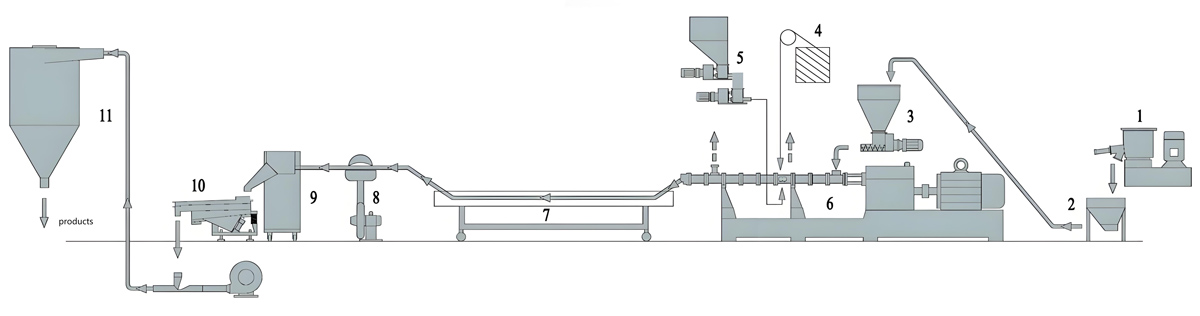
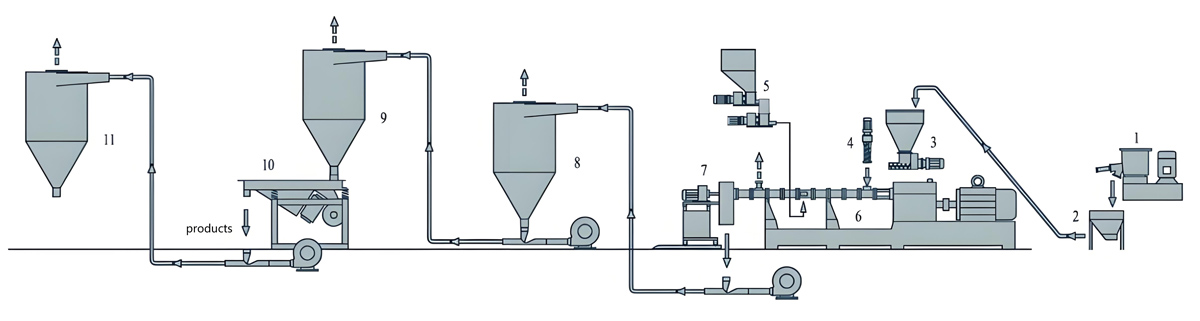
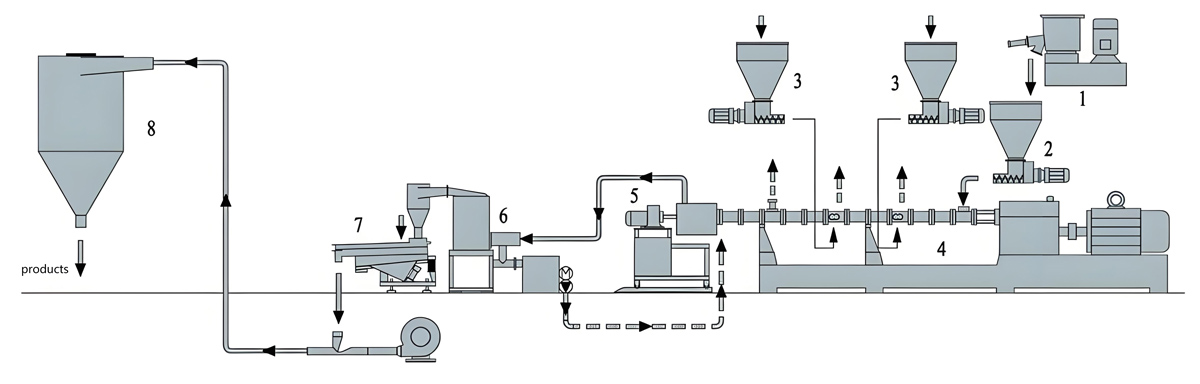
The production process of PP-R masterbatches using low energy twin screw extruders (Kerke KTE Series) consists of 8 sequential steps, optimized for energy efficiency and product uniformity:
3.1 Raw Material Preprocessing
All raw materials (PP-R carrier resin, additives, fillers) are preprocessed to remove moisture and impurities, a critical step to avoid processing defects and reduce extruder energy consumption:
- PP-R resin drying: Dry in a dehumidifying dryer at 80–90°C for 2–3 hours to reduce moisture content to <0.02%.
- Additive drying: Glass fiber, titanium dioxide, and mineral fillers are dried at 100–110°C for 4–6 hours to eliminate surface moisture.
- Impurity removal: Pass all materials through a 40-mesh screen to remove metal particles and large agglomerates, preventing extruder screw wear and energy loss.
3.2 Material Mixing
Preprocessed materials are mixed in a high-speed mixer (800–1000 rpm) to ensure uniform distribution of additives before extrusion:
- Add PP-R carrier resin to the mixer and run at low speed (300 rpm) for 1 minute.
- Add liquid additives (waxes, coupling agents) and mix at medium speed (500 rpm) for 2 minutes to coat the resin pellets.
- Add solid additives (antioxidants, colorants, glass fiber) and mix at high speed (800 rpm) for 3–5 minutes; the mixing temperature is controlled at 40–50°C to avoid premature melting of waxes.
- Discharge the mixture into a cooling mixer to reduce temperature to <30°C, preventing agglomeration during storage.
3.3 Feeding
The mixed material is fed into the Kerke KTE Series extruder using a loss-in-weight feeder (accuracy ±0.1%) to ensure stable feeding rate—critical for maintaining low energy consumption and consistent masterbatch quality:
- Set the feeding rate based on extruder model (e.g., 20–30 kg/h for KTE-36, 80–100 kg/h for KTE-50).
- The feeder is synchronized with the extruder screw speed to avoid material accumulation in the feed throat (which increases torque and energy use).
3.4 Twin Screw Extrusion
The core step of PP-R masterbatch production, where the mixed material is melted, mixed, and homogenized in the Kerke KTE Series extruder (co-rotating twin screw design):
- Material enters the feeding zone (temperature 160–170°C) and is conveyed forward by the screws.
- In the compression zone (170–180°C), the material is compressed and melted, with additives dispersed into the PP-R melt.
- In the melting/mixing zone (180–190°C), high shear from the screw elements ensures uniform dispersion of additives (critical for PP-R masterbatch quality).
- In the degassing zone (185–190°C), a vacuum pump (vacuum degree -0.06 to -0.08 MPa) removes volatile gases (moisture, low-molecular-weight waxes) to prevent bubbles in the masterbatch.
- In the metering zone (180–185°C), the melt is pressurized and pushed through the die head at a stable rate, minimizing energy waste from pressure fluctuations.
3.5 Strand Die & Cooling
The molten PP-R masterbatch is extruded through a strand die (8–12 holes, diameter 2.5–3.0 mm) into cooling water:
- The die temperature is controlled at 180–185°C to avoid strand breakage (which increases material waste and energy loss from reprocessing).
- The strands are cooled in a water bath (temperature 25–30°C) for 3–5 seconds to solidify, with water flow rate adjusted to 0.5–1.0 m/s (too fast increases energy use for water circulation; too slow causes uneven cooling).
3.6 Pelletizing
The cooled strands are cut into uniform pellets (length 2.5–3.0 mm) using a rotary cutter:
- Set the cutter speed to 300–500 rpm, synchronized with the extruder output to ensure consistent pellet length.
- The cutter blade gap is adjusted to 0.1–0.2 mm to avoid strand jamming (which increases extruder backpressure and energy consumption).
3.7 Drying & Sieving
The wet pellets are dried and sieved to remove fines and oversized pellets:
- Dry in a hot air dryer at 60–70°C for 1–2 hours to reduce moisture content to <0.03% (prevents clumping during storage).
- Sieve through a 10-mesh upper screen and 20-mesh lower screen to remove oversized (>3.5 mm) and undersized (<2.0 mm) pellets, ensuring masterbatch uniformity (critical for pipe extrusion downstream).
3.8 Packaging
The finished PP-R masterbatches are packaged in moisture-proof bags (25 kg/bag) with batch numbers and quality certificates:
- Use an automatic weighing and packaging machine (accuracy ±0.1 kg) to reduce labor costs and ensure consistent bag weight.
- Store packaged masterbatches in a dry, ventilated warehouse (temperature 20–30°C, humidity <60%) to maintain performance.
4. Production Equipment Introduction
The production of PP-R masterbatches with low energy consumption relies on a complete set of equipment, with the Kerke KTE Series twin screw extruder as the core. Below is a detailed introduction to each piece of equipment:
4.1 Core Equipment: Kerke KTE Series Low Energy Twin Screw Extruder
Kerke’s KTE Series co-rotating twin screw extruders are specifically designed for PP-R masterbatch production, with energy-saving features and optimized mixing performance:
4.1.1 Screw and Barrel
- Screw diameter: 36mm (KTE-36), 50mm (KTE-50), 65mm (KTE-65) (common models for PP-R masterbatch).
- L/D ratio: 40:1 (ideal for PP-R resin mixing, balancing shear and energy efficiency).
- Screw material: Bimetallic alloy (WC-Co coating, hardness 65 HRC) for wear resistance (critical for glass fiber-reinforced masterbatches), reducing maintenance frequency and energy loss from worn screws.
- Barrel design: Segmented barrel with independent temperature control zones (5–7 zones) and water cooling channels, minimizing heat loss and improving energy efficiency.
4.1.2 Drive System
- Servo motor drive (instead of traditional AC motor) reduces energy consumption by 20–25% by matching motor speed to extruder load (no idle energy waste).
- High-torque gearbox (torque range 110–500 N·m/cm³) ensures stable operation even with high additive loading (e.g., glass fiber masterbatches).
4.1.3 Temperature Control System
- PID temperature control (accuracy ±1°C) prevents overheating of PP-R resin (which causes degradation and increased energy use).
- Heat recovery system: Recycles waste heat from the barrel cooling to preheat raw materials, reducing overall energy consumption by an additional 5–8%.
4.1.4 Control System
- PLC touch screen control (Siemens S7-1200) for real-time monitoring of key parameters (screw speed, temperature, torque, energy consumption), with automatic adjustment to maintain optimal energy efficiency.
- Energy consumption monitoring module: Displays real-time energy use per kg of masterbatch, allowing operators to optimize parameters for minimum energy consumption.
4.2 Auxiliary Equipment
4.2.1 High-Speed Mixer
- Capacity: 100–500 L (matches extruder output), mixing speed 0–1000 rpm, with jacket cooling to control mixing temperature (prevents premature melting of additives).
- Energy efficiency: Variable frequency drive (VFD) reduces energy use during low-load mixing.
4.2.2 Loss-in-Weight Feeder
- Accuracy ±0.1%, ensures stable feeding rate to the extruder (avoids energy waste from inconsistent load).
4.2.3 Dehumidifying Dryer
- Dehumidification capacity 50–200 m³/h, reduces PP-R resin moisture to <0.02%, preventing bubble formation and extruder energy loss.
4.2.4 Strand Cooling Water Bath
- Temperature-controlled (25–30°C) with recirculating water system (energy-efficient pump, reduces water and energy consumption).
4.2.5 Rotary Pelletizer
- Cutter speed 0–600 rpm, synchronized with extruder output, with sharp carbide blades (reduces energy use for cutting).
4.2.6 Hot Air Dryer
- Temperature 60–70°C, energy-efficient heating element (ceramic instead of resistance wire), reduces drying energy consumption by 15%.
4.2.7 Vibrating Sieve
- 10/20 mesh double-layer screen, VFD drive (adjustable speed), low noise (<75 dB) and energy consumption.
5. Parameter Settings
Optimal parameter settings for the Kerke KTE Series extruder are critical to achieving low energy consumption and high-quality PP-R masterbatches. Below are the recommended parameters for different PP-R masterbatch types:
5.1 General Parameter Principles for Low Energy Operation
- Screw speed: Operate at 60–80% of the maximum rated speed (balances mixing efficiency and energy use; too high increases shear and energy consumption, too low reduces output and increases specific energy consumption).
- Temperature control: Maintain the lowest possible temperature that ensures complete melting of PP-R resin (avoids overheating and energy waste).
- Feeding rate: Match the feeding rate to screw speed to avoid material accumulation (high torque) or starvation (low output, high specific energy consumption).
- Vacuum degree: Maintain -0.06 to -0.08 MPa (sufficient to remove volatiles without excessive energy use for vacuum pumping).
5.2 Parameter Settings for Different PP-R Masterbatches
5.2.1 PP-R Antioxidant Masterbatch (Kerke KTE-50 as an example)
- Screw speed: 300–350 rpm
- Feeding rate: 80–100 kg/h
- Temperature zones (from feed throat to die): 160°C, 170°C, 180°C, 185°C, 180°C, 175°C (die)
- Vacuum degree: -0.07 MPa
- Torque: 60–70% (normal range, low energy consumption)
- Specific energy consumption: 1.2–1.4 kWh/kg
5.2.2 PP-R Color Masterbatch (White, Kerke KTE-50)
- Screw speed: 280–320 rpm (lower speed to reduce titanium dioxide abrasion on screws)
- Feeding rate: 70–90 kg/h
- Temperature zones: 165°C, 175°C, 185°C, 190°C, 185°C, 180°C (die)
- Vacuum degree: -0.08 MPa (removes volatile from PE wax)
- Torque: 65–75%
- Specific energy consumption: 1.4–1.6 kWh/kg
5.2.3 PP-R Glass Fiber Reinforced Masterbatch (Kerke KTE-65)
- Screw speed: 250–300 rpm (lower speed to reduce glass fiber breakage and screw wear)
- Feeding rate: 120–150 kg/h
- Temperature zones: 170°C, 180°C, 190°C, 195°C, 190°C, 185°C (die)
- Vacuum degree: -0.08 MPa (removes moisture from glass fiber)
- Torque: 70–80% (higher due to glass fiber loading)
- Specific energy consumption: 1.6–1.8 kWh/kg
5.2.4 PP-R Weather-Resistant Masterbatch (Kerke KTE-50)
- Screw speed: 300–350 rpm
- Feeding rate: 80–100 kg/h
- Temperature zones: 160°C, 170°C, 180°C, 185°C, 180°C, 175°C (die)
- Vacuum degree: -0.07 MPa
- Torque: 60–70%
- Specific energy consumption: 1.2–1.5 kWh/kg
6. Equipment Price
The price of low energy twin screw extruders for PP-R masterbatch production (Kerke KTE Series) varies by model, configuration, and customization. All prices are FOB Nanjing (China) in US dollars (2024 pricing), excluding shipping, taxes, and installation:
6.1 Kerke KTE Series Extruder Base Prices
6.1.1 Kerke KTE-36 (36mm screw diameter, L/D 40:1)
- Standard configuration (servo drive, PLC control, basic mixing elements): $45,000–$55,000
- Enhanced configuration (heat recovery system, energy monitoring, wear-resistant screw elements): $55,000–$65,000
- Output: 20–40 kg/h (PP-R antioxidant masterbatch), specific energy consumption 1.2–1.4 kWh/kg
6.1.2 Kerke KTE-50 (50mm screw diameter, L/D 40:1)
- Standard configuration: $80,000–$95,000
- Enhanced configuration: $95,000–$110,000
- Output: 70–100 kg/h (PP-R color masterbatch), specific energy consumption 1.4–1.6 kWh/kg
6.1.3 Kerke KTE-65 (65mm screw diameter, L/D 40:1)
- Standard configuration: $120,000–$140,000
- Enhanced configuration: $140,000–$160,000
- Output: 120–180 kg/h (PP-R glass fiber masterbatch), specific energy consumption 1.6–1.8 kWh/kg
6.2 Auxiliary Equipment Prices (PP-R Masterbatch Production Line)
- High-speed mixer (200 L): $8,000–$12,000
- Loss-in-weight feeder: $6,000–$9,000
- Dehumidifying dryer (100 m³/h): $7,000–$10,000
- Cooling water bath + pelletizer: $5,000–$8,000
- Hot air dryer + vibrating sieve: $4,000–$6,000
- Automatic packaging machine: $3,000–$5,000
Total auxiliary equipment cost: $33,000–$50,000 (varies by capacity and configuration)
6.3 Total Investment for PP-R Masterbatch Production Lines
- Small-scale line (Kerke KTE-36 + basic auxiliary equipment): $80,000–$100,000
- Medium-scale line (Kerke KTE-50 + enhanced auxiliary equipment): $130,000–$160,000
- Large-scale line (Kerke KTE-65 + full auxiliary equipment): $180,000–$220,000
6.4 Factors Affecting Price
- Customization: Custom screw elements (for specific PP-R masterbatch types) add $5,000–$15,000.
- Certification: CE/FDA certification (for export to EU/US) adds $3,000–$5,000.
- Warranty: Extended warranty (3 years full warranty vs. standard 2 years) adds 5–8% of the base price.
- Training & Installation: On-site installation and operator training (global) add $5,000–$10,000.
7. Production Process Problems, Solutions, and Prevention
PP-R masterbatch production with low energy twin screw extruders may encounter several common problems, which affect product quality and energy efficiency. Below is a detailed analysis of each problem, its solutions, and prevention methods:
7.1 Problem 1: Uneven Dispersion of Additives in PP-R Masterbatch
Problem Description
Additives (e.g., antioxidants, titanium dioxide) form agglomerates in the masterbatch, leading to inconsistent PP-R pipe performance (e.g., uneven color, reduced antioxidant efficacy).
Reason Analysis
- Insufficient mixing in the high-speed mixer (short mixing time, low speed).
- Inadequate shear in the extruder (low screw speed, improper screw element configuration).
- Extruder temperature too low (PP-R resin not fully melted, additives cannot disperse).
- Poor quality dispersant (e.g., low-grade PE wax with poor compatibility with PP-R).
Solution
- Extend mixing time in the high-speed mixer (increase to 5–6 minutes) and raise mixing speed to 800–1000 rpm.
- Increase extruder screw speed by 20–30% (within rated range) or replace screw elements with high-shear kneading blocks.
- Raise extruder temperature by 5–10°C (ensure PP-R resin is fully melted, but do not exceed 195°C to avoid degradation).
- Replace with high-quality dispersant (e.g., oxidized PE wax with acid value 10–15 mg KOH/g) and increase dispersant ratio by 0.5–1%.
Prevention Methods
- Establish a standard mixing procedure (time, speed, temperature) for each PP-R masterbatch type.
- Regularly inspect and clean extruder screw elements (remove accumulated material that reduces shear).
- Use only high-quality additives and dispersants from certified suppliers.
- Conduct periodic dispersion tests (microscopy analysis) on masterbatches to detect agglomerates early.
7.2 Problem 2: Abnormally High Energy Consumption of Extruder
Problem Description
Specific energy consumption exceeds 2.0 kWh/kg (far higher than the normal 1.2–1.8 kWh/kg), increasing operational costs.
Reason Analysis
- Extruder screw/barrel wear (increased friction between screw and barrel, higher torque).
- Overfeeding (material accumulation in the feed throat, high torque and energy use).
- Extruder temperature set too high (excessive heating energy consumption).
- Vacuum pump malfunction (high energy use to maintain vacuum, or vacuum degree too low leading to reprocessing).
- Drive system inefficiency (servo motor not calibrated, energy loss in gearbox).
Solution
- Inspect screw/barrel wear (measure screw flight thickness); replace worn screw elements or barrel liners if wear exceeds 0.5 mm.
- Reduce feeding rate by 10–20% to match screw speed, and check the loss-in-weight feeder for calibration errors.
- Lower extruder temperature by 5–10°C (verify PP-R resin is still fully melted via melt flow test).
- Repair or replace vacuum pump components (e.g., seals, impellers) and adjust vacuum degree to -0.06 to -0.08 MPa (optimal range).
- Calibrate the servo motor and gearbox (check for oil leakage or wear, replace lubricant if necessary).
Prevention Methods
- Implement regular maintenance of screw/barrel (weekly inspection, annual overhaul).
- Calibrate the loss-in-weight feeder monthly to ensure accurate feeding rate.
- Use the extruder’s energy monitoring module to track specific energy consumption in real time; set alerts for values exceeding 2.0 kWh/kg.
- Schedule quarterly maintenance of the drive system and vacuum pump (lubrication, seal replacement).
7.3 Problem 3: PP-R Masterbatch Discoloration (Yellowing/Browning)
Problem Description
Masterbatch appears yellow or brown, indicating PP-R resin degradation (reduces pipe performance and safety).
Reason Analysis
- Extruder temperature too high (PP-R resin thermal degradation at >200°C).
- Insufficient antioxidant content in the formula (or expired antioxidants).
- Long residence time of material in the extruder (slow screw speed, small die diameter).
- Contamination of raw materials (e.g., metal impurities causing catalytic degradation).
Solution
- Lower extruder temperature by 10–15°C (reduce the melting/mixing zone temperature first) and increase screw speed to shorten residence time.
- Increase antioxidant blend ratio by 0.5–1% (replace expired antioxidants with fresh stock).
- Replace the die head with a larger diameter (increase number of holes or hole diameter) to reduce backpressure and residence time.
- Reclean the extruder feed throat and barrel (remove accumulated degraded material) and install a metal detector in the feeding line to remove impurities.
Prevention Methods
- Strictly control extruder temperature (set upper limit at 195°C for PP-R resin).
- Store antioxidants in a cool, dry place (shelf life 12 months) and check batch numbers before use.
- Optimize screw speed and die size to keep material residence time <2 minutes (ideal for PP-R resin).
- Implement raw material inspection (metal detection, moisture content) before mixing.
7.4 Problem 4: Uneven Pellet Size of PP-R Masterbatch
Problem Description
Masterbatch pellets have inconsistent length/diameter (2.0–4.0 mm vs. target 2.5–3.0 mm), leading to uneven feeding in PP-R pipe extrusion.
Reason Analysis
- Pelletizer cutter speed not synchronized with extruder output (too fast = short pellets, too slow = long pellets).
- Cutter blades dull (cannot cut strands cleanly, leading to irregular pellets).
- Strand cooling uneven (some strands harden faster, leading to uneven cutting).
- Die holes blocked (uneven strand output, varying pellet size).
Solution
- Synchronize pelletizer speed with extruder output (increase/decrease cutter speed by 50–100 rpm to match strand output rate).
- Sharpen or replace cutter blades (replace carbide blades every 3–6 months for PP-R masterbatch production).
- Adjust water flow rate in the cooling bath (increase to 1.0 m/s) and ensure uniform water temperature (25–30°C) across the bath.
- Remove the die head and clean blocked holes (use a drill bit matching hole diameter) and inspect for wear (replace die head if hole diameter varies by >0.2 mm).
Prevention Methods
- Install a speed synchronization system between extruder and pelletizer (automatic adjustment based on output).
- Establish a blade replacement schedule (every 3 months for glass fiber masterbatches, every 6 months for antioxidant/color masterbatches).
- Regularly clean the cooling bath (remove sediment) and check water temperature sensors for accuracy.
- Clean the die head daily (after production) to prevent hole blockage from degraded material.
7.5 Problem 5: Extruder Torque Fluctuation
Problem Description
Extruder torque varies by >10% (e.g., 60–80% range), leading to unstable output and increased energy consumption.
Reason Analysis
- Unstable feeding rate (loss-in-weight feeder malfunction, material bridging in the hopper).
- Inconsistent material moisture content (moisture causes sudden expansion in the extruder, increasing torque).
- Screw element loose (uneven material conveyance, torque spikes).
- Additive agglomerates (large hard agglomerates increase shear and torque).
Solution
- Inspect the loss-in-weight feeder (clean hopper to remove bridging, calibrate load cell) and install a vibrator on the hopper to ensure smooth feeding.
- Re-dry raw materials (increase drying time by 1–2 hours) to reduce moisture content to <0.02%.
- Stop the extruder and tighten loose screw elements (replace damaged elements if necessary).
- Increase mixing time/speed in the high-speed mixer to break down additive agglomerates, or add an additional pre-mixing step with a powder mill for large agglomerates.
Prevention Methods
- Calibrate the loss-in-weight feeder weekly and inspect the hopper for bridging (especially for glass fiber masterbatches).
- Implement strict raw material drying procedures (record drying time/temperature for each batch).
- Inspect screw elements for looseness before each production run (torque check).
- Use sieving (40-mesh) for all powder additives to remove agglomerates before mixing.
8. Maintenance and Care
Regular maintenance of the Kerke KTE Series low energy twin screw extruder and auxiliary equipment is critical to maintaining low energy consumption, extending equipment lifespan, and ensuring consistent PP-R masterbatch quality. Below is a detailed maintenance schedule:
8.1 Daily Maintenance (Before/After Production)
Before Production
- Inspect the extruder feed hopper for debris and material bridging.
- Check temperature and pressure sensors for accuracy (verify with a calibrated thermometer/gauge).
- Inspect the cooling water bath level and temperature (top up water if necessary).
- Check pelletizer blade condition (ensure no dullness or damage).
After Production
- Purge the extruder with clean PP-R resin (5–10 kg) to remove residual masterbatch material (prevents degradation and cross-contamination).
- Clean the feed hopper, loss-in-weight feeder, and die head (remove accumulated material).
- Drain and clean the cooling water bath filter (remove sediment).
- Record key operational data (energy consumption, torque, output) for trend analysis.
- Turn off all power and water supply to equipment (ensure safety).
8.2 Weekly Maintenance
Extruder
- Lubricate screw drive bearings and gearbox (use high-temperature lubricant, check oil level).
- Inspect screw/barrel for leaks (melt leakage at barrel joints) and tighten bolts if necessary.
- Clean the extruder vacuum system (filter and condenser) to maintain vacuum efficiency (reduces energy use).
Auxiliary Equipment
- Inspect high-speed mixer blades for wear (replace if blade thickness reduces by >1 mm).
- Calibrate the loss-in-weight feeder (check accuracy with a calibrated scale).
- Clean the dehumidifying dryer filter (prevents airflow restriction and energy loss).
8.3 Monthly Maintenance
Extruder
- Check extruder temperature control system (PID calibration) to ensure temperature accuracy (±1°C).
- Inspect servo motor and drive system (check for abnormal noise, vibration, or overheating).
- Measure screw flight thickness (use a micrometer) to detect early wear (replace elements if wear >0.3 mm).
Auxiliary Equipment
- Inspect cooling water pump (check for leaks, replace seals if necessary).
- Clean the hot air dryer heat exchanger (remove dust to improve heat transfer efficiency).
- Inspect vibrating sieve screen (replace if damaged or clogged).
8.4 Annual Maintenance (Overhaul)
Extruder
- Disassemble the screw and barrel (clean thoroughly, replace worn elements/liner).
- Overhaul the gearbox (drain old oil, replace with new lubricant, inspect gear wear).
- Calibrate the energy monitoring module (verify with a certified power analyzer).
- Test the emergency stop system (ensure compliance with safety standards).
Auxiliary Equipment
- Replace all seals and gaskets in the mixing and drying equipment (prevent leaks).
- Overhaul the pelletizer motor and gearbox (lubrication, bearing replacement).
- Inspect and repair all electrical components (PLC, sensors, motors) to prevent unexpected downtime.
8.5 Maintenance of Key Wear Parts
- Screw Elements: Replace every 12–18 months (PP-R antioxidant/color masterbatches) or 6–12 months (glass fiber masterbatches).
- Barrel Liner: Replace every 24–36 months (or when wear exceeds 1 mm).
- Pelletizer Blades: Replace every 3–6 months (glass fiber masterbatches) or 6–12 months (other masterbatches).
- Seals and O-Rings: Replace every 12 months (prevent melt/water leakage and energy loss).
9. FAQ
Below are frequently asked questions about low energy twin screw extruders for PP-R masterbatch production, with detailed answers:
9.1 Q1: How can I further reduce the energy consumption of the Kerke KTE Series extruder for PP-R masterbatch production?
A1: Several strategies can reduce energy consumption by an additional 5–10%:
- Use the heat recovery system to preheat raw materials (recycles barrel cooling waste heat).
- Optimize the formula to reduce high-load additives (e.g., glass fiber) where possible, or use surface-treated additives to reduce extruder torque.
- Operate the extruder at 70–80% of maximum output (the most energy-efficient load range).
- Insulate the extruder barrel with ceramic insulation sleeves (reduce heat loss by 10–15%).
- Implement a shift schedule to avoid peak energy tariffs (reduces energy costs, not just consumption).
9.2 Q2: Can the Kerke KTE Series extruder process multiple types of PP-R masterbatches without reconfiguration?
A2: Yes, the KTE Series features modular screw elements that allow quick reconfiguration for different PP-R masterbatch types:
- For antioxidant/color masterbatches: Use standard mixing elements (low shear, energy-efficient).
- For glass fiber masterbatches: Replace with high-wear-resistant kneading blocks (no need to replace the entire screw).
- Reconfiguration time is typically 2–4 hours (trained technicians), minimizing downtime between product changes.
9.3 Q3: What is the typical payback period for investing in a Kerke KTE Series low energy extruder vs. a conventional extruder?
A3: The payback period is 12–18 months for most manufacturers:
- Conventional extruder energy consumption: 2.5 kWh/kg; Kerke KTE Series: 1.5 kWh/kg (1 kWh/kg savings).
- For a medium-scale line (100 kg/h, 8h/day, 250 days/year, $0.10/kWh): Annual energy savings = 100 × 8 × 250 × 1 × 0.10 = $20,000.
- The price premium for the KTE Series (vs. conventional extruder) is $20,000–$30,000, leading to payback in 12–18 months.
- Additional savings from reduced maintenance and higher product quality shorten the payback period further.
9.4 Q4: How to troubleshoot if the PP-R masterbatch has bubbles after extrusion?
A4: Bubbles are typically caused by moisture or volatiles; troubleshoot as follows:
- Check raw material moisture content (re-dry if >0.02%).
- Verify vacuum pump operation (ensure vacuum degree ≥-0.06 MPa; clean the vacuum filter if necessary).
- Increase extruder temperature by 5–10°C (to volatilize moisture/volatiles).
- Extend the degassing zone residence time (reduce screw speed slightly or adjust screw elements).
9.5 Q5: What warranty does Kerke offer for the KTE Series extruder?
A5: Kerke provides a comprehensive warranty for the KTE Series:
- Standard warranty: 2 years for the entire extruder (parts + labor) and 5 years for core components (screw, barrel, servo motor).
- Extended warranty: Optional 3-year full warranty or 7-year core components warranty (5–8% of the base price).
- Global service: Kerke has regional service centers in Asia, Europe, and the Americas, with 48-hour response time for critical repairs and spare parts delivery.
9.6 Q6: Can the Kerke KTE Series extruder process recycled PP-R resin in masterbatch production?
A6: Yes, the KTE Series is optimized for recycled PP-R resin (up to 30% recycled content in masterbatches):
- Use a pre-shredding and washing step for recycled PP-R pipes (remove contaminants).
- Increase antioxidant content by 1–2% to compensate for recycled resin degradation.
- Adjust extruder temperature to 175–185°C (lower than virgin resin to avoid further degradation).
- Use a larger degassing zone (or additional degassing port) to remove volatiles from recycled resin.
10. Summary
Low energy twin screw extruders—specifically Kerke’s KTE Series—are a game-changer for PP-R masterbatch production, addressing the dual challenges of rising energy costs and strict quality requirements for PP-R pipes. This guide has detailed every aspect of PP-R masterbatch production with low energy extruders, from formula ratios (tailored to antioxidant, color, reinforced, and weather-resistant grades) to production processes (optimized for energy efficiency and uniformity), equipment specifications (Kerke KTE Series core features), parameter settings (balanced for low energy use and product quality), pricing (transparent USD pricing for different models), troubleshooting (detailed problem analysis, solutions, and prevention), maintenance (daily/weekly/monthly/annual schedules), and FAQs (practical answers to common questions).
The Kerke KTE Series extruders deliver key benefits for PP-R masterbatch manufacturers: 35–40% lower energy consumption than conventional extruders (1.2–1.8 kWh/kg vs. 2.5–3.0 kWh/kg), superior additive dispersion (critical for PP-R pipe performance), and a short payback period (12–18 months). By following the recommended formulas, processes, parameter settings, and maintenance schedules, manufacturers can achieve consistent PP-R masterbatch quality, reduce operational costs, and meet sustainability goals.
As the global PP-R pipe market grows, the demand for energy-efficient masterbatch production solutions will continue to rise. Kerke’s KTE Series low energy twin screw extruders combine technical excellence, energy efficiency, and durability, making them the ideal choice for PP-R masterbatch manufacturers looking to improve competitiveness and profitability. With proper operation and maintenance, the KTE Series extruders can deliver reliable performance for 15–20 years, ensuring long-term return on investment and sustainable production.