Introduction to Anti-Yellowing Masterbatches
Anti-yellowing masterbatches represent specialized formulations designed to prevent or minimize yellowing and discoloration in polymer materials exposed to ultraviolet radiation, heat, and environmental degradation factors. These masterbatches incorporate concentrated UV absorbers, hindered amine light stabilizers, and various antioxidant systems that work synergistically to maintain polymer color stability over extended service periods. The production of anti-yellowing masterbatches requires sophisticated compounding equipment capable of precisely distributing and activating light stabilizing additives while maintaining additive functionality and dispersion quality.
Parallel twin screw extruders provide the intensive mixing capabilities, precise temperature control, and modular screw configurations necessary for effective anti-yellowing masterbatch manufacturing. The intense dispersive mixing ensures uniform distribution of UV absorbers and stabilizers throughout the polymer matrix, while controlled temperature profiles prevent degradation of sensitive additive components. This comprehensive guide explores anti-yellowing technology, masterbatch formulation principles, parallel twin screw extrusion equipment, and processing optimization strategies for high-quality production.
Understanding Anti-Yellowing Mechanisms
Yellowing in polymers occurs through multiple degradation pathways initiated by ultraviolet radiation, thermal exposure, and environmental factors. Photo-oxidation represents the most common yellowing mechanism, where UV radiation breaks chemical bonds in the polymer backbone, creating chromophores that absorb visible light and cause yellow appearance. Thermal oxidation causes similar degradation pathways through heat-induced oxidation processes. Environmental factors including ozone exposure and chemical contact can also contribute to yellowing.
Anti-yellowing formulations incorporate additives that interfere with these degradation mechanisms. UV absorbers capture harmful UV radiation before it can damage polymer chains. Hindered amine light stabilizers scavenge free radicals generated by UV exposure, interrupting degradation chain reactions. Antioxidants prevent thermal oxidation that contributes to yellowing. Understanding these mechanisms enables optimized formulation design for specific application requirements.
UV Absorber Chemistry
UV absorbers function by selectively absorbing ultraviolet radiation and converting it to harmless thermal energy through energy dissipation mechanisms. Common UV absorber types include benzophenones, benzotriazoles, and triazines. Benzophenones provide broad-spectrum UV absorption with good compatibility with many polymers. Benzotriazoles offer excellent UV absorption characteristics and weather resistance, making them particularly effective for outdoor applications. Triazines provide high extinction coefficients and thermal stability for demanding applications.
UV absorber effectiveness depends on absorption spectrum matching the UV exposure conditions, concentration levels, polymer compatibility, and thermal stability. Selection of appropriate UV absorber chemistry requires consideration of application UV exposure spectrum, processing temperatures, and service life requirements. Combined UV absorber systems often provide synergistic effects and broader protection than single-component systems.
Hindered Amine Light Stabilizers
Hindered amine light stabilizers (HALS) function by scavenging free radicals generated during photo-oxidation, interrupting degradation chain reactions and preventing yellowing. HALS do not absorb UV radiation directly but regenerate and provide long-term protection through radical scavenging cycles. This mechanism enables HALS to provide protection over extended service periods, making them critical for applications requiring long-term color stability.
HALS selection considers polymer type, processing conditions, and application requirements. Different HALS chemistries demonstrate varying compatibility with polymer matrices and effectiveness under specific UV exposure conditions. Some HALS chemistries may cause processing interactions or coloration effects at elevated temperatures. Optimal HALS selection balances effectiveness, compatibility, and cost considerations for specific applications.
Formulation Design Principles
Effective anti-yellowing masterbatch formulations require strategic component selection, precise additive ratios, and consideration of processing effects on additive functionality. Formulation design must address specific polymer types, application UV exposure conditions, service life requirements, and processing constraints. Typical anti-yellowing masterbatch concentration levels range from 5% to 25% active ingredient loading, with most applications utilizing 10% to 20% stabilizer loading.
Base Polymer Selection
The base polymer serves as the carrier for anti-yellowing additives and significantly influences formulation effectiveness. The base polymer should demonstrate good compatibility with UV absorbers and HALS, appropriate processing characteristics, and minimal intrinsic yellowing tendency. Common base polymers for anti-yellowing masterbatches include polyethylene, polypropylene, polystyrene, polyvinyl chloride, and various engineering polymers.
Polyolefin bases are most common due to widespread application and susceptibility to yellowing degradation. Polypropylene bases require careful HALS selection due to potential processing interactions. Polystyrene bases benefit from UV absorbers with good compatibility to prevent extraction. Engineering polymer bases require additive selection considering high processing temperatures and chemical resistance requirements.
Stabilizer System Design
Anti-yellowing stabilizer systems typically combine UV absorbers and HALS to provide comprehensive protection against UV-induced yellowing. UV absorber loading typically ranges from 5% to 15% of masterbatch formulation depending on polymer susceptibility and application UV exposure intensity. HALS loading typically ranges from 2% to 8% depending on polymer type and required service life.
Stabilizer system design requires consideration of synergistic effects between components. Some UV absorber and HALS combinations demonstrate synergistic protection, enabling lower total loading while maintaining effectiveness. Other combinations may show antagonistic effects requiring careful formulation design. Additive ratios, particularly HALS to UV absorber ratios, significantly influence overall system effectiveness and processing characteristics.
Antioxidant and Secondary Stabilizers
Primary antioxidants prevent thermal oxidation that can contribute to yellowing during processing and service. Antioxidant loading typically ranges from 1% to 5% depending on polymer thermal stability and processing conditions. Secondary stabilizers including phosphites and thioesters provide synergistic effects with primary antioxidants and light stabilizers.
Processing stabilizers may be required for polymers with narrow processing windows or high processing temperatures. Metal deactivators prevent catalytic degradation caused by metal contaminants that can accelerate yellowing. Acid scavengers neutralize acidic species that can catalyze degradation. Secondary stabilizers enhance overall system effectiveness and stability under processing and service conditions.
Parallel Twin Screw Extruder Technology
Parallel twin screw extruders provide the intensive mixing capabilities necessary for anti-yellowing masterbatch production. These machines feature two parallel screws rotating in the same direction (co-rotating) or opposite directions (counter-rotating) within a closely fitting barrel. The close screw clearance creates high shear rates that break down additive agglomerates and ensure uniform distribution. Nanjing Kerke Extrusion Equipment Company KTE Series parallel twin screw extruders offer advanced mixing capabilities optimized for stabilizer masterbatch production.
Mixing Characteristics of Parallel Designs
Parallel twin screw extruders provide superior dispersive mixing compared to other extruder types due to the narrow clearance between intermeshing screws and barrel. This geometry creates high shear rates that effectively break down additive agglomerates and ensure intimate contact between polymer and additives. Distributive mixing is enhanced through the intermeshing action that continuously divides and recombines material streams, ensuring uniform spatial distribution throughout the polymer matrix.
Co-rotating parallel designs provide particularly effective dispersive mixing for anti-yellowing masterbatches. The material flow in co-rotating systems creates figure-eight patterns that enhance distributive mixing while the narrow clearances provide dispersive mixing. This combination ensures uniform distribution of UV absorbers and HALS throughout the polymer matrix while maintaining additive integrity.
Screw Configuration Options
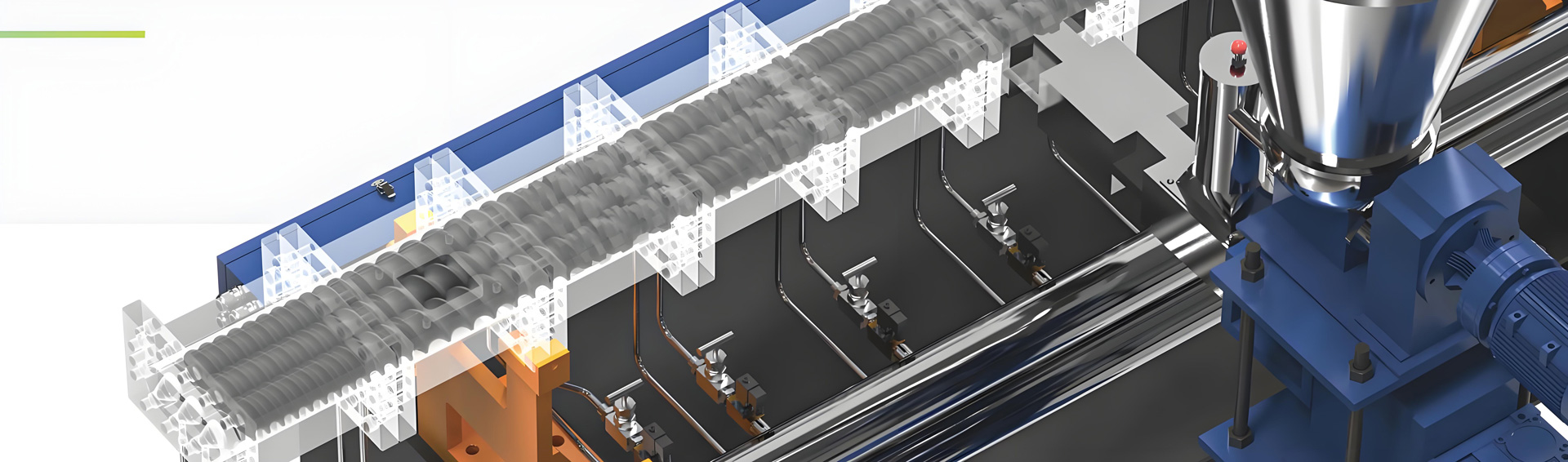
Parallel twin screw extruders feature modular screw designs that enable customized configuration for specific formulation requirements. Screw elements include conveying sections that transport material forward, kneading blocks that provide mixing intensity, and special mixing elements that enhance distributive or dispersive mixing. Modular configuration enables optimization for specific anti-yellowing formulations considering additive characteristics and processing requirements.
Kneading block configuration significantly influences mixing intensity and residence time. Forward-conveying kneading blocks provide intensive mixing while maintaining forward transport. Reverse-conveying kneading blocks create back-mixing zones that increase residence time and mixing intensity. Neutral kneading blocks provide high shear for breaking down agglomerates. Optimal configuration depends on additive agglomeration tendencies and dispersion quality requirements.
Production Process Overview
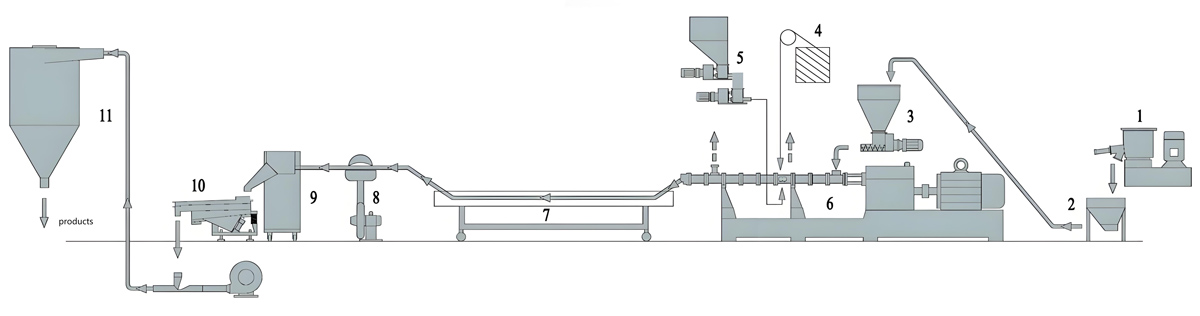
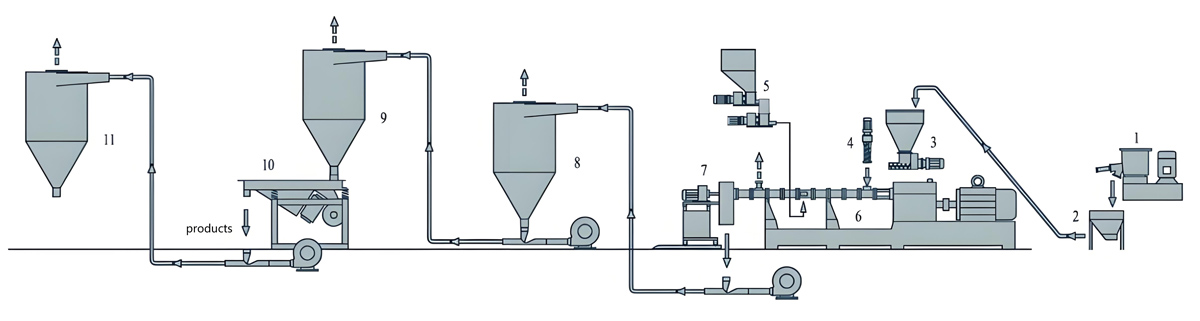
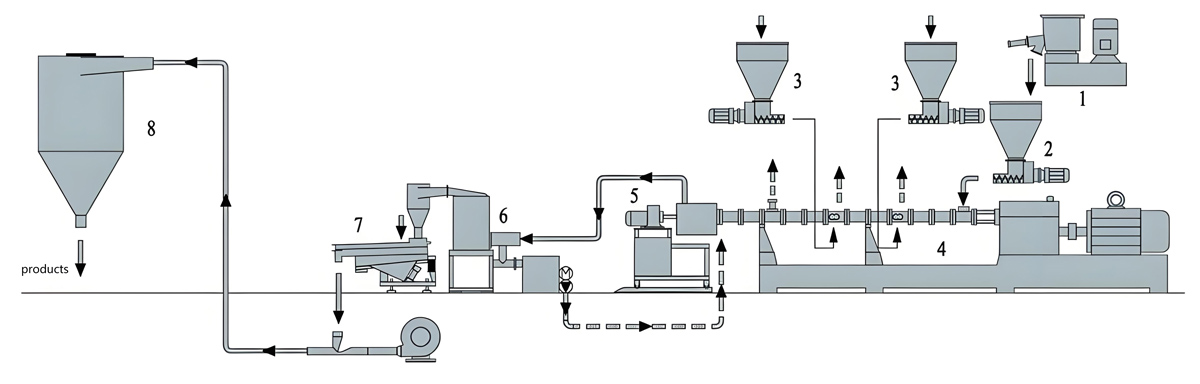
The production of anti-yellowing masterbatches using parallel twin screw extruders involves sequential processing stages including material preparation, feeding, melting, mixing, and pelletization. Each stage requires careful parameter control to achieve optimal additive dispersion while maintaining stabilizer functionality. Parallel twin screw technology provides the processing capabilities necessary for high-quality anti-yellowing masterbatch production.
Material Preparation and Handling
Material preparation for anti-yellowing masterbatch production requires attention to moisture control, additive handling, and pre-mixing protocols. UV absorbers and HALS often require protection from moisture and light exposure during storage and handling to prevent degradation. Some stabilizers may be sensitive to oxidation, requiring storage under inert atmosphere or with oxygen scavengers.
Pre-mixing of additives with polymer base using high-intensity mixers can improve initial distribution and reduce processing demands. Dry blending eliminates concentration gradients and reduces residence time requirements in the extruder. Pre-blending protocols must ensure adequate mixing without generating excessive heat that could degrade sensitive stabilizers. Proper material preparation ensures consistent formulation and additive functionality.
Feeding System Configuration
Feeding systems for anti-yellowing masterbatch production must handle diverse component forms including polymer pellets, powders, and potentially liquid additives. Main feeding systems for polymer base typically utilize gravimetric feeders for precise formulation control. Side feeding systems enable introduction of temperature-sensitive stabilizers at downstream locations where temperatures are lower.
Feeding accuracy is critical for maintaining consistent stabilizer concentrations. Gravimetric feeders provide accuracy within 0.5% to 1% for major components and 1% to 2% for stabilizer additives. Liquid stabilizer feeding requires precise metering pumps with calibration capabilities. Feeding system consistency ensures uniform formulation ratios and consistent product performance.
Melting and Plasticization
The melting zone achieves polymer transition from solid to molten state capable of incorporating stabilizers. Temperature profiles in this zone must achieve complete melting without degrading temperature-sensitive stabilizers. Typical temperature settings for polyolefin-based anti-yellowing masterbatches range from 170 to 190 degrees Celsius for initial barrel zones.
Screw configuration in the melting zone emphasizes conveying and initial plasticization while providing gentle mixing to avoid premature introduction of stabilizers to high-shear zones. Barrier screw designs can enhance melting efficiency by creating separate melt pools. Proper melting establishes the foundation for subsequent mixing stages and significantly influences processing energy consumption and additive functionality.
Intensive Mixing Zone
The intensive mixing zone represents the critical stage where stabilizers are thoroughly distributed throughout the polymer matrix. This zone typically incorporates a high density of kneading blocks and special mixing elements to achieve excellent dispersion quality. Mixing intensity must be balanced against thermal considerations to prevent stabilizer degradation.
Temperature in the intensive mixing zone typically ranges from 180 to 200 degrees Celsius for polyolefin formulations. This temperature provides adequate polymer fluidity for mixing while remaining below degradation thresholds for most UV absorbers and HALS. Residence time in this zone must be sufficient to achieve uniform distribution without causing excessive thermal exposure. Screw configuration optimization balances mixing intensity and additive thermal protection.
Processing Parameters and Optimization
Processing parameters for anti-yellowing masterbatch production must optimize additive dispersion while maintaining stabilizer functionality and achieving target product quality. Temperature profile, screw speed, throughput, and vacuum conditions influence product quality and process efficiency.
Temperature Profile Optimization
Temperature profile configuration requires careful consideration of polymer thermal stability, stabilizer degradation characteristics, and dispersion requirements. Typical temperature profiles for polyolefin-based anti-yellowing masterbatches start at 170-180 degrees Celsius in feed zones, increase to 180-195 degrees Celsius in mixing zones, and maintain 185-200 degrees Celsius through die zones.
Stabilizer thermal stability dictates maximum temperature limits. Some HALS chemistries may require temperatures below 190 degrees Celsius to prevent decomposition. UV absorbers generally demonstrate higher thermal stability but may degrade at elevated temperatures over extended residence times. Temperature profile optimization should include testing of additive functionality after processing at various temperature settings.
Screw Speed and Residence Time
Screw speed and residence time must be balanced to achieve optimal dispersion while protecting stabilizer functionality. Parallel twin screw extruders for anti-yellowing masterbatch production typically operate at screw speeds from 150 to 350 rpm depending on screw size and formulation complexity. Higher screw speeds increase shear rates and mixing intensity but reduce residence time.
Residence time in parallel twin screw extruders typically ranges from 1.5 to 3 minutes depending on L/D ratio, screw speed, and throughput. Sufficient residence time ensures complete melting and dispersion but excessive residence time may cause stabilizer degradation. Optimal residence time depends on additive sensitivity and dispersion requirements.
Vacuum and Degassing
Vacuum venting removes volatiles, residual monomers, and entrapped air that can cause defects in anti-yellowing masterbatches. Some stabilizers may release small amounts of volatiles during processing that must be removed to prevent porosity or surface defects. Vacuum systems typically apply 30-80 mbar absolute pressure to effectively remove volatiles.
Vent port location must be optimized to avoid stabilizer loss. Some UV absorbers and HALS may have low molecular weight components that could be extracted through vacuum vents if venting is too aggressive. Vacuum level optimization balances effective degassing with stabilizer retention. Multiple venting zones may be required for formulations releasing significant volatiles at different processing stages.
Equipment Investment Analysis
Investment in parallel twin screw extrusion equipment for anti-yellowing masterbatch production requires careful consideration of machine capabilities, configuration options, and total cost of ownership. Understanding investment considerations enables informed equipment selection.
Capital Investment Requirements
Parallel twin screw extruders for anti-yellowing masterbatch production typically range in price from 70,000 to 280,000 US dollars depending on screw size, L/D ratio, and configuration. Smaller machines with 25-40mm screw diameters for pilot or specialty production typically cost 70,000 to 120,000 US dollars. Medium-sized machines with 50-65mm screw diameters for production capacities 200-800 kg/hr typically cost 120,000 to 200,000 US dollars. Larger machines with 75-100mm screw diameters for capacities 800-2000 kg/hr typically cost 200,000 to 280,000 US dollars.
Configuration options significantly influence pricing. Higher L/D ratios (40:1 to 48:1) add 10-20% to base machine cost but provide improved mixing and dispersion. Advanced automation including gravimetric feeding and automatic pelletizing adds 15-25% to base cost. Specialized screw coatings or corrosion-resistant construction for reactive additives adds 8-15% to investment.
Operating Cost Considerations
Operating costs include energy consumption, labor, maintenance, and materials. Energy consumption for parallel twin screw extruders typically ranges from 0.12 to 0.22 kWh per kg of product depending on machine size and formulation complexity. The high shear mixing of parallel designs consumes more energy than alternative extruder types but provides superior dispersion quality.
Labor requirements vary based on automation level, with fully automated systems requiring minimal operator intervention. Maintenance costs typically represent 2-4% of initial investment annually when proper preventive maintenance programs are followed. Material costs represent the largest operating expense, with stabilizers often accounting for 30-60% of material cost depending on formulation complexity.
Production Challenges and Solutions
Anti-yellowing masterbatch production encounters specific challenges related to stabilizer sensitivity, dispersion quality, and functionality retention. Understanding these challenges and implementing appropriate solutions ensures consistent product quality.
Stabilizer Degradation During Processing
Problem: Stabilizer degradation manifests as reduced yellowing protection effectiveness, discoloration of masterbatch, or reduced service life in final products. Degraded stabilizers lose functionality, significantly compromising product performance.
Cause Analysis: Excessive processing temperatures, prolonged residence time, thermal hot spots in the barrel, or shear-induced degradation can cause stabilizer breakdown. Some HALS chemistries are particularly sensitive to thermal stress. High shear zones may mechanically degrade stabilizer molecules. Poor temperature control leads to temperature excursions beyond stabilizer stability limits.
Solution and Prevention: Optimize temperature profile to minimize thermal exposure, particularly for sensitive HALS. Reduce screw speed to decrease shear-induced degradation. Ensure adequate cooling and eliminate hot spots in barrel design. Utilize thermally stable stabilizer alternatives when necessary. Implement temperature monitoring with alarms to detect overheating. Optimize screw configuration to reduce high-shear exposure times.
Poor Stabilizer Dispersion
Problem: Poor dispersion results in inconsistent yellowing protection across product surfaces, visible streaks, or property variations. Poor dispersion significantly compromises uniform protection and product quality.
Cause Analysis: Inadequate mixing intensity, inappropriate screw configuration, excessive throughput rates, or additive agglomeration can cause dispersion problems. Insufficient residence time prevents complete additive distribution. Poor additive particle size distribution or compatibility may promote agglomeration. Inadequate pre-mixing leads to concentration gradients.
Solution and Prevention: Optimize screw configuration by increasing kneading block intensity or adding special mixing elements. Reduce throughput rates to increase residence time and mixing intensity. Ensure adequate pre-mixing to eliminate concentration gradients. Utilize dispersion aids or compatibilizers to improve additive distribution. Optimize additive particle size distribution for processing conditions. Regular screw maintenance ensures consistent mixing performance.
Additive Extraction and Loss
Problem: Additive extraction through vacuum vents causes reduced stabilizer concentration and performance. Extracted stabilizers represent material loss and may contaminate vacuum systems.
Cause Analysis: Excessive vacuum levels extract low molecular weight stabilizer components. Inappropriate vent port placement exposes stabilizers to vacuum before sufficient dispersion and polymer encapsulation. Some stabilizer chemistries have lower molecular weight components susceptible to extraction. High vacuum applied too aggressively removes additive material.
Solution and Prevention: Optimize vacuum level to balance degassing with stabilizer retention. Position vent ports after adequate mixing and polymer encapsulation zones. Select stabilizer chemistries with appropriate molecular weight distribution. Consider multiple venting stages with progressively higher vacuum to gradually remove volatiles while minimizing stabilizer loss. Implement vacuum system filtration to capture extracted stabilizers for potential recovery.
Post-Processing Performance Variations
Problem: Post-processing performance variations occur when yellowing protection effectiveness differs between masterbatch and final product performance. This discrepancy may result from additive interactions, reprocessing degradation, or formulation incompatibilities.
Cause Analysis: Additive interactions with downstream process additives or processing aids can reduce effectiveness. Reprocessing under different temperature or shear conditions may cause additive degradation. Incompatibilities between masterbatch base polymer and final product polymer can cause additive migration or phase separation. Incomplete dispersion in masterbatch leads to inconsistent distribution in final product.
Solution and Prevention: Test formulations under simulated downstream processing conditions before full-scale production. Adjust additive loading to compensate for potential performance losses during reprocessing. Ensure compatibility between masterbatch base polymer and final product polymers. Implement quality control tests to verify final product performance. Optimize dispersion quality in masterbatch production to ensure uniform additive distribution.
Maintenance and Equipment Care
Regular maintenance ensures consistent parallel twin screw extruder performance and extends equipment life. Preventive maintenance programs must address screw and barrel condition, drive systems, feeding equipment, temperature controls, and vacuum systems.
Screw and Barrel Maintenance
Screw and barrel maintenance includes regular inspection of wear patterns, clearance measurements, and cleaning to remove material deposits. Stabilizer residues may accumulate in screw elements and barrel surfaces, potentially causing contamination or processing difficulties. Regular cleaning schedules prevent accumulation and maintain product quality.
Clearance measurements track wear rates and predict when screw element or barrel replacement is necessary. Tight clearances in parallel twin screw extruders are critical for mixing performance, and excessive wear significantly impacts dispersion quality. Worn screw elements should be replaced to maintain mixing performance. Barrel wear liners may require replacement after extended operation.
Drive System and Gearbox Maintenance
Drive system maintenance ensures reliable operation and consistent screw speed control. Gearbox lubrication should follow manufacturer schedules using appropriate oil types and change intervals. Oil analysis provides early detection of bearing or gear problems. Gearbox cooling systems must be maintained to prevent overheating.
Motor and drive coupling inspection identifies developing problems. Coupling misalignment can cause vibration and premature bearing wear. Motor current monitoring detects increasing loads indicating processing problems or equipment wear. Electrical system inspection prevents unexpected failures and ensures safe operation.
Temperature Control System Maintenance
Temperature control system maintenance ensures precise heating and cooling across all barrel zones. Heater element inspection identifies failed or degraded elements requiring replacement. Thermocouple calibration ensures accurate temperature measurement and control. Cooling system inspection including water flow, pump operation, and heat exchanger condition ensures adequate cooling capacity.
PID controller tuning ensures optimal temperature control response times and stability. Temperature uniformity testing across barrel zones ensures consistent processing conditions. Regular maintenance prevents temperature control problems that could affect stabilizer functionality or product quality.
Quality Assurance and Testing
Comprehensive quality assurance protocols are essential for ensuring anti-yellowing masterbatch performance and batch consistency. Testing should evaluate stabilizer dispersion, functionality, stability, and color characteristics throughout production.
UV Stability Testing
UV stability testing evaluates masterbatch effectiveness through accelerated exposure testing using standardized UV weathering chambers. Samples are exposed to controlled UV radiation while monitoring color changes according to standard scales such as Yellowness Index (YI) measurements. Results are compared to established standards to ensure performance meets application requirements.
UV stability testing should be performed on masterbatch samples and final products to verify performance transfer. Different UV spectra testing may be required depending on application exposure conditions. Accelerated testing provides rapid evaluation, but long-term exposure testing may be required for critical applications.
Color and Appearance Testing
Color and appearance testing evaluates masterbatch color characteristics including initial color, color consistency, and potential color transfer effects. Colorimetric measurements using standardized lighting conditions quantify color values and ensure consistency. Visual inspection identifies streaks, specks, or other defects affecting appearance.
Color testing monitors batch-to-batch consistency and identifies processing variations that may affect product quality. Initial color evaluation identifies potential contamination or degradation that could affect final product appearance. Consistent color quality ensures predictable performance and customer satisfaction.
Frequently Asked Questions
This section addresses common questions regarding anti-yellowing masterbatch production using parallel twin screw extruders.
What is the recommended stabilizer loading for outdoor polypropylene applications?
Typical stabilizer loading for outdoor polypropylene applications ranges from 10% to 18% in masterbatch form, translating to 0.5% to 2% in final product depending on application severity. Loading requirements depend on UV exposure intensity, required service life, and polymer susceptibility. Higher loadings are required for severe UV exposure or long service life requirements.
How does processing temperature affect stabilizer effectiveness?
Processing temperature significantly affects stabilizer effectiveness through potential thermal degradation. Most UV absorbers demonstrate thermal stability up to 220-240 degrees Celsius for short exposure times. HALS generally have lower thermal stability, with degradation beginning around 190-210 degrees Celsius depending on specific chemistry. Processing temperature optimization must balance polymer processability with stabilizer thermal protection.
What mixing intensity is required for effective stabilizer dispersion?
Mixing intensity requirements depend on additive particle size, agglomeration tendencies, and dispersion quality requirements. Typical kneading block configurations for anti-yellowing masterbatches include multiple staggered kneading blocks providing high shear rates. Screw speed and configuration must achieve sufficient specific mechanical energy input to break down agglomerates and ensure uniform distribution.
How often should screws and barrels be replaced?
Screw and barrel life depends on abrasiveness of formulation, operating conditions, and maintenance practices. With typical anti-yellowing formulations, screw element life can exceed 3-5 years of continuous operation. Barrel wear liners may require replacement after 4-7 years. Regular wear inspection and proactive replacement planning prevents unexpected downtime and quality problems.
What quality control tests are essential for anti-yellowing masterbatches?
Essential quality control tests include UV stability testing using accelerated weathering exposure, color measurement using colorimetric methods, dispersion quality assessment through microscopy, stabilizer concentration verification through spectroscopy, and melt flow rate testing to monitor processing consistency. Comprehensive testing ensures product meets yellowing protection requirements.
Conclusion
Parallel twin screw extrusion technology represents the preferred equipment choice for anti-yellowing masterbatch production due to superior dispersive mixing capabilities, modular screw configurations, and precise temperature control. Nanjing Kerke Extrusion Equipment Company KTE Series parallel twin screw extruders provide the advanced processing capabilities necessary for high-quality anti-yellowing masterbatch manufacturing.
Success in anti-yellowing masterbatch production depends on understanding stabilizer chemistry, formulation design principles, processing parameter optimization, and comprehensive quality assurance. The expanding demand for color-stable polymer products across outdoor applications, consumer goods, and automotive markets ensures continued growth for anti-yellowing masterbatches. By implementing appropriate production practices and leveraging parallel twin screw technology, manufacturers can meet these market demands with consistent high-quality products.