Introduction
Packaging grade masterbatch production represents one of the largest segments in the compounding industry due to the extensive use of color masterbatches in packaging applications including food packaging, beverage containers, consumer product packaging, and industrial packaging. PLC controlled twin screw extruders have become essential equipment for packaging grade masterbatch production due to their ability to provide precise process control, ensure consistent quality, and enable automated operation critical for high-volume production environments. The programmable logic controller systems integrated into modern extruders provide real-time monitoring, automatic parameter adjustment, data logging capabilities, and recipe management features essential for maintaining consistent masterbatch quality across large production volumes. Nanjing Kerke Extruder Equipment Company KTE Series PLC controlled twin screw extruders offer advanced automation capabilities specifically optimized for packaging grade masterbatch applications requiring high throughput, consistent quality, and operational efficiency.
Packaging grade masterbatches serve critical functions in visual appeal, brand identification, product differentiation, and functional properties in packaging applications. These masterbatches must provide excellent color consistency, good dispersion quality, and compatibility with packaging polymers including polyethylene, polypropylene, PET, and polystyrene. The high volumes and demanding quality requirements of packaging applications make process control and automation essential for maintaining competitive production costs while meeting customer specifications. PLC controlled twin screw extruders provide the precise control and monitoring capabilities needed to produce packaging masterbatches with consistent quality at high production rates.
Market dynamics in the packaging industry demand flexible production capabilities, rapid changeovers, and consistent product quality to support diverse customer requirements and just-in-time delivery models. PLC controlled extrusion systems enable rapid recipe changes, automated startup and shutdown procedures, and real-time quality monitoring supporting efficient multi-product production. The data logging and traceability features of PLC systems support quality management systems essential for food packaging applications where safety and compliance are critical. KTE Series PLC controlled twin screw extruders provide comprehensive automation capabilities meeting the demanding requirements of modern packaging grade masterbatch production.
Formulation Ratios for Packaging Grade Masterbatch
Formulation development for packaging grade masterbatch must balance color strength, processing requirements, cost considerations, and regulatory compliance while ensuring compatibility with packaging polymers. Different packaging applications require specific additive types and concentrations optimized for end-use requirements.
White masterbatch formulations for packaging applications typically incorporate titanium dioxide carrier polymer at 80 to 95 percent, titanium dioxide pigment at 5 to 20 percent, and dispersants at 1 to 3 percent. Titanium dioxide is the dominant white pigment for packaging due to its excellent opacity, brightness, and regulatory approval for food contact applications. Carrier polymer selection typically matches the packaging polymer including high-density polyethylene for HDPE packaging, linear low-density polyethylene for LLDPE packaging, polypropylene for PP packaging, or polyester for PET packaging. Dispersants ensure proper titanium dioxide dispersion and prevent agglomeration during processing and storage. High opacity applications such as dairy packaging and detergent packaging may require titanium dioxide loading up to 20 percent while general packaging uses 5 to 10 percent loading.
Black masterbatch formulations for packaging applications incorporate carbon black at 2 to 30 percent, carrier polymer making up the balance to 100 percent, and dispersants at 1 to 3 percent. Carbon black selection for packaging applications focuses on tinting strength, particle size, and dispersibility. Lower loading levels of 2 to 5 percent provide basic black coloration for industrial packaging. Medium loading levels of 5 to 10 percent provide deep black coloration for consumer product packaging. High loading levels of 10 to 30 percent provide maximum opacity and UV protection for applications requiring light barrier properties. Carbon black particle size affects tinting strength with smaller particles providing higher strength but potentially requiring more intensive dispersion efforts.
Color masterbatch formulations for packaging applications include organic pigments at 2 to 20 percent depending on color strength requirements, carrier polymer at 80 to 98 percent, and dispersants at 1 to 5 percent. Organic pigments provide wide color gamut for packaging applications including bright reds, blues, greens, yellows, and special effect colors. Pigment selection considers color strength requirements, light fastness needs, heat stability requirements for processing, and regulatory compliance for food contact applications. Transparent packaging applications may use lower pigment loadings of 2 to 5 percent for subtle tinting. Opaque packaging applications typically use higher loadings of 10 to 20 percent for strong color development. Special effect pigments including metallics, pearlescents, and fluorescents require specialized formulation approaches.
UV stabilizer masterbatch formulations for packaging applications incorporate UV absorbers at 5 to 15 percent, hindered amine light stabilizers at 3 to 10 percent, processing aids at 1 to 3 percent, with carrier polymer making up the balance. Packaging applications requiring UV protection include outdoor storage products, transparent containers, and packaging for light-sensitive contents. UV stabilizer concentration depends on required protection level and end-use exposure conditions. Short-term protection for products stored indoors for limited periods may use 5 to 8 percent total loading. Long-term protection for outdoor storage or light-sensitive products may require 15 to 25 percent total loading. The ratio of UV absorbers to hindered amine stabilizers is optimized based on polymer type and application requirements.
Additive masterbatch formulations for packaging applications include various functional additives at concentrations ranging from 5 to 50 percent depending on additive type and required functionality. Antistatic masterbatch typically contains 5 to 20 percent antistatic agents. Slip agent masterbatch contains 2 to 10 percent slip additives. Antiblock masterbatch contains 5 to 15 percent antiblock agents. Antioxidant masterbatch contains 10 to 30 percent antioxidant additives. The high additive loadings require careful formulation to maintain dispersion quality while maintaining processing characteristics and additive effectiveness. Additive compatibility with carrier polymer and end-use packaging polymer is critical for performance.
Carrier polymer selection for packaging grade masterbatch must match end-use material and provide appropriate melt flow characteristics. Polyethylene carrier grades should have melt flow rates matching end-use materials with typical range from 0.5 to 20 grams per 10 minutes. Polypropylene carrier grades should match melt flow rates from 2 to 50 grams per 10 minutes depending on application. PET carrier grades require appropriate intrinsic viscosity matching end-use requirements. Carrier polymer must be compatible with end-use polymer to avoid delamination or property issues in final packaging products.
Production Process for Packaging Grade Masterbatch
Packaging grade masterbatch production requires precise process control and efficient operation to meet high volume demands while maintaining consistent quality. PLC controlled twin screw extruders provide the automation and control capabilities needed for efficient packaging masterbatch production.
Material preparation procedures for packaging masterbatch focus on efficiency while maintaining quality. Carrier polymers for packaging applications may or may not require drying depending on polymer type and storage conditions. Polyethylene and polypropylene typically do not require drying if stored properly. PET carrier requires drying to 50 parts per million moisture content before processing. Pigments and additives should be pre-weighed and prepared for accurate feeding. Pre-mixing of solid components in ribbon blenders or tumble mixers improves initial distribution and feeding consistency. Material preparation for high-volume packaging production emphasizes efficiency with automated weighing and pre-mixing systems minimizing manual labor and ensuring consistency.
Feeding system automation is critical for packaging masterbatch production efficiency and consistency. Gravimetric feeding systems with PLC integration provide accurate material delivery with real-time monitoring and automatic correction. Loss-in-weight feeders for carrier polymer and major additives ensure precise formulation control. Volumetric feeders for minor additives may be used with PLC control providing compensation for density variations. Multiple feeder configurations enable separate feeding of different components allowing individual optimization of feeding parameters. PLC systems monitor feeder performance, alarm on deviations, and automatically adjust to maintain target formulation ratios.
Extrusion temperature profiles for packaging masterbatch depend on carrier polymer type and additive loading. For polyethylene carrier systems, typical temperature profiles range from 160 to 220 degrees Celsius with gradual heating through feed, melting, mixing, and metering zones. Polypropylene carrier systems typically process at 180 to 240 degrees Celsius. PET carrier requires higher temperatures of 260 to 290 degrees Celsius. The PLC temperature control system provides precise zone control with accuracy better than plus or minus1 degree Celsius ensuring consistent thermal conditions. Temperature profiles are stored as recipes in the PLC enabling quick changeovers between different formulations with automatic temperature ramping.
Screw speed optimization for packaging masterbatch balances throughput and mixing quality. Higher screw speeds increase throughput and reduce residence time but may reduce mixing effectiveness. Lower speeds improve mixing but reduce productivity. Optimal screw speed depends on pigment loading, dispersibility requirements, and equipment capabilities. For high-loading color masterbatch with 15 to 20 percent pigment, typical screw speeds range from 100 to 200 rpm. For lower loading additive masterbatch, speeds of 150 to 250 rpm may be appropriate. The PLC control system automatically adjusts screw speed based on production rate requirements while maintaining other process parameters constant.
Throughput control in PLC systems enables production rate optimization based on demand and efficiency considerations. The PLC monitors actual throughput through material usage and adjusts feeding and screw speed to maintain target production rates. Production rate optimization considers material characteristics, equipment capabilities, and energy consumption to minimize cost per kilogram while meeting production targets. Throughput can be adjusted automatically in response to order changes or manually by operators through the PLC interface. Real-time throughput monitoring provides data for production planning and efficiency analysis.
Quality monitoring integrated into PLC systems provides real-time assessment of masterbatch quality. Inline color measurement systems feed data to the PLC for real-time color control and consistency monitoring. Torque and power consumption monitoring provide indirect quality indicators as changes in mixing requirements affect motor load. Melt pressure monitoring ensures consistent extrusion conditions. The PLC compares monitored parameters to specification ranges and provides alarms when deviations occur that may indicate quality problems. Advanced systems may implement automatic process adjustments to correct quality deviations.
Pelletizing system automation ensures consistent pellet quality and efficient downstream handling. Strand pelletizing systems with PLC control maintain consistent strand speed, cooling water temperature, and pelletizer operation. The PLC monitors pellet size through vision systems or other sensors and automatically adjusts knife speed and cutter position to maintain target pellet dimensions. Automatic bagging systems integrated with PLC control ensure accurate weighing and packaging of finished masterbatch. Pelletizing optimization through PLC control minimizes fines, off-size pellets, and other quality issues affecting downstream processing.
Production Equipment Introduction
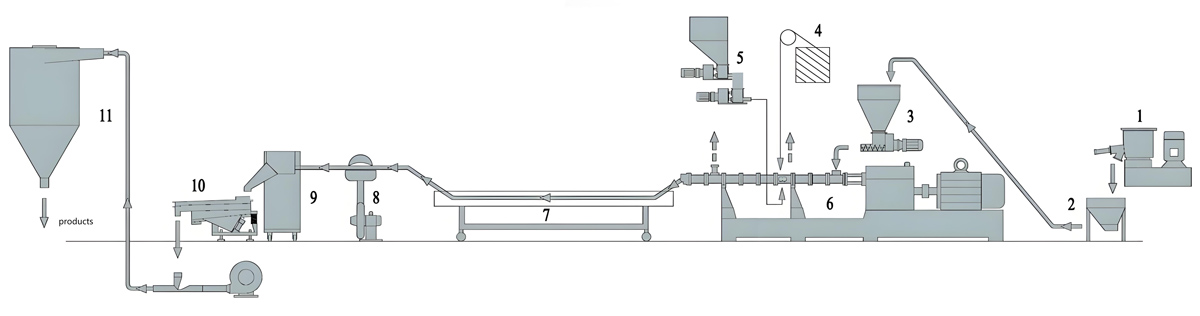
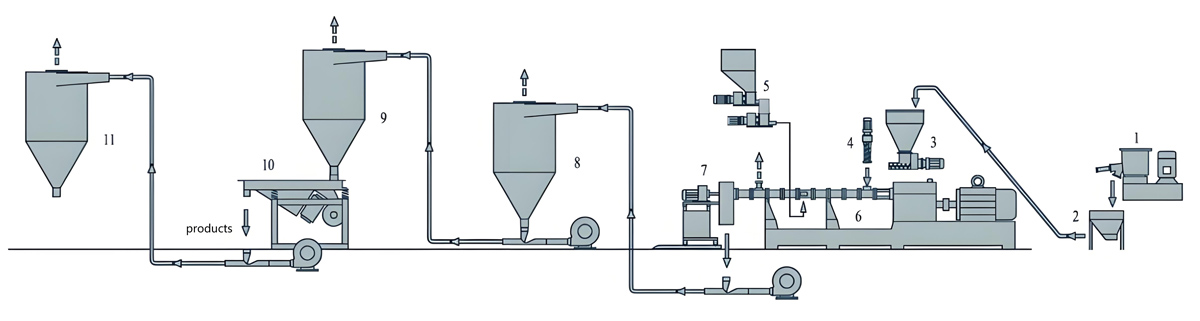
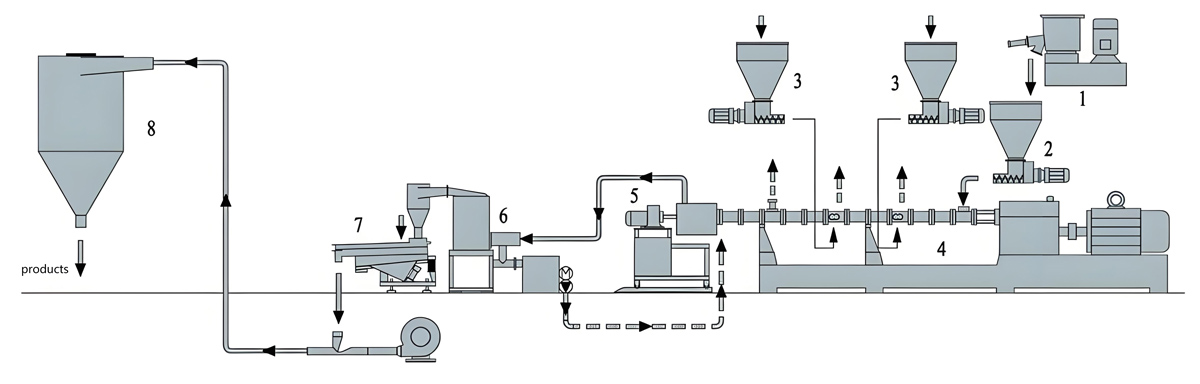
PLC controlled twin screw extruders for packaging grade masterbatch production incorporate advanced automation features designed to maximize efficiency, ensure consistent quality, and support high-volume production requirements.
KTE Series PLC controlled twin screw extruders from Nanjing Kerke Extruder Equipment Company provide comprehensive automation capabilities specifically optimized for packaging grade applications. The PLC system integrates control of all extruder functions including temperature control, drive system, feeding systems, pelletizing, and auxiliary equipment. This integration enables coordinated operation of all systems and automatic compensation for interactions between process variables. The co-rotating twin screw configuration provides excellent mixing characteristics essential for achieving uniform color and additive distribution in packaging masterbatches. High throughput capabilities up to 3000 kg per hour support the high-volume requirements of packaging applications.
PLC system architecture uses programmable logic controllers with human machine interface for operator interaction and system monitoring. The PLC provides real-time control loops for temperature, speed, feeding, and other process parameters. Distributed input-output modules provide connectivity to sensors, actuators, and field devices throughout the production line. Communication protocols enable integration with plant-level systems for production scheduling, data collection, and enterprise resource planning. The PLC system includes redundancy and safety features ensuring reliable operation and protection for personnel and equipment.
Human machine interface provides intuitive operator control and monitoring capabilities. Touch screen displays with graphical process visualization show current operating conditions, parameter trends, alarm status, and production data. Operators can adjust process parameters, select production recipes, and control equipment functions through the interface. The interface supports multiple user access levels with appropriate security for different operational roles. Historical data display and trend analysis enable operators to identify performance trends and optimize process parameters. Remote access capabilities enable monitoring and control from off-site locations for technical support and operational oversight.
Temperature control system integrated with PLC provides precise thermal management. Multi-zone electric heating with individual zone control typically includes 8 to 12 zones along barrel length plus die zone heating. Heating capacity ranges from 5 to 15 kW per zone depending on barrel size and processing requirements. Cooling systems incorporate both air and water cooling with PLC-controlled valves for responsive temperature regulation. Temperature sensors provide feedback to PLC control loops with accuracy better than plus or minus0.5 degree Celsius. Advanced control algorithms including cascade control and feedforward compensation optimize temperature response and minimize deviation from setpoints.
Drive system with PLC integration provides precise speed control and performance monitoring. AC vector drives with high-efficiency motors provide 15 to 30 percent energy savings compared to older DC drive technology. Drive power ranges from 50 to 800 kW depending on extruder size and throughput requirements. Speed control provides adjustment from 10 to 100 percent of maximum speed with accuracy better than 0.1 percent of setpoint. The PLC monitors motor current, torque, and power consumption providing performance data for optimization and predictive maintenance. Drive system controls including acceleration and deceleration ramps, torque limits, and protection functions are managed through the PLC.
Feeding system integration with PLC ensures accurate material delivery and formulation control. Gravimetric feeding systems provide continuous weight-based feeding with PLC communication for real-time monitoring and control. Feeders typically include load cells with weighing accuracy of 0.1 percent of setpoint ensuring precise formulation ratios. The PLC monitors actual feed rates and compares to setpoints, automatically adjusting feeder speed to maintain target rates. Multiple feeder systems for different components enable independent control of each formulation ingredient. Feed rate data logging provides formulation verification and traceability support for quality management systems.
Data logging and storage capabilities support quality management and process optimization. The PLC continuously logs process data including temperatures, pressures, speeds, feed rates, and quality measurements. Historical data storage for months or years enables trend analysis, performance comparison, and root cause analysis. Data export capabilities enable analysis using statistical software and reporting systems. Batch records linking production data to production lots provide traceability essential for packaging applications with regulatory requirements. Data backup and recovery features ensure data integrity and loss prevention.
Parameter Settings
Optimal parameter settings depend on specific formulation, carrier polymer, and production requirements. PLC controlled extruders enable precise parameter control with recipe storage for quick changeovers and consistent operation.
Temperature profile settings vary based on carrier polymer and additive loading. For polyethylene-based color masterbatch with 10 percent pigment loading, typical PLC recipe settings include feed zone at 160 to 180 degrees Celsius, melting zone at 180 to 200 degrees Celsius, mixing zone at 190 to 210 degrees Celsius, and die zone at 190 to 210 degrees Celsius. For polypropylene-based masterbatch with 10 percent loading, settings include feed zone at 180 to 200 degrees Celsius, melting zone at 200 to 220 degrees Celsius, mixing zone at 210 to 230 degrees Celsius, and die zone at 210 to 230 degrees Celsius. Higher pigment loadings may require slightly increased temperatures in mixing zone to maintain appropriate viscosity. Additive masterbatches with high loading may require lower temperatures to prevent additive degradation.
Screw speed settings in PLC recipes are optimized for throughput and mixing balance. For medium-loading color masterbatch with 8 to 12 percent pigment, typical screw speed settings range from 150 to 250 rpm depending on extruder size. For high-loading color masterbatch with 15 to 20 percent pigment, speeds of 100 to 200 rpm provide better mixing at expense of throughput. For low-loading additive masterbatch with 5 percent or less loading, speeds of 200 to 300 rpm maximize throughput while providing adequate mixing. The PLC can automatically adjust screw speed to maintain constant throughput when material characteristics change.
Feeder rate settings in PLC recipes ensure accurate formulation ratios. Gravimetric feeders are set to deliver materials at rates corresponding to formulation percentages and target throughput. For a 1000 kg per hour production rate with 10 percent pigment loading, carrier polymer feeder would be set to 900 kg per hour and pigment feeder to 100 kg per hour. Dispersant feeders would be set according to formulation typically 10 to 30 kg per hour. The PLC monitors actual feed rates and automatically adjusts feeder speeds to maintain targets. Feeder rate tolerance in PLC control is typically plus or minus0.5 percent of setpoint ensuring formulation accuracy.
Vent settings in PLC control manage volatile removal and foam control. First vent typically positioned after melting zone at 50 to 60 percent of barrel length. Vent temperature setting in PLC is typically 20 to 30 degrees Celsius above melt temperature to prevent condensation. Vent vacuum level can be controlled from atmospheric to 500 mm Hg absolute depending on requirements. The PLC monitors vent pressure and automatically adjusts vacuum pumps to maintain setpoint. Vent filter status monitoring alerts operators when filters require cleaning or replacement.
Die settings in PLC ensure consistent strand formation and pellet quality. Die temperature setpoint in PLC is typically 5 to 10 degrees Celsius above final zone temperature ensuring smooth flow through die. Die pressure setpoint range of 50 to 150 bar ensures consistent strand formation. The PLC monitors die pressure and can automatically adjust pump speed or take-away speed to maintain pressure within range. Strand speed control through take-away rollers ensures consistent tension for uniform pellet cutting. Strand diameter monitoring through vision systems can provide feedback for automatic adjustment.
Pelletizer settings controlled through PLC ensure consistent pellet size and quality. Knife speed setpoint determines pellet length with higher speeds producing shorter pellets. The PLC can automatically adjust knife speed to maintain target pellet length based on vision system measurements. Strand speed setpoint must be coordinated with knife speed to achieve desired pellet dimensions. Knife sharpening schedule tracked by PLC alerts operators when knives require maintenance for consistent cutting quality. Pelletizer clearance settings monitored through position sensors ensure proper knife to die alignment.
Equipment Pricing
Equipment investment for PLC controlled twin screw extruder systems varies based on automation level, production capacity, and specific features required for packaging grade masterbatch production.
KTE Series PLC controlled twin screw extruder base machine pricing depends on screw diameter and automation level. Models with 65 mm screw diameter and advanced PLC automation typically range from USD 90,000 to USD 120,000. Models with 90 mm screw diameter and comprehensive automation range from USD 140,000 to USD 180,000. Models with 110 mm screw diameter and high-level automation typically range from USD 200,000 to USD 280,000. Large capacity models with 130 to 150 mm screw diameter range from USD 300,000 to USD 450,000 depending on automation complexity and production capacity requirements.
PLC system and automation features significantly affect total investment. Basic PLC systems with temperature control and drive integration typically add USD 15,000 to USD 25,000 to base machine cost. Advanced PLC systems with recipe management, data logging, and HMI interfaces add USD 25,000 to USD 45,000. High-level automation including real-time quality monitoring, automatic parameter adjustment, and plant-level integration add USD 40,000 to USD 70,000. The automation level should be selected based on production complexity, quality requirements, and operational efficiency targets.
Feeding systems with PLC integration add to total investment. Gravimetric feeding systems for two to four components typically cost USD 12,000 to USD 35,000 depending on capacity and accuracy requirements. Loss-in-weight feeders with PLC communication provide highest accuracy but represent higher investment. Volumetric feeders with PLC integration offer lower cost but reduced accuracy. Feeding system selection should balance formulation complexity, accuracy requirements, and cost considerations for packaging masterbatch production.
Pelletizing systems with PLC control vary based on pelletizing method and capacity. Strand pelletizing systems with PLC integration typically cost USD 20,000 to USD 45,000 including water bath, strand handling, and pelletizer. Water ring pelletizing systems providing higher quality pellets typically cost USD 30,000 to USD 60,000. Underwater pelletizing systems providing highest quality pellets cost USD 50,000 to USD 90,000. Automated bagging systems integrated with PLC control add USD 15,000 to USD 35,000. Pelletizing system selection should balance quality requirements, production capacity, and operational complexity.
Complete system costs including extruder, PLC automation, feeding, pelletizing, and necessary ancillary equipment typically range from USD 150,000 to USD 600,000 for packaging grade masterbatch production. Medium capacity systems with 65 to 90 mm extruders and moderate automation typically range from USD 180,000 to USD 320,000. High-capacity systems with 110 to 150 mm extruders and comprehensive automation typically range from USD 350,000 to USD 650,000. Additional costs for installation, training, and system integration typically add 10 to 20 percent to equipment costs. Operational savings from automation including reduced labor costs, improved consistency, and reduced scrap typically provide return on investment within 1 to 3 years depending on production volume and automation level.
Production Problems and Solutions
Packaging grade masterbatch production may encounter various problems affecting quality, yield, or production efficiency. PLC controlled systems provide monitoring and control capabilities that help prevent and resolve many production problems.
Color inconsistency between production batches represents significant problem for packaging applications where color consistency is critical. This problem manifests as noticeable color differences between different production runs of the same formulation despite using the same recipe. Root causes may include material batch variations, parameter deviations, equipment drift, or environmental factors affecting material properties. Color inconsistency can cause customer complaints, rework requirements, and material waste.
Solutions for color inconsistency start with implementing comprehensive material quality control with incoming material testing to ensure material consistency. PLC systems with batch tracking capabilities link material lot numbers to production batches enabling traceability when problems occur. Tight parameter control using PLC recipe management with tolerance limits for critical parameters ensures consistent processing conditions. Statistical process control integrated with PLC monitoring identifies parameter trends before they cause color variation. Regular calibration of temperature sensors, feeders, and other measurement devices maintains measurement accuracy. For persistent color problems, reformulation with improved dispersant systems or alternative pigment sources may provide better consistency. Avoiding color inconsistency requires comprehensive quality management system, PLC recipe management with tight parameter control, regular calibration, and material supplier management ensuring consistent material quality.
Pellet size variation affects downstream processing and material flow characteristics in packaging applications. This problem occurs when pelletizing system produces pellets with inconsistent size or shape. Root causes may include die wear, knife wear, inconsistent strand formation, or parameter variations. Pellet size variation can cause feeding problems in downstream extrusion and injection molding processes affecting final product quality consistency.
Solutions for pellet size variation include PLC monitoring of critical pelletizing parameters including knife speed, strand speed, die pressure, and water temperature. Automated vision systems integrated with PLC control provide real-time pellet size measurement and automatic adjustment feedback. Regular die inspection and replacement based on usage hours or wear measurement prevents die-related problems. Knife sharpening or replacement schedules tracked by PLC ensure knives remain sharp for consistent cutting. Optimizing water bath temperature and flow maintains consistent strand cooling preventing deformation. PLC-controlled automatic adjustment of take-away speed maintains consistent strand tension for uniform pellet formation. Avoiding pellet size variation requires PLC monitoring with automatic adjustment capabilities, regular maintenance schedules based on actual usage and condition, and operator training to recognize and respond to pellet quality problems promptly.
Production rate variations affect production planning and efficiency in high-volume packaging masterbatch production. This problem occurs when actual throughput differs from target production rate despite using consistent settings. Root causes may include material property variations, feeding problems, equipment performance drift, or parameter settings not optimized for current material batch. Production rate variations can cause delivery delays, inventory fluctuations, and inefficient resource utilization.
Solutions for production rate variations include PLC-based throughput monitoring with real-time display of actual versus target production rates. Automatic feed rate adjustment based on material consumption measurements ensures consistent formulation while achieving target throughput. Material property testing before production identifies variations requiring parameter adjustment. PLC systems with automatic parameter adjustment based on material characteristics can compensate for minor material variations. Regular equipment maintenance ensures consistent performance reducing production rate drift. Optimization of parameter settings for specific material batches ensures efficient operation. Avoiding production rate variations requires PLC monitoring with automatic adjustment capabilities, material quality control, regular maintenance, and parameter optimization procedures adjusting settings based on material characteristics.
Dispersion problems manifest as streaks, specks, or inconsistent color development in finished masterbatch. This problem indicates inadequate mixing or pigment agglomeration during processing. Root causes may include insufficient mixing energy, inappropriate screw configuration, excessive throughput, or material incompatibility. Dispersion problems cause quality failures requiring rework or disposal and can cause processing problems in downstream applications.
Solutions for dispersion problems include PLC monitoring of mixing-related parameters including screw speed, motor load, and melt pressure. Motor load trends indicate changes in mixing requirements potentially signaling dispersion problems. Parameter optimization through PLC recipes ensures appropriate mixing conditions for each formulation. Screw configuration optimization based on specific formulation requirements ensures adequate mixing characteristics. Reducing throughput increases residence time and mixing energy improving dispersion. Temperature profile adjustments optimizing material flow and viscosity can improve mixing effectiveness. Avoiding dispersion problems requires proper screw configuration selection, PLC recipe management with appropriate parameter settings for each formulation, regular monitoring of mixing indicators, and parameter adjustment based on formulation characteristics.
Equipment downtime affects production efficiency and delivery reliability critical for packaging industry just-in-time requirements. Downtime causes include equipment failures, maintenance requirements, and material-related problems causing process upsets. Unplanned downtime can cause production delays, customer delivery failures, and increased production costs.
Solutions for reducing downtime include PLC-based predictive maintenance technologies monitoring equipment conditions including vibration, temperature, and load to predict failures before they occur. Automated alarms in PLC systems alert operators to developing problems before they cause downtime. Condition-based maintenance schedules triggered by actual equipment condition rather than fixed intervals optimize maintenance timing. Quick-change features on critical components reduce maintenance downtime when repairs are required. Spare parts inventory based on PLC-monitored equipment usage ensures parts availability when needed. Redundancy in critical systems including backup pumps, drives, and sensors reduces impact of individual component failures. Avoiding downtime requires predictive maintenance, adequate spare parts inventory, quick-change features, and comprehensive operator training for efficient problem response.
Maintenance and Care
PLC controlled twin screw extruders require comprehensive maintenance programs addressing both mechanical components and automation systems. Regular maintenance ensures consistent performance, extends equipment service life, and maximizes return on automation investment.
Daily maintenance tasks performed during normal operation focus on monitoring and basic inspection. Operators should monitor PLC HMI displays for alarms, parameter trends, and abnormal conditions. Temperature readings should be checked for consistency across zones and with recipes. Feeder performance should be monitored for accuracy and consistency. Pelletizing operation should be observed for consistent pellet formation. Daily maintenance logs should record all observations, parameter readings, and any corrective actions taken. PLC data logging automatically records many parameters but operator observations remain important for detecting problems not captured by sensors.
Weekly maintenance tasks include more detailed inspection and calibration verification. Temperature sensor calibration should be verified using reference thermometers comparing actual temperature to PLC display values. Feeder calibration verification using known weight samples confirms feeding accuracy within specified tolerances. Die and knife visual inspection checks for wear affecting pellet quality. Electrical systems should be inspected for loose connections, proper ground connections, and adequate ventilation. PLC system health check should verify proper operation of control loops, alarms, and data logging. Weekly maintenance provides opportunity to catch developing problems before they cause downtime.
Monthly maintenance tasks address more comprehensive inspection and preventive maintenance. Drive system inspection includes checking motor bearings for wear, coupling condition, drive belt or gearbox operation. Temperature control system inspection includes checking heating element continuity, cooling system operation, and valve operation. Feeding system maintenance includes cleaning feeder components, checking flow aids, and verifying proper operation of feeding mechanisms. Pelletizing system maintenance includes checking knife sharpness, die condition, and proper operation of cutting mechanism. PLC system maintenance includes backing up program files, verifying data storage, and checking communication network integrity. Monthly maintenance helps prevent problems and ensures continued reliable operation.
Semi-annual maintenance tasks involve more extensive maintenance requiring production downtime. Screw and barrel inspection includes examining wear patterns, measuring screw diameter, and checking barrel condition. Drive system overhaul may include motor bearing replacement, gearbox oil change, and drive component inspection. Electrical system testing includes thermal imaging, insulation resistance testing, and protective device testing. Heating elements should be tested for proper operation and continuity. Control system review includes software updates, verification of alarm setpoints, and validation of control loop tuning. Semi-annual maintenance provides opportunity for thorough cleaning and deep inspection not possible during routine operation.
Annual maintenance tasks represent comprehensive service requiring significant planning and possibly vendor support. Complete screw and barrel inspection determines if reconditioning or replacement is needed based on wear assessment and remaining service life prediction. Drive system overhaul including complete bearing replacement, gearbox rebuild, and motor testing ensures long-term reliability. Control system review includes software audit, verification of backup procedures, and assessment of system performance against original specifications. Complete system cleaning including removal and cleaning of screw and barrel provides opportunity to assess condition and cleaning effectiveness. Annual maintenance supports continued reliable operation and supports validation requirements for packaging applications with regulatory oversight.
PLC and automation system maintenance requires specialized procedures distinct from mechanical maintenance. PLC programs should be backed up regularly and stored securely in off-site locations. HMI screens and graphic displays should be updated to reflect process changes. Communication networks should be tested for proper operation and adequate bandwidth. Security measures should be reviewed and updated to protect against unauthorized access and cyber threats. Software updates from PLC vendors should be evaluated and implemented as appropriate. Automation system maintenance should be performed by qualified personnel with understanding of both automation technology and process requirements.
FAQ
Q: What are the key advantages of PLC controlled twin screw extruders for packaging grade masterbatch production?
A: PLC controlled extruders provide precise process control ensuring consistent masterbatch quality critical for packaging applications. Automated parameter adjustment and recipe management enable quick changeovers between different formulations supporting multi-product production. Data logging and traceability support quality management systems essential for food packaging applications. Real-time monitoring and alarms prevent quality problems before they affect finished product. Automated operation reduces labor requirements and human error. Production optimization through PLC control improves efficiency and reduces cost per kilogram. KTE Series PLC controlled extruders provide comprehensive automation specifically designed for packaging masterbatch applications.
Q: How does PLC control improve consistency in packaging grade masterbatch production?
A: PLC systems maintain process parameters within tight tolerance ranges ensuring consistent thermal history, mixing conditions, and material throughput. Recipe management stores optimal parameter sets for each formulation enabling consistent reproduction. Automatic parameter adjustment compensates for minor variations in material properties and environmental conditions. Real-time monitoring detects deviations from setpoints enabling immediate correction before quality is affected. Data logging provides traceability linking production parameters to specific batches supporting quality investigation when problems occur. Statistical process control capabilities identify trends indicating developing problems before they cause quality failures.
Q: What type of PLC system is recommended for packaging grade masterbatch production?
A: Packaging masterbatch production benefits from PLC systems with comprehensive capabilities including temperature control, drive integration, feeding control, and data logging. Systems should support recipe management for multiple formulations and quick changeovers. Human machine interface should provide clear process visualization and intuitive operator control. Communication capabilities for plant-level integration support production planning and data collection. Redundancy and security features ensure reliable operation and protection against unauthorized access. KTE Series extruders use industrial-grade PLC systems specifically selected for packaging industry requirements including reliability, performance, and integration capabilities.
Q: How often should recipes be updated for packaging grade masterbatch production?
A: Recipes should be updated whenever material formulations change, new materials are introduced, or process optimization identifies improved parameter settings. Regular recipe review every 6 to 12 months ensures recipes reflect current best practices and material characteristics. Recipe version control should be maintained to track changes and enable rollback if problems occur. Recipe testing on pilot or small-scale production before full implementation reduces risk of problems. Recipe changes should be documented with justification and approved through appropriate change control procedures especially for packaging applications with regulatory requirements.
Q: What data should be logged for packaging grade masterbatch production?
A: Critical data for packaging masterbatch includes temperature profiles across all zones, screw speed and motor load, feeder rates for all components, die pressure, pelletizing parameters, and production rate. Quality data including color measurements, pellet size distribution, and lab test results should be linked to production batches. Material lot numbers linking raw materials to production batches support traceability. Operator actions and parameter changes should be logged for complete production history. Data retention periods should consider regulatory requirements and business needs with typical retention of 1 to 5 years. Data analysis capabilities enable performance optimization and root cause investigation.
Q: How can PLC control reduce production costs in packaging grade masterbatch production?
A: Automated control reduces labor requirements for operation and monitoring. Consistent quality reduces scrap and rework costs. Production optimization reduces energy consumption and improves throughput. Predictive maintenance enabled by PLC monitoring reduces unplanned downtime and repair costs. Quick changeovers increase effective production time and reduce transition costs. Data analysis identifies optimization opportunities for continuous improvement. Overall, PLC automation typically provides 10 to 25 percent reduction in production costs compared to manual operation depending on automation level and production volume.
Q: What safety considerations are important for PLC controlled twin screw extruders?
A: Important safety considerations include emergency stop functionality accessible from multiple locations, safety interlocks preventing access to moving parts during operation, overcurrent and overload protection for drive systems, temperature alarms and interlocks preventing thermal runaway, and proper grounding and electrical safety. PLC systems should include safety-rated components where required by regulations. Security measures prevent unauthorized parameter changes that could create unsafe conditions. Safety training for operators should cover both general equipment hazards and PLC-specific risks including automatic operation. Regular safety system testing ensures continued proper operation.
Q: How does PLC control support multi-product production in packaging grade masterbatch manufacturing?
A: Recipe management enables storage of parameter sets for multiple formulations enabling quick switchovers. Automated temperature ramping during changeovers reduces transition time and material waste. Formulation tracking ensures correct materials are used for each product. Production scheduling integration optimizes changeover timing based on order requirements. Quality monitoring ensures product quality before switching to next formulation. Data logging provides traceability for each product batch. Overall, PLC automation reduces changeover time by 30 to 60 percent compared to manual control enabling efficient multi-product production.
Q: What training is required for operators of PLC controlled twin screw extruders?
A: Operators need training covering basic extrusion principles, PLC system operation, recipe management, HMI navigation, alarm response, quality monitoring, and emergency procedures. Training should include both classroom instruction and hands-on operation practice. Refresher training should be provided periodically especially when system updates or changes occur. Operators should understand both how to operate the system and how to interpret data provided by the system. Training for troubleshooting and problem response enables operators to resolve minor issues without technician support. KTE provides comprehensive training programs for PLC-controlled extruder operation.
Q: How can PLC systems support quality improvement in packaging grade masterbatch production?
A: Statistical process control capabilities identify parameter trends indicating quality drift before failures occur. Real-time quality monitoring enables immediate response to quality problems. Data logging enables correlation of process parameters with quality results identifying optimal conditions. Automated parameter adjustment maintains conditions within optimal ranges. Comparative analysis of historical data identifies improvement opportunities. Continuous improvement cycles benefit from data-driven decision making enabled by PLC systems. Overall, PLC automation typically improves first-pass yield by 5 to 15 percent and reduces quality variation by 20 to 40 percent depending on implementation level.
Conclusion
PLC controlled twin screw extruders provide essential capabilities for modern packaging grade masterbatch production enabling high-volume operation with consistent quality and efficient production. The precise process control, automation capabilities, and data management features of modern PLC systems address the demanding requirements of packaging industry applications where quality consistency, production efficiency, and reliable delivery are critical. KTE Series PLC controlled twin screw extruders from Nanjing Kerke Extruder Equipment Company offer comprehensive automation specifically optimized for packaging masterbatch production.
Successful implementation of PLC controlled extrusion for packaging masterbatch requires careful consideration of automation level, production requirements, and quality needs. Appropriate PLC system selection balances capability requirements with investment considerations. Recipe development and optimization ensures parameter sets are optimized for each formulation. Integration with plant systems enables data flow for production planning and quality management. Training for operators and maintenance personnel ensures effective use of automation capabilities.
The investment in PLC automation provides significant returns through improved quality consistency, reduced labor costs, higher throughput, lower scrap rates, and enhanced production flexibility. Data logging and traceability support quality management systems essential for food packaging and other regulated applications. Predictive maintenance capabilities reduce unplanned downtime and extend equipment life. Overall, PLC controlled extrusion enables packaging masterbatch producers to meet the demanding quality and delivery requirements of modern packaging industry while maintaining competitive production costs.