Introduction
Polyhydroxyalkanoates PHA and polyhydroxybutyrate PHB represent promising biodegradable polymers derived from renewable resources. The production of PHA/PHB blend masterbatch demands precise process control and advanced monitoring capabilities to ensure consistent quality. PLC touch screen twin screw extruders provide the sophisticated automation required for these sensitive biopolymers which require careful temperature management and gentle processing conditions to maintain their unique properties.
The growing market for compostable packaging materials has increased demand for PHA/PHB blend masterbatches with enhanced performance characteristics. Modern extrusion equipment with PLC control systems enables manufacturers to achieve repeatable results while minimizing material waste and energy consumption. Touch screen interfaces simplify operation and provide real-time process monitoring essential for maintaining product consistency in biopolymer production.
Formulation Ratios for PHA/PHB Blend Masterbatch
PHA/PHB blend formulations vary based on the desired balance of mechanical properties biodegradation rates and processing characteristics. Different PHA types and PHB ratios require specific formulation adjustments to achieve optimal performance for various applications.
Pure PHB Masterbatch
Pure PHB formulations typically consist of 85-95 percent PHB polymer with 5-15 percent additives. Additives include plasticizers processing aids nucleating agents and stabilizers to improve processing characteristics and final product properties. The high crystallinity of PHB requires careful formulation to control brittleness while maintaining biodegradability. PLC-controlled extruders ensure precise temperature management to prevent thermal degradation during processing.
PHA/PHB 75/25 Blend
This blend ratio balances the stiffness of PHB with the flexibility of PHA. Formulations typically contain 70-80 percent PHB and 20-30 percent PHA with 5-10 percent total additives. The blend exhibits improved impact strength compared to pure PHB while maintaining good barrier properties. Processing temperatures must be optimized to accommodate the different thermal behaviors of both polymers. Touch screen control systems enable fine-tuning of temperature profiles for consistent blend quality.
PHA/PHB 50/50 Blend
Equal ratio formulations provide balanced mechanical properties suitable for flexible packaging applications. The blend composition includes 45-55 percent each of PHB and PHA with 5-10 percent additives. This formulation requires thorough mixing to ensure homogeneous distribution of both polymers. The PLC control system maintains precise screw speeds and temperature gradients to achieve optimal blend morphology without phase separation.
PHA/PHB 25/75 Blend
This formulation emphasizes PHA characteristics while retaining some PHB stiffness. Typical composition includes 20-30 percent PHB and 70-80 percent PHA with 5-10 percent additives. The blend offers improved flexibility and reduced brittleness compared to higher PHB content formulations. Touch screen monitoring enables detection of processing variations that could affect blend homogeneity.
Pure PHA Masterbatch
Pure PHA formulations contain 90-98 percent PHA with 2-10 percent additives. Various PHA types including PHBV PHBH and P3HB4HB can be processed depending on desired properties. Additives include nucleating agents slip agents and biodegradable plasticizers. The PLC control system manages the precise thermal profile required for different PHA types which have varying melting characteristics.
Production Process
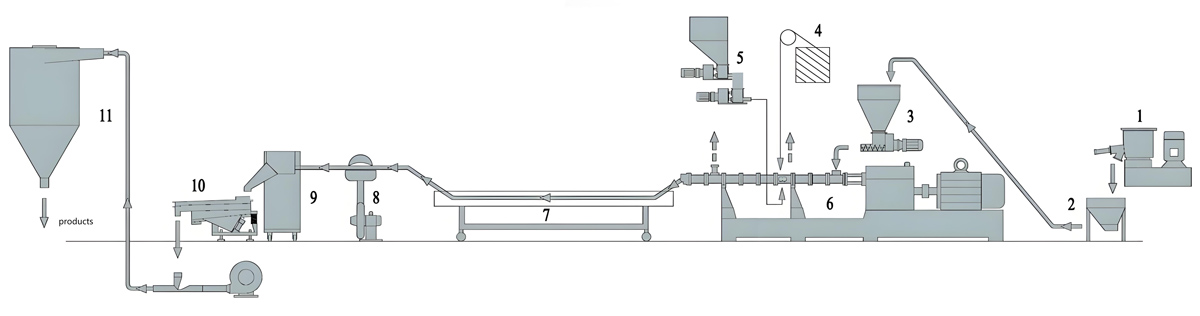
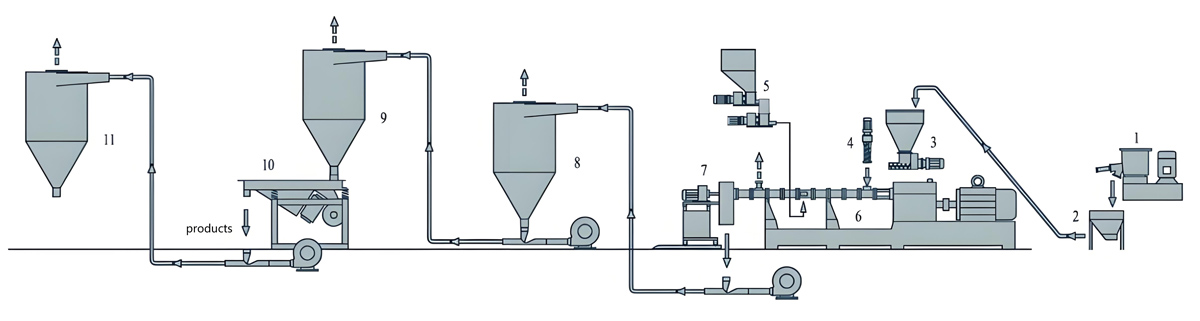
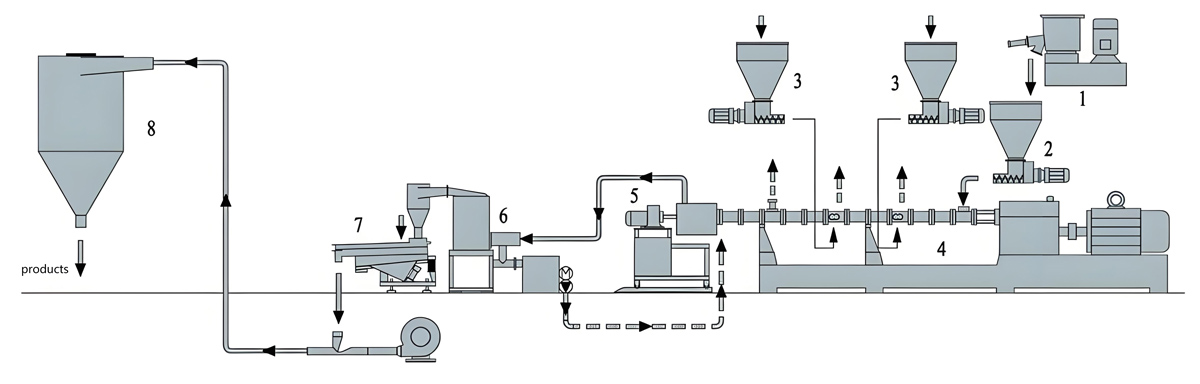
The PHA/PHB blend masterbatch production process involves multiple carefully controlled stages to ensure proper mixing and minimal polymer degradation. PLC control systems coordinate all process parameters for consistent quality output.
Material Drying
PHA and PHB are hygroscopic materials requiring thorough drying before processing. Drying conditions typically involve 60-80°C for 4-8 hours to reduce moisture content below 0.1 percent. The PLC system monitors dryer temperature and humidity to ensure consistent material preparation. Inadequate drying leads to hydrolytic degradation during extrusion causing molecular weight reduction and property loss. Touch screen displays show real-time moisture content readings.
Feeding Stage
Precise feeding is critical for maintaining blend ratios in masterbatch production. Gravimetric feeders deliver accurate quantities of each polymer component to the main hopper. The PLC system synchronizes feeder operation with screw speed to maintain consistent throughput. Additives are pre-mixed and fed through secondary feeders for accurate formulation control. Touch screen interfaces allow operators to adjust feed rates and monitor consumption in real time.
Compounding Zone
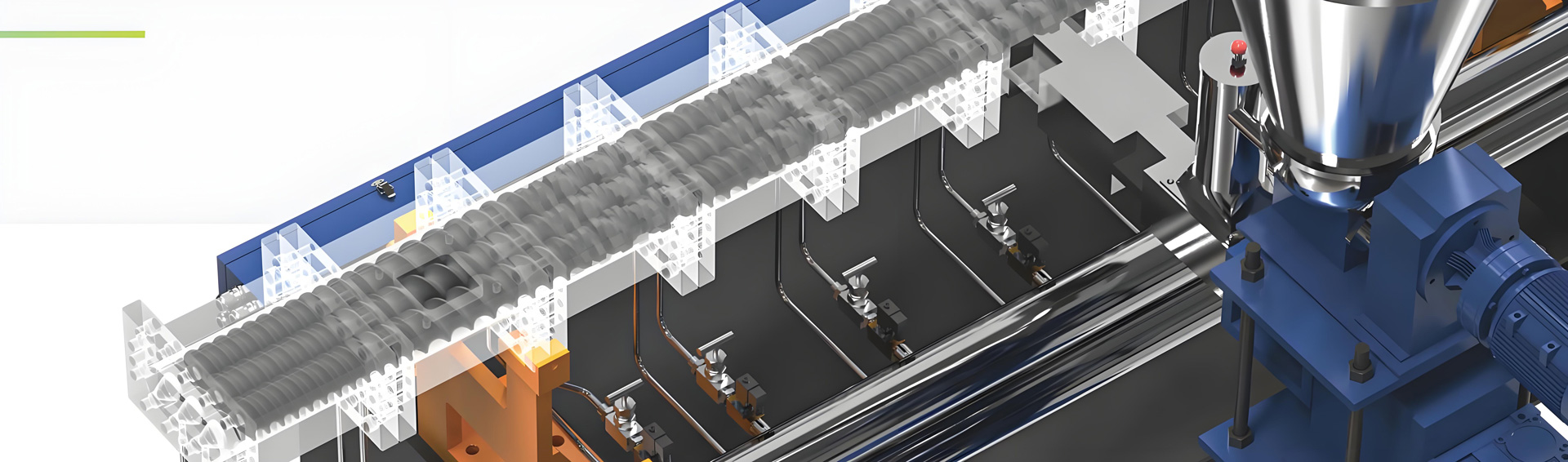
The compounding zone applies thermal and mechanical energy to melt and mix the polymers. Temperature progression typically starts at 130-140°C in the feed zone increasing to 160-180°C in the mixing zone. The PLC system maintains precise temperature control within plus or minus 1°C to prevent thermal degradation. Screw speed is adjusted between 150-300 RPM depending on formulation viscosity. Touch screen monitoring displays real-time melt temperature and pressure data.
Blending Zone
The blending zone ensures homogeneous distribution of PHA and PHB components throughout the masterbatch. Kneading blocks and mixing elements create intensive dispersive and distributive mixing. The PLC system adjusts screw speed based on torque readings to optimize mixing intensity. Residence time in this zone is controlled to achieve complete blend homogeneity without excessive thermal exposure. Touch screen displays show real-time energy consumption indicating mixing efficiency.
Additive Incorporation
Additives are injected downstream through liquid or solid feeders controlled by the PLC system. The location of additive injection is carefully selected to optimize dispersion while minimizing degradation. The touch screen interface allows operators to set injection rates and monitor flow accuracy. Some additives such as thermal stabilizers are added early while others like slip agents are added later in the process.
Degassing Zone
The degassing zone removes any residual moisture or volatile components from the melt. Vacuum vents maintain pressures between 10-50 mbar to extract volatiles without polymer loss. The PLC system controls vacuum pump operation and monitors vent pressure. Counter rotating screw configurations provide sufficient residence time for effective devolarization. Touch screen displays show vacuum levels and alert operators to any vent blockage issues.
Pelletizing
The extruded strand is cooled through water baths or air cooling systems before pelletizing. Water temperature is maintained at 15-25°C to ensure rapid cooling without thermal shock. Strand diameter is monitored and controlled through die design and take-up speed. The PLC system coordinates pelletizer speed with extrusion rate to maintain consistent pellet size. Touch screen displays show pellet count and reject rates.
Production Equipment Introduction
Modern PLC touch screen twin screw extruders feature advanced control systems specifically designed for biopolymer processing. The KTE Series from Kerke offers comprehensive automation capabilities for PHA/PHB blend masterbatch production.
PLC Control System
The PLC control system provides centralized management of all extrusion processes. Industrial PLC platforms ensure reliable operation with comprehensive safety interlocks. Modular architecture allows easy integration of additional sensors and actuators. The control system stores multiple recipe parameters for quick changeovers between formulations. Touch screen interfaces provide intuitive operation with customizable display layouts for different operator requirements.
Touch Screen Interface
High resolution touch screens enable easy monitoring and adjustment of process parameters. Color coded displays indicate status of temperature zones motors and auxiliary equipment. Trend graphs show historical data for temperature pressure and energy consumption. Alarm screens highlight deviations with suggested corrective actions. Remote monitoring capabilities allow supervision from multiple locations. The interface supports multiple languages for international operations.
Temperature Control
Precise temperature control is essential for PHA/PHB processing due to thermal sensitivity. Each barrel zone features independent PID control with plus or minus 0.5°C accuracy. Heating and cooling rates are programmable for optimized start-up and shutdown sequences. The PLC system implements temperature profiling to accommodate different formulations. Touch screen displays show setpoints actual values and heating element status for each zone.
Screw Speed Control
Variable frequency drives enable precise screw speed control across the operating range. The PLC system maintains screw speed within plus or minus 1 RPM of setpoint. Torque monitoring allows automatic speed adjustment to protect equipment from overload. Screw speed can be synchronized with feeder operation for optimal filling degree. Touch screen displays show real-time speed and torque data with trend tracking.
Feeder Integration
The PLC system integrates with gravimetric feeders for precise ingredient control. Loss-in-weight feeders continuously monitor material flow with automatic adjustment. The touch screen interface displays individual and cumulative feeder rates. Recipe management stores different formulation compositions for quick changeovers. Feeder calibration routines are accessible through the control system interface to ensure accuracy.
Vacuum System Control
Integrated vacuum systems provide automatic control of vent zone pressures. The PLC system adjusts vacuum pump operation based on pressure feedback. Condensers recover volatile components to reduce environmental emissions. Touch screen displays show vacuum levels pump status and maintenance requirements. Alarm conditions alert operators to vent blockage or pump malfunction. Automated cleaning cycles maintain vent port efficiency.
Data Logging and Traceability
Comprehensive data logging capabilities support quality control requirements. The PLC system records all process parameters with time stamps for batch traceability. Historical data can be exported for analysis and regulatory compliance. Touch screen interfaces provide access to production reports and statistical process control charts. Recipe version tracking ensures consistent production of specific formulations. Audit trail functionality documents all operator changes.
Parameter Settings
Optimal parameter settings vary based on specific PHA/PHB blend composition and production requirements. The PLC system enables precise control and repeatability of these parameters.
Temperature Profile
Barrel temperature profiles typically range from 130-140°C in the feed zone to 160-180°C in the mixing zone. Die temperatures are maintained at 150-165°C to prevent thermal degradation while ensuring proper flow. The PLC system implements ramping profiles during start-up and shutdown to minimize thermal shock. Temperature settings must account for the specific thermal properties of different PHA types. Touch screen displays allow operators to adjust zone temperatures individually or as a coordinated profile.
Screw Speed
Screw speeds between 150-300 RPM are typical for PHA/PHB blend processing depending on formulation viscosity. Higher speeds increase throughput but may reduce residence time affecting blend homogeneity. The PLC system automatically adjusts speed based on torque and pressure readings to maintain optimal operation. Variable speed control enables optimization of mixing intensity without excessive shear heating. Touch screen displays show real-time speed with adjustable limits for equipment protection.
Feed Rate
Feed rates are determined by desired production capacity and extruder specifications. Typical throughput ranges from 30-200 kg per hour depending on machine size and formulation. The PLC system synchronizes feeder rates with screw speed to maintain optimal filling degree. Gravimetric feeders provide accurate control of each component in the blend. Touch screen interfaces display individual and total feed rates with deviation alarms.
Vacuum Level
Vacuum levels in vent zones typically range from 10-50 mbar depending on formulation requirements. Lower pressures improve moisture removal but may cause polymer loss if too aggressive. The PLC system maintains vacuum within setpoint range with automatic pump control. Touch screen displays show real-time vacuum readings with trend tracking. Pressure transmitters provide feedback for precise control and alarm conditions.
Residence Time
Residence time typically ranges from 1-3 minutes depending on screw configuration and throughput requirements. Longer residence times improve blending but increase thermal exposure. The PLC system can estimate residence time based on throughput and barrel volume. Operators can adjust screw speed and feed rate to achieve optimal residence time. Touch screen displays show calculated residence time based on current operating conditions.
Back Pressure
Back pressure is controlled through die restriction to enhance mixing and devolarization. Typical settings range from 30-60 bar depending on formulation and die configuration. The PLC system monitors die pressure and adjusts breaker plates or choker bars as needed. Increased back pressure improves dispersion quality but may reduce throughput. Touch screen displays show real-time pressure with historical trend tracking.
Equipment Price
PLC touch screen twin screw extruder pricing varies based on configuration size and control system sophistication. Investment considerations include automation level production capacity and integration with auxiliary equipment.
Base Extruder Pricing
Entry-level PLC-controlled extruders with 30mm screw diameter start at approximately 55000 to 75000 US dollars. Mid-range models with 40-50mm screw diameter range from 100000 to 150000 US dollars including advanced PLC control systems. High capacity systems with 75mm or larger screw diameters exceed 250000 US dollars with comprehensive automation features. These prices typically include the extruder barrel screws basic control system and touch screen interface.
Control System Costs
Advanced PLC control systems with touch screen interfaces add 20000 to 40000 US dollars to the base extruder price. Features such as recipe management data logging and remote monitoring increase cost accordingly. Integration with gravimetric feeders and vacuum systems requires additional control hardware and programming costs. High performance PLC systems with redundant configurations for critical applications can add 50000 to 80000 US dollars to the total investment.
Gravimetric Feeding Systems
Precise feeding systems are essential for PHA/PHB blend masterbatch production. Individual loss-in-weight feeders cost 15000 to 25000 US dollars each. Complete feeding systems for multiple components including installation and PLC integration range from 50000 to 150000 US dollars. Touch screen integration for feeder monitoring and control requires additional programming costs. Feeder calibration and validation services add 3000 to 8000 US dollars to the investment.
Vacuum Degassing Systems
Integrated vacuum systems with condensation units cost between 25000 and 50000 US dollars. Advanced systems with multiple vent zones and automated cleaning capabilities range from 40000 to 70000 US dollars. PLC integration and touch screen monitoring require additional programming and hardware costs. Regular maintenance for vacuum pumps and condensers should be budgeted annually. Spare parts for critical vacuum components should be maintained on site.
Pelletizing Systems
Pelletizing equipment including strand cutters or water ring pelletizers ranges from 30000 to 70000 US dollars. Advanced systems with automatic cut length control and size sorting capabilities cost 50000 to 100000 US dollars. PLC integration with touch screen monitoring requires additional programming investment. Cooling systems including water baths and chillers add 15000 to 35000 US dollars to the total system cost.
Total Investment Considerations
A complete PHA/PHB blend masterbatch production line with PLC automation typically requires investment between 300000 and 700000 US dollars for medium capacity production. Large capacity fully automated systems may exceed 1500000 US dollars. The level of automation control system sophistication and production capacity are primary cost drivers. Financing options and leasing arrangements can help manage capital requirements while enabling access to advanced technology.
Production Problems and Solutions
PHA/PHB blend masterbatch production may encounter various processing challenges that affect product quality and consistency. Understanding these problems and implementing solutions ensures optimal equipment performance.
Polymer Degradation
Problem Analysis: Thermal degradation of PHA and PHB polymers results in molecular weight loss and impaired mechanical properties. Symptoms include yellowing of product reduced melt strength and increased brittleness. Causes include excessive barrel temperatures prolonged residence time high shear rates or inadequate thermal stabilizers. The PLC control system must maintain precise thermal management to prevent degradation of these sensitive biopolymers.
Solutions: Reduce barrel temperatures to minimum required levels while maintaining proper melt viscosity. Implement temperature ramping profiles during start-up to avoid thermal shock. Increase feed rate to reduce residence time without compromising mixing. Add thermal stabilizers to the formulation compatible with end use requirements. Optimize screw configuration to minimize high shear zones. Use the PLC monitoring to detect early signs of degradation through torque and pressure changes.
Prevention Methods: Implement strict temperature control protocols with regular calibration of sensors. Establish maximum residence time limits for different formulations. Use polymer grades with appropriate thermal stability for intended processing conditions. Develop standard operating procedures based on PLC monitoring data for temperature and pressure. Conduct regular quality testing including molecular weight analysis to detect degradation early. Train operators to recognize symptoms of polymer degradation.
Blend Inhomogeneity
Problem Analysis: Inadequate mixing of PHA and PHB components results in inconsistent blend properties and poor product performance. Causes include insufficient mixing time inappropriate screw configuration or incompatible polymer viscosities. The PLC system must coordinate screw speed and feeding to achieve optimal blend morphology. Inhomogeneous blends may cause processing difficulties in downstream applications.
Solutions: Optimize screw configuration by adding kneading blocks and mixing elements in appropriate zones. Increase screw speed to enhance distributive mixing while monitoring for polymer degradation. Adjust temperature profile to reduce viscosity differences between blend components. Implement compatibilizers to improve interface adhesion between PHA and PHB phases. Use PLC monitoring to track energy consumption as an indicator of mixing efficiency.
Prevention Methods: Develop validated screw configurations for each blend ratio. Monitor blend homogeneity through analytical testing on a regular basis. Implement statistical process control based on PLC data to detect variations. Establish standard procedures for screw element assembly and replacement. Train operators on proper screw configuration for different formulations. Maintain detailed records of successful processing parameters for future reference.
Vent Port Blockage
Problem Analysis: Vent ports can become blocked by polymer carryover reducing moisture removal efficiency. This leads to excessive moisture content causing bubbles and reduced mechanical properties. Causes include excessive feed rate insufficient vent port diameter or material bridging in the vent zone. The PLC system monitors vacuum levels to detect blockage early.
Solutions: Increase vent port diameter or add multiple vent ports to improve capacity. Adjust feed rate to reduce material carryover into vent zones. Implement vent stuffer screws to prevent material blockage. Use atmospheric vents before vacuum vents to remove bulk material. Optimize vent zone temperature to prevent polymer solidification. Program PLC alarms to alert operators to vacuum level deviations indicating potential blockage.
Prevention Methods: Establish regular vent port cleaning schedules based on operating hours. Monitor vacuum levels continuously through PLC tracking and trend analysis. Implement automated vent cleaning systems for continuous operation. Design screw configuration to minimize material carryover into vent zones. Train operators to respond promptly to vacuum level alarms. Keep spare vent port components available for quick replacement.
Feeder Accuracy Issues
Problem Analysis: Inaccurate feeding results in formulation deviations affecting blend composition and product properties. Causes include feeder calibration errors material flow problems or PLC integration issues. Touch screen monitoring should display real-time feeder performance to detect accuracy problems. Inaccurate feeding is particularly critical for PHA/PHB blend ratios.
Solutions: Recalibrate feeders according to manufacturer procedures. Verify material flow characteristics and adjust feeder parameters accordingly. Check PLC integration and communication with feeder controllers. Implement regular feeder performance monitoring and validation routines. Replace worn feeder components such as screws and weigh cells. Use touch screen displays to track feeder accuracy and set alarm limits.
Prevention Methods: Establish scheduled calibration intervals for all feeders. Implement routine feeder maintenance including cleaning and inspection. Use gravimetric feeders with loss-in-weight control for highest accuracy. Maintain spare parts inventory for critical feeder components. Train operators on feeder operation and troubleshooting. Develop standard procedures for feeder changeover between different materials.
Moisture Content Variations
Problem Analysis: Inconsistent moisture content in finished masterbatch affects processing and final product properties. Causes include inadequate drying of raw materials insufficient devolarization or ambient humidity variations. The PLC system monitors dryer performance and vacuum levels to maintain consistent moisture control. Excessive moisture can cause hydrolysis during subsequent processing.
Solutions: Verify and adjust dryer performance to achieve consistent material moisture content. Increase vacuum level in vent zones to improve moisture removal. Add additional vent ports or increase vent zone length. Monitor ambient humidity and implement dehumidification if necessary. Use moisture sensors in the extruder for real-time monitoring. Adjust throughput to increase residence time in vent zones if needed.
Prevention Methods: Establish strict raw material moisture specifications and incoming inspection procedures. Implement regular moisture content testing of dried materials. Monitor dryer performance continuously through PLC tracking. Maintain vent system performance through regular maintenance. Train operators on moisture control procedures and the importance of consistent drying.
Maintenance and Care
Proper maintenance of PLC-controlled extrusion systems ensures reliable operation and extends equipment life. Touch screen interfaces provide maintenance reminders and diagnostic information to support preventive maintenance programs.
Daily Maintenance
Daily maintenance includes checking oil levels in gearboxes and lubrication points as indicated by PLC alarms. Inspect all temperature sensors for proper operation through touch screen diagnostic displays. Clean vent ports and strainers to prevent blockage. Monitor motor current and torque readings for any deviations from normal ranges. Verify cooling water flows and temperatures are within specifications. Document any unusual observations in the maintenance log.
Weekly Maintenance
Weekly maintenance involves inspecting screw and barrel surfaces for wear patterns visible through cleanout ports. Check all seals and gaskets for leaks that could affect performance. Test safety interlocks and emergency stop systems through touch screen diagnostic menus. Clean or replace air filters on control cabinets to maintain proper cooling. Verify accuracy of feeder calibrations through PLC testing routines. Inspect pelletizing equipment for wear and proper operation.
Monthly Maintenance
Monthly maintenance includes changing gearbox oil according to manufacturer recommendations and PLC maintenance schedules. Inspect heater bands and thermocouples for proper function through touch screen temperature verification. Check alignment of drive system components. Test all alarm and safety systems through PLC diagnostic routines. Review process logs and maintenance records to identify developing trends. Inspect die and adapter surfaces for wear or damage.
Quarterly Maintenance
Quarterly maintenance involves removing and inspecting screw elements for wear patterns and proper assembly. Measure screw and barrel dimensions to monitor wear rates using precision measurement tools. Inspect bearing seals and replace if necessary. Check motor and drive couplings for wear and alignment. Test emergency stop circuits and safety systems thoroughly through PLC safety testing routines. Review and update maintenance schedules based on equipment condition and operating history.
Annual Maintenance
Annual maintenance includes comprehensive inspection of all major components by qualified technicians. Replace worn parts according to manufacturer recommendations and maintenance history. Realign drive system if necessary to prevent premature wear. Test and calibrate all control systems through PLC diagnostic programs. Review and update maintenance procedures based on operating experience. Conduct thorough safety inspection and testing of all safety interlocks. Plan for any needed upgrades or modifications based on production requirements and technology advancements.
Control System Maintenance
Regular PLC and touch screen maintenance ensures reliable automation performance. Backup PLC programs and recipe data regularly to prevent loss. Update PLC firmware and touch screen software according to manufacturer recommendations. Test all input and output modules through diagnostic routines. Calibrate sensors and instruments according to established schedules. Clean touch screen displays with appropriate materials to maintain responsiveness. Review alarm history and adjust alarm setpoints as needed based on operating experience.
FAQ
What are the advantages of PLC control for PHA/PHB blend processing?
PLC control systems provide precise management of all process parameters critical for biopolymer processing. Automated temperature control maintains thermal profiles within tight tolerances preventing polymer degradation. Integrated feeder control ensures accurate blend ratios for consistent product quality. Real-time monitoring enables rapid detection and correction of processing variations. Recipe management allows quick changeovers between different formulations while maintaining consistency. Data logging supports quality control and regulatory compliance requirements.
How do I optimize the touch screen interface for my operation?
Touch screen interfaces can be customized to match specific operational requirements. Configure main screens to display the most critical process parameters for your production. Set up trend graphs to track variables that indicate product quality. Organize alarm screens to prioritize issues requiring immediate attention. Create recipe selection screens that simplify changeover procedures. Implement user access levels to protect critical settings while allowing operator adjustments for optimization. Regular training ensures operators can effectively use all interface features.
What is the typical moisture specification for PHA/PHB raw materials?
Raw material moisture content should typically be below 0.1 percent for PHA and PHB polymers before processing. Some specialty grades may require even lower moisture content down to 0.05 percent. Proper drying conditions involve 60-80°C for 4-8 hours depending on material form and initial moisture content. The PLC system monitors dryer performance and can integrate moisture sensors for real-time verification. Maintaining low moisture content prevents hydrolytic degradation during extrusion.
How can I improve the mechanical properties of PHA/PHB blend masterbatch?
Mechanical properties can be enhanced through several formulation and processing approaches. Adjust blend ratio to balance stiffness and toughness for your application. Add nucleating agents to control crystallinity and improve strength. Incorporate reinforcing fillers such as biodegradable fibers or nanoclay for strength enhancement. Optimize processing parameters to achieve complete blend homogeneity without degradation. Consider compatibilizers to improve interface adhesion between blend components. Use PLC monitoring to maintain consistent processing conditions that affect final properties.
What safety features are integrated into PLC-controlled extruders?
Modern PLC-controlled extruders include comprehensive safety systems for operator protection. Emergency stop buttons provide immediate shutdown capability from multiple locations. Safety interlocks prevent operation with guards open or cooling systems disabled. Pressure and temperature alarms alert operators to unsafe conditions. Automatic shutdown sequences protect equipment from overload conditions. Touch screen interfaces provide clear indication of alarm conditions with recommended actions. Safety circuits are designed to fail-safe to prevent unsafe operation.
How do I troubleshoot PLC communication errors with feeders?
PLC communication errors with feeders can be diagnosed through touch screen diagnostic screens. Check network connections and cable integrity for physical damage. Verify IP addresses and communication settings match both devices. Restart both PLC and feeder controllers to clear transient errors. Update firmware to latest versions to fix known communication issues. Consult communication logs through PLC diagnostic tools to identify error patterns. Contact technical support if persistent communication problems occur.
What is the recommended backup strategy for PLC programs and recipes?
Comprehensive backup strategies protect against data loss and enable quick recovery. Perform regular automatic backups of PLC programs and recipe data according to a defined schedule. Store backups in multiple locations including cloud storage for disaster recovery. Maintain version control to track changes and enable rollback if needed. Document all backup procedures and recovery processes. Test backup restoration periodically to verify data integrity. Assign responsibility for backup management to specific personnel with clear procedures.
How can I reduce energy consumption in PHA/PHB blend masterbatch production?
Energy efficiency can be improved through several equipment and process optimizations. Use variable frequency drives on all motors to match power consumption to actual demand. Implement barrel insulation to reduce heat loss and improve thermal efficiency. Optimize temperature profiles to minimize heating requirements while maintaining product quality. Recover waste heat from cooling systems when feasible. Monitor energy consumption through PLC tracking to identify optimization opportunities. Maintain equipment properly to ensure efficient operation and minimize energy waste.
Conclusion
PLC touch screen twin screw extruders provide the advanced automation and precise control required for PHA/PHB blend masterbatch production. The KTE Series from Kerke offers integrated solutions combining sophisticated control systems with robust mechanical design optimized for biopolymer processing. Touch screen interfaces simplify operation while providing comprehensive process monitoring and data logging capabilities essential for consistent quality production.
The growing market for compostable packaging materials continues to drive demand for PHA/PHB blend masterbatches with enhanced performance characteristics. Modern extrusion technology enables manufacturers to meet these demands efficiently while maintaining product consistency and minimizing material waste. Proper equipment selection parameter optimization and comprehensive maintenance programs ensure reliable operation and optimal productivity in biopolymer masterbatch manufacturing.