The global plastics industry is undergoing a significant transformation as manufacturers increasingly seek sustainable alternatives to traditional petroleum-based materials. Plant-based masterbatch has emerged as one of the most promising solutions, offering environmental benefits while maintaining excellent performance characteristics. The production of high-quality plant-based masterbatch requires precision equipment capable of handling bio-derived polymers and additives without compromising their beneficial properties. Stainless steel twin screw extruders have become the preferred choice for manufacturers entering this rapidly growing market segment. These machines provide the necessary combination of gentle processing, precise temperature control, and consistent mixing that plant-based formulations demand. This comprehensive guide explores every aspect of plant-based masterbatch production using stainless steel twin screw extrusion technology, from formulation development to equipment selection and operational best practices.
Introduction
Plant-based masterbatch represents a revolutionary approach to colorants and additives in the plastics industry. Unlike conventional masterbatch made from petroleum-derived polymers, plant-based masterbatch utilizes biodegradable polymers derived from renewable sources such as corn starch, sugarcane, cellulose, and other agricultural feedstocks. These materials offer compelling advantages including reduced carbon footprint, improved biodegradability, and alignment with circular economy principles. However, the production of plant-based masterbatch presents unique challenges that require specialized processing equipment and expertise.
The selection of appropriate production equipment significantly impacts the final quality of plant-based masterbatch. Stainless steel twin screw extruders have proven particularly effective for this application due to their superior corrosion resistance, excellent mixing capabilities, and precise temperature management. The co-rotating intermeshing screw design provides intensive mixing while maintaining relatively low shear forces that could damage sensitive bio-based polymers. Manufacturers investing in stainless steel twin screw extrusion technology position themselves to capture market opportunities in sustainable packaging, consumer goods, and industrial applications.
This article provides comprehensive technical guidance for manufacturers seeking to produce plant-based masterbatch using stainless steel twin screw extrusion equipment. The information presented addresses formulation considerations, production processes, equipment specifications, operational parameters, and troubleshooting guidance. By understanding these key factors, manufacturers can optimize their production operations and deliver high-quality plant-based masterbatch products to an environmentally conscious market.
Formulation Ratios for Plant-Based Masterbatch
Basic Formulation Components
The formulation of plant-based masterbatch requires careful balance of multiple components to achieve desired processing characteristics and final product properties. The carrier resin typically constitutes 50-70% of the total formulation weight, with bio-based polymers such as polylactic acid, polyhydroxyalkanoates, or starch-based compounds serving as the primary carrier material. These bio-based carriers provide the matrix within which colorants and functional additives are dispersed and delivered to end-use applications. Selection of the appropriate carrier resin depends on the intended application requirements, processing compatibility, and cost considerations.
Colorants and pigments typically comprise 15-35% of the masterbatch formulation, with organic pigments preferred for their superior dispersibility in bio-based carriers and broader color gamut availability. Inorganic pigments offer excellent heat stability and opacity but may require additional surface treatment to ensure proper dispersion in plant-based carrier systems. The choice between organic and inorganic colorants affects processing parameters, final color intensity, and regulatory compliance for specific applications such as food packaging.
PLA-Based Formulation
Polylactic acid represents the most widely used bio-based carrier for plant-based masterbatch production due to its favorable processing characteristics and excellent mechanical properties. A typical PLA-based formulation for general-purpose applications includes 60% PLA resin with a melt flow index of 20-30 g/10min, 25% organic or inorganic pigments, 10% processing aids including fatty acid esters, and 5% stabilizers and antioxidants. This formulation produces masterbatch with excellent color development and consistent dispersion quality.
For high-clarity applications requiring transparent or semi-transparent appearances, formulators may reduce pigment loading to 10-15% while increasing the proportion of clarification agents and processing modifiers. Such formulations require careful attention to processing temperatures and screw configuration to prevent thermal degradation of the PLA carrier. The addition of chain extenders at 0.5-1% helps maintain molecular weight during processing, preserving the mechanical properties of the final compounded material.
Starch-Based Formulation
Starch-based masterbatch formulations offer excellent biodegradability and cost advantages compared to pure PLA systems. These formulations typically include 45-55% thermoplastically processed starch, 25-35% PLA or other biodegradable co-polyesters as compatibilizers, 15-20% plasticizers such as glycerol or sorbitol, and 5-10% functional additives including lubricants and processing stabilizers. The hydrophilic nature of starch requires careful moisture management during storage and processing to prevent degradation and ensure consistent product quality.
Compatibilization between starch and biodegradable polyesters requires the use of coupling agents or reactive extrusion techniques to achieve adequate adhesion between the different polymer phases. Maleic anhydride-grafted PLA or polybutylene adipate terephthalate serve as effective compatibilizers at addition levels of 5-10%. The resulting interpenetrating network structure provides improved mechanical properties and moisture resistance compared to uncompatibilized starch blends.
PHA-Based Formulation
Polyhydroxyalkanoates represent a premium bio-based carrier option offering excellent biodegradability and unique performance properties. PHA-based formulations typically contain 55-65% PHA resin, 20-30% pigments and colorants, and 10-15% performance additives including UV stabilizers and impact modifiers. The higher cost of PHA materials limits their use to specialized applications requiring superior mechanical properties or specific biodegradation profiles.
Processing of PHA materials requires particular attention to oxygen exposure and thermal history due to their susceptibility to thermal-oxidative degradation. Antioxidant systems including phosphites and hindered amine light stabilizers should be incorporated at 0.3-0.5% to maintain product stability during processing and end-use applications. The addition of nucleating agents at 1-3% improves crystallization kinetics, enabling faster production cycle times and improved dimensional stability of the final molded articles.
Production Process for Plant-Based Masterbatch
Raw Material Preparation
The production of high-quality plant-based masterbatch begins with proper raw material preparation and handling. Bio-based polymers are typically supplied in pellet or powder form and require drying prior to extrusion to remove residual moisture that could cause hydrolysis and degradation during processing. PLA materials generally require drying at 80-100 degrees Celsius for 4-6 hours to achieve moisture content below 0.02%. Starch-based materials require more aggressive drying conditions, typically 120-140 degrees Celsius for 6-8 hours, due to their higher moisture binding capacity.
Pigments and additives must be properly pretreated and checked for contamination before incorporation into the formulation. Organic pigments may require surface treatment to improve their compatibility with bio-based carriers and prevent agglomeration during compounding. Liquid colorants or pre-dispersed pigment preparations can simplify handling and improve dispersion quality but require compatible feeding systems and modified screw configurations to prevent processing instabilities.
Extrusion Compounding
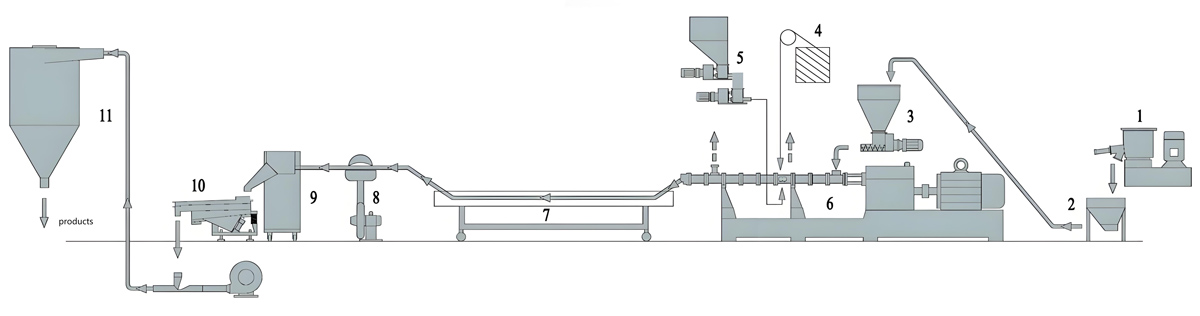
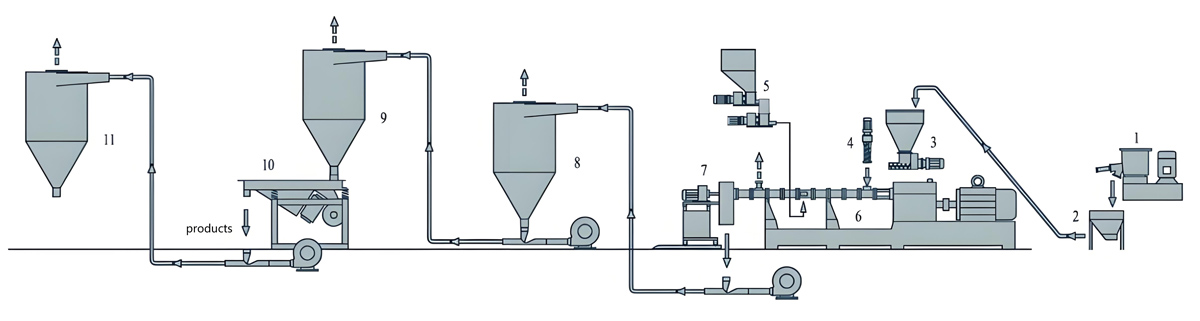
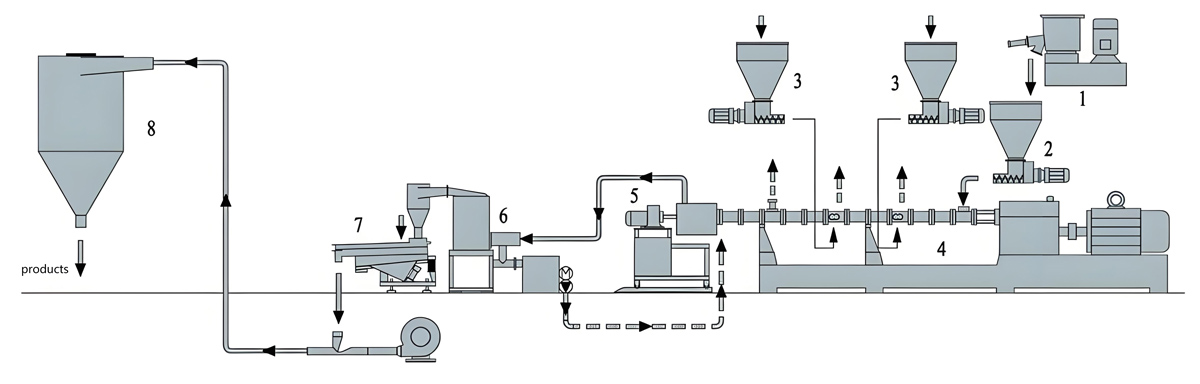
The extrusion compounding process transforms raw materials into homogeneous masterbatch through controlled melting, mixing, and shaping operations. The stainless steel twin screw extruder provides the controlled processing environment necessary for sensitive bio-based materials. Material feeding occurs through either side-feed or main-hopper introduction, depending on the thermal sensitivity of the components and desired mixing intensity. Volatile additives and heat-sensitive colorants may be added downstream through side-feeder ports to minimize degradation losses.
Melting occurs primarily in the first third of the extruder barrel as material transitions from solid to molten state. The screw configuration in this zone includes transport elements and浅槽 designs that efficiently melt material while minimizing residence time variations. A typical melting section for plant-based materials includes forward-conveying elements followed by kneading blocks arranged in a staggered pattern to promote efficient heat transfer and melting without excessive shear heating.
Mixing and dispersion follow the melting section, where kneading blocks and mixing elements subject the material to intensive shearing forces that break apart pigment agglomerates and distribute additives uniformly throughout the carrier matrix. The intensity and configuration of mixing elements significantly impact final dispersion quality and throughput capacity. For plant-based masterbatch production, moderate mixing intensity with extended mixing zones provides the best balance between dispersion quality and polymer degradation prevention.
Vacuum venting removes volatiles and moisture that accumulate during processing, preventing gas formation in the extrusion head and improving final product quality. Multiple vent positions may be utilized for formulations containing highly volatile components or moisture-laden ingredients. The vacuum system should provide adequate extraction capacity while preventing material loss through the vent openings.
Pelletizing and Cooling
Extruded material exits the die plate as a continuous strand or through underwater pelletizing systems depending on production volume and product requirements. Strand pelletizing involves cooling the extruded strands in a water bath followed by cutting with rotating knife blades. This method provides excellent pellet quality and flexibility for production runs of varying volumes. Underwater pelletizing offers higher throughput capacity and reduced water consumption but requires more precise process control to maintain consistent pellet geometry.
Pellet cooling must be sufficient to prevent agglomeration during storage and bagging while avoiding excessive moisture absorption by hydrophilic bio-based materials. Indirect cooling systems that separate the cooling medium from the pellets provide better control over final moisture content. Processed pellets should be cooled to ambient temperature and packaged in moisture-proof containers to maintain quality during storage and transport.
Production Equipment Introduction
KTE Series Stainless Steel Twin Screw Extruder Overview
The KTE Series twin screw extruder from Kerke represents a premium solution for plant-based masterbatch production, offering precision engineering and advanced features specifically designed for bio-based polymer processing. As a leading manufacturer of extrusion equipment, Kerke has developed the KTE Series to address the unique requirements of sensitive material processing while maintaining the durability and reliability expected in industrial production environments.
The KTE Series features stainless steel construction throughout the barrel and screw elements, providing superior corrosion resistance compared to standard nitrided steel configurations. This corrosion resistance proves essential for processing acidic bio-based polymers and formulations containing reactive additives that could accelerate wear in conventional equipment. The stainless steel barrel construction also facilitates cleaning between production runs, minimizing cross-contamination risks when manufacturing different color or additive masterbatch formulations.
Screw design flexibility in the KTE Series enables optimization for specific plant-based masterbatch formulations and production requirements. The modular screw element system allows processors to configure screw geometry with precision control over transport, melting, mixing, and venting functions. Kerke’s engineering team provides technical support for screw configuration selection, ensuring optimal performance for each unique application requirement.
Key Equipment Features
The KTE Series incorporates advanced temperature control systems that provide precise thermal management throughout the extrusion process. Multi-zone barrel heating with individual controller circuits enables fine adjustment of temperature profiles to match specific formulation requirements. Liquid cooling channels in each heating zone provide rapid temperature response and prevent overshoot during setpoint changes. This level of thermal control proves critical for plant-based materials that exhibit narrow processing windows and sensitivity to both underheating and overheating conditions.
High-torque drive systems deliver the mixing intensity necessary for proper pigment dispersion while maintaining controlled shear conditions that protect sensitive bio-based polymers. The KTE Series offers multiple drive power options ranging from 55 kW for laboratory and pilot scale production up to 500 kW for high-volume industrial manufacturing. Variable frequency drive control enables precise speed adjustment and soft-start functionality that reduces mechanical stress during operation and maintenance activities.
Material feeding systems for the KTE Series include gravimetric and volumetric options to match production requirements and budget considerations. Gravimetric feeders provide superior accuracy and batch-to-batch consistency by continuously measuring and adjusting material flow based on actual weight measurements. Loss-in-weight feeders eliminate feed rate variations caused by bulk density changes, ensuring consistent formulation ratios throughout production runs. Volumetric feeders offer a cost-effective alternative for less demanding applications where absolute formulation precision is less critical.
Supporting Equipment
Complete plant-based masterbatch production lines include material handling and preparation equipment that significantly impact overall production efficiency and product quality. Drying systems must provide adequate temperature and airflow capacity to achieve and maintain target moisture levels for hygroscopic bio-based materials. Desiccant dryers with dew point monitoring ensure consistent drying performance and provide alerts when maintenance is required to restore drying capacity.
Pigment and additive handling systems range from simple manual addition through bag dumps to sophisticated automatic dosing systems with inventory management capabilities. The selection of handling equipment depends on production volumes, formulation complexity, and required batch-to-batch consistency. Automatic dosing systems eliminate operator variability and ensure precise formulation replication across multiple production batches.
Pellet classification and packaging equipment complete the production line, ensuring consistent product quality from the extrusion system to final shipment. Vibrating screens remove fines and oversized particles that could cause processing problems in downstream applications. Metal detectors protect product quality and equipment integrity by identifying and removing any metallic contamination. Automated packaging systems with nitrogen flushing capability extend shelf life by displacing oxygen that could promote oxidative degradation of bio-based materials.
Parameter Settings for Plant-Based Masterbatch
Temperature Profile Configuration
Temperature profile settings directly impact processing stability, product quality, and production throughput for plant-based masterbatch manufacturing. The extruder barrel typically operates with 8-10 temperature zones, each independently controlled to establish the optimal thermal environment for each processing stage. Zone temperatures generally increase from the feed section toward the die, following the progression of material from solid feed through melting and mixing stages.
For PLA-based masterbatch production, typical barrel temperature settings range from 170 degrees Celsius in the feed zone to 200-220 degrees Celsius in the final mixing and pumping zones. The die temperature should be maintained 10-20 degrees Celsius lower than the final barrel zone to prevent material thermal degradation while maintaining adequate flow for strand formation or underwater pelletizing. These temperatures represent starting points that should be adjusted based on actual material characteristics, throughput rates, and product quality observations.
Starch-based formulations require higher processing temperatures due to the need for complete gelatinization and plasticization of the starch component. Barrel temperatures for starch-based masterbatch typically range from 140 degrees Celsius in the feed zone to 180-200 degrees Celsius in the discharge zone. The higher processing temperatures necessary for starch materials increase the risk of thermal degradation and require careful monitoring of motor load and product quality indicators.
Screw Speed and Throughput
Screw speed settings influence mixing intensity, residence time, and throughput capacity in twin screw extrusion. Plant-based materials generally require lower screw speeds compared to petroleum-based polymers due to their sensitivity to shear heating and mechanical stress. Typical screw speeds for PLA-based masterbatch range from 200-400 rpm, with lower speeds preferred for heat-sensitive formulations and higher speeds used when maximizing throughput takes priority over ultimate quality optimization.
Throughput rates depend on screw configuration, barrel temperature settings, and material characteristics. Laboratory and pilot scale KTE Series extruders typically achieve throughput rates of 5-50 kg/hour, while production scale equipment processes 200-2000 kg/hour depending on barrel size and drive power. The relationship between screw speed and throughput must be carefully balanced to maintain adequate filling degree and mixing intensity while avoiding starve feeding or overfilling conditions.
Vacuum and Venting Settings
Vacuum venting configuration and settings significantly impact volatile removal and final product quality for plant-based masterbatch. Vacuum levels typically range from -0.5 to -0.9 bar, with higher vacuum levels providing more effective volatile removal but requiring more robust sealing systems to maintain stable vacuum conditions. The vent port position must be located at a point in the extruder where material is adequately melted but not fully compressed to allow volatiles to escape freely.
Screw configuration in the vent zone should promote material filling while allowing vapor escape through the vent opening. Special venting screw elements create sufficient volume and reduce pressure buildup to facilitate volatile removal. For formulations with high moisture content or volatile additive components, multiple vent positions may be required to achieve adequate degassing without excessive product loss through the vent openings.
Equipment Price
Equipment investment for plant-based masterbatch production varies significantly based on production capacity, automation level, and feature requirements. Laboratory and pilot scale KTE Series twin screw extruders suitable for product development and small batch production range from $25,000 to $75,000 depending on barrel size, drive power, and control system sophistication. These smaller machines enable thorough process development and market testing before committing to larger production scale investments.
Medium-scale production systems with throughput capacity of 200-500 kg/hour typically range from $150,000 to $350,000 for complete extruder systems including feeders, controls, and basic support equipment. These systems represent the optimal balance of production capacity and capital efficiency for most independent masterbatch manufacturers entering the plant-based market segment.
Large-scale production lines with throughput capacity exceeding 1000 kg/hour require investments of $500,000 to $1,500,000 or more depending on the specific configuration and automation level. Complete production systems include not only the twin screw extruder but also comprehensive material handling, drying, pelletizing, and packaging equipment. The higher capital investment for large-scale systems offers economies of scale that improve production economics and competitive positioning in the growing plant-based masterbatch market.
Production Problems, Causes, Solutions and Prevention
Pigment Agglomeration and Poor Dispersion
Problem: The produced masterbatch exhibits visible pigment agglomerates, streaks, or uneven color distribution when processed into final plastic articles. End-users report inconsistent coloration, surface defects, and quality complaints that indicate inadequate dispersion of pigments within the carrier matrix.
Cause Analysis: Pigment agglomeration typically results from insufficient mixing intensity or improper screw configuration that fails to break apart pigment aggregates during compounding. High pigment loadings exceed the dispersion capacity of standard screw configurations, leaving oversized pigment particles that cause processing and quality problems. Inadequate pre-drying of pigments or contamination with moisture can create agglomeration through particle moisture bridging. Incompatible additive combinations may cause flocculation or reagglomeration of pigments during cooling and solidification.
Solution: Modify the screw configuration to increase mixing intensity in the dispersion zone through additional kneading blocks or specialized mixing elements. Reduce pigment loading to within the dispersion capacity of the current equipment configuration, or invest in higher-intensity mixing equipment capable of processing the desired formulation. Implement pre-drying for all pigments and maintain moisture-free storage conditions to prevent moisture-related agglomeration. Review additive compatibility and adjust the formulation to prevent chemical interactions that promote pigment agglomeration.
Prevention: Establish clear specifications for pigment particle size and compatibility before purchasing raw materials. Develop and validate screw configurations for each formulation type before production, maintaining documentation of validated configurations for reference. Implement incoming quality inspection for all pigments and additives to identify potential dispersion problems before production. Train operators to recognize early warning signs of dispersion problems and take corrective action before quality problems develop.
Material Discoloration and Thermal Degradation
Problem: The masterbatch exhibits unexpected yellowing, browning, or other discoloration compared to expected color specifications. Processing generates unusual odors indicating thermal degradation of organic components. Physical properties of compounded material show signs of molecular weight reduction through reduced melt viscosity.
Cause Analysis: Thermal degradation of plant-based materials results from excessive temperatures, extended residence time at elevated temperatures, or contamination with materials that catalyze oxidative degradation. Bio-based polymers including PLA and starch derivatives exhibit relatively narrow thermal processing windows where molecular integrity can be maintained. Oxygen exposure during processing accelerates thermal-oxidative degradation reactions that produce discoloration and property degradation. Inadequate antioxidant protection leaves materials vulnerable to degradation during processing and subsequent storage.
Solution: Reduce barrel temperatures systematically, beginning with the highest temperature zones, until discoloration is eliminated while maintaining adequate processing conditions. Implement vacuum venting or inert gas purging to reduce oxygen exposure during processing. Add antioxidant stabilizers to the formulation to provide protection against thermal-oxidative degradation. Review and optimize screw configuration to reduce residence time and prevent material from dwelling in high-temperature zones beyond the minimum necessary for complete melting and mixing.
Prevention: Establish and validate temperature profiles for each formulation, documenting settings that produce acceptable product quality without degradation. Implement antioxidant systems as standard components of plant-based formulations to provide inherent protection against thermal degradation. Monitor processing parameters continuously and investigate any anomalies in motor load, pressure, or product quality that might indicate developing problems. Establish material qualification procedures that include thermal stability testing before approving new raw materials or formulations for production.
Moisture-Related Processing Instabilities
Problem: The extrusion process exhibits surging, pressure fluctuations, or intermittent die blockage that produces inconsistent product quality and requires frequent parameter adjustments to maintain production stability. Produced pellets show evidence of steam voids or bubbles that indicate moisture flash during extrusion. Final compounded material exhibits reduced mechanical properties or surface defects related to moisture-induced degradation.
Cause Analysis: Plant-based materials readily absorb moisture from the environment during storage and handling, and insufficient drying leaves residual moisture that flashes to steam during extrusion processing. Steam generation creates pressure variations that disrupt smooth material flow and produce the surging behavior observed during production. Hydrolytic degradation of polymer chains reduces molecular weight and compromises material properties in the final product. Moisture can also promote biological growth in starch-based materials during storage, creating additional contamination and degradation concerns.
Solution: Implement comprehensive drying procedures with validated parameters for each material type, including extended drying times for materials showing particularly high moisture absorption. Install and properly maintain desiccant dryers with continuous monitoring to ensure consistent achievement of target moisture levels. Verify material moisture content before production using Karl Fischer titration or similar analytical methods. Reduce throughput rates during processing to minimize steam generation effects while addressing underlying moisture issues.
Prevention: Establish strict moisture specifications for all raw materials and verify compliance through incoming quality testing. Maintain proper storage conditions with humidity control to prevent moisture absorption between drying and processing. Implement first-in-first-out inventory rotation to minimize storage duration and associated moisture exposure. Install hopper dryers on the extrusion system to provide continuous drying protection for hygroscopic materials during processing.
Inconsistent Batch Properties
Problem: Successive production batches exhibit unacceptable variations in color strength, melt flow characteristics, or physical properties despite using identical formulations and processing parameters. Quality control testing reveals significant batch-to-batch variability that complicates customer qualification and end-use processing.
Cause Analysis: Batch property inconsistencies typically originate from variations in raw material characteristics, feeder calibration drift, or process parameter fluctuations during production. Pigment batches from different suppliers or production lots may exhibit different tinting strength, color shade, or dispersion characteristics. Gravimetric feeders can drift from calibration due to bulk density variations, environmental conditions, or mechanical wear. Temperature controller drift, thermocouple degradation, or inconsistent cooling water temperature can produce subtle processing variations that accumulate into significant batch property differences.
Solution: Implement rigorous incoming quality testing for all raw materials to identify and segregate materials with out-of-specification characteristics. Calibrate feeders before each production run using standardized weight verification procedures. Establish statistical process control monitoring for critical parameters including motor load, pressure, and throughput to identify process variations requiring investigation. Implement blending of production batches to average out minor batch-to-batch variations and produce consistent product quality.
Prevention: Establish long-term supply relationships with qualified raw material vendors to minimize variation from source changes. Implement preventive maintenance schedules for all feeder and temperature control equipment to ensure consistent accuracy. Develop and document standard operating procedures that specify parameter limits and response actions for process variations. Conduct regular capability studies to verify that the production process can consistently meet quality specifications and identify any degradation in process capability over time.
Screw Wear and Contamination
Problem: Produced masterbatch exhibits contamination with metallic particles or shows evidence of screw wear through reduced mixing efficiency, increased motor load, or visible damage to processed pellets. Processing efficiency decreases over time as worn screw elements lose their designed geometry and mixing performance.
Cause Analysis: Abrasive filler materials including certain inorganic pigments and mineral additives accelerate screw and barrel wear during processing. Corrosive degradation of stainless steel surfaces can occur with some bio-based polymers and additives that produce acidic byproducts during processing. Mechanical damage from foreign objects entering the feed throat or from dry running when material feed is interrupted can accelerate wear damage. Normal wear over extended production hours eventually degrades screw element geometry and matching between screw and barrel surfaces.
Solution: Implement regular inspection and measurement of screw elements to detect wear before it produces quality problems. Replace worn screw elements promptly to maintain processing quality and prevent catastrophic failure during production. Consider wear-resistant coating options for processing highly abrasive formulations that exceed standard material capabilities. Implement foreign object detection and prevention procedures to protect equipment from damage through accidental contamination.
Prevention: Establish scheduled maintenance intervals for screw inspection and wear measurement based on production volume and formulation abrasiveness. Maintain records of production hours and formulation types to predict maintenance needs accurately. Train operators to recognize early warning signs of wear including unusual noise, increased motor load, or product quality changes. Stock essential spare screw elements to enable rapid replacement when wear limits are reached without extended production downtime.
Maintenance and Care
Daily Maintenance Procedures
Consistent daily maintenance procedures ensure reliable production performance and extend equipment service life for stainless steel twin screw extruders processing plant-based masterbatch. Operator startup inspections should verify proper function of temperature controllers, vacuum systems, and safety interlock devices before initiating production. Material feed systems require verification of proper loading, calibration, and function to ensure accurate formulation throughout the production run.
Visual inspection of extruded strands or pelletizing operation provides immediate feedback on processing stability and product quality. Any changes from normal appearance warrant investigation and corrective action before continuing production. Recording of critical parameters including motor load, pressure readings, and throughput measurements enables trend analysis that can identify developing problems before they cause quality failures or equipment damage.
Weekly Maintenance Activities
Weekly maintenance activities focus on system components that affect product quality and production efficiency. Cleaning of feed hopper and intake areas prevents material buildup that could fall into the extrusion and contaminate product. Inspection and cleaning of die plate and pelletizing systems removes polymer buildup that could affect strand quality or pellet geometry. Verification of feeder calibration using test weights ensures continued formulation accuracy throughout the production week.
Temperature controller calibration verification confirms that indicated temperatures match actual material temperatures throughout the barrel. Thermocouple function testing identifies sensors showing drift or degradation that could affect thermal management accuracy. Vacuum system performance testing verifies that extraction capacity remains adequate for volatile removal requirements.
Periodic Maintenance and Inspection
Monthly and quarterly maintenance extends beyond daily and weekly activities to address wear components and system integrity. Screw element inspection and measurement provides data for wear tracking and replacement planning. Barrel inspection through borescope examination identifies wear patterns and potential problem areas before they cause production problems. Gearbox oil analysis and change intervals prevent mechanical failures that could result from lubricant degradation or contamination.
Annual shutdown maintenance provides opportunity for comprehensive system evaluation and component replacement as needed. Complete screw removal and inspection enables accurate wear measurement and replacement planning for the coming production year. Control system calibration and software updates ensure continued accuracy and feature availability. Complete electrical system inspection identifies potential problems in motor windings, heater elements, and control circuits before they cause failures during production.
FAQ
What are the main advantages of using stainless steel twin screw extruders for plant-based masterbatch production?
Stainless steel construction provides superior corrosion resistance against acidic bio-based polymers and reactive additives commonly used in plant-based formulations. The smooth surface finish of stainless steel barrels facilitates cleaning and prevents material buildup that could cause contamination between color changes. Additionally, stainless steel offers excellent thermal conductivity that improves temperature control accuracy throughout the extrusion process. These advantages result in consistent product quality, extended equipment life, and reduced maintenance requirements compared to standard nitrided steel alternatives.
How does the cost of plant-based masterbatch compare to conventional petroleum-based masterbatch?
Current production costs for plant-based masterbatch typically run 20-50% higher than conventional alternatives due to the premium pricing of bio-based carrier resins and more demanding processing requirements. However, prices continue declining as bio-based polymer production capacity expands and manufacturing efficiency improves. The premium pricing may be justified for applications where environmental sustainability, biodegradability, or regulatory requirements for bio-based content create sufficient value to support higher costs.
What certifications or compliance requirements apply to plant-based masterbatch for food contact applications?
Food contact applications require compliance with relevant regulations including FDA requirements in the United States and EU Regulation 10/2011 in Europe. Bio-based carriers and additives must be specifically approved for food contact use, and masterbatch manufacturers must maintain documentation supporting compliance claims. Certification from recognized organizations such as DIN CERTCO or Vinçotte for compostability provides additional market access for biodegradable products. Food contact masterbatch production requires dedicated equipment or thorough cleaning validation to prevent contamination from non-food-grade materials.
What production capacity is required to make plant-based masterbatch manufacturing economically viable?
Economic viability depends on multiple factors including target market segments, equipment utilization rates, and product pricing strategy. Laboratory and pilot scale equipment enables market development and small volume specialty production with minimum capital investment. Commercial scale production typically requires minimum throughput of 200-500 kg/hour to achieve sufficient volume for competitive pricing. The increasing market demand for sustainable materials improves the economics of plant-based masterbatch production as scale advantages accumulate.
How do processing parameters differ when running plant-based materials compared to conventional polymers?
Plant-based materials generally require lower processing temperatures due to their narrower thermal stability windows and sensitivity to thermal degradation. Screw speeds typically run lower to reduce shear heating that could damage mechanically sensitive bio-based polymer chains. Extended drying times and more aggressive moisture control measures prove necessary for hygroscopic plant-based materials. Processing windows may shift during production runs as materials undergo thermal conditioning or moisture equilibration, requiring active parameter adjustment to maintain consistent quality.
Conclusion
The production of plant-based masterbatch using stainless steel twin screw extrusion technology offers compelling opportunities for manufacturers seeking to serve the growing market for sustainable plastics. The unique processing requirements of bio-based polymers and additives are well addressed by the precision, flexibility, and corrosion resistance of stainless steel twin screw equipment. Successful production requires careful attention to formulation development, process optimization, and quality control throughout the manufacturing operation.
Investment in appropriate equipment such as the KTE Series stainless steel twin screw extruder from Kerke provides the foundation for consistent, high-quality plant-based masterbatch production. Combined with proper raw material handling, validated processing parameters, and comprehensive quality assurance procedures, manufacturers can achieve the production performance and product quality necessary to compete effectively in this dynamic market segment.
The continued growth of sustainability requirements across industries ensures strong demand for plant-based masterbatch products. Manufacturers who invest now in the technical capabilities and process expertise required for this specialized production will be well positioned to capture market opportunities as environmental awareness drives adoption of bio-based plastic materials. The combination of sound equipment selection, rigorous process control, and continuous improvement practices creates the foundation for long-term success in plant-based masterbatch manufacturing.