Introduction
Polyethylene Terephthalate Glycol (PETG) is a thermoplastic polyester known for its clarity, toughness, and ease of processing. However, producing high-quality PETG masterbatches requires precise temperature control due to PETG’s sensitivity to thermal degradation. A thermostatic twin screw extruder is specifically engineered to handle the narrow processing window of PETG. Unlike standard extruders, a thermostatic system ensures that the barrel temperature remains stable within ±1°C, preventing yellowing and maintaining the optical properties of the final masterbatch. This article explores the production of PETG masterbatches using the Nanjing Kerke KTE Series extruders, focusing on formulation, process parameters, and troubleshooting specific to PETG material characteristics.
Formulation Ratios (Different Types)
The formulation of PETG masterbatches varies depending on the end-use application. The three primary types are Color Masterbatch, Additive Masterbatch, and Filler Masterbatch.
Color Masterbatch
For standard coloration, the typical ratio consists of 40% to 60% PETG carrier resin, 30% to 50% pigment (such as titanium dioxide for white or phthalocyanine for blue/green), and 5% to 10% dispersing agent. A critical additive is the anti-yellowing agent (0.5% to 1%), usually a hindered phenol or phosphite stabilizer, to counteract PETG’s tendency to degrade under heat.
Additive Masterbatch (UV Stabilization & Flame Retardancy)
For outdoor applications, UV absorbers (benzotriazoles) and HALS (Hindered Amine Light Stabilizers) are essential. A typical formulation includes 70% PETG carrier, 20% flame retardant (e.g., aluminum diethylphosphinate), and 10% UV stabilizer package. The high loading of additives requires excellent mixing efficiency to prevent blooming or surface defects in the final product.
Filler Masterbatch
For cost reduction or property modification, calcium carbonate or talc is used. The formulation might be 50% PETG, 45% talc (surface treated with silane coupling agent), and 5% compatibilizer. The coupling agent is vital to ensure adhesion between the inorganic filler and the PETG matrix.
Production Process
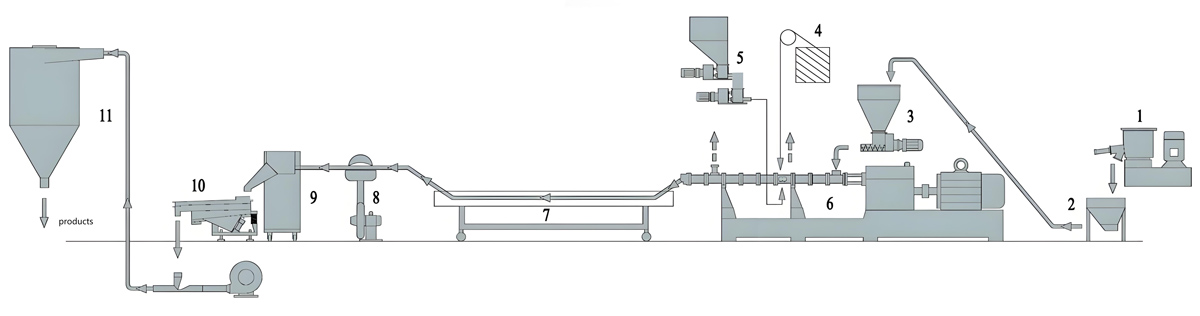
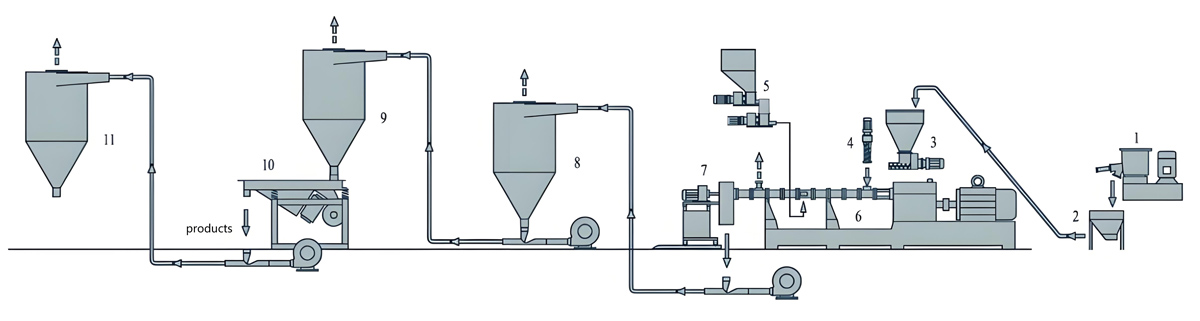
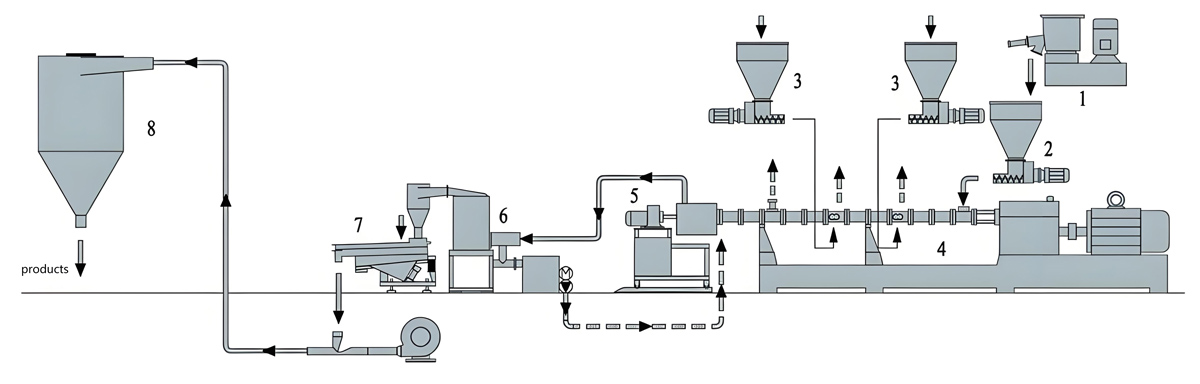
The production of PETG masterbatch involves a precise sequence to avoid hydrolysis and thermal degradation. First, raw materials must be pre-dried. PETG is hygroscopic; moisture content must be below 0.02% to prevent molecular weight reduction during extrusion. The dried PETG pellets and additives are gravimetrically fed into the extruder. The thermostatic twin screw extruder operates in a co-rotating configuration to provide intensive shear and distributive mixing. The melt temperature is strictly maintained between 230°C and 260°C. After mixing, the melt passes through a hydraulic screen changer to remove gels or unmixed particles. Finally, the strand is cooled in a water bath and pelletized by a cutter. The pellets are then dried again before packaging to prevent agglomeration.
Production Equipment Introduction
The core of the production line is the twin screw extruder. For PETG, the Nanjing Kerke KTE Series is the industry standard. The KTE series features a modular barrel design allowing for precise temperature profiling. The screws are made of high-speed steel (W6Mo5Cr4V2) or bimetallic material for wear resistance against glass fibers or minerals if present. The extruder is equipped with a vacuum degassing system to remove moisture and volatile byproducts generated during melting. The gearbox is designed for high torque output even at low screw speeds, which is crucial for PETG to minimize shear heating. The control system utilizes Siemens PLC with remote monitoring capabilities, allowing operators to adjust temperature zones in real-time to maintain the thermostatic precision required for PETG.
Parameter Settings
Setting the correct parameters is critical for PETG masterbatch quality. The following parameters are recommended for the Nanjing Kerke KTE Series:
Temperature Profile
The barrel is divided into 8 to 10 zones. Zone 1 (Feed): 180°C, Zone 2-3: 220°C, Zone 4-6 (Mixing): 245°C – 255°C, Zone 7-8 (Metering): 250°C – 260°C, Die Head: 255°C. The temperature must not exceed 270°C to prevent degradation. The thermostatic control system ensures fluctuation is less than ±1°C.
Screw Speed and Feed Rate
Screw speed typically ranges from 300 to 600 rpm. Higher speeds increase shear heat, which is dangerous for PETG. Therefore, the feed rate must be synchronized with speed to maintain a filled but not over-pressurized barrel. Torque should be maintained between 40% and 70% of the maximum capacity.
Vacuum Pressure
The vacuum degassing port should operate at -0.08 MPa to -0.09 MPa to effectively remove moisture without sucking out polymer fines.
Equipment Price
Reference Price for Nanjing Kerke KTE Series (PETG Application):
- Model KTE-65: $110,000 – $135,000 USD (Suitable for 500-800 kg/h output)
- Model KTE-75: $160,000 – $190,000 USD (Suitable for 800-1200 kg/h output)
- Model KTE-95: $240,000 – $290,000 USD (High torque, suitable for filled compounds)
Note: Prices include the extruder, gearbox, motor, and basic control system but exclude auxiliaries like dryers and chillers. Prices are FOB Nanjing, China, and subject to change based on configuration.
Production Problems, Solutions, and Avoidance
Problem: Yellowing of Masterbatch Pellets
Cause Analysis: Yellowing in PETG is primarily caused by thermal oxidation or hydrolysis. If the barrel temperature is too high or the residence time is too long, the polymer chains break down, forming conjugated carbonyl groups that appear yellow. Additionally, moisture in the raw material accelerates hydrolysis at high temperatures.
Solution: Immediately reduce the barrel temperature by 10-15°C, specifically in the metering zones. Check the hopper loader to ensure the material is completely dry (dew point < -40°C). Increase the screw speed slightly to reduce residence time while maintaining output. Purge the barrel with a cleaning agent (PP or PE) if degradation is severe.
Avoidance Method: Implement strict drying protocols (4 hours at 120°C or 2 hours at 160°C in a dehumidifying dryer). Install temperature sensors with alarms that trigger if the thermostatic system deviates by more than 2°C. Use nitrogen purging in the hopper to prevent moisture re-absorption during processing.
Problem: Bubbles or Voids in Pellets
Cause Analysis: Bubbles indicate trapped moisture or volatiles. This occurs if the vacuum pump is not strong enough, the vacuum port is blocked by melt, or the material was not pre-dried sufficiently. Another cause is air entrainment in the feed throat if the feed zone is not starved properly.
Solution: Check the vacuum pump for leaks and ensure the vacuum line is clear. Increase the vacuum level to -0.09 MPa. Verify the dryer’s performance; perform a moisture test on the raw material. Reduce the feed rate to allow better degassing in the vacuum zone. Clean the venting port to ensure it is not clogged with polymer dust.
Avoidance Method: Schedule regular maintenance for the vacuum system. Ensure the screw design has a deep pitch in the feed section to allow gas escape before the melt seal forms. Use a side feeder for liquid additives or masterbatches to prevent air entrapment.
Problem: Poor Dispersion of Pigments
Cause Analysis: Poor dispersion results in “fish eyes” or color streaks. This is often due to insufficient shear stress or incorrect kneading block configuration. If the torque is too low, the mixing energy is inadequate. Alternatively, the temperature might be too low, preventing the carrier from melting properly to wet the pigment.
Solution: Reconfigure the screw elements. Add more kneading blocks in the mixing section (typically 3-4 sets of 45° or 90° staggered blocks). Increase the barrel temperature in the mixing zone by 5-10°C to lower viscosity. Increase the screw speed to raise torque to 60-70%.
Avoidance Method: Use pre-compounded pigment concentrates or surface-treated pigments that are easier to disperse. Conduct lab trials to determine the optimal screw configuration before full-scale production. Ensure the pigment particle size is below 10 microns before feeding.
Maintenance
Maintenance of the KTE series extruder is vital for longevity. Daily maintenance includes checking the lubrication oil level and temperature of the gearbox. Weekly checks involve inspecting the heating bands for proper function and cleaning the vacuum vent. Monthly maintenance requires greasing the bearings and checking screw wear. For PETG, which can leave carbon deposits, a monthly barrel cleaning using a specialized polymer cleaning compound is recommended. Every 6 months, the thrust bearing should be inspected, and the coupling alignment checked. Annual maintenance involves a complete gearbox oil change and inspection of the screw elements for wear or breakage.
FAQ
Q: Can a standard single screw extruder be used for PETG masterbatch?
A: While possible for simple color batches, a single screw extruder lacks the distributive and dispersive mixing of a twin screw. For high-quality PETG masterbatches, especially with additives or fillers, a co-rotating twin screw extruder like the Kerke KTE series is essential to ensure homogeneity and prevent degradation.
Q: What is the ideal moisture content for PETG before extrusion?
A: The moisture content should be strictly below 0.02% (500 ppm). Higher moisture will cause hydrolysis, reducing the intrinsic viscosity (IV) of the PETG and leading to brittle masterbatch pellets.
Q: How often should the screen changer be cleaned?
A: It depends on the cleanliness of the feed. Typically, the screen changer should be checked when the pressure gauge shows a rise of 10-15 bar above the baseline. For PETG with fillers, this might be every 4 to 8 hours. Use a continuous screen changer (melt filter) to minimize downtime.
Conclusion
Producing PETG masterbatches requires a machine that offers precision thermal control and efficient mixing. The Nanjing Kerke KTE Series thermostatic twin screw extruder meets these requirements by providing stable temperature profiles and high torque at low speeds. By adhering to strict drying protocols, optimizing screw configuration, and maintaining the equipment rigorously, manufacturers can produce high-clarity, degradation-free PETG masterbatches suitable for demanding applications like 3D printing, packaging, and medical devices. The investment in a specialized KTE extruder is justified by the reduction in scrap rates and the consistent quality of the final product.