Introduction to ABS Calcium Carbonate Filled Masterbatch Production
ABS calcium carbonate filled masterbatch represents one of the most widely used additive systems in the plastics industry, providing significant cost reduction while maintaining acceptable material properties. The combination of ABS resin with calcium carbonate filler enables manufacturers to achieve material cost savings of 20 to 40 percent while maintaining mechanical properties sufficient for many applications. Twin screw extruders have become the preferred equipment for producing these masterbatches due to their superior mixing capabilities, precise temperature control, and ability to handle high filler loadings. Modern twin screw extruders, particularly the KTE Series from Nanjing Kerke Extrusion Equipment Company, have been specifically designed to optimize the production of filled masterbatches with exceptional dispersion quality and production efficiency.
The economic advantages of calcium carbonate filled ABS masterbatches have driven significant market growth, with annual production volumes exceeding 5 million tons globally. This growth has created increasing demand for production equipment capable of delivering consistent quality while maintaining high throughput rates. The KTE Series twin screw extruders address these requirements through advanced screw geometry, optimized barrel design, and sophisticated control systems that ensure uniform dispersion of calcium carbonate particles throughout the ABS matrix. The result is masterbatch products that deliver consistent performance characteristics while providing the cost benefits that manufacturers seek.
Formulation Ratio Variations
The formulation of ABS calcium carbonate filled masterbatches varies significantly based on the target application and required properties. Understanding these formulation variations is essential for selecting appropriate processing conditions and equipment configurations. The calcium carbonate loading typically ranges from 30 to 70 percent by weight, with each loading level requiring specific processing approaches to achieve optimal dispersion and product quality.
Low loading formulations containing 30 to 45 percent calcium carbonate are commonly used when maintaining maximum mechanical properties is critical while still achieving meaningful cost reduction. These formulations typically use surface-treated calcium carbonate with particle sizes between 3 and 6 micrometers. The ABS matrix generally consists of a blend of impact modifier grades to compensate for the embrittlement effect of the filler. Processing temperatures for these formulations typically range from 210 to 230 degrees Celsius, with screw speeds optimized to achieve adequate mixing without excessive shear that could degrade the ABS matrix.
Medium loading formulations with 45 to 55 percent calcium carbonate represent the most common masterbatch compositions for general-purpose applications. These formulations achieve an excellent balance between cost reduction and property retention. The calcium carbonate used in these formulations typically has particle sizes between 4 and 8 micrometers, often with stearic acid surface treatment to improve compatibility with the ABS matrix. Processing temperatures range from 215 to 235 degrees Celsius, with the twin screw extruder configured to provide high dispersion efficiency through the combination of kneading elements and distributive mixing sections.
High loading formulations containing 55 to 70 percent calcium carbonate are used when maximum cost reduction is the primary objective and some property reduction is acceptable. These formulations present the greatest processing challenges due to the high viscosity and poor flow characteristics. The calcium carbonate typically has larger particle sizes of 6 to 10 micrometers to reduce surface area and improve flow. Processing temperatures often require elevation to 220 to 240 degrees Celsius, and the twin screw extruder must be configured with more aggressive mixing elements to overcome the reduced matrix material available for dispersion.
Production Process Overview
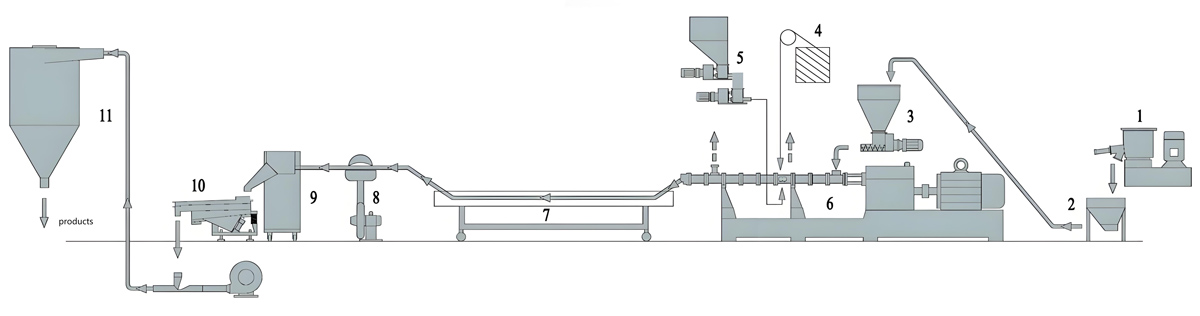
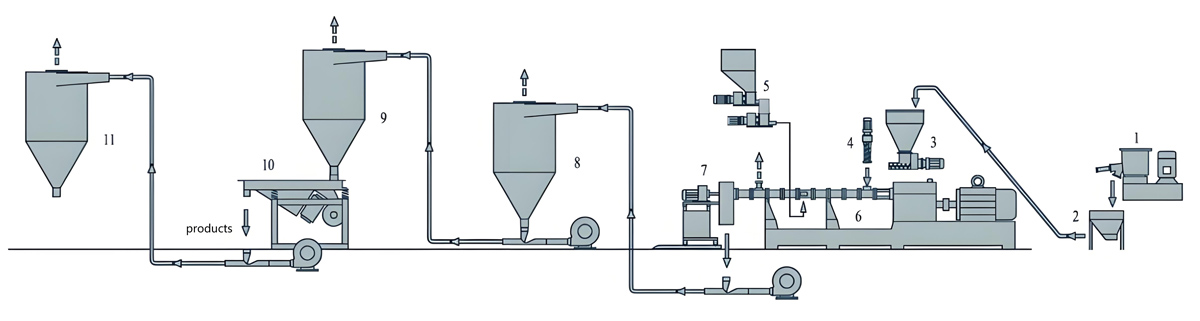
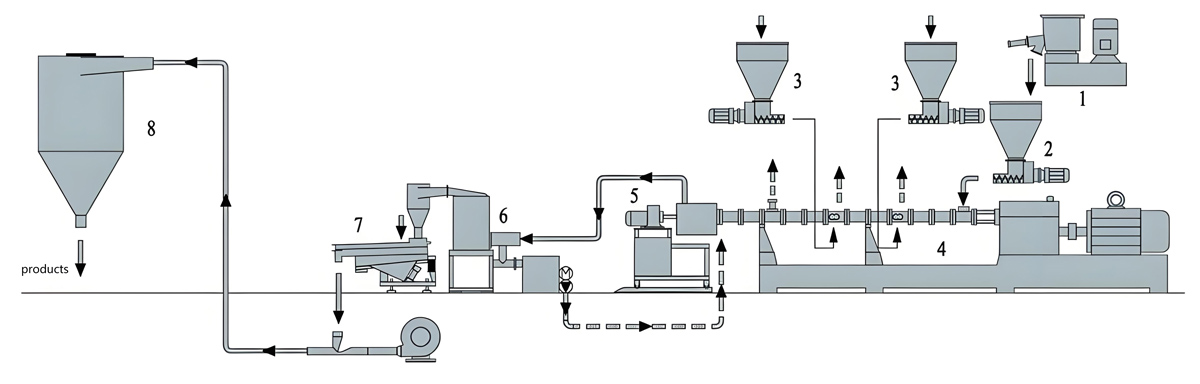
The production of ABS calcium carbonate filled masterbatch follows a systematic process that begins with material preparation and concludes with finished masterbatch pelletization. Each stage of the process requires specific attention to achieve the desired product quality and production efficiency. Twin screw extruders from the KTE Series are engineered to optimize each stage of this process through integrated material handling, precise temperature control, and advanced mixing capabilities.
Material preparation represents the first critical stage in masterbatch production. The ABS resin typically requires drying to moisture levels below 0.02 percent before processing, as excess moisture can cause hydrolytic degradation and surface defects. Calcium carbonate filler, depending on its source and treatment, may also require drying to remove adsorbed moisture that could cause void formation or poor dispersion. The KTE Series extruders can be equipped with integrated drying hoppers that ensure consistent material dryness before the materials enter the extrusion process. The drying systems typically operate at 80 to 90 degrees Celsius for 3 to 4 hours, with capacity matching the extrusion throughput rate.
Material feeding into the twin screw extruder requires precise metering to maintain the correct formulation ratio. Gravimetric feeders are typically employed for both the ABS resin and calcium carbonate filler to ensure accuracy within plus or minus 0.5 percent of target values. The KTE Series extruders feature optimized feeder interfaces that provide consistent material flow and prevent bridging or rat-holing that could disrupt the formulation ratio. The feeders are typically configured to deliver materials to the extruder through a common feed throat, allowing initial pre-mixing before entering the barrel.
The extrusion process itself is where the critical dispersion of calcium carbonate occurs within the ABS matrix. The twin screw design provides both distributive and dispersive mixing action that breaks up agglomerates and distributes individual filler particles throughout the polymer. The mixing elements are strategically positioned along the screw length to provide initial breakup of filler agglomerates, followed by distributive mixing for uniform distribution, and final dispersive mixing to ensure no agglomerates remain. The KTE Series screw designs feature optimized element placement for filled masterbatch applications, reducing the need for extensive screw configuration changes when switching between different loading levels.
Degassing represents an important processing stage, particularly when using untreated calcium carbonate that may contain volatile components or when processing recycled ABS that could contain volatiles. The KTE Series extruders feature venting zones that can be configured for vacuum degassing to remove these volatiles and prevent void formation in the final product. The venting zones are typically positioned after the major dispersion stages and before the final mixing and pumping stages.
Pelletizing the extruded masterbatch represents the final production stage. The extruded strand must be cooled sufficiently before pelletizing to prevent deformation and ensure consistent pellet dimensions. Water bath cooling is typically employed, with bath temperatures of 15 to 25 degrees Celsius. The KTE Series extruders can be equipped with strand pelletizers that cut the cooled strand into pellets of consistent size, typically 2 to 4 millimeters in length. The pelletizing action must be carefully controlled to prevent fines generation, as excessive fines can cause feeding problems in downstream applications.
Production Equipment Specifications
Twin screw extruders designed for calcium carbonate filled masterbatch production require specific features and capabilities to achieve optimal results. The KTE Series from Nanjing Kerke Extrusion Equipment Company incorporates several key design elements that address the unique requirements of filled masterbatch production. These design elements focus on mixing efficiency, wear resistance, and temperature control accuracy.
Screw geometry represents the most critical design element for filled masterbatch production. The KTE Series extruders employ co-rotating, intermeshing twin screw designs that provide excellent mixing action while maintaining good conveying efficiency. The screw L/D ratio typically ranges from 40:1 to 48:1 for masterbatch applications, providing sufficient length for the multiple mixing stages required for high filler loadings. The screw configuration incorporates forward-conveying elements for material transport, kneading blocks for dispersive mixing, and special mixing elements for distributive action. The kneading block stagger angles are optimized to provide the balance between dispersive mixing intensity and heat generation that is appropriate for ABS materials.
Barrel design for masterbatch extruders must provide excellent temperature control while resisting the abrasive wear caused by calcium carbonate particles. The KTE Series barrels feature multiple independent heating zones, typically 8 to 12 zones depending on barrel length, allowing precise temperature profile control along the entire extrusion length. The barrel material includes bimetallic liners that provide wear resistance significantly exceeding standard steel barrels. The liner materials typically consist of a hard facing material such as tungsten carbide or ceramic composite that provides service life 3 to 5 times longer than standard barrels when processing abrasive fillers.
Drive systems for masterbatch extruders must provide sufficient torque to handle the high viscosity of filled melts while maintaining speed control accuracy. The KTE Series extruders employ AC vector drives that provide both the necessary torque and precise speed regulation. Drive power requirements typically range from 55 to 400 kilowatts depending on extruder size and throughput requirements. The drive systems feature tachometer feedback that maintains screw speed accuracy within plus or minus 0.25 percent, ensuring consistent processing conditions essential for masterbatch quality consistency.
Control systems for modern masterbatch extruders provide comprehensive monitoring and adjustment capabilities. The KTE Series extruders feature PLC-based control systems with touch-screen interfaces that provide real-time monitoring of all critical processing parameters. The control systems can store and recall processing recipes for different formulations, reducing changeover time and ensuring consistent reproduction of processing conditions. The systems also provide data logging capabilities that track processing parameters over time, enabling quality trend analysis and process optimization.
Parameter Settings for Optimal Production
Setting appropriate processing parameters is essential for achieving optimal ABS calcium carbonate masterbatch quality and production efficiency. The parameters must be tailored to the specific formulation, filler characteristics, and equipment configuration. The KTE Series extruders provide the control precision and flexibility needed to maintain optimal parameters across different production conditions.
Temperature profiles must be carefully established to achieve proper melting and mixing without degrading the ABS matrix. For typical medium loading formulations, a temperature profile might start at 180 degrees Celsius in the feed zone, gradually increase through the mixing zones to 225 to 235 degrees Celsius in the final zones. The precise profile depends on the specific ABS grade, filler loading, and desired output quality. The KTE Series extruders maintain zone temperature accuracy within plus or minus 1.5 degrees Celsius, ensuring consistent thermal conditions essential for quality masterbatch production.
Screw speed selection balances production throughput against mixing quality and residence time. Higher screw speeds increase production rate but reduce residence time, potentially compromising dispersion quality. For medium loading formulations, screw speeds typically range from 200 to 350 RPM depending on extruder size and specific formulation characteristics. The KTE Series extruders provide precise speed control that enables optimization of this balance for each formulation.
Feeder rate settings determine the formulation ratio and must be precisely maintained. Gravimetric feeders typically deliver the ABS matrix at rates from 50 to 500 kilograms per hour depending on extruder capacity and formulation loading. Calcium carbonate feed rates are set according to the target loading percentage. For example, for a 50 percent loading formulation with 200 kilograms per hour total throughput, the calcium carbonate feed rate would be set to 100 kilograms per hour and the ABS feed rate to 100 kilograms per hour. The feeders maintain accuracy within plus or minus 0.5 percent, ensuring consistent formulation.
Vent vacuum settings are critical for removing volatiles and preventing void formation. Vacuum levels typically range from 600 to 760 millimeters of mercury absolute pressure. The precise vacuum level depends on the volatility of the materials being processed and the desired void content in the final product. The KTE Series extruders feature vacuum pumps sized appropriately for the vent zone volume and throughput rate.
Equipment Pricing Analysis
The investment in twin screw extruder equipment for ABS calcium carbonate masterbatch production varies based on throughput requirements, included features, and equipment specifications. Understanding the pricing structure helps in making informed investment decisions that match production needs with budgetary constraints. The KTE Series extruders are positioned to provide excellent value through advanced design and reasonable pricing.
Complete twin screw extruder lines for masterbatch production typically range in price from 80,000 to 600,000 dollars depending on capacity and included features. Small capacity lines suitable for laboratory or pilot scale production, with throughput of 50 to 150 kilograms per hour, typically cost between 80,000 and 150,000 dollars. Medium capacity lines with throughput of 200 to 500 kilograms per hour range from 180,000 to 350,000 dollars. Large capacity lines capable of 600 to 1500 kilograms per hour range from 400,000 to 600,000 dollars. These prices typically include the extruder, drive system, control system, pelletizer, and basic material handling equipment.
Individual extruder units without pelletizing and handling systems represent a significant portion of the total line cost. Twin screw extruder units range from 50,000 to 400,000 dollars depending on size and features. Extruder size is typically designated by screw diameter, with common sizes ranging from 25 to 120 millimeters for masterbatch applications. Larger screw diameters provide higher throughput but require larger drives and supporting equipment, increasing the total system cost proportionally.
Pelletizing systems and associated cooling equipment add 15,000 to 80,000 dollars to the total investment, depending on capacity and automation level. Strand pelletizers are most common for masterbatch production, with water bath cooling and strand handling. More advanced systems such as underwater pelletizers may cost 50,000 to 120,000 dollars but provide certain advantages for specific formulations.
Additional equipment options can increase the total investment but provide valuable capabilities. Integrated drying systems add 8,000 to 25,000 dollars depending on capacity. Advanced gravimetric feeding systems with multiple feeders add 12,000 to 40,000 dollars. Automated strand handling and palletizing systems can add 20,000 to 60,000 dollars but provide significant labor savings for high volume production.
Production Issues and Solutions
Various production issues can occur during ABS calcium carbonate masterbatch production that affect product quality and production efficiency. Understanding these issues, their root causes, and appropriate solutions is essential for maintaining consistent production. The KTE Series extruders incorporate design features that help prevent many of these issues, but proper operating practices are also critical.
Filler Agglomeration
Filler agglomeration represents one of the most common quality issues in filled masterbatch production. This problem manifests as visible white spots or streaks in the final product and occurs when calcium carbonate particles are not adequately dispersed throughout the ABS matrix. The root causes typically include insufficient mixing intensity, inadequate screw configuration, or processing conditions that prevent proper dispersion.
Preventing filler agglomeration requires attention to screw configuration and processing parameters. The screw should include adequate kneading blocks and mixing elements positioned along its length. KTE Series extruders feature optimized screw configurations specifically designed for filled masterbatch production. Processing screw speed should be set to provide sufficient residence time for dispersion while maintaining reasonable throughput rates. Temperature profile should ensure adequate melt viscosity to facilitate mixing without being so low that mixing efficiency is reduced.
When filler agglomeration occurs, immediate solutions include reducing screw speed to increase residence time, adjusting the temperature profile to optimize melt viscosity, and checking that all kneading elements are properly positioned and functioning. In some cases, modifying the screw configuration to include additional mixing elements may be necessary. The KTE Series extruders feature modular screw designs that allow relatively easy reconfiguration to address specific dispersion challenges.
Voids and Porosity
Voids and porosity in the final masterbatch pellets significantly affect downstream processing and product quality. This issue manifests as small holes or air pockets within the pellets and can cause feeding problems and surface defects in final products. The root causes typically include inadequate degassing, moisture in the materials, or excessive screw speed causing volatiles to be trapped.
Preventing voids requires ensuring proper material drying before processing, particularly for both the ABS resin and calcium carbonate filler. The integrated drying systems available on KTE Series extruders help ensure consistent material dryness. Adequate venting with appropriate vacuum levels is essential for removing volatiles during processing. Processing screw speed should be balanced to provide sufficient venting time without causing excessive shear that generates additional volatiles.
When voids are detected, immediate solutions include checking material drying effectiveness, increasing vacuum levels at the vent zone, and reducing screw speed to increase residence time for venting. Inspecting the vent zone for proper operation and ensuring that vent lines are not blocked is also important. The KTE Series extruders feature accessible vent zones that facilitate inspection and cleaning.
Color Inconsistency
Color inconsistency in masterbatch pellets, when colorants are included in the formulation, can cause significant quality issues. This problem manifests as color variation between batches or within a single production run. Root causes include poor dispersion of colorants, feeding ratio variations, or temperature inconsistencies causing color degradation.
Preventing color inconsistency requires ensuring excellent dispersion of all components, including colorants. The mixing capabilities of KTE Series extruders provide the foundation for good dispersion. Precise feeder calibration and regular verification of feed rates help maintain formulation consistency. Stable temperature conditions prevent thermal degradation that could affect color consistency. The control systems on KTE Series extruders provide the temperature stability needed for color-critical applications.
When color inconsistency occurs, solutions include verifying feeder calibration, checking mixing element condition, and ensuring temperature profile stability. For color-critical applications, implementing more frequent sampling and testing can help detect issues before large quantities of off-spec material are produced. The data logging capabilities of KTE Series extruders facilitate tracking of processing parameters to identify correlations with color variations.
Equipment Wear
Equipment wear, particularly of screw and barrel components, represents an ongoing challenge in calcium carbonate masterbatch production due to the abrasive nature of the filler. Excessive wear reduces mixing efficiency, affects dimensional accuracy, and can ultimately require expensive component replacement. The root causes include high filler loading, abrasive filler characteristics, and processing conditions that accelerate wear.
Preventing excessive wear requires using equipment designed for abrasive filler processing. The KTE Series extruders feature bimetallic barrel liners and wear-resistant screw coatings specifically selected for calcium carbonate processing. Maintaining appropriate processing conditions, including avoiding excessive screw speeds and ensuring proper melting to reduce unmelted particles that accelerate wear, helps extend component life. Regular inspection of wear components allows planned replacement before catastrophic failure occurs.
When excessive wear is detected, solutions include adjusting processing conditions to reduce wear rate and planning for component replacement. The modular design of KTE Series extruders facilitates relatively straightforward screw and barrel replacement when needed. For operations with particularly abrasive formulations, upgrading to more advanced wear-resistant materials may be justified despite the higher initial cost.
Maintenance Requirements
Regular maintenance is essential for maintaining optimal performance of twin screw extruders producing ABS calcium carbonate masterbatch. The abrasive nature of calcium carbonate and the importance of consistent quality make maintenance particularly critical. The KTE Series extruders are designed with maintenance accessibility and durability in mind, but proper maintenance practices remain essential.
Daily maintenance should include visual inspection of equipment operation, checking for unusual sounds or vibrations, and verifying that all temperature and pressure readings are within normal ranges. Checking feeder calibration and ensuring consistent material flow helps prevent formulation drift. The control systems on KTE Series extruders provide alarms and indicators that assist in daily monitoring activities.
Weekly maintenance should include more detailed inspection of critical components. Checking screw and barrel alignment, inspecting kneading elements for wear or damage, and cleaning vent zones help maintain optimal performance. Lubrication of drive system components according to manufacturer recommendations prevents premature bearing wear. The KTE Series extruders feature accessible lubrication points and clear maintenance access to facilitate these activities.
Monthly maintenance should include thorough cleaning of the extruder interior to remove material buildup that could affect performance. Inspection of wear patterns on screws and barrels helps identify potential problems before they cause production issues. Checking electrical connections and control system calibration ensures consistent operation. The KTE Series extruders feature designs that facilitate thorough cleaning with reasonable downtime.
Annual maintenance should include comprehensive inspection of all major components and replacement of items showing significant wear. Screw and barrel replacement is typically required every 18 to 36 months depending on operating conditions and filler loading. Major drive system maintenance, including bearing replacement, may be required every 3 to 5 years. The KTE Series extruders are designed for durability, but planned component replacement based on wear patterns is the most cost-effective maintenance strategy.
Frequently Asked Questions
What is the typical service life of screws and barrels in calcium carbonate masterbatch production?
Screw and barrel service life typically ranges from 18 to 36 months depending on filler loading, processing conditions, and wear-resistant materials used. The KTE Series extruders feature bimetallic barrel liners and wear-resistant screw coatings that help achieve the upper end of this range. Regular inspection and monitoring of wear patterns allows planned replacement before performance is affected.
What throughput rates are achievable for different extruder sizes?
Throughput rates vary significantly based on extruder size, screw diameter, and formulation. Small 25 to 35 millimeter diameter extruders typically achieve 50 to 200 kilograms per hour. Medium 45 to 65 millimeter extruders typically achieve 200 to 600 kilograms per hour. Large 80 to 120 millimeter extruders can achieve 600 to 1500 kilograms per hour depending on formulation and processing conditions.
How does calcium carbonate particle size affect processing and product quality?
Smaller particle sizes generally improve dispersion quality but increase viscosity and processing difficulty. Larger particles reduce viscosity and improve flow but can cause visible filler spots if not properly dispersed. The optimal particle size depends on the application and cost considerations, but typically ranges from 4 to 8 micrometers for general-purpose applications.
What are the power requirements for twin screw extruders producing masterbatch?
Power requirements vary based on extruder size and processing conditions. Small extruders typically require 30 to 75 kilowatts. Medium extruders typically require 100 to 250 kilowatts. Large extruders may require 300 to 500 kilowatts or more. The KTE Series extruders feature efficient drive systems that minimize power consumption while providing necessary torque.
How often should screw configuration be adjusted for different formulations?
Screw configuration adjustments are typically necessary when changing between significantly different filler loadings or when switching between different base polymer types. Small adjustments may be required when changing between different filler particle sizes or surface treatments. The KTE Series extruders feature modular screw designs that facilitate relatively straightforward configuration changes when needed.
Conclusion
Twin screw extruders play an essential role in the production of ABS calcium carbonate filled masterbatch, enabling manufacturers to achieve significant cost reductions while maintaining acceptable material properties. The KTE Series extruders from Nanjing Kerke Extrusion Equipment Company provide advanced mixing capabilities, wear resistance, and process control that optimize masterbatch production quality and efficiency. Understanding formulation variations, processing parameters, and maintenance requirements enables operators to achieve consistent results and maximize equipment utilization.
The economic advantages of calcium carbonate filled ABS masterbatches continue to drive market growth, creating demand for equipment capable of delivering reliable quality at high throughput rates. The combination of advanced extruder design and proper operating practices allows producers to meet this demand while maintaining competitive economics. The KTE Series extruders represent an excellent choice for manufacturers seeking to establish or expand their masterbatch production capabilities.