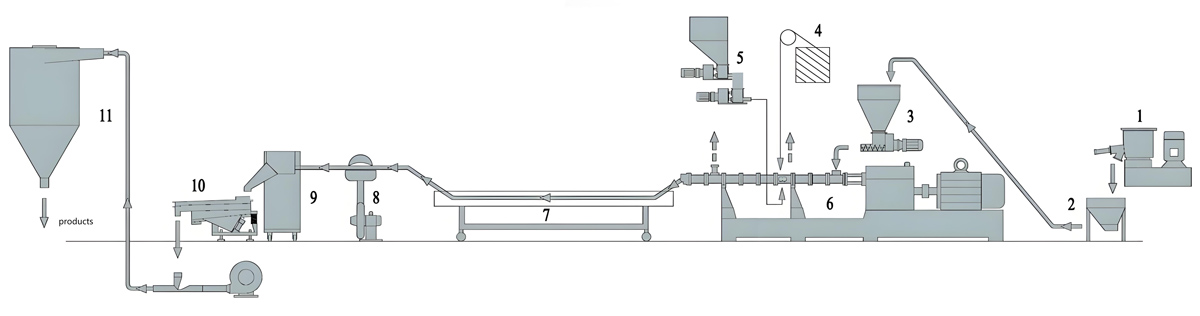
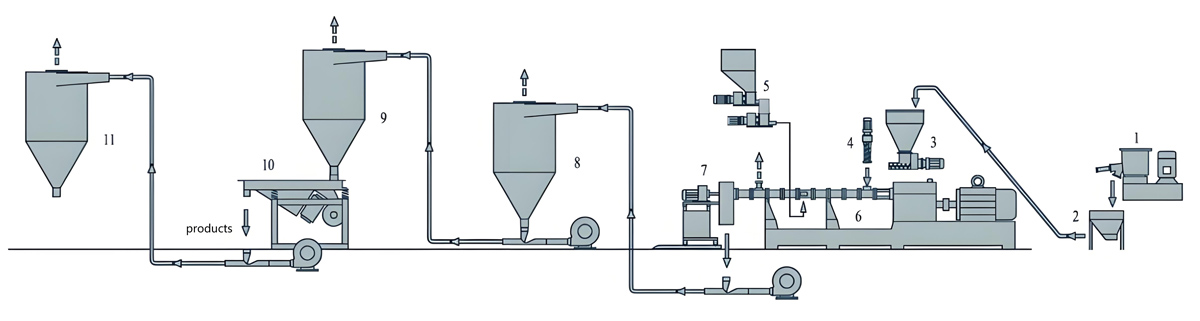
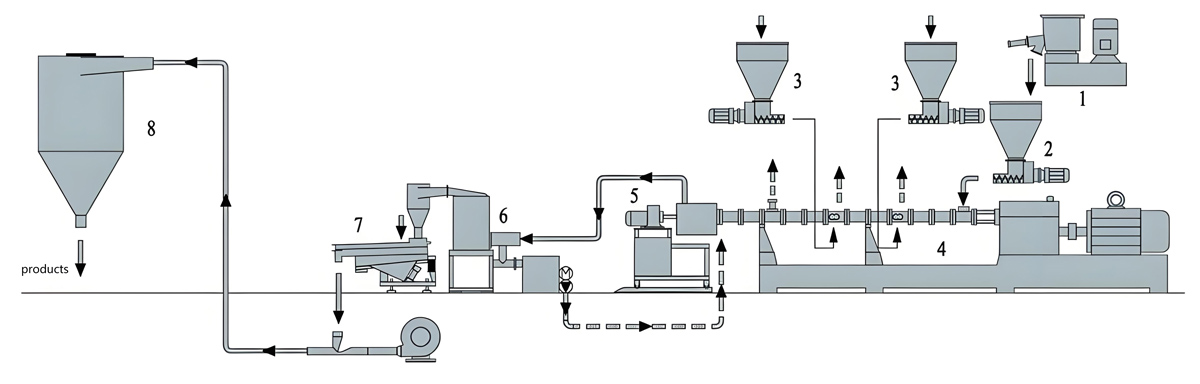
Anti-fog masterbatch represents a specialized category of additive concentrates designed to prevent condensation formation on transparent plastic surfaces, a critical requirement for food packaging, agricultural films, and optical applications. The production of anti-fog masterbatch demands precise control over additive distribution, particle size, and thermal stability to ensure consistent performance in end-use applications. Twin screw extruders have become the preferred equipment for anti-fog masterbatch manufacturing due to their superior mixing capabilities, precise temperature control, and ability to handle the complex formulations required for effective anti-fog performance.
The fundamental principle behind anti-fog masterbatch involves incorporating surfactant-based additives that migrate to the polymer surface during processing and use, forming a hydrophilic layer that reduces the surface tension of water droplets and prevents the formation of visible condensation. This technology is particularly valuable in applications where optical clarity and visibility must be maintained under humid conditions, such as fresh produce packaging, freezer bags, greenhouse films, and automotive headlight lenses. The effectiveness of anti-fog masterbatch depends heavily on achieving uniform additive distribution and maintaining the thermal stability of these temperature-sensitive surfactants during the compounding process.
Manufacturing high-quality anti-fog masterbatch requires a thorough understanding of polymer compatibility, additive chemistry, and processing conditions. The selection of appropriate twin screw extruder configuration, processing parameters, and quality control measures significantly impacts the final product performance. This comprehensive guide explores the technical aspects of anti-fog masterbatch production, providing detailed insights into formulation design, processing optimization, equipment selection, and troubleshooting strategies for achieving consistent, high-performance anti-fog masterbatch products.
Formulation Ratios for Anti-Fog Masterbatch (Different Types)
Anti-Fog Masterbatch for Polyethylene Applications (PE-AF-100)
Polyethylene-based anti-fog masterbatch formulations must account for the relatively low surface energy of PE and the need for efficient additive migration to the surface. The recommended formulation ratio for general-purpose PE anti-fog masterbatch consists of 75% low-density polyethylene (LDPE) with melt flow index of 2-4 g/10min as the carrier resin, 20% anti-fog active ingredient (typically a blend of non-ionic surfactants such as ethoxylated fatty alcohols), 3% processing aid (typically maleic anhydride grafted polyethylene), and 2% stabilizer package (anti-oxidants and thermal stabilizers). The anti-fog agent concentration of 20% provides effective fog prevention while maintaining good processing characteristics and mechanical properties in the final product. This formulation achieves anti-fog performance rated at 4-5 on the standard fog test scale (where 5 represents complete fog prevention), suitable for most food packaging applications.
For premium applications requiring enhanced anti-fog performance and longer lasting effects, the formulation can be modified to 70% carrier resin, 25% anti-fog active ingredient, 3% processing aid, and 2% stabilizer. The higher anti-fog agent loading extends the effective service life and provides superior performance in high-humidity environments. However, the increased surfactant content requires more precise processing control to prevent additive blooming and ensure uniform distribution. The anti-fog agent system for premium formulations typically incorporates a synergistic blend of non-ionic and anionic surfactants with different molecular weights and migration rates to provide both immediate and long-term anti-fog effects.
Anti-Fog Masterbatch for Polypropylene Applications (PP-AF-120)
Polypropylene presents different challenges for anti-fog additive formulation due to its higher melting temperature and different surface characteristics compared to polyethylene. The standard formulation ratio for PP anti-fog masterbatch comprises 72% polypropylene homopolymer with melt flow index of 8-12 g/10min, 23% anti-fog active ingredient (thermally stable ethoxylated compounds designed for higher processing temperatures), 3% compatibilizer (typically polypropylene grafted with maleic anhydride), and 2% high-temperature stabilizer package. The anti-fog agents used in PP formulations must withstand processing temperatures of 200-240°C without thermal degradation, requiring surfactants with higher ethoxylation degrees and improved thermal stability. This formulation achieves anti-fog ratings of 3-4 on the standard scale, suitable for applications such as microwave food containers and transparent packaging where moderate anti-fog performance is acceptable.
For high-temperature PP applications requiring superior anti-fog performance, the formulation ratio is adjusted to 68% carrier resin, 27% anti-fog active ingredient, 3% compatibilizer, and 2% stabilizer. The anti-fog agent system for these formulations incorporates proprietary high-molecular-weight surfactants with enhanced thermal stability, allowing operation at temperatures up to 250°C without significant degradation. The higher additive loading and surfactant stability provide anti-fog ratings of 4-5, making these formulations suitable for demanding applications such as retort pouches and hot-fill containers. However, the higher surfactant concentrations and processing temperatures require careful control of screw configuration and residence time to prevent surfactant migration to the mold surface during processing, which could cause sticking or surface defects.
Anti-Fog Masterbatch for Polystyrene Applications (PS-AF-80)
Polystyrene-based anti-fog masterbatch formulations require careful selection of anti-fog agents that are compatible with the aromatic polymer structure and can migrate effectively through the PS matrix. The recommended formulation ratio consists of 78% general purpose polystyrene (GPPS) with melt flow index of 8-12 g/10min, 18% anti-fog active ingredient (polystyrene-compatible ethoxylated surfactants), 3% processing aid (polystyrene grafted with styrene-maleic anhydride copolymer), and 1% stabilizer package. The lower anti-fog agent concentration compared to polyolefin formulations reflects the different migration characteristics and surfactant requirements in polystyrene. The anti-fog agents selected for PS applications must have appropriate solubility parameters to ensure adequate dispersion and controlled migration rates. This formulation achieves anti-fog ratings of 3-4, suitable for applications such as disposable food containers and transparent packaging where optical clarity is important.
For specialized PS applications requiring maximum anti-fog performance and optical clarity, the formulation can be modified to 75% carrier resin, 20% anti-fog active ingredient, 4% processing aid, and 1% stabilizer. The anti-fog agent system incorporates surfactants with refractive index matching that of polystyrene to minimize light scattering and maintain transparency. The processing aid concentration is increased to improve additive distribution and prevent surfactant accumulation at the die surface during extrusion, which could cause surface defects. This premium formulation achieves anti-fog ratings of 4-5 and maintains excellent optical clarity, making it suitable for high-end applications such as premium food packaging and consumer electronics components where both anti-fog performance and optical appearance are critical.
Anti-Fog Masterbatch for PET Applications (PET-AF-90)
Polyethylene terephthalate (PET) anti-fog masterbatch presents unique formulation challenges due to PET’s higher processing temperatures, sensitivity to hydrolysis, and the need for food-contact compliance. The standard formulation ratio for PET anti-fog masterbatch includes 70% PET resin with intrinsic viscosity of 0.65-0.72 dl/g, 25% anti-fog active ingredient (food-grade ethoxylated surfactants with PET compatibility), 3% compatibilizer (typically PET grafted with maleic anhydride or epoxy-functionalized polymer), and 2% stabilizer package (including hydrolytic stabilizers and thermal stabilizers). The anti-fog agents must be specifically selected for PET applications to ensure compatibility with the polyester polymer and compliance with food contact regulations. The high stabilizer concentration is necessary to protect both the PET resin and the temperature-sensitive surfactants from thermal and hydrolytic degradation during processing.
For bottle applications requiring excellent anti-fog performance and clarity, the formulation ratio is adjusted to 68% carrier resin, 27% anti-fog active ingredient, 3% compatibilizer, and 2% stabilizer. The anti-fog agent system incorporates surfactants with optimized molecular weight to provide effective migration through the PET matrix without affecting bottle clarity or mechanical properties. The formulations must be processed under strictly controlled moisture conditions (below 50 ppm) to prevent PET hydrolysis, which would reduce molecular weight and affect mechanical properties. This formulation achieves anti-fog ratings of 4-5 and maintains the excellent clarity and mechanical properties required for beverage bottle applications.
Anti-Fog Masterbatch for EVA Applications (EVA-AF-150)
Ethylene-vinyl acetate (EVA) copolymer anti-fog masterbatch is particularly important for agricultural films and greenhouse applications where excellent anti-fog performance is critical. The recommended formulation ratio consists of 70% EVA copolymer with vinyl acetate content of 18-28% and melt flow index of 3-6 g/10min, 25% anti-fog active ingredient (specifically designed for agricultural film applications with enhanced durability and UV stability), 3% processing aid (typically EVA-compatible lubricants), and 2% stabilizer package (including UV stabilizers and thermal stabilizers). The anti-fog agents for agricultural applications must provide long-lasting performance under outdoor conditions, resisting degradation from UV exposure and maintaining effectiveness over extended service periods. The higher vinyl acetate content in the EVA carrier improves compatibility with the anti-fog surfactants and enhances additive migration to the film surface.
For premium agricultural films requiring superior anti-fog performance and extended service life, the formulation ratio is modified to 65% carrier resin, 30% anti-fog active ingredient, 3% processing aid, and 2% stabilizer. The anti-fog agent system incorporates a synergistic blend of surfactants with different migration rates, providing both immediate and long-term anti-fog effects. The stabilizer package includes enhanced UV stabilizers to protect both the EVA matrix and the anti-fog agents from UV degradation, maintaining performance over the expected service life of agricultural films. This formulation achieves anti-fog ratings of 4-5 and maintains effectiveness for 6-12 months under normal outdoor exposure conditions.
Production Process for Anti-Fog Masterbatch
Raw Material Preparation and Premixing
The production process for anti-fog masterbatch begins with careful preparation of raw materials, with particular attention to the temperature-sensitive nature of anti-fog surfactants. Anti-fog active ingredients should be stored in climate-controlled conditions (15-25°C, 40-60% RH) to prevent moisture absorption and thermal degradation. Some anti-fog surfactants may be supplied in liquid form and should be stored in sealed containers to prevent evaporation. Carrier resins should be stored under similar conditions and preheated to 50-60°C before feeding to improve flow characteristics and reduce thermal shock to the temperature-sensitive additives.
For formulations containing solid anti-fog agents, these should be sieved through 80-mesh screens to remove agglomerates and ensure uniform particle size distribution. The premixing operation combines the carrier resin with solid components in a high-speed mixer for 3-4 minutes at 800-1000 rpm. Lower mixing speed and shorter mixing time compared to pigment masterbatch are necessary to prevent heat buildup that could degrade the temperature-sensitive anti-fog additives. The premix temperature should not exceed 40°C to maintain additive stability. For liquid anti-fog agents, these should not be premixed with solid components but instead injected directly into the extruder through a dedicated liquid injection port to prevent premature absorption or degradation.
Feeding and Melting
The feeding system for anti-fog masterbatch production requires precise control to maintain consistent additive concentrations, which directly affect anti-fog performance. Gravimetric feeders with accuracy of ±0.5% are essential for maintaining the tight tolerances required for anti-fog formulations. Feed rates are calculated based on extruder throughput capacity and formulation composition, with typical feed rates of 40-150 kg/hr depending on extruder size and formulation. The feed section temperature should be set 10-15°C below the melting point of the carrier resin, with additional consideration for the thermal sensitivity of anti-fog additives. For polyethylene-based formulations, the feed section temperature is typically set at 120-140°C, significantly lower than for pigment masterbatch to protect the temperature-sensitive surfactants.
The melting zone of the extruder, typically covering the first 3-4 barrel sections, is configured with forward-conveying elements to gradually melt the polymer carrier and initiate additive incorporation. Temperature in this zone increases progressively from the feed section to the target melt temperature, but with a more gradual gradient than for pigment masterbatch to protect anti-fog additives. Typical temperature gradients are 5°C per barrel section, compared to 8-10°C for pigment masterbatch. For PE-based anti-fog masterbatch, the melting zone typically operates at 150-170°C, for PP-based at 180-200°C, for PS-based at 190-210°C, and for PET-based at 230-250°C (with strict moisture control). The key objective is to achieve complete melting while minimizing the thermal exposure time for the temperature-sensitive surfactants.
Additive Incorporation and Mixing
The additive incorporation zone represents the most critical section of the extruder for anti-fog masterbatch production, where the surfactants must be uniformly distributed throughout the polymer matrix without thermal degradation. This zone typically comprises 4-6 barrel sections configured with a combination of mild kneading blocks and distributive mixing elements. Unlike pigment masterbatch, anti-fog masterbatch does not require high-intensity dispersive mixing, as the surfactants are typically supplied as finely divided powders or liquids that distribute readily. However, uniform distributive mixing is essential to ensure consistent anti-fog performance throughout the final product.
For solid anti-fog additives, a screw configuration including mixing elements such as toothed elements or blister rings provides effective distributive mixing without generating excessive shear heat. For liquid anti-fog additives injected through a dedicated port, the screw configuration includes reverse-conveying elements downstream of the injection point to create a mixing zone where the liquid additive can be thoroughly incorporated into the polymer melt. Processing temperatures in this zone are maintained at the minimum necessary for adequate additive incorporation, typically 160-180°C for PE-based formulations, 190-210°C for PP-based, 200-220°C for PS-based, and 240-260°C for PET-based.
The screw speed during additive incorporation is set lower than for pigment masterbatch to minimize viscous heating. Typical screw speeds range from 150-250 rpm depending on the formulation and extruder size. The lower screw speed reduces the residence time at elevated temperatures, protecting the temperature-sensitive surfactants from thermal degradation. However, sufficient mixing must still be achieved to ensure uniform additive distribution. The balance between mixing intensity and thermal protection is achieved through careful optimization of screw configuration, temperature profile, and screw speed for each specific formulation.
Degassing and Filtration
After additive incorporation, the melt passes through a vacuum vent zone where any volatile components from the anti-fog additives or entrapped air are removed from the melt. The vacuum level for anti-fog masterbatch production is typically maintained at 600-800 mbar absolute pressure, slightly less stringent than for pigment masterbatch due to the lower volatile content in most anti-fog formulations. However, proper degassing is still essential to prevent surface defects and ensure consistent anti-fog performance. The vent zone temperature is maintained at 5-10°C lower than the preceding mixing zone to stabilize melt viscosity and improve degassing efficiency while protecting temperature-sensitive additives.
Filtration for anti-fog masterbatch is generally less critical than for pigment masterbatch, as the additives are typically supplied in fine particle form or as liquids. However, filtration is still recommended to remove any agglomerates or contaminants that could affect product quality. A single filtration system with mesh size of 300-500 μm is typically sufficient for most anti-fog formulations. The filtration housing temperature should be maintained at the same temperature as the preceding barrel section to prevent melt solidification and ensure consistent flow. For formulations with solid anti-fog additives that tend to agglomerate, a finer mesh size of 200-300 μm may be used to ensure removal of any undispersed particles.
Pellitizing and Cooling
The final stage of anti-fog masterbatch production involves pelletizing the extrudate into uniform pellets suitable for downstream processing. Water bath strand pelletizing is the most common method for anti-fog masterbatch production, similar to other masterbatch types. The die plate temperature should be set 5-10°C above the melt temperature to ensure smooth extrusion, but care must be taken not to exceed the thermal stability limits of the anti-fog additives. For most anti-fog formulations, die temperatures of 170-190°C for PE-based, 200-220°C for PP-based, 210-230°C for PS-based, and 250-270°C for PET-based are typical.
The strand cooling system should provide rapid cooling to lock in the additive distribution achieved during extrusion and prevent surfactant migration during cooling. Water bath temperature is typically 15-20°C for anti-fog masterbatch, slightly cooler than for pigment masterbatch to achieve rapid quenching. Residence time in the water bath is 2-3 seconds depending on strand diameter. After pelletizing, the pellets should be dried in a centrifugal dryer followed by convection drying at 50-60°C for 1-2 hours. Lower drying temperatures than for pigment masterbatch are used to prevent thermal degradation of anti-fog additives on the pellet surface. The final product should be packaged in moisture-barrier bags with desiccant to maintain product quality during storage.
Production Equipment Introduction
KTE Series Twin Screw Extruder Configuration for Anti-Fog Masterbatch
The KTE Series twin screw extruders from Nanjing Kerke Extrusion Equipment Company offer excellent performance for anti-fog masterbatch production through their modular design and precise control capabilities. For anti-fog applications, models with L/D ratios of 36:1 to 40:1 are typically recommended, providing sufficient mixing length for uniform additive distribution while minimizing residence time to protect temperature-sensitive surfactants. The KTE-50 model (50mm screw diameter) and KTE-65 model (65mm screw diameter) are particularly well-suited for commercial anti-fog masterbatch production, offering throughput capacities of 50-200 kg/hr and 100-300 kg/hr respectively.
The barrel design of KTE Series extruders is especially important for anti-fog masterbatch production due to the need for precise temperature control to protect sensitive additives. The segmented barrel with individual temperature control for each section allows for customized temperature profiling that minimizes thermal exposure of anti-fog agents while ensuring adequate melting and mixing. Temperature stability of ±1°C is essential for consistent anti-fog performance. The barrel bore is hard-chrome plated with surface roughness Ra 0.4 μm or better to minimize material hang-up and prevent degradation of anti-fog additives in stagnant areas.
The screw configuration for anti-fog masterbatch production differs significantly from that for pigment masterbatch. Instead of high-intensity kneading blocks for dispersive mixing, anti-fog masterbatch requires distributive mixing elements that provide uniform additive distribution without generating excessive shear heat. A typical screw configuration for anti-fog masterbatch includes forward-conveying elements in the feed and melting sections, followed by distributive mixing elements such as toothed elements or blister rings in the additive incorporation zone, and a final conveying section to build pressure for extrusion. For formulations with liquid anti-fog additives, reverse-conveying elements are incorporated downstream of the injection point to create effective mixing zones.
Liquid Additive Injection System
Many anti-fog masterbatch formulations incorporate liquid surfactants that must be precisely injected into the extruder. The KTE Series extruders are compatible with precision liquid additive injection systems that are essential for maintaining consistent additive levels in anti-fog masterbatch production. These systems typically consist of a temperature-controlled storage tank, precision metering pump, injection nozzle, and associated piping and controls.
The precision metering pump for anti-fog additive injection should have flow control accuracy of ±1.0% or better to maintain the tight tolerances required for consistent anti-fog performance. Gear pumps or piston pumps with variable speed control are commonly used, providing flow rates of 0.5-50 kg/hr depending on formulation requirements. The injection nozzle is typically located in barrel section 4-6 of the extruder, downstream of the melting zone but upstream of the final mixing zones. The injection point should be equipped with a check valve to prevent melt backflow into the injection system.
Temperature control of the liquid additive is critical to maintain consistent viscosity and prevent degradation. The storage tank and injection lines should be equipped with heating jackets and temperature controls, maintaining the additive at 40-60°C depending on the specific surfactant. The injection system should include pressure sensors and flow monitoring to ensure consistent delivery and detect any blockages or malfunctions that could affect product quality. For formulations with multiple liquid additives, separate injection systems should be used to prevent cross-contamination and allow independent control of each additive.
Vacuum Venting System
Proper vacuum venting is essential for anti-fog masterbatch production to remove volatile components from the surfactants and any entrapped air. The KTE Series extruders can be equipped with vented barrel sections equipped with vacuum ports and associated vacuum pumps. For anti-fog masterbatch production, a single vent port is typically sufficient, located downstream of the additive incorporation zone.
The vacuum system should be capable of maintaining vacuum levels of 600-800 mbar absolute pressure. Vacuum pumps with appropriate capacity for the vented barrel volume and gas loading are essential. Liquid ring vacuum pumps are commonly used for this application due to their ability to handle vapors and maintain stable vacuum levels. The vacuum vent should be equipped with a melt seal to prevent polymer melt from entering the vacuum system. The melt seal is typically achieved through a reverse-conveying screw element or a gear pump that builds pressure before the vent zone.
The vent line should be equipped with a condenser to condense any volatiles from the anti-fog additives, protecting the vacuum pump and environmental control systems. The condenser should be maintained at a temperature low enough to effectively condense the volatiles but high enough to prevent freezing. Regular maintenance of the vacuum system, including cleaning of vent lines, condenser, and vacuum pump, is essential for consistent performance and prevention of contamination.
Feeding Systems
Accurate feeding is critical for anti-fog masterbatch production due to the direct relationship between additive concentration and anti-fog performance. The KTE Series extruders are compatible with gravimetric feeding systems that provide the accuracy required for consistent formulation ratios. For anti-fog masterbatch production, a main gravimetric feeder for the carrier resin and solid components typically has a capacity of 40-200 kg/hr with accuracy of ±0.5%.
For formulations containing solid anti-fog additives, a secondary gravimetric feeder for these minor components may be used, particularly when precise control of additive concentration is required. These minor component feeders typically have capacities of 1-20 kg/hr with accuracy of ±1.0%. However, many anti-fog formulations premix the solid components and feed them through a single feeder to ensure uniform distribution before entering the extruder.
For liquid anti-fog additives, the precision injection system described above provides accurate metering. Some formulations may use both solid and liquid anti-fog additives, requiring a combination of gravimetric feeding for solid components and precision injection for liquids. The feeding system should be equipped with level sensors and hopper agitation to ensure consistent material flow and prevent bridging or rat-holing, particularly for fine-particle anti-fog additives that tend to fluidize.
Pellitizing and Cooling Equipment
The pelletizing system for anti-fog masterbatch production is similar to that for other masterbatch types, with some considerations for the temperature-sensitive nature of anti-fog additives. Water bath strand pelletizing is the most common method, providing uniform pellets with good dimensional consistency. The water bath temperature is maintained at 15-20°C for rapid cooling, as described in the production process section.
The pelletizer should be equipped with sharp cutting blades to ensure clean cuts and prevent string formation. However, blade materials and coatings should be selected to minimize frictional heating that could degrade anti-fog additives on the pellet surface. Stainless steel blades with appropriate coatings are commonly used for anti-fog masterbatch production. The pelletizer cutting speed should be optimized to produce consistent pellet dimensions while minimizing heat generation.
The drying system for anti-fog masterbatch typically includes a centrifugal dryer to remove surface water followed by convection drying at moderate temperatures. The convection dryer temperature should not exceed 60-70°C to prevent thermal degradation of anti-fog additives on the pellet surface. The drying time is typically 1-2 hours depending on pellet size and moisture content. Proper drying prevents moisture absorption during storage, which could affect anti-fog performance in downstream applications.
Auxiliary Equipment
Complete anti-fog masterbatch production lines require several pieces of auxiliary equipment beyond the main extruder. Material drying equipment is critical for hygroscopic carrier resins, particularly for PET and EVA formulations. Dehumidifying dryers with capacity of 300-3000 kg/hr are typically used, with drying temperatures of 80-120°C depending on material requirements. For PET formulations, the drying must achieve moisture content below 50 ppm to prevent hydrolysis during processing.
Process water systems provide cooling water for barrel cooling, die cooling, and strand pelletizing operations. These systems include chillers with capacity of 15-150 kW depending on extruder size and ambient conditions, circulating pumps, and temperature control units for maintaining consistent water temperature. The process water temperature control is particularly important for anti-fog masterbatch production to ensure rapid and consistent cooling.
Dust collection systems are installed at feeding and pelletizing points to maintain clean production environment and prevent cross-contamination between different formulations. For anti-fog masterbatch production, dust collection is particularly important due to the potential for airborne surfactant particles to affect product quality and operator safety.
Parameter Settings for Anti-Fog Masterbatch Production
Temperature Profile Settings
The temperature profile for anti-fog masterbatch production is significantly lower and more gradual than for pigment masterbatch to protect temperature-sensitive surfactants. For polyethylene-based anti-fog masterbatch on a KTE Series extruder with 10 barrel sections (L/D ratio 40:1), a typical temperature profile is: Barrel Section 1 (feed zone): 120°C; Barrel Section 2: 135°C; Barrel Section 3: 150°C; Barrel Section 4-6 (melting and mixing zone): 160-170°C; Barrel Section 7 (vent zone): 155°C; Barrel Section 8-9 (final mixing): 165-170°C; Barrel Section 10 (metering zone): 170°C. The die temperature is set at 175°C. This profile minimizes thermal exposure while ensuring adequate melting and mixing.
For polypropylene-based anti-fog masterbatch, the temperature profile is set higher but still conservative to protect additives: Barrel Section 1: 150°C; Barrel Section 2: 165°C; Barrel Section 3: 180°C; Barrel Section 4-6: 195-205°C; Barrel Section 7: 190°C; Barrel Section 8-9: 200-205°C; Barrel Section 10: 205°C; Die: 210°C. For formulations with thermally stable surfactants, the dispersion zone temperature may be increased by 5-10°C, but this should be balanced against the potential for surfactant degradation.
For polystyrene-based anti-fog masterbatch: Barrel Section 1: 170°C; Barrel Section 2: 185°C; Barrel Section 3: 200°C; Barrel Section 4-6: 210-220°C; Barrel Section 7: 205°C; Barrel Section 8-9: 215-220°C; Barrel Section 10: 220°C; Die: 225°C. The temperatures are kept lower than for pigment masterbatch to protect the temperature-sensitive surfactants used in PS applications.
For PET-based anti-fog masterbatch, the temperature profile must be carefully controlled while maintaining the higher temperatures required for PET processing: Barrel Section 1: 220°C; Barrel Section 2: 230°C; Barrel Section 3: 240°C; Barrel Section 4-6: 250-260°C; Barrel Section 7: 245°C; Barrel Section 8-9: 255-260°C; Barrel Section 10: 260°C; Die: 265°C. Strict moisture control below 50 ppm is essential to prevent hydrolysis. The temperatures are kept at the minimum necessary for PET processing to minimize thermal degradation of anti-fog additives.
Screw Speed and Throughput Settings
Screw speed for anti-fog masterbatch production is set lower than for pigment masterbatch to minimize residence time at elevated temperatures and reduce viscous heating that could degrade temperature-sensitive surfactants. For PE-based anti-fog masterbatch on KTE Series extruders, screw speeds between 150-250 rpm are typically optimal. The exact speed depends on formulation viscosity and required mixing intensity, with higher speeds used for formulations with better thermal stability. Throughput is typically set between 60-120 kg/hr for a 50mm extruder, with specific rates adjusted to maintain residence time of 2-2.5 minutes in the mixing zone.
For PP-based anti-fog masterbatch, screw speeds of 180-280 rpm are typical, with throughputs of 80-150 kg/hr for a 50mm extruder. The higher screw speeds compared to PE formulations compensate for the higher melt viscosity of PP while still maintaining acceptable residence times. For PS-based anti-fog masterbatch, screw speeds of 200-300 rpm with throughputs of 70-140 kg/hr for a 50mm extruder are typical. For PET-based anti-fog masterbatch, lower screw speeds of 150-200 rpm are used despite the higher processing temperatures, with throughputs of 50-100 kg/hr for a 50mm extruder. The lower screw speed for PET reduces viscous heating and protects the temperature-sensitive surfactants while still providing adequate mixing.
Liquid Additive Injection Parameters
For formulations with liquid anti-fog additives, the injection parameters must be precisely controlled to maintain consistent additive levels. The injection rate is calculated based on the total throughput and formulation composition, with typical injection rates of 0.5-30 kg/hr depending on the formulation. The injection point is typically in barrel section 5-6 of the extruder, ensuring adequate mixing downstream while protecting the additive from excessive thermal exposure.
The liquid additive temperature should be maintained at 40-60°C during injection, depending on the specific surfactant viscosity characteristics. The injection pressure should be maintained 5-10 bar above the melt pressure at the injection point to ensure consistent flow and prevent melt backflow. The injection system should include flow monitoring and feedback control to maintain injection rates within ±1.0% of setpoint. For formulations with multiple liquid additives, each should have independent injection systems with appropriate spacing along the extruder barrel.
Vacuum and Venting Settings
Vacuum settings for anti-fog masterbatch production are less stringent than for pigment masterbatch but still important for product quality. Typical vacuum levels of 600-800 mbar absolute pressure are maintained in the vent zone. The exact vacuum level depends on the volatile content of the specific anti-fog formulation, with higher vacuum levels used for formulations with higher surfactant volatility. The vent zone temperature is maintained 5-10°C below the preceding mixing zone to improve degassing efficiency while protecting additives.
The vacuum system should be capable of maintaining stable vacuum levels despite variations in volatile loading from the anti-fog additives. The vacuum pump capacity should be sized appropriately for the vented barrel volume and expected gas loading. Regular monitoring of vacuum level and pump performance is essential to ensure consistent degassing and prevent vacuum system issues that could affect product quality.
Melt Pressure Settings
Melt pressure monitoring for anti-fog masterbatch production follows similar principles to other masterbatch types, with typical pressure ranges of 20-40 bar in the metering zone and 15-35 bar post-filtration. The exact pressure depends on formulation viscosity and processing conditions. Pressure variations of more than ±3 bar from normal operating range should be investigated, as they may indicate processing issues such as temperature variations, filtration issues, or formulation changes.
Melt pressure sensors should be installed at multiple points along the extruder to monitor pressure development and detect developing issues. The filtration system pressure drop should be monitored, with typical allowable pressure drop of 5 bar or less for the single filtration system commonly used in anti-fog masterbatch production. Increasing pressure drop indicates filter loading and the need for screen change.
Equipment Price for Anti-Fog Masterbatch Production
KTE Series Twin Screw Extruder Pricing
The investment in twin screw extruder equipment for anti-fog masterbatch production varies depending on production capacity and specific configuration requirements. For anti-fog applications, models with L/D ratios of 36:1 to 40:1 are typically recommended, providing adequate mixing length while minimizing residence time. The most commonly used KTE Series models for anti-fog masterbatch production and their approximate prices are:
KTE-32 model (32mm screw diameter, L/D 36:1, throughput 15-40 kg/hr): US$80,000 – US$95,000. This model is suitable for pilot scale production or formulations requiring frequent changes. The shorter L/D ratio compared to pigment masterbatch applications reduces residence time and better protects temperature-sensitive anti-fog additives.
KTE-50 model (50mm screw diameter, L/D 40:1, throughput 50-150 kg/hr): US$155,000 – US$180,000. This is the most commonly used model for commercial anti-fog masterbatch production, providing an excellent balance between capacity and thermal protection for additives. The 50mm diameter provides good mixing performance with distributive elements while the 40:1 L/D ratio provides adequate mixing length without excessive residence time.
KTE-65 model (65mm screw diameter, L/D 40:1, throughput 100-250 kg/hr): US$270,000 – US$310,000. This model is suitable for higher volume production operations or facilities producing multiple anti-fog formulations with frequent changeovers. The larger diameter provides increased capacity while maintaining the thermal protection requirements for anti-fog additives.
KTE-75 model (75mm screw diameter, L/D 40:1, throughput 150-350 kg/hr): US$370,000 – US$420,000. This full-scale production model is designed for high-volume anti-fog masterbatch production with established product lines. The larger capacity provides economies of scale for high-demand applications while still maintaining the temperature control necessary for additive stability.
Special configurations for anti-fog masterbatch production, such as vented barrel sections, liquid injection ports, and specialized screw configurations for distributive mixing, may add 10-20% to the base equipment cost. Installation and commissioning typically cost 10-15% of equipment price. Operator training for anti-fog masterbatch production, including liquid additive system operation and temperature-sensitive material handling, costs US$2,500 – US$6,000 depending on program content and duration.
Auxiliary Equipment Pricing
Liquid additive injection system with precision metering pump, temperature control, and associated piping: US$15,000 – US$30,000. This system is essential for formulations with liquid anti-fog agents and represents a key difference from pigment masterbatch production lines. The precision of this system directly affects the consistency of anti-fog performance.
Vacuum venting system with vented barrel section, liquid ring vacuum pump, condenser, and associated piping: US$25,000 – US$45,000. While less complex than systems required for pigment masterbatch with multiple vent zones, the vacuum system is still important for removing volatiles from anti-fog surfactants.
Gravimetric feeder system for main ingredients (capacity 40-200 kg/hr, accuracy ±0.5%): US$22,000 – US$40,000. For formulations requiring precise control of solid anti-fog additives, a secondary gravimetric feeder (capacity 1-20 kg/hr, accuracy ±1.0%) costs US$10,000 – US$18,000. However, many anti-fog formulations premix components and use a single feeder.
Single melt filtration system with manual or automated screen changer (mesh 300-500 μm): US$20,000 – US$35,000. Anti-fog masterbatch typically requires less stringent filtration than pigment masterbatch, and single filtration systems are generally adequate.
Water bath strand pelletizing system with centrifugal dryer: US$32,000 – US$50,000. The pelletizing system is similar to other masterbatch types, but may include features for reduced heat generation during cutting to protect anti-fog additives.
Dehumidifying dryer (capacity 300-3000 kg/hr): US$18,000 – US$55,000. Drying is particularly important for hygroscopic resins like PET and EVA used in anti-fog masterbatch formulations.
Process water system including chiller, circulating pumps, and temperature control (capacity 15-150 kW): US$12,000 – US$40,000. Precise water temperature control is important for consistent cooling of anti-fog masterbatch.
Complete Production Line Investment
For a complete anti-fog masterbatch production line based on a KTE-50 extruder (50mm diameter, 50-150 kg/hr throughput), the approximate equipment cost breakdown is:
- Main extruder (KTE-50 with vented barrel and liquid injection): US$170,000
- Liquid additive injection system: US$22,000
- Vacuum venting system: US$30,000
- Feeding systems (2 gravimetric feeders): US$32,000
- Filtration system: US$28,000
- Pelletizing system with dryer: US$40,000
- Dehumidifying dryer: US$30,000
- Process water system: US$25,000
- Dust collection system: US$15,000
- Installation and commissioning: US$40,000
- Initial spare parts and tooling: US$20,000
Total investment for complete KTE-50 based anti-fog masterbatch production line: approximately US$450,000 – US$550,000, depending on specific configuration and formulation requirements.
For higher capacity lines based on KTE-65 or KTE-75 extruders, the investment scales approximately proportionally to production capacity. A line based on a KTE-65 extruder would require approximately US$750,000 – US$900,000, while a line based on a KTE-75 extruder would require US$1,000,000 – US$1,200,000.
Operating costs for anti-fog masterbatch production are somewhat higher than for basic pigment masterbatch due to the higher cost of anti-fog surfactants and the need for more precise temperature control. Raw material costs typically represent 65-75% of total production costs, with anti-fog active ingredients accounting for 30-40% of material costs. Energy costs represent 5-8%, labor 6-10%, maintenance 4-6%, and quality control 3-4%. Profit margins vary depending on market and application but typically range from 20-35% for standard anti-fog masterbatch products and 35-50% for premium formulations with enhanced performance and food-contact compliance.
Common Problems and Solutions in Anti-Fog Masterbatch Production
Inadequate Anti-Fog Performance
Problem Analysis: Inadequate anti-fog performance manifests as fog formation on the surface of end products under humid conditions, despite the presence of anti-fog masterbatch. This issue can result from insufficient additive concentration, poor additive distribution, additive degradation during processing, or incompatibility between the anti-fog agent and the carrier or final application polymer. The anti-fog effect depends on surfactants migrating to the polymer surface and forming a hydrophilic layer that reduces water surface tension. Any factor affecting surfactant concentration at the surface or surfactant functionality can reduce anti-fog performance.
Root Cause Analysis: Insufficient additive concentration can result from inaccurate feeding of anti-fog agents, particularly with liquid surfactants where metering pump calibration drift can cause significant concentration variations. Poor additive distribution results from inadequate mixing in the extruder, causing localized areas with lower or higher additive concentrations that lead to inconsistent performance. Additive degradation during processing occurs when processing temperatures exceed the thermal stability limits of surfactants, or when residence time at elevated temperature is too long, causing chemical changes that reduce surfactant effectiveness. Incompatibility issues arise when the anti-fog agent chemistry is not properly matched to the carrier resin or the final application polymer, reducing migration rate or surface effectiveness.
Solution: For insufficient additive concentration, implement regular calibration of gravimetric feeders and liquid injection pumps using certified test weights and flow meters. For liquid additive systems, implement flow monitoring with real-time feedback control to maintain injection rates within ±1.0% of setpoint. Check for wear or damage to feeder components that could affect accuracy, and replace as needed. For formulations with solid anti-fog additives, implement stricter control of premixing quality to ensure uniform distribution before feeding.
For poor additive distribution, modify screw configuration to include more distributive mixing elements such as toothed elements or blister rings in the additive incorporation zone. The mixing elements should be spaced at 2-3 barrel diameters apart to ensure multiple mixing events. For formulations with liquid anti-fog additives, ensure adequate mixing downstream of the injection point by including reverse-conveying elements to create a dedicated mixing zone. Verify that the mixing elements are not worn and still provide effective distributive action, replacing as necessary.
For additive degradation issues, reduce processing temperatures to the minimum necessary for adequate melting and mixing, with particular attention to the maximum temperature exposure. Optimize temperature profile to reduce residence time at elevated temperatures while still achieving adequate mixing. Lower screw speed may be used to reduce viscous heating, but this must be balanced against the need for adequate mixing. Consider using extruders with shorter L/D ratios for formulations with extremely thermally sensitive surfactants. Implement antioxidant or stabilizer additives in the formulation to protect surfactants from thermal and oxidative degradation.
For compatibility issues, conduct compatibility testing between anti-fog agents and carrier resins using small-scale trials before full production. Evaluate migration rates and surface effectiveness for different anti-fog agent chemistries in the specific polymer system. Consider using compatibilizers such as maleic anhydride grafted polymers to improve additive distribution and migration. For applications where anti-fog performance is marginal, consider increasing additive concentration by 2-5% to compensate for compatibility limitations, but this must be balanced against potential for additive blooming or other negative effects.
Prevention: Implement regular anti-fog performance testing using standard fog test methods such as the fog test according to ASTM D1003 or equivalent. Test samples from each production batch using standardized conditions (temperature, humidity) to verify performance meets specification. Establish minimum anti-fog ratings for different applications, with typical requirements of rating 3-4 for general applications and rating 4-5 for premium applications. Maintain statistical process control charts for anti-fog performance to detect trends indicating potential formulation or processing issues. Conduct periodic customer feedback to verify that anti-fog performance meets end-use requirements under actual application conditions.
Surfactant Blooming and Migration Issues
Problem Analysis: Surfactant blooming occurs when anti-fog additives migrate to the surface excessively, forming visible deposits or causing surface tackiness. This issue can result from excessive additive concentration, incompatibility between surfactant and polymer, improper processing conditions causing additive migration during processing rather than during use, or insufficient stabilization of the formulation. Blooming affects product appearance and can interfere with downstream processing operations such as printing or lamination.
Root Cause Analysis: Excessive additive concentration typically results from formulation errors where the anti-fog agent content is too high for the specific polymer system, or from feeding inaccuracies that cause higher than intended additive levels. Incompatibility issues arise when the surfactant has too high migration rate in the polymer matrix, or when the surfactant chemistry is not properly matched to the polymer. Processing condition problems occur when temperatures are too high or residence time too long, causing additive migration during extrusion and pelletizing rather than controlled migration during end use. Insufficient stabilization results when the formulation lacks appropriate additives to control surfactant migration rate and maintain proper distribution within the polymer matrix.
Solution: For excessive additive concentration, review formulation design and reduce anti-fog agent content to the minimum level that provides adequate performance. Conduct performance testing at different additive concentrations to identify the optimal balance between anti-fog effectiveness and blooming tendency. Verify feeder and injection system calibration to ensure additive levels are within specified tolerance. For formulations where blooming occurs despite correct additive concentration, consider using surfactants with lower molecular weight or different chemistry that have reduced migration tendency.
For compatibility issues, select anti-fog agents with appropriate migration rates for the specific polymer system. Higher molecular weight surfactants generally migrate more slowly and reduce blooming tendency. Consider using combinations of surfactants with different migration rates to provide both initial and long-term anti-fog effects while minimizing surface blooming. Implement compatibilizers in the formulation to improve surfactant distribution and control migration. Conduct compatibility and migration testing during formulation development to identify potential blooming issues before full production.
For processing condition issues, reduce processing temperatures to the minimum necessary for adequate processing, particularly in the final barrel sections and die area. Lower temperatures reduce the mobility of surfactants during processing and minimize migration to surfaces. Optimize residence time by adjusting throughput and screw speed to minimize thermal exposure while still achieving adequate mixing. Ensure that cooling after extrusion is rapid and uniform to lock the additive distribution achieved during processing. For formulations prone to blooming during processing, consider using slightly lower additive concentrations and compensating through improved surfactant effectiveness.
For insufficient stabilization issues, implement anti-blooming agents or migration control additives in the formulation. These additives can help control surfactant distribution and migration rate, preventing excessive surface accumulation. The type and concentration of migration control agents must be carefully selected and tested to ensure they do not interfere with anti-fog performance. Consider using surfactants with built-in migration control features or formulations that include synergistic additive packages to control both anti-fog performance and migration behavior.
Prevention: Implement visual inspection of pellets and test specimens for signs of blooming or surface deposits. Conduct surface analysis techniques such as FTIR or GC-MS to detect surfactant accumulation on surfaces. Monitor processing conditions to ensure they remain within specified ranges that prevent processing-induced blooming. Maintain formulation records with detailed additive specifications and migration characteristics. Conduct periodic testing of end products under accelerated aging conditions to verify that blooming does not develop over time. Customer feedback should be monitored for reports of surface issues or deposit formation in end-use applications.
Thermal Degradation of Anti-Fog Agents
Problem Analysis: Thermal degradation of anti-fog agents during processing can significantly reduce anti-fog performance and may also cause discoloration, odor formation, or other product defects. Anti-fog surfactants are typically more thermally sensitive than pigments and many other additives, making careful thermal control essential during compounding. Degradation can occur from excessive processing temperatures, prolonged residence time at elevated temperatures, or from localized hot spots in the extruder or die.
Root Cause Analysis: Excessive processing temperatures result from setting barrel temperatures too high for the specific anti-fog agent thermal stability, or from inadequate cooling control allowing temperature excursions above setpoints. Prolonged residence time occurs when throughput is too low or screw configuration includes unnecessary mixing zones that extend the time the material spends at elevated temperature. Localized hot spots can develop in areas of high shear, in dead zones where material stagnates, or in the die area where cooling may be inadequate. Surfactant degradation can also be accelerated by the presence of oxygen or other reactive species in the processing environment.
Solution: For excessive temperature issues, reduce barrel temperature settings to the minimum necessary for adequate processing of the specific formulation. Develop temperature profiles that gradually increase through the extruder but stay below the thermal stability limits of the anti-fog agents. Implement tighter temperature control with more responsive controllers and improved cooling capacity to maintain temperatures within ±1°C of setpoint. Monitor actual melt temperature at multiple points along the extruder using melt temperature probes to verify that actual conditions match settings. For formulations that require higher temperatures due to carrier resin requirements, consider using anti-fog agents with enhanced thermal stability.
For residence time issues, increase throughput to reduce the time material spends in the heated zones of the extruder. Optimize screw configuration to eliminate unnecessary mixing zones or recirculation areas that extend residence time. Use shorter L/D ratio extruders for formulations with extremely thermally sensitive surfactants, provided adequate mixing can still be achieved. For formulations requiring both good mixing and short residence time, consider using extruders with higher screw speed capability to increase mixing intensity without extending residence time.
For hot spot issues, inspect extruder barrel and screw for wear or damage that could create areas of stagnation or excessive shear. Replace worn elements that could create dead zones where material degrades. Ensure that cooling channels in the barrel are functioning properly and providing uniform cooling. Optimize die temperature to prevent overheating while still maintaining good flow characteristics. Consider using dies with improved cooling designs or internal temperature control for formulations that are particularly sensitive to thermal degradation.
For oxidative degradation issues, implement inert gas purging (nitrogen or argon) in the feed zone and vent zones to reduce oxygen content in the processing environment. Ensure that vacuum venting systems are functioning properly to remove volatile degradation products that could accelerate further degradation. Consider adding antioxidant additives to the formulation to provide additional thermal and oxidative protection for anti-fog agents. Use antioxidant-stabilized carrier resins when available to reduce the overall oxidative degradation potential.
Prevention: Implement regular thermal stability testing of anti-fog agents and final masterbatch products using techniques such as TGA (thermogravimetric analysis) or DSC (differential scanning calorimetry). Monitor discoloration or odor development during production as early indicators of thermal degradation. Conduct accelerated aging tests on final products to verify that anti-fog performance is maintained over the expected service life. Maintain detailed processing temperature logs for each batch to establish optimal conditions and detect trends indicating thermal stress. Implement regular maintenance of temperature control systems including calibration of sensors, inspection of heating elements, and verification of cooling system performance.
Inconsistent Additive Distribution
Problem Analysis: Inconsistent distribution of anti-fog additives throughout the masterbatch pellets can lead to variable anti-fog performance in end products, with some areas or batches performing well while others show inadequate fog prevention. Distribution inconsistency can result from inadequate mixing, segregation of components during feeding or processing, or localized additive concentration variations due to processing conditions.
Root Cause Analysis: Inadequate mixing stems from screw configuration that provides insufficient distributive mixing, worn mixing elements that no longer provide effective mixing, or processing conditions (low screw speed, short residence time) that prevent adequate distribution. Segregation can occur when solid anti-fog additives have different particle size or density than the carrier resin, causing separation during feeding, hopper discharge, or conveying. For liquid additives, inconsistent distribution can result from improper injection point location, inadequate mixing downstream of injection, or variations in injection rate.
Solution: For inadequate mixing, modify screw configuration to include more distributive mixing elements such as toothed elements, blister rings, or other elements designed for lateral mixing. Space mixing elements at 2-3 barrel diameters apart to ensure multiple mixing events throughout the extruder length. Replace worn mixing elements that have lost effectiveness due to wear or damage. Increase screw speed moderately (by 10-20%) to enhance mixing action, while monitoring for excessive temperature increase. Consider using twin screw extruders with specialized distributive mixing elements specifically designed for additive masterbatch applications.
For segregation issues, implement hopper agitation systems to prevent component separation during feeding and discharge. Use mass flow hopper designs rather than funnel flow designs to minimize segregation. Consider using intermediate hoppers with recirculation to maintain homogeneity before final feeding. For formulations with extreme particle size or density differences, consider feeding components through separate feeders and combining them in the extruder throat rather than premixing. For solid anti-fog additives that tend to segregate, consider pre-dispersing them in a carrier resin at higher concentration before final addition to the masterbatch formulation.
For liquid additive distribution issues, optimize injection point location to provide adequate mixing downstream while avoiding excessive thermal exposure. Typically, injection in barrel section 5-6 provides 2-3 barrel sections for mixing before extrusion. Include reverse-conveying elements downstream of injection to create dedicated mixing zones. Ensure that mixing elements are properly configured for effective liquid incorporation. Implement real-time monitoring of injection rate with feedback control to maintain consistent addition. For formulations with multiple liquid additives, use separate injection systems with appropriate spacing to prevent interference between additives.
For processing condition issues, ensure that temperature profile and screw speed are stable and consistent. Temperature variations can cause viscosity differences that affect mixing efficiency. Implement process control algorithms to maintain stable operating conditions. Monitor melt pressure as an indicator of consistent material flow through the extruder. Conduct regular sampling and analysis of additive distribution using techniques such as spectroscopy or chemical analysis to verify uniformity.
Prevention: Implement statistical process control of additive distribution through regular sampling and analysis. Use techniques such as FTIR mapping or chemical extraction to verify additive concentration at different locations within pellets and between batches. Establish specifications for additive distribution uniformity, with typical requirements of variation less than ±5% throughout the product. Conduct periodic customer application testing to verify that inconsistent distribution is not causing performance variations in end-use products. Maintain detailed processing records to identify optimal conditions for consistent distribution.
Maintenance and Upkeep for Anti-Fog Masterbatch Production
Daily Maintenance Procedures
Daily maintenance tasks for anti-fog masterbatch production equipment focus on ensuring consistent operation and preventing issues that could affect additive stability or distribution. Key daily procedures include:
Visual inspection of extruder barrel and die areas for material leakage, abnormal temperature patterns, or signs of surfactant accumulation. Check that all barrel section thermocouples are properly installed and providing stable readings. Verify temperature stability within ±1°C of setpoints, with particular attention to zones containing anti-fog additives. Inspect die for uniform extrusion without surfactant separation or blooming.
Inspection of liquid additive injection system for proper operation. Check that the injection pump is running smoothly without unusual noise or vibration. Verify injection rate using flow indicators, checking against setpoint and investigating deviations greater than ±1.0%. Check injection lines for leaks or blockages that could affect additive delivery. Verify that the temperature control system for liquid additive is maintaining proper temperature (typically 40-60°C).
Examination of feeding systems for consistent material flow and absence of bridging in hoppers. For gravimetric feeders, perform quick calibration checks by weighing material delivered over a timed period, comparing to setpoint and investigating discrepancies greater than ±0.5%. Check feeder discharge areas for material buildup or wear that could affect accuracy.
Verification of vacuum system operation, ensuring vacuum level is within specified range (600-800 mbar absolute). Check vacuum pump operation for unusual noise or vibration. Inspect vent line and condenser for blockages or contamination that could reduce vacuum efficiency. Verify that the vent zone melt seal is preventing polymer melt from entering the vacuum system.
Inspection of pelletizing equipment for proper operation and pellet quality. Check cutting blades for sharpness, noting any signs of wear or damage that could affect pellet quality. Verify water bath operation with consistent water temperature and adequate flow. Monitor pellet appearance for surfactant blooming or surface defects that could indicate processing issues.
Weekly Maintenance Procedures
Weekly maintenance provides more detailed inspection and preventive maintenance for anti-fog masterbatch production equipment. Key procedures include:
Comprehensive inspection of barrel heating and cooling systems. Check all heating bands for proper operation using voltage and current measurements. Verify cooling water circuits are flowing properly with adequate flow rate and temperature. Test temperature controller accuracy using calibrated thermocouple, adjusting calibration if necessary. Pay particular attention to cooling system performance, as adequate cooling is critical for protecting temperature-sensitive anti-fog additives.
Detailed inspection of mixing elements through available access points. Measure element wear using calipers or templates where accessible, documenting wear patterns. Anti-fog masterbatch generally causes less abrasive wear than pigment masterbatch, but element condition should still be monitored for signs of chemical degradation or buildup of surfactant residues.
Feeder system inspection and maintenance. Perform complete feeder calibration using certified test weights, adjusting if deviation exceeds ±0.5%. Clean feeder hoppers and discharge chutes to remove material buildup, particularly from fine-particle anti-fog additives. Inspect feeder drive systems for wear and proper operation.
Liquid additive injection system maintenance. Perform complete calibration of metering pumps using flow meters, adjusting if deviation exceeds ±1.0%. Clean injection lines and nozzle to remove any surfactant buildup. Check pump seals and replace if necessary. Inspect temperature control system for injection tank and lines, verifying proper operation.
Vacuum system maintenance. Clean vent lines and condenser to remove any accumulated condensate or surfactant residues. Check vacuum pump oil level and condition, changing if necessary. Perform vacuum leak check using soap solution on all connections. Verify that condenser temperature is appropriate for effective condensation of volatiles.
Monthly Maintenance Procedures
Monthly maintenance involves more in-depth inspection and maintenance that may require partial equipment shutdown. Key procedures include:
Complete barrel inspection using bore scope or internal camera to examine internal surface for wear patterns, surfactant buildup, or coating damage. Pay particular attention to areas near mixing elements and vent zones. Document barrel condition and compare to previous inspections to track any changes or developing issues.
Screw element removal and inspection for anti-fog masterbatch specific issues. While abrasive wear is less critical than for pigment masterbatch, inspect elements for chemical attack, surfactant buildup, or coating degradation. Clean all elements thoroughly and examine for any signs of degradation. Replace elements showing significant chemical attack or buildup that cannot be removed.
Liquid additive injection system disassembly and cleaning. Remove metering pump for internal inspection and cleaning if necessary. Clean all lines, valves, and injection nozzle to remove surfactant deposits. Inspect pump seals and replace if worn. Reassemble and recalibrate system to ensure accurate operation.
Vacuum system comprehensive maintenance. Disassemble vacuum pump (if applicable) for internal inspection. Change vacuum pump oil, using appropriate oil type for anti-fog applications. Inspect and clean condenser thoroughly, verifying cooling system operation. Check vent port and melt seal components for wear or damage.
Process control system verification. Calibrate all temperature sensors using reference thermocouple. Calibrate pressure transmitters using dead weight tester. Verify all alarm functions and control loops are operating properly. Backup process control data and recipes.
Quarterly Maintenance Procedures
Quarterly maintenance involves comprehensive inspection and maintenance of critical systems. Key procedures include:
Complete extruder disassembly and inspection, with particular attention to chemical compatibility issues. Remove screws for thorough inspection of all elements. Look for signs of chemical attack from anti-fog surfactants, particularly on kneading blocks and mixing elements. Inspect barrel bore for chemical attack or surfactant staining. Replace elements showing significant chemical degradation.
Gearbox inspection and maintenance. Perform oil analysis to check for contamination. Inspect gears and bearings through access ports. Change gearbox oil according to manufacturer recommendations. Replace seals as needed to prevent oil leakage that could contaminate product.
Heat transfer system maintenance. Clean heat exchangers to remove scale or fouling. Verify chiller performance meets specification. Check cooling tower water treatment and cleaning if used.
Control system updates. Check for firmware updates and implement if necessary. Backup all process data and recipes. Verify UPS operation for control system protection.
Documentation and Records
Maintain comprehensive maintenance records including maintenance logs, calibration certificates, and equipment history for anti-fog masterbatch production equipment. These records are essential for tracking maintenance performance and predicting future maintenance needs. Implement computerized maintenance management system for efficient tracking and scheduling.
Track equipment downtime and root cause analysis to identify recurring issues. Analyze maintenance costs to optimize maintenance intervals. Maintain spare parts inventory for critical components, with particular attention to liquid additive system components and vacuum system parts that may have longer lead times.
FAQ for Anti-Fog Masterbatch Production
Q: What are the key differences between processing anti-fog masterbatch versus pigment masterbatch?
A: The primary differences are related to the temperature-sensitive nature of anti-fog surfactants. Anti-fog masterbatch requires lower processing temperatures, more gradual temperature profiles, and shorter residence times compared to pigment masterbatch to prevent thermal degradation of surfactants. The screw configuration emphasizes distributive mixing rather than high-intensity dispersive mixing used for pigment breakdown. Liquid additive injection systems are commonly used for anti-fog agents, while pigment masterbatch typically uses all-solid formulations. The filtration requirements are generally less stringent for anti-fog masterbatch, with single filtration systems typically adequate.
Q: How do I determine the optimal anti-fog agent concentration for my application?
A: The optimal anti-fog agent concentration depends on several factors including the polymer system, end-use conditions (temperature and humidity), required performance duration, and regulatory requirements for food contact applications. Start with manufacturer-recommended concentrations (typically 15-25% in masterbatch) and conduct performance testing using standard fog test methods. Test different concentrations in the target application to identify the minimum level that provides adequate performance. Consider migration rate and service life requirements, as higher concentrations may provide longer-lasting performance. For food contact applications, ensure that all additives and concentrations comply with relevant regulations.
Q: What are the most common causes of anti-fog performance failure?
A: Common causes include insufficient additive concentration due to feeding or formulation errors, inadequate additive distribution during processing, thermal degradation of surfactants during compounding, incompatibility between anti-fog agent and polymer matrix, and improper selection of anti-fog agent chemistry for the specific application conditions. Performance can also be affected by moisture content in the polymer matrix, particularly for hydrophilic surfactants. Inadequate cooling during end-use processing can also reduce effectiveness. Regular performance testing and quality control are essential to identify and address these issues before they cause customer complaints.
Q: How do I prevent surfactant blooming in my anti-fog masterbatch?
A: Preventing blooming requires careful control of several factors. First, ensure additive concentration is optimized for the specific polymer system, avoiding excessive loading that increases migration tendency. Select anti-fog agents with appropriate migration rates for the application. Process at the minimum necessary temperatures and with appropriate residence times to prevent processing-induced migration. Implement migration control additives if needed. Ensure adequate cooling after extrusion to lock in additive distribution. For formulations prone to blooming, consider using higher molecular weight surfactants or combinations of surfactants with different migration rates. Regular testing for blooming tendency and customer feedback can help identify and address issues early.
Q: What type of twin screw extruder is best for anti-fog masterbatch production?
A: Co-rotating twin screw extruders with moderate L/D ratios (36:1 to 40:1) are generally recommended for anti-fog masterbatch production. These provide adequate mixing length while minimizing residence time to protect temperature-sensitive surfactants. The KTE Series from Nanjing Kerke Extrusion Equipment Company offers models well-suited for anti-fog applications, featuring precise temperature control, modular barrel design for vented sections, and compatibility with liquid additive injection systems. For formulations with extremely thermally sensitive surfactants, shorter L/D ratios (32:1) may be used, provided adequate mixing can be achieved through optimized screw configuration.
Q: How often should liquid additive injection systems be calibrated?
A: Liquid additive injection systems for anti-fog masterbatch should be calibrated weekly to maintain accuracy within ±1.0% of setpoint. More frequent calibration may be necessary if drift is observed or if the formulation is particularly sensitive to additive concentration variations. Regular flow monitoring with real-time feedback control can help maintain accurate delivery between calibrations. Any maintenance to the injection pump or changes to the system components should be followed by recalibration. Document all calibration results to track performance and identify developing issues.
Q: What are the best storage conditions for anti-fog masterbatch?
A: Anti-fog masterbatch should be stored in climate-controlled conditions at 15-25°C with relative humidity of 40-60%. Temperature fluctuations should be minimized to prevent condensation and moisture absorption. The storage area should be protected from direct sunlight and UV exposure that could degrade surfactants. For masterbatch with particularly sensitive additives, refrigerated storage may be recommended. Ensure adequate air circulation to prevent local temperature variations. Masterbatch should be stored in moisture-barrier packaging with desiccant to maintain product quality during storage. First-in-first-out inventory management helps ensure older material is used before performance degradation can occur.
Q: How do I troubleshoot color or odor issues in anti-fog masterbatch?
A: Color or odor issues in anti-fog masterbatch typically indicate thermal degradation of surfactants or other additives. First, verify processing temperatures are not exceeding the thermal stability limits of the formulation. Check temperature controller accuracy and adjust if necessary. Reduce processing temperatures or residence time to minimize thermal exposure. Inspect barrel and screw for hot spots or dead zones where material could degrade. Ensure adequate venting to remove volatile degradation products. If degradation persists, consider switching to thermally more stable surfactant formulations. Implement antioxidant additives to improve thermal stability. Document the conditions under which issues occur to help identify root cause.
Q: Can anti-fog masterbatch be produced using single screw extruders?
A: While theoretically possible, single screw extruders are generally not recommended for anti-fog masterbatch production due to inadequate mixing capability and poor temperature control. The distributive mixing required for uniform additive distribution is difficult to achieve with single screw designs. Temperature control is less precise, increasing the risk of thermal degradation of temperature-sensitive surfactants. Twin screw extruders provide superior mixing, better temperature control, and the ability to incorporate liquid additives and venting systems that are essential for quality anti-fog masterbatch production. The modest additional cost of twin screw equipment is justified by the improved product quality and consistency.
Q: How do I verify anti-fog performance of my masterbatch?
A: Anti-fog performance is typically verified using standardized fog test methods such as ASTM D1003 (Standard Test Method for Haze and Luminous Transmittance of Transparent Plastics) or ISO 14846 (Plastics – Determination of Fogging Characteristics of Plastic Films and Sheets). The test involves exposing samples to controlled temperature and humidity conditions and measuring light transmission or visual fog formation. Performance is typically rated on a scale of 1-5, with 5 indicating complete fog prevention. Test samples should be prepared using standard processing conditions that simulate end-use applications. Testing should be conducted on samples from multiple production batches to verify consistency. Customer field testing under actual application conditions provides additional verification of performance.
Summary
The production of high-quality anti-fog masterbatch requires specialized equipment and processing techniques that account for the temperature-sensitive nature of anti-fog surfactants and the critical importance of additive distribution and stability. Twin screw extruders, particularly the KTE Series from Nanjing Kerke Extrusion Equipment Company, provide the mixing capabilities, precise temperature control, and compatibility with liquid injection and venting systems necessary for successful anti-fog masterbatch manufacturing.
Key factors for successful anti-fog masterbatch production include careful formulation design with appropriate surfactant selection and concentration; optimized processing conditions with controlled temperatures and minimal residence time to protect sensitive additives; precise screw configuration emphasizing distributive mixing over dispersive mixing; accurate feeding and liquid injection systems to maintain consistent additive levels; rigorous quality control including anti-fog performance testing; and comprehensive preventive maintenance to ensure equipment performance and prevent degradation issues.
Investment in appropriate production equipment, including twin screw extruders with vented barrel sections and liquid additive injection capabilities, is essential for consistent quality. While capital costs are significant, typically US$450,000 to US$1,200,000 for complete production lines depending on capacity, the return on investment can be attractive due to the higher value and margins for specialized anti-fog masterbatch products compared to basic pigment concentrates.
Continuous improvement through careful analysis of production data, regular testing of anti-fog performance, and proactive adjustment of processing conditions enables manufacturers to optimize production efficiency while maintaining the high quality standards required for anti-fog applications. Understanding the complex interactions between formulation, processing, and equipment characteristics allows producers to develop robust manufacturing processes that consistently deliver products meeting the demanding requirements of food packaging, agricultural films, and optical applications where fog prevention is critical to product success.