Electrostatic discharge poses significant risks in electronic manufacturing, explosive environments, and precision processing applications. Anti-static and conductive masterbatch produced through twin screw extrusion technology provides effective electrical conductivity control that protects sensitive components, prevents hazardous discharges, and enables specialized manufacturing processes. This comprehensive guide covers formulation considerations, production processes, equipment selection, and operational best practices for manufacturing high-performance anti-static and conductive masterbatch.
Introduction
Electrostatic charge accumulation on polymer surfaces creates multiple operational challenges across diverse industries. Static electricity attracts dust and contaminants that compromise surface quality, causes painful shocks to workers, and presents serious explosion hazards in environments containing flammable vapors or dusts.
Anti-static masterbatch incorporates additives that reduce surface resistivity, enabling controlled dissipation of electrostatic charges before hazardous levels accumulate. Conductive masterbatch achieves higher conductivity levels suitable for electromagnetic interference shielding, electrostatic coating applications, and electrical grounding components.
The electronics industry drives substantial demand for anti-static materials used in component handling, packaging, and manufacturing equipment. Healthcare applications require anti-static polymers for surgical environments and sensitive medical equipment. Explosive atmosphere protection regulations mandate anti-static materials in fuel handling and chemical processing equipment.
Understanding Electrical Conductivity in Polymers
Polymer electrical properties span an enormous range from excellent insulators to conductive materials approaching metals in conductivity. Surface resistivity measurements characterize this range, with insulators exceeding 10^12 ohms per square, anti-static materials ranging from 10^9 to 10^12 ohms per square, and conductive materials falling below 10^9 ohms per square.
Charge dissipation mechanisms differ between anti-static and conductive materials. Anti-static additives function by absorbing atmospheric moisture that creates conductive surface layers enabling gradual charge dissipation. Conductive fillers create continuous electrical pathways through the polymer matrix that provide rapid charge dissipation and electromagnetic shielding.
Percolation threshold theory explains how conductive filler loading affects material conductivity. Below the percolation threshold, conductive particles remain isolated and conductivity approaches that of the polymer matrix. Above the percolation threshold, particle-to-particle contact creates conductive networks that dramatically increase material conductivity.
Formulation Ratio for Anti-Static and Conductive Masterbatch
Internal Anti-Static Agent Formulations
Internal anti-static agents are migratory additives that bloom to polymer surfaces, absorbing atmospheric moisture to create conductive surface layers. These materials provide cost-effective surface resistivity reduction suitable for general-purpose packaging and processing applications.
Typical internal anti-static agent masterbatch formulations contain 10 to 25 percent anti-static active ingredient, 70 to 85 percent carrier resin, and 3 to 8 percent processing aids ensuring uniform distribution and migration behavior. Glycerol esters, ethoxylated amines, and phosphoric acid esters represent common anti-static agent types.
Erasers and similar ethoxylated amine derivatives provide effective anti-static performance in polyolefin and polystyrene applications. Phosphoric acid esters offer improved compatibility with engineering polymers including ABS and polycarbonate. The specific agent selection depends on polymer type, processing conditions, and application requirements.
Carbon Black Conductive Masterbatch
Carbon black provides the most cost-effective route to conductive polymers through high-surface-area conductive particles that create percolation networks at relatively low loading levels. Specialty conductive carbon blacks achieve percolation thresholds below 10 percent loading while providing conductivity suitable for many applications.
Typical carbon black conductive masterbatch formulations contain 30 to 50 percent conductive carbon black, 45 to 60 percent carrier resin, and 3 to 8 percent dispersants and processing aids ensuring adequate carbon black dispersion and network formation. High structure carbon blacks with large surface areas and high porosity provide superior conductivity at lower loadings.
The balance between conductivity requirements and mechanical property retention guides carbon black loading selection. Higher loadings increase conductivity but reduce impact strength and flexibility. Formulation optimization addresses application-specific requirements for conductivity level, mechanical properties, and processing characteristics.
Carbon Nanotube Conductive Formulations
Carbon nanotubes provide exceptional electrical conductivity at extremely low loadings due to their high aspect ratio and intrinsic conductivity. CNT masterbatch achieves conductivity requirements with minimal impact on polymer mechanical properties.
Typical carbon nanotube masterbatch formulations contain 5 to 15 percent multi-wall or single-wall carbon nanotubes, 75 to 90 percent carrier resin, and 3 to 8 percent dispersants ensuring adequate nanotube dispersion and network formation. The high aspect ratio of carbon nanotubes means that lower loadings achieve percolation compared to spherical conductive fillers.
CNT masterbatch represents premium pricing compared to carbon black alternatives but provides advantages in optical clarity, mechanical properties, and conductivity efficiency. Applications requiring transparent conductive films particularly benefit from CNT technology.
Metal Particle Conductive Formulations
Metal particles including silver, copper, nickel, and aluminum provide high conductivity options for specialized applications requiring superior electrical performance. These materials achieve the highest conductivity levels but at substantial cost premiums and typically significant property impacts.
Typical silver particle conductive masterbatch formulations contain 30 to 60 percent silver particles, 30 to 60 percent carrier resin, and 5 to 10 percent dispersants ensuring particle distribution. Silver-coated copper particles offer cost-reduced alternatives providing conductivity approaching pure silver at lower material costs.
Metal particle conductive masterbatch suits specialized applications including electromagnetic interference shielding, electrical connectors, and medical electrodes where the highest conductivity levels are essential and cost considerations are secondary.
Graphene-Based Conductive Formulations
Graphene provides exceptional electrical conductivity combined with excellent mechanical properties and thermal conductivity. Graphene masterbatch represents emerging technology with growing commercial availability for specialized applications.
Typical graphene masterbatch formulations contain 5 to 20 percent graphene platelets or nanoplatelets, 75 to 90 percent carrier resin, and 3 to 8 percent dispersants ensuring adequate graphene dispersion. Graphene oxide and reduced graphene oxide provide different property balances suitable for specific application requirements.
Graphene masterbatch suits premium applications requiring combination of electrical conductivity, thermal conductivity, and mechanical reinforcement. The high cost of graphene materials currently limits applications to specialty products where unique property combinations justify premium pricing.
Production Process for Anti-Static and Conductive Masterbatch
Raw Material Handling Considerations
Conductive masterbatch production requires attention to raw material handling that addresses the unique challenges of conductive filler materials. Carbon black and graphene powders present dust control requirements and feeding challenges that differ from conventional additives.
Closed material handling systems minimize airborne conductive particles that create housekeeping challenges and potential contamination issues. Dedicated handling equipment prevents cross-contamination between conductive and standard masterbatch production lines.
Carrier resin preparation addresses moisture content and physical form requirements for optimal extrusion processing. Resin drying ensures moisture levels below specification limits, preventing hydrolysis during processing that could compromise mechanical properties of highly-filled conductive formulations.
Pre-Mixing and Compounding
Pre-mixing ensures uniform conductive filler distribution before extrusion processing. The pre-mixing stage addresses the challenge of incorporating high-viscosity conductive formulations into a homogeneous carrier matrix.
High-intensity mixing equipment provides rapid blending of conductive concentrates with carrier resin. Mixing time optimization balances thorough distribution against potential filler damage from excessive shear forces. Carbon nanotube and graphene materials particularly require attention to dispersion technique to preserve their high aspect ratio properties.
Masterbatch concentrates enable efficient handling of high conductive loadings through let-down into appropriate carrier systems during final compounding. This approach provides manufacturing flexibility while maintaining consistent conductive additive quality.
Twin Screw Extrusion Processing
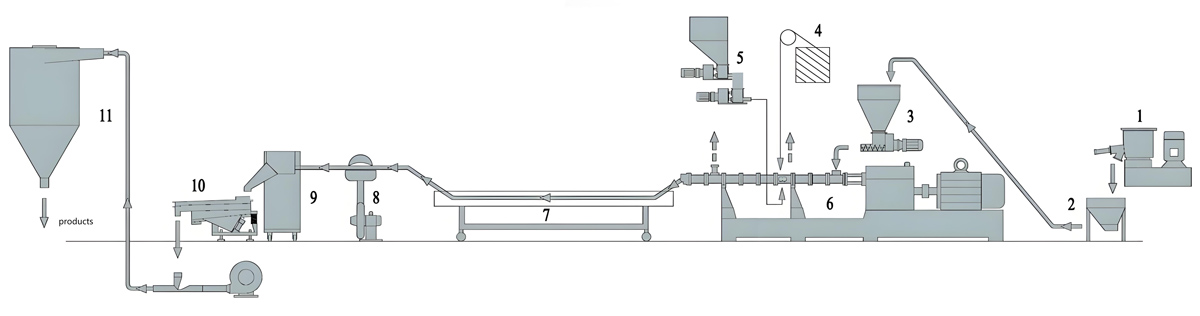
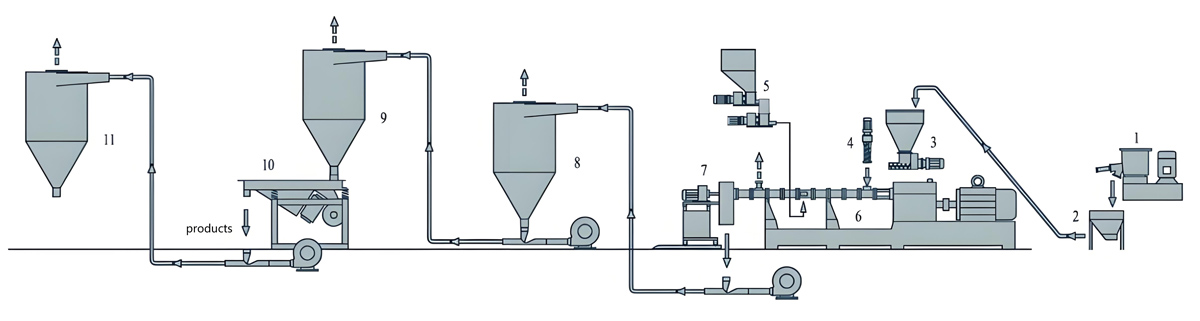
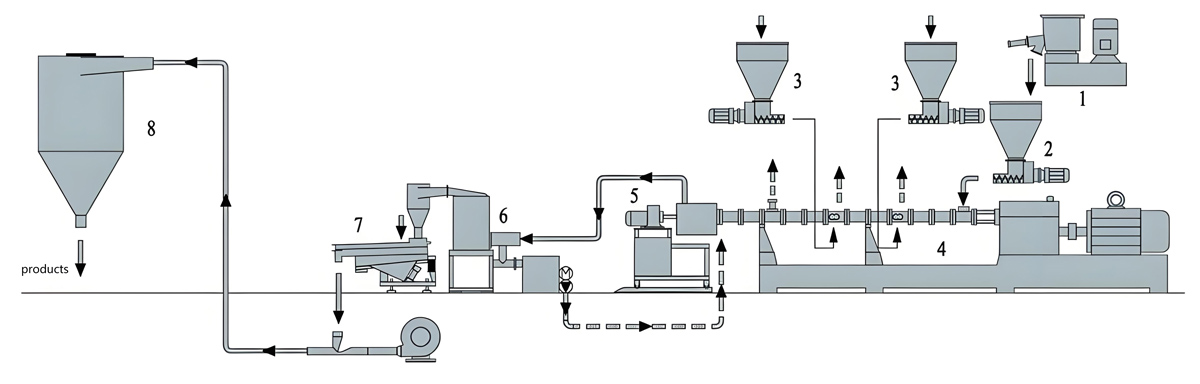
The twin screw extrusion process transforms conductive formulations into homogeneous masterbatch suitable for downstream application. Process optimization addresses the unique requirements of conductive materials including high viscosity, filler dispersion challenges, and percolation network preservation.
Feeding systems introduce formulation components at controlled rates maintaining appropriate extruder fill levels. Side feeders enable controlled introduction of conductive fillers at barrel locations offering optimal dispersion conditions. Gravimetric feeding provides continuous formulation verification through real-time weight monitoring.
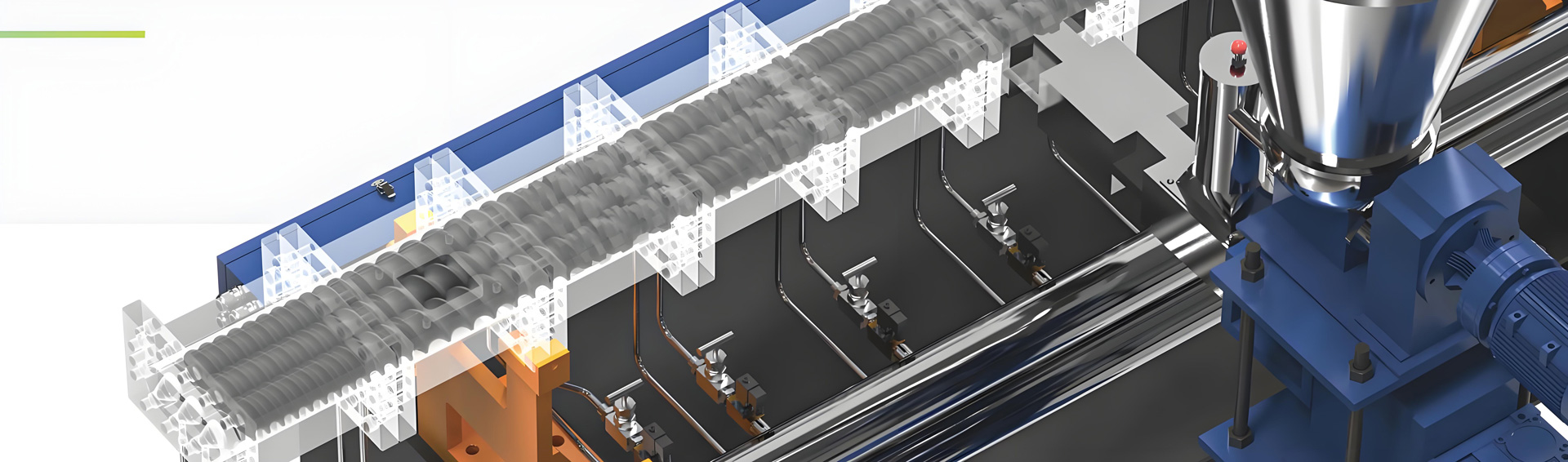
Mixing zones incorporate specialized screw elements that distribute conductive fillers throughout the polymer matrix while minimizing filler agglomeration. Kneading blocks create high shear zones for breaking up carbon black aggregates and ensuring uniform dispersion. Screw element configuration requires careful optimization to balance dispersion requirements against viscosity challenges in highly-filled formulations.
The pumping zone maintains consistent throughput while developing pressure for die extrusion. This zone requires screw elements providing uniform delivery without excessive mixing that could disrupt percolation networks already established in earlier mixing zones.
Pelletizing and Quality Verification
Pelletizing systems transform extruded melt into uniform pellet forms suitable for handling, storage, and subsequent application. Strand pelletizing may be preferred for highly-filled conductive formulations where underwater pelletizing water systems could be contaminated with conductive particles.
Pellet cooling must be controlled to prevent thermal shock that could cause cracking in formulations with high filler loadings. Water spray cooling systems provide gentle temperature reduction without the rapid cooling that creates internal stresses in brittle highly-filled formulations.
Quality verification testing confirms conductive filler content, dispersion quality, and electrical properties meet specifications before product release. Surface resistivity and volume resistivity measurements verify that percolation thresholds have been achieved and conductivity meets requirements.
Production Equipment Introduction
Kerke KTE Series Twin Screw Extruders
Kerke KTE series twin screw extruders provide the processing capabilities required for anti-static and conductive masterbatch production. The series encompasses models suited to various production scales from laboratory development through industrial volume manufacturing.
The KTE-36B extruder features 35.6mm screw diameter and achieves throughput rates of 20 to 100kg per hour. This compact machine suits formulation development, pilot production, and small volume specialty masterbatch manufacturing. The precise control capabilities enable optimization of challenging conductive formulations with high viscosity and dispersion requirements.
The KTE-50B extruder provides 50.5mm screw diameter with production rates of 80 to 200kg per hour. This mid-range model balances processing quality with production efficiency for moderate volume commercial anti-static masterbatch production.
The KTE-65B extruder offers 62.4mm screw diameter and throughput of 200 to 450kg per hour. This capacity level addresses commercial production requirements while maintaining the mixing efficiency necessary for uniform conductive filler dispersion.
The KTE-75B extruder features 71mm screw diameter with production capabilities of 300 to 800kg per hour. This higher capacity model suits established masterbatch suppliers serving volume electronics packaging and ESD protection markets.
The KTE-95D extruder provides the largest production capacity in the series with 93mm screw diameter and throughput of 1000 to 2000kg per hour. This industrial scale machine meets high volume production requirements for major conductive polymer markets while maintaining quality consistency.
Feeding and Material Handling Equipment
Gravimetric feeding systems provide the precise ingredient introduction rates required for consistent anti-static and conductive masterbatch formulations. These systems incorporate loss-in-weight technology that continuously measures and adjusts feed rates to maintain formulation accuracy throughout production.
Side feeder equipment enables controlled introduction of high carbon black or graphene loadings at specific barrel locations. The side feeder design must provide sufficient capacity for high feed rates while maintaining accurate feeding of difficult-to-handle conductive powders.
Dust collection systems protect worker safety and equipment reliability by capturing airborne conductive particles generated during material handling. Dedicated collection equipment prevents cross-contamination between production lines handling different formulation types.
Pelletizing and Downstream Equipment
Strand pelletizing systems may be preferred for highly-filled conductive formulations where underwater pelletizing creates challenges with particle contamination of cooling water systems. These systems produce cylindrical pellets with consistent dimensions suitable for subsequent processing.
Water ring pelletizing systems offer alternative pellet quality characteristics for less concentrated conductive formulations. These systems produce spherical pellets with high surface quality suitable for applications requiring specific handling characteristics.
Centrifugal dryers remove surface water while minimizing mechanical stress that could damage pellets containing high conductive filler loadings. Integrated classification systems remove oversized and undersized particles to ensure consistent product quality.
Parameter Settings for Anti-Static and Conductive Masterbatch
Temperature Profile Optimization
Temperature profile configuration directly impacts masterbatch quality by affecting melt viscosity, additive stability, and percolation network formation. Profile optimization balances processing requirements against the unique challenges of highly-filled conductive formulations.
Typical temperature profiles for carbon black conductive masterbatch production begin at 180 to 200 degrees Celsius in the feeding zone, increase to 200 to 220 degrees through primary mixing sections, and maintain 200 to 210 degrees in pumping and die zones. The specific profile requires adjustment based on carrier resin, conductive filler type, and throughput rate.
Lower processing temperatures increase melt viscosity which can improve carbon black dispersion through higher shear stress. However, excessive viscosity creates feeding and pressure problems in high-loading formulations. Temperature optimization balances these competing requirements.
Carbon nanotube formulations typically require lower processing temperatures to preserve nanotube aspect ratio and prevent degradation. Temperatures below 220 degrees Celsius generally preserve nanotube properties while providing adequate melt flow for processing.
Screw Speed and Mixing Intensity
Screw speed selection influences mixing efficiency, melt temperature development, and percolation network formation. Higher speeds increase shear rates that improve conductive filler dispersion but may disrupt established conductive networks in pumping zones.
Optimal screw speeds for conductive masterbatch typically range from 150 to 300 revolutions per minute depending on formulation requirements and equipment configuration. Lower speeds maintain network structures established in mixing zones while higher speeds enable better dispersion of difficult-to-mix conductive fillers.
Screw element selection creates specific mixing intensity profiles throughout the barrel. Kneading blocks generate high shear zones for breaking up carbon black aggregates and ensuring uniform dispersion in early mixing zones. Downstream elements must provide transport without excessive mixing that could disrupt established percolation networks.
Residence Time and Throughput Balance
Residence time within the extruder must provide sufficient thermal and mechanical energy for complete melting and conductive filler dispersion while maintaining network structures required for conductivity. Mean residence times of 45 to 120 seconds typically achieve adequate processing for conductive formulations.
Throughput rate selection must consider the extruder fill level required for effective mixing of high-viscosity conductive formulations. Carbon black loadings above 30 percent create significantly higher melt viscosities requiring careful balance of throughput against screw speed.
Residence time distribution affects final conductivity through its impact on network formation. Longer residence times allow more complete dispersion but may disrupt networks through extended shear exposure. Screw design optimization balances these effects for specific formulation requirements.
Pressure and Vacuum Settings
Barrel pressure monitoring provides valuable feedback regarding melt homogeneity and potential contamination. Highly-filled conductive formulations generate higher pressures requiring attention to equipment pressure ratings and seal integrity.
Vacuum ventilation removes moisture and volatile degradation products that could compromise masterbatch quality. Vacuum levels of 50 to 100 millibars effectively remove volatiles without excessive polymer loss through the vent system.
Vent zone positioning requires consideration of formulation-specific requirements. Conductive formulations may require different vent positioning than standard masterbatch to account for higher melt viscosity and different volatile release patterns.
Equipment Price
Equipment investment for anti-static and conductive masterbatch production varies based on production capacity requirements and formulation complexity. The Kerke KTE series provides equipment options spanning research to industrial production scales.
The KTE-36B twin screw extruder represents the entry level investment at $25,000 to $35,000. This model suits research and development applications, pilot production, and small volume specialty conductive masterbatch manufacturing.
The KTE-50B twin screw extruder requires an investment of $40,000 to $60,000. This mid-range equipment balances processing capability with production efficiency for moderate volume commercial production.
The KTE-65B twin screw extruder costs between $50,000 and $80,000. This model addresses commercial production requirements for established anti-static and conductive masterbatch suppliers.
The KTE-75B twin screw extruder commands prices ranging from $70,000 to $100,000. This higher capacity model suits dedicated production facilities serving volume electronics packaging and ESD protection markets.
The KTE-95D twin screw extruder represents the premium equipment tier with prices of $120,000 to $200,000. This industrial scale machine enables high volume production for major conductive polymer markets while maintaining quality consistency.
Complete production system investment extends beyond extruder purchase to include feeding systems with dust collection, pelletizing equipment, material handling, quality control instrumentation including resistivity measurement equipment, and facility requirements. Total system investments typically range from 1.5 to 3 times the extruder purchase price depending on automation level and quality system requirements.
Problems in Production Process and Solutions
Inadequate Conductivity in Finished Masterbatch
Problem Description: Finished conductive masterbatch fails to achieve target conductivity levels, manifesting as surface resistivity values above specifications. This results in products unable to meet application requirements for ESD protection or electromagnetic shielding.
Root Cause Analysis: Insufficient conductive filler loading, inadequate dispersion causing filler agglomeration, or processing conditions that disrupt percolation networks can all cause conductivity failures. Carbon black must be adequately dispersed to achieve percolation while maintaining contact between particles for network formation.
Solution Approach: Increase conductive filler loading if below percolation threshold for the specific formulation. Review screw element configuration to ensure adequate dispersion in mixing zones. Verify processing temperatures and residence times preserve percolation networks. Consider alternative conductive fillers with lower percolation thresholds.
Prevention Methods: Establish validated formulations with demonstrated conductivity meeting specifications. Monitor production parameters that affect conductivity including dispersion efficiency and network preservation. Conduct resistivity testing on production samples to verify consistent performance.
Carbon Black Dispersion Problems
Problem Description: Poor carbon black dispersion creates agglomerates that reduce conductivity efficiency and create surface defects in finished products. Agglomerates also create stress concentrations that may reduce mechanical properties in compounded polymers.
Root Cause Analysis: Insufficient mixing intensity, inadequate pre-mixing, or formulation issues causing particle agglomeration can all produce dispersion problems. High viscosity in highly-loaded formulations challenges mixing efficiency.
Solution Approach: Review screw element configuration to ensure adequate mixing elements for high-viscosity formulations. Increase mixing intensity through additional kneading blocks or higher screw speeds if thermal limits permit. Verify pre-mixing equipment operation and mixing times ensure adequate carbon black wetting.
Prevention Methods: Establish standard screw configurations for each conductive formulation type. Monitor product quality trends to identify gradual degradation indicating equipment wear. Conduct dispersion efficiency validation testing using standardized procedures.
Feed Blocking and Surge Issues
Problem Description: Intermittent feeding of conductive fillers creates formulation variation that affects conductivity consistency. Feed blocking and surge events create noticeable quality variations between production batches.
Root Cause Analysis: Powder bridging in hoppers, hopper design issues for difficult-to-handle carbon black, or equipment malfunctions can all cause feeding problems. Carbon black powders with low bulk density particularly challenge feeding equipment designed for conventional polymer pellets.
Solution Approach: Modify hopper design to eliminate bridging points for carbon black powders. Implement vibration or agitation systems that prevent powder consolidation. Verify feeding equipment calibration and maintenance status. Consider alternative feeding equipment designs specifically suited to carbon black handling.
Prevention Methods: Establish standard operating procedures for carbon black handling that prevent consolidation before feeding. Maintain feeding equipment according to manufacturer recommendations. Monitor feed rate variance during production to identify feeding problems before significant quality impact occurs.
Dust Contamination Issues
Problem Description: Carbon black dust migration creates housekeeping problems and potential contamination of other products. Dust accumulation on equipment surfaces can create electrical shorts and other problems in sensitive applications.
Root Cause Analysis: Inadequate dust collection systems, improper material transfer procedures, and worn equipment seals can all contribute to dust generation and migration. Carbon black powders with fine particle size distributions particularly challenge containment systems.
Solution Approach: Upgrade dust collection equipment to handle the specific dust loads from carbon black materials. Implement closed material handling systems that minimize airborne dust generation. Review and repair equipment seals that may allow dust migration.
Prevention Methods: Establish standard material handling procedures that minimize dust generation. Maintain dust collection equipment according to manufacturer recommendations. Schedule regular housekeeping activities to control dust accumulation in production areas.
Mechanical Property Degradation
Problem Description: Conductive masterbatch with high filler loadings may cause excessive property degradation in final compounded products. This limits application opportunities where mechanical performance requirements constrain filler loading levels.
Root Cause Analysis: High conductive filler loadings required to achieve percolation thresholds create stress concentrations and reduce polymer matrix continuity. Carbon black and metal particles particularly impact impact strength and elongation at break.
Solution Approach: Consider alternative conductive fillers with lower percolation thresholds such as carbon nanotubes or graphene that achieve conductivity at lower loadings. Implement impact modifier additions that partially compensate for property degradation. Optimize filler morphology to minimize property impacts at required conductivity levels.
Prevention Methods: Establish minimum property requirements for target applications before formulation development. Test final compound properties with masterbatch let-down to verify suitability for specific applications. Document property data for each formulation to enable appropriate application matching.
Maintenance
Daily Operational Maintenance
Daily maintenance activities ensure consistent product quality and equipment reliability for anti-static and conductive masterbatch production. Operator inspections at shift start verify equipment readiness and identify any issues requiring attention before production begins.
Temperature controller verification confirms accurate temperature measurement and control throughout the barrel profile. Recording actual temperatures against setpoints enables trend analysis that identifies developing problems. Any significant deviations require investigation and correction before production continues.
Feeding system inspection verifies smooth material flow and proper function of feeding equipment. Carbon black handling systems require particular attention to hopper condition and prevention of bridging or consolidation. Hopper level monitoring ensures adequate material supply throughout production runs.
Die plate inspection and cleaning removes accumulated material that could restrict flow or cause contamination. Visual inspection of startup pellets verifies product quality before releasing production for packaging.
Weekly Maintenance Activities
Weekly maintenance extends equipment care beyond daily activities to address components requiring less frequent attention. Gravimetric feeding system calibration verification using certified test weights confirms continued accuracy within specification limits.
Vacuum system inspection examines filters, seals, and connections for condition and proper function. Filter inspection and replacement maintains vacuum efficiency and prevents material loss through the vent system.
Screw torque indicator inspection identifies any loosening that could allow element rotation during operation. Torque measurements provide baseline data for detecting changes over time indicating potential mechanical issues.
Pelletizing system inspection examines knife wear, die plate condition, and water system function. Regular knife sharpening maintains cutting quality while die inspection identifies wear patterns requiring attention.
Monthly and Quarterly Maintenance
Monthly maintenance addresses wear patterns and component conditions requiring periodic assessment. Barrel and screw wear inspection identifies sections approaching replacement thresholds based on accumulated operating hours and historical wear rates.
Gearbox oil analysis provides early warning of contamination or degradation that could lead to mechanical failure. Carbon black contamination in oil samples indicates seal wear requiring attention. Oil replacement schedules maintain transmission health while analysis results guide maintenance timing decisions.
Electrical system inspection examines connections, motor condition, and control system calibration. Temperature controller calibration verification ensures accurate temperature measurement throughout the barrel profile.
Quarterly maintenance encompasses comprehensive equipment assessment addressing all major systems. Extruder barrel inspection using borescope equipment documents internal wear patterns and accumulated deposits affecting product quality. Performance qualification testing verifies equipment capability to produce product meeting specifications.
Annual and Long-Term Maintenance
Annual maintenance represents comprehensive equipment overhaul ensuring continued reliability and quality performance. Complete extruder disassembly and inspection examines all internal components for wear, damage, or accumulated material affecting performance.
Screw element replacement planning considers accumulated operating hours and historical wear patterns to optimize replacement timing. Carbon black formulations create abrasive conditions that accelerate wear in mixing elements. Proactive replacement prevents quality problems emerging from excessive wear while enabling scheduled maintenance during planned downtime.
Control system updates and calibration ensure continued accurate equipment operation. Process parameter documentation enables rapid recovery following control system maintenance or upgrades.
Performance qualification testing documents equipment capability for quality system compliance purposes. These records demonstrate continued ability to produce anti-static and conductive masterbatch meeting demanding electronics and ESD protection requirements.
FAQ
What conductivity levels can anti-static and conductive masterbatch achieve?
Anti-static masterbatch typically achieves surface resistivity of 10^9 to 10^12 ohms per square, suitable for general ESD protection and dust attraction prevention. Carbon black conductive masterbatch achieves 10^3 to 10^7 ohms per square depending on loading and carbon black type. Carbon nanotube masterbatch can achieve 10^2 to 10^5 ohms per square at lower loadings. Metal particle masterbatch achieves the highest conductivity down to 10^-2 ohms per square comparable to some metals.
How do I select the appropriate conductive filler for my application?
Selection depends on required conductivity level, cost constraints, and property requirements. General anti-static applications use internal anti-static agents at lowest cost. ESD protection applications requiring 10^5 to 10^8 ohms per square use carbon black systems. Electromagnetic interference shielding applications requiring 10^0 to 10^4 ohms per square typically use carbon nanotubes or metal particles. Consultation with additive suppliers helps match filler selection to specific application requirements.
What carrier resins work best for conductive masterbatch?
Carrier resin selection depends on final application polymer compatibility and processing requirements. Polypropylene and polyethylene carriers offer broad compatibility and cost-effective performance. ABS carriers suit application in ABS and related engineering polymers. Specialty carriers including polycarbonate and polyamide address engineering polymer applications requiring specific performance characteristics.
How do high filler loadings affect polymer processing?
Conductive fillers increase melt viscosity significantly, requiring processing temperature increases to maintain adequate flow. Higher viscosity affects feeding, mixing, and pressure development throughout the extrusion process. Die pressure increases may approach equipment limits in highly-loaded formulations. Screw speed adjustments and temperature profile modifications typically compensate for viscosity increases.
What quality control tests are essential for conductive masterbatch?
Essential quality tests include surface resistivity and volume resistivity measurement using standardized methods, conductive filler content verification through analytical methods, moisture content determination, and dispersion evaluation. Particle size distribution analysis verifies pellet characteristics. Mechanical property testing on compounded samples confirms that masterbatch let-down maintains acceptable performance levels.
Can I combine multiple conductive filler types in one formulation?
Synergistic combinations of conductive fillers can enhance overall conductivity while potentially reducing required loadings. Common synergistic combinations include carbon black with carbon nanotubes and carbon black with graphene. These combinations create hybrid percolation networks that achieve conductivity at lower total loadings than single filler systems.
How should I store conductive masterbatch?
Conductive masterbatch storage requires protection from moisture, heat, and contamination that could affect performance. Carbon black masterbatch is relatively stable during storage but benefits from sealed packaging preventing moisture uptake. FIFO inventory practices ensure oldest material is used first. Storage at moderate temperatures away from direct sunlight maintains product quality during storage periods of 12 to 24 months.
What ESD standards apply to anti-static materials?
ANSI/ESD S20.20 provides comprehensive ESD control program requirements for electronic manufacturing environments. Materials used in these environments must meet specific resistivity requirements defined in the program documentation. IEC 61340 addresses ESD phenomena and measurement methods for materials used in electronics and other sensitive applications. ASTM D257 covers standard test methods for DC resistance or conductance of insulating materials.
Conclusion
Anti-static and conductive masterbatch production through twin screw extrusion technology addresses critical requirements for electrostatic discharge protection across electronics manufacturing, healthcare, explosive environment, and precision processing applications. The range of available conductive technologies from cost-effective carbon black systems to advanced carbon nanotube and graphene formulations provides options for diverse application requirements and cost constraints.
Successful conductive masterbatch manufacturing requires careful attention to formulation design, process optimization, and quality control. The Kerke KTE series provides processing equipment capable of producing consistent, high-quality masterbatch across the production capacity range required by different market segments.
Equipment investment considerations must account for the specialized requirements of conductive production including dust control, material handling challenges, and quality system capabilities. Supporting systems including feeding equipment, pelletizing systems, and quality control instrumentation including resistivity measurement equipment all contribute to effective production operations.
Ongoing process optimization based on product quality feedback and maintenance activities ensure continued production of masterbatch meeting demanding ESD and conductivity requirements. Investment in operator training, quality systems, and equipment maintenance yields returns through consistent product quality and reduced production problems.
The technical knowledge presented in this guide provides a foundation for developing anti-static and conductive masterbatch manufacturing capabilities. Organizations pursuing opportunities in electronics manufacturing, healthcare, explosive environment protection, and precision processing can leverage this knowledge to establish effective production operations serving markets demanding reliable electrostatic discharge protection and electrical conductivity performance.