Introduction
Calcium carbonate (CaCO3) filler masterbatch represents one of the most widely used compounding products in the plastic industry. The material offers significant cost savings by reducing virgin polymer usage while maintaining or improving mechanical properties. Calcium carbonate improves dimensional stability, reduces shrinkage, and enhances heat deflection temperature in polyolefin and other polymer systems. The twin screw extruder is the preferred processing equipment due to its excellent mixing capabilities and ability to handle high filler loadings.
Calcium carbonate filler masterbatch production requires careful formulation design and processing optimization to achieve uniform dispersion and consistent properties. The filler concentration typically ranges from 40% to 70%, though some specialized formulations achieve up to 80% filler loading through optimized processing conditions and compatibilizer technology. The balance between filler loading and processing characteristics determines the final product cost-effectiveness.
This comprehensive guide explores calcium carbonate filler masterbatch production technology, from formulation principles to processing optimization and quality assurance. It addresses technical challenges of high filler loading, dispersion quality, and mechanical property optimization. By understanding critical factors affecting filler performance and available processing technology, manufacturers can produce high-quality calcium carbonate masterbatch that meets customer requirements.
Key topics covered include formulation design principles, twin screw extrusion technology specifics, process parameter optimization, dispersion quality assessment, equipment selection criteria, and troubleshooting strategies. Special emphasis is placed on practical implementation recommendations based on extensive production experience with calcium carbonate compounding.
Formulation Proportions (Different Types)
The formulation of calcium carbonate filler masterbatch varies based on application requirements, filler characteristics, and desired performance properties. Basic formulation principles involve balancing filler loading with matrix polymer type, compatibilizer level, and dispersant selection to achieve optimal product properties.
General Purpose Formulation
For general purpose applications requiring good processability and basic mechanical properties, formulation consists of 50-70% calcium carbonate, 25-45% carrier polymer, 1-5% compatibilizer, and 0.5-3% dispersant. The exact proportions depend on filler particle size and surface treatment characteristics.
A typical general purpose formulation uses 60% calcium carbonate, 35% LDPE carrier, 3% maleic anhydride grafted polyethylene (PE-g-MAH) compatibilizer, and 2% polyethylene wax dispersant. This formulation provides good dispersion quality and processability in various polyolefin applications while offering significant cost savings.
For polypropylene applications, formulation adjusts to use PP-g-MAH compatibilizer and polypropylene wax dispersant to improve compatibility. Typical proportions are 60% calcium carbonate, 35% PP carrier, 3% PP-g-MAH, and 2% PP wax. This maintains good dispersion quality while optimizing mechanical properties in PP systems.
Carrier polymer selection depends on the intended use. For polyolefin applications, LDPE or LLDPE is common due to lower cost and better processability. For engineering plastics, the corresponding engineering polymer or functionalized polymer compatibilizer may be required to ensure adhesion between filler and matrix.
High Loading Formulation
For applications requiring maximum cost savings, high loading formulations achieve 70-80% calcium carbonate loading through advanced formulation and processing optimization. These formulations require sophisticated compatibilizer systems and specialized processing conditions to maintain acceptable dispersion quality.
A high loading formulation consists of 75% surface-treated calcium carbonate, 20% carrier polymer, 3% dual compatibilizer system (PE-g-MAH and silane coupling agent), and 2% high-performance dispersant. Surface treatment of calcium carbonate with stearic acid improves polymer-filler interaction, enabling higher loadings.
For maximum loading formulations approaching 80%, additional processing aids including viscosity modifiers and mold release agents may be necessary to maintain processability. Specialized dispersant systems with dual action compatibilization and lubrication properties improve mixing efficiency and reduce melt viscosity at high filler concentrations.
High loading formulations typically use finer calcium carbonate particles (d50 < 5μm) to maintain mechanical properties at high filler content. Smaller particles provide better particle reinforcement effect and lower viscosity increase compared to coarser fillers at same loading level.
Functional Masterbatch Formulation
Functional calcium carbonate masterbatch incorporates additional components to provide specific performance benefits beyond cost reduction. Common functional additives include flame retardants, UV stabilizers, antistatic agents, and optical brighteners.
A typical functional formulation combines 50% calcium carbonate as cost-effective filler with 5-10% specific performance additive, 35-40% carrier polymer, and 1-5% compatibilizer. The filler acts as diluent for expensive functional additives, reducing overall cost per unit performance.
For example, flame retardant masterbatch may consist of 50% calcium carbonate, 20% magnesium hydroxide flame retardant, 25% carrier polymer, 3% compatibilizer, and 2% processing aids. This combines the cost savings benefits of calcium carbonate with flame retardant performance.
UV stabilizer masterbatch formulation often uses 40-50% calcium carbonate, 30-40% carrier polymer, 2-5% UV stabilizer package, and 3-5% compatibilizer. The calcium carbonate acts as inert filler while providing some UV scattering effect, enhancing overall UV resistance.
Nanoscale Calcium Carbonate Formulation
Nanoscale calcium carbonate formulations require specialized design to achieve dispersion of particles below 100nm diameter. These formulations typically have lower filler loading (20-40%) due to higher surface energy challenges but provide significant property enhancement at lower loading levels.
Nanoclay masterbatch formulation consists of 20-30% nanoscale calcium carbonate, 60-70% carrier polymer, 5-10% specialized compatibilizer, and 2-5% dispersant. The smaller particle size requires higher compatibilizer level to achieve good dispersion quality.
Processing aid selection becomes critical for nanoscale formulations to prevent agglomerate formation and maintain processability. Flow improvers and viscosity modifiers reduce melt viscosity increase typically observed with nanoscale filler loading.
Surface treatment of nanoscale calcium carbonate is especially important, requiring dual treatment combining silane coupling agents and stearic acid to provide compatibility with polymer matrix while reducing interparticle forces between nanoparticles.
Production Process
Calcium carbonate filler masterbatch production follows systematic processes requiring precise control at each stage to ensure consistent quality. Production begins with raw material preparation and ends with final quality verification before shipment.
Raw Material Preparation
Raw material preparation involves careful handling and conditioning of incoming materials to ensure consistency and quality. Calcium carbonate fillers must be tested for particle size distribution, moisture content, surface treatment effectiveness, and whiteness index.
Moisture content should be reduced below 0.1% using dehumidifying dryers to prevent moisture-related processing issues during extrusion. Moisture above this level can cause foam formation, inconsistent melting, and poor dispersion quality.
Carrier polymers require melt flow index verification to ensure consistent processing characteristics. Virgin polymer is typically used, though specific applications may allow limited recycled content when regulatory requirements permit.
All additives including compatibilizers and dispersants must be examined for melt characteristics and purity. Compatibilizers should be tested for grafting level to ensure effective polymer-filler interaction is achieved.
Formulation Preparation
Formulation preparation involves precise weighing and batching according to formulation specifications. Automated batching systems provide the accuracy and consistency required for high filler loading formulations.
For high loading formulations requiring precise filler proportioning (±0.5%), gravimetric batching systems are strongly recommended. Batch records should document all raw material lot numbers, weights, and batching parameters for complete traceability.
Pre-mixing may be performed using low-shear tumble blenders to improve initial distribution before extrusion. However, high-shear mixing should be avoided to prevent filler particle size reduction that could affect final properties.
Material transfer systems must prevent segregation during handling, particularly for formulations with significantly different particle sizes. Closed transfer systems maintain material homogeneity during transport to extrusion feed zone.
Twin Screw Extrusion Process
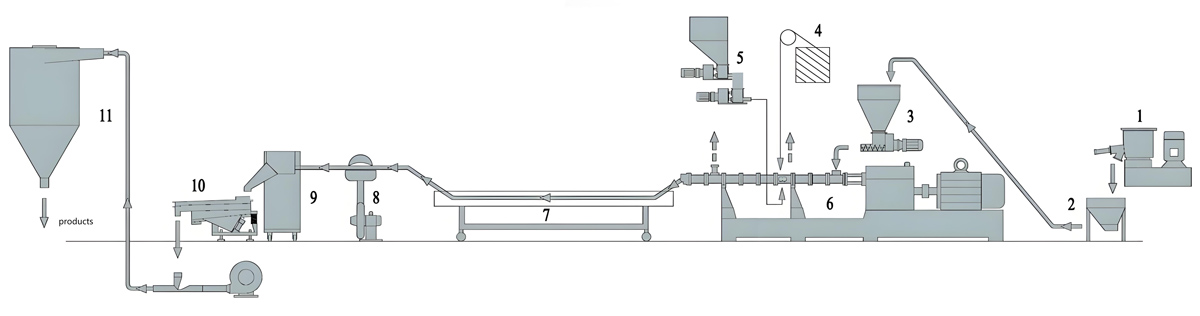
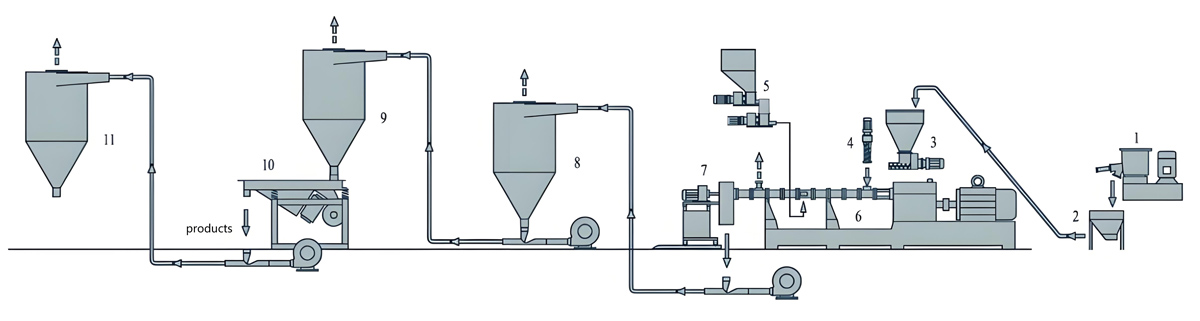
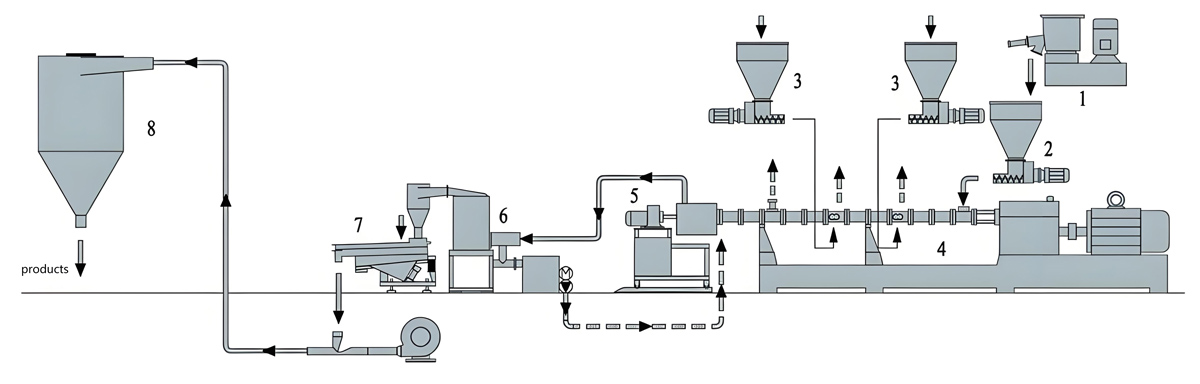
The extrusion process for calcium carbonate filler masterbatch requires optimizing processing parameters to achieve uniform dispersion while minimizing energy input. The twin screw extruder provides the mixing quality necessary for high filler loading compounds.
Feed system accuracy is critical for maintaining formulation consistency throughout continuous production. Gravimetric feeding systems with loss-in-weight technology ensure consistent component proportioning, even during production rate adjustments.
Extrusion temperature profile must be optimized for specific formulation components, balancing complete polymer melting with energy efficiency. Typical temperature profile starts at 140-160°C in feed zone, increasing to 180-200°C in compression zones, and 200-220°C at die.
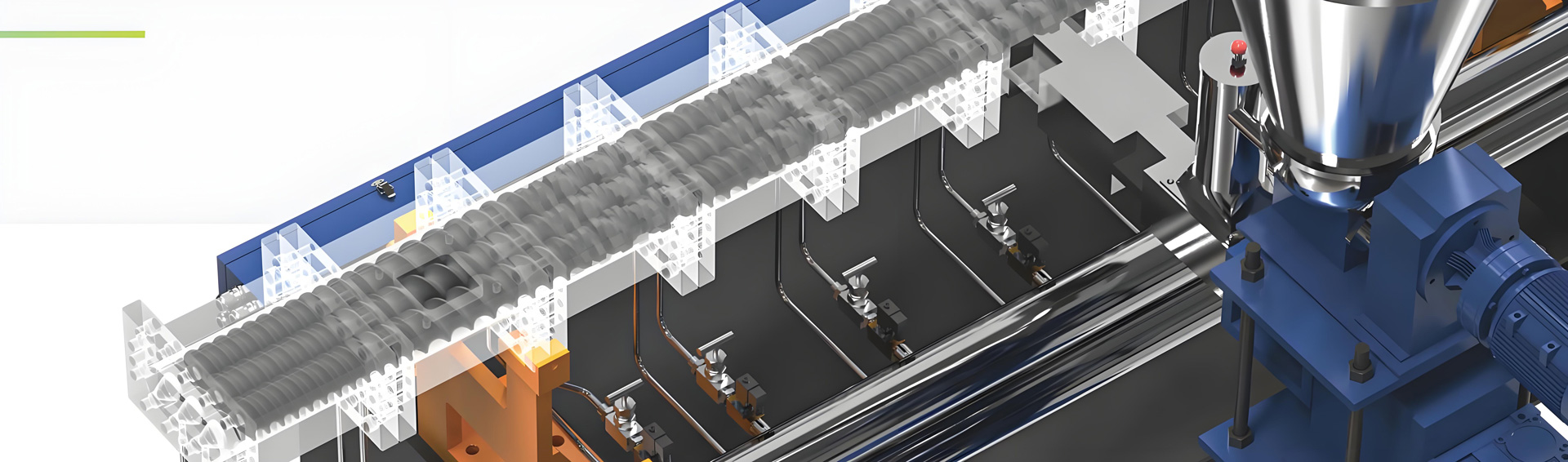
Screw configuration should be designed for effective distributive mixing and melt homogenization. The KTE Series twin screw extruder includes specialized kneading block configurations optimized for calcium carbonate compounding applications.
Pelletizing Process
Pelletizing converts extrudate into uniform granules suitable for downstream processing. Strand pelletizing is commonly used due to simplicity and cost-effectiveness, though underwater pelletizing produces higher quality pellets with more consistent shape and size.
Strand pelletizing involves passing extrudate through a cooling water bath to solidify strands before cutting into pellets. The water temperature should be maintained between 15-25°C to achieve proper cooling without excessive strand shrinkage.
Underwater pelletizing processes strands under water, cutting them immediately after exiting die. This prevents oxidation and produces spherical pellets with excellent flow characteristics, though at higher capital cost compared to strand pelletizing.
Pellet size should be controlled between 2-3mm diameter to ensure good flow and feeding characteristics in downstream processing applications. Cutter blade maintenance and adjustment are critical for maintaining consistent pellet dimensions.
Quality Control and Testing
Comprehensive quality control protocols ensure consistent product quality and customer satisfaction. Testing includes visual inspection, dispersion quality assessment, melt flow index measurement, and mechanical property evaluation.
Dispersion quality is evaluated through microscopic examination of molded test plaques. Good dispersion should show uniform filler distribution without large agglomerates (>20μm). A grading system from 1-5 is often used, where 5 represents excellent dispersion quality.
Melt flow index measurement indicates processability and formulation consistency. Significant variations may indicate inconsistent filler loading or additive proportioning during production.
Mechanical property testing typically includes tensile strength, elongation at break, and impact resistance evaluation. These properties provide insight into formulation effectiveness and filler reinforcement characteristics.
Moisture content analysis confirms adequate pre-drying levels were achieved before extrusion. Moisture levels below 0.1% ensure processing stability and product quality consistency.
Production Equipment Introduction
Kerke KTE Series Twin Screw Extruder
The Kerke KTE Series twin screw extruder offers advanced extrusion technology optimized for calcium carbonate filler masterbatch production. Specifically designed for high filler loading applications, the KTE Series provides excellent mixing quality while maintaining energy efficiency and operational stability.
The KTE Series features co-rotating twin screw design with screw diameters from 25mm to 100mm and length-to-diameter ratios from 36:1 to 48:1. This extended processing length provides sufficient residence time for thorough dispersion of high filler loadings. Barrel segments incorporate precise temperature control zones with individual PID controllers to maintain uniform heat distribution.
Variable speed drive technology enables independent screw speed control from 50-600 rpm depending on machine size. The AC vector drive provides excellent torque characteristics at all speeds, allowing operators to optimize shear levels for specific filler concentrations.
Advanced screw configurations optimized for calcium carbonate compounding are available, focusing on distributive mixing to achieve uniform filler distribution while minimizing shear energy that could affect particle morphology.
Feeding System
Precise feeding is critical for maintaining formulation consistency and product quality in filler masterbatch production. Multiple feeding configurations can be employed depending on formulation complexity and filler characteristics.
Gravimetric feeding systems with loss-in-weight technology are recommended for all calcium carbonate applications. These systems provide continuous weight measurement and automatic feed rate adjustment to maintain accurate formulation ratios, even with varying material flow properties.
For high filler loading formulations, twin screw side feeders with dedicated drives ensure smooth filler introduction without disrupting main polymer melt flow. Side feeding is particularly useful for large particle fillers that would otherwise cause feeding issues in main feed zone.
Material level control systems prevent material starvation or overfeeding conditions. Vibratory feed hoppers with level sensors ensure consistent material flow to extrusion feed zone, maintaining process stability throughout production runs.
For moisture-sensitive materials requiring dry processing, dehumidifying dryers with dew point control (-40°C or lower) ensure consistent moisture content below 0.1% to prevent processing issues related to foam formation or inconsistent melting.
Precision Temperature Control
Precise temperature control is essential for calcium carbonate filler masterbatch production to ensure consistent melting and dispersion quality. The KTE Series incorporates advanced temperature management systems for uniform heat distribution.
Zone-based temperature control provides individual PID regulation for each barrel section, allowing precise temperature profile optimization. Barrel heating elements use high-efficiency cartridge heaters with rapid response time, while water cooling jackets provide effective temperature regulation during start-up and shutdown cycles.
Melt temperature monitoring at strategic barrel positions ensures actual melt conditions match set points. Thermal couples placed in melt flow channels provide direct melt temperature measurement rather than relying solely on surface temperature readings.
Temperature control algorithms optimize heating and cooling cycles to minimize temperature fluctuations and ensure uniform melt conditions throughout production. Temperature limits established for each formulation prevent overheating that could affect additive stability or processing characteristics.
Processing Optimization Equipment
Specialized processing optimization tools enhance filler masterbatch production efficiency and quality. Vacuum degassing systems remove volatiles and moisture from melt, improving product quality and stability.
Melt filtration systems remove contaminants and large filler agglomerates that could cause downstream processing issues. Screen pack configurations depend on application requirements, with 40-60 mesh screens commonly used for calcium carbonate applications.
Inline quality monitoring systems provide real-time feedback on melt characteristics and dispersion quality. Near-infrared (NIR) spectroscopy sensors detect moisture content, filler loading variations, and phase separation issues during production.
Process data collection systems store detailed production parameters for later analysis and process optimization purposes. This data helps identify correlations between processing conditions and final product quality.
Parameter Settings
Optimal parameter settings for calcium carbonate filler masterbatch production depend on formulation specifics, filler loading, and equipment configuration. The following sections provide general guidelines that should be adjusted based on actual production conditions.
Extrusion Parameters
Screw speed settings depend on filler loading and particle size. For moderate loading formulations (50-60%), screw speeds typically range from 150-250 rpm for 50mm extruder size. Higher loadings may require lower speeds to maintain consistent melt quality and prevent excessive energy input.
Temperature profile should be optimized to achieve adequate polymer melting while minimizing energy consumption. For polyolefin-based formulations, typical temperatures start at 150°C in feed zone, increase to 180°C in compression zones, 200°C in mixing zones, and 210°C at die.
Throughput rates depend on machine size and filler loading level. A 50mm KTE Series extruder can process 100-200 kg/h with 60% calcium carbonate loading, depending on formulation viscosity characteristics.
Back pressure should be maintained between 2-3 MPa to ensure adequate melt compression and uniform flow through die. Lower pressures may cause inconsistent pellet quality, while excessively high pressures increase energy consumption and thermal load on materials.
Feeding Parameters
Feeding system calibration requires validation using actual production materials to account for specific material flow characteristics. Regular calibration checks every 100 hours of production help maintain consistent formulation ratio.
Main polymer feed rate sets base extrusion rate, with filler and additive feeds adjusted proportionally according to formulation specifications. The feed control system synchronizes multiple feeders to maintain constant formulation ratio at varying production rates.
Filler feeding position optimization may provide better dispersion results. Side feeding filler after partial polymer melting can improve wetting efficiency and reduce energy required for mixing.
Material handling parameters include moisture control level (-40°C dew point), feeder response time (less than 2 seconds), and material transfer rate matching extrusion requirements to prevent material accumulation or starvation.
Mixing System Parameters
Screw configuration should be optimized for distributive rather than intensive mixing to ensure uniform filler distribution without reducing particle size significantly. The KTE Series includes mixing elements specially designed for calcium carbonate applications.
Mixing zone location should provide sufficient residence time for complete filler wetting and distribution without prolonged thermal exposure. The optimal position is typically after full polymer melting before final extrusion stages.
Shear balance optimization ensures adequate mixing intensity to break up filler agglomerates without causing polymer degradation or excessive energy input. Throughput optimization balances residence time with energy consumption for maximum efficiency.
Barrel pressure monitoring provides insight into melt viscosity and mixing effectiveness. Pressure variations indicate changes in formulation consistency or dispersion quality that may require process adjustment.
Equipment Price
The investment required for calcium carbonate filler masterbatch production depends on production scale, automation level, and quality control requirements. The following price estimates provide general guidance for various equipment configurations.
KTE Series Twin Screw Extruder Pricing
The Kerke KTE Series offers competitive pricing while maintaining high quality standards for calcium carbonate compounding applications. Price levels vary by machine size and configuration complexity:
KTE-25 (25mm screw diameter): $80,000 – $110,000. Laboratory/pilot-scale model suitable for formulation development and small-scale production.
KTE-40 (40mm screw diameter): $140,000 – $180,000. Mid-range production model offering capacity of 50-120 kg/h with basic process control features.
KTE-50 (50mm screw diameter): $210,000 – $270,000. Standard production model suitable for medium-scale filler masterbatch production with advanced control systems.
KTE-75 (75mm screw diameter): $330,000 – $420,000. High-capacity production model for large-scale operations with integrated automation and quality control systems.
Custom configurations with specialized quality assurance equipment and advanced control capabilities may increase prices by 15-25% above standard model prices.
Accessory Equipment Pricing
Essential accessory systems contribute to total investment but are critical for maintaining product quality and process efficiency:
Gravimetric feeding system with loss-in-weight technology: $25,000 – $55,000 depending on number of feeding stations and complexity requirements.
Quality assurance laboratory equipment: $40,000 – $80,000 including optical microscopy for dispersion analysis, melt flow index tester, and mechanical property testing equipment.
Automated batching system with traceability features: $30,000 – $70,000 for closed-loop formulation management and compliance documentation.
Continuous quality monitoring system with NIR spectroscopy: $35,000 – $70,000 for real-time formulation consistency measurement and process control.
Complete filler masterbatch production line with KTE-50 extruder and essential accessories: $320,000 – $420,000 installed, depending on specific configuration complexity and automation level.
Operating Cost Considerations
Beyond initial capital investment, ongoing operating costs significantly impact total cost of ownership. Key operating cost factors include raw material costs, energy consumption, maintenance expenses, and quality control costs.
Energy consumption varies by machine size and operating conditions. A KTE-50 extruder typically consumes 70-110 kW/h during production, translating to $11,000-$19,000 in annual electricity costs at typical industrial rates assuming 5000 operating hours per year.
Maintenance costs average 2-3% of equipment value annually when following preventive maintenance protocols. This includes routine inspection, wear part replacement, control system calibration, and quality assurance equipment servicing.
Quality control costs including routine testing and process monitoring should be budgeted at 0.3-0.8% of annual sales revenue for most applications. This includes raw material inspection, in-process testing, and final product verification.
Raw material costs represent the largest variable cost component, with calcium carbonate typically representing 50-70% of material cost. Filler selection based on particle size and surface treatment level significantly affects material cost and final product properties.
Production Problems and Solutions
Calcium carbonate filler masterbatch production presents unique challenges requiring specialized troubleshooting approaches. Issues often relate to dispersion quality, process stability, and final product performance properties. The following sections address common problems and recommended solutions.
Problem 1: Poor Filler Dispersion
Poor filler dispersion is one of the most common quality issues in calcium carbonate compounding. This manifests as visible filler agglomerates in pellets, uneven color distribution, and reduced mechanical properties in finished parts.
Cause Analysis
Multiple factors can contribute to poor dispersion: inadequate wetting due to low temperature or insufficient shear, insufficient compatibilizer level for filler loading, incorrect dispersant selection, improper screw configuration providing insufficient mixing, or poorly formulated pre-mix causing segregation during feeding.
Incompatibility between filler and matrix polymer without sufficient compatibilizer leads to poor adhesion and phase separation during processing. Excessive filler loading beyond screw configuration capabilities also causes poor dispersion quality.
Variations in filler surface treatment effectiveness significantly impact dispersion quality. Inadequate surface treatment results in higher filler-filler interaction forces that are difficult to overcome during mixing process.
Solution
Improve dispersion quality through process parameter optimization. Increase extrusion temperature by 10-20°C to reduce melt viscosity and improve filler wetting. Lower melt viscosity allows polymer melt to penetrate filler agglomerates more effectively.
Adjust screw speed to increase shear energy without causing polymer degradation. For most calcium carbonate formulations, speeds between 200-250 rpm provide adequate mixing intensity while maintaining process stability.
Revise screw configuration to include more intensive mixing elements. The KTE Series offers specialized kneading block configurations designed for filler compounding applications, including various kneading block angles and lengths.
Optimize compatibilizer level and type based on filler characteristics. For surface-treated calcium carbonate, compatibilizer level may need adjustment based on treatment effectiveness. Increase compatibilizer level gradually while monitoring mechanical properties to find optimal balance.
Prevention
Implement comprehensive raw material testing to verify filler characteristics including particle size distribution, surface treatment level, and moisture content. Only materials meeting strict acceptance criteria should be used in production.
Establish formulation guidelines based on filler particle size and surface treatment. Finer particles typically require higher compatibilizer levels and more intensive mixing conditions to achieve good dispersion quality.
Regular equipment maintenance ensures consistent clearance dimensions between screw elements and barrel. Wear increases clearance, reducing mixing effectiveness and dispersion quality over time.
Implement process monitoring systems to detect dispersion issues early. Visual inspection of extrudate during production helps identify agglomerate formation before finished pellets are produced.
Problem 2: High Viscosity Limiting Throughput
High melt viscosity commonly occurs with high filler loading formulations, limiting production throughput and increasing energy consumption. This issue also affects downstream processing characteristics such as injection molding flow behavior.
Cause Analysis
High viscosity results from increased polymer-filler interaction and restricted polymer chain mobility. High filler loading increases melt viscosity due to hydrodynamic interactions between filler particles acting as obstacles to polymer flow.
Insufficient dispersant level causes inadequate lubrication between polymer chains and filler surfaces, further increasing viscosity. Poor dispersion creates larger filler agglomerates that interact with polymer matrix more significantly than individual particles.
Temperature-related viscosity issues occur when processing temperature is too low, resulting in higher than necessary polymer viscosity. Inconsistent temperature control through barrel sections creates viscosity gradients affecting overall melt flow behavior.
Solution
Reduce melt viscosity through temperature optimization. Increase processing temperature 10-20°C to reduce base polymer viscosity, improving flow characteristics and reducing energy input required for extrusion.
Optimize dispersant level and type. Increase polyethylene wax level from 2% to 3% to improve lubrication between polymer and filler interfaces. For high loading formulations, consider adding specialized flow improvers to reduce viscosity.
Improve filler dispersion quality through better mixing conditions, as more uniformly distributed particles cause lower viscosity increase than poorly dispersed agglomerates. Optimizing screw configuration enhances particle distribution and reduces apparent viscosity effects.
Use lower molecular weight carrier polymer with higher melt flow index. This base polymer inherently has lower viscosity, allowing higher filler loading before critical viscosity limits are reached that restrict processing.
Prevention
Develop formulation guidelines based on filler loading limits determined through viscosity profiling tests. These guidelines help establish maximum achievable loading for specific formulation and equipment combination.
Implement viscosity monitoring systems during production to detect viscosity increases early. Inline viscometers provide real-time feedback on melt viscosity, allowing proactive process adjustments to maintain consistent production rates.
Establish temperature control protocols to maintain consistent melt temperature throughout production. Advanced control systems using model predictive control (MPC) algorithms can anticipate viscosity changes and adjust temperature accordingly.
Maintain comprehensive viscosity database correlating formulation variables with melt viscosity characteristics. This information helps guide future formulation development and processing optimization efforts.
Problem 3: Pellet Quality Issues
Pellet quality problems such as inconsistent sizing, surface defects, and brittle pellets affect downstream processing performance and customer satisfaction. These issues often relate to formulation characteristics and processing conditions.
Cause Analysis
Inconsistent pellet sizing typically results from improper synchronization between haul-off speed and cutter speed in strand pelletizing systems. Variations in strand thickness due to inconsistent melt flow also affect pellet dimensions.
Surface defects including pitting or roughness often occur due to insufficient strand cooling before pelletizing, leading to soft strands that adhere to cutter blades. Contamination in cooling water can also cause surface issues on pellets.
Brittle pellets typically result from excessive filler loading reducing melt strength or poor polymer-filler adhesion causing weak fracture paths through interface regions between filler and polymer.
Die build-up from material degradation or poor flow can cause strand breakage during pelletizing, requiring frequent manual intervention and resulting in inconsistent production output quality.
Solution
Improve pellet consistency through system calibration and maintenance. Regularly calibrate haul-off and cutter speed synchronization to maintain uniform pellet length and size.
Optimize cooling water temperature and immersion length to achieve complete strand solidification before pelletizing. Water temperature between 15-20°C typically provides proper cooling rate without causing thermal shock to strands.
Upgrade die design or optimize extrusion conditions to reduce die build-up. Special die materials or coatings can reduce material adhesion and extend clean intervals. Process parameter optimization focusing on temperature profile and shear levels helps reduce degradation causing build-up.
Adjust formulation composition by adding processing aids or optimizing compatibilizer level to improve melt strength and pellet quality. Small amounts of elastomeric modifiers can improve pellet toughness without significantly affecting cost effectiveness.
Prevention
Implement scheduled maintenance program for pelletizing system components including cutter blade sharpening, haul-off roller cleaning, and water filtration system inspection. Maintaining clean and sharp equipment minimizes pellet defects during production.
Develop pellet quality standards including dimensional tolerances and visual inspection criteria. Perform regular pellet quality checks throughout production runs to identify trends requiring corrective actions.
Establish die cleaning schedule based on formulation characteristics. Highly filled formulations or those with more temperature-sensitive additives may require more frequent die cleaning intervals.
Use automatic pellet quality inspection systems where production volume justifies the investment. Vision systems can detect dimensional variations and surface defects automatically, providing real-time feedback to operators.
Problem 4: Mechanical Property Reduction
Mechanical property reduction is a common issue when introducing filler particles into polymer matrix. This manifests as reduced impact strength, elongation at break, and tensile strength compared to unfilled polymer.
Cause Analysis
Reduced properties result from several factors: poor dispersion quality creating stress concentration points at agglomerate sites, inadequate interfacial adhesion allowing filler-polymer debonding under load, and poor filler particle morphology acting as crack initiators.
High filler loading levels above critical concentrations cause percolation threshold where filler particles interact directly rather than being fully separated by polymer matrix. This continuous filler network significantly reduces ductility of composite material.
Thermal degradation during processing weakens polymer matrix and reduces effective interfacial bonding. Excessive shear or temperature can break polymer chains, reducing molecular weight and composite mechanical performance.
Solution
Improve mechanical properties through formulation optimization. Adjust compatibilizer level to improve interfacial adhesion between filler and polymer matrix. For most calcium carbonate formulations, 3-5% compatibilizer provides effective adhesion without excessive cost.
Optimize filler particle size selection for intended application. Finer particles generally provide better mechanical property retention at same loading level due to more uniform distribution and reduced stress concentration effects.
Revise extrusion conditions to minimize degradation risks. Lower peak temperatures slightly while maintaining adequate polymer melting to reduce thermal stress on materials. Adjust screw speed to balance mixing quality with degradation avoidance.
Consider adding secondary modifiers such as elastomers or impact modifiers to improve impact resistance. Small amounts (2-5%) of ethylene-octene copolymers or similar elastomers can significantly improve toughness without significant cost increase.
Prevention
Develop formulation guidelines correlating filler loading with expected property levels based on comprehensive mechanical testing results. This information helps set realistic customer expectations regarding mechanical property reduction at specific filler loadings.
Implement process control systems to maintain consistent extrusion parameters, minimizing variations that could cause property fluctuations between batches. Statistical process control charts monitor critical properties over time to identify developing trends requiring intervention.
Perform regular mechanical property testing on production batches to verify compliance with quality standards. Establish property acceptance limits based on application requirements to ensure only acceptable material reaches customers.
Provide customers with technical guidelines specifying recommended maximum filler levels for maintaining target mechanical properties in their applications. This helps customers select appropriate product for specific performance requirements.
Problem 5: Processing Instability
Processing instability manifests as pressure fluctuations, temperature variations, and inconsistent melt quality during production. This leads to inconsistent product quality and increased downtime for equipment troubleshooting.
Cause Analysis
Multiple factors contribute to processing instability: material feed irregularities causing formulation inconsistencies, temperature control issues leading to uneven melting, screw wear affecting mixing efficiency, and formulation changes requiring process adaptation.
Changes in filler characteristics between batches affect formulation behavior and process stability. Variations in particle size distribution or surface treatment effectiveness require process parameter adjustments to maintain consistent operation.
Equipment component wear changes clearance dimensions between screw elements and barrel, reducing process stability and mixing performance over time. This creates inconsistent melt flow characteristics and pressure variations during extrusion.
Solution
Address processing instability through systematic troubleshooting approach. First, verify feed system operation is consistent with no material bridging or starvation issues. Implement level control sensors in material hoppers to ensure continuous material flow.
Calibrate temperature control system and verify heater performance in all zones. Replace faulty heaters or temperature sensors to maintain accurate temperature profile control throughout production.
Inspect screw elements for wear and replace worn components as needed. Maintaining proper clearance dimensions is critical for process stability and consistent mixing quality.
Implement process control algorithms designed to compensate for process disturbances automatically. Advanced control systems using model predictive control can anticipate potential instability sources and adjust parameters accordingly.
Prevention
Implement preventive maintenance program with scheduled equipment inspection intervals. Regular measurement of screw clearance dimensions helps identify developing wear issues before they cause process instability.
Develop formulation changeover procedures ensuring proper parameter adjustment when switching between different filler types or loading levels. Document recommended parameter settings for each common formulation to guide operators during changeovers.
Monitor process parameters continuously using data acquisition systems. Statistical analysis of production data can identify trends indicating developing instability issues before they affect product quality.
Train operators to recognize early signs of process instability and implement appropriate corrective actions based on established procedures. Empowering operators to address minor issues early prevents larger production interruptions later.
Maintenance
Proper maintenance is essential for consistent production quality and maximum equipment uptime in calcium carbonate filler masterbatch production. Calcium carbonate is abrasive and accelerates wear of screw elements, barrel surfaces, and other components requiring regular monitoring and maintenance.
Preventive Maintenance Schedule
The following maintenance schedule provides recommended intervals for calcium carbonate filler masterbatch production equipment. Adjustments may be needed based on specific operating conditions and formulation characteristics.
Daily Maintenance
Operators should perform routine daily checks including visual inspection of machine for leaks, unusual sounds, or vibration. Temperature and pressure gauge readings should be verified against set points and logged in batch records.
Inspect material feed system for proper operation, ensuring smooth material flow and no bridging in hoppers. Clean feed zones if necessary to maintain consistent material delivery to extruder.
Record production parameters including throughput, screw speed, temperatures, and energy consumption. Compare these to baseline values and investigate any significant deviations that may indicate developing problems.
Clean pelletizing system and water bath to remove accumulated polymer residues that could affect pellet quality over time. Verify proper operation of haul-off and cutter systems.
Weekly Maintenance
Weekly maintenance includes detailed inspection of wear components including screw elements and barrel surfaces. Measure wear indicators on critical sections using precision measuring tools.
Calibrate gravimetric feeding systems using standardized weight verification procedures. Check feeder accuracy across operational range to ensure consistent formulation ratio maintenance.
Inspect temperature control systems including sensor calibration status and heater performance. Clean heating element insulation covers to maintain heat transfer efficiency and prevent overheating hazards.
Inspect vacuum degassing system performance including pump oil level and filter condition. Replace filters and perform pump maintenance according to manufacturer recommended intervals.
Monthly Maintenance
Monthly maintenance includes comprehensive inspection of drive system components including motor bearings, gearbox, and coupling condition. Check gear lubrication level and quality, replenish or change oil as needed.
Validate process control system performance through simulated process deviation tests. Verify alarm response times and safety interlock functionality according to equipment safety documentation.
Inspect quality assurance laboratory equipment including melt flow index tester calibration status and microscope performance. Review analytical method documentation for ongoing compliance with quality standards.
Clean material transfer system components and perform leak testing of closed transfer lines. Verify air quality in pneumatic systems is maintained within specifications for reliable operation.
Quarterly Maintenance
Quarterly maintenance involves major wear component inspection and potential replacement. Remove screw elements and check wear patterns and dimensional accuracy using precision measurement equipment.
Perform complete electrical system safety audit including ground continuity testing, motor winding resistance measurement, and control panel enclosure integrity check according to safety standards.
Validate quality monitoring system performance through cross-checking with laboratory testing results. Verify online sensor calibration against reference standards and adjust as needed.
Review maintenance records and update preventive maintenance schedule based on observed equipment wear rates and formulation-specific operational demands. Adjust frequency based on actual performance data.
Annual Maintenance
Annual preventive maintenance includes complete machine disassembly and component inspection at major service intervals. Evaluate wear condition of screw elements, barrel liners, bearings, seals, and drive system components.
Validate calibration of all control system instruments using traceable reference standards. Document calibration records for regulatory audit purposes including instrument serial numbers, calibration dates, and adjustment history.
Perform comprehensive safety system validation including emergency stop functionality, guard interlocks, and pressure relief valve testing. Review safety documentation update status based on regulatory requirements changes.
Review complete maintenance program effectiveness and adjust based on equipment performance data. Implement continuous improvement initiatives based on downtime analysis and maintenance cost trends.
FAQ
Q1: What is the optimal calcium carbonate loading for cost-effectiveness?
The optimal filler loading depends on application requirements, processing capabilities, and desired mechanical properties. For most general purpose applications, 50-60% loading provides good balance between cost savings and mechanical performance retention. Higher loadings up to 70-75% offer maximum cost savings but require optimized formulation design and more sophisticated processing conditions to maintain acceptable properties.
The cost-effectiveness calculation should consider raw material cost difference between filler and polymer, processing energy cost increase at higher loadings, and potential downstream processing difficulties. Economic analysis typically shows that 60% loading provides the best overall cost savings without significant negative impacts on processing characteristics.
For specific applications requiring minimal property reduction such as impact-sensitive products, lower loadings (40-50%) may be necessary despite higher material cost. The balance between cost savings and property requirements must be evaluated for each specific application scenario.
Q2: How does filler particle size affect processing and properties?
Filler particle size significantly influences dispersion quality, mechanical properties, and processing behavior. Finer particles generally provide better mechanical property retention at same loading level due to more uniform distribution and reduced stress concentration effects. However, finer particles also increase specific surface area requiring higher compatibilizer levels and more intensive mixing conditions to achieve good dispersion quality.
Larger particles (>10μm) are easier to disperse but cause greater property reduction at equivalent loading due to higher stress concentration at particle sites. Large particles also increase abrasion on processing equipment components during extrusion and downstream processing operations.
Typical calcium carbonate particle sizes range from 0.7μm for ultra-fine grades up to 20μm for coarse grades. The optimal size depends on application requirements, with finer grades used for higher quality applications and coarser grades used for cost-sensitive applications where property reduction is acceptable.
The particle size distribution (PSD) also affects properties, with narrower PSD generally providing more consistent dispersion quality and properties compared to broader distributions containing both fine and large particles simultaneously.
Q3: What is the role of compatibilizer in calcium carbonate masterbatch?
Compatibilizer plays a critical role in improving interfacial adhesion between inorganic calcium carbonate filler and organic polymer matrix. Without compatibilizer, weak interfacial bonding leads to poor stress transfer and reduced mechanical properties.
Typical compatibilizers for polyolefin systems are maleic anhydride grafted polyolefins (PE-g-MAH or PP-g-MAH). The maleic anhydride groups react with surface hydroxyl groups on calcium carbonate, forming covalent bonds that improve filler-matrix interaction. This improves stress transfer efficiency and overall composite mechanical properties.
Compatibilizer also improves dispersion quality by reducing filler-filler interaction forces and aiding in break-up of filler agglomerates during mixing process. This leads to more uniform filler distribution throughout polymer matrix, improving consistency of mechanical properties.
The optimal compatibilizer level depends on filler particle size and surface treatment characteristics. Finer particles and untreated fillers typically require higher compatibilizer levels to achieve same adhesion effectiveness as larger particles or surface-treated filler.
Q4: How does surface treatment affect calcium carbonate performance?
Surface treatment of calcium carbonate filler significantly improves performance by reducing filler-polymer interaction issues and improving dispersion quality. The most common surface treatment is coating with stearic acid or similar fatty acids to make filler surface more compatible with polymer matrix.
Stearic acid treatment reduces filler-filler interaction forces, improving dispersion quality and reducing melt viscosity increase compared to untreated filler. The treatment also reduces moisture absorption during storage and processing, minimizing related issues like foam formation during extrusion.
Other treatments include silane coupling agents that provide stronger chemical bonds between filler and polymer matrix, particularly with engineering polymers requiring higher performance properties. Dual treatment systems combining stearic acid and silanes can provide both lubrication benefits and improved chemical bonding.
The effectiveness of surface treatment must be evaluated through testing, including dispersion quality assessment, mechanical property testing, and moisture absorption measurement. Treatment level optimization balances performance improvement with additional processing cost incurred.
Q5: What processing equipment is best for calcium carbonate compounding?
Co-rotating twin screw extruders are considered the gold standard for calcium carbonate compounding due to their excellent mixing capabilities and ability to handle high filler loadings. The KTE Series from Kerke Extrusion Equipment offers advanced twin screw technology specifically designed for filler compounding applications.
Key advantages include modular barrel design allowing flexible configuration, variable screw speed control to optimize shear levels independently of throughput, and precise temperature control systems ensuring uniform melt quality.
Twin screw extruders provide self-wiping characteristics that maintain consistent material transfer even with high filler loadings. This prevents material accumulation and ensures continuous mixing throughout processing length.
The screw configuration can be customized based on specific formulation requirements, with specialized kneading block geometries designed for effective distributive and dispersive mixing of filler particles. These features make twin screw extruders the optimal choice for consistent, high-quality calcium carbonate filler masterbatch production.
Q6: How do I troubleshoot common process issues with calcium carbonate masterbatch?
Troubleshooting requires systematic approach beginning with careful observation of process parameters and product characteristics. For dispersion issues, first check temperature profile and screw speed settings, then examine screw configuration and compatibilizer level if necessary.
For viscosity-related throughput limitations, optimize temperature settings, adjust dispersant level, or consider using lower molecular weight carrier polymer with higher melt flow index. Flow improvers can also reduce melt viscosity significantly with minimal formulation changes.
When dealing with mechanical property reduction issues, focus on interfacial adhesion quality through compatibilizer adjustment or surface treatment optimization. Particle size reduction strategy may also improve property retention at same loading level.
Processing instability issues should start with verifying feed system accuracy and temperature control performance. Equipment wear components and process control calibration status should also be checked regularly as potential contributors to instability problems.
Q7: What storage conditions are recommended for calcium carbonate masterbatch?
Proper storage is essential for maintaining product quality and shelf life. Calcium carbonate masterbatch should be stored in cool, dry environment with temperature between 15-25°C and relative humidity below 60%. Exposure to moisture can cause agglomeration and processing issues later.
Pellets should be stored in original sealed containers to prevent contamination and protect against environmental moisture. Opened containers should be resealed tightly and used within reasonable time frame (typically 3-6 months) to maintain consistent quality.
Long-term storage beyond 6 months may cause slow moisture absorption depending on packaging and storage conditions. Re-drying may be required before processing if moisture levels exceed 0.1%, detected through moisture analysis testing.
Storage area should be free of contaminants including dust, oil, or other chemicals that could affect product quality. Storing different color or formulation types separately prevents accidental mixing that could cause production issues later.
Q8: How can I improve impact resistance in calcium carbonate filled compounds?
Impact resistance improvement requires formulation adjustments focusing on enhancing matrix ductility or improving filler-matrix interface adhesion. Adding elastomeric modifiers such as ethylene-octene copolymers or similar rubbery materials can significantly improve impact strength without major cost increases.
Typical modifier levels range from 2-5%, depending on desired impact improvement level and cost constraints. These modifiers create energy dissipation mechanisms that absorb impact energy rather than allowing rapid crack propagation through material.
Optimizing compatibilizer level to improve interfacial adhesion also helps maintain impact strength by preventing filler-polymer debonding that would otherwise create crack initiation sites. Ensuring good dispersion quality reduces stress concentration effects at agglomerate sites that could otherwise initiate fracture.
Particle size selection also affects impact resistance, with finer particles generally providing better impact performance at same loading level compared to coarser alternatives. Combining elastomer addition with good dispersion quality and effective compatibilization provides the best overall impact property improvement.
Q9: What are the common downstream processing issues with calcium carbonate masterbatch?
Common downstream issues include increased mold wear due to filler abrasion, reduced part gloss from filler particle surface exposure, and processing stability issues with inconsistent melt viscosity. Mold wear can be reduced using hardened steel molds or ceramic coatings to withstand abrasive filler particles.
Surface gloss reduction can be minimized by using finer filler particles with good dispersion quality, maintaining sufficient resin cap layer on part surface through mold design or processing parameter optimization. Compounding agents such as gloss improvers can also be added to formulation to enhance surface finish.
Injection molding flow issues caused by viscosity variations can be addressed through formulation adjustments including flow improver addition or carrier polymer melt flow optimization. Ensuring consistent melt quality through masterbatch production also helps downstream processing stability.
Shrinkage and warpage changes compared to unfilled polymer require mold design adjustment and processing parameter optimization. Calcium carbonate typically reduces shrinkage compared to unfilled polymer, which can be used advantageously to improve dimensional stability in molded parts.
Q10: How does calcium carbonate masterbatch affect film extrusion properties?
Calcium carbonate addition affects film properties in several ways: reduced transparency due to light scattering at filler-polymer interfaces, improved tear resistance especially at medium filler loadings, decreased elongation at break, and potentially improved barrier properties to water vapor depending on filler dispersion quality.
Optimal filler loading for film applications typically ranges from 20-40% depending on film thickness and transparency requirements. Higher loadings reduce transparency significantly while providing cost savings and improved tear properties for opaque applications.
Dispersion quality becomes critical for maintaining film optical properties, with good dispersion minimizing visible particle aggregation that would otherwise create surface defects and optical inconsistencies. Specialized processing conditions including temperature optimization and screw configuration are necessary to achieve good dispersion quality for film applications.
Surface treatment of filler particles also affects film properties, with stearic acid treatment typically improving processability while maintaining film surface quality. Adhesion promoters may be required when using calcium carbonate masterbatch for laminated films to ensure proper interlayer bonding strength.
Summary
Calcium carbonate filler masterbatch production is a technically challenging process requiring careful formulation design, processing optimization, and quality control measures. The twin screw extruder is the preferred processing equipment due to its excellent mixing capabilities and ability to handle high filler loadings. The KTE Series twin screw extruder from Kerke Extrusion Equipment offers advanced technology specifically optimized for calcium carbonate compounding applications.
Formulation design involves balancing filler loading with matrix polymer type, compatibilizer level, and dispersant selection to achieve optimal product properties. General purpose formulations typically contain 50-70% calcium carbonate, with variations based on specific application requirements and filler characteristics.
Processing parameters including temperature profile, screw speed, and screw configuration must be optimized to achieve uniform dispersion while minimizing energy input and material degradation. The variable speed drive on KTE Series allows precise screw speed control to balance mixing intensity with process efficiency requirements.
Comprehensive quality assurance programs including dispersion quality assessment, mechanical property testing, and process parameter monitoring ensure consistent product quality and customer satisfaction. Regular maintenance programs addressing wear components, control system calibration, and safety equipment validation are essential for long-term equipment reliability.
By understanding critical factors affecting filler performance and implementing appropriate control measures throughout production process, manufacturers can produce high-quality calcium carbonate filler masterbatch that meets stringent customer requirements. This requires ongoing commitment to continuous improvement through process optimization and technological upgrades to meet evolving industry demands.
Ultimately, successful calcium carbonate filler masterbatch production combines advanced extrusion technology with rigorous quality management systems and technical expertise in filler compounding applications. This enables manufacturers to establish themselves as reliable suppliers of cost-effective filler masterbatch products in competitive plastic compounding industry.