Introduction
Color masterbatch compounding represents a critical process in the plastic industry, enabling precise coloration and enhanced properties of plastic materials. Twin screw extruders have become the preferred equipment for this application due to their superior mixing capabilities, excellent dispersion performance, and efficient production characteristics. The compounding process involves uniformly dispersing color pigments or dyes into carrier resins at high concentrations, typically 20-50 percent pigment loading, which then get diluted during final product manufacturing. This comprehensive guide explores all aspects of color masterbatch production using twin screw extruders, from formulation considerations to operational parameters and maintenance requirements.
Modern twin screw extruders, particularly the co-rotating parallel twin screw extruders, provide optimal conditions for color masterbatch production. The intermeshing screw geometry creates intense mixing action ensuring uniform pigment dispersion throughout the carrier resin. Temperature control zones along the barrel enable proper melting of both carrier resin and pigments while maintaining thermal stability of sensitive colorants. The modular design allows for customization of screw configuration and barrel length to accommodate different pigment types and carrier materials. Understanding the complete production system enables operators to achieve consistent quality while maximizing production efficiency.
The selection of appropriate twin screw extruder for color masterbatch production depends on multiple factors including pigment types, carrier resins, required production capacity, and quality specifications. Different pigment characteristics such as particle size distribution, oil absorption, and thermal stability influence equipment selection and processing parameters. Carrier resin properties including melt flow index, melting temperature, and chemical compatibility determine processing conditions and equipment requirements. Proper matching of extruder capabilities with material characteristics ensures optimal performance and product quality.
Formulation Ratios (Different Types)
Formulation development for color masterbatch requires careful consideration of pigment concentration, carrier resin selection, and additive incorporation. The formulation ratio directly affects processing conditions, dispersion quality, and final product performance. Different color masterbatch types require specific formulation approaches based on pigment characteristics, carrier properties, and end-use requirements.
Pigment Concentration Levels
Pigment concentration in color masterbatch typically ranges from 20 to 50 percent by weight depending on pigment type and application requirements. Standard concentration levels include 25, 30, and 40 percent pigment loading for organic pigments used in polyolefin applications. Inorganic pigments such as titanium dioxide typically require lower concentrations of 20-30 percent due to higher hiding power and dispersion challenges. Fluorescent pigments and metallic effects often require lower concentrations of 10-20 percent due to their high optical density. High-concentration masterbatches above 50 percent pose processing challenges due to pigment agglomeration and poor flow characteristics.
The selection of pigment concentration considers factors including pigment strength, dispersion quality requirements, and dilution ratios in final applications. Higher pigment concentrations offer advantages in terms of reduced material handling costs and lower carrier resin dilution in end products. However, high concentrations increase processing difficulty requiring more intense mixing and longer residence times. Lower concentrations provide easier processing and better dispersion but increase material costs and require higher let-down ratios in final products. The optimal concentration balances processing efficiency with economic considerations.
Carrier Resin Selection
Carrier resin selection represents critical formulation decision affecting both processing characteristics and final product compatibility. Polyethylene carriers including LDPE, LLDPE, and HDPE represent common choices for polyolefin applications due to excellent compatibility and processing characteristics. Polypropylene carriers provide good compatibility for PP-based applications while offering improved thermal stability. PVC carriers require specific formulation considerations due to plasticizer requirements and thermal sensitivity. Engineering plastic carriers including PC, PA, and PET require processing temperatures above 250C demanding specialized equipment considerations.
Carrier resin properties including melt flow index significantly influence processing parameters. Low MFI resins below 2 g/10min require higher processing temperatures and screw speeds to achieve adequate melt flow. High MFI resins above 20 g/10min process at lower temperatures but may require lower screw speeds to maintain adequate residence time. The carrier resin selection also affects pigment dispersion quality with higher melt viscosity resins providing better shear conditions for pigment wetting but requiring higher energy input. Matching carrier resin properties with end application requirements ensures optimal performance and processing efficiency.
Additive Incorporation
Additives play essential roles in color masterbatch formulations affecting processing behavior and final product properties. Dispersing agents including fatty acids and waxes improve pigment wetting and reduce agglomeration during processing. Typical dispersing agent concentrations range from 1 to 5 percent depending on pigment surface characteristics and required dispersion quality. Processing aids including fluoropolymers and metal stearates reduce melt viscosity and improve pigment flow characteristics. Antioxidants and stabilizers protect pigments and carriers from thermal degradation during processing and storage.
Specific additive types address different formulation requirements. Surface treatment agents modify pigment surface energy improving compatibility with carrier resins. Wetting agents reduce pigment surface tension promoting better resin penetration. Flow enhancers improve masterbatch flow characteristics during both processing and end-use applications. Light stabilizers incorporate into formulations for outdoor applications preventing color fade from UV exposure. Antistatic agents address static electricity issues in certain processing conditions. The additive package must be carefully balanced to achieve desired effects without compromising color development or processing characteristics.
Pigment Type Specific Formulations
Different pigment types require specific formulation approaches due to their unique characteristics. Organic pigments typically require dispersing agent concentrations of 2-4 percent to achieve proper wetting and prevent agglomeration. Inorganic pigments including titanium dioxide and iron oxides often require lower dispersing agent levels of 1-2 percent but demand higher shear conditions for adequate deagglomeration. Fluorescent pigments require lower processing temperatures below 220C to maintain fluorescent properties and avoid thermal degradation. Carbon black formulations require special considerations due to high oil absorption and strong agglomeration tendencies.
Special effect pigments including pearlescent and metallic types require gentle mixing conditions to preserve effect characteristics. These pigments often utilize lower screw speeds and special screw configurations to prevent damage to platelet structures. Liquid color masterbatches incorporate liquid pigments into solid carriers requiring specific formulations with appropriate compatibility agents. Heat-sensitive pigments require careful temperature control and residence time management to prevent color changes or thermal degradation. Understanding pigment-specific requirements enables formulation optimization for each color type.
Masterbatch Concentration Ranges
Masterbatch concentration ranges determine appropriate let-down ratios in final applications. Standard concentration ratios include 1:4, 1:10, and 1:20 masterbatch to resin ratios for typical applications. Higher concentration masterbatches (40-50% pigment) enable lower let-down ratios reducing material handling and improving color accuracy. Lower concentration masterbatches (20-25% pigment) provide easier processing and better dispersion but require higher usage rates. The selection of masterbatch concentration considers processing equipment capabilities, dispersion quality requirements, and economic factors.
Let-down ratio calculation requires consideration of pigment strength, carrier resin compatibility, and final product color requirements. Let-down ratios typically range from 1% to 5% masterbatch addition depending on pigment concentration and desired color depth. Precise let-down ratios ensure consistent color accuracy across production batches while optimizing material usage. Higher let-down ratios reduce masterbatch usage but increase carrier resin dilution potentially affecting final product properties. Lower let-down ratios reduce carrier dilution but increase masterbatch cost contribution. The optimal let-down ratio balances cost considerations with product performance requirements.
Production Process
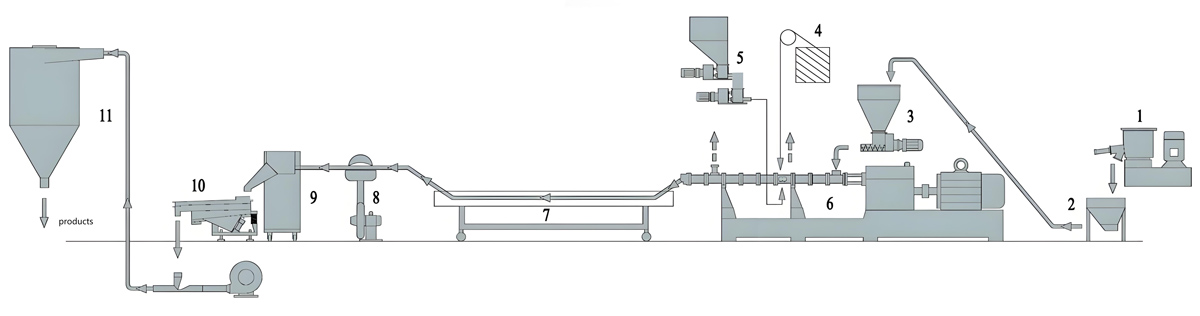
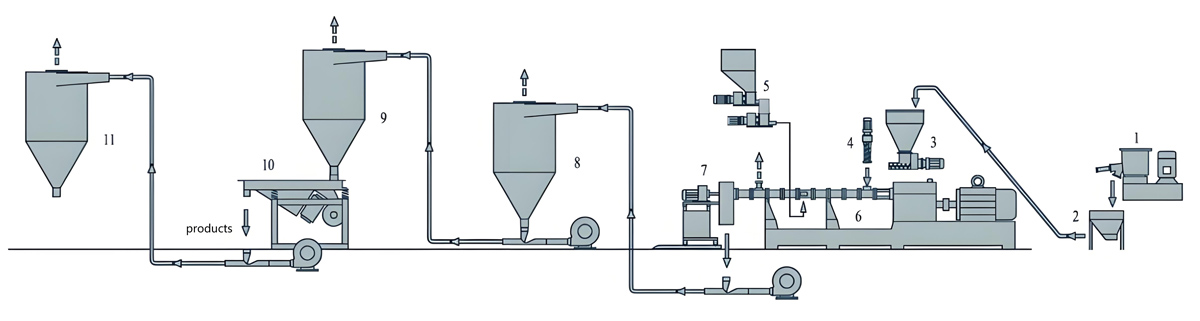
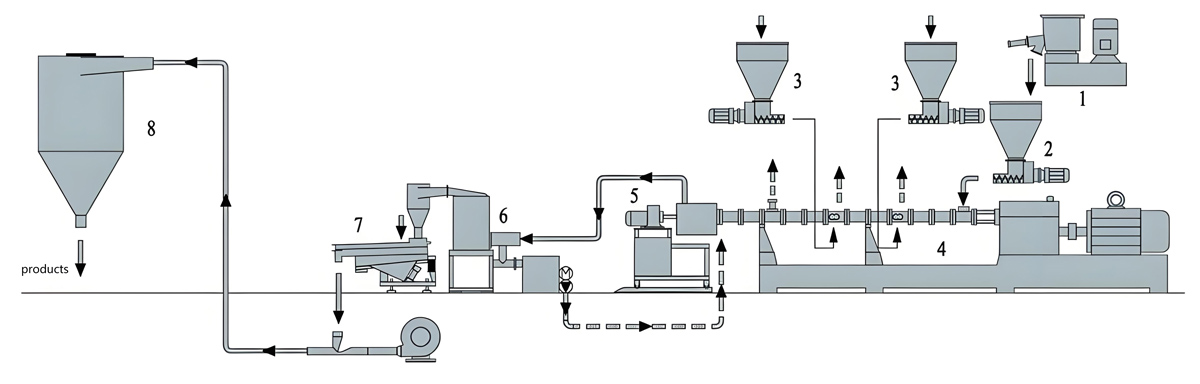
Color masterbatch production process on twin screw extruders involves multiple stages from material preparation through pelletizing and packaging. Understanding each stage enables proper process control and quality assurance. The continuous nature of twin screw extruder operation requires consistent material feeding, precise temperature control, and stable operating parameters to achieve consistent product quality.
Material Preparation
Material preparation represents critical first step in color masterbatch production ensuring consistent feeding and processing. Raw materials including carrier resin pellets, pigments, and additives require proper handling and storage conditions before processing. Carrier resin typically fed via gravimetric or volumetric feeders requiring consistent flow characteristics. Pigments fed via separate feeders or pre-mixed with carriers depending on equipment configuration and formulation requirements. Dry materials stored in controlled conditions to prevent moisture absorption and contamination.
Material quality verification includes checking carrier resin for moisture content, melt flow index, and contamination levels. Pigment quality verification includes checking color strength, particle size distribution, and oil absorption values. Weighing accuracy of all components ensures formulation consistency across batches. Material handling equipment including feeders, conveyors, and storage hoppers require regular cleaning to prevent cross-contamination between different color batches. Proper material preparation prevents processing issues and ensures consistent product quality.
Feeding System Operation
Feeding system operation ensures consistent material delivery to extruder barrel enabling stable processing conditions. Gravimetric feeders provide precise weight-based feeding enabling accurate formulation control. Volumetric feeders offer simpler operation at lower cost but require calibration for density variations. Side feeding of pigments after polymer melting improves dispersion while reducing pigment degradation. Premixing pigments with small portions of carrier before main feeding improves feed consistency and reduces feeder maintenance.
Feeding system calibration ensures accurate material delivery to extruder. Regular calibration of feeders prevents formulation drift and ensures consistent product quality. Feeder maintenance includes checking for material bridging, screw wear, and control system accuracy. Feed rate adjustments accommodate different production rates and formulation changes. Feeding system design considers material flow characteristics including angle of repose and bulk density ensuring reliable material delivery. Proper feeding system operation represents foundation for stable extrusion process.
Melting and Mixing Zone
The melting and mixing zone in twin screw extruder represents critical area where carrier resin melting and pigment dispersion occur. Initial barrel sections operating at temperatures 10-20C above carrier resin melting point ensure proper melting without thermal degradation. Screw configuration in melting zone typically includes conveying elements followed by mixing elements to promote resin melting. Intermeshing screw design creates intense shearing action ensuring thorough melting of carrier resin.
Pigment dispersion occurs primarily in mixing zone following resin melting. Mixing elements including kneading blocks and reverse elements create distributive and dispersive mixing action ensuring pigment deagglomeration. Screw speed and barrel temperature in mixing zone balance dispersion quality with thermal degradation risks. High shear mixing promotes pigment deagglomeration but generates heat requiring temperature control. Low shear mixing reduces thermal effects but may result in inadequate dispersion. Optimizing mixing zone parameters ensures proper pigment dispersion while maintaining thermal stability.
Dispersion Zone Configuration
Dispersion zone configuration significantly affects final product quality and pigment distribution. Advanced twin screw extruders feature modular screw configurations allowing customization for specific pigment types. Kneading block elements with varying stagger angles control mixing intensity and residence time. Narrow kneading blocks provide high shear for pigment deagglomeration. Wide kneading blocks provide distributive mixing for color uniformity. Reverse elements increase residence time allowing complete dispersion of difficult-to-disperse pigments.
Dispersion zone temperature control prevents pigment thermal degradation while maintaining sufficient melt viscosity for effective mixing. Temperature typically maintained 20-30C above melting point in dispersion zone. Screw speed affects both mixing intensity and residence time influencing dispersion quality. Higher screw speeds increase shear and reduce residence time requiring balance between mixing efficiency and thermal degradation. Dispersion zone optimization considers pigment characteristics, carrier properties, and required dispersion quality.
Venting and Degassing
Venting and degassing remove volatiles and entrapped air from melt ensuring product quality and preventing defects. Open vents allow moisture and volatiles to escape from melt during processing. Vacuum vents enhance removal of volatiles particularly important for moisture-sensitive formulations. Vent port location typically placed after mixing zone when most volatiles have been released. Vent plug design prevents melt escape while allowing vapor removal.
Effective degassing prevents bubble formation in pellets and reduces defect formation in final applications. Vacuum level control in vented extruders ranges from atmospheric to 100 mbar depending on formulation requirements. Vent temperature control prevents volatiles from condensing back into melt. Regular vent port cleaning prevents melt accumulation and vent blockage. Proper venting and degassing ensure high-quality pellets free of voids and bubbles.
Pelletizing Process
Pelletizing process converts extruded melt into uniform pellets suitable for handling and storage. Strand pelletizing remains common method for color masterbatch production due to simplicity and low cost. Strand die produces multiple melt strands cooled in water bath before pelletizing. Water bath temperature typically 30-50C for polyolefin carriers and 40-60C for engineering plastic carriers. Strand cooling prevents pellet deformation and ensures proper solidification.
Underwater pelletizing offers alternative method producing uniform spherical pellets with smooth surfaces. Melt cut directly into water producing pellets with excellent heat transfer and rapid cooling. Die face design and cutting blade alignment affect pellet size and shape consistency. Pellet drying after water-based pelletizing removes surface moisture preventing handling issues. Pellet size typically 2-4mm diameter suitable for most processing equipment. Proper pelletizing ensures consistent pellet quality for downstream processing.
Production Equipment Introduction
Modern twin screw extruders for color masterbatch production feature advanced design and control systems. Co-rotating parallel twin screw extruders represent most common configuration for this application due to superior mixing capabilities. The KTE Series twin screw extruder from Nanjing Kerke Extrusion Equipment Company offers excellent performance for color masterbatch compounding. These extruders feature modular screw configurations allowing customization for different formulation requirements. Barrel length to diameter ratio (L/D) typically 40:1 to 52:1 providing sufficient mixing length for proper pigment dispersion.
The KTE Series extruders incorporate advanced temperature control systems with multiple independent zones enabling precise thermal management. Screw diameters range from 20mm to 90mm accommodating production capacities from 50 kg/hr to 2000 kg/hr. Drive systems provide precise speed control typically from 50 to 600 rpm allowing adjustment of mixing intensity and residence time. Control systems feature touchscreen interfaces providing real-time monitoring and adjustment of all processing parameters. The modular design allows for future capacity expansion through screw configuration changes or equipment upgrades.
Specialized equipment features enhance color masterbatch production performance. Pigment side feeding systems enable introduction of pigments after polymer melting reducing thermal degradation. Vacuum venting systems remove volatiles and moisture improving product quality. Die face pelletizing systems produce uniform pellets with excellent heat transfer. Material handling systems include gravimetric feeders, storage silos, and bulk bag unloading stations. Complete production lines integrate all components ensuring coordinated operation and optimal performance.
Parameter Settings
Optimal parameter settings for color masterbatch production depend on formulation characteristics, equipment capabilities, and quality requirements. Temperature profiles, screw speeds, and feed rates require careful adjustment to achieve desired dispersion quality while maintaining thermal stability. Understanding parameter effects enables process optimization for specific formulations.
Temperature Profile Settings
Temperature profile settings along extruder barrel control melting and mixing processes. Feed zone temperature typically set 10-20C below melting point to prevent material bridging and ensure consistent feeding. Compression zone temperature set 10-20C above melting point promoting polymer melting without thermal degradation. Mixing zone temperature maintained 20-30C above melting point ensuring proper melt viscosity for dispersion. Metering zone temperature set 10-20C above mixing zone temperature maintaining consistent melt flow. Die temperature matched to metering zone ensuring proper melt flow and pellet formation.
For polyethylene carriers, typical temperature profile ranges from 160C in feed zone to 200C in die zone for LDPE and 180C to 230C for HDPE. Polypropylene carriers require higher temperatures typically 190C to 240C depending on MFI. Engineering plastic carriers require significantly higher temperatures ranging from 250C to 300C for PC, 260C to 300C for PA, and 260C to 290C for PET. Temperature profile optimization considers pigment thermal stability with more sensitive pigments requiring lower maximum temperatures. Precise temperature control ensures consistent melting and mixing without thermal degradation.
Screw Speed Settings
Screw speed affects mixing intensity, residence time, and thermal generation during processing. Typical screw speeds for color masterbatch production range from 100 to 300 rpm depending on formulation and equipment size. Higher screw speeds increase shear and mixing intensity promoting better pigment dispersion but also increase thermal generation potentially causing thermal degradation. Lower screw speeds reduce thermal effects but may provide insufficient mixing for difficult-to-disperse pigments.
Screw speed optimization considers pigment dispersion requirements and thermal stability of components. Organic pigments typically require moderate screw speeds 150-200 rpm providing adequate mixing without excessive heat generation. Inorganic pigments require higher speeds 200-300 rpm providing necessary shear for deagglomeration. Heat-sensitive pigments require lower speeds 100-150 rpm to prevent thermal degradation. Screw speed also affects production rate with higher speeds increasing throughput provided dispersion quality maintained. Optimal screw speed balances dispersion quality, thermal stability, and production efficiency.
Feed Rate Settings
Feed rate settings control material delivery to extruder affecting residence time and throughput. Feed rates typically set to achieve desired throughput while maintaining adequate residence time for dispersion. Residence time typically 1-3 minutes depending on formulation and equipment length. Higher feed rates increase production but reduce residence time potentially compromising dispersion quality. Lower feed rates increase residence time improving dispersion but reduce production efficiency.
Feed rate optimization considers specific feed rate (kg/hr/rpm) ensuring appropriate material loading in extruder channels. Typical specific feed rates range from 2 to 5 kg/hr/rpm depending on formulation viscosity and mixing requirements. Overfeeding causes excessive fill in channels reducing mixing effectiveness and potentially causing overload conditions. Underfeeding reduces material contact with screws decreasing mixing efficiency and potentially causing channel starvation. Proper feed rate ensures optimal channel fill for effective mixing while maintaining target throughput.
Side Feeding Parameters
Side feeding parameters control introduction of pigments after initial melting reducing thermal degradation. Side feed location typically positioned after polymer melting zone and before primary mixing zone. Side feed rate set according to formulation pigment loading typically 20-50% of total feed rate. Side feeder screw speed adjusted to maintain consistent pigment flow preventing surges or starvation.
Side feeding reduces pigment thermal exposure improving thermal stability of sensitive pigments. Pigment introduction in partially melted matrix reduces shear heating compared to feeding with solid resin. Side feeding location optimization ensures proper wetting of pigments by molten resin before intensive mixing. Side feeding particularly beneficial for heat-sensitive pigments and high concentration formulations. Proper side feeding parameter settings maximize benefits while ensuring complete pigment incorporation.
Die and Pelletizing Parameters
Die and pelletizing parameters affect pellet quality and production efficiency. Die temperature set to maintain proper melt flow typically matching metering zone temperature. Die diameter determines pellet size with strand diameters typically 2-4mm for color masterbatch. Die design includes multiple strand holes to increase throughput typically 4-12 strands depending on production rate. Cutting blade speed synchronized to strand speed ensuring proper pellet length.
Pelletizing parameters vary between strand and underwater systems. For strand pelletizing, water bath temperature 30-60C depending on carrier type. Water flow rate ensures proper cooling without strand deformation. Strand pull speed matched to extruder throughput preventing strand stretching or accumulation. For underwater pelletizing, cutter speed 2000-4000 rpm producing uniform pellets. Water temperature 20-40C ensuring rapid solidification. Die face design and cutter alignment critical for pellet quality in underwater systems.
Equipment Price
Equipment pricing for twin screw extruder systems varies based on capacity, configuration, and included features. Understanding price factors enables proper budgeting and investment planning for color masterbatch production facilities. Complete production line pricing includes extruder, auxiliary equipment, and installation costs.
Extruder Pricing
Twin screw extruder pricing varies significantly based on screw diameter and production capacity. Small capacity extruders with 20mm-25mm screw diameter suitable for lab and pilot scale production cost $25,000-45,000. Medium capacity extruders with 35mm-50mm screw diameter suitable for small commercial production cost $45,000-120,000. Large capacity extruders with 65mm-90mm screw diameter suitable for high volume production cost $120,000-350,000. KTE Series extruders offer competitive pricing across capacity ranges.
Equipment configuration options significantly affect pricing. Basic configuration includes standard screw design and simple temperature controls. Advanced configuration features modular screw systems, enhanced temperature control, and advanced drive systems increasing cost 20-40%. Specialized features including vacuum venting, side feeding, and pelletizing systems add $15,000-50,000 depending on complexity. Material upgrades including stainless steel barrel and screw add 15-30% to base cost. Control system upgrades from basic to advanced PLC systems add $10,000-25,000.
Complete Production Line Pricing
Complete production line pricing includes all auxiliary equipment necessary for operation. Basic line including extruder, feeder, pelletizer, and conveyor systems costs $40,000-80,000 for small capacity 50-100 kg/hr. Medium capacity lines 200-500 kg/hr with gravimetric feeding, advanced temperature control, and complete pelletizing systems cost $80,000-200,000. Large capacity lines 1000-2000 kg/hr with vacuum venting, side feeding, and fully automated systems cost $200,000-500,000. Complete line pricing typically 2-3 times extruder cost depending on automation level.
Auxiliary equipment costs vary by component and capacity. Gravimetric feeder systems cost $8,000-25,000 depending on number of feeders and capacity. Strand pelletizing systems cost $12,000-30,000 depending on strand count and automation level. Underwater pelletizing systems cost $25,000-60,000 depending on capacity and automation. Material handling systems including conveyors and storage silos cost $15,000-40,000. Complete auxiliary system enables automated operation reducing labor requirements.
Installation and Commissioning Costs
Installation and commissioning costs represent significant portion of total project investment. Installation costs including equipment delivery, foundation preparation, and equipment mounting cost $5,000-20,000 depending on equipment size and site conditions. Electrical installation costs $8,000-25,000 depending on power requirements and facility infrastructure. Piping and utility connections cost $5,000-15,000 for water, air, and gas connections as required.
Commissioning costs include equipment setup, calibration, and training services. Basic commissioning for standard equipment costs $3,000-10,000. Advanced commissioning for complex systems with multiple auxiliary equipment costs $10,000-25,000. Training programs for operators and maintenance personnel cost $2,000-8,000 depending on program length and number of trainees. Startup support typically included in commissioning costs covering initial production runs and optimization.
Operating Cost Considerations
Operating costs include energy consumption, maintenance, and material costs affecting total cost of ownership. Energy consumption for twin screw extruder operation typically 0.8-1.2 kWh/kg depending on formulation and efficiency. Maintenance costs typically 2-5% of equipment cost annually for routine maintenance and 5-10% for major overhauls. Spare parts budget typically 1-3% of equipment cost annually.
Energy costs vary based on local electricity rates and production volume. At typical rates $0.10-0.20 per kWh, energy costs represent $0.08-0.24 per kg production. Maintenance costs including labor and parts typically $0.02-0.06 per kg. Material efficiency including yield and scrap typically 98-99% for well-optimized operations. Total operating costs typically $0.12-0.35 per kg excluding material costs. Operating cost optimization improves profitability through efficiency improvements and waste reduction.
Production Problems and Solutions
Production problems in color masterbatch compounding affect product quality, process efficiency, and equipment reliability. Understanding common problems, their causes, and effective solutions enables rapid troubleshooting and preventive measures. Systematic problem identification and resolution minimizes production downtime and quality issues.
Poor Pigment Dispersion
Poor pigment dispersion manifests as color streaks, pigment agglomerates, and inconsistent color strength. This problem typically results from insufficient mixing intensity, inadequate residence time, or improper screw configuration. Causes include low screw speed reducing shear mixing, insufficient mixing elements in screw design, or too high feed rate reducing residence time. Carrier resin with too low viscosity may also reduce shear stress for dispersion.
Solutions for poor dispersion begin with process parameter optimization. Increasing screw speed to 200-300 rpm provides higher shear for pigment deagglomeration. Reducing feed rate increases residence time allowing more thorough mixing. Increasing barrel temperature in mixing zone reduces melt viscosity improving wetting of pigment particles. Screw configuration modifications including adding kneading blocks or adjusting stagger angle increase mixing intensity. Adding reverse elements increases residence time for difficult-to-disperse pigments. Monitoring dispersion quality through microscopic evaluation of pellets verifies improvement effectiveness.
Preventive measures for poor dispersion include proper screw configuration selection for specific pigment types. High pigment loading formulations require more intensive mixing configurations. Regular screw inspection ensures mixing elements maintain effectiveness. Process parameter validation during startup ensures adequate mixing before full production. Regular dispersion quality testing including pigment particle size analysis maintains product consistency. Preventive maintenance prevents screw wear that reduces mixing effectiveness over time.
Color Inconsistency Between Batches
Color inconsistency between production batches results in customer complaints and material waste. Causes include feeder calibration drift, formulation errors, pigment quality variation, or processing parameter changes. Gravimetric feeder accuracy problems cause formulation variation between batches. Raw material quality variation in either pigment strength or carrier properties affects color development. Temperature profile changes between runs cause thermal degradation affecting color.
Solutions for color inconsistency start with system calibration and validation. Regular feeder calibration ensures accurate material delivery for consistent formulation. Raw material testing including pigment strength and carrier MFI verification prevents material variation issues. Standardized operating procedures ensure consistent processing parameters between batches. Temperature profile verification prevents thermal degradation issues. Color measurement including spectrophotometry provides quantitative data for color consistency monitoring.
Preventive measures include establishing control limits for color parameters based on customer requirements. Statistical process control monitoring identifies process drift before producing out-of-specification material. Material specification requirements ensure consistent raw material quality. Documentation of processing parameters enables reproducibility between batches. Regular training reinforces proper operating procedures and parameter settings. Color matching procedures ensure new batches match established color standards.
Pellet Quality Issues
Pellet quality issues including irregular shapes, voids, and surface defects affect downstream processing and final product appearance. Causes include improper pelletizing parameters, moisture or volatiles in melt, or die design issues. Strand pelletizing problems include poor cutting causing irregular pellet lengths and stretched strands. Water temperature issues cause pellet deformation or poor solidification. Die design problems include improper strand diameter or hole spacing.
Solutions for pellet quality issues begin with pelletizing system optimization. Water bath temperature adjustment ensures proper cooling without strand deformation typically 30-50C for polyolefins. Cutting blade adjustment ensures clean cuts without strand dragging. Strand pull speed synchronization prevents stretching or accumulation. Die hole diameter and spacing optimization ensures proper strand formation and cutting. For underwater pelletizing, cutter speed adjustment and die face alignment produce uniform pellets. Pellet size sorting removes oversized or undersized pellets.
Preventive measures include regular pelletizing equipment maintenance ensuring consistent operation. Water bath filtration removes debris affecting strand quality. Cutting blade replacement maintains sharp edges for clean cutting. Die cleaning prevents build-up affecting strand formation. Regular pellet quality inspection including size distribution and surface quality identifies issues before customer problems. Process parameter documentation ensures reproducibility of optimal pelletizing conditions.
Thermal Degradation
Thermal degradation causes color changes, molecular weight reduction, and property deterioration in masterbatch products. Causes include excessive temperature, long residence time, high shear heating, or thermally unstable components. Temperature set points too high cause thermal breakdown of pigments or carrier resin. Long residence time from low screw speed or overfeeding increases thermal exposure. High shear from fast screw speed generates excessive heat degrading sensitive components.
Solutions for thermal degradation involve temperature and residence time optimization. Reducing barrel temperature in mixing and metering zones reduces thermal exposure. Increasing screw speed reduces residence time despite higher shear. Feed rate optimization prevents overfilling that extends residence time. Side feeding of pigments reduces thermal exposure of heat-sensitive components. Vacuum venting removes volatiles and prevents degradation buildup. Thermal stabilizer addition improves thermal stability of formulation if compatible with final application.
Preventive measures include temperature monitoring throughout extruder zones ensuring operation within specified limits. Residence time measurement and control prevent excessive thermal exposure. Material selection considering thermal stability of pigments and carriers prevents degradation issues. Process design including side feeding for heat-sensitive components reduces thermal stress. Regular maintenance including temperature sensor calibration ensures accurate temperature control. Formulation optimization selects components with compatible thermal stability requirements.
Equipment Overload and Shutdown
Equipment overload and shutdown conditions cause production interruptions and potential equipment damage. Causes include material blockage, excessive feed rate, screw configuration mismatch, or mechanical issues. Material bridging in feeder causes starvation and potential screw damage. Overfeeding causes channel overload increasing motor load and potential shutdown. Screw configuration mismatched to formulation requirements causes excessive pressure buildup. Mechanical issues including bearing wear cause increased load and potential failure.
Solutions for overload conditions begin with feed system optimization. Feeder adjustment prevents bridging and ensures consistent material flow. Feed rate reduction decreases channel load and motor load. Screw configuration optimization provides appropriate mixing characteristics for formulation. Temperature adjustment reduces melt viscosity decreasing processing load. Motor current monitoring detects overload conditions before shutdown. Regular maintenance including bearing lubrication and screw inspection prevents mechanical overload.
Preventive measures include load monitoring systems providing early warning before shutdown conditions. Feed system design prevents bridging and ensures consistent delivery. Screw configuration validation ensures appropriate selection for formulation. Process parameter limits prevent operation beyond equipment capabilities. Regular maintenance including lubrication and inspection prevents mechanical failures. Operator training enables recognition of early overload indicators and proper response.
Maintenance
Regular maintenance ensures twin screw extruder performance, reliability, and product quality. Preventive maintenance schedules address component wear and prevent unexpected failures. Proper maintenance practices extend equipment life, reduce downtime, and maintain consistent product quality.
Daily Maintenance
Daily maintenance tasks ensure equipment operates at optimal performance levels. Visual inspection of equipment for leaks, unusual noises, or vibrations identifies developing problems. Temperature verification ensures all zones operate at set points. Feed system inspection ensures consistent material flow without bridging or surging. Pelletizing system inspection ensures proper cutting and pellet quality. Lubrication check ensures adequate lubricant levels in required locations.
Daily cleaning procedures prevent cross-contamination between different color batches. Feed hopper and feeder cleaning remove residue from previous batches. Extruder barrel cleaning between color changes prevents cross-contamination. Die cleaning prevents build-up affecting pellet quality. Pelletizing system cleaning removes debris affecting pellet formation. Proper cleaning procedures ensure product purity and color accuracy.
Weekly Maintenance
Weekly maintenance tasks address components requiring more detailed inspection and servicing. Screw inspection through inspection port checks for wear, corrosion, or damage. Barrel inspection for signs of wear or scoring affecting mixing performance. Feeder calibration verification ensures accurate material delivery. Temperature sensor verification ensures accurate readings throughout barrel. Drive system inspection including belts, gears, and couplings checks for wear or alignment issues.
Weekly lubrication of bearings, gears, and moving components ensures proper lubrication levels. Electrical system inspection including control panel, motor connections, and sensor wiring ensures proper electrical function. Safety device verification ensures emergency stops, guards, and interlocks function properly. Documentation review ensures maintenance tasks completed and recorded properly. Weekly maintenance prevents minor issues from developing into major problems.
Monthly Maintenance
Monthly maintenance addresses components requiring periodic servicing based on usage. Screw removal and inspection for wear measurement provides data for replacement planning. Barrel bore inspection for wear or damage evaluates barrel condition. Feeder disassembly and cleaning removes accumulated material affecting feeding accuracy. Die cleaning and inspection ensures proper hole condition and surface finish. Pelletizing cutter blade inspection and replacement if worn ensures proper cutting.
Monthly lubrication including bearing replacement if specified by manufacturer ensures proper lubrication. Drive system service including gear oil changes as specified prevents lubricant breakdown. Electrical system testing including motor current draw and control system response detects developing issues. Calibration verification of temperature, pressure, and feed rate sensors ensures accurate process control. Monthly maintenance provides detailed condition assessment for long-term planning.
Quarterly Maintenance
Quarterly maintenance provides comprehensive equipment evaluation and servicing. Complete disassembly for thorough cleaning removes accumulated material from all surfaces. Detailed measurement of screw and barrel wear provides data for replacement planning. Feeder and auxiliary equipment service ensures all systems operate at optimal performance. Electrical system service including control system calibration and connection tightening ensures reliability.
Screw and barrel replacement based on wear measurements maintains optimal mixing performance. Bearing replacement based on condition monitoring prevents unexpected failures. Drive system service including belt replacement and gearbox service maintains power transmission efficiency. Safety system testing ensures all safety devices function properly. Quarterly maintenance provides opportunity for major component service and replacement planning.
Annual Maintenance
Annual maintenance provides comprehensive equipment evaluation and major component service. Complete equipment teardown for thorough inspection provides detailed condition assessment. Screw and barrel replacement based on wear or performance degradation maintains mixing quality. Complete bearing replacement prevents unexpected failures. Drive system overhaul including gearbox rebuild maintains power transmission efficiency. Control system update and calibration ensures accurate process control.
Structural inspection including frame, mounting, and foundation ensures equipment stability and alignment. Electrical system overhaul including motor service and control system update ensures reliability. Safety system overhaul including guard replacement and interlock testing ensures operator safety. Documentation update including maintenance records and operating manual revisions ensures accurate information. Annual maintenance provides opportunity for equipment upgrades and capacity planning.
FAQ
Frequently asked questions provide quick reference for common concerns and issues in color masterbatch production using twin screw extruders. These questions address typical operational, quality, and equipment-related issues encountered in production environments.
What is the optimal screw configuration for different pigment types?
Optimal screw configuration varies by pigment characteristics and dispersion requirements. Organic pigments typically require moderate mixing configuration with standard kneading block arrangement providing adequate shear without excessive heat generation. Inorganic pigments require more intensive mixing with additional kneading blocks and tighter stagger angles providing necessary shear for deagglomeration. Heat-sensitive pigments require gentler mixing with wider kneading blocks and reduced mixing elements minimizing thermal exposure. Fluorescent and special effect pigments require gentle mixing configurations preserving pigment characteristics while achieving adequate dispersion.
Screw configuration should be optimized based on specific formulation requirements. Trial runs with different configurations help identify optimal arrangement for each pigment type. Modular screw systems allow configuration changes without purchasing new screws. Consulting with equipment manufacturers provides recommendations for specific application requirements. Regular evaluation of screw performance ensures configuration remains optimal as materials or requirements change.
How do I determine the proper pigment concentration for my application?
Proper pigment concentration depends on multiple factors including pigment strength, carrier resin compatibility, and let-down ratio requirements. Pigment strength provided by supplier indicates tinting strength affecting required concentration. Carrier resin compatibility affects pigment effectiveness and dispersion requirements. Let-down ratio considerations determine optimal masterbatch concentration balancing material handling with color development.
Testing different concentrations through trial production helps determine optimal loading. Color measurement including delta E evaluation provides quantitative comparison between concentrations. Processability evaluation including melt flow and dispersion quality identifies concentration limits. Economic analysis comparing material costs against processing efficiency determines cost-effective concentration. Customer requirements for color accuracy and performance affect concentration selection. Proper concentration determination balances technical requirements with economic considerations.
What causes color variation between production batches?
Color variation between batches results from multiple potential causes affecting color development. Feeder calibration drift causes formulation variation altering pigment concentration. Raw material quality variation in pigment strength or carrier properties affects color output. Temperature profile changes cause thermal degradation altering color characteristics. Processing parameter variations including screw speed and feed rate affect dispersion quality and thermal exposure.
Material contamination from previous batches causes color shifts. Equipment wear affecting mixing performance changes dispersion quality. Measurement errors including improper color measurement procedures cause apparent variation. Environmental factors including humidity and temperature affect material handling and processing. Systematic investigation including process parameter review, material testing, and equipment evaluation identifies root cause of variation. Implementation of statistical process control helps prevent variation through early detection of process drift.
How often should I replace the screw and barrel?
Screw and barrel replacement depends on wear rate and performance requirements. Typical service life for screws and barrels in color masterbatch production ranges from 3 to 7 years depending on operating conditions and abrasive formulations. Abrasive pigments including titanium dioxide and certain metal oxides accelerate wear reducing service life. Operating conditions including high screw speeds and temperatures accelerate wear. Performance degradation including decreased dispersion quality or increased energy consumption indicates need for replacement.
Regular wear measurement including screw diameter and barrel bore measurement provides data for replacement planning. Visual inspection for scoring, pitting, or surface damage indicates wear condition. Performance monitoring including dispersion quality evaluation and specific energy consumption indicates wear effects. Preventive replacement before complete failure prevents unplanned downtime. Budgeting for replacement based on expected service life prevents financial surprises. Planning replacement during scheduled maintenance minimizes production impact.
What is the recommended pellet size for color masterbatch?
Recommended pellet size balances handling characteristics with processing requirements. Standard pellet sizes range from 2mm to 4mm diameter with length to diameter ratio of 1.5 to 2.5. Smaller pellets 2mm provide better flow and easier handling but require more cutting energy increasing production cost. Larger pellets 4mm handle well but may not process as effectively in some downstream equipment. Pellet shape consistency ensures uniform feeding and processing.
Pellet size selection considers downstream processing equipment requirements. Injection molding typically accepts 2-4mm pellets. Extrusion processes may prefer 3-5mm pellets for better feeding. Blow molding processes typically require 2-3mm pellets. Specific customer requirements dictate acceptable pellet size range. Pellet quality including uniformity and absence of fines affects feeding and processing regardless of size. Optimization of pelletizing parameters ensures consistent pellet size and shape.
How do I prevent cross-contamination between different color batches?
Cross-contamination prevention requires proper cleaning procedures and material handling practices. Complete equipment cleaning between color changes including feed hopper, feeder, extruder, and pelletizing system removes previous color residues. Dedicated equipment for different color families particularly light colors prevents contamination. Material handling procedures including proper storage and labeling prevent accidental mixing. Verification of cleanliness including visual inspection and trial runs ensures complete removal of previous colors.
Cleaning procedures vary based on color sequence and material properties. Light to dark color transitions may require less extensive cleaning. Dark to light transitions typically require more thorough cleaning including purging with clean resin. Abrasive cleaning materials may be used for stubborn color removal. Validation of cleaning effectiveness ensures no color contamination in next batch. Documented cleaning procedures ensure consistent execution across operators and shifts.
Summary
Color masterbatch production using twin screw extruders represents sophisticated process requiring careful attention to formulation, processing parameters, and maintenance. Successful production depends on understanding material characteristics, equipment capabilities, and quality requirements. The KTE Series twin screw extruders from Nanjing Kerke Extrusion Equipment Company provide excellent performance for color masterbatch compounding with modular designs supporting various formulation requirements.
Key success factors include proper formulation development considering pigment characteristics, carrier selection, and additive packages. Process parameter optimization ensures adequate dispersion while maintaining thermal stability. Regular maintenance prevents unexpected failures and maintains consistent quality. Quality control including color measurement and dispersion testing ensures product meets customer requirements. Continuous improvement through monitoring and optimization enhances efficiency and quality over time.
Investing in appropriate equipment selection based on production requirements and quality standards provides foundation for successful operations. Understanding total cost of ownership including initial investment, operating costs, and maintenance requirements enables proper financial planning. Training of operators and maintenance personnel ensures equipment operation at optimal performance. Implementation of preventive maintenance programs reduces downtime and extends equipment life. Strategic planning for capacity growth ensures equipment selection supports future business development.
Color masterbatch production presents opportunities for value-added products serving diverse industries and applications. Success requires attention to quality consistency, process efficiency, and customer service. Continuous learning about new materials, technologies, and processing methods maintains competitive advantage. Partnership with equipment manufacturers and material suppliers provides access to expertise and support for process improvement and product development. Commitment to quality and efficiency ensures long-term success in color masterbatch production.