Electronic and electrical plastic masterbatch production represents one of the most demanding segments of the masterbatch industry, requiring formulations that meet stringent performance specifications for flame retardancy, electrical insulation, static dissipation, and long-term durability under challenging environmental conditions. The plastic components used in electronic devices, electrical enclosures, wiring infrastructure, and consumer electronics must satisfy rigorous safety standards and performance requirements that directly depend on masterbatch quality.
The electronics industry continues to experience rapid growth and innovation, driving increasing demand for high-performance plastic materials that enable lighter, smaller, more efficient, and more reliable electronic products. Masterbatch manufacturers serving this sector must maintain exceptional quality standards and technical capabilities to meet the evolving requirements of electronic applications.
Twin screw extrusion technology provides the precise processing control and formulation flexibility necessary for electronic and electrical masterbatch production. The ability to incorporate multiple additive systems, achieve uniform dispersion of potentially hazardous flame retardant compounds, and maintain strict quality tolerances makes twin screw extrusion the preferred manufacturing technology for this demanding application sector.
Introduction
Electronic and electrical applications impose some of the most stringent requirements on plastic materials of any industry sector. Electrical safety regulations mandate specific flame retardancy levels, while electronic performance requirements demand consistent dielectric properties, dimensional stability, and reliable long-term performance. The masterbatch used in these applications must deliver all necessary performance characteristics while maintaining compatibility with the base polymer and processing requirements.
Plastic materials in electronic applications serve diverse functions ranging from structural housings and enclosures to insulating components, connectors, and circuit board substrates. Each application presents unique requirements that influence masterbatch formulation design. Understanding these application-specific requirements enables masterbatch manufacturers to develop products optimized for specific customer needs.
The electronics industry operates under rigorous regulatory frameworks governing material safety, environmental compliance, and product performance. Masterbatch formulations must comply with regulations including RoHS (Restriction of Hazardous Substances), REACH (Registration, Evaluation, Authorisation and Restriction of Chemicals), and various flame retardant safety standards. Compliance documentation and traceability systems have become essential capabilities for manufacturers serving this sector.
Twin screw extruders from manufacturers like Nanjing Kerke Extrusion Equipment Company provide the processing capabilities necessary to produce electronic and electrical masterbatch meeting these demanding requirements. The KTE series equipment offers the precise control, flexibility, and quality consistency essential for this specialized market segment.
This comprehensive guide examines all critical aspects of electronic and electrical plastic masterbatch production using twin screw extrusion technology, providing formulation guidance, process descriptions, equipment recommendations, and practical production expertise. Whether establishing new production capabilities or optimizing existing operations, the information presented here supports achievement of superior results in this demanding application area.
Formulation Ratio
Electronic and electrical masterbatch formulations must address multiple functional requirements simultaneously, from flame retardancy and electrical insulation to color, UV protection, and processing stability. The complexity of these formulations requires careful balancing of component interactions and processing considerations.
Flame Retardant Masterbatch Formulations
Flame retardant masterbatch represents the largest segment of the electronic and electrical masterbatch market. These formulations must achieve specified flame retardancy levels while maintaining acceptable mechanical properties, processing characteristics, and cost efficiency.
Halogenated flame retardant systems, including brominated and chlorinated compounds, have traditionally dominated this application area. These additives are effective at relatively low concentrations but face increasing regulatory pressure due to environmental and health concerns. Brominated flame retardants such as decabromodiphenyl oxide and tetrabromobisphenol A are incorporated at 5-20% depending on the specific compound and required flame retardancy level.
Halogen-free flame retardant systems have gained significant market share as regulatory requirements and environmental concerns increase. These systems typically employ phosphorus-based compounds, mineral fillers such as aluminum trihydroxide (ATH) and magnesium hydroxide, or nitrogen-based compounds. Halogen-free flame retardant masterbatch formulations may contain 20-60% additive loading depending on the effectiveness of the specific system employed.
Antimony trioxide serves as a synergist with halogenated flame retardants, typically incorporated at 2-5% concentration. This compound enhances the effectiveness of brominated or chlorinated flame retardants, allowing reduced flame retardant concentrations while achieving equivalent performance.
The carrier resin selection for flame retardant masterbatch must consider compatibility with both the flame retardant system and the target application polymer. Common carrier resins include polypropylene, polyethylene, polystyrene, and ABS, with selection based on the final application requirements. Carrier resin typically constitutes 50-80% of the masterbatch formulation.
Electrical Insulation Masterbatch Formulations
Masterbatch for electrical insulation applications must provide specific dielectric properties while achieving required color and appearance characteristics. These formulations are used in wire and cable jacketing, electrical component housings, and insulating films.
Color masterbatch for electrical insulation applications must employ pigments specifically approved for electrical applications. Certain pigments can affect electrical properties or thermal stability in ways unsuitable for insulation applications. Pigment concentrations typically range from 1-5% depending on color intensity requirements and regulatory specifications.
UV stabilizer packages protect insulation materials from degradation during storage, installation, and outdoor service. Hindered amine light stabilizers (HALS) combined with appropriate UV absorber systems provide comprehensive UV protection. Stabilizer concentrations typically range from 0.3-1.0% depending on exposure conditions and required service life.
Processing stabilizers, including phosphite and thioester antioxidant compounds, protect the polymer during processing and extend long-term thermal oxidative stability of finished products. These additives are typically incorporated at 0.1-0.5% concentration levels.
Static Dissipative and Conductive Masterbatch
Electronic applications often require materials with specific electrical conductivity characteristics, ranging from static dissipative properties for sensitive electronic components to conductive formulations for electromagnetic interference (EMI) shielding.
Static dissipative masterbatch formulations incorporate carbon black with controlled conductivity characteristics, conductive polymer additives, or specialty anti-static agents. Carbon black loadings for static dissipation typically range from 5-15%, with precise loading determined by the target surface resistance requirements.
Conductive masterbatch for EMI shielding applications requires higher conductivity levels, typically achieved through carbon black loadings of 15-30% or metal fiber incorporation. These high-loading formulations present significant processing challenges requiring specialized equipment configurations and processing parameters.
Anti-static agent masterbatch employs surface-active compounds that migrate to the polymer surface to dissipate static charges. These additives are typically incorporated at 2-10% concentration and provide moderate static dissipation effectiveness suitable for general electronic packaging and handling applications.
Color Masterbatch for Electronic Housings
Consumer electronics require aesthetically appealing housings and components with consistent color matching and surface appearance. Color masterbatch for these applications must achieve precise color matching while maintaining processing compatibility and regulatory compliance.
Pigment selection for electronic housing applications considers lightfastness, heat stability, migration resistance, and regulatory compliance. Premium organic pigments, inorganic pigments, and specialized effect pigments may be employed depending on color requirements and cost considerations. Pigment concentrations vary widely from 0.5% for light shades to 3% or higher for deep, saturated colors.
Impact modifier additives are often incorporated in electronic housing masterbatch formulations to enhance toughness and resistance to impact damage during product use and handling. Typical impact modifier concentrations range from 5-15% depending on the specific polymer system and toughness requirements.
Production Process
Electronic and electrical masterbatch production requires careful attention to process controls and quality assurance procedures due to the critical performance requirements of these applications. The production process incorporates specific procedures addressing the unique challenges of this market segment.
Raw Material Handling and Safety
Electronic and electrical masterbatch formulations often incorporate additives requiring special handling precautions. Flame retardant compounds, particularly brominated and chlorinated types, require appropriate personal protective equipment and handling procedures to minimize operator exposure.
Dust containment systems and enclosed material handling equipment help minimize airborne particle exposure during weighing and blending operations. Dedicated production areas for flame retardant masterbatch prevent cross-contamination with other product types. Material Safety Data Sheet (MSDS) documentation and operator training on hazardous material handling are essential regulatory compliance elements.
Raw material storage conditions must maintain material integrity throughout shelf life. Humidity-controlled storage prevents moisture absorption by hygroscopic additives. Temperature-controlled storage may be necessary for temperature-sensitive flame retardant compounds.
Extrusion Processing
The twin screw extrusion process for electronic and electrical masterbatch must achieve uniform dispersion of potentially challenging additives while maintaining strict quality standards. Processing parameters require careful optimization for each formulation type.
Feeding procedures for high-loading flame retardant masterbatch formulations may require specialized feeding equipment capable of handling powders with poor flow characteristics. Gravimetric feeding systems with appropriate hopper designs ensure accurate addition rates and consistent formulation throughout production runs.
The extrusion process incorporates specific mixing sequences optimized for the additive system being processed. For flame retardant masterbatch, mixing configurations must achieve uniform additive dispersion while minimizing mechanical energy input that could cause thermal degradation of sensitive additives. Kneading block element arrangements with reduced intensity may be necessary for heat-sensitive flame retardant formulations.
Temperature profiles for electronic and electrical masterbatch typically employ lower processing temperatures compared to general-purpose masterbatch to protect heat-sensitive additives. Monitoring of melt temperature, in addition to barrel zone temperatures, provides more accurate assessment of actual thermal exposure.
Quality Control Procedures
Quality control for electronic and electrical masterbatch extends beyond standard color and dispersion testing to include application-specific performance verification. Flame retardancy testing, electrical property measurement, and regulatory compliance documentation are essential quality assurance elements.
Laboratory flame testing using standardized procedures (UL 94, IEC 60695) verifies flame retardancy performance of production samples. Regular testing frequency depends on product type and customer requirements, with critical applications requiring testing of each production batch.
Electrical property testing including surface resistance, volume resistance, and dielectric strength verification ensures compliance with electrical performance specifications. These tests require specialized equipment and trained personnel to perform accurately.
Pelletization and Packaging
Pelletization of electronic and electrical masterbatch follows standard procedures with specific attention to contamination prevention and quality preservation. Underwater pelletization provides superior pellet quality and is preferred for these demanding applications.
Packaging for electronic and electrical masterbatch employs materials and procedures designed to preserve product quality and ensure regulatory compliance. Airtight packaging prevents moisture absorption and preserves additive effectiveness. Clear labeling with formulation details, batch information, and regulatory compliance data supports proper product use and traceability requirements.
Production Equipment Introduction
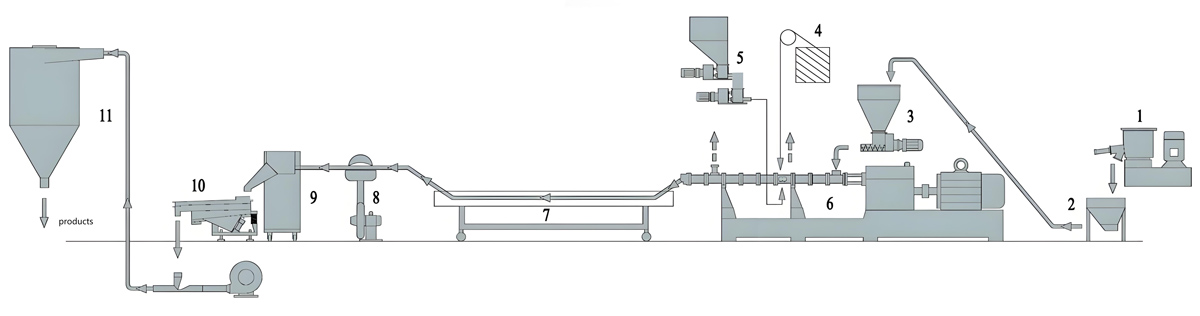
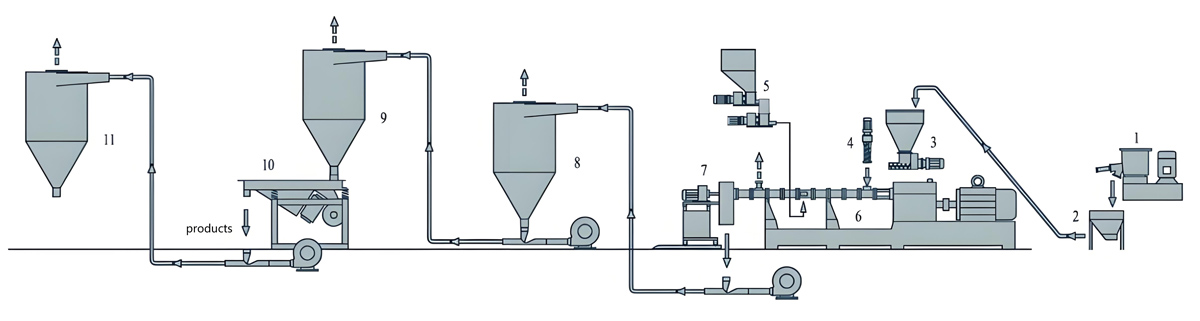
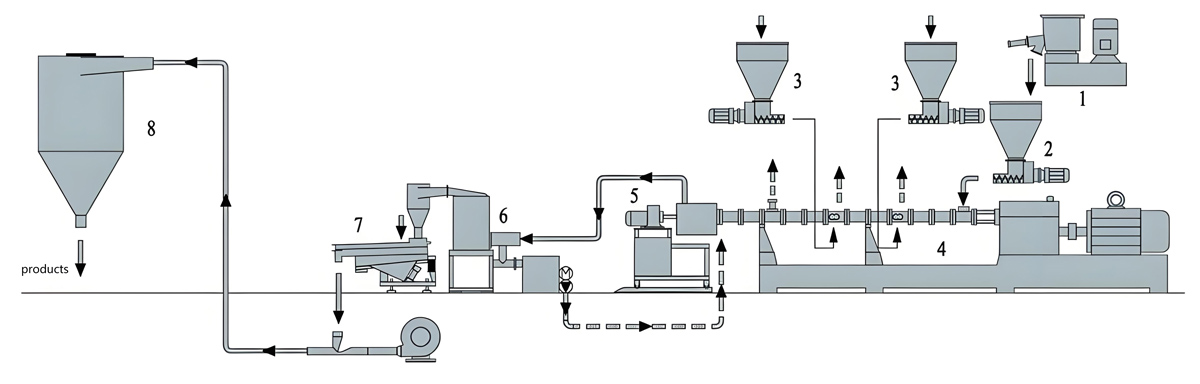
Equipment selection for electronic and electrical masterbatch production must consider the specific requirements of flame retardant processing, high-loading formulations, and stringent quality standards. The Kerke KTE series provides equipment options suitable for this demanding application segment.
KTE-36B Twin Screw Extruder
The compact KTE-36B with 35.6mm screw diameter and 20-100kg per hour output capacity serves smaller production volumes and specialized formulations. This model is particularly suitable for development work, small batch production, and premium specialty products where production volume is limited.
The smaller equipment size enables precise process control valuable for challenging formulations. The shorter barrel length reduces thermal exposure time for heat-sensitive additives. Flexibility in screw configuration allows optimization for diverse formulation requirements.
KTE-50B Twin Screw Extruder
The KTE-50B with 50.5mm screw diameter and 80-200kg per hour output capacity provides an excellent balance of production capability and processing flexibility for medium-scale electronic and electrical masterbatch production.
This model accommodates higher additive loadings while maintaining adequate mixing efficiency for uniform dispersion. The modular barrel configuration enables customization for specific formulation requirements, including additional mixing zones, devolatilization sections, or specialized feeding ports.
Advanced temperature control systems provide precise thermal management essential for heat-sensitive flame retardant formulations. Digital control systems enable accurate monitoring and documentation of processing parameters for quality assurance and regulatory compliance.
KTE-65B Twin Screw Extruder
For higher-volume production requirements, the KTE-65B with 62.4mm screw diameter and 200-450kg per hour output capacity provides the throughput necessary for cost-effective production of standard electronic and electrical masterbatch products.
Despite higher production volumes, this model maintains the processing quality necessary for demanding electronic applications. Screw configurations can be optimized for flame retardant processing, high-loading conductive formulations, or other specialized requirements.
The KTE-65B benefits from robust mechanical design engineered for continuous production operation, supporting the extended production runs typical of volume masterbatch manufacturing.
Support Equipment
Complete electronic and electrical masterbatch production requires specialized support equipment addressing the unique requirements of this application segment.
Dust collection and containment systems protect operator health and maintain clean production environments. Enclosed feeding systems minimize airborne exposure to potentially hazardous additives. Material handling equipment designed for flame retardant compounds ensures safe and efficient production operations.
Quality control laboratory equipment includes flame testing apparatus, electrical property measurement instruments, and analytical equipment for formulation verification. Investment in comprehensive quality testing capabilities is essential for serving the electronic and electrical market segment.
Parameter Settings
Processing parameter optimization for electronic and electrical masterbatch requires balancing multiple competing requirements including dispersion quality, additive effectiveness, thermal stability, and production efficiency.
Temperature Profile Settings
Temperature profiles for flame retardant masterbatch typically employ lower settings than general-purpose formulations to protect heat-sensitive additives from thermal degradation.
For halogenated flame retardant masterbatch in polypropylene carrier, temperature profiles typically range from 180-200 degrees Celsius in the feeding zone, 200-220 degrees Celsius in the processing zones, and 210-230 degrees Celsius at the die. These temperatures provide adequate melt flow while minimizing flame retardant degradation.
Halogen-free flame retardant masterbatch formulations may require different temperature profiles depending on the specific additive system. ATH-filled formulations typically employ temperatures of 190-210 degrees Celsius throughout due to the endothermic decomposition of aluminum trihydroxide at higher temperatures. Phosphorus-based flame retardant systems generally tolerate processing temperatures similar to halogenated formulations.
Conductive carbon black masterbatch may require elevated temperatures to achieve adequate melt flow for high-loading formulations. Temperature profiles in the range of 210-240 degrees Celsius may be necessary depending on carrier resin and carbon black loading level.
Screw Speed Optimization
Screw speed influences shear stress, residence time, and processing temperature, all of which affect masterbatch quality. Optimization balances these factors for specific formulation requirements.
For flame retardant masterbatch, lower screw speeds in the range of 150-300 rpm typically provide optimal processing conditions by reducing mechanical energy input and associated shear heating. Higher speeds may cause thermal degradation of sensitive flame retardant compounds.
High-loading formulations such as conductive carbon black masterbatch may benefit from higher screw speeds to increase throughput and improve dispersion of high filler loadings. Speeds up to 400 rpm may be appropriate for these formulations, with adjustments based on observed quality results.
Feeding System Parameters
Accurate feeding is critical for maintaining formulation accuracy, particularly for flame retardant masterbatch where additive concentration directly affects performance characteristics.
Loss-in-weight feeders provide the accuracy necessary for precise formulation control. Separate feeders for carrier resin and additive systems enable formulation flexibility and accurate addition rate control. Feeder calibration verification at regular intervals ensures ongoing formulation accuracy.
Equipment Price
Investment in electronic and electrical masterbatch production equipment requires consideration of capacity requirements, formulation complexity, and quality assurance needs.
KTE-36B Investment
The KTE-36B, suitable for lower-volume and specialty production, is priced from $25,000 to $35,000. This compact model provides an entry point for electronic masterbatch production or serves as dedicated equipment for specialty formulations.
Complete production line investment for KTE-36B systems typically ranges from $50,000 to $80,000, including material handling, pelletization, and quality control equipment.
KTE-50B Investment
The KTE-50B with 80-200kg per hour capacity is priced between $40,000 and $60,000. This model provides an excellent balance of capacity and capability for medium-scale electronic and electrical masterbatch production.
Complete production facilities based on KTE-50B typically require investment ranging from $80,000 to $130,000 depending on support equipment specifications and facility requirements.
KTE-65B Investment
For higher-volume production, the KTE-65B is priced from $50,000 to $80,000. This model supports cost-effective production of standard electronic and electrical masterbatch products at volumes suitable for most market requirements.
Complete production lines based on KTE-65B typically require investment ranging from $100,000 to $160,000.
Quality Assurance Investment
Beyond basic production equipment, electronic and electrical masterbatch production requires investment in quality assurance capabilities. Flame testing equipment, electrical property measurement systems, and analytical instrumentation represent significant additional investment requirements typically ranging from $30,000 to $80,000 depending on the scope of testing capabilities required.
Problems in Production Process and Solutions
Electronic and electrical masterbatch production presents specific challenges requiring systematic understanding and effective management approaches.
Flame Retardant Degradation
Thermal degradation of flame retardant additives during processing reduces effectiveness in finished products, potentially resulting in failure to meet flame retardancy specifications.
Corrective actions focus on reducing thermal exposure. Temperature profile reduction throughout the barrel can significantly decrease degradation rates. Screw speed reduction decreases mechanical energy input and associated shear heating. Increased throughput reduces residence time in high-temperature zones.
Preventive measures include careful formulation design selecting flame retardants with appropriate thermal stability for processing conditions. Temperature monitoring throughout the barrel enables early detection of excursions. Standard operating procedures should specify maximum acceptable temperatures and residence times for each formulation.
Dispersion Quality Problems
Inadequate dispersion of flame retardant compounds, carbon black, or pigments can result in inconsistent performance, color variation, or processing problems in customer applications.
Solutions involve increasing mixing intensity through screw configuration modification. Additional kneading block elements in mixing zones increase shear stress and residence time. Reducing throughput increases material fill level and mixing effectiveness. For carbon black formulations, using pre-dispersed concentrates can improve dispersion quality.
Prevention requires establishing standard screw configurations optimized for each formulation type. Regular inspection and replacement of worn screw elements maintains consistent mixing performance. Quality control testing including dispersion assessment provides verification of adequate mixing.
Electrical Property Variation
Inconsistent electrical properties between batches can cause customer complaints and potential application failures. Property variation may result from formulation inconsistencies, processing variations, or raw material changes.
Systematic investigation identifies specific causes. Verify formulation accuracy through weighing and feeder calibration checks. Monitor processing parameters for variations that might affect final properties. Review raw material specifications and consider implementing tighter incoming quality controls.
Prevention involves implementing statistical process control for electrical property measurements, establishing comprehensive quality specifications for raw materials, and maintaining detailed production records supporting traceability.
Regulatory Compliance Issues
Failure to meet regulatory requirements for restricted substances or flame retardancy standards can result in product rejections, customer complaints, and potential legal liability.
Corrective actions for compliance issues depend on the specific problem. Reformulation may be necessary if current formulations cannot be modified to meet requirements. Enhanced testing procedures help identify compliance issues before product shipment.
Prevention requires comprehensive understanding of applicable regulations, implementation of appropriate testing procedures, and maintenance of documentation supporting compliance claims. Working with reputable raw material suppliers who provide complete regulatory documentation reduces compliance risk.
Maintenance
Maintenance requirements for electronic and electrical masterbatch production equipment follow general twin screw extruder maintenance principles with specific attention to contamination prevention and quality preservation.
Production Hygiene
Maintaining production hygiene is particularly important for electronic and electrical masterbatch due to the sensitivity of these applications and regulatory compliance requirements. Color changeovers, formulation transitions, and equipment cleaning require careful procedures to prevent cross-contamination.
Equipment cleaning procedures between production runs should specify appropriate purging compounds and cleaning methods. Extended purging runs may be necessary when switching between formulations with significantly different colors or additive systems. Some production facilities maintain dedicated equipment for specific flame retardant formulations to eliminate contamination concerns.
Standard Maintenance Procedures
Daily maintenance includes visual inspection, parameter monitoring, and routine cleaning activities. Verification of feeding system accuracy, temperature controller calibration, and pelletizer function supports consistent production quality.
Weekly and monthly maintenance encompasses more detailed inspection activities including screw element examination for wear, temperature system verification, and drive component inspection. Lubrication schedules and mechanical checks follow manufacturer recommendations.
Annual maintenance includes comprehensive equipment overhaul, wear component replacement, and calibration verification. This is an appropriate time for detailed inspection of barrels, screws, and other critical components.
FAQ
What flame retardancy levels can be achieved with twin screw extruded masterbatch?
Twin screw extruded flame retardant masterbatch can achieve flame retardancy ratings from V-2 to V-0 in the UL 94 vertical burn test depending on formulation selection and loading level. Higher flame retardancy levels typically require higher additive loadings and more sophisticated additive systems. The specific achievable rating depends on the base polymer, flame retardant system, and concentration in the final application.
What is the typical loading level for halogen-free flame retardant masterbatch?
Halogen-free flame retardant masterbatch typically contains 30-60% additive loading depending on the specific flame retardant system and target application requirements. ATH-based systems generally require higher loadings of 50-60% for effective flame retardancy, while phosphorus-based systems may achieve similar performance at lower concentrations of 15-30%.
How do we ensure regulatory compliance for RoHS and REACH requirements?
Regulatory compliance requires systematic procedures including supplier documentation review, incoming material testing, production process controls, and finished product verification. Maintaining detailed records supporting traceability enables response to customer or regulatory inquiries. Working with suppliers committed to regulatory compliance and capable of providing comprehensive documentation simplifies compliance management.
What equipment is recommended for conductive carbon black masterbatch?
Conductive carbon black masterbatch with high loading levels requires equipment capable of handling high-viscosity melts and providing adequate mixing for dispersion of high filler concentrations. The KTE-65B or larger models are recommended for volume production of conductive masterbatch. Processing parameters may require higher temperatures and specific screw configurations optimized for high-loading formulations.
How do we handle flame retardant compounds safely?
Safe handling of flame retardant compounds requires appropriate personal protective equipment including respirators, gloves, and protective clothing. Dust containment systems and enclosed equipment minimize airborne exposure. Adequate ventilation in production areas removes any released particles. Operator training on hazards and safe handling procedures is essential. Material Safety Data Sheets should be readily available and reviewed by all personnel handling these materials.
Conclusion
Electronic and electrical plastic masterbatch production represents one of the most demanding segments of the masterbatch industry, requiring exceptional technical capabilities, rigorous quality assurance, and comprehensive regulatory compliance. The critical performance requirements of electronic applications leave no margin for quality compromises, making manufacturing excellence essential for success in this market segment.
Twin screw extrusion technology provides the precise processing control necessary for electronic and electrical masterbatch production. The ability to incorporate multiple additive systems, achieve uniform dispersion of challenging flame retardant compounds, and maintain strict quality tolerances makes twin screw extrusion the preferred technology for this application area.
The Kerke KTE series offers equipment options suitable for electronic and electrical masterbatch production across all volume scales. From compact KTE-36B systems for specialty production to high-capacity KTE-65B equipment for volume manufacturing, these machines provide the capabilities necessary to serve this demanding market effectively.
Success in electronic and electrical masterbatch production requires comprehensive understanding of application requirements, regulatory frameworks, and processing technologies. Formulation expertise, quality assurance capabilities, and operational excellence combine to create the competencies necessary for sustained success in this important market segment.
As electronic applications continue to evolve and regulatory requirements become more stringent, the demand for high-quality electronic and electrical masterbatch will continue to grow. Manufacturers who invest in the technical capabilities, quality systems, and operational excellence necessary to meet these demanding requirements will be well-positioned to capture growth opportunities in this attractive market segment.