Introduction
Flame retardant masterbatch is a type of functional masterbatch that is added to plastic products to improve their fire resistance. It contains flame retardant additives that inhibit or delay the combustion process, reducing the risk of fire and minimizing the damage caused by fire. Flame retardant masterbatch is widely used in various industries, including electronics, construction, automotive, and aerospace, to meet strict fire safety regulations.
Twin screw extruders play a crucial role in the production of flame retardant masterbatch, providing efficient mixing, precise temperature control, and high throughput rates. The Nanjing Kerke Extrusion Equipment Co., Ltd. KTE Series twin screw extruder is specifically designed for flame retardant masterbatch making, offering exceptional performance and reliability.
Formulation Ratios (Different Types of Formulation Ratios)
The formulation ratio of flame retardant masterbatch depends on various factors, including the type of flame retardant, carrier resin, and desired fire resistance level. Here are some common formulation ratios for different types of flame retardant masterbatch:
1. Inorganic Flame Retardant Masterbatch
- Flame retardant: 30-60%
- Carrier resin: 30-60%
- Dispersant: 5-10%
- Other additives: 0-10%
2. Organic Flame Retardant Masterbatch
- Flame retardant: 20-40%
- Carrier resin: 50-70%
- Dispersant: 5-10%
- Other additives: 0-10%
3. Intumescent Flame Retardant Masterbatch
- Flame retardant: 20-40%
- Carrier resin: 50-70%
- Dispersant: 5-10%
- Other additives: 0-10%
It is important to note that these ratios are general guidelines and may vary depending on the specific requirements of the application. The selection of flame retardants and additives should be based on factors such as fire resistance efficiency, heat resistance, and compatibility with the carrier resin.
Production Process (For Specific Masterbatch Production)
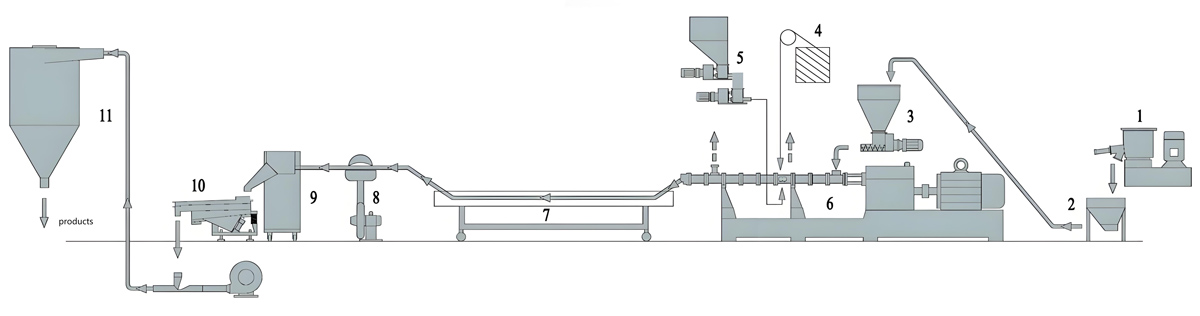
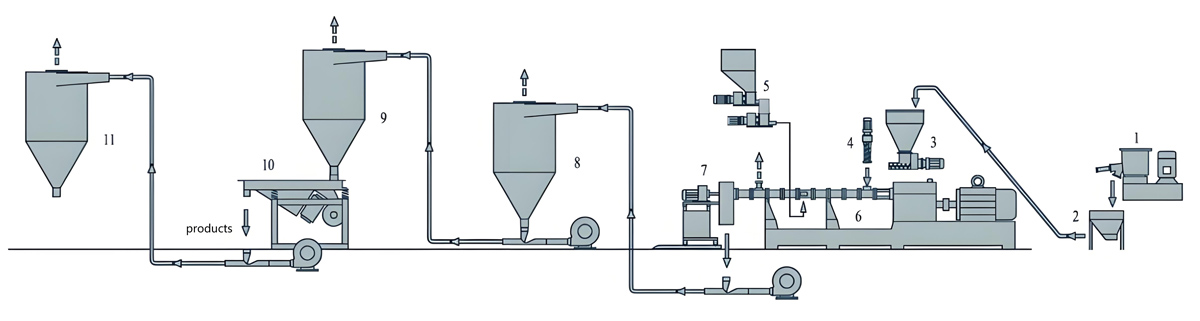
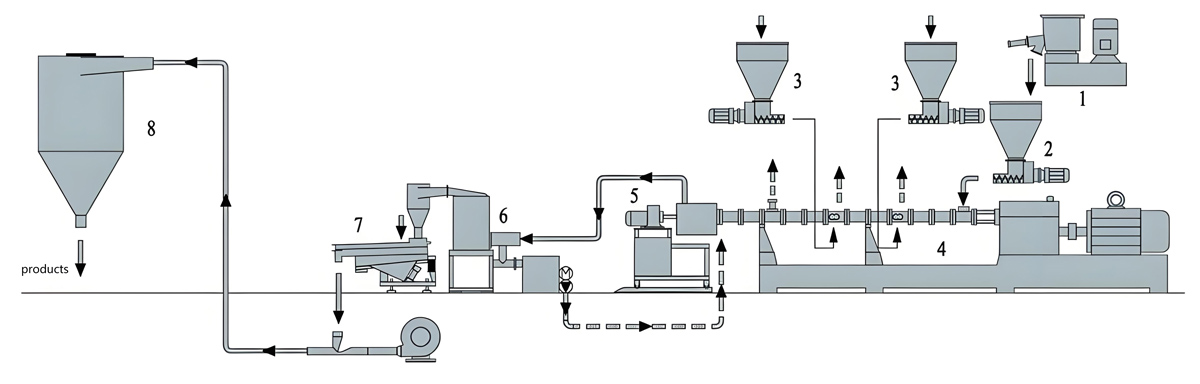
The production process of flame retardant masterbatch typically involves the following steps:
1. Raw Material Preparation
- Select the appropriate flame retardant, carrier resin, and additives based on the desired fire resistance level and application.
- Dry the carrier resin to remove moisture, which can affect the quality of the masterbatch.
- Pre-mix the flame retardant and additives with a small amount of carrier resin to ensure uniform dispersion.
2. Mixing and Compounding
- Feed the pre-mixed raw materials into the twin screw extruder.
- The extruder’s screws rotate to mix, melt, and compound the materials, ensuring uniform dispersion of the flame retardant and additives in the carrier resin.
- The temperature and screw speed are controlled to optimize the mixing and compounding process.
3. Extrusion and Granulation
- The compounded mixture is extruded through a die at the end of the extruder to form continuous strands.
- The strands are cooled in a water bath or air cooling system to solidify them.
- The cooled strands are cut into small, uniform pellets using a pelletizer.
4. Quality Control and Testing
- The masterbatch pellets are tested for fire resistance efficiency, dispersion uniformity, and other properties to ensure they meet the specified standards.
- Samples are taken at various stages of the production process to monitor the quality and make adjustments as needed.
Production Equipment Introduction (For Specific Masterbatch Production)
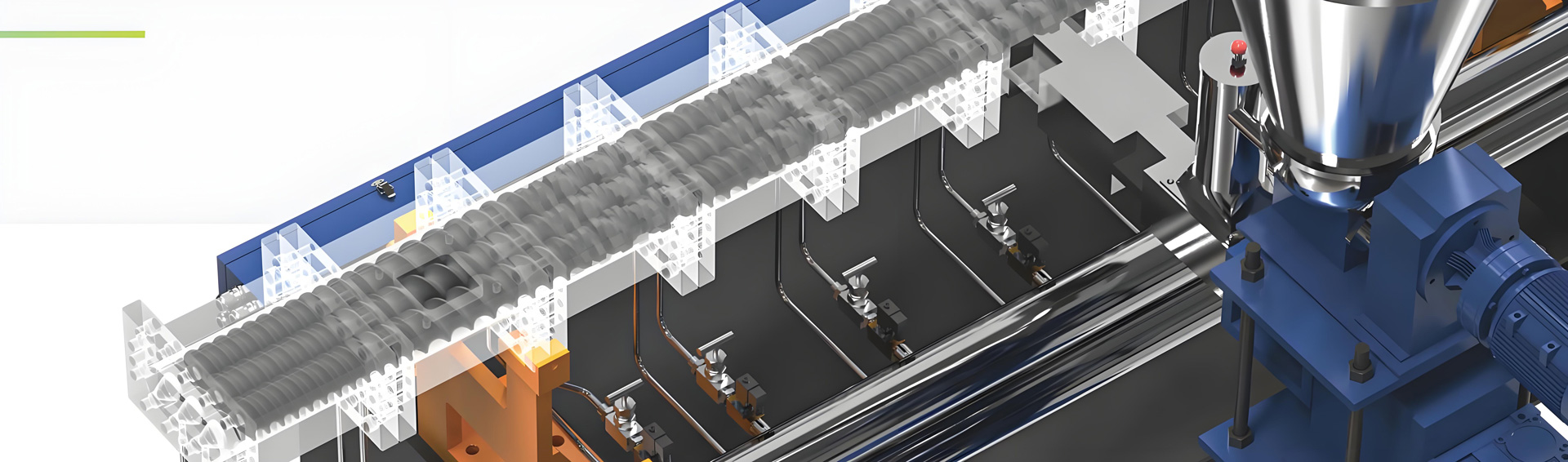
The Nanjing Kerke Extrusion Equipment Co., Ltd. KTE Series twin screw extruder is specifically designed for flame retardant masterbatch making, offering exceptional performance and reliability. Here are some key features of the KTE Series extruder:
1. High Torque Transmission Design
- The extruder uses a high torque transmission design, with imported bearings and a forced lubrication system, to ensure stable and reliable operation.
- The screw speed can reach up to 600 rpm, providing high throughput rates and efficient mixing.
2. Modular Design
- The extruder features a modular design, allowing for easy customization and maintenance.
- The screw and barrel can be easily replaced or modified to meet the specific requirements of different applications.
3. Precise Temperature Control
- The extruder is equipped with a precise temperature control system, which ensures uniform heating of the materials and prevents overheating or degradation.
- The temperature can be adjusted in different zones of the extruder to optimize the processing conditions.
4. Advanced Control System
- The extruder is controlled by a Siemens PLC system, which provides user-friendly operation and reliable performance.
- The system can store multiple recipes, allowing for quick and easy switching between different production processes.
Parameter Settings (For Specific Masterbatch Production)
The parameter settings for the KTE Series twin screw extruder depend on various factors, including the type of flame retardant masterbatch, raw materials, and production requirements. Here are some general guidelines for parameter settings:
1. Temperature Settings
- The temperature of the extruder barrel should be set based on the melting point of the carrier resin and the processing requirements.
- For most flame retardant masterbatch applications, the temperature range is typically between 150°C and 250°C.
- The temperature should be gradually increased from the feed section to the die section to ensure uniform melting and mixing of the materials.
2. Screw Speed Settings
- The screw speed should be set based on the desired throughput rate and mixing efficiency.
- For most flame retardant masterbatch applications, the screw speed range is typically between 100 rpm and 500 rpm.
- Higher screw speeds provide better mixing but may increase the risk of material degradation.
3. Feed Rate Settings
- The feed rate should be set based on the screw speed and the capacity of the extruder.
- It is important to ensure that the feed rate is matched to the screw speed to avoid overloading or underloading the extruder.
4. Vacuum Degassing Settings
- The vacuum degassing system should be used to remove volatile components and trapped gases from the melt.
- The vacuum level should be set based on the type of masterbatch and the processing requirements.
Equipment Prices (For Specific Masterbatch Production)
The prices of the KTE Series twin screw extruder vary depending on the model, specifications, and configuration. Here are some approximate price ranges for different models:
| Model | Screw Diameter (mm) | Output (kg/h) | Price Range (USD) |
|---|---|---|---|
| KTE-20 | 20 | 2-10 | 15,000-25,000 |
| KTE-36 | 36 | 20-100 | 30,000-50,000 |
| KTE-50 | 50 | 100-300 | 50,000-80,000 |
| KTE-65 | 65 | 200-500 | 80,000-120,000 |
| KTE-75 | 75 | 300-800 | 120,000-180,000 |
| KTE-95 | 95 | 500-1200 | 180,000-250,000 |
| KTE-110 | 110 | 800-1800 | 250,000-350,000 |
| KTE-135 | 135 | 1200-2500 | 350,000-500,000 |
It is important to note that these prices are approximate and may vary depending on the specific requirements of the customer. The final price will be determined based on the selected model, specifications, and additional options.
Possible Problems During Production and Their Solutions and Prevention
1. Poor Fire Resistance Efficiency
Problem: The masterbatch does not provide the desired fire resistance efficiency, resulting in increased flammability of the final product.
Causes:
- Insufficient amount of flame retardant.
- Poor dispersion of the flame retardant in the carrier resin.
- Incompatibility between the flame retardant and the carrier resin.
Solutions:
- Increase the amount of flame retardant in the formulation.
- Improve the dispersion of the flame retardant by adjusting the mixing parameters or using a more effective dispersant.
- Select a more compatible flame retardant or carrier resin.
Prevention:
- Optimize the formulation ratio to ensure sufficient flame retardant content.
- Ensure proper mixing and compounding of the raw materials.
- Conduct compatibility tests between the flame retardant and carrier resin.
2. Material Degradation
Problem: The carrier resin or additives degrade during the extrusion process, resulting in reduced quality of the masterbatch.
Causes:
- Excessive temperature or screw speed.
- Long residence time in the extruder.
- Presence of moisture or impurities in the raw materials.
Solutions:
- Reduce the temperature or screw speed.
- Shorten the residence time by adjusting the screw configuration or feed rate.
- Dry the raw materials to remove moisture.
Prevention:
- Control the processing parameters within the recommended range.
- Use high-quality raw materials.
- Regularly maintain and clean the extruder.
3. Pellet Size Variation
Problem: The masterbatch pellets have inconsistent size, which can affect the feeding and processing in subsequent stages.
Causes:
- Uneven cooling of the strands.
- Improper adjustment of the pelletizer.
- Variations in the extrusion rate.
Solutions:
- Adjust the cooling system to ensure uniform cooling of the strands.
- Calibrate the pelletizer to ensure consistent cutting.
- Stabilize the extrusion rate by adjusting the feed rate and screw speed.
Prevention:
- Ensure proper operation and maintenance of the cooling system and pelletizer.
- Monitor and control the extrusion rate.
4. High Energy Consumption
Problem: The extruder consumes excessive energy, increasing the production cost.
Causes:
- Inefficient screw design.
- High temperature or screw speed.
- Poor insulation of the extruder barrel.
Solutions:
- Optimize the screw design to improve mixing efficiency and reduce energy consumption.
- Reduce the temperature or screw speed to the minimum required for processing.
- Improve the insulation of the extruder barrel to reduce heat loss.
Prevention:
- Select an extruder with an efficient screw design.
- Operate the extruder within the recommended parameter range.
- Regularly maintain and inspect the extruder to ensure optimal performance.
Maintenance and Care (For Specific Masterbatch Production)
Proper maintenance and care of the twin screw extruder are essential to ensure its long-term performance and reliability. Here are some maintenance tips:
1. Regular Cleaning
- Clean the extruder barrel, screws, and die after each production run to remove residual materials.
- Use appropriate cleaning agents and tools to avoid damaging the equipment.
2. Lubrication
- Regularly lubricate the bearings, gears, and other moving parts to reduce friction and wear.
- Use the recommended lubricants and follow the manufacturer’s instructions for lubrication intervals.
3. Inspection and Maintenance
- Inspect the extruder regularly for signs of wear, damage, or leakage.
- Replace worn or damaged parts promptly to prevent further damage.
- Follow the manufacturer’s maintenance schedule for major overhauls and repairs.
4. Storage
- Store the extruder in a dry, clean, and well-ventilated area when not in use.
- Cover the equipment to protect it from dust and moisture.
FAQ
1. What is the difference between inorganic and organic flame retardants?
Inorganic flame retardants, such as aluminum hydroxide and magnesium hydroxide, work by releasing water vapor when heated, which cools the material and dilutes the oxygen concentration. Organic flame retardants, such as brominated and phosphorus-based compounds, work by inhibiting the combustion process in the gas phase or condensed phase.
2. How do I choose the right flame retardant for my application?
Consider factors such as the desired fire resistance level, compatibility with the plastic material, and environmental regulations. Consult with the manufacturer or a technical expert to determine the most suitable flame retardant for your specific needs.
3. What are the common applications of flame retardant masterbatch?
Flame retardant masterbatch is widely used in various industries, including electronics, construction, automotive, and aerospace. It is used to improve the fire resistance of plastic products such as electrical components, building materials, automotive parts, and aerospace components.
4. How can I ensure the quality of the flame retardant masterbatch?
Use high-quality raw materials, including flame retardants, carrier resin, and additives. Optimize the formulation ratio and processing parameters. Implement strict quality control measures, including testing and inspection of the masterbatch.
Summary
The Nanjing Kerke Extrusion Equipment Co., Ltd. KTE Series twin screw extruder is a high-performance and reliable solution for flame retardant masterbatch making. With its advanced design, precise control system, and modular configuration, it offers exceptional mixing, compounding, and granulation capabilities.
By following the recommended formulation ratios, production process, and parameter settings, you can produce high-quality flame retardant masterbatch with consistent fire resistance efficiency. Regular maintenance and care of the extruder are essential to ensure its long-term performance and reliability.
If you are looking for a twin screw extruder for flame retardant masterbatch production, the KTE Series is definitely worth considering. Contact Nanjing Kerke Extrusion Equipment Co., Ltd. for more information and to discuss your specific requirements.