Introduction
Food grade masterbatch plays a critical role in the food packaging industry, ensuring that plastic containers, films, and other food contact materials meet strict safety and quality standards. As consumer awareness of food safety grows, manufacturers are increasingly turning to specialized masterbatch solutions that comply with international regulations such as FDA 21 CFR 178.3297 and EU Regulation 10/2011.
Traditional masterbatch production methods often struggle to meet the demanding requirements of food grade applications due to issues with pigment migration, residual contaminants, and inconsistent quality. The twin screw extruder has emerged as the technology of choice for food grade masterbatch manufacturing due to its superior mixing capabilities, precise temperature control, and ability to handle complex formulations.
Nanjing Kerke Extrusion Equipment Co., Ltd. has established itself as a leading provider of twin screw extrusion solutions with their KTE Series extruders. These machines are specifically designed to meet the unique requirements of food grade masterbatch production, offering exceptional performance, reliability, and compliance with strict food safety standards.
Formulation Ratios (Different Types)
1. Clear Food Packaging Masterbatch
This formulation is designed for transparent food packaging applications such as bottles, jars, and films. It typically consists of:
- Carrier resin: Food-grade polyethylene terephthalate (PET) – 75-85%
- UV stabilizers: HALS and UV absorbers – 5-10%
- Processing aids: Slip agents and anti-blocking agents – 3-7%
- Antioxidants: Hindered phenols – 0.5-2%
2. Opaque Food Container Masterbatch
For opaque food containers requiring high opacity and UV protection, this formulation includes:
- Carrier resin: Food-grade polypropylene (PP) – 60-70%
- Pigment: Titanium dioxide (TiO2) – 25-35%
- Dispersant: Fatty acid esters – 2-5%
- UV stabilizers: Benzotriazoles – 0.5-2%
3. Flexible Food Packaging Masterbatch
Designed for flexible packaging films and laminates:
- Carrier resin: Food-grade low-density polyethylene (LDPE) – 70-80%
- Pigment: Organic or inorganic colorants – 15-25%
- Slip agents: Erucamide – 1-3%
- Antioxidants: Phosphites – 0.5-1.5%
4. Antimicrobial Food Contact Masterbatch
For applications requiring antimicrobial properties:
- Carrier resin: Food-grade polyamide (PA) – 65-75%
- Antimicrobial agent: Silver zeolite or triclosan – 5-10%
- Pigment: Optional colorants – 5-15%
- Dispersant: Polyethylene wax – 2-4%
Production Process
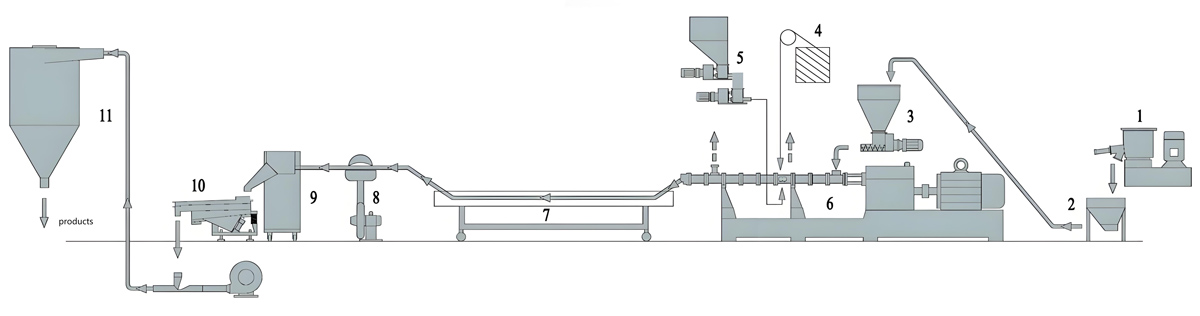
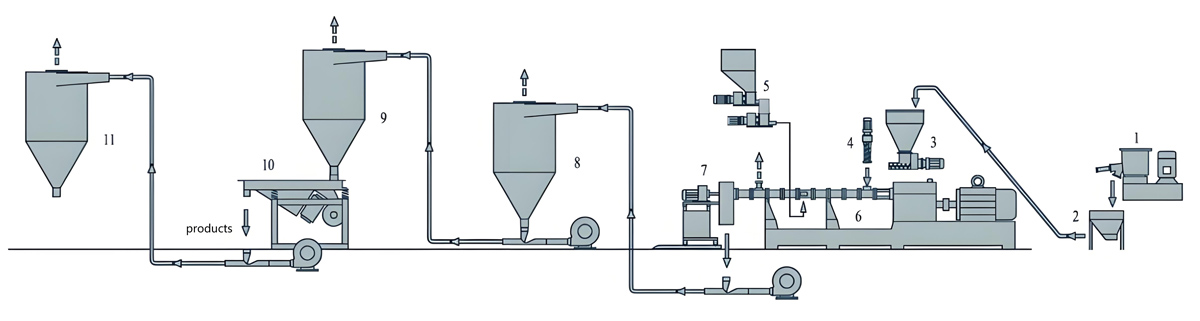
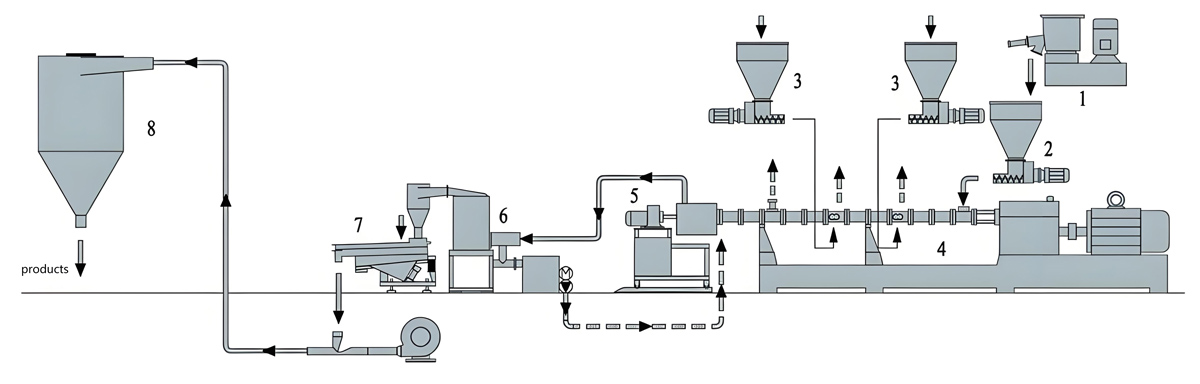
The production of food grade masterbatch requires a highly controlled process to ensure compliance with strict food safety regulations and consistent product quality. The following is a detailed overview of the production workflow using the Kerke KTE Series twin screw extruder:
1. Raw Material Selection and Preparation
All raw materials must be carefully selected to meet food safety requirements and comply with relevant regulations. Carrier resins, pigments, and additives must be sourced from reputable suppliers and tested for compliance with FDA and EU food contact standards.
Raw materials are thoroughly dried to remove moisture and volatile compounds, which can affect product quality and compliance. Food-grade resins such as PET and PP are typically dried at 100-120°C for 4-6 hours using dehumidifying dryers.
2. Precise Formulation and Premixing
Raw materials are weighed according to the specific formulation ratio using high-precision scales. Automatic gravimetric feeding systems ensure accurate and consistent material dosing, minimizing batch-to-batch variation.
Before extrusion, the raw materials are premixed in a high-speed mixer to ensure uniform distribution of pigments and additives within the carrier resin matrix. This helps to improve the efficiency of the extrusion process and ensure consistent product quality.
3. Twin Screw Extrusion
The premixed material is fed into the Kerke KTE Series twin screw extruder, where it undergoes melting, compounding, and dispersion. The extruder’s modular screw design allows for precise control of shear rates and residence times, ensuring optimal pigment dispersion without causing degradation of sensitive components.
The extrusion process is carefully controlled to maintain consistent temperatures throughout the barrel, typically ranging from 220-280°C depending on the specific formulation. Multiple vacuum degassing ports effectively remove moisture and volatile compounds from the melt, ensuring compliance with strict food safety standards.
4. Pelletizing and Cooling
After exiting the extruder die head, the molten masterbatch is formed into strands and cooled in a water bath. The cooling process is carefully controlled to ensure uniform solidification of the pellets and minimize the formation of defects.
The cooled strands are then cut into uniform pellets using a strand pelletizer or underwater pelletizer. Underwater pelletizing is often preferred for food grade applications due to its ability to produce smooth, dust-free pellets with consistent size and shape.
5. Quality Control and Packaging
Finished masterbatch pellets undergo rigorous quality testing, including melt flow index (MFI) measurement, color consistency analysis, migration testing, and microbial contamination screening. Only batches that meet all specified quality standards are approved for packaging and shipment.
Food grade masterbatch is packaged in food-safe containers such as polyethylene bags or fiber drums, ensuring compliance with strict food handling regulations. Proper labeling is applied to indicate the product composition, batch number, and relevant certification information.
Production Equipment Introduction
The Kerke KTE Series twin screw extruders are specifically engineered to meet the unique requirements of food grade masterbatch production. These machines offer several key features that set them apart from conventional extrusion equipment:
1. Hygienic Design
The extruders feature a hygienic design with smooth surfaces, easy-to-clean components, and minimal dead spaces to prevent the accumulation of contaminants. This is critical for ensuring compliance with strict food safety regulations and minimizing the risk of product contamination.
2. Precision Temperature Control
Each extruder barrel section is equipped with independent temperature control systems using high-precision heaters and water-cooling channels. This ensures uniform temperature distribution throughout the processing zone, preventing overheating of sensitive materials and maintaining consistent product quality.
3. Advanced Mixing Technology
The KTE Series extruders feature a modular screw system with various conveying, mixing, and kneading elements that can be customized to meet specific formulation requirements. This allows for precise control of material flow, shear rates, and residence times, ensuring optimal compounding and dispersion of pigments and additives.
4. Efficient Vacuum Degassing
The extruders are equipped with multiple vacuum degassing ports that effectively remove volatile compounds, moisture, and air from the melt. This is critical for producing food grade masterbatch, as it helps eliminate potential sources of contamination and ensures high product purity.
5. Integrated Feeding Systems
To ensure accurate formulation ratios, the KTE Series extruders are paired with gravimetric feeding systems that provide precise control over material input rates. This minimizes batch-to-batch variation and ensures consistent product quality.
6. Compliance with Food Safety Standards
Kerke extruders are designed and manufactured to comply with international food safety standards such as FDA, EU, and HACCP. The machines are made from food-grade materials and undergo rigorous testing to ensure compliance with strict hygiene requirements.
Parameter Setting
Optimal parameter settings for food grade masterbatch production depend on various factors, including the specific formulation, raw materials, and desired product characteristics. The following are general guidelines for setting parameters on the Kerke KTE Series twin screw extruders:
1. Temperature Profile
Temperature settings should be carefully calibrated to ensure complete melting of the carrier resin while minimizing thermal degradation of pigments and additives. A typical temperature profile for food grade masterbatch production might include:
- Feeding zone: 120-160°C
- Compression zone: 200-240°C
- Mixing zone: 220-260°C
- Degassing zone: 230-270°C
- Die head: 240-280°C
2. Screw Speed
Screw speed is typically set between 200-500 rpm, depending on the specific formulation and production requirements. Higher screw speeds can improve pigment dispersion but may increase shear forces, potentially causing degradation of sensitive materials.
3. Feed Rate
Feed rates are determined based on the desired production output and the specific capabilities of the extruder model. For food grade masterbatch production, feed rates typically range from 50-300 kg/h, depending on the extruder size and configuration.
4. Vacuum Level
Vacuum levels should be maintained between 0.08-0.1 MPa to effectively remove volatile compounds and moisture from the melt. Higher vacuum levels may be required for formulations containing hygroscopic materials or high levels of volatile additives.
5. Water Cooling Temperature
For underwater pelletizing applications, the water cooling temperature is typically set between 20-40°C to ensure rapid and uniform solidification of the pellets. Proper water temperature control helps to minimize the formation of defects and ensure consistent product quality.
Equipment Price
The cost of twin screw extruders for food grade masterbatch production varies depending on the model, capacity, and specific features required. The following are approximate price ranges for Kerke KTE Series extruders in US dollars:
1. Small Laboratory Models (KTE-20B to KTE-36B)
These compact extruders are ideal for research and development applications, offering production capacities between 3-100 kg/h. Prices typically range from $9,900 to $37,500, depending on the specific configuration and optional features.
2. Medium-Scale Production Models (KTE-50B to KTE-65B)
Designed for pilot production and small-scale manufacturing, these extruders offer capacities between 120-500 kg/h. Prices range from $42,600 to $75,000, depending on the model and customization options.
3. Large-Scale Production Models (KTE-75B to KTE-95B)
These high-capacity extruders are suitable for full-scale industrial production, offering output rates between 300-1400 kg/h. Prices typically range from $80,000 to $160,000, depending on the specific configuration and optional equipment.
4. Complete Food Grade Production Lines
For customers requiring turnkey solutions, Kerke offers complete production lines including extruders, feeding systems, pelletizers, and auxiliary equipment. These lines are specifically designed for food grade applications and include features such as hygienic design, closed-loop cooling systems, and automated quality control. Prices for complete lines typically range from $150,000 to $400,000, depending on the scale and complexity of the system.
Potential Problems During Production and Solutions for Avoidance
Food grade masterbatch production presents several unique challenges that can impact product quality and compliance with strict food safety regulations. The following are some of the most common problems encountered in this process, along with their root causes and effective solutions:
Problem 1: Pigment Migration
Root cause: Poor pigment dispersion, incompatible carrier resins, or excessive processing temperatures can lead to pigment migration, which violates regulatory limits for food contact applications.
Solution: Ensure proper pigment dispersion through optimized screw design and processing parameters. Use carrier resins with good compatibility with the selected pigments and additives. Implement strict temperature control to prevent overheating of materials.
Avoidance: Conduct thorough pre-production testing of raw materials and formulations to identify potential migration issues. Use pigments specifically designed for food contact applications and follow recommended processing guidelines.
Problem 2: Residual Contaminants
Root cause: Inadequate cleaning of production equipment, contaminated raw materials, or cross-contamination between products can result in residual contaminants that compromise food safety.
Solution: Implement rigorous cleaning protocols for production equipment, including disassembly and manual cleaning of critical components. Use dedicated production lines for food grade products to minimize the risk of cross-contamination.
Avoidance: Source raw materials from reputable suppliers with strict quality control processes. Conduct regular testing of raw materials and finished products for contaminants such as heavy metals, volatile organic compounds (VOCs), and microbial pathogens.
Problem 3: Inconsistent Color and Quality
Root cause: Imprecise formulation ratios, inconsistent raw material quality, or inadequate process control can lead to variations in color and quality between batches.
Solution: Implement automated gravimetric feeding systems to ensure accurate formulation ratios. Conduct regular testing of raw materials to identify variations in quality. Use advanced process control systems with real-time monitoring and feedback capabilities.
Avoidance: Establish standardized operating procedures and train operators to follow them consistently. Conduct regular calibration and maintenance of production equipment to ensure consistent performance.
Problem 4: Thermal Degradation
Root cause: Excessive processing temperatures, long residence times, or incompatible additives can cause thermal degradation of the carrier resin or pigments, leading to reduced product quality and compliance issues.
Solution: Implement strict temperature control throughout the processing zone. Optimize screw design to minimize residence times and avoid stagnation points. Use stabilizers and processing aids to protect sensitive materials from degradation.
Avoidance: Select materials with appropriate thermal stability for the intended processing conditions. Conduct thermal stability testing of formulations before full-scale production.
Problem 5: Hygiene and Sanitation Issues
Root cause: Poor production environment sanitation, inadequate employee training, or insufficient pest control measures can lead to hygiene and sanitation issues that compromise food safety.
Solution: Implement a comprehensive food safety management system (FSMS) based on HACCP principles. Provide regular training for employees on food safety protocols and personal hygiene practices. Conduct regular inspections of the production facility to identify and address sanitation issues.
Avoidance: Establish a rigorous sanitation schedule for the production facility, including daily cleaning of production areas and equipment. Implement effective pest control measures to minimize the risk of contamination.
Maintenance and Care
Proper maintenance and care are essential to ensure the long-term performance and reliability of twin screw extruders used for food grade masterbatch production. The following are key maintenance practices for Kerke KTE Series extruders:
1. Regular Cleaning and Sanitization
Thoroughly clean and sanitize the extruder barrel and screw after each production run to remove residual materials and prevent cross-contamination. Use food-safe cleaning agents and follow recommended procedures for removing pigment residues and difficult-to-clean materials.
2. Screw and Barrel Inspection
Inspect screw elements and barrel liners regularly for signs of wear or damage. Replace worn components as needed to maintain optimal mixing performance and prevent material degradation. For food grade applications, use materials that are compatible with food contact requirements.
3. Lubrication System Maintenance
Regularly check and replace lubricants in the extruder gearbox and bearings to ensure smooth operation and prevent premature wear. Use food-grade lubricants for components that may come into contact with the product.
4. Temperature Control System Maintenance
Calibrate temperature sensors and controllers regularly to ensure accurate temperature control. Clean heating elements and cooling channels to maintain efficient heat transfer and prevent overheating.
5. Vacuum System Maintenance
Inspect vacuum pumps and hoses regularly for leaks or damage. Clean vacuum filters and degassing ports to maintain optimal performance and prevent contamination of the melt.
6. Feeding System Maintenance
Calibrate gravimetric feeders regularly to ensure accurate material delivery. Clean feeding hoppers and augers to prevent material buildup and ensure consistent flow. For food grade applications, use feeding systems made from food-safe materials.
7. Preventive Maintenance Program
Implement a comprehensive preventive maintenance program that includes regular inspections, cleaning, and component replacement based on manufacturer recommendations and production usage. This helps to minimize downtime, extend equipment lifespan, and ensure consistent product quality.
FAQ
Q1: What makes a masterbatch suitable for food contact applications?
A: A food grade masterbatch must meet strict regulatory requirements regarding pigment migration, residual contaminants, and microbial safety. It should be formulated using food-safe raw materials, processed under controlled conditions, and tested to ensure compliance with international food safety standards.
Q2: How do I ensure that my masterbatch meets FDA and EU food safety regulations?
A: To ensure compliance with FDA and EU food safety regulations, you should source raw materials from reputable suppliers, implement strict quality control processes, and conduct regular testing of finished products. It’s also important to work with a trusted equipment supplier who understands the unique requirements of food grade masterbatch production.
Q3: What are the key differences between food grade and non-food grade masterbatch production?
A: Food grade masterbatch production requires stricter quality control, more precise process control, and a greater focus on hygiene and sanitation compared to non-food grade applications. Special attention must be paid to issues such as pigment migration, residual contaminants, and microbial safety.
Q4: Can I use recycled materials in food grade masterbatch production?
A: The use of recycled materials in food grade masterbatch production is possible but requires careful consideration. Recycled materials must be thoroughly tested to ensure they meet the required purity and safety standards. It’s often necessary to use specialized processing techniques and additives to remove contaminants and ensure compliance with regulatory standards.
Q5: How does the Kerke KTE Series extruder ensure compliance with food safety standards?
A: The Kerke KTE Series extruders are designed with several features that ensure compliance with food safety standards, including hygienic design, precision temperature control, efficient vacuum degassing, and compliance with FDA and EU food contact regulations. The machines are made from food-grade materials and undergo rigorous testing to ensure compliance with strict food safety requirements.
Conclusion
The production of food grade masterbatch requires advanced technology, careful formulation design, and strict process control to meet the demanding regulatory requirements of the food packaging industry. The twin screw extruder has emerged as the technology of choice for this application, offering superior mixing capabilities, precise temperature control, and the ability to handle complex formulations.
Nanjing Kerke Extrusion Equipment Co., Ltd. has established itself as a leading provider of twin screw extrusion solutions with their KTE Series extruders. These machines are specifically designed to meet the unique requirements of food grade masterbatch production, offering exceptional performance, reliability, and compliance with strict food safety standards.
By understanding the key formulation considerations, production processes, and equipment requirements for food grade masterbatch production, manufacturers can ensure they produce high-quality products that meet the strictest food safety standards. With the right technology, expertise, and commitment to quality, food grade masterbatch production can be a profitable and sustainable business venture.