Introduction
The manufacturing of graphene modified masterbatch represents one of the most significant advancements in compound materials processing within the plastics industry. Graphene, a single layer of carbon atoms arranged in a two-dimensional honeycomb lattice, has revolutionized material science with its exceptional electrical conductivity, thermal conductivity, mechanical strength, and barrier properties. When properly dispersed within polymer matrices, graphene creates masterbatches that transform ordinary plastic products into high-performance materials suitable for advanced applications in electronics, automotive, aerospace, and energy storage industries.
Twin screw extruder technology has emerged as the preferred manufacturing method for graphene modified masterbatch production. The intensive mixing capabilities, precise temperature control, and excellent distributive and dispersive mixing characteristics of twin screw extruders make them indispensable for achieving uniform graphene dispersion at concentrations ranging from 1% to 40% by weight. Nanjing Kerke Extrusion Equipment Company has developed the KTE series of co-rotating parallel twin screw extruders specifically designed to meet the demanding requirements of graphene masterbatch manufacturing.
The production of high-quality graphene modified masterbatch requires careful attention to formulation design, processing parameters, equipment configuration, and quality control measures. This comprehensive guide explores every aspect of using twin screw extruders for graphene modified masterbatch manufacturing, providing manufacturers with the technical knowledge and practical insights necessary to establish or optimize their production capabilities.
Formulation Ratio for Graphene Modified Masterbatch
Graphene Types and Selection
The choice of graphene form significantly impacts masterbatch performance and processing characteristics. Manufacturers typically select from several graphene variants based on application requirements and cost considerations.
Graphene nanoplatelets (GNPs) represent the most commonly used form in masterbatch production, offering an optimal balance between performance and cost. GNPs typically consist of stacks of 5 to 10 graphene sheets with lateral dimensions ranging from 1 to 15 micrometers and thicknesses between 1 and 15 nanometers. This platelet morphology creates extensive barrier pathways within the polymer matrix, enhancing electrical and thermal conductivity at relatively low loading levels. The typical concentration range for GNP-based masterbatches spans from 10% to 40% by weight, depending on the target conductivity level and processing compatibility.
Few-layer graphene (FLG) with 2 to 5 atomic layers provides superior properties compared to GNPs but at higher material costs. FLG-based masterbatches achieve percolation thresholds (the critical concentration where electrical conductivity dramatically increases) at lower loadings, typically between 1% and 5% by weight. This makes FLG masterbatches particularly attractive for applications where maintaining the mechanical properties of the base polymer is critical while achieving moderate conductivity improvements.
Graphene oxide (GO) and reduced graphene oxide (rGO) offer excellent dispersibility in aqueous systems and can be processed through melt extrusion after appropriate drying. GO-modified masterbatches typically require concentrations between 5% and 20% to achieve target properties, with the oxygen-containing functional groups facilitating better compatibility with polar polymers such as polyamide and polyethylene terephthalate.
Base Polymer Selection
The selection of base polymer for graphene modified masterbatch depends on the target application and processing requirements. Different polymer matrices interact uniquely with graphene, affecting dispersion quality, final properties, and processing conditions.
Polyethylene (PE) represents the most widely used base polymer for graphene masterbatch production due to its excellent processing characteristics and broad application range. Low-density polyethylene (LDPE) and linear low-density polyethylene (LLDPE) offer superior melt flow characteristics that facilitate graphene dispersion. Masterbatch concentrations for PE-based systems typically range from 15% to 30% graphene loading. These masterbatches serve applications including antistatic packaging, electromagnetic interference (EMI) shielding, and conductive films for electronic device packaging.
Polypropylene (PP) provides excellent mechanical properties and chemical resistance, making it suitable for automotive interior components, industrial containers, and consumer goods requiring enhanced stiffness and dimensional stability. Graphene-modified PP masterbatches typically contain 10% to 25% graphene loading, achieving property improvements in tensile strength, flexural modulus, and thermal stability while maintaining acceptable impact resistance.
Polyamide (PA6, PA66) offers superior mechanical strength and thermal resistance for engineering applications. Graphene-modified polyamide masterbatches achieve significant property enhancements at lower loading levels (5% to 15%) due to the strong interfacial interactions between graphene and the polar polymer matrix. These masterbatches serve demanding applications in automotive engine components, electrical connectors, and industrial machinery parts.
Additive Package Formulation
Optimizing the additive package is essential for achieving consistent graphene dispersion and protecting the masterbatch properties during processing and end-use applications.
Dispersing agents such as maleic anhydride-grafted polyethylene (PE-g-MAH) and maleic anhydride-grafted polypropylene (PP-g-MAH) significantly improve graphene wetting and interfacial adhesion with the polymer matrix. Typical addition rates range from 2% to 5% of the total formulation, depending on graphene loading and surface characteristics. Thesecompatibilizers create chemical bonding between graphene surfaces and polymer chains, preventing re-aggregation during cooling and subsequent processing.
Antioxidants play a critical role in protecting both the graphene and polymer matrix from thermal oxidation during high-temperature extrusion processing. Phenolic antioxidants such as Irganox 1010 combined with phosphite stabilizers like Irgafos 168 provide comprehensive thermal protection. Typical addition rates range from 0.2% to 0.5% for each antioxidant component, with total stabilizer packages not exceeding 1.5% of the formulation.
Processing aids including fatty acid esters and silicone-based flow modifiers help reduce melt viscosity and improve graphene dispersion efficiency. These additives decrease the interaction forces between polymer chains, allowing more effective shear forces to break down graphene aggregates. Addition rates typically range from 0.5% to 2% depending on the base polymer viscosity and processing temperature.
Production Process for Graphene Modified Masterbatch
Raw Material Preparation
Proper raw material preparation establishes the foundation for consistent masterbatch quality and efficient production operations. Each raw material component requires specific handling procedures to ensure optimal processing performance.
Graphene receiving and storage procedures must prevent contamination and moisture absorption. Graphene materials should be stored in sealed containers within climate-controlled environments maintained at temperatures below 25 degrees Celsius and relative humidity below 50%. Before use, graphene should be dried in vacuum ovens at temperatures between 80 and 120 degrees Celsius for 4 to 12 hours depending on the graphene type and initial moisture content. Visual inspection for agglomerates and foreign matter should accompany each batch received from suppliers.
Polymer resin preparation involves drying procedures matched to the polymer moisture sensitivity. Polyamide resins require particular attention, with drying conditions of 80 to 100 degrees Celsius for 12 to 24 hours to achieve moisture contents below 0.1%. Polyethylene and polypropylene resins typically require 4 to 6 hours of drying at 60 to 80 degrees Celsius to achieve moisture levels below 0.05%. Moisture超标above these thresholds causes hydrolysis reactions that degrade polymer molecular weight and compromise masterbatch mechanical properties.
Masterbatch formulation weighing and mixing follows strict batch control procedures. Each component is weighed on calibrated scales with accuracy within plus or minus 0.1 grams for small batches and plus or minus 1 gram for production-scale batches exceeding 100 kilograms. Pre-blending procedures combine graphene with a portion of the polymer resin (typically 20% to 30% of the total polymer weight) and all additive components in drum tumblers or high-intensity mixers for 10 to 20 minutes before final addition to the extruder feed hopper.
Extrusion Processing Sequence
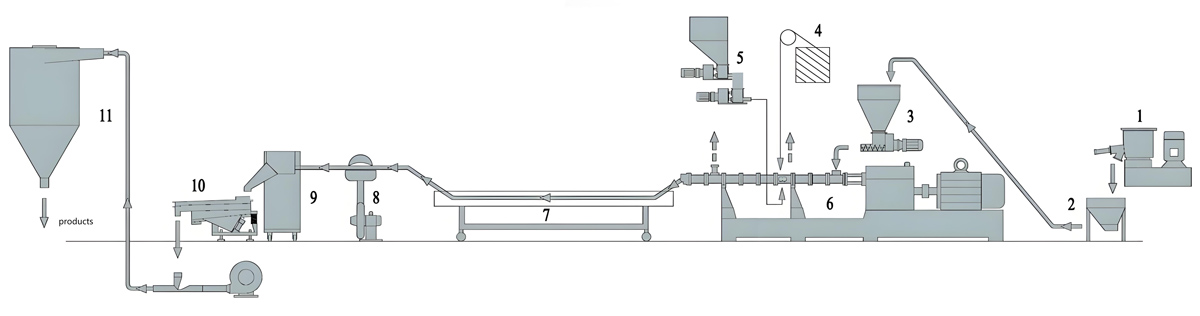
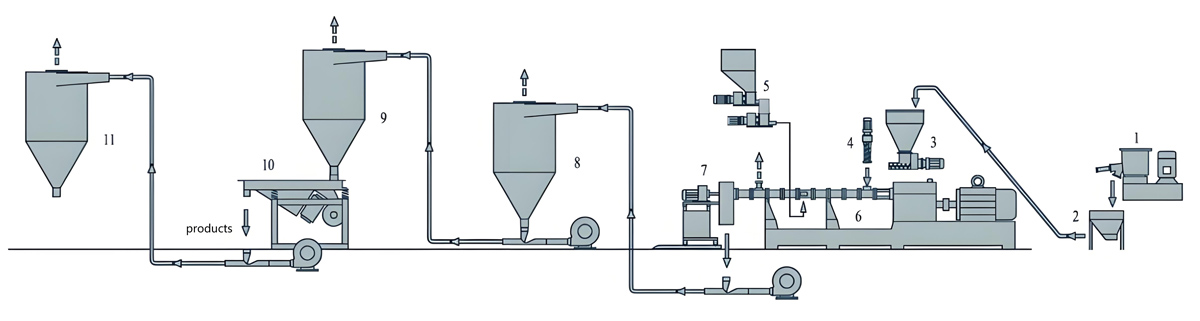
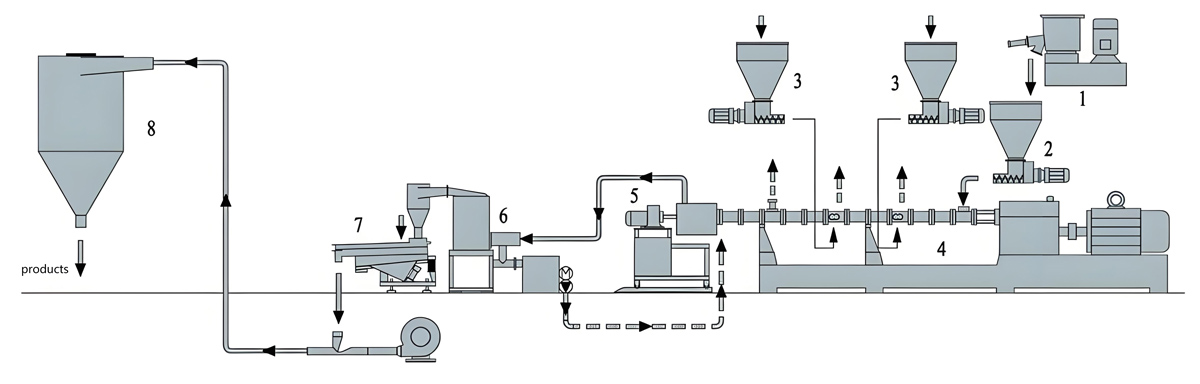
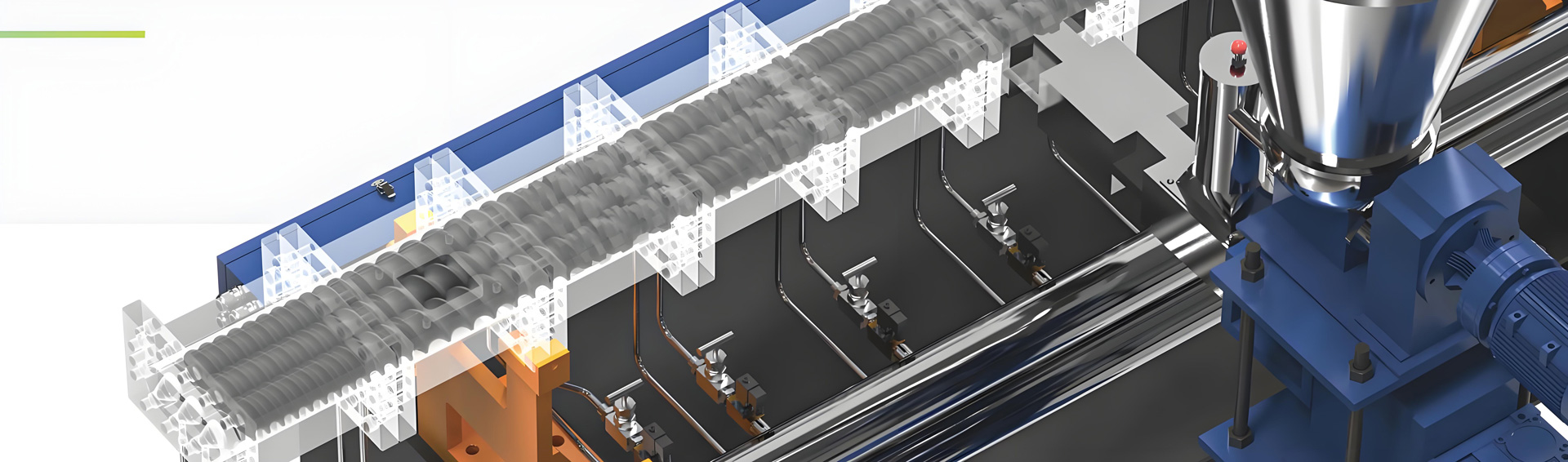
The twin screw extrusion process for graphene modified masterbatch manufacturing proceeds through distinct functional zones, each contributing to the overall mixing and dispersion quality.
The feeding zone occupies the first two to three barrel sections and operates at relatively low temperatures (typically 20 to 40 degrees Celsius above the polymer melt temperature) to ensure consistent polymer feeding and initial graphene incorporation. Screw elements in this zone consist primarily of conveying elements and low-shear mixing elements that promote uniform polymer melting and graphene distribution without excessive thermal degradation. Feed throat cooling prevents polymer melt-back and ensures stable feeding performance.
The melting and initial mixing zone spans barrel sections 4 through 8 and experiences the highest shear stress within the extrusion system. Temperatures in this zone are carefully controlled (typically 10 to 30 degrees Celsius above the nominal melt temperature) to achieve complete polymer melting while generating sufficient shear forces to begin breaking down graphene agglomerates. Screw elements transition from conveying elements to kneading blocks and mixing elements that create intensive distributive mixing. The residence time in this critical zone typically ranges from 30 to 60 seconds depending on screw speed and throughput settings.
The dispersion and homogenization zone occupies barrel sections 9 through 14 and provides the extended mixing time necessary for achieving uniform graphene dispersion. Lower shear elements (such as reversed conveying elements and wide-pitch kneading blocks) maintain material flow while allowing graphene platelets to orient and distribute throughout the polymer matrix. Temperature profiles in this zone are adjusted to optimize viscosity for maximum graphene separation without thermal degradation, typically operating at temperatures 5 to 20 degrees Celsius below the peak temperatures used in the melting zone.
The devolatilization and feeding zone, when included in the screw configuration, removes moisture, residual monomers, and volatile byproducts from the polymer-graphene mixture. Vacuum venting through barrel sections 10 or 12 effectively removes moisture and volatile contaminants that compromise masterbatch quality. Vacuum levels between 50 and 100 millibars absolute pressure achieve moisture removal efficiency sufficient for achieving target moisture contents below 0.05%.
The die and pelletizing zone converts the molten polymer-graphene mixture into uniform masterbatch pellets. Flat-stream dies with precision-machined land lengths produce consistent strand dimensions that feed directly into underwater pelletizing systems. Water temperatures between 20 and 40 degrees Celsius rapidly solidify the pellets while preventing thermal oxidation. Alternative air-cooling strand pelletizing systems may be employed for high-viscosity formulations requiring extended cooling times.
Production Equipment Introduction: Kerke KTE Series Twin Screw Extruders
Equipment Overview and Design Philosophy
Nanjing Kerke Extrusion Equipment Company has established itself as a leading manufacturer of co-rotating parallel twin screw extruders for advanced polymer processing applications. The KTE series represents the culmination of extensive research and development efforts focused on achieving superior mixing performance, operational reliability, and processing flexibility for demanding masterbatch production applications.
The Kerke design philosophy centers on modularity, precision engineering, and operator-friendly functionality. Each KTE extruder features a precisely engineered screw and barrel system that enables processors to optimize configurations for specific material requirements while maintaining the flexibility to adapt to changing production needs. The company’s commitment to quality manufacturing standards ensures consistent performance across the entire KTE product range.
The KTE series encompasses five main models spanning throughput capacities from 20 kilograms per hour to over 2000 kilograms per hour. This comprehensive range enables manufacturers to select equipment matched precisely to their production volume requirements without compromising mixing performance or quality consistency.
KTE-36B Compact Production System
The KTE-36B twin screw extruder serves as Kerke entry-level production system designed for research and development, pilot production, and small-volume specialty masterbatch manufacturing. The 35.6 millimeter screw diameter provides sufficient throughput capacity (20 to 100 kilograms per hour) for product development while maintaining excellent mixing performance characteristics required for graphene dispersion.
The 500 to 600 revolutions per minute maximum screw speed delivers high specific torque transmission to the material, generating the intensive shear forces necessary for breaking down graphene agglomerates. The 18.5 to 22 kilowatt main motor provides adequate power for processing standard graphene masterbatch formulations while maintaining energy efficiency at moderate throughput rates. The KTE-36B price range of $25,000 to $35,000 positions this system as an accessible entry point for manufacturers entering the graphene masterbatch market or establishing pilot production capabilities.
The compact physical dimensions of the KTE-36B (approximately 3.5 meters length, 1.2 meters width, and 2.0 meters height) enable installation in facilities with limited floor space while the 1500 to 2000 kilogram shipping weight facilitates standard industrial floor loading without specialized foundation requirements. Complete system integration includes the extruder, gearbox, motor, barrel temperature control system, and die assembly, with optional downstream pelletizing and material handling systems available.
KTE-50B Mid-Scale Production System
The KTE-50B represents the workhorse model in the Kerke lineup, offering an optimal balance between throughput capacity and mixing performance for mid-volume graphene masterbatch production. The 50.5 millimeter screw diameter provides approximately twice the throughput capacity of the KTE-36B while maintaining excellent mixing intensity and quality consistency.
Production rates of 80 to 200 kilograms per hour make the KTE-50B suitable for commercial-scale graphene masterbatch production serving multiple end-use applications. The 500 to 600 revolutions per minute speed range combined with 55 to 75 kilowatt motor power ensures consistent quality across the entire throughput range without compromising dispersion performance. The KTE-50B price range of $40,000 to $60,000 reflects the increased manufacturing complexity and component sizing required for this higher-capacity system.
The KTE-50B barrel length-to-diameter ratio of 40:1 provides extended mixing zones for achieving superior graphene dispersion while maintaining reasonable equipment footprints. The modular barrel section design (eight to ten individual barrel elements) enables precise temperature zone configuration and optional venting port installation for devolatilization applications.
KTE-65B Production Scale System
The KTE-65B twin screw extruder addresses production requirements for manufacturers requiring higher throughput rates while maintaining quality standards required for premium graphene masterbatch applications. The 62.4 millimeter screw diameter achieves production rates of 200 to 450 kilograms per hour, positioning this system at the threshold of commercial-scale production operations.
The 90 to 110 kilowatt motor system provides sufficient power reserves for processing challenging formulations including high-loading graphene masterbatches and thermally sensitive material combinations. The KTE-65B price range of $50,000 to $80,000 reflects the industrial-grade engineering required for continuous production operations at elevated throughput rates.
Advanced temperature control features including individual zone PID controllers and high-capacity barrel heating and cooling systems ensure precise thermal management throughout the extrusion process. The KTE-65B compatibility with automated feeding systems, downstream pelletizers, and quality control instrumentation enables integration into comprehensive production automation systems.
KTE-75B High-Capacity Production System
The KTE-75B serves manufacturers requiring high-volume production capabilities without sacrificing the mixing performance essential for graphene masterbatch quality. The 71 millimeter screw diameter achieves throughput rates of 300 to 800 kilograms per hour, enabling single-machine production capacities sufficient for supplying regional market demand.
The 132 to 160 kilowatt motor system provides substantial power reserves for processing the most demanding graphene formulations, including those requiring extended mixing times or elevated processing temperatures. The KTE-75B price range of $70,000 to $100,000 reflects the industrial-scale engineering required for continuous high-volume production operations.
Robust construction features including heavy-duty gearbox design, precision-machined barrel surfaces, and high-capacity cooling systems ensure reliable performance in continuous production environments. The KTE-75B barrel configuration accommodates up to twelve temperature zones for precise thermal profile management across extended processing lengths.
KTE-95D Ultra-High-Capacity Production System
The KTE-95D represents the pinnacle of Kerke twin screw extruder technology, designed for the most demanding graphene masterbatch production requirements. The 93 millimeter screw diameter achieves throughput rates of 1000 to 2000 kilograms per hour, enabling single-machine production capacities that rival the output of multiple smaller machines while maintaining superior mixing performance.
The 500 to 800 revolutions per minute maximum speed range (exceeding the 500 to 600 rpm limit of smaller models) provides enhanced mixing intensity for achieving superior graphene dispersion at elevated production rates. The substantial 315 to 500 kilowatt motor system ensures consistent power delivery for processing the most challenging formulations without speed or quality compromises. The KTE-95D price range of $120,000 to $200,000 reflects the advanced engineering and manufacturing precision required for this production-scale system.
The KTE-95D features enhanced automation capabilities including programmable production recipes, real-time process monitoring, and automated quality verification systems. These advanced features optimize production efficiency while ensuring consistent quality across extended production runs. The extended barrel length options (up to 52:1 length-to-diameter ratio) provide maximum flexibility for configuring processing zones matched to specific formulation requirements.
Parameter Settings for Graphene Modified Masterbatch Production
Temperature Profile Configuration
Optimizing temperature profiles represents one of the most critical factors in achieving consistent graphene dispersion while preventing thermal degradation of both the polymer matrix and graphene additives. The temperature profile must balance competing requirements for sufficient thermal energy to melt the polymer and reduce viscosity (enabling graphene separation) against the need to minimize thermal residence time and prevent oxidation reactions.
For polyethylene-based graphene masterbatches, the recommended temperature profile typically ranges from 160 degrees Celsius in the feed zone to 220 degrees Celsius in the melting zone, with gradual reduction to 200 to 210 degrees Celsius in the mixing and die zones. The lower temperatures in the final zones prevent thermal degradation while maintaining sufficient melt viscosity for effective graphene orientation and distribution.
Polypropylene-based formulations require higher processing temperatures due to the higher melt temperature of PP. Feed zone temperatures of 180 to 200 degrees Celsius transition to melting zone temperatures of 220 to 250 degrees Celsius, with mixing zone temperatures maintained between 210 and 240 degrees Celsius. The exothermic nature of graphene mixing (due to friction and viscous dissipation) must be accounted for when establishing these profiles.
Polyamide graphene masterbatches require the highest processing temperatures, with feed zones at 220 to 240 degrees Celsius, melting zones at 260 to 280 degrees Celsius, and mixing zones at 250 to 270 degrees Celsius. The moisture sensitivity of polyamide requires particular attention to drying procedures and barrel purging between production runs to prevent hydrolysis reactions.
Screw Speed and Throughput Optimization
Screw speed directly impacts shear stress, residence time, and mixing intensity within the extrusion system. For graphene masterbatch production, screw speeds between 300 and 500 revolutions per minute typically provide optimal balance between mixing performance and thermal management. Speeds below 300 rpm may insufficiently break down graphene agglomerates, while speeds above 500 rpm increase the risk of thermal degradation and excessive energy consumption.
Throughput rate selection depends on the target production volume and graphene loading level. Higher graphene concentrations require proportionally lower throughput rates to maintain adequate residence time for dispersion. A general guideline suggests throughput rates of 0.5 to 1.0 kilograms per hour per millimeter of screw diameter for standard graphene masterbatch formulations. For the KTE-50B (50.5 mm diameter), this translates to throughput rates between 25 and 50 kilograms per hour for high-loading formulations (above 20% graphene) and 50 to 100 kilograms per hour for moderate-loading formulations.
The relationship between screw speed and throughput must be optimized for each specific formulation. The specific mechanical energy input (SME), measured in kilowatt-hours per kilogram, provides a useful metric for comparing processing conditions. Graphene masterbatch production typically requires SME values between 0.15 and 0.25 kilowatt-hours per kilogram for adequate dispersion while avoiding excessive energy input that contributes to thermal degradation.
Feeding System Configuration
Consistent feeding of graphene and polymer materials directly impacts final masterbatch quality and production efficiency. Gravimetric feeding systems provide superior accuracy compared to volumetric feeders, maintaining formulation precision within plus or minus 0.5% of target composition.
Graphene feeding typically requires specialized equipment due to the low bulk density and tendency for airborne dispersion of graphene powders. Loss-in-weight feeders with agitator mechanisms prevent bridging and ensure consistent graphene flow rates. Side-feeder installation at barrel sections 4 to 6 introduces graphene directly into the molten polymer stream, minimizing airborne graphene exposure while maximizing dispersion efficiency.
Polymer resin feeding through main hoppers should maintain steady flow rates matched to target throughput specifications. Hopper design should include baffles and vibration mechanisms to prevent arching and ensure consistent feeding of the polymer material. Optional twin-hopper configurations enable pre-blended additive packages to be fed separately from the main polymer stream, improving dispersion uniformity for sensitive additive components.
Equipment Price Analysis for Graphene Masterbatch Production
Investment planning for graphene modified masterbatch production facilities requires comprehensive analysis of equipment costs, facility requirements, and operational expenses. The following price analysis provides detailed guidance for manufacturers evaluating twin screw extruder investments.
The KTE-36B system priced between $25,000 and $35,000 represents the optimal choice for research and development activities, pilot production runs, and small-volume specialty product manufacturing. This system achieves production rates of 20 to 100 kilograms per hour, enabling detailed process optimization before committing to larger production equipment. The relatively modest capital requirement makes this system accessible for startup operations and academic research facilities exploring graphene masterbatch applications.
The KTE-50B system at $40,000 to $60,000 provides the economic foundation for commercial-scale graphene masterbatch production. The 80 to 200 kilograms per hour throughput rate achieves production economics that support competitive pricing while maintaining the quality standards required for premium applications. This price range reflects the increased manufacturing complexity of the larger screw and barrel components and enhanced drive system required for continuous production operations.
The KTE-65B system priced between $50,000 and $80,000 serves production requirements for manufacturers with moderate to high volume demands. The 200 to 450 kilograms per hour capacity reduces per-kilogram production costs through economies of scale while maintaining quality consistency across extended production runs. This investment level typically appeals to established masterbatch manufacturers expanding into graphene-modified product lines or vertically integrated end-user manufacturers establishing captive supply capabilities.
The KTE-75B system at $70,000 to $100,000 addresses high-volume production requirements for manufacturers serving regional or national markets. The 300 to 800 kilograms per hour throughput rate enables single-machine production volumes that significantly reduce labor costs and facility overhead per unit of output. This investment level represents a substantial commitment requiring comprehensive market analysis and production planning to ensure adequate capacity utilization.
The KTE-95D system priced between $120,000 and $200,000 represents the ultimate production capacity in the Kerke twin screw extruder lineup. The 1000 to 2000 kilograms per hour throughput rate positions this system for serving national or international markets with consistent high-quality graphene masterbatch. The substantial capital investment requires corresponding production volumes to achieve acceptable return on investment timelines, typically exceeding 5000 tons annually for full capacity utilization.
Beyond the primary extruder investment, comprehensive facility setup requires additional capital allocation for raw material handling systems ($10,000 to $50,000 depending on automation level), downstream pelletizing and cooling systems ($15,000 to $75,000), quality control laboratory equipment ($20,000 to $100,000), and facility modifications including ventilation, electrical supply, and material handling infrastructure ($30,000 to $150,000 depending on existing facility conditions).
Problems in Production Process and Solutions
Graphene Agglomeration and Poor Dispersion
Problem Description: Graphene particles fail to disperse uniformly within the polymer matrix, resulting in visible agglomerates, inconsistent conductivity, and variable mechanical properties across production batches. This defect manifests as dark spots or streaks in injection molded parts and compromised electrical performance in conductive applications.
Root Cause Analysis: Inadequate shear stress during extrusion processing represents the primary cause of graphene agglomeration. When processing conditions fail to generate sufficient mechanical energy to overcome the attractive forces between graphene layers, particle agglomerates persist throughout the extrusion process. Additional contributing factors include improper graphene surface treatment, insufficient drying of raw materials, and incompatible polymer-graphene combinations that promote re-aggregation during cooling.
Technical Solutions: Increasing screw speed within acceptable limits enhances shear stress and improves dispersion efficiency. Adding distributive and dispersive mixing elements in the mixing zone extends the intensity and duration of mechanical treatment applied to the graphene-polymer mixture. Implementing side-feeding of graphene directly into the molten polymer stream (rather than through the main hopper) reduces exposure to atmospheric moisture and improves incorporation efficiency. Incorporating dispersing agents such as maleic anhydride-grafted polymers at addition rates of 2% to 5% improves graphene wetting and interfacial bonding with the polymer matrix.
Preventive Measures: Establish comprehensive supplier qualification procedures to ensure consistent graphene quality with controlled particle size distribution and surface characteristics. Implement statistical process control monitoring of key quality parameters including electrical conductivity measurements and tensile property testing. Maintain detailed process documentation enabling precise replication of successful production runs. Conduct regular screw element wear inspections to ensure mixing elements retain proper clearances and geometries.
Thermal Degradation and Discoloration
Problem Description: Graphene modified masterbatch exhibits yellowing, browning, or surface oxidation patterns indicating thermal degradation during extrusion processing. This defect reduces mechanical properties, compromises electrical conductivity performance, and creates aesthetic concerns for applications where color stability is important.
Root Cause Analysis: Excessive thermal exposure during processing causes polymer chain scission and oxidation reactions that degrade material properties. High barrel temperatures, extended residence times, and insufficient antioxidant protection all contribute to thermal degradation. Graphene loadings above 30% increase viscous dissipation within the extrusion system, generating additional thermal energy beyond the nominal barrel temperature settings.
Technical Solutions: Reduce barrel temperature settings by 10 to 20 degrees Celsius while increasing screw speed to maintain equivalent output rates. Implement vacuum devolatilization to remove volatile oxidation byproducts and prevent secondary degradation reactions. Increase antioxidant addition rates to 1.0% to 1.5% total stabilizer package, emphasizing phosphite stabilizers that provide excellent protection during high-temperature processing. Consider adding chain extenders such as multifunctional epoxides to restore molecular weight in thermally degraded polymers.
Preventive Measures: Install real-time temperature monitoring at multiple barrel locations to identify temperature excursions immediately. Implement strict production scheduling to minimize cleaning and transition downtime between batches. Establish maximum residence time limits based on the specific polymer-graphene combination being processed. Maintain antioxidant inventory at fresh stock levels and implement first-in-first-out inventory rotation to prevent stabilizer degradation during storage.
Inconsistent Pellet Size and Shape
Problem Description: Masterbatch pellets exhibit excessive variation in dimensions, irregular shapes, or inconsistent surface characteristics that compromise feeding behavior in downstream processing equipment and create dosing inconsistencies in final product manufacturing.
Root Cause Analysis: Fluctuations in melt temperature and pressure within the extrusion system create variable flow conditions through the die plate. Inadequate cooling water temperature control results in partial melting or sticking of pellets during the initial cooling phase. Worn die plate holes or misaligned die inserts create uneven flow distribution across the die area.
Technical Solutions: Implement precise temperature control on die plate and cooling water systems to maintain temperature stability within plus or minus 1 degree Celsius. Replace worn die plate components and verify die hole alignment to ensure uniform flow distribution. Adjust underwater pelletizer water flow rates to optimize cooling efficiency while preventing thermal shock that creates internal stresses within pellets. Install melt pressure sensors upstream of the die to identify flow restrictions and pressure variations.
Preventive Measures: Establish regular die plate inspection and maintenance schedules with replacement intervals based on production volume rather than calendar time. Implement automated pellet quality monitoring using optical sorting systems to identify and remove out-of-specification pellets. Maintain detailed records of pellet quality measurements to enable early identification of trends indicating equipment wear or process drift.
Feed Hopper Bridging and Feeding Interruptions
Problem Description: Raw material feeding becomes intermittent or completely stops due to arching or bridging of polymer resin or graphene powder within the feed hopper. This creates throughput fluctuations that compromise production efficiency and quality consistency.
Root Cause Analysis: Low bulk density of graphene powders combined with moisture absorption creates cohesive forces that resist flow through hoppers. Polymer resin particles with smooth surfaces and uniform size distributions tend to interlock and form stable arches. Hopper geometry with steep angles or smooth internal surfaces exacerbates flow problems.
Technical Solutions: Install hopper vibrators or agitators to prevent material consolidation and promote continuous flow. Modify hopper geometry to increase discharge angles and eliminate smooth surfaces that contribute to arch formation. Implement gravimetric loss-in-weight feeding systems that detect flow rate changes and automatically adjust feeder settings to maintain consistent throughput. Consider pre-blending graphene with a portion of the polymer resin to improve handling characteristics and reduce airborne dispersion.
Preventive Measures: Control raw material moisture content within specified limits to prevent moisture-related cohesion. Implement pre-blending procedures that create free-flowing graphene-polymer mixtures before hopper addition. Establish maximum storage time limits for hoppers to prevent material compaction during extended idle periods. Conduct regular hopper inspection and cleaning to remove accumulated material that contributes to bridging problems.
Electrical Conductivity Variation in Final Products
Problem Description: Graphene masterbatch exhibits inconsistent electrical conductivity measurements despite uniform processing conditions and consistent formulation compositions. This variability compromises product quality and creates customer complaints regarding application performance.
Root Cause Analysis: Incomplete graphene dispersion creates localized regions with insufficient conductive pathway formation, resulting in variable conductivity measurements across product samples. Graphene re-aggregation during cooling occurs when insufficient compatibilizer addition fails to stabilize the dispersed particles. Inconsistent mixing due to worn screw elements or improper screw configuration creates batch-to-batch variability in dispersion quality.
Technical Solutions: Increase mixing element count and extend mixing zone length to achieve more thorough graphene dispersion. Increase compatibilizer addition rates to improve interfacial adhesion between graphene and polymer matrix. Verify screw element wear by measuring clearances and replace worn elements that compromise mixing efficiency. Implement post-extrusion annealing treatments that promote graphene rearrangement into conductive network structures.
Preventive Measures: Establish comprehensive quality control testing procedures including electrical conductivity measurements on representative samples from each production batch. Implement statistical process control charts to identify trends before they create out-of-specification product. Qualify backup suppliers for critical raw materials to prevent formulation variability due to graphene source changes. Document and replicate successful processing conditions to ensure consistency across production campaigns.
Maintenance for Twin Screw Extruders in Graphene Masterbatch Production
Screw Element and Barrel Maintenance
Screw elements represent the most critical and wear-prone components in twin screw extruder operation. Graphene particles, despite their small size, create abrasive wear on screw surfaces that progressively degrades mixing performance and efficiency. Scheduled inspection and replacement of screw elements ensures consistent production quality and prevents catastrophic equipment failures.
Visual inspection of screw elements should occur at intervals of 500 to 1000 production hours, depending on graphene loading levels and processing severity. Inspectors should document element wear patterns, identifying areas of concentrated wear that indicate specific processing problems such as excessive shear or material accumulation. Worn kneading blocks exhibit rounded edges and reduced mixing tooth heights, while conveying elements show polished surfaces and reduced helix angles. Elements with wear exceeding 15% of original dimensions should be replaced to maintain proper clearances.
Barrel inspection focuses on surface wear, particularly in the mixing zone regions where screw elements generate the highest contact pressures. Barrel borescope inspections enable detailed evaluation without disassembly, identifying wear patterns and material accumulation that compromise heat transfer efficiency. Hardened barrel liners resist abrasive wear but eventually require replacement when wear depths exceed design tolerances.
Temperature Control System Maintenance
Precise temperature control is essential for maintaining consistent processing conditions throughout production runs. Temperature control system maintenance ensures accurate thermal management and prevents temperature excursions that compromise product quality.
Barrel heating bands should be inspected quarterly for signs of physical damage, loose electrical connections, and degraded thermal insulation. Resistance measurements verify heating element integrity, with significant increases in resistance indicating element degradation that reduces heating capacity. Replacement of heating bands should follow manufacturer recommendations regarding watt density ratings to ensure adequate heat output for specific barrel sections.
Cooling system maintenance includes inspection of water connections, flow controls, and heat exchangers. Water quality testing identifies mineral deposits and biological contamination that reduce cooling efficiency. Annual descaling procedures remove accumulated deposits from barrel cooling channels, restoring heat transfer efficiency to design specifications. Closed-loop cooling systems with water treatment equipment minimize maintenance requirements while ensuring consistent cooling performance.
Temperature controller calibration should occur annually using traceable reference thermometers. Calibration verification confirms that displayed temperatures match actual melt temperatures within specified tolerances, typically plus or minus 2 degrees Celsius. Controller software updates should be applied according to manufacturer recommendations to ensure access to the latest control algorithms and diagnostic features.
Drive System and Gearbox Maintenance
The drive system converts electrical energy into mechanical rotation of the screw elements, representing a critical component requiring regular maintenance attention. Proper drive system care ensures reliable operation and extends equipment service life.
Gearbox oil analysis provides early warning of mechanical wear within the gearbox assembly. Oil samples should be collected at 1000-hour intervals and analyzed for metal particle content, viscosity changes, and contamination levels. Oil replacement intervals typically range from 2000 to 4000 operating hours depending on gearbox design and operating conditions. Gearbox temperature monitoring during operation provides additional indication of mechanical health, with temperatures exceeding design limits indicating potential problems requiring investigation.
Motor maintenance includes insulation resistance testing at annual intervals to verify electrical integrity. Motor bearing inspection and replacement at manufacturer-recommended intervals prevents unexpected failures that create production interruptions. Variable frequency drive (VFD) systems require periodic inspection of capacitors, cooling fans, and electrical connections to ensure reliable speed control and protection functions.
Preventive Maintenance Scheduling
Comprehensive preventive maintenance programs coordinate all equipment care activities into systematic schedules that minimize production interruptions while ensuring optimal equipment performance throughout the equipment lifecycle.
Daily maintenance activities include visual inspections of feed systems, die assemblies, and pelletizing equipment. Operators should monitor processing parameters for any deviations from established specifications and document any unusual sounds, vibrations, or visual indicators of potential problems. Recording production metrics including throughput, energy consumption, and quality measurements enables trend analysis that identifies emerging equipment problems.
Weekly maintenance includes cleaning of feed hoppers, inspection of feeding system components, and verification of temperature control system performance. Die plate inspection and cleaning removes accumulated material that restricts flow and creates pressure variations. Water system inspection verifies adequate flow rates and identifies any leaks or contamination issues.
Monthly maintenance encompasses comprehensive equipment inspections including gearbox oil analysis, drive system alignment verification, and electrical system testing. Screw element inspection during scheduled production stops enables detailed evaluation of wear patterns and identification of replacement requirements. Calibration verification of all measurement instruments ensures data accuracy for quality control and process optimization activities.
Annual maintenance programs include major component inspections, rebuilds of critical wear components, and comprehensive system testing. Gearbox overhaul by qualified technicians ensures reliable operation for the upcoming production year. Complete barrel and screw system inspection enables identification of wear patterns and planning for capital expenditure requirements in future budget periods.
FAQ
What graphene loading levels are achievable in twin screw extruder masterbatch production?
Graphene modified masterbatch loadings typically range from 10% to 40% depending on the graphene form and target application requirements. Graphene nanoplatelets achieve stable dispersions at loadings up to 40% for conductive compound applications, while few-layer graphene typically achieves optimal performance at 5% to 15% loading levels due to superior dispersion efficiency and lower percolation thresholds.
How does screw configuration affect graphene dispersion quality?
Screw configuration directly impacts the shear stress, residence time, and mixing efficiency experienced by the graphene-polymer mixture. Kneading blocks with staggered angles create intensive distributive mixing, while reversed conveying elements provide extended residence times for thorough incorporation. The optimal configuration balances dispersion requirements against thermal degradation risks by matching element selection to specific formulation characteristics.
What is the typical production rate for graphene modified masterbatch on Kerke KTE extruders?
Production rates depend on the specific extruder model and formulation requirements. The KTE-36B achieves 20 to 100 kilograms per hour, the KTE-50B produces 80 to 200 kilograms per hour, the KTE-65B delivers 200 to 450 kilograms per hour, the KTE-75B provides 300 to 800 kilograms per hour, and the KTE-95D reaches 1000 to 2000 kilograms per hour. Higher graphene loadings generally require reduced throughput rates to maintain adequate dispersion quality.
What antioxidant package is recommended for graphene masterbatch production?
A comprehensive antioxidant system combining phenolic primary antioxidants (such as Irganox 1010 at 0.2% to 0.5%) with phosphite secondary stabilizers (such as Irgafos 168 at 0.2% to 0.5%) provides effective thermal protection during high-temperature extrusion processing. Total stabilizer addition rates between 0.5% and 1.5% are typical depending on processing severity and end-use application requirements.
How do I prevent graphene agglomeration during extrusion processing?
Preventing graphene agglomeration requires addressing multiple factors including screw configuration optimization, processing parameter adjustment, and formulation modifications. Increasing shear intensity through higher screw speeds and additional mixing elements breaks down agglomerates more effectively. Adding dispersing agents such as maleic anhydride-grafted polymers at 2% to 5% improves graphene wetting and prevents re-aggregation. Ensuring proper raw material drying eliminates moisture-related cohesion effects.
What is the expected equipment lifespan for Kerke KTE twin screw extruders?
With proper maintenance, Kerke KTE twin screw extruders provide reliable service for 15 to 25 years of production operation. Critical wear components including screw elements, barrel liners, and gearbox components require periodic replacement at intervals depending on production volume and material characteristics. Annual maintenance programs ensure optimal performance throughout the equipment lifecycle.
Can existing production equipment be reconfigured for graphene masterbatch production?
Standard polymer compounding extruders can be adapted for graphene masterbatch production through screw configuration modifications and processing parameter adjustments. However, the abrasive nature of graphene accelerates wear on standard steel components. For dedicated graphene production, consider upgrading to hardened steel screw elements and barrel liners to extend maintenance intervals and reduce operating costs.
What quality control tests should be performed on graphene masterbatch?
Essential quality control testing includes electrical conductivity measurements (for conductive applications), tensile property testing, melt flow rate determination, moisture content analysis, and particle size distribution evaluation. Scanning electron microscopy provides detailed visualization of graphene dispersion quality. Thermal analysis techniques including DSC and TGA verify thermal stability and filler content accuracy.
Conclusion
The manufacturing of graphene modified masterbatch through twin screw extrusion technology offers substantial opportunities for manufacturers seeking to participate in the growing advanced materials market. The exceptional properties of graphene, including electrical conductivity, thermal conductivity, mechanical reinforcement, and barrier performance, translate into significant value creation for end-use applications across diverse industries including electronics, automotive, aerospace, and energy storage.
Twin screw extruder technology provides the processing capabilities necessary to achieve uniform graphene dispersion within polymer matrices, overcoming the challenges associated with incorporating nanoscale materials into conventional polymer processing equipment. The intensive mixing, precise temperature control, and flexible configuration options of modern twin screw extruders enable manufacturers to optimize production processes for specific formulation requirements and quality targets.
Nanjing Kerke Extrusion Equipment Company offers a comprehensive range of KTE series twin screw extruders spanning production capacities from 20 kilograms per hour to over 2000 kilograms per hour. Each model provides the quality, reliability, and processing flexibility required for successful graphene masterbatch production, with capital investments ranging from $25,000 for the KTE-36B entry-level system to $200,000 for the KTE-95D production-scale extruder.
Successful graphene masterbatch production requires attention to formulation design, raw material preparation, processing optimization, and quality control throughout the manufacturing process. By understanding the critical parameters affecting graphene dispersion and implementing appropriate preventive maintenance procedures, manufacturers can establish reliable production capabilities that deliver consistent, high-quality masterbatch products to demanding customers.
The future of graphene modified masterbatches continues to expand as new applications emerge and existing applications benefit from improved material performance. Twin screw extrusion technology provides the foundation for this growth, enabling manufacturers to translate the remarkable properties of graphene into practical products that enhance the performance and value of plastic materials across countless applications.