Introduction
Halloysite nanotube filled masterbatch represents an advanced category of nanomaterial reinforced polymer composites with unique structural characteristics and diverse application potential. Halloysite is a naturally occurring aluminosilicate clay mineral that forms hollow nanotubular structures with diameters in the nanometer range and lengths typically between 0.5 and 15 micrometers. When processed through twin screw extrusion technology, halloysite nanotubes can be incorporated into polymer matrices to create composites with enhanced mechanical properties, improved thermal stability, and unique functional characteristics including flame retardancy and controlled release capabilities.
The distinctive nanotubular structure of halloysite distinguishes it from other clay fillers commonly used in polymer composites. Unlike layered clay materials such as montmorillonite that require complex exfoliation procedures, halloysite nanotubes naturally exist in a dispersed tubular form that is more readily incorporated into polymer matrices. The hollow interior lumen of halloysite nanotubes can be loaded with functional additives including flame retardants, corrosion inhibitors, antioxidants, and antimicrobial agents, enabling the creation of multifunctional composite materials with enhanced performance characteristics.
The applications of halloysite nanotube filled composites span multiple industries including automotive, aerospace, construction, packaging, and consumer products. The automotive sector benefits from halloysite reinforcement in interior components where improved thermal stability and reduced smoke emissions enhance fire safety. Construction applications utilize halloysite composites in pipes, fittings, and structural components where enhanced durability and barrier properties extend service life. The unique combination of reinforcement capability and functional additive delivery makes halloysite an attractive material for advanced polymer composite development.
Twin screw extrusion processing of halloysite nanotube filled masterbatch requires specialized equipment configurations and process parameters to achieve optimal nanotube dispersion and preservation of the unique structural characteristics. The gentle processing conditions required to preserve nanotube structure contrast with the intensive mixing often employed for other fillers, requiring careful optimization of extrusion parameters and screw configurations.
Formulation Ratio
Standard Halloysite Nanotube Masterbatch Formulation
Halloysite nanotube masterbatch formulation balances nanotube loading levels against processing characteristics, final product properties, and cost considerations. Unlike conventional mineral fillers where high loading levels provide cost reduction, halloysite formulations often target lower loading levels where the unique nanotube properties provide functional benefits exceeding the material cost premium.
Carrier resin selection should consider compatibility with halloysite nanotubes, optical clarity requirements, and target application properties. Polypropylene and polyethylene provide excellent compatibility and processing characteristics for general purpose applications. For optical clarity requirements, cyclic olefin copolymers or specific polyethylene grades may be appropriate. The carrier resin typically constitutes 70% to 90% of the formulation depending on the target halloysite loading level.
Halloysite nanotube loading levels typically range from 5% to 30% depending on the specific application requirements and property targets. Lower loading levels in the 5% to 10% range provide meaningful reinforcement effects while maintaining processing characteristics similar to unfilled polymers. Intermediate loading levels of 10% to 20% provide enhanced property improvements suitable for demanding applications. Higher loading levels approaching 30% may be appropriate for applications prioritizing cost reduction or where maximum property enhancement is required despite processing challenges.
Dispersant additives facilitate uniform nanotube distribution and prevent re agglomeration during processing. The effectiveness of dispersant systems for halloysite nanotubes depends on the surface characteristics of the specific nanotube grade and the carrier resin chemistry. Common dispersant choices include fatty acid derivatives, polymer dispersants, and silane coupling agents. Typical dispersant concentrations range from 1% to 4% of the formulation.
High Performance Halloysite Formulation
High performance formulations targeting maximum mechanical property enhancement incorporate coupling agent systems that improve interfacial bonding between halloysite nanotubes and the polymer matrix. These formulations achieve superior stress transfer and mechanical reinforcement compared to standard dispersant only approaches.
Silane coupling agents provide effective interfacial modification for halloysite nanotube composites. Aminopropyltriethoxysilane, glycidoxypropyltrimethoxysilane, and similar reactive silanes create chemical bonds between the aluminosilicate nanotube surface and the polymer matrix. Coupling agent concentrations typically range from 0.5% to 2% depending on the nanotube loading level and surface area.
Maleic anhydride grafted polymers provide alternative coupling approaches for polyolefin matrices. These functionalized polymers create interfacial bonds through chemical reaction or physical entanglement with the polymer matrix while providing compatibility with the halloysite nanotube surface. Maleic anhydride grafted polyethylene and polypropylene are commonly employed coupling agents for halloysite reinforced polyolefin composites.
Thermal stabilizer systems protect the polymer matrix during processing and extend service life in demanding thermal environments. Halloysite nanotubes can provide some thermal stabilization effect, but additional antioxidant systems ensure comprehensive protection. Primary and secondary antioxidant combinations should be selected for compatibility with the specific polymer and processing conditions.
Functional Halloysite Formulations
Functional halloysite formulations exploit the unique hollow nanotube structure for controlled release applications. Nanotubes loaded with functional agents provide sustained release behavior that extends the effective lifetime of functional additives while reducing initial leaching or migration.
Flame retardant halloysite formulations utilize the nanotube structure to achieve improved fire safety characteristics. Halloysite nanotubes act as reinforcing agents while their hollow lumen can be loaded with flame retardant compounds. The nanotube structure creates barrier effects that slow flame spread and smoke generation. Combined with conventional flame retardant systems, halloysite reinforcement enables reduced flame retardant loading while achieving target fire safety performance.
Antimicrobial halloysite formulations incorporate antimicrobial agents within the nanotube lumen for slow release into the surrounding environment. Silver compounds, copper salts, and organic antimicrobial agents can be loaded into halloysite nanotubes for healthcare, food packaging, and consumer product applications. The controlled release behavior provides long lasting antimicrobial protection while reducing the initial loading required for effective treatment.
Corrosion inhibitor loaded halloysite formulations provide active corrosion protection for metal components in composite structures or coating applications. The nanotube structure enables sustained release of corrosion inhibitor compounds, extending the protective effect and reducing maintenance requirements. These formulations serve applications in automotive, marine, and industrial equipment sectors.
Production Process
Halloysite Nanotube Characterization and Preparation
Halloysite nanotube raw materials require characterization and preparation procedures to ensure consistent processing behavior and product quality. The nanotube characteristics including aspect ratio, purity, and surface chemistry influence processing requirements and final composite properties.
Particle morphology analysis through electron microscopy provides visualization of nanotube structure and enables assessment of aspect ratio, lumen diameter, and any damaged or collapsed nanotube structures. High aspect ratio nanotubes provide superior reinforcement effects but may present processing challenges requiring gentler mixing conditions.
Purity assessment through chemical analysis identifies impurities that might affect processing or final product properties. Common impurities include other clay minerals, iron oxides, and organic contaminants from extraction and processing. High purity halloysite grades with minimal impurity content provide the most consistent processing behavior and property enhancement.
Moisture content determination establishes the pre drying requirements for halloysite nanotube materials. While less hygroscopic than layered clay materials, halloysite nanotubes can absorb moisture that affects processing behavior. Pre drying protocols typically employ temperatures of 100 to 120 degrees Celsius for 2 to 4 hours to achieve moisture levels below 1%.
Surface modification procedures may be employed to enhance compatibility with specific polymer matrices or improve nanotube dispersion characteristics. Silane coupling agent treatments, surfactant coating, or plasma modification can alter the surface chemistry to improve interfacial interactions with the carrier resin.
Premixing and Nanotube Dispersion
Premixing procedures for halloysite nanotube formulations should achieve uniform distribution of nanotubes within the carrier resin matrix while avoiding conditions that could damage the delicate nanotube structures. The high aspect ratio of halloysite nanotubes makes them susceptible to breakage under excessive shear conditions.
Low intensity premixing using tumble blending or gentle mechanical mixing provides initial distribution of halloysite nanotubes within the carrier resin. High intensity mixing equipment should be avoided during premixing to prevent nanotube breakage. Extended mixing times at low intensity can achieve adequate distribution without damaging nanotube structures.
Masterbatch concentrate preparation at elevated nanotube concentrations enables more efficient handling and processing of halloysite materials. Concentrates containing 20% to 40% halloysite nanotubes can be prepared and subsequently diluted during final processing or by end users. The concentrate approach provides handling advantages and enables processing through equipment optimized for the high viscosity characteristics of nanotube filled melts.
Dilution and let down processing of halloysite masterbatch concentrates requires careful attention to mixing uniformity to achieve consistent final composition. Static mixers, dynamic mixers, or extended extrusion processing can ensure adequate dilution while preserving nanotube structure.
Extrusion Processing Optimization
Extrusion processing of halloysite nanotube filled formulations requires careful balance between achieving adequate nanotube dispersion and preserving the delicate nanotube structures. The processing conditions should be optimized to maximize stress transfer benefits while minimizing nanotube damage that would reduce reinforcement efficiency.
Screw configuration design for halloysite processing emphasizes distributive mixing over intensive dispersive mixing. Screw elements that gently reorient material without excessive shear stress preserve nanotube integrity. Forward conveying elements with moderate compression ratios provide adequate mixing while avoiding excessive energy input.
The balance between dispersive and distributive mixing elements should favor distributive approaches for halloysite applications. Kneading blocks can be employed in moderate intensities and limited extent to achieve adequate agglomerate dispersion without causing excessive nanotube breakage. The number and arrangement of kneading elements should be optimized based on formulation characteristics and quality requirements.
Temperature profile configuration should achieve adequate melting and viscosity reduction to facilitate nanotube distribution while avoiding excessive temperatures that could cause polymer degradation or thermal damage to nanotube structures. Typical processing temperatures range from 180 to 240 degrees Celsius depending on the carrier resin type.
Screw speed selection significantly influences nanotube preservation during processing. Lower screw speeds reduce shear stress and residence time, preserving nanotube structure but potentially limiting dispersion efficiency. Optimal screw speed balances these competing considerations to achieve adequate dispersion while preserving nanotube integrity.
Pelletizing and Product Handling
Pelletizing operations for halloysite nanotube masterbatch should preserve the quality achieved during extrusion processing while producing granules suitable for storage, handling, and subsequent processing. The relatively high viscosity of nanotube filled melts may require specific attention to pelletizing conditions.
Underwater pelletizing systems provide efficient cooling and size control for halloysite nanotube masterbatch production. Water temperatures between 30 and 50 degrees Celsius ensure complete solidification without thermal shock. The cutter speed and die configuration should be optimized for the viscosity characteristics of the nanotube filled melt.
Product handling procedures should minimize conditions that could cause nanotube agglomeration or damage during post processing storage and transport. Sealed containers protect against moisture absorption and contamination. Storage temperatures below 40 degrees Celsius prevent quality degradation during extended storage periods.
Quality verification testing confirms that halloysite nanotube structures have been preserved through the production process and that dispersion quality meets requirements. Electron microscopy analysis of masterbatch samples enables visualization of nanotube dispersion and structural integrity. Mechanical testing of representative composites provides verification of reinforcement effectiveness.
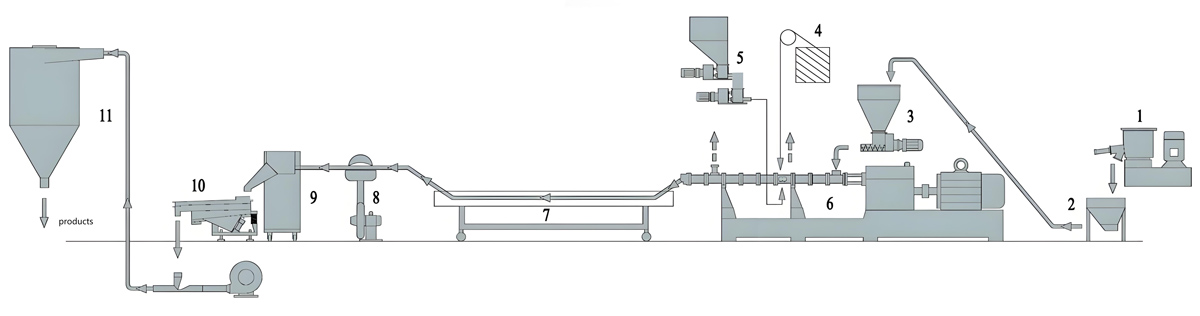
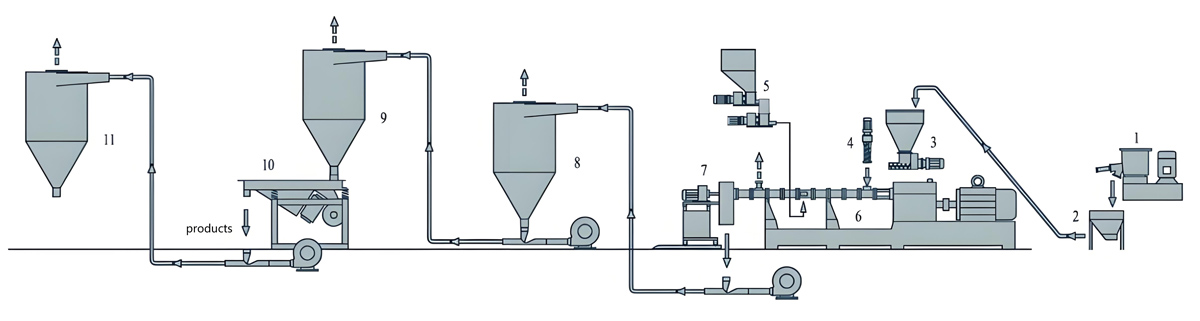
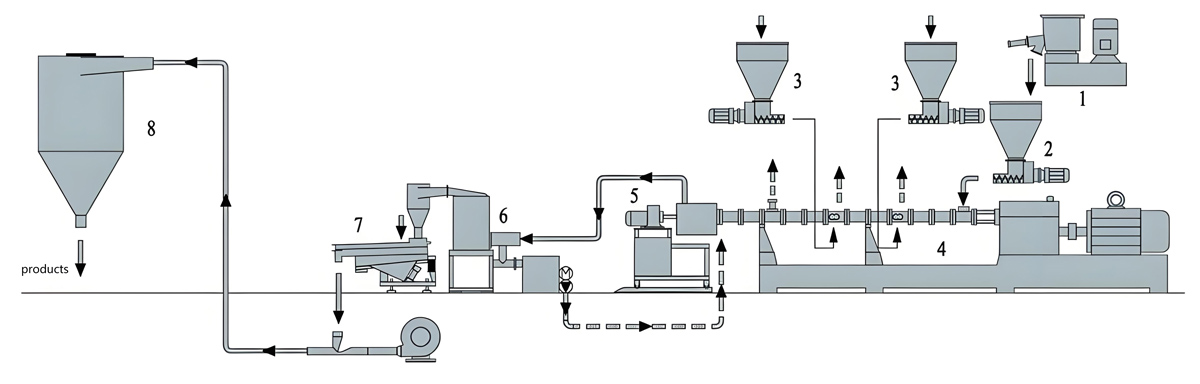
Production Equipment Introduction
Twin Screw Extruder Selection for Nanotube Processing
Equipment selection for halloysite nanotube masterbatch production should prioritize gentle processing conditions that preserve nanotube structure while achieving adequate dispersion. Equipment specifications including screw design flexibility, temperature control precision, and torque capacity influence the capability to process nanotube formulations effectively.
Screw configuration flexibility enables optimization of mixing element arrangement for the specific requirements of nanotube processing. Equipment with extensive screw element libraries and modular barrel configurations supports the optimization required for effective nanotube dispersion while preserving structural integrity.
Temperature control precision ensures accurate temperature management throughout the extrusion process. Multiple independent heating zones enable precise temperature profile configuration to balance melt viscosity requirements against thermal degradation risks.
Torque capacity determines the mechanical energy available for mixing while maintaining control over processing intensity. High torque equipment enables processing of higher viscosity nanotube formulations without sacrificing speed or throughput efficiency.
Kerke KTE Series Equipment Specifications
The Kerke KTE series provides comprehensive equipment options suitable for halloysite nanotube masterbatch production across various capacity requirements and quality objectives. Equipment selection should consider the specific formulation characteristics and production volume targets for the target applications.
The KTE 36B model with 35.6mm screw diameter offers production rates of 20 to 100kg per hour at investment levels ranging from 25,000 to 35,000 USD. This compact equipment provides an excellent platform for pilot production, process development, and small volume specialty product manufacturing. The moderate capacity enables detailed process optimization to identify conditions that preserve nanotube structure while achieving adequate dispersion.
The KTE 50B extruder featuring 50.5mm screw diameter achieves production rates of 80 to 200kg per hour at pricing from 40,000 to 60,000 USD. This intermediate capacity equipment addresses commercial production requirements for moderate volume applications. The flexible screw configuration options support optimization for halloysite processing requirements.
The KTE 65B model with 62.4mm screw diameter provides production capacity of 200 to 450kg per hour at investment levels of 50,000 to 80,000 USD. This higher capacity equipment serves commercial production requirements with robust processing capability. The reliable temperature control and mixing flexibility support consistent production of high quality halloysite masterbatch.
The KTE 75B extruder featuring 71mm screw diameter delivers throughput rates of 300 to 800kg per hour at pricing from 70,000 to 100,000 USD. This industrial scale equipment addresses high volume commercial production requirements with enhanced efficiency and quality consistency. Advanced control systems enable precise management of processing parameters critical for nanotube preservation.
The KTE 95D model with 93mm screw diameter achieves production rates of 1000 to 2000kg per hour at investment levels ranging from 120,000 to 200,000 USD. This large scale industrial machine provides maximum production capacity for established commercial operations with sophisticated control and monitoring capabilities suitable for high volume halloysite masterbatch production.
Parameter Settings
Temperature Profile Optimization for Nanotube Processing
Temperature profile configuration for halloysite nanotube masterbatch production balances melt viscosity requirements against thermal stability considerations. The relatively gentle processing conditions required for nanotube preservation influence temperature profile design.
Feed zone temperatures typically range from 160 to 180 degrees Celsius to ensure proper feeding behavior while avoiding premature melting that could cause material accumulation. Initial heating establishes controlled conditions for subsequent melting and mixing operations.
Compression zone temperatures range from 180 to 210 degrees Celsius depending on the carrier resin type and halloysite concentration. The compression zone temperature profile should achieve complete melting while avoiding excessive temperature that could degrade the polymer or affect nanotube surface chemistry.
Mixing zone temperatures significantly influence melt viscosity and nanotube dispersion. Typical mixing zone temperatures range from 190 to 230 degrees Celsius. Higher temperatures reduce melt viscosity, facilitating nanotube distribution but potentially increasing thermal degradation risk. The optimal temperature should be determined based on systematic process studies evaluating dispersion quality and nanotube preservation.
Die zone temperatures should ensure smooth melt flow through die openings while preserving nanotube structure. Typical die temperatures range from 200 to 240 degrees Celsius depending on the formulation and processing rate requirements.
Screw Speed and Shear Management
Screw speed selection critically influences nanotube preservation during processing. Lower screw speeds reduce shear stress and residence time, preserving nanotube structure while potentially limiting dispersion efficiency. Optimal screw speed balances these competing considerations based on formulation characteristics and quality requirements.
Typical screw speeds for halloysite nanotube masterbatch production range from 150 to 350 rpm depending on the extruder size and formulation requirements. The lower end of this range provides gentle processing conditions beneficial for nanotube preservation. Higher speeds may be acceptable for formulations where dispersion requirements dominate or where shorter residence time reduces total thermal exposure.
Residence time distribution significantly influences nanotube processing. Shorter average residence times reduce total thermal exposure and shear stress, benefiting nanotube preservation. Screw configurations that minimize dead spots and promote plug flow characteristics reduce residence time distribution width and ensure consistent processing.
Specific mechanical energy monitoring provides guidance for process optimization. Lower specific mechanical energy values generally correlate with gentler processing conditions favorable for nanotube preservation. However, sufficient specific mechanical energy must be provided to achieve adequate nanotube dispersion.
Process Optimization Strategy
Systematic process optimization for halloysite nanotube masterbatch production should evaluate the relationships between processing parameters, dispersion quality, and nanotube preservation to identify optimal operating conditions for specific formulations.
Design of experiments approaches enable efficient characterization of the parameter space and identification of optimal operating conditions. Key parameters including temperature profile, screw speed, and throughput rate should be evaluated for their effects on dispersion quality and nanotube integrity.
Response surface methodology can identify optimal parameter combinations that balance competing objectives including dispersion quality, nanotube preservation, and production efficiency.
Process validation testing confirms that optimized parameters consistently produce product meeting quality specifications across normal operating variation.
Equipment Price
Investment analysis for halloysite nanotube masterbatch production equipment should consider production capacity requirements, quality specifications, and the premium value of nanomaterial containing products. The Kerke KTE series provides options spanning various capacities and price points.
The KTE 36B at 25,000 to 35,000 USD provides an accessible entry point for businesses developing halloysite masterbatch production capabilities. This investment level enables pilot production, process development, and market evaluation activities.
The KTE 50B at 40,000 to 60,000 USD addresses intermediate capacity commercial production with robust processing capability. This equipment tier provides attractive economics for growing businesses and specialty product manufacturers.
The KTE 65B at 50,000 to 80,000 USD serves higher volume commercial operations with enhanced production efficiency. This investment provides access to industrial scale processing capabilities suitable for premium nanomaterial products.
The KTE 75B at 70,000 to 100,000 USD delivers substantial production capacity for established commercial operations. The enhanced throughput enables competitive production economics for high volume applications.
The KTE 95D at 120,000 to 200,000 USD represents the premium industrial investment for high volume production. This equipment tier provides maximum capacity and sophisticated control capabilities for large scale commercial operations.
Total capital requirements beyond base equipment should include ancillary systems, quality control instrumentation for nanomaterial characterization, and employee training. The premium pricing achievable for nanomaterial containing products supports favorable return on investment analysis.
Problems in Production Process and Solutions
Nanotube Dispersion Challenges
Achieving adequate dispersion of halloysite nanotubes while preserving their structural integrity presents significant challenges compared to conventional filler systems. The balance between dispersion and preservation requires careful optimization of equipment configuration and process parameters.
Solutions for dispersion challenges focus on screw configuration optimization and process parameter adjustment. Increasing distributive mixing through additional mixing elements or extended mixing zones improves nanotube distribution without excessive shear stress. Screw element selection should emphasize reorienting mixing mechanisms rather than high shear dispersive elements.
Dispersant system optimization can improve nanotube dispersion while reducing the processing intensity required. Testing different dispersant types and concentrations identifies optimal combinations for specific formulations. Surface modified halloysite grades with enhanced compatibility may reduce dispersion requirements.
Multi stage processing approaches can achieve superior dispersion through sequential mixing operations. Initial intensive mixing to achieve basic dispersion followed by gentler processing for nanotube preservation can combine the benefits of both approaches.
Prevention of dispersion issues requires systematic process development to identify optimal processing conditions, regular equipment maintenance to ensure consistent mixing capability, and quality control testing to verify dispersion quality.
Nanotube Damage and Aspect Ratio Loss
Mechanical processing conditions can cause breakage of halloysite nanotubes, reducing aspect ratio and compromising reinforcement efficiency. The hollow tubular structure makes nanotubes more susceptible to damage than solid particles of similar dimensions.
Solutions for nanotube damage focus on reducing mechanical stress during processing. Lower screw speeds reduce shear stress and particle interactions that cause breakage. Shorter residence times reduce cumulative stress exposure. Screw configurations with gentler mixing elements minimize stress concentrations that could cause fracture.
Processing sequence optimization can reduce nanotube damage by minimizing stress exposure during critical processing stages. Premixing in low shear equipment preserves nanotube structure before extrusion processing. Multiple low intensity processing steps may achieve adequate dispersion with less damage than single intensive processing.
Electron microscopy analysis of processed samples enables assessment of nanotube structural preservation. Comparison with unprocessed nanotube samples identifies processing conditions causing damage and guides optimization efforts.
Prevention of nanotube damage requires process validation to establish safe operating limits, regular quality verification testing, and equipment maintenance to ensure consistent processing conditions.
Processing Instability in High Viscosity Formulations
High nanotube loading levels create high viscosity melts that can cause processing instability including pressure fluctuations, surging, and inconsistent product quality. The non Newtonian flow behavior of nanotube filled melts requires specific attention to equipment and process design.
Solutions for processing instability focus on viscosity management and equipment configuration optimization. Temperature increases reduce melt viscosity and improve flow stability. However, temperature increases must be balanced against thermal degradation risks and nanotube preservation requirements.
Screw configuration modifications can address specific instability causes. Feed zone geometry modifications can improve feeding consistency. Pumping element adjustments can stabilize melt delivery to the die. Mixing element rearrangements can reduce pressure fluctuations associated with mixing operations.
Throughput reduction may be necessary to achieve stable processing for high viscosity formulations. Operating at reduced throughput within the stable processing window ensures consistent product quality while maintaining production capability.
Prevention of processing instability requires comprehensive process characterization to establish stable operating windows, regular equipment maintenance, and process monitoring to detect developing issues.
Maintenance
Equipment Maintenance for Nanomaterial Processing
Maintenance programs for halloysite nanotube masterbatch production should address the specific requirements of nanomaterial processing including screw and barrel wear from abrasive materials and cleanliness requirements for nanomaterial handling.
Screw element wear monitoring through regular inspection and dimensional measurement ensures reliable processing performance. While halloysite nanotubes are less abrasive than some mineral fillers, extended production can cause measurable wear that affects mixing efficiency and product quality.
Barrel wear evaluation focuses on high stress regions and potential accumulation of nanotube material in wear affected areas. Regular inspection identifies wear progression and enables planning for replacement before performance degradation occurs.
Cleanliness maintenance prevents contamination between production runs and ensures consistent product quality. Thorough purging and cleaning procedures between formulation changes prevent cross contamination that could affect product characteristics.
Systematic Maintenance Programs
Comprehensive preventive maintenance programs ensure reliable equipment performance for nanomaterial processing operations. Maintenance scheduling should balance production requirements against maintenance needs to minimize operational disruptions.
Daily maintenance activities include equipment inspection, die cleaning, and parameter verification. Operator attention to cleanliness and contamination prevention protects product quality.
Weekly maintenance includes more thorough inspection, calibration verification, and cleaning verification. Documentation supports quality assurance requirements.
Monthly and quarterly maintenance activities include comprehensive equipment inspection, wear measurement, and component replacement as indicated. Statistical analysis of production quality data identifies trends requiring attention.
Annual maintenance programs include major overhauls, system optimization, and comprehensive performance testing to ensure continued reliable operation.
FAQ
What halloysite nanotube loading levels provide effective reinforcement?
Effective reinforcement typically requires halloysite nanotube loadings of 5% to 20% depending on the specific application requirements and property targets. Lower loading levels provide meaningful reinforcement effects while maintaining processing characteristics similar to unfilled polymers. Higher loading levels provide enhanced property improvements but may present processing challenges and increased material costs. The optimal loading level should be determined through testing of specific property requirements.
How do halloysite nanotubes differ from other clay fillers?
Halloysite nanotubes differ fundamentally from layered clay fillers such as montmorillonite in their structural morphology. Halloysite naturally exists as discrete hollow nanotubes rather than requiring exfoliation from layered structures. This characteristic enables more straightforward incorporation into polymer matrices without the complex processing required for layered clay exfoliation. The hollow interior lumen of halloysite provides additional functionality including additive loading and controlled release capabilities not available with conventional clay fillers.
What applications benefit most from halloysite nanotube reinforcement?
Applications requiring enhanced mechanical properties combined with fire safety or functional additive delivery benefit most from halloysite nanotube reinforcement. Automotive interior components benefit from improved thermal stability and reduced smoke emissions. Packaging applications utilize barrier enhancement and antimicrobial delivery capabilities. Construction materials gain improved durability and corrosion protection. The specific benefits depend on the application requirements and formulation optimization.
How does halloysite affect processing compared to unfilled polymers?
Halloysite nanotube incorporation increases melt viscosity compared to unfilled polymers, with the degree of increase depending on loading level and nanotube aspect ratio. Processing temperatures may need adjustment to compensate for viscosity increases. The gentle processing conditions required for nanotube preservation may require lower screw speeds or modified screw configurations compared to conventional filled polymer processing.
Can halloysite nanotubes be loaded with functional additives?
Halloysite nanotube hollow interior lumens can be loaded with various functional additives for controlled release applications. Flame retardants, antimicrobial agents, corrosion inhibitors, and other functional compounds can be incorporated into nanotubes through vacuum loading, solution impregnation, or melt processing techniques. The nanotube structure provides sustained release behavior that extends functional effectiveness while reducing initial loading requirements.
What quality testing is recommended for halloysite masterbatch?
Recommended quality testing for halloysite nanotube masterbatch includes nanotube loading verification through ash content or elemental analysis, dispersion quality assessment through electron microscopy, mechanical property testing of representative composites, melt flow characterization, and thermal analysis for thermal stability verification. Regular quality testing ensures consistent product characteristics.
Conclusion
Halloysite nanotube filled masterbatch production through twin screw extrusion technology enables the creation of advanced polymer composites with enhanced mechanical properties and unique functional capabilities. The distinctive hollow nanotubular structure of halloysite provides reinforcement benefits and additive delivery functionality that distinguish it from conventional mineral fillers.
Successful halloysite masterbatch production requires careful attention to processing conditions that preserve nanotube structural integrity while achieving adequate dispersion throughout the polymer matrix. Equipment selection from the Kerke KTE series provides options addressing various production capacity requirements with the flexible configuration capabilities required for nanotube processing optimization.
Investment levels ranging from 25,000 to 200,000 USD enable access to professional grade twin screw extrusion capabilities for businesses developing halloysite masterbatch products. The premium pricing achievable for nanomaterial containing products supports favorable economics for well positioned manufacturers.
Process optimization focusing on gentle processing conditions, systematic parameter studies, and quality verification testing enables achievement of consistent product quality while maximizing nanotube reinforcement effectiveness. Maintenance programs ensure long term equipment reliability and production consistency.
The unique combination of reinforcement capability and functional additive delivery makes halloysite nanotube masterbatch attractive for advanced applications across automotive, construction, packaging, and consumer products sectors. Success in this market segment requires technical expertise in nanomaterial processing and commitment to quality excellence in all aspects of production operations.