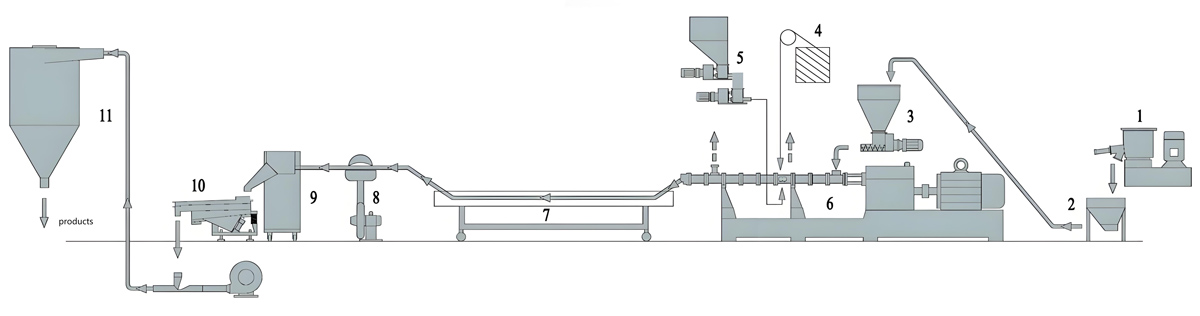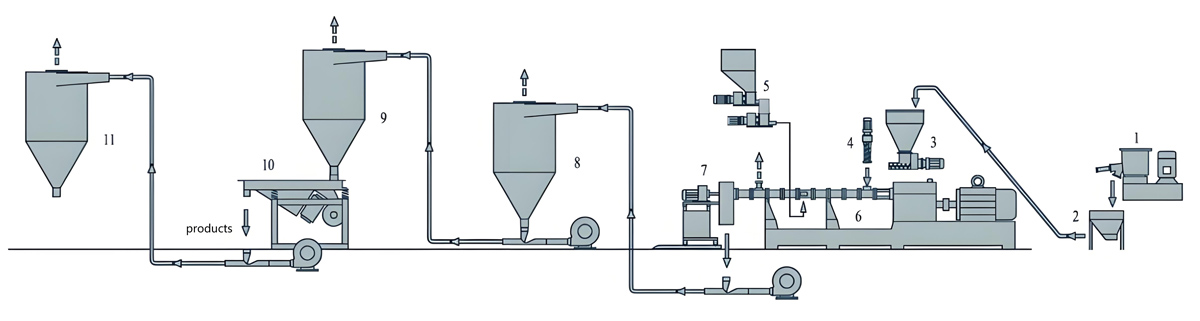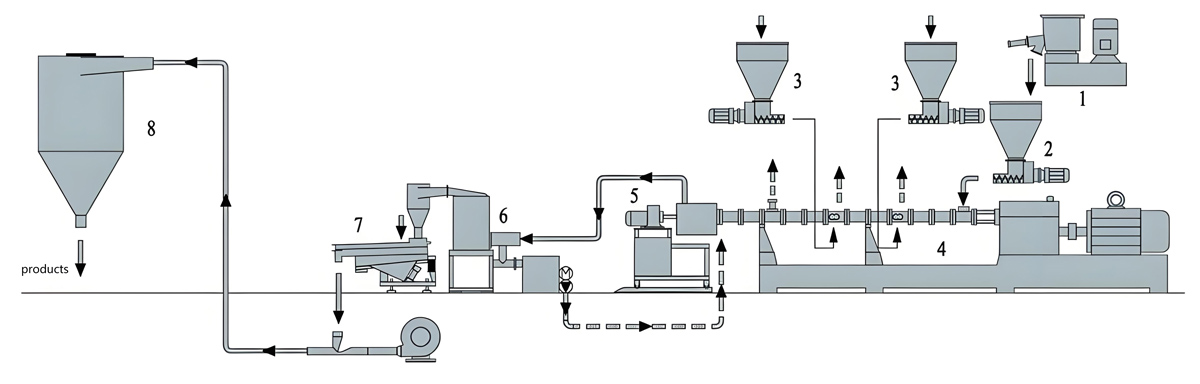
Nucleating and reinforcing masterbatch formulations serve essential functions in improving the performance characteristics of plastic materials. Nucleating agents accelerate the crystallization process in semi-crystalline polymers, improving stiffness, heat resistance, and processing efficiency. Reinforcing additives including glass fibers, carbon fibers, and mineral fillers enhance mechanical properties including tensile strength, flexural modulus, and dimensional stability. The production of high-quality nucleating and reinforcing masterbatch using twin screw extrusion technology enables manufacturers to achieve superior dispersion and property enhancement. This comprehensive guide covers all aspects of manufacturing these performance-enhancing masterbatch products.
Introduction to Nucleating and Reinforcing Masterbatch
Nucleating agents function by providing sites for polymer crystal formation during cooling from the melt state. By increasing the number of crystallization nuclei, these additives create a more uniform and fine crystalline structure that improves the physical properties of semi-crystalline polymers. The enhanced crystallization results in faster cycle times during injection molding, improved stiffness and heat deflection temperature, and better dimensional stability in finished products.
Common nucleating agents include sorbitol derivatives, organic phosphates, metal salts of organic acids, and inorganic compounds such as talc and kaolin. Each nucleating agent type offers different performance characteristics and compatibility with specific polymer systems. The selection of appropriate nucleating agent depends on the polymer being treated, processing conditions, and property enhancement requirements.
Reinforcing additives provide mechanical property improvements through load transfer from the polymer matrix to the reinforcing phase. The effectiveness of reinforcement depends on the aspect ratio of reinforcing particles or fibers, the interfacial bonding between reinforcement and matrix, and the dispersion quality achieved during processing. Higher aspect ratio reinforcements such as glass fibers provide greater property improvements but present greater processing challenges.
Masterbatch production offers significant advantages for nucleating and reinforcing formulations. Converting powdered nucleating agents and fibrous or particulate reinforcing additives into pellet form improves handling, dosing accuracy, and dispersion quality. The carrier resin also provides processing benefits and improves compatibility with the base polymer being reinforced or nucleated.
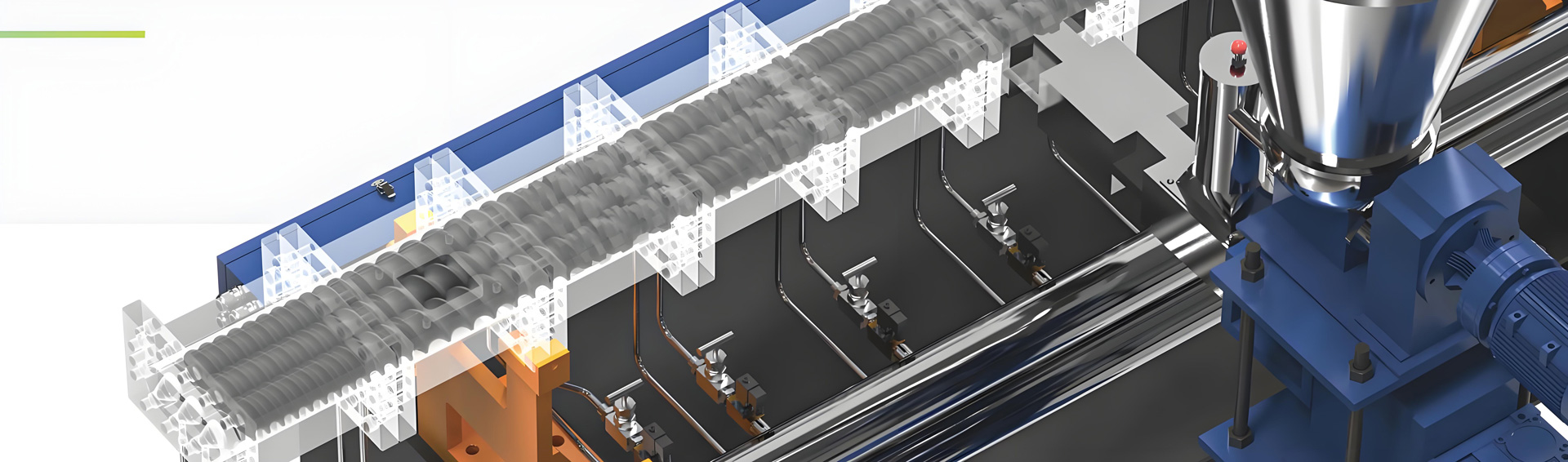
Twin screw extrusion provides the intensive mixing required to disperse nucleating and reinforcing additives uniformly throughout the polymer matrix. The modular screw configuration enables customization of mixing intensity and shear conditions to match the specific requirements of different additive types and concentration levels.
Formulation Ratios for Nucleating and Reinforcing Masterbatch
Formulation development for nucleating and reinforcing masterbatch requires careful balancing of additive concentration against processing constraints, cost considerations, and target property improvements. Different applications require different additive packages and concentration levels.
Sorbitol Nucleating Agent Masterbatch Formulation
Sorbitol derivatives including dibenzylidene sorbitol and dibenzylidene sorbitol derivatives provide excellent clarification and nucleation in polypropylene and polyethylene applications. These additives create a fine crystalline structure that improves transparency, stiffness, and heat resistance.
A standard sorbitol nucleating masterbatch formulation contains 5 to 15 percent active sorbitol compound, with the balance carrier resin selected to match the target polymer. The low effective concentration of sorbitol nucleating agents means that masterbatch products typically contain relatively low additive loading compared to other masterbatch types. The formulation may include processing aids at 1 to 3 percent to improve dispersion and reduce dust generation.
Sorbitol nucleating agents are temperature-sensitive and may sublime or degrade at excessive processing temperatures. Temperature profile management during extrusion preserves nucleating activity for delivery to customer applications.
Organic Phosphate Nucleating Agent Masterbatch Formulation
Organic phosphate nucleating agents including sodium 2,2-methylene bis(4,6-di-tert-butylphenyl)phosphate provide high-efficiency nucleation for polypropylene and polyamide applications. These additives offer excellent property improvements including increased flexural modulus, higher heat deflection temperature, and faster cycle times.
Organic phosphate nucleating masterbatch formulations typically contain 5 to 20 percent active nucleating compound depending on the specific additive and target application. Higher concentrations may be used for demanding applications requiring maximum property enhancement. The carrier resin is selected for compatibility with the target polymer system.
Some organic phosphate nucleating agents may affect the color of finished products, requiring consideration of aesthetic requirements when selecting nucleating agent type and concentration.
Mineral Reinforcement Masterbatch Formulation
Mineral reinforcements including talc, calcium carbonate, mica, and kaolin improve stiffness, dimensional stability, and in some cases thermal conductivity of polymer compounds. The effectiveness of mineral reinforcement depends on particle size, aspect ratio, and surface treatment that improves polymer-filler interfacial bonding.
Talc-reinforced masterbatch formulations typically contain 40 to 70 percent active talc with median particle sizes between 1 and 5 micrometers. Higher aspect ratio talcs with plate-like particle shapes provide greater stiffness improvement. Surface treatment with silane coupling agents improves interfacial bonding and property transfer from filler to matrix.
Calcium carbonate masterbatch formulations typically contain 50 to 80 percent active calcium carbonate. Smaller particle sizes provide better property improvements but may present greater dispersion challenges and increase melt viscosity. Surface treatment with stearic acid or other coupling agents improves dispersion and compatibility.
Glass Fiber Reinforcement Masterbatch Formulation
Glass fiber reinforcement provides the highest level of mechanical property enhancement for thermoplastic polymers. Short glass fibers in masterbatch form enable processors to introduce reinforcement during standard compounding operations without requiring specialized equipment for direct fiber incorporation.
Glass fiber masterbatch formulations typically contain 20 to 50 percent glass fiber loading, with the balance carrier resin selected for compatibility with the target polymer. The formulation may include coupling agents such as silanes that improve interfacial bonding between glass fiber and polymer matrix, enhancing property transfer and moisture resistance.
Processing of glass fiber masterbatch requires attention to fiber length preservation. Excessive shear during extrusion can break fibers, reducing reinforcement effectiveness. Screw configurations optimized for glass fiber processing maintain fiber length while achieving adequate dispersion of carrier resin and any additional additives.
Carbon Fiber Reinforcement Masterbatch Formulation
Carbon fiber reinforcement provides exceptional mechanical property improvement with lower density compared to glass fiber alternatives. Carbon fiber-reinforced polymers offer high strength-to-weight ratios suitable for aerospace, automotive, and sporting goods applications.
Carbon fiber masterbatch formulations typically contain 10 to 30 percent active carbon fiber with lengths between 0.2 and 6 millimeters. The lower loading compared to glass fiber masterbatch reflects the higher cost of carbon fiber raw material. The formulation includes coupling agents to improve carbon fiber-polymer interfacial bonding.
Carbon fiber masterbatch processing requires careful attention to fiber length preservation and dispersion quality. The brittle nature of carbon fiber makes it susceptible to breakage during high-shear processing. Screw configurations emphasizing gentle material handling preserve fiber length and reinforcement effectiveness.
Combined Nucleating and Reinforcing Masterbatch Formulation
Some applications benefit from combined nucleating and reinforcing functionality in single masterbatch products. These hybrid formulations address both crystallization behavior and mechanical property requirements efficiently.
A combined nucleating and reinforcing masterbatch for polypropylene injection molding might include 5 to 10 percent nucleating agent combined with 20 to 40 percent mineral reinforcement. This combination provides faster cycle times through enhanced crystallization, improved stiffness from reinforcement, and better dimensional stability from both mechanisms.
The interaction between nucleating agents and reinforcing fillers must be considered during formulation development. Some nucleating agents may affect the effectiveness of reinforcing fillers or vice versa. Testing of combined formulations verifies that both mechanisms function as intended.
Production Process for Nucleating and Reinforcing Masterbatch
The production of nucleating and reinforcing masterbatch requires attention to dispersion quality, fiber length preservation, and preservation of nucleating agent activity. Different additive types present different processing challenges that must be addressed through proper equipment configuration and parameter control.
Raw Material Preparation
Nucleating agents and reinforcing fillers must be properly dried before processing to remove moisture that could cause hydrolysis reactions, steam formation, or surface defects. Mineral reinforcements particularly require thorough drying, typically at 120 to 150 degrees Celsius for 4 to 6 hours to achieve moisture contents below 0.1 percent.
Glass fiber and carbon fiber materials should be stored in dry conditions to prevent moisture absorption. Wet fibers during processing create steam that can cause voids in the masterbatch and degrade fiber-matrix interfacial bonding. Fiber materials should be dried according to manufacturer recommendations before use.
Pre-blending combines all formulation components in the correct proportions. For mineral reinforcement formulations, high-intensity mixing ensures uniform distribution of high-density filler particles throughout the carrier resin. For fiber-containing formulations, gentle mixing preserves fiber length and prevents fiber damage during pre-blending.
Extrusion Processing for Mineral Reinforcement
Extrusion processing for mineral reinforcement masterbatch focuses on achieving uniform dispersion of filler particles while maintaining adequate throughput for commercial production. The high loadings typical of mineral reinforcement formulations create processing challenges that require proper equipment configuration.
Temperature profiles for mineral reinforcement extrusion typically range from 180 to 260 degrees Celsius depending on the carrier resin and nucleating agent type. The feeding zone operates at lower temperatures to ensure consistent material introduction. Progressive temperature increases through the compression and melting zones achieve complete polymer melting. The final mixing zones maintain temperatures that provide adequate flow without excessive thermal stress.
Screw configuration for mineral reinforcement formulations emphasizes distributive mixing over dispersive mixing. Kneading blocks with moderate staggering angles provide adequate dispersion without excessive shear that might generate excessive heat. Forward-conveying elements maintain material flow throughout the extrusion length.
Extrusion Processing for Fiber Reinforcement
Extrusion processing for fiber reinforcement masterbatch requires careful attention to fiber length preservation. High shear processing breaks fibers, reducing reinforcement effectiveness in the finished product. The screw configuration must balance mixing requirements against the need to preserve fiber integrity.
Screw configurations optimized for glass fiber processing use gentle conveying elements and limited mixing sections to preserve fiber length. Reverse-pitch screw elements and restriction rings should be avoided as they create high shear zones that damage fibers. Moderate-intensity kneading blocks with wide staggering angles may be used in limited sections to achieve adequate mixing without excessive fiber breakage.
Temperature profiles for fiber reinforcement extrusion should be set to achieve adequate melting and flow while minimizing residence time. Higher temperatures reduce melt viscosity and allow shorter residence times, preserving fiber length. The specific temperature profile depends on the polymer system and processing equipment.
Pelletizing and Quality Control
Pelletizing systems for nucleating and reinforcing masterbatch must handle the specific requirements of different formulation types. Mineral reinforcement formulations typically pelletize without difficulty, while fiber-containing formulations require attention to cutting quality and granule consistency.
The cooling water system must provide adequate heat removal to solidify high-melting-point formulations. Water temperature and flow rate should be monitored to ensure proper granule solidification before cutting.
Centrifugal drying removes surface moisture from finished granules. The dried product is inspected for visual quality and then packaged in appropriate containers that provide moisture and contamination protection during storage and transport.
Quality testing of nucleating and reinforcing masterbatch includes verification of nucleating effectiveness, mechanical property testing of compounded samples, and microscopy examination for dispersion quality. For fiber-containing masterbatches, fiber length analysis provides important information about processing quality and expected reinforcement effectiveness.
Production Equipment Introduction
Equipment selection for nucleating and reinforcing masterbatch production considers the specific processing requirements of different additive types. The Kerke KTE series offers equipment options suitable for different production scales and formulation requirements.
Kerke KTE-36B Twin Screw Extruder
The compact KTE-36B serves pilot production and small-batch requirements for nucleating and reinforcing masterbatch. The 35.6 millimeter screw diameter and 40:1 length-to-diameter ratio provide adequate processing capability for formulation development and low-volume specialty production at 20 to 100 kilograms per hour.
The six-zone temperature control enables precise temperature profiling for temperature-sensitive nucleating agent compounds. Modular screw element configuration allows customization of transport and mixing capability to match specific formulation requirements. This model is suitable for businesses establishing nucleating and reinforcing masterbatch capabilities or conducting product development activities.
Kerke KTE-50B Twin Screw Extruder
The mid-range KTE-50B offers increased production capacity with 50.5 millimeter screw diameter achieving throughput rates of 80 to 200 kilograms per hour. The eight-zone temperature control provides enhanced flexibility for optimizing processing conditions of various nucleating and reinforcing formulations.
This model serves small to medium-scale commercial production effectively. The combination of capacity, temperature control capability, and moderate investment makes the KTE-50B an attractive option for growing nucleating and reinforcing masterbatch businesses.
Kerke KTE-65B Twin Screw Extruder
Medium-scale commercial production is served by the KTE-65B with 62.4 millimeter screw diameter and throughput rates of 200 to 450 kilograms per hour. The ten-zone temperature control enables precise management of temperature-sensitive nucleating agent and reinforcing filler formulations.
The robust construction and reinforced components support continuous production operation. The KTE-65B provides an excellent balance of capacity, control capability, and investment level for established nucleating and reinforcing masterbatch production operations.
Kerke KTE-75B Twin Screw Extruder
High-volume nucleating and reinforcing masterbatch production is addressed by the KTE-75B with 71 millimeter screw diameter and throughput rates of 300 to 800 kilograms per hour. The twelve-zone temperature control system provides maximum flexibility for demanding formulations.
The extended length-to-diameter ratio of 48:1 offers additional residence time for complete mixing of high-viscosity formulations. Advanced screw elements optimize dispersion quality while maintaining throughput efficiency. This model suits manufacturers with established markets seeking capacity expansion.
Kerke KTE-95D Twin Screw Extruder
Maximum production capacity is available through the KTE-95D with 93 millimeter screw diameter achieving throughput rates between 1000 and 2000 kilograms per hour. This industrial-scale platform delivers the throughput required for large-volume nucleating and reinforcing masterbatch manufacturing.
The comprehensive automation and control systems support continuous production operation with consistent quality. Multiple side-feeder ports and devolatilization zones provide enhanced processing capability for complex formulations. The KTE-95D serves major production facilities requiring maximum capacity output.
Parameter Settings for Nucleating and Reinforcing Masterbatch
Optimal parameter settings for nucleating and reinforcing masterbatch balance processing efficiency against product quality requirements. Different additive types present different parameter requirements that must be managed for successful production.
Temperature Profile Configuration
Temperature profiles must be configured to provide adequate melting and flow while preserving nucleating agent activity. Sorbitol-based nucleating agents are particularly temperature-sensitive and may degrade or sublime at excessive temperatures. Maximum processing temperatures typically should not exceed 280 degrees Celsius for these sensitive additives.
For mineral reinforcement masterbatch, typical temperature profiles range from 180 to 260 degrees Celsius across processing zones depending on the carrier resin. Higher temperatures reduce viscosity and improve dispersion but may cause degradation of carrier resin or additives if excessive.
Die zone temperatures are set 5 to 15 degrees Celsius below the final barrel zone to ensure proper melt consolidation. Temperature uniformity across the die plate ensures uniform strand formation and consistent granule quality.
Screw Speed and Throughput Optimization
Screw speeds between 150 and 300 revolutions per minute typically provide good balance between processing efficiency and product quality. For nucleating agent formulations, lower speeds reduce mechanical energy input and temperature rise, benefiting temperature-sensitive compounds. For fiber reinforcement formulations, lower speeds may help preserve fiber length.
Throughput optimization considers the relationship between production rate and product quality. Higher throughput rates reduce residence time, which benefits temperature-sensitive nucleating agents but may compromise mixing quality for high-viscosity formulations.
Recommended throughput ranges for different equipment sizes are: KTE-36B at 25 to 50 kilograms per hour, KTE-50B at 80 to 140 kilograms per hour, KTE-65B at 180 to 320 kilograms per hour, KTE-75B at 280 to 550 kilograms per hour, and KTE-95D at 900 to 1500 kilograms per hour.
Fiber Length and Dispersion Control
For fiber reinforcement masterbatch, controlling fiber length during processing is critical to achieving expected reinforcement effectiveness. Monitoring process parameters including torque, pressure, and motor current provides indirect indication of processing severity and potential fiber damage.
Achieving uniform dispersion of nucleating agents and reinforcing fillers requires adequate mixing intensity and residence time. Process parameters should be optimized based on quality testing of finished product including microscopy examination and mechanical property testing.
Equipment Price
Investment levels for twin screw extrusion equipment vary based on production capacity, features, and configuration. Kerke offers the KTE series across a comprehensive price range suitable for different market segments and production requirements.
The Kerke KTE-36B is priced between 25,000 and 35,000 dollars, providing an accessible entry point for pilot production and development activities. The compact design minimizes installation requirements while delivering professional-grade mixing performance for nucleating and reinforcing formulations.
The Kerke KTE-50B ranges from 40,000 to 60,000 dollars, offering increased capacity and enhanced temperature control for small to medium-scale commercial nucleating and reinforcing masterbatch production. The additional temperature zones and improved control systems support demanding formulation requirements.
Medium-scale production capacity is available through the Kerke KTE-65B at 50,000 to 80,000 dollars. The higher throughput capability and extended features support established commercial production operations requiring consistent output of quality nucleating and reinforcing masterbatch.
The Kerke KTE-75B, priced between 70,000 and 100,000 dollars, serves high-volume production requirements with maximum capacity and advanced control features. The robust construction supports continuous production operation in demanding manufacturing environments.
Maximum capacity production is available through the Kerke KTE-95D at 120,000 to 200,000 dollars. This industrial-scale platform provides the throughput and automation capabilities required for large-volume nucleating and reinforcing masterbatch manufacturing operations.
Problems in Production Process and Solutions
Production of nucleating and reinforcing masterbatch presents specific technical challenges related to additive sensitivity, dispersion requirements, and fiber length preservation. Understanding these challenges enables processors to develop effective solutions.
Problem: Inadequate Nucleating Agent Effectiveness
Inadequate nucleating agent effectiveness manifests as lower-than-expected crystallization temperatures, reduced stiffness improvement, or slower cycle times in customer applications. This problem indicates that nucleating agent was lost or deactivated during processing.
Root Cause Analysis
Excessive processing temperatures cause thermal degradation or sublimation of nucleating agent compounds, reducing their effectiveness. Each nucleating agent has specific temperature limits beyond which degradation occurs. Sorbitol derivatives are particularly temperature-sensitive and may lose effectiveness at relatively low processing temperatures.
Extended residence time at processing temperatures increases the extent of thermal degradation or volatilization losses. Even at temperatures within acceptable ranges, longer residence times increase total exposure and reduce nucleating effectiveness.
Inadequate dispersion of nucleating agent results in localized areas of high and low concentration. Nucleating agents must be uniformly distributed to provide consistent crystallization sites throughout the polymer matrix. Poor dispersion creates regions with insufficient nucleating agent concentration.
Solutions
Systematic temperature reduction throughout the extrusion profile addresses thermal degradation problems. Beginning with the final zones and die, reduce temperatures by 5 to 10 degree increments while monitoring product quality. The minimum temperature that produces acceptable product quality represents the optimal processing condition for each formulation.
Increasing throughput rate reduces residence time at processing temperatures, decreasing the time available for thermal degradation reactions. This approach must be balanced against mixing quality and product consistency requirements.
Modifying screw configuration to improve distributive mixing ensures uniform nucleating agent distribution. Kneading blocks with moderate staggering angles provide mixing that distributes nucleating agent particles without excessive shear heating. Adding mixing sections where appropriate improves dispersion quality.
Prevention Methods
Establishing maximum temperature limits for each nucleating agent formulation based on thermal stability specifications prevents degradation-related problems. Including safety margins accounts for normal variations in equipment performance and processing conditions.
Implementing quality testing of finished masterbatch verifies nucleating effectiveness before product release. Differential scanning calorimetry testing measures crystallization temperature improvement as an indicator of nucleating agent effectiveness. Establishing specification limits for crystallization temperature ensures consistent product quality.
Regular monitoring of process parameters including temperature, pressure, and throughput identifies variations that might affect nucleating agent effectiveness. Maintaining detailed production records supports troubleshooting when quality issues occur.
Problem: Fiber Breakage During Processing
Excessive fiber breakage during extrusion reduces reinforcement effectiveness in the finished masterbatch. This problem manifests as lower-than-expected mechanical property improvements in customer applications.
Root Cause Analysis
Excessive shear stress during extrusion breaks glass and carbon fibers, reducing their aspect ratio and reinforcement effectiveness. The high shear rates in intensive mixing elements and the mechanical stresses during polymer melting create conditions that damage fibers.
Screw configurations with aggressive mixing elements create excessive shear that breaks fibers. Kneading blocks with tight staggering angles, reverse-pitch elements, and extensive mixing sections all contribute to fiber damage.
Excessive throughput rates create high fill levels and mechanical stress on fibers during transport through the extruder. The combination of high viscosity and high throughput creates severe processing conditions that damage fibers.
Solutions
Modifying screw configuration to reduce shear stress preserves fiber length during processing. Replacing aggressive mixing elements with gentle conveying elements, reducing the number and intensity of kneading sections, and avoiding reverse-pitch elements all contribute to gentler processing.
Reducing throughput rate decreases fill level and material stress in the processing zones, providing a gentler processing environment. This approach trades processing efficiency for product quality, which may be appropriate for high-value fiber reinforcement masterbatches.
Increasing temperature reduces melt viscosity and shear stress during processing. Higher temperatures allow equivalent throughput with lower torque and pressure requirements, reducing mechanical stress on fibers. However, temperatures must remain within limits that prevent polymer degradation.
Prevention Methods
Establishing validated screw configurations for fiber reinforcement formulations ensures consistent processing conditions that preserve fiber length. Documenting successful configurations and reusing them for similar formulations prevents problems from inappropriate screw designs.
Quality testing of finished masterbatch verifies fiber length preservation. Fiber length analysis using dissolution and microscopy techniques provides quantitative measurement of fiber length distribution. Establishing specification limits for average fiber length ensures consistent product quality.
Mechanical property testing of compounded samples using appropriate test methods confirms that fibers survived processing with adequate length for reinforcement effectiveness. Tensile testing, flexural testing, and impact testing provide confirmation of reinforcement quality.
Problem: Poor Mineral Filler Dispersion
Inadequate dispersion of mineral reinforcement creates localized areas of high filler concentration, resulting in inconsistent mechanical properties and surface quality in customer applications. This problem manifests as streaks, agglomerates, or property variation in compounded products.
Root Cause Analysis
Insufficient mixing during extrusion results from screw configurations lacking adequate distributive mixing elements. Mineral fillers with high loadings require sufficient mixing to achieve uniform distribution throughout the carrier resin. Inadequate mixing sections in the screw configuration fail to break down agglomerates and distribute filler particles.
Pre-blending deficiencies leave filler particles poorly distributed before they enter the extruder. Large agglomerates formed during storage or handling resist breakdown during extrusion. Inadequate pre-blending intensity fails to achieve the initial distribution required for effective extrusion mixing.
Temperature variations during processing create viscosity fluctuations that affect mixing effectiveness. Cold spots or temperature instability creates regions of high viscosity where mixing efficiency is reduced and dispersion suffers.
Solutions
Modifying screw configurations to include additional distributive mixing elements improves mineral filler dispersion. Kneading blocks with moderate staggering angles provide intensive mixing that distributes high-density filler particles throughout the carrier resin. Adding mixing sections where appropriate improves dispersion quality.
Improving pre-blending procedures ensures better initial distribution of mineral fillers before extrusion. Using high-intensity mixing equipment or extended mixing times improves the wetting and distribution of filler particles. The improved pre-blend requires less processing to achieve complete dispersion.
Optimizing temperature profiles to ensure uniformity and adequate temperature levels improves mixing effectiveness. Temperature adjustments in mixing zones can improve melt viscosity and mixing efficiency. Installing additional temperature control zones addresses temperature uniformity problems.
Prevention Methods
Standardizing pre-blending procedures ensures consistent preparation regardless of operator or batch. Documenting mixing parameters including time, speed, and sequence provides reproducible preparation conditions. Regular calibration of mixing equipment maintains consistent performance.
Implementing raw material specifications and incoming quality control procedures prevents dispersion problems caused by poor-quality input materials. Testing particle size distribution, moisture content, and bulk density identifies potential problems before they affect production.
Quality testing of finished masterbatch verifies dispersion effectiveness. Microscopy examination of diluted samples identifies agglomerates and distribution uniformity. Mechanical property testing provides functional confirmation of dispersion quality.
Maintenance of Twin Screw Extruders for Nucleating and Reinforcing Masterbatch
Consistent maintenance of extrusion equipment ensures reliable production and consistent product quality for nucleating and reinforcing masterbatch manufacturing. The maintenance program addresses equipment condition, control system accuracy, and processing efficiency.
Screw and Barrel Wear Management
High filler loadings in reinforcing masterbatch formulations accelerate wear of screw elements and barrel liners. Regular inspection of these components identifies wear patterns and determines when replacement is necessary. Measuring clearances and comparing with specifications quantifies wear levels.
Abrasion-resistant coatings and materials can extend component life in reinforcing masterbatch applications. Chromium nitride, titanium nitride, and similar coatings provide improved wear resistance for screw flights and barrel surfaces. The additional cost of coated components may be justified by extended service life in demanding applications.
Barrel liner inspection using borescope equipment reveals wear patterns and surface condition. Worn barrel liners create clearance increases that affect compression and mixing performance. Replacing worn liners restores original equipment specifications and processing capability.
Temperature Control System Maintenance
Accurate temperature control is essential for consistent nucleating and reinforcing masterbatch production, particularly for temperature-sensitive nucleating agent formulations. Regular calibration of temperature sensors ensures measurement accuracy. Verification of temperature readings against known standards identifies drift and accuracy problems.
Heating element condition affects temperature control performance and energy efficiency. Testing element resistance identifies degradation before failure occurs. Replacing worn elements during scheduled maintenance prevents unexpected production interruptions and maintains temperature control quality.
Cooling system performance directly impacts temperature control capability. Scale buildup in water-cooled zones reduces heat transfer efficiency and creates control difficulties. Regular cleaning of cooling passages maintains proper heat removal capacity.
Drive System and Feeding Equipment Care
Gearbox maintenance including oil level checks, oil analysis, and regular oil changes maintains drive system reliability. Analyzing oil samples for wear metals and contamination provides early warning of developing problems. Following manufacturer recommendations for maintenance intervals ensures long equipment life.
Feeding system accuracy affects batch-to-batch consistency. Loss-in-weight feeder calibration ensures accurate feed rate control. For high-solids-content pre-blends, feeder screw condition affects accuracy. Regular inspection and replacement of worn components maintains feeding accuracy.
Pelletizing equipment maintenance ensures consistent granule quality. Knife blade sharpness affects cut quality and granule appearance. Regular inspection and replacement of dull blades maintains granule quality and minimizes fines production. Die plate condition affects granule shape and consistency.
FAQ
What nucleating agent concentration is needed for effective crystallization enhancement?
Nucleating agent concentrations between 0.1 and 0.5 percent in the final compound typically provide effective crystallization enhancement for most semi-crystalline polymers. Higher concentrations may provide additional improvement but at diminishing returns and potentially higher cost. The specific concentration depends on the nucleating agent type and target property improvements.
How do nucleating agents improve polymer properties?
Nucleating agents provide sites for polymer crystal formation during cooling from the melt state. By increasing the number of crystallization nuclei, these additives create a more uniform and fine crystalline structure. The enhanced crystallization improves stiffness, heat deflection temperature, dimensional stability, and in some cases transparency. Faster crystallization also enables shorter processing cycle times.
What factors affect the effectiveness of mineral reinforcement in polymers?
The effectiveness of mineral reinforcement depends on particle size, particle shape, loading level, surface treatment, and compatibility with the polymer matrix. Smaller particles with higher aspect ratios generally provide greater property improvements. Surface treatment with coupling agents improves interfacial bonding and property transfer from filler to matrix.
How is fiber length affected by extrusion processing?
Fiber length in masterbatch is reduced during processing through mechanical shear stress in the extruder. The extent of fiber breakage depends on screw configuration, processing conditions, and fiber type. Optimized processing conditions can preserve 50 to 80 percent of the original fiber length, while aggressive processing may reduce fiber length significantly.
Can nucleating agents and reinforcing fillers be combined in the same masterbatch?
Nucleating agents and reinforcing fillers can be combined in the same masterbatch formulation to address both crystallization behavior and mechanical property requirements. Testing of combined formulations verifies that both mechanisms function as intended and that the additives are compatible.
What storage conditions are recommended for nucleating and reinforcing masterbatch?
Nucleating and reinforcing masterbatch should be stored in a dry environment with relative humidity below 60 percent to prevent moisture absorption. Storage temperatures between 15 and 30 degrees Celsius are recommended. Sealed packaging prevents moisture absorption and contamination during storage.
How does nucleating agent selection affect polymer processing?
Nucleating agent selection affects processing through its influence on crystallization behavior. Effective nucleating agents enable faster mold filling, shorter cooling times, and easier ejection from molds. The specific nucleating agent affects the temperature at which crystallization occurs and the rate of crystal formation, which in turn affects cycle time and processing conditions.
What testing methods verify nucleating agent effectiveness?
Differential scanning calorimetry measures crystallization temperature and enthalpy as indicators of nucleating effectiveness. Higher crystallization temperatures indicate more effective nucleation. Mechanical property testing including tensile, flexural, and impact testing verifies property improvements from enhanced crystallization. Mold release testing and cycle time studies provide practical confirmation of processing benefits.
Conclusion
Nucleating and reinforcing masterbatch production represents a sophisticated manufacturing operation that enables significant property improvements in plastic materials. Nucleating agents enhance crystallization behavior to improve stiffness, heat resistance, and processing efficiency. Reinforcing additives provide mechanical property enhancements that extend the performance capabilities of polymer materials.
Successful production of effective nucleating and reinforcing masterbatch depends on preserving additive functionality during processing while achieving the uniform dispersion required for consistent product performance. The specific processing requirements of different additive types, from temperature-sensitive nucleating agents to fiber reinforcement systems, require careful attention to equipment configuration and parameter optimization.
The growing demand for high-performance plastic materials across industries including automotive, packaging, construction, and consumer products creates expanding opportunities for nucleating and reinforcing masterbatch manufacturers. Twin screw extrusion technology provides the capabilities required to produce high-quality, consistent products that deliver the property improvements customers require. Processors who master the technical requirements of nucleating agent and reinforcing filler formulation and processing position themselves to serve these demanding markets with high-value products that enhance plastic material performance.