Introduction
The manufacturing of polypropylene calcium carbonate filled masterbatch represents one of the most significant segments of the polymer compounding industry, serving applications that demand cost reduction, stiffness improvement, dimensional stability enhancement, and processing property optimization. Calcium carbonate, derived from naturally occurring limestone deposits, provides the most widely used mineral filler in polypropylene compound applications, offering substantial economic benefits while enabling property modifications that expand the application range of standard polypropylene resins.
Twin screw extrusion technology has become the standard manufacturing method for PP CaCO3 filled masterbatch production due to its superior mixing efficiency, precise temperature control, and excellent throughput capabilities for high-volume mineral filler processing. The intensive distributive and dispersive mixing characteristics of twin screw extruders enable uniform calcium carbonate dispersion at high loading levels while maintaining the processing efficiency required for competitive manufacturing economics.
Nanjing Kerke Extrusion Equipment Company has developed the comprehensive KTE series of co-rotating parallel twin screw extruders optimized for calcium carbonate filled masterbatch production. These machines combine high torque transmission, efficient cooling capabilities, and modular configurations that enable processors to achieve optimal balance between production efficiency, filler dispersion quality, and final compound performance characteristics.
This comprehensive technical guide examines every aspect of PP CaCO3 filled masterbatch manufacturing using twin screw extrusion technology. From formulation development and raw material selection through process optimization, equipment configuration, and quality assurance, this resource provides manufacturers with the detailed technical knowledge necessary to establish or enhance their PP calcium carbonate masterbatch production capabilities.
Formulation Ratio for PP CaCO3 Filled Masterbatch
Calcium Carbonate Types and Selection
The selection of appropriate calcium carbonate specifications significantly impacts masterbatch performance, processing characteristics, and final compound properties. Understanding the various calcium carbonate types and their characteristics enables optimal formulation development for specific application requirements.
Ground calcium carbonate (GCC) represents the most commonly used form for polypropylene filler applications, produced through mechanical grinding of limestone to various particle sizes ranging from 0.5 to 20 micrometers. Particle size distribution significantly impacts compound properties, with finer particles providing better mechanical property improvements and surface finish while coarser particles offer easier processing and lower cost. Standard GCC grades for PP masterbatch applications typically range from 1 to 5 micrometers in median particle diameter.
Precipitated calcium carbonate (PCC) provides smaller particle sizes and more controlled particle morphology compared to ground calcium carbonate. PCC particles typically range from 0.02 to 0.15 micrometers and exhibit more uniform shape characteristics that can improve reinforcement efficiency in certain applications. However, the higher cost of precipitated calcium carbonate limits its use to specialty applications where the enhanced properties justify premium pricing.
Surface-treated calcium carbonate grades include calcium carbonate particles coated with fatty acid or stearate treatments that improve filler-matrix compatibility and dispersion characteristics. Surface treatment reduces particle agglomeration tendencies and improves interfacial bonding with the polypropylene matrix, enhancing mechanical property retention and processing stability. Treated calcium carbonate grades typically command 15% to 30% price premiums compared to untreated materials.
Particle Size Distribution Considerations
Particle size distribution analysis provides critical information for formulation development and quality control in PP CaCO3 masterbatch production. The distribution characteristics influence processing behavior, mechanical properties, and surface finish of filled compounds.
Narrow particle size distributions provide more consistent compound properties but may require specialized surface treatment to prevent agglomeration. Wide particle size distributions can create processing advantages through improved packing efficiency and easier filler incorporation but may exhibit more variable mechanical properties depending on the specific distribution characteristics.
Maximum particle size specifications ensure that calcium carbonate particles remain below thresholds that could create processing problems or surface defects in finished products. Typical maximum particle size limits for PP masterbatch applications range from 10 to 25 micrometers depending on the application requirements and downstream processing methods.
Polypropylene Matrix Selection
The polypropylene matrix selection for CaCO3 filled masterbatch depends on application requirements, processing conditions, and cost considerations. Different PP grades offer varying melt flow characteristics, mechanical properties, and compatibility with calcium carbonate fillers.
Homopolymer polypropylene provides the highest stiffness and heat resistance among standard PP grades, making it suitable for applications requiring dimensional stability and elevated temperature performance. CaCO3 filled homopolymer PP masterbatches typically achieve 20% to 50% filler loading while maintaining adequate mechanical properties for target applications. The non-polar nature of PP homopolymer requires appropriate surface treatment of calcium carbonate to ensure adequate filler-matrix interfacial bonding.
Random copolymer polypropylene offers improved impact resistance and clarity compared to homopolymer grades, making it suitable for applications requiring a balance between stiffness and toughness. CaCO3 filled random copolymer PP masterbatches typically contain 15% to 40% filler loading, achieving property improvements while maintaining adequate impact performance for packaging and consumer products applications.
Impact copolymer polypropylene provides superior impact resistance through rubber phase incorporation, making it suitable for applications requiring toughness at low temperatures. CaCO3 filled impact copolymer masterbatches achieve 15% to 35% filler loading while maintaining adequate impact performance for automotive interior and appliance components.
Additive Components for Performance Enhancement
Optimizing additive packages for PP CaCO3 masterbatch formulations addresses processing requirements, end-use performance needs, and production efficiency objectives. Each additive component requires careful selection and concentration optimization.
Coupling agents improve interfacial bonding between calcium carbonate particles and polypropylene matrix, enhancing mechanical property retention and reducing water absorption. Maleic anhydride-grafted polypropylene (PP-g-MAH) at addition rates of 2% to 5% provides effective coupling for mineral-filled PP compounds. Silane coupling agents may be used alternatively, though PP-g-MAH typically offers better cost-effectiveness for PP matrix applications.
Dispersing agents facilitate calcium carbonate particle separation and distribution within the polypropylene matrix, reducing agglomeration and improving dispersion efficiency. Fatty acid esters and amide waxes at addition rates of 0.5% to 2% improve processing characteristics and surface finish while reducing melt viscosity in highly filled compounds.
Thermal stabilizers protect polypropylene from thermal oxidation during high-temperature extrusion processing and subsequent thermal exposure in end-use applications. Phenolic antioxidants combined with phosphite stabilizers at total addition rates of 0.3% to 0.8% provide comprehensive thermal protection without interfering with calcium carbonate incorporation.
Production Process for PP CaCO3 Filled Masterbatch
Raw Material Preparation
Proper raw material preparation establishes the foundation for consistent masterbatch quality and efficient production operations in PP CaCO3 masterbatch manufacturing.
Calcium carbonate storage should occur in dry, covered facilities that prevent moisture absorption and contamination. Despite the relative thermal stability of calcium carbonate, moisture control remains important for polypropylene processing as residual moisture can cause hydrolysis reactions that degrade PP molecular weight during extrusion. Calcium carbonate moisture contents should remain below 0.2% before processing.
Polypropylene resin drying for standard PP grades requires 2 to 4 hours at temperatures of 60 to 80 degrees Celsius to achieve moisture contents below 0.1%. While PP has relatively low moisture sensitivity compared to polyamide or polyester resins, proper drying improves processing stability and reduces the risk of surface defects in filled compounds.
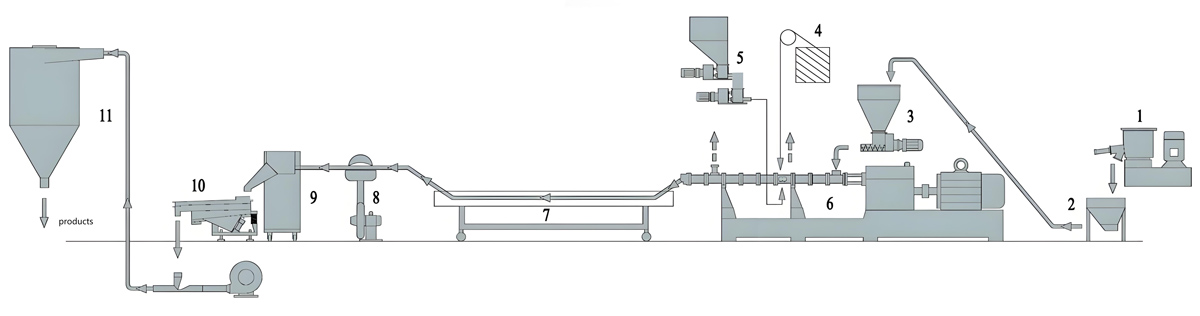
Pre-blending operations combine polypropylene resin, calcium carbonate, and additive components before extrusion processing. Gravimetric batching systems provide superior accuracy compared to volumetric approaches, maintaining formulation precision within plus or minus 0.5% of target values. Pre-blending typically occurs in high-intensity mixers for 3 to 5 minutes to achieve uniform component distribution without causing excessive thermal history before extrusion.
Extrusion Processing Configuration
The twin screw extrusion process for PP CaCO3 filled masterbatch production requires optimized configuration of screw elements, temperature profiles, and processing parameters to achieve uniform filler dispersion while maintaining efficient production rates.
The feeding zone (barrel sections 1 through 3) introduces polypropylene resin and pre-blended additives into the extrusion system. Temperatures slightly above the PP melt temperature (typically 180 to 200 degrees Celsius) ensure consistent polymer flow without causing premature melting that could interfere with feeding. Conveying elements with standard pitch dimensions provide uniform material transport into the melting zone.
The melting zone (barrel sections 4 through 7) achieves complete polymer melting and begins calcium carbonate incorporation. Kneading blocks with moderate staggering angles (45 to 60 degrees) provide distributive mixing that begins incorporating filler particles into the polymer matrix. Temperature profiles in this zone peak at 200 to 230 degrees Celsius, providing sufficient thermal energy for complete melting while maintaining viscosity levels compatible with filler incorporation.
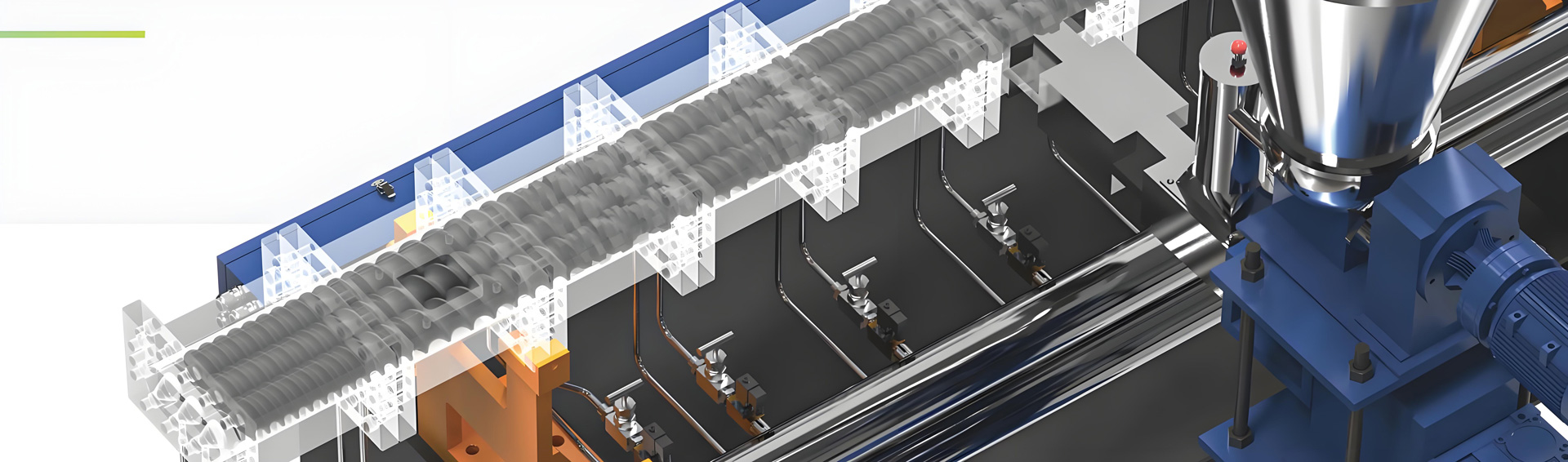
The mixing and dispersion zone (barrel sections 8 through 14) provides intensive mixing conditions necessary for achieving uniform calcium carbonate distribution at high loading levels. High-shear kneading blocks with tight staggering angles (90 degrees) create aggressive mixing that separates filler agglomerates and ensures complete polymer encapsulation of individual particles. However, mixing intensity must be balanced against thermal energy generation from viscous dissipation.
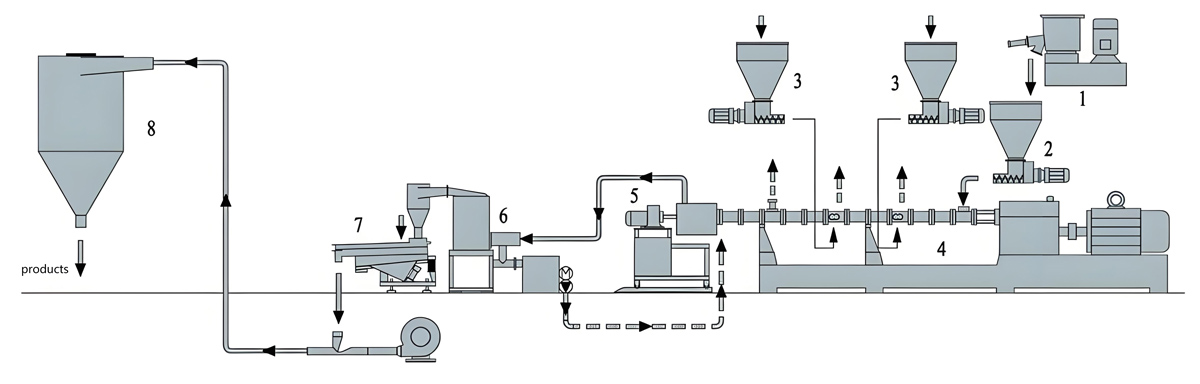
Side-feeder installation at barrel sections 4 through 6 provides efficient introduction of high filler loadings without over-compressing the polymer melt in the feeding zone. This configuration enables processing of formulations with 50% or higher calcium carbonate loading while maintaining adequate dispersion quality and production efficiency.
Pelletizing and Cooling Procedures
Pelletizing operations convert the molten PP CaCO3 mixture into uniform masterbatch pellets suitable for storage, handling, and downstream processing. Equipment selection and parameter optimization impact pellet quality and production efficiency.
Strand pelletizing with water quenching represents the standard approach for PP CaCO3 masterbatch production. Die plate configuration with 2 to 4 millimeter holes produces strands with adequate cooling rates for the specific compound viscosity. Water temperatures between 20 and 40 degrees Celsius provide rapid solidification that prevents thermal oxidation and maintains pellet dimensional stability.
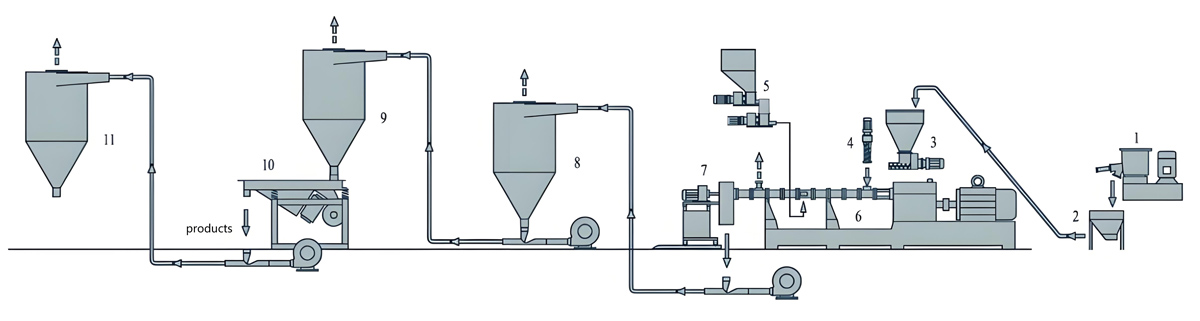
Underwater pelletizing systems offer advantages for high-viscosity highly filled compounds that may experience strand drawing or breakage in conventional strand pelletizing systems. The immediate pellet formation in the underwater chamber prevents strand integrity issues and enables higher production rates for demanding formulations.
Pellet classification through screening removes fines, oversized material, and irregularly shaped pellets that could cause feeding problems in downstream processing. Vibrating screens with appropriate mesh sizes separate conforming pellets from waste material for recycling or disposal.
Production Equipment Introduction: Kerke KTE Series Twin Screw Extruders
KTE-36B Entry Level System
The KTE-36B twin screw extruder serves as an excellent platform for PP CaCO3 masterbatch product development, process optimization, and small-volume specialty production. The 35.6 millimeter screw diameter achieves throughput rates of 20 to 100 kilograms per hour, enabling detailed process studies and pilot production capabilities.
The 500 to 600 revolutions per minute maximum speed range provides adequate mixing intensity for calcium carbonate dispersion while maintaining processing stability within the moderate power envelope provided by the 18.5 to 22 kilowatt motor. The KTE-36B price range of $25,000 to $35,000 makes this system accessible for research institutions, startup operations, and pilot production facilities establishing PP CaCO3 compound capabilities.
The compact physical dimensions simplify installation and relocation, supporting applications where production requirements vary or space constraints limit equipment options. This system provides the ideal platform for establishing processing parameters and quality specifications before scaling up to larger production equipment.
KTE-50B Commercial Production System
The KTE-50B represents the standard choice for commercial-scale PP CaCO3 masterbatch production, offering throughput capacities of 80 to 200 kilograms per hour that achieve favorable production economics while maintaining quality standards required for standard packaging and consumer product applications.
The 50.5 millimeter screw diameter provides adequate processing length for effective calcium carbonate dispersion at loading levels up to 50% while maintaining the mixing intensity necessary for uniform filler distribution. The 500 to 600 revolutions per minute speed range combined with 55 to 75 kilowatt motor power ensures consistent processing quality across the full throughput range.
At $40,000 to $60,000, the KTE-50B provides the optimal balance of capability and cost for manufacturers entering the PP CaCO3 masterbatch market or expanding production capacity. Modular barrel configuration enables side-feeder installation for optimized high-filler loading formulations and optional venting ports for demanding applications.
KTE-65B Production Scale System
The KTE-65B twin screw extruder addresses production requirements for manufacturers with substantial volume demands requiring throughput rates exceeding 200 kilograms per hour. The 62.4 millimeter screw diameter achieves production rates of 200 to 450 kilograms per hour, enabling efficient supply to regional and national markets with standard PP CaCO3 compounds.
The 90 to 110 kilowatt motor system provides substantial power reserves for processing challenging formulations including very high filler loadings and difficult-to-process PP grades. The KTE-65B price range of $50,000 to $80,000 reflects the industrial-grade engineering required for continuous high-volume production operations.
Enhanced temperature control systems ensure precise thermal management throughout the extrusion process, critical for maintaining consistent quality with high-throughput production. Comprehensive automation options support integration with factory management systems for production tracking and quality documentation.
KTE-75B High-Capacity System
The KTE-75B serves manufacturers requiring high-volume PP CaCO3 masterbatch production capabilities for large-scale packaging, construction, and consumer products markets. The 71 millimeter screw diameter achieves throughput rates of 300 to 800 kilograms per hour, enabling single-machine annual production capacities that supply significant regional market demand.
The 132 to 160 kilowatt motor system provides substantial power reserves for demanding formulations at elevated throughput rates. The KTE-75B price range of $70,000 to $100,000 positions this system for established masterbatch manufacturers with proven market positions and comprehensive production capabilities.
Extended barrel length options and twelve-barrel-section configuration provide maximum flexibility for configuring processing zones matched to specific PP CaCO3 compound requirements. Advanced control features enable automated production recipe management and comprehensive process monitoring.
KTE-95D Maximum Production Capacity
The KTE-95D represents the highest capacity option in the Kerke twin screw extruder lineup, designed for the most demanding PP CaCO3 masterbatch production requirements. The 93 millimeter screw diameter achieves throughput rates of 1000 to 2000 kilograms per hour for dedicated production facilities serving international markets.
The 500 to 800 revolutions per minute speed range combined with 315 to 500 kilowatt motor power provides exceptional processing capability for the most challenging formulations. The KTE-95D price range of $120,000 to $200,000 reflects the advanced engineering required for continuous maximum-capacity production.
Advanced features including automated configuration systems, real-time quality monitoring integration, and predictive maintenance capabilities support continuous production operations at maximum capacity. This system represents the optimal choice for manufacturers requiring dedicated high-volume PP CaCO3 masterbatch production capabilities.
Parameter Settings for PP CaCO3 Masterbatch Production
Temperature Profile Optimization
Temperature profile configuration for PP CaCO3 masterbatch production requires balancing processing efficiency against dispersion quality requirements and thermal stability considerations for filled compounds.
For standard PP CaCO3 masterbatch production, feed zone temperatures of 170 to 190 degrees Celsius transition to melting zone temperatures of 200 to 230 degrees Celsius. Mixing zone temperatures of 195 to 220 degrees Celsius provide adequate viscosity for calcium carbonate incorporation while minimizing thermal degradation. Die zone temperatures of 190 to 210 degrees Celsius maintain processing stability while preventing surface oxidation.
High-filler loading formulations may require temperature adjustments to accommodate increased viscosity and viscous dissipation from intensive mixing. Generally, reducing melting zone temperatures by 10 to 15 degrees Celsius while maintaining adequate mixing zone temperatures prevents excessive thermal exposure while preserving dispersion quality.
Cooling water temperature management impacts pellet solidification and dimensional stability. Water temperatures between 25 and 40 degrees Celsius provide adequate cooling without thermal shock that could create internal stresses in pellets.
Screw Speed and Throughput Coordination
Screw speed and throughput optimization for PP CaCO3 masterbatch production balances mixing efficiency against production rate requirements and energy consumption considerations.
Maximum screw speeds of 400 to 550 revolutions per minute typically provide optimal balance for PP CaCO3 masterbatch production on KTE series extruders. This speed range achieves adequate mixing for calcium carbonate dispersion while maintaining processing stability and manageable energy consumption.
Throughput selection depends on filler loading, particle size, and target production volume. A general guideline establishes throughput rates of 0.5 to 1.2 kilograms per hour per millimeter of screw diameter for PP CaCO3 masterbatch production. For the KTE-50B, this translates to 25 to 60 kilograms per hour for high-loading formulations (above 40% CaCO3) and 60 to 120 kilograms per hour for moderate-loading formulations.
Specific mechanical energy input monitoring provides useful guidance for processing optimization. Optimal PP CaCO3 masterbatch processing typically requires SME values between 0.12 and 0.22 kilowatt-hours per kilogram, indicating the mechanical work required for filler incorporation.
Feeding System Configuration
Feeding system design for PP CaCO3 masterbatch production requires attention to the high-volume handling characteristics of mineral fillers and the precise formulation control required for consistent compound quality.
Gravimetric loss-in-weight feeders provide superior accuracy compared to volumetric systems, maintaining formulation precision within plus or minus 0.5% of target values for both polymer and filler components. Separate feeding systems for polypropylene resin and calcium carbonate enable independent optimization of each feed rate.
Side-feeder installation at barrel sections 4 through 6 provides efficient introduction of calcium carbonate directly into the molten polymer stream. This configuration eliminates the handling challenges associated with main hopper feeding of high-volume mineral fillers and enables processing of formulations with 50% or higher filler loading.
Main hopper feeding delivers polypropylene resin and pre-blended additive components at rates synchronized with the calcium carbonate side-feeder to maintain consistent formulation composition throughout production.
Equipment Price Analysis for PP CaCO3 Masterbatch Production
Capital investment planning for PP CaCO3 masterbatch production facilities requires evaluation of equipment costs, facility requirements, and projected production economics for the high-volume mineral filler compound market.
The KTE-36B at $25,000 to $35,000 serves product development, process optimization, and pilot production applications. This system achieves production rates of 20 to 100 kilograms per hour, enabling detailed process studies at modest capital investment. The accessible price point makes this system attractive for research institutions and startup operations developing PP CaCO3 compound capabilities.
The KTE-50B priced between $40,000 and $60,000 provides the foundation for commercial-scale PP CaCO3 masterbatch production. The 80 to 200 kilograms per hour capacity achieves production economics that support competitive pricing for the high-volume standard compound market. This investment level suits established masterbatch manufacturers and processors expanding into PP CaCO3 products.
The KTE-65B at $50,000 to $80,000 addresses production requirements for manufacturers with substantial volume demands. The 200 to 450 kilograms per hour throughput enables efficient production economics for regional market supply. This investment level typically appeals to established masterbatch manufacturers with packaging, construction, or consumer products customer bases.
The KTE-75B priced between $70,000 and $100,000 serves high-volume production requirements for manufacturers supplying national or international markets with PP CaCO3 masterbatch products. The 300 to 800 kilograms per hour capacity enables single-machine production volumes that substantially reduce per-kilogram manufacturing costs through improved productivity.
The KTE-95D at $120,000 to $200,000 represents the maximum production capability in the Kerke twin screw extruder lineup. The 1000 to 2000 kilograms per hour throughput positions this system for dedicated production facilities serving large-scale international markets with standard PP CaCO3 compounds.
Comprehensive facility setup requires additional investments including calcium carbonate storage and handling systems ($10,000 to $40,000), pneumatic conveying equipment ($15,000 to $50,000), downstream processing and packaging equipment ($20,000 to $60,000), and quality control laboratory instrumentation ($10,000 to $30,000).
Problems in Production Process and Solutions
Filler Agglomeration and Poor Dispersion
Problem Description: Calcium carbonate particles fail to disperse uniformly within the polypropylene matrix, forming agglomerates that create stress concentration points, surface defects, and inconsistent mechanical properties in finished products.
Root Cause Analysis: Inadequate mixing intensity fails to break down calcium carbonate agglomerates and achieve uniform particle distribution. Insufficient shear stress during processing allows particle clusters to persist through the extrusion process. Improper surface treatment of calcium carbonate creates interfacial adhesion failures that allow agglomerate formation during cooling.
Technical Solutions: Increase mixing intensity through additional kneading blocks or tighter staggering angles in the mixing zones. Extend mixing zone length to provide additional residence time for particle dispersion. Implement surface-treated calcium carbonate grades that reduce agglomeration tendencies and improve filler-matrix interfacial bonding.
Preventive Measures: Establish calcium carbonate supplier qualification procedures ensuring consistent particle size distribution and surface treatment quality. Implement statistical process control monitoring of dispersion quality through sampling and microscopy inspection. Document approved screw configurations for each formulation and verify configuration compliance before production starts.
High Viscosity and Processing Difficulties
Problem Description: High filler loading creates excessive melt viscosity that causes processing difficulties including high motor loads, pressure fluctuations, and equipment strain that limits production rates and compromises equipment reliability.
Root Cause Analysis: Calcium carbonate addition increases compound viscosity beyond the pumping capability of the extrusion system at standard throughput rates. Inadequate temperature profiles leave the melt viscosity too high for stable processing. Screw configuration with insufficient melting capacity creates bottlenecks that limit throughput.
Technical Solutions: Increase barrel temperature profiles by 10 to 20 degrees Celsius to reduce melt viscosity and improve processing stability. Implement processing aids such as fatty acid esters or waxes that reduce melt viscosity without compromising final compound properties. Reconfigure screw elements to improve melting capacity and reduce viscosity-related processing bottlenecks.
Preventive Measures: Establish maximum filler loading limits based on specific equipment capabilities and formulation characteristics. Maintain comprehensive process documentation enabling replication of successful production campaigns. Monitor motor load trends to identify viscosity increases before they create processing problems.
Dimensional Instability in Finished Products
Problem Description: Injection molded or extruded products made from PP CaCO3 masterbatch exhibit warpage, shrinkage variation, or dimensional instability that exceeds acceptable tolerances for target applications.
Root Cause Analysis: Inconsistent filler distribution creates localized variations in shrinkage behavior that cause warpage and dimensional instability. High filler loadings increase compound stiffness and reduce the ability to relieve internal stresses during cooling. Inconsistent cooling conditions during processing create thermal gradients that amplify warpage tendencies.
Technical Solutions: Increase mixing intensity and extend mixing zones to achieve more uniform filler distribution that eliminates shrinkage variations. Adjust processing parameters including cooling rates and mold temperatures to accommodate the higher shrinkage resistance of filled compounds. Implement consistent processing conditions throughout production campaigns to ensure uniform product dimensions.
Preventive Measures: Establish quality specifications for filler distribution uniformity verified through regular testing. Implement statistical process control monitoring of product dimensions throughout production. Document and replicate successful processing conditions for each formulation to ensure dimensional consistency.
Color Variation and Discoloration
Problem Description: PP CaCO3 masterbatch exhibits unexpected color variations or discoloration ranging from yellowing to gray tones that exceeds acceptable specifications for aesthetic applications.
Root Cause Analysis: Calcium carbonate impurity levels create color contamination that becomes visible in finished products. Thermal oxidation during processing causes PP degradation that creates discoloration. Inconsistent thermal processing creates batch-to-batch color variations.
Technical Solutions: Verify calcium carbonate purity specifications and source consistency through incoming material testing. Increase antioxidant addition rates to prevent thermal oxidation during processing. Standardize temperature profiles and residence times across production campaigns to ensure color consistency.
Preventive Measures: Implement strict incoming material inspection procedures including color and purity verification. Maintain antioxidant inventory at fresh stock levels with first-in-first-out rotation. Establish color specifications verified through regular spectrophotometric testing.
Feed System Blockages and Feeding Interruptions
Problem Description: Calcium carbonate feeding becomes inconsistent or completely interrupted due to bridging, clumping, or inadequate flow through feeding equipment, creating formulation variations that compromise product quality.
Root Cause Analysis: High bulk density of calcium carbonate creates flow difficulties through standard hopper configurations. Moisture absorption causes clumping that blocks feeding equipment. Inadequate feeder design for high-volume mineral fillers causes erratic flow rates.
Technical Solutions: Implement hoppers with steep angles and anti-bridging devices such as vibrators or agitators. Control calcium carbonate storage conditions to prevent moisture absorption. Configure gravimetric feeders with appropriate resolution and response characteristics for mineral filler feeding.
Preventive Measures: Control raw material storage conditions to prevent moisture-related flow problems. Implement regular feeder calibration and performance verification. Establish maximum storage time limits for calcium carbonate before processing to prevent compaction and moisture absorption.
Maintenance for Twin Screw Extruders in PP CaCO3 Masterbatch Production
Screw Element Care and Inspection
Screw element maintenance for PP CaCO3 masterbatch production requires attention to wear patterns from mineral filler processing and potential material buildup from high-filler-load formulations.
Visual inspection of screw elements should occur at intervals of 800 to 1200 production hours depending on filler loading levels and processing severity. Inspectors should document wear patterns including surface scoring, material buildup, and clearance increases that indicate maintenance requirements.
Calcium carbonate processing creates abrasive wear on screw elements that progressively degrades mixing efficiency. Element replacement should follow established schedules based on production volume rather than waiting for visible wear symptoms to prevent quality degradation.
Barrel and Feeding System Maintenance
Barrel maintenance for PP CaCO3 masterbatch production requires attention to wear in mixing zones and material accumulation in feeding areas that can affect heat transfer and processing consistency.
Heating and cooling system maintenance ensures accurate temperature control throughout the extrusion process. Quarterly inspection of heating bands, cooling water systems, and temperature controllers verifies system integrity and accuracy.
Feeding system maintenance for mineral filler applications requires attention to wear on feeder components and buildup of calcium carbonate dust that can affect feeding accuracy and equipment reliability.
Preventive Maintenance Program Structure
Comprehensive preventive maintenance programs for PP CaCO3 masterbatch production coordinate equipment care activities with the high-volume production requirements of the mineral filler compound market.
Daily maintenance includes visual inspection of feeding systems, temperature monitoring verification, and recording of production parameters. Operators should document any unusual sounds, vibrations, or processing variations.
Weekly maintenance encompasses hopper inspection and cleaning, die plate inspection, and cooling system verification. Material accumulation in hoppers and feeding systems should be removed to prevent flow problems.
Monthly maintenance includes gearbox oil analysis, motor inspection, and comprehensive equipment condition assessment. Screw element condition assessment enables planning for replacement requirements.
Annual maintenance programs include major component overhauls, comprehensive system testing, and calibration verification. This annual review enables planning for capital expenditure requirements.
FAQ
What calcium carbonate loading levels are achievable in PP masterbatch production?
PP CaCO3 filled masterbatch loadings typically range from 20% to 70% depending on the application requirements, polymer matrix, and processing capabilities. Standard packaging applications commonly use 20% to 40% loading, while cost-focused applications may achieve 50% to 70% loading with appropriate formulation and processing optimization. Higher loadings require specialized equipment configurations and surface-treated calcium carbonate grades.
What particle size of calcium carbonate is optimal for PP masterbatch applications?
Optimal calcium carbonate particle size depends on the target application requirements. Finer particles (1 to 3 micrometers) provide better mechanical property improvements and surface finish but require more intensive processing. Coarser particles (5 to 10 micrometers) offer easier processing and lower cost but may create surface defects in thin-walled applications. Most PP CaCO3 masterbatch applications use 2 to 5 micrometer calcium carbonate as a balance between performance and processing efficiency.
What are the primary benefits of calcium carbonate filler in polypropylene?
Calcium carbonate filler in polypropylene provides multiple benefits including cost reduction (calcium carbonate costs 10% to 20% of polypropylene per unit weight), increased stiffness and flexural modulus, improved dimensional stability and reduced warpage, enhanced thermal conductivity for heat dissipation applications, and improved surface hardness and scratch resistance. Appropriate loading levels and surface treatment optimization enable these benefits while minimizing property tradeoffs.
What screw configuration is recommended for PP CaCO3 masterbatch production?
Optimal screw configuration for PP CaCO3 masterbatch production includes conveying elements in the feeding zone, moderate-shear kneading blocks for polymer melting, side-feeder introduction at barrel sections 4 through 6 for calcium carbonate addition, and additional kneading blocks and distributive mixing elements in the mixing zone to achieve uniform filler dispersion. The specific configuration depends on filler loading and particle size requirements.
What is the typical production rate for PP CaCO3 masterbatch on Kerke KTE extruders?
Production rates depend on the specific extruder model and formulation characteristics. The KTE-36B achieves 20 to 100 kilograms per hour, the KTE-50B produces 80 to 200 kilograms per hour, the KTE-65B delivers 200 to 450 kilograms per hour, the KTE-75B provides 300 to 800 kilograms per hour, and the KTE-95D reaches 1000 to 2000 kilograms per hour. Higher filler loadings generally require reduced throughput rates to maintain adequate dispersion quality.
What quality control tests are essential for PP CaCO3 masterbatch?
Essential quality control testing includes melt flow rate determination, tensile property measurements, filler content verification through ash testing, moisture content analysis, and particle size distribution verification. For critical applications, impact resistance testing, shrinkage measurement, and surface finish evaluation provide additional characterization of compound performance.
Can PP CaCO3 masterbatch be used in food contact applications?
PP CaCO3 masterbatch can be formulated for food contact applications using food-grade calcium carbonate and appropriate additive packages. Regulatory compliance with relevant standards such as FDA regulations in the United States or EU Regulation 10/2011 requires specific formulation development and certification. Manufacturers should verify food contact suitability with their masterbatch supplier and obtain appropriate documentation for the target application.
What are the main applications for PP CaCO3 filled compounds?
PP CaCO3 filled compounds serve diverse applications including packaging (containers, closures, thin-walled packaging), automotive (instrument panels, door panels, interior trim), construction (pipe fittings, window profiles, sheet materials), and consumer products (furniture, appliances, containers). The specific application determines filler loading requirements, polymer matrix selection, and property specifications.
Conclusion
Polypropylene calcium carbonate filled masterbatch production through twin screw extrusion technology enables manufacturers to participate in the high-volume polymer compound market with products that deliver substantial cost savings, property improvements, and processing advantages. Calcium carbonate remains the most widely used mineral filler in polypropylene applications, providing an optimal balance between economic benefits and performance characteristics that serve diverse industrial and consumer product applications.
Twin screw extruder technology provides the processing capabilities necessary to incorporate high calcium carbonate loadings into polypropylene matrices while achieving uniform dispersion and maintaining production efficiency. The intensive mixing, precise temperature control, and flexible configuration options of modern twin screw extruders enable processors to optimize production processes for specific formulation requirements and quality targets.
Nanjing Kerke Extrusion Equipment Company offers the comprehensive KTE series of twin screw extruders designed to meet the specific requirements of PP CaCO3 masterbatch production. The KTE product range spans production capacities from 20 kilograms per hour to over 2000 kilograms per hour, with prices ranging from $25,000 for the KTE-36B entry-level system to $200,000 for the KTE-95D maximum-capacity production extruder.
Successful PP CaCO3 masterbatch production requires attention to formulation optimization, processing parameter control, and quality assurance throughout the manufacturing process. By understanding the critical factors affecting calcium carbonate dispersion and implementing appropriate maintenance procedures, manufacturers can establish reliable production capabilities that deliver consistent, high-quality masterbatch products for the demanding packaging, automotive, and consumer products markets.
The continued growth of global polypropylene consumption creates substantial opportunities for manufacturers with efficient PP CaCO3 masterbatch production capabilities. Twin screw extrusion technology provides the manufacturing foundation for this market, enabling producers to deliver cost-effective compound solutions that enhance polypropylene performance across countless applications in packaging, automotive, construction, and consumer products industries.