Introduction
UV printing masterbatch represents specialized functional material designed for ultraviolet curable printing applications across diverse industries including packaging, graphic arts, electronics, decorative coatings, and specialty printing applications. These advanced materials incorporate UV-curable components, photoinitiators, pigments, and specialty additives providing rapid curing, excellent adhesion, superior color development, and enhanced print quality characteristics meeting demanding printing requirements.
The global UV printing masterbatch market demonstrates exceptional growth driven by increasing demand for sustainable printing technologies, rapid curing requirements for high-speed production, environmental regulations favoring UV-curable systems, and expanding application areas across multiple industries. Market analysis indicates annual growth of 14-16% through 2030 creating significant opportunities for manufacturers investing in advanced production technology. Nanjing Kerke KTE Series twin screw extruders provide optimal processing solution for UV printing masterbatch manufacturing ensuring excellent pigment dispersion and consistent UV curing performance.
UV printing masterbatch production requires specialized equipment capable of achieving precise pigment dispersion, maintaining photoinitiator stability, preventing premature polymerization, and ensuring consistent UV curing characteristics. Twin screw extrusion technology provides ideal manufacturing platform due to superior mixing capability, precise temperature control, and gentle processing preserving sensitive UV components. Co-rotating twin screw designs ensure optimal pigment distribution and photoinitiator dispersion without premature activation.
Formulation Ratios and Component Selection
UV printing masterbatch formulations demand careful component selection and precise ratio optimization balancing UV curing performance, color development, processing characteristics, and shelf stability. Different applications require specific formulations optimizing curing speed, color intensity, adhesion properties, and compatibility with printing processes. Comprehensive formulation understanding enables manufacturers to develop products meeting diverse UV printing requirements across different printing technologies.
Pigment-Based UV Formulation
Pigment-based UV printing masterbatch incorporates high-performance organic pigments providing excellent color strength and UV stability. Typical formulation composition includes carrier polymer 50-65%, organic pigments 25-35%, photoinitiators 5-8%, dispersing agents 2-4%, processing aids 1-2%, stabilizers 0.5-1%, and UV absorbers 0.5-1%. Organic pigments selected for UV stability and compatibility with UV-curable systems including phthalocyanines, quinacridones, and azo compounds.
Pigment particle size distribution significantly affects color development, transparency, and curing performance. Optimal particle size range 0.5-3 micrometers balances color strength with dispersion ease and UV penetration. Smaller particles provide better transparency and dispersion but may reduce color strength. Larger particles enhance color strength but reduce transparency and may affect UV curing efficiency. Pigment surface treatment improves dispersion and compatibility with UV-curable components.
Photoinitiator System Formulation
Photoinitiator system formulation incorporates multiple photoinitiator types providing comprehensive UV absorption across different wavelength ranges. Standard composition includes carrier polymer 55-70%, photoinitiators 15-25%, pigments 10-20%, dispersing agents 2-4%, and stabilizers 0.5-1%. Type I photoinitiators undergo homolytic cleavage while Type II photoinitiators require co-initiators. Mixed photoinitiator systems ensure complete curing across different UV wavelengths and depths.
Photoinitiator selection depends on UV light source characteristics, curing depth requirements, and substrate characteristics. Different photoinitiators exhibit optimal absorption at specific UV wavelengths ranging from 250-400nm. Complementary photoinitiator combinations provide broad-spectrum absorption ensuring complete curing. Photoinitiator concentration affects curing speed and depth requiring precise optimization for specific applications.
UV-Curable Oligomer Formulation
UV-curable oligomer formulations incorporate reactive oligomers providing film formation and curing performance. Typical oligomer-based composition includes UV-curable oligomers 35-50%, carrier polymer 30-45%, photoinitiators 8-12%, pigments 5-10%, reactive diluents 3-5%, and dispersing agents 1-2%. Oligomers including epoxy acrylates, urethane acrylates, and polyester acrylates provide specific performance characteristics including flexibility, hardness, and adhesion.
Oligomer selection depends on application requirements including final film properties, substrate compatibility, and curing speed. Epoxy acrylates provide excellent adhesion and chemical resistance. Urethane acrylates deliver flexibility and toughness. Polyester acrylates offer good balance of properties at reasonable cost. Reactive diluents adjust viscosity and curing characteristics affecting processability and final performance.
Carrier Polymer Selection Criteria
Carrier polymer selection critically affects final masterbatch performance and compatibility with UV printing processes. Common carrier options include acrylic polymers, polyester polymers, vinyl polymers, and specialty UV-compatible resins selected based on application requirements, compatibility with UV-curable components, and printing process compatibility. Acrylic polymers provide excellent UV transparency and compatibility with photoinitiators.
Carrier polymer UV transmission characteristics significantly affect curing performance and print quality. High UV transparency enables efficient photoinitiator activation and complete curing. Polymer molecular weight affects viscosity and processability. Compatibility with printing substrates ensures proper adhesion and film formation. Carrier polymer selection considers all factors affecting UV printing performance.
Production Process Technology
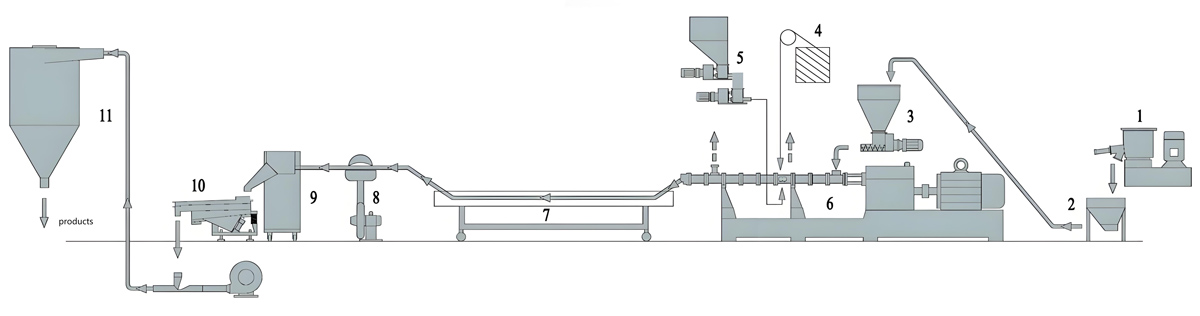
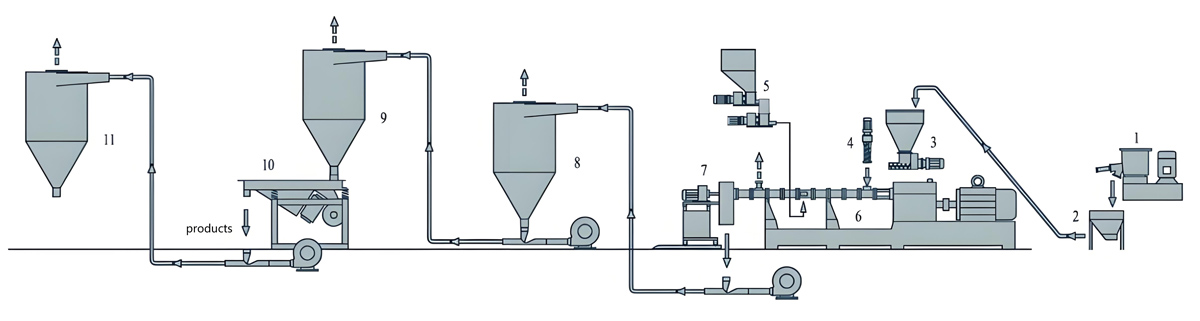
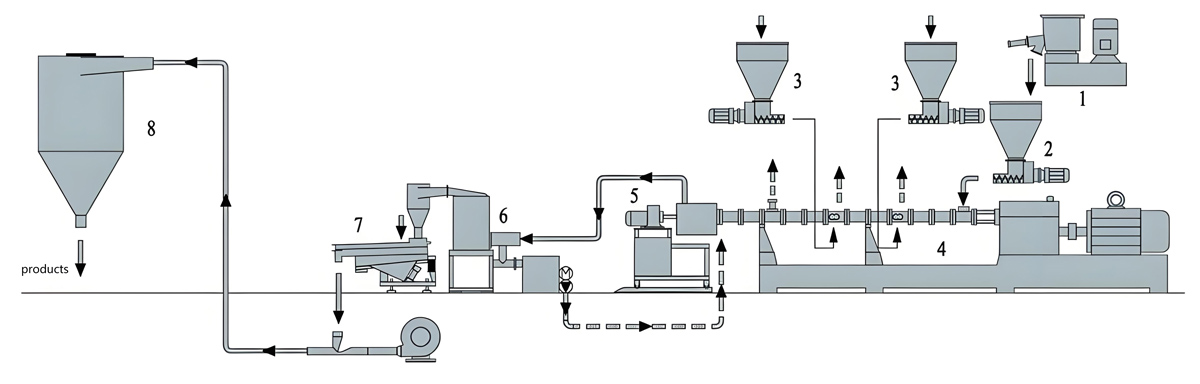
UV printing masterbatch production involves sophisticated multi-stage processing requiring precise control and optimization throughout manufacturing sequence. Production process encompasses raw material preparation and protection from light, pre-mixing under controlled conditions, twin screw extrusion with light protection, pelletizing, packaging in light-blocking materials, and quality testing. Each stage requires specific attention ensuring optimal final product quality meeting UV curing specifications and shelf life requirements.
Process control parameters must be carefully monitored and maintained including material feeding rates, temperature profiles, screw speed, melt pressure, and environmental light exposure. Consistent process control ensures uniform pigment dispersion, consistent photoinitiator distribution, and minimal batch-to-batch variation. Advanced process control systems enable precise parameter management and real-time adjustment responding to process variations and material changes protecting UV components.
Raw Material Preparation
Raw material preparation represents critical initial stage ensuring optimal feeding and processing while protecting sensitive UV components from premature activation. Carrier polymer and pigments require drying to reduce moisture content below 0.05% preventing processing problems including hydrolytic degradation and moisture-related quality defects. Drying conditions typically 80-100 degrees Celsius for 2-3 hours depending on material type and initial moisture content ensuring complete moisture removal.
Photoinitiators and UV-curable components require special handling preventing premature UV exposure. Materials stored in amber containers or light-blocking packaging. Handling performed under yellow lighting or low UV conditions preventing premature polymerization. Moisture-sensitive photoinitiators require additional drying at lower temperatures 50-60 degrees Celsius preventing thermal degradation while removing moisture.
Pre-Mixing Process Under Controlled Conditions
Pre-mixing combines carrier polymer granules, pigments, photoinitiators, and additives ensuring uniform composition before extrusion while protecting UV components. High-speed mixers or ribbon blenders achieve homogeneous distribution under light-controlled conditions. Pre-mixing time typically 6-10 minutes ensuring complete coating of polymer particles with pigments and photoinitiators. Adequate pre-mixing reduces feeding variations, improves dispersion efficiency, and minimizes composition fluctuations affecting UV curing performance.
Pre-mixing performed under yellow lighting or opaque equipment preventing photoinitiator activation. Mixer equipped with light-enclosed design preventing UV exposure. Temperature monitoring prevents premature heating of photoinitiators. Pre-mixed material immediately transferred to light-protected feed hoppers preventing accidental UV exposure preserving photoinitiator activity.
Extrusion Processing with Light Protection
Twin screw extrusion represents core processing stage achieving pigment dispersion, photoinitiator distribution, melt homogenization, and UV curing performance development. Co-rotating twin screw design provides superior mixing capability essential for uniform pigment and photoinitiator distribution. Extrusion process performed with light protection preventing premature polymerization. Barrel and hopper design includes light shielding preventing UV exposure during processing.
Temperature profile optimization critical for UV printing masterbatch production affecting both pigment dispersion and photoinitiator stability. Typical temperature profile ranges from 150-220 degrees Celsius depending on carrier polymer type and photoinitiator thermal stability. Temperature ramp from feed zone to die ensures progressive melting without thermal degradation of sensitive photoinitiators. Precise temperature control prevents thermal damage preserving photoinitiator activity and UV curing performance.
Pelletizing and Cooling with Light Protection
Pelletizing transforms continuous melt stream into uniform pellets suitable for handling and downstream processing while maintaining UV component stability. Strand pelletizing commonly used for UV printing masterbatch providing consistent pellet size and shape. Strand diameter controlled by die selection and haul-off speed. Cooling water system rapidly solidifies strands while maintaining protection from ambient UV exposure during pellet formation.
Pellet cutting uses precision rotary cutters creating pellets 2-3mm length ensuring consistent feeding behavior and uniform distribution in subsequent processing. Pellet cooling completed to ambient temperature before collection preventing agglomeration. Cooling area protected from direct UV exposure preventing premature curing on pellet surfaces. Pellets immediately packaged in light-blocking containers preserving photoinitiator activity and shelf life.
Production Equipment Configuration
UV printing masterbatch production demands specialized equipment capable of achieving precise pigment dispersion, maintaining photoinitiator stability, providing light protection during processing, and ensuring consistent output quality. Nanjing Kerke KTE Series twin screw extruders represent ideal equipment choice featuring advanced co-rotating twin screw design, modular screw elements, precise temperature control, and optional light protection capabilities specifically engineered for UV-curable material applications.
KTE Series extruders incorporate L/D ratios ranging from 36:1 to 44:1 providing sufficient residence time for complete pigment dispersion and photoinitiator distribution without excessive thermal exposure. Screw diameters from 20mm to 75mm enable production capacities from 50kg/h to 1200kg/h matching diverse production requirements. Advanced drive systems deliver high torque essential for processing viscous UV-curable formulations while maintaining precise temperature control.
Nanjing Kerke KTE Series Twin Screw Extruder
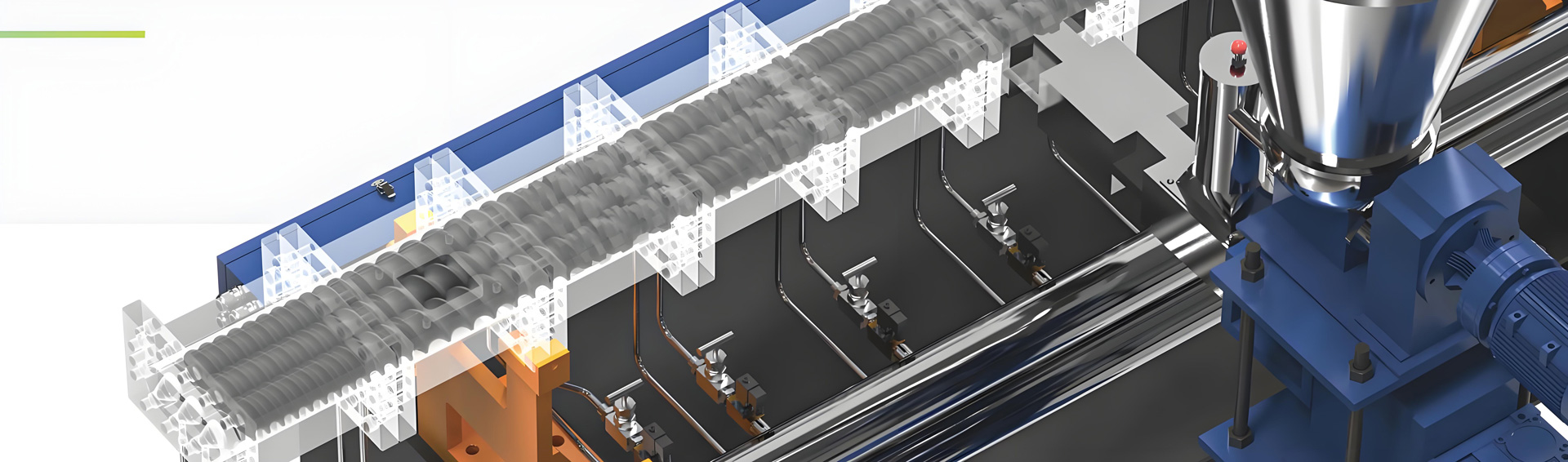
Nanjing Kerke KTE Series twin screw extruders feature modular co-rotating screw design enabling customization for specific UV printing masterbatch formulations. Screw elements include conveying elements, kneading blocks, distributive mixing elements, and discharge elements arranged in optimized configuration providing progressive melting, gentle mixing, and excellent pigment dispersion preserving photoinitiator activity. Modular design allows rapid screw configuration adjustment for different formulation requirements.
High-torque drive systems specifically designed for UV-curable applications deliver up to 10Nm per cubic centimeter screw volume ensuring sufficient power for processing viscous melts while maintaining precise temperature control. Drive systems include AC vector motors, high-performance gearboxes, and precision torque control enabling consistent operation despite viscosity variations. High-torque capability enables processing formulations with high pigment loadings while maintaining dispersion quality.
Light-Protected Feeding System
Precise feeding systems with light protection essential for UV printing masterbatch production ensuring consistent composition and photoinitiator stability. Gravimetric feeders with light-protected hoppers enable accurate dosing of carrier polymer, pigments, photoinitiators, and additives. Loss-in-weight feeders provide continuous feedback and automatic adjustment maintaining precise feed ratios within 0.5% accuracy critical for UV curing performance consistency. Multiple feeder configurations support complex formulations requiring numerous UV-sensitive components.
Feed hopper design includes amber or opaque construction preventing UV exposure. Agitators and bridge breakers prevent material bridging and ensure consistent flow particularly important for pigments and photoinitiators. Feeder calibration and regular maintenance ensure accurate dosing and stable operation preventing UV curing performance variations. Light shielding throughout feeding system protects photoinitiators from premature activation.
Precision Temperature Control System
Advanced temperature control system maintains precise thermal profile across barrel zones ensuring optimal processing conditions for both carrier polymer and UV-sensitive components. Multi-zone heating with independent control for each barrel zone enables tailored temperature profiles matching processing requirements. Electric heating bands with ceramic insulation provide rapid heating and efficient heat transfer. Cooling water circulation enables precise temperature control preventing overheating protecting sensitive photoinitiators.
Temperature sensors provide continuous feedback enabling automatic adjustment maintaining setpoint within plus or minus 1 degree Celsius ensuring consistent processing conditions. Advanced control algorithms include PID control with feedforward compensation responding to process variations and maintaining optimal thermal environment. Uniform temperature distribution prevents thermal degradation and ensures consistent UV curing performance in final product.
Vacuum Degassing System
Vacuum degassing system removes volatile components, entrapped air, and moisture from melt improving product quality and preventing defects affecting UV curing. Vent ports positioned along barrel enable staged removal of volatiles at appropriate pressure levels. Vacuum pumps achieve pressure levels down to 30-70 millibar ensuring effective degassing without excessive pigment entrainment. Vent stack design prevents pigment loss while allowing gas extraction.
Degassing particularly important for UV formulations containing moisture-sensitive components or formulations producing volatiles during processing. Effective degassing prevents surface defects, improves UV curing consistency, and enhances optical properties of final masterbatch product ensuring consistent printing performance.
Process Parameter Optimization
Optimal parameter settings critical for achieving consistent UV curing performance, maximizing pigment dispersion, and preventing photoinitiator degradation. Parameter optimization considers formulation characteristics, equipment capabilities, and UV curing requirements. Systematic approach identifies optimal settings balancing competing objectives including throughput, UV performance, pigment dispersion, energy consumption, and photoinitiator protection.
Key controllable parameters include screw speed, temperature profile, feed rate, vacuum level, and die pressure. Each parameter influences multiple output characteristics including pigment dispersion, photoinitiator distribution, and curing performance requiring careful balancing and optimization. Process monitoring and data collection enable continuous improvement and parameter refinement for UV optimization.
Screw Speed Parameter Optimization
Screw speed significantly affects mixing intensity, residence time, shear heating, and pigment dispersion while influencing photoinitiator distribution. Typical screw speed range for UV printing masterbatch production 100-250 rpm depending on formulation viscosity and extruder size. Higher screw speeds increase mixing intensity and throughput but reduce residence time potentially compromising pigment dispersion quality. Lower speeds improve dispersion and distribution but reduce productivity increasing per-unit costs.
Optimal screw speed depends on formulation viscosity, pigment loading, and photoinitiator sensitivity. High-pigment formulations require sufficient mixing energy achieving good pigment dispersion and distribution without damaging photoinitiators. Trial runs determine optimal speed balancing UV curing quality with productivity requirements. Screw speed adjustment capability enables fine-tuning during production for UV optimization.
Temperature Profile Parameter Settings
Temperature profile optimization critical for pigment dispersion and photoinitiator stability. Typical profile increases progressively from feed zone to die ensuring gradual melting and preventing thermal shock to sensitive photoinitiators. Feed zone temperature 140-160 degrees Celsius for acrylic formulations, 160-180 degrees Celsius for polyester formulations. Subsequent zones increase gradually reaching maximum 190-220 degrees Celsius at die depending on polymer type and photoinitiator thermal stability.
Temperature ramp rate controlled to prevent thermal stress on photoinitiators and prevent thermal degradation affecting curing performance. Excessive temperatures cause degradation of photoinitiators reducing UV curing capability. Insufficient temperature leads to incomplete melting and poor dispersion affecting UV consistency. Precise temperature control essential for consistent UV curing performance in final product.
Feed Rate Parameter Control
Feed rate affects residence time, degree of fill, and shear intensity all influencing pigment dispersion and photoinitiator distribution. Feed rate typically 35-130 kg/h depending on extruder size and formulation characteristics. Optimal feed rate achieves 70-80% degree of fill ensuring sufficient material for effective mixing while preventing overfilling causing excessive pressure and potential photoinitiator thermal exposure. Feed rate matched to screw speed maintaining consistent degree of fill and processing conditions.
Feed rate variation causes fluctuations in residence time, shear history, and UV curing performance consistency. Automatic feed rate adjustment based on torque feedback maintains consistent processing conditions protecting photoinitiator integrity. Stable feed rate essential for uniform pigment distribution and consistent UV curing performance meeting specifications.
Vacuum Level Parameter Optimization
Vacuum level influences degassing effectiveness and volatile removal while preventing excessive pigment entrainment. Typical vacuum level 30-70 millibar for UV printing masterbatch formulations. Higher vacuum levels improve volatile removal and defect reduction but may cause pigment loss through vent ports affecting UV consistency. Lower vacuum levels preserve pigment inventory but reduce degassing effectiveness potentially affecting UV curing performance.
Vacuum level optimization considers formulation moisture content, volatile generation, and pigment characteristics including particle size and density. Formulations with moisture-sensitive components require more aggressive vacuum levels ensuring thorough volatile removal. Vent stack design and baffles prevent pigment loss while maintaining effective degassing protecting UV curing performance.
Equipment Pricing and Investment Analysis
UV printing masterbatch production equipment investment varies significantly based on production capacity, light protection requirements, and configuration complexity. Nanjing Kerke KTE Series twin screw extruders offer competitive pricing providing excellent value for UV-curable material applications requiring precise pigment dispersion and photoinitiator protection. Investment analysis considers equipment cost, installation expenses, operating costs, and revenue potential ensuring sound financial decision-making for UV masterbatch production.
Complete production line investment includes extruder with optional light protection, light-protected feeding systems, pelletizing equipment, cooling system with UV protection, and auxiliary equipment. Investment ranges from moderate capacity lines suitable for startup UV masterbatch operations to large-scale production facilities for established manufacturers serving printing and graphics markets. ROI analysis typically demonstrates 2-3 year payback period depending on market conditions and operational efficiency.
KTE Series Extruder Pricing Structure
Nanjing Kerke KTE Series twin screw extruders priced according to screw diameter, L/D ratio, and configuration complexity optimized for UV printing masterbatch production. KTE-25 model with 25mm screw diameter and 40:1 L/D ratio priced approximately USD 46,000-56,000 for capacities 50-100kg/h suitable for UV masterbatch applications. KTE-45 model with 45mm screw diameter and 40:1 L/D ratio priced USD 76,000-96,000 for capacities 200-400kg/h.
KTE-65 model with 65mm screw diameter and 40:1 L/D ratio priced USD 120,000-150,000 for capacities 400-700kg/h supporting UV masterbatch production. KTE-75 model with 75mm screw diameter and 40:1 L/D ratio priced USD 160,000-195,000 for capacities 700-1200kg/h for large-scale UV masterbatch manufacturing. Prices include standard configuration with optional light protection increasing cost by 8-15%.
Complete Production Line Investment Analysis
Complete UV printing masterbatch production line investment includes extruder, light-protected gravimetric feeders, pelletizing system with UV protection, cooling tank with light shielding, conveyor, and control system optimized for UV curing performance consistency. Small capacity line 50-100kg/h complete investment approximately USD 125,000-170,000 including KTE-25 extruder with UV protection capabilities. Medium capacity line 200-400kg/h complete investment USD 205,000-285,000 including KTE-45 extruder.
Large capacity line 700-1200kg/h complete investment USD 350,000-480,000 including KTE-75 extruder for high-volume UV masterbatch production. Additional investments include UV curing testing equipment, light-protected raw material handling, and light-blocking packaging systems. Installation costs typically 8-12% of equipment cost depending on site conditions and light protection requirements specific to UV masterbatch production.
Operating Cost Analysis for UV Masterbatch
Operating costs for UV printing masterbatch production include energy consumption, labor, maintenance, and consumables optimized for UV curing performance consistency. Energy consumption typically 0.6-1.2kWh per kg depending on formulation viscosity and UV component requirements. At USD 0.15 per kWh, energy cost USD 0.09-0.18 per kg. Labor requirements 1-2 operators per shift depending on automation level and UV monitoring requirements.
Maintenance costs typically USD 0.015-0.03 per kg produced including regular maintenance, screw element replacement, and component overhaul optimized for pigment processing. Consumable costs including cutter blades, wear parts, and light-blocking packaging add USD 0.01-0.02 per kg. Total operating cost USD 0.115-0.23 per kg excluding raw materials ensuring competitive UV masterbatch production economics.
Production Problems and Solutions
UV printing masterbatch production encounters various challenges requiring systematic problem identification and solution implementation affecting UV curing performance consistency. Common problems include poor pigment dispersion, photoinitiator degradation, premature polymerization, UV curing performance variation, and color development issues affecting print quality. Understanding root causes enables effective solution implementation and preventive measures maintaining UV curing characteristics.
Problem resolution requires structured approach including symptom identification, root cause analysis affecting UV curing performance, solution implementation, and preventive measure development protecting UV characteristics. Documentation of problems and solutions creates knowledge base supporting continuous improvement and operator training for UV masterbatch production.
Poor Pigment Dispersion Affecting UV Performance
Poor pigment dispersion manifests as agglomerates, inconsistent color development, and reduced UV curing efficiency affecting print quality. Root causes include inadequate mixing energy, insufficient residence time, poor pigment wetting by carrier polymer, and improper screw configuration for pigment dispersion. Inadequate mixing energy results from low screw speed or insufficient distributive mixing elements. Insufficient residence time caused by excessive feed rate or high screw speed reducing pigment wetting time.
Solutions for poor pigment dispersion affecting UV performance include increasing screw speed within equipment limits enhancing mixing intensity, adding distributive mixing elements to screw configuration improving pigment distribution, reducing feed rate to increase residence time improving pigment wetting, and optimizing temperature profile enhancing polymer flow and pigment coating. Pigment surface treatment using dispersants improves compatibility and dispersion quality. Optimized mixing element configuration enhances distributive mixing breaking agglomerates protecting UV curing performance.
Preventive measures include regular screw configuration optimization based on formulation viscosity changes, maintaining adequate degree of fill ensuring proper mixing, and monitoring dispersion quality through microscopic analysis verifying UV curing performance consistency. Regular inspection of pigment quality prevents contamination and agglomeration issues affecting UV properties. Pre-mixing optimization ensures uniform initial distribution reducing dispersion burden on extruder protecting UV characteristics.
Photoinitiator Thermal Degradation
Photoinitiator thermal degradation causes reduced UV curing capability, discoloration, and curing performance deterioration affecting printing quality. Root causes include excessive barrel temperatures especially in high-shear zones, excessive residence time causing thermal exposure, inadequate venting of degradation byproducts, and oxygen ingress accelerating thermal damage. Excessive temperature accelerates thermal degradation of photoinitiators reducing UV curing efficiency.
Solutions for photoinitiator degradation include reducing barrel temperature profile especially in mixing zones where shear heating occurs, optimizing screw speed reducing residence time while maintaining dispersion, improving vacuum degassing removing degradation byproducts preventing property deterioration, and ensuring proper ventilation excluding oxygen protecting photoinitiator integrity. Temperature sensors verify actual barrel temperatures confirming proper operation protecting UV curing performance.
Preventive measures include implementing temperature monitoring and alarm systems protecting photoinitiators, maintaining proper screw configuration minimizing residence time and shear heating, using thermal stabilizers in formulation protecting photoinitiator activity, and regular vent system maintenance ensuring effective removal of degradation byproducts. Processing window optimization balances dispersion requirements with photoinitiator thermal stability ensuring UV curing performance.
Premature Polymerization During Processing
Premature polymerization during processing causes gel formation, equipment fouling, and inconsistent UV curing characteristics affecting production efficiency and product quality. Root causes include accidental UV exposure during processing, excessive temperature causing thermal initiation, contamination with reactive materials, and inadequate stabilizer levels. UV exposure from ambient lighting or equipment leaks can initiate polymerization affecting processing.
Solutions for premature polymerization include implementing complete light protection throughout processing chain preventing UV exposure, optimizing temperature profile preventing thermal initiation, ensuring material purity preventing contamination, and adding stabilizers inhibiting unintended polymerization. Light protection includes amber hoppers, light-enclosed conveyors, and UV-filtered lighting in processing areas protecting photoinitiators.
Preventive measures include complete equipment inspection ensuring light sealing, regular monitoring of ambient UV levels in processing areas, material quality control preventing contamination, and stabilizer optimization preventing unintended initiation. Light protection protocols and operator training prevent accidental UV exposure protecting photoinitiator integrity and UV curing performance.
UV Curing Performance Inconsistency
UV curing performance inconsistency manifests as variations in cure speed, final hardness, and adhesion characteristics affecting print quality and processing efficiency. Root causes include photoinitiator distribution variations, pigment concentration differences, processing parameter fluctuations, and material quality inconsistencies affecting UV absorption and curing efficiency. Photoinitiator distribution variations cause uneven curing affecting print uniformity.
Solutions for UV curing performance consistency include implementing closed-loop feed rate control maintaining constant material input composition, optimizing temperature control reducing fluctuations affecting photoinitiator distribution, regular maintenance preventing wear-induced mixing efficiency changes, and improving material consistency through better quality control and storage conditions. Statistical process control identifies variations and root causes enabling corrective action protecting UV curing performance.
Preventive measures include regular feeder calibration ensuring accurate dosing maintaining UV formulation consistency, implementing automated temperature control responding to variations protecting photoinitiator distribution, establishing maintenance schedules preventing wear-induced UV curing performance changes, and material quality control ensuring consistent input characteristics. Real-time UV curing performance monitoring enables early detection and correction of variations protecting print quality.
Color Development Issues Affecting Print Quality
Color development issues including inconsistent color strength, hue variation, and poor transparency affect print quality and customer satisfaction. Root causes include pigment dispersion variations, pigment quality inconsistencies, processing temperature variations affecting pigment chemistry, and carrier polymer compatibility issues affecting color development. Poor pigment dispersion causes inconsistent color strength affecting print uniformity.
Solutions for color development issues include optimizing mixing intensity and residence time ensuring complete pigment dispersion, implementing pigment quality specifications ensuring consistent pigment characteristics, optimizing temperature profile preventing pigment thermal degradation, and selecting compatible carrier polymers ensuring proper color development. Regular pigment quality control and supplier qualification ensure consistent color characteristics.
Preventive measures include regular dispersion quality monitoring, pigment quality specifications and testing, temperature profile optimization preventing thermal degradation, and carrier polymer compatibility testing ensuring proper color development. Color measurement and control systems enable real-time monitoring and adjustment protecting print quality consistency.
Maintenance and Service Requirements
Regular maintenance essential for reliable operation, consistent UV curing performance, and extended equipment life in UV printing masterbatch production. Maintenance programs include daily checks, weekly inspections, monthly servicing, and annual overhauls specifically addressing UV component protection requirements. Systematic maintenance approach prevents unexpected downtime, maintains UV curing performance consistency, and optimizes equipment utilization.
Maintenance requirements for UV printing masterbatch production equipment include standard maintenance plus special attention to light protection systems, temperature control precision, and pigment handling equipment ensuring UV component stability and consistent curing performance.
Daily Maintenance Procedures
Daily maintenance includes visual inspection of equipment for leaks, unusual sounds, and abnormal vibrations indicating developing issues. Checking temperature indicators verifying proper operation and temperature profile protecting photoinitiators. Monitoring drive torque and current detecting increasing friction indicating wear development affecting dispersion quality. Inspecting light protection systems ensuring proper UV shielding protecting photoinitiators.
Lubrication checks ensuring adequate lubrication of drive components and bearings protecting against wear affecting mixing efficiency. Checking cooling water flow and temperature ensuring proper heat removal protecting photoinitiator stability. Verifying vacuum system operation ensuring effective degassing preventing defects affecting UV curing. Documenting observations and measurements for trend analysis and preventive action.
Weekly Maintenance Activities
Weekly maintenance includes detailed inspection of wear components including screw elements, barrel liners, and die surfaces critical for dispersion quality and UV performance. Checking feeder calibration and operation ensuring accurate dosing maintaining UV formulation integrity. Inspecting electrical connections and control systems ensuring proper operation protecting process stability. Checking light protection systems ensuring continued UV shielding preventing photoinitiator activation.
Cleaning vent stacks and vacuum systems removing accumulated pigment and contaminants protecting degassing effectiveness. Inspecting pelletizing components including cutter blades and strand guides ensuring consistent pellet quality affecting photoinitiator distribution. Testing safety devices including emergency stop systems and interlocks protecting equipment and operators. Maintenance log documentation enables tracking and analysis protecting UV curing performance.
Monthly Maintenance Requirements
Monthly maintenance includes comprehensive screw and barrel inspection measuring wear affecting mixing efficiency and UV performance. Reversing screw elements if design allows balancing wear distribution maintaining consistent mixing. Checking gearbox oil level and quality replacing if necessary protecting drive system integrity. Calibrating temperature sensors and control systems ensuring accuracy protecting photoinitiator integrity.
Inspecting drive belts, couplings, and motor conditions replacing worn components preventing unplanned downtime affecting UV production. Cleaning cooling water systems removing scale and contaminants ensuring efficient heat removal protecting photoinitiators. Testing and calibrating feeders and measuring systems ensuring accurate composition control protecting UV curing performance. Performing preventive maintenance on electrical systems and controls.
Annual Maintenance Overhauls
Annual maintenance includes complete equipment disassembly and inspection measuring wear quantifying replacement needs affecting UV performance. Measuring screw element wear quantifying mixing efficiency changes affecting dispersion quality. Inspecting barrel internal condition identifying wear patterns affecting distributive mixing. Replacing worn components including screw elements, barrel liners, and wear parts restoring UV curing performance capability. Gearbox inspection and oil change.
Complete electrical system inspection and testing ensuring control system reliability protecting UV curing performance. Control system calibration and software update as required improving performance consistency. Complete safety system inspection and testing protecting equipment and operators. Performance verification ensuring equipment meets UV production specifications. Documentation of all maintenance activities and measurements protecting UV curing quality.
Frequently Asked Questions
What is the optimal pigment loading for UV printing masterbatch?
Optimal pigment loading depends on target color strength, transparency requirements, and curing characteristics. Organic pigment formulations typically achieve optimal balance at 25-35% loading providing excellent color strength while maintaining UV penetration for curing. Higher loadings increase color strength but reduce transparency and may affect UV curing efficiency. Pigment selection and particle size optimization enable high color strength at moderate loadings preserving UV curing performance.
How do photoinitiators function in UV curing systems?
Photoinitiators absorb UV light energy and generate reactive species initiating polymerization of UV-curable components. Type I photoinitiators undergo homolytic cleavage forming free radicals upon UV absorption. Type II photoinitiators require co-initiators abstracting hydrogen upon UV absorption. Photoinitiator absorption spectra determine UV wavelength requirements. Mixed photoinitiator systems provide broad-spectrum absorption ensuring complete curing across different UV wavelengths and material depths.
What carrier polymers are suitable for UV printing applications?
Carrier polymer selection based on UV transparency, compatibility with UV-curable components, and printing process requirements. Acrylic polymers provide excellent UV transparency and good compatibility with photoinitiators making them popular choice for UV printing masterbatch. Polyester polymers offer good balance of properties and UV transmission. Vinyl polymers provide specific characteristics for particular applications. Polymer selection considers UV transmission, molecular weight, viscosity, and compatibility with printing substrates.
How can photoinitiator stability be maintained during processing?
Photoinitiator stability maintained through temperature control, light protection, and minimized residence time. Temperature profile optimization prevents thermal degradation keeping temperatures below photoinitiator decomposition points. Complete light protection throughout processing prevents premature UV activation. Minimized residence time reduces thermal exposure and chance of unintended reactions. Vacuum degassing removes volatile byproducts preventing degradation. Stabilizer additives further protect photoinitiator integrity ensuring consistent curing performance.
What causes poor UV curing performance in printed applications?
Poor UV curing performance causes include insufficient photoinitiator concentration, pigment interference with UV penetration, inadequate UV light intensity, improper photoinitiator selection for UV source, and material thickness exceeding UV penetration depth. Insufficient photoinitiator concentration reduces reactive species generation affecting cure speed and completeness. Pigment absorption interferes with UV penetration limiting depth and uniformity of curing. UV light source characteristics must match photoinitiator absorption spectra ensuring efficient initiation.
How does pigment particle size affect UV curing and print quality?
Pigment particle size significantly affects both UV curing performance and print quality. Smaller particles provide better transparency allowing deeper UV penetration improving curing uniformity. Smaller particles also improve dispersion and color consistency but may reduce color strength requiring higher loadings. Larger particles enhance color strength but reduce transparency potentially interfering with UV penetration affecting curing. Optimal particle size range 0.5-3 micrometers balances color development with UV curing performance and print quality requirements.
Conclusion
UV printing masterbatch production demands specialized equipment, precise process control, light protection, and comprehensive understanding of UV formulation and processing relationships. Nanjing Kerke KTE Series twin screw extruders provide ideal platform for UV-curable formulations delivering excellent pigment dispersion and consistent UV curing performance. Successful production requires systematic approach covering formulation optimization, process parameter adjustment, equipment maintenance, and quality control protecting UV curing characteristics.
Market growth and printing technology advancement create substantial opportunities for UV printing masterbatch manufacturers investing in advanced production technology. Careful attention to UV formulation science, process engineering, and equipment reliability enables production of high-quality products meeting demanding application requirements across printing and graphics industries. Continuous improvement and problem-solving capability ensure competitive position in growing UV printing materials market.
Investment in KTE Series extruder technology delivers excellent return through enhanced UV product quality, improved productivity, and reduced operating costs. Partnership with equipment manufacturers providing technical support and ongoing optimization ensures long-term success in competitive UV printing masterbatch market serving rapid curing and high-quality printing requirements.