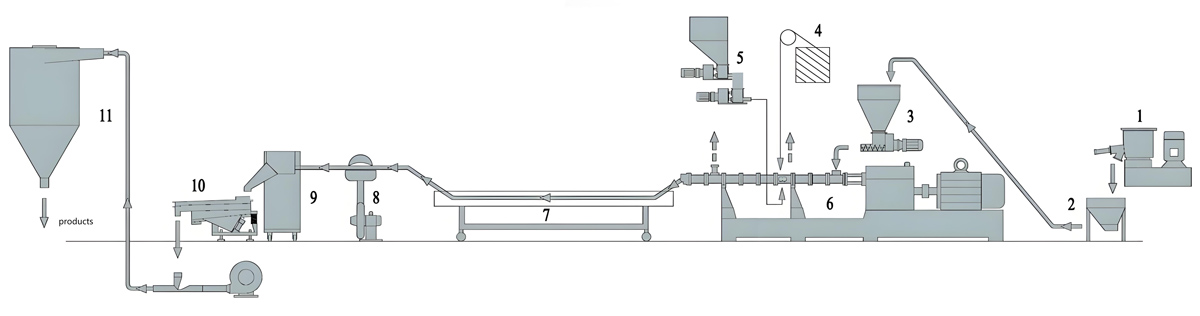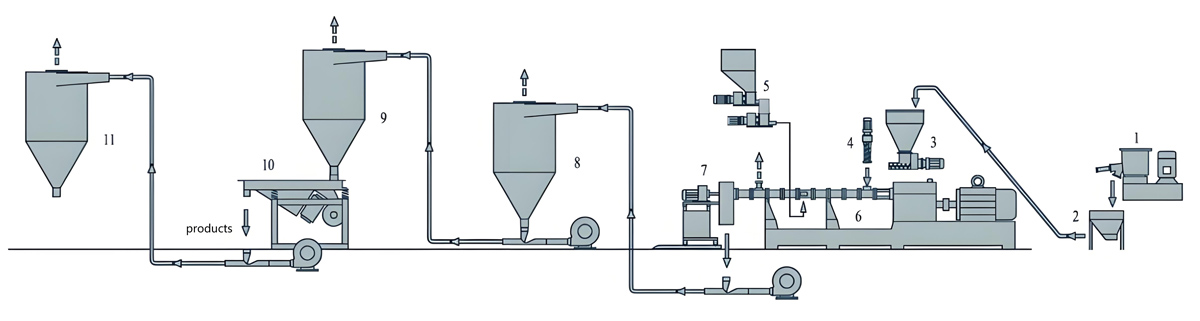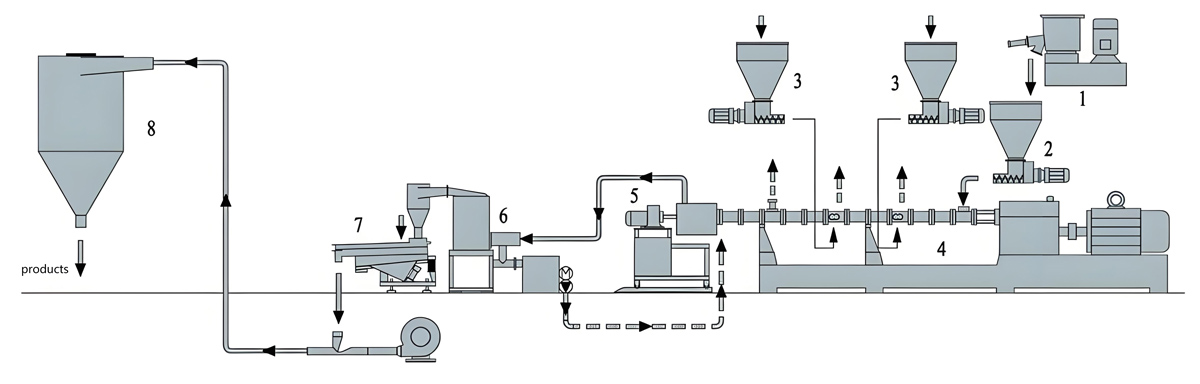
The degradation of polymeric materials under ultraviolet light exposure presents significant challenges across multiple industries. UV resistant and anti-aging masterbatch produced through twin screw extrusion technology provides effective protection against photochemical degradation, extending the service life of outdoor applications and maintaining material aesthetics over extended exposure periods. This comprehensive guide covers the technical aspects, formulations, production processes, and operational best practices for manufacturing high performance UV protective masterbatch using twin screw extrusion equipment.
Introduction
Polymer materials experience rapid degradation when exposed to ultraviolet radiation from sunlight. UV photons break chemical bonds in polymer chains, causing chain scission, color change, surface cracking, and loss of mechanical properties. This photochemical degradation limits the useful service life of many polymer products used in outdoor applications.
UV resistant masterbatch incorporates specialized additives that absorb or scatter ultraviolet radiation, preventing or significantly reducing the photochemical reactions that cause polymer degradation. Anti-aging additives complement UV protection by neutralizing reactive species generated during photo-oxidation and thermal oxidation processes.
The global demand for durable outdoor polymer products continues to increase as manufacturers seek to reduce replacement costs and environmental impacts associated with premature material failure. Twin screw extrusion technology provides the precise control and processing conditions required to produce effective UV protective masterbatch formulations.
Understanding UV Degradation Mechanisms
UV degradation initiates when polymer molecules absorb photons with sufficient energy to break chemical bonds. Different polymer types absorb UV radiation at specific wavelengths determined by their chemical structure. Polypropylene shows particular sensitivity to UV degradation, while polymers like polyethylene exhibit somewhat better inherent stability.
The photo-oxidation process creates free radicals that initiate chain reactions consuming the polymer matrix. These reactions propagate through chain scission and cross-linking mechanisms that progressively degrade material properties. Antioxidants interrupt these chain reactions, extending material service life.
Effective UV protection requires addressing both the absorption of harmful radiation and the neutralization of reactive degradation products. Comprehensive stabilization systems combine multiple additive types to provide multi-mechanism protection against environmental degradation.
Formulation Ratio for UV Resistant and Anti-Aging Masterbatch
UV Absorber Based Formulations
UV absorber compounds convert absorbed radiation energy into harmless heat through reversible photochemical reactions. Benzotriazoles, triazines, and oxanilides represent major UV absorber classes used in polymer applications.
Standard formulation ratios for UV absorber masterbatch include 10 to 25 percent UV absorber concentration, 60 to 80 percent carrier resin, and 5 to 15 percent co-additives including antioxidants and processing stabilizers. The specific UV absorber selection depends on the polymer type requiring protection and the required service life extension.
Benzotriazole UV absorbers offer excellent protection across a broad UV spectrum and are compatible with many polymer systems. Typical usage levels range from 0.5 to 2 percent in final applications when using concentrated masterbatch with typical 15 to 20 percent active content.
HALS Stabilizer Based Formulations
Hindered Amine Light Stabilizers (HALS) provide highly effective long term UV protection through radical scavenging mechanisms. These additives regenerate during the stabilization process, providing extended protection that increases rather than decreases over time.
HALS masterbatch formulations typically contain 5 to 20 percent hindered amine stabilizer content, 70 to 85 percent carrier resin, and supplementary antioxidants to enhance overall stabilization efficiency. The synergistic combination of HALS with UV absorbers provides comprehensive protection superior to either additive type alone.
Norbornyl-type HALS offer excellent compatibility with polyolefin polymers and provide exceptional long term weathering resistance. Piperidine-based HALS are widely used across polymer types with good performance in demanding outdoor applications.
Synergistic Combination Formulations
High performance UV protective masterbatch combines multiple stabilization mechanisms for comprehensive protection. These advanced formulations incorporate UV absorbers, HALS stabilizers, and antioxidants in optimized ratios.
Typical synergistic formulation ratios include 8 to 15 percent UV absorber, 5 to 12 percent HALS stabilizer, 3 to 8 percent primary antioxidant, and 2 to 5 percent phosphite processing stabilizer, with the balance being carrier resin typically comprising 55 to 75 percent of the formulation.
These combination systems provide immediate UV absorption protection combined with long term radical scavenging stabilization. The multi-mechanism approach addresses both short term surface protection and long term bulk property retention.
Application Specific Formulations
Agricultural film applications require UV protection formulations optimized for extended outdoor exposure under demanding conditions. These formulations typically feature high HALS content (10-15 percent) combined with UV absorbers (8-12 percent) to achieve multi-year service life in greenhouse and mulching applications.
Automotive interior formulations focus on UV protection that prevents discoloration and surface embrittlement while meeting stringent emission and odor requirements. Lower additive levels with carefully selected non-volatile stabilizers characterize these specialty formulations.
Building and construction applications require cost-effective UV stabilization for profiles, pipes, and sheets exposed to direct sunlight. These formulations balance performance requirements against competitive pricing pressures typical in volume construction markets.
Production Process for UV Resistant and Anti-Aging Masterbatch
Raw Material Handling and Preparation
Proper raw material handling ensures consistent masterbatch quality and effective additive performance. UV absorbers and HALS stabilizers are typically supplied as powders or granules requiring careful handling to prevent dust generation and ensure accurate dosing.
Carrier resin selection significantly impacts masterbatch performance and processing characteristics. Low melt flow index polymers provide better carrier properties for high additive loading while facilitating dispersion into final application polymers. Pre-drying of hygroscopic carriers prevents moisture related processing issues and protects additive effectiveness.
Additive powder handling requires attention to worker safety and accurate feeding. Closed transfer systems minimize airborne dust while ensuring complete transfer of expensive additives to mixing equipment. Gravimetric feeding systems provide precise additive introduction rates that maintain formulation accuracy throughout production.
Pre-mixing Operations
Pre-mixing ensures uniform additive distribution before extrusion processing. The pre-mixing stage addresses the challenge of incorporating concentrated additive formulations into a homogeneous carrier matrix.
High intensity mixing equipment provides rapid and thorough blending of additive concentrates with carrier resin. Mixing time optimization balances thorough distribution against potential additive damage from excessive shear forces. Visual inspection of pre-mix uniformity provides quality verification before extrusion processing.
Masterbatch concentrates may be produced at higher additive concentrations during pre-mixing, with subsequent let-down into appropriate carrier systems for specific applications. This approach enables manufacturing flexibility while maintaining consistent additive quality.
Twin Screw Extrusion Processing
The twin screw extrusion process transforms pre-mixed formulations into homogeneous masterbatch pellets suitable for downstream application. Process optimization addresses additive dispersion, thermal stability, and production efficiency requirements.
Feeding zones introduce pre-mixed materials at controlled rates that maintain appropriate extruder fill levels. Gravimetric feeding systems provide continuous formulation verification through real-time weight monitoring of introduced materials. Multiple feed points enable sequential addition of heat-sensitive additives at barrel locations offering optimal thermal exposure.
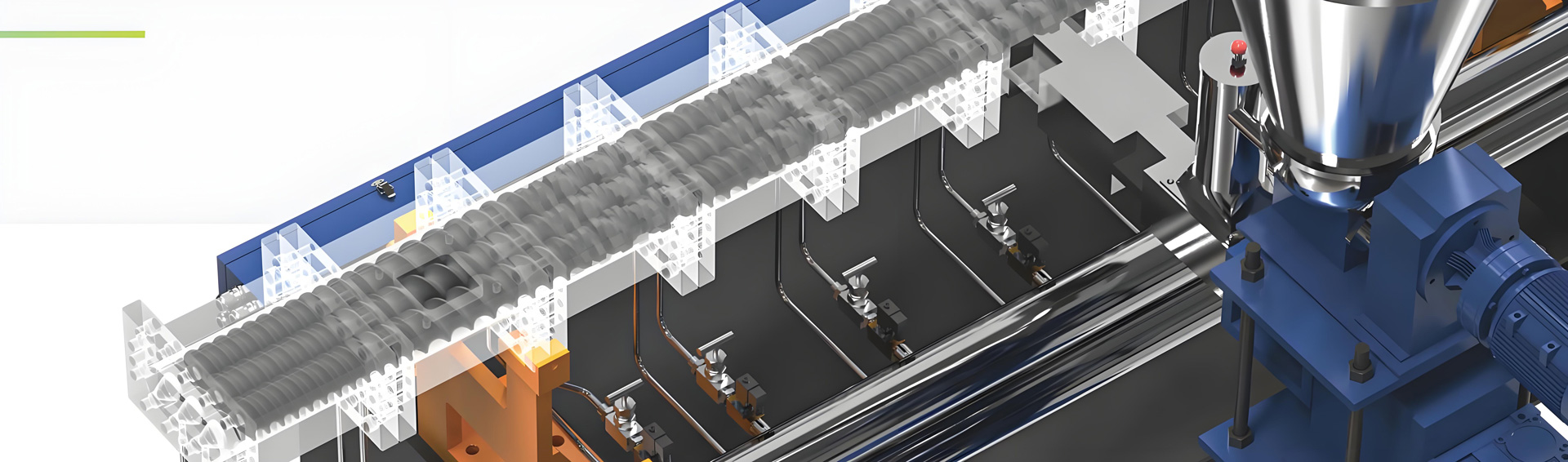
Mixing zones incorporate specialized screw elements that distribute additives throughout the polymer matrix while minimizing thermal stress on sensitive components. Kneading blocks and mixing elements create the flow patterns necessary for thorough additive dispersion without degradation from excessive shear heating.
The pumping zone delivers consistent melt flow to the die plate while maintaining temperature conditions that preserve additive effectiveness. Pressure development in this zone forces melt through the die plate openings, creating pellets through underwater or water ring pelletizing systems.
Pelletizing and Post-Processing
Pelletizing systems transform extruded melt into uniform pellet forms suitable for handling, storage, and subsequent application. Underwater pelletizing provides the most consistent pellet quality for UV masterbatch production.
Pellet cooling must be controlled to prevent thermal damage to surface-adjacent additives while ensuring complete solidification for handling. Water spray cooling systems provide gentle temperature reduction without thermal shock that could cause pellet cracking or deformation.
Pellet classification removes oversized and undersized particles that could cause feeding issues or property variations in downstream applications. Sieving and air classification systems produce pellets with narrow size distribution optimized for handling and dispersion.
Packaging operations protect finished masterbatch from environmental exposure that could compromise additive effectiveness. Airtight containers prevent moisture uptake and UV exposure that could degrade sensitive stabilizers before customer use.
Production Equipment Introduction
Kerke KTE Series Twin Screw Extruders
Kerke KTE series twin screw extruders provide the processing capabilities required for high quality UV resistant masterbatch production. The series encompasses models suited to various production scales from laboratory development through industrial volume manufacturing.
The KTE-36B extruder features 35.6mm screw diameter and achieves throughput rates of 20 to 100kg per hour. This compact machine suits formulation development, pilot production, and small volume specialty masterbatch manufacturing. The precise control capabilities enable optimization of sensitive UV absorber formulations.
The KTE-50B extruder provides 50.5mm screw diameter with production rates of 80 to 200kg per hour. This mid-range model balances processing quality with production efficiency for moderate volume commercial production.
The KTE-65B extruder offers 62.4mm screw diameter and throughput of 200 to 450kg per hour. This capacity level addresses commercial production requirements while maintaining the mixing efficiency necessary for uniform additive dispersion.
The KTE-75B extruder features 71mm screw diameter with production capabilities of 300 to 800kg per hour. This higher capacity model suits established masterbatch suppliers serving volume outdoor polymer applications.
The KTE-95D extruder provides the largest production capacity in the series with 93mm screw diameter and throughput of 1000 to 2000kg per hour. This industrial scale machine meets high volume production requirements while maintaining quality consistency essential for demanding UV protection applications.
Feeding and Handling Systems
Gravimetric feeding systems provide the precise ingredient introduction rates required for consistent UV masterbatch formulations. These systems incorporate loss-in-weight technology that continuously measures and adjusts feed rates to maintain formulation accuracy.
Additive feeding equipment handles both liquid and powder UV stabilizers with appropriate delivery mechanisms. Powder feeders require careful design to prevent segregation and ensure uniform additive introduction throughout production runs.
Material handling systems transfer raw materials from storage to production equipment and finished product to packaging. Closed transfer systems protect light-sensitive additives from UV exposure during handling operations.
Pelletizing and Packaging Equipment
Underwater pelletizing systems produce the spherical pellets preferred for UV masterbatch applications. These systems maintain precise water temperature and flow control to produce pellets with consistent geometry and surface quality.
Centrifugal dryers remove surface water while minimizing mechanical stress that could damage pellets. Integrated screens classify pellets by size and remove fines that could cause feeding problems.
Metal detection and optical sorting systems provide quality verification that identifies contaminated or defective pellets. These inspection systems protect product quality and customer satisfaction in demanding applications.
Parameter Settings for UV Resistant and Anti-Aging Masterbatch
Temperature Profile Optimization
Temperature profile configuration directly impacts masterbatch quality by affecting melt viscosity, additive stability, and dispersion efficiency. Profile optimization balances processing requirements against thermal stability limitations of UV sensitive additives.
Typical temperature profiles for UV absorber masterbatch production begin at 160 to 180 degrees Celsius in the feeding zone, increase to 200 to 220 degrees through primary mixing sections, and maintain 190 to 210 degrees in pumping and die zones. The specific profile requires adjustment based on carrier resin, additive package sensitivity, and throughput rate.
Temperature deviations from optimized profiles create quality problems including additive degradation, incomplete dispersion, and color shift in sensitive formulations. Continuous temperature monitoring enables rapid identification of problems requiring profile adjustment.
Die temperature control proves particularly important for UV masterbatch production. Excessive die temperatures can cause thermal degradation of UV absorbers and HALS stabilizers, reducing their effectiveness in finished products. Precise die temperature control maintains additive integrity throughout the production process.
Screw Speed and Shear Control
Screw speed selection influences mixing efficiency, melt temperature development, and additive integrity. Higher speeds increase shear rates that improve dispersion but also increase thermal stress on sensitive additives.
Optimal screw speeds for UV masterbatch typically range from 150 to 400 revolutions per minute depending on formulation, equipment configuration, and quality requirements. Lower speeds protect heat-sensitive additives while higher speeds enable faster production rates when additive stability permits.
Screw element selection creates specific mixing intensity profiles throughout the barrel. Conveying elements transport materials through the barrel while mixing elements provide the dispersion required for uniform additive distribution. Kneading blocks generate high shear zones for breaking up additive agglomerates while limiting their application to zones requiring intensive mixing.
Residence Time and Throughput Balance
Residence time within the extruder must provide sufficient thermal and mechanical energy for complete melting and additive dispersion while avoiding degradation of sensitive UV stabilizers. Mean residence times of 30 to 90 seconds typically achieve adequate processing without excessive thermal exposure.
Throughput rate selection must consider the extruder fill level required for effective mixing. Insufficient fill creates poor mixing quality while excessive fill causes pressure instability and potential quality variation. Throughput and screw speed coordination maintains optimal fill levels across production rate requirements.
Narrow residence time distribution improves product consistency by ensuring all material receives similar processing. Screw design optimization through barrier elements and specialized pumping sections narrows the distribution and reduces product quality variation.
Vacuum and Ventilation Settings
Vacuum ventilation removes moisture and volatile degradation products from the melt. Vacuum levels of 50 to 100 millibars effectively remove volatiles without excessive polymer loss through the vent system.
Vent zone placement requires consideration of when volatiles reach maximum concentration during melting and mixing. Positioning vents downstream of melting zones captures moisture released as polymers transition from solid to melt state.
Excessive vacuum can draw fine additive particles from the melt, creating formulation variation and potentially damaging vacuum equipment. Vacuum level optimization balances volatile removal efficiency against material loss and additive retention requirements.
Equipment Price
Equipment investment for UV resistant masterbatch production varies based on production capacity requirements and automation levels. The Kerke KTE series provides equipment options spanning research to industrial production scales.
The KTE-36B twin screw extruder represents the entry level investment at $25,000 to $35,000. This model suits research and development applications and pilot production before scale-up to commercial volumes.
The KTE-50B twin screw extruder requires an investment of $40,000 to $60,000. This mid-range equipment balances processing capability with production efficiency for moderate volume commercial production.
The KTE-65B twin screw extruder costs between $50,000 and $80,000. This model addresses commercial production requirements for established masterbatch suppliers serving outdoor polymer applications.
The KTE-75B twin screw extruder commands prices ranging from $70,000 to $100,000. This higher capacity model suits dedicated production facilities serving volume UV masterbatch markets.
The KTE-95D twin screw extruder represents the premium equipment tier with prices of $120,000 to $200,000. This industrial scale machine enables high volume production for major outdoor polymer markets while maintaining quality consistency.
Complete production system investment extends beyond extruder purchase to include feeding systems, pelletizing equipment, material handling, quality control instrumentation, and facility requirements. Total system investments typically range from 1.5 to 2.5 times the extruder purchase price depending on automation level and quality system requirements.
Problems in Production Process and Solutions
Additive Degradation During Processing
Problem Description: Thermal degradation of UV absorbers and HALS stabilizers during extrusion reduces their effectiveness in finished applications. This manifests as reduced UV protection performance, color change, and premature failure of protected products in outdoor exposure.
Root Cause Analysis: Excessive barrel temperatures, extended residence time at elevated temperatures, or excessive shear heating can degrade heat-sensitive stabilizers. Inadequate temperature control or incorrect process parameters create conditions exceeding additive thermal stability limits.
Solution Approach: Reduce barrel temperatures in mixing zones where additives are present. Increase throughput rate to reduce material residence time in high temperature zones. Modify screw configuration to reduce shear heating in sensitive zones. Consider split feeding where heat-sensitive additives are introduced downstream of the highest temperature zones.
Prevention Methods: Establish validated temperature profiles and throughput limits for each formulation based on additive thermal stability data. Implement temperature monitoring with alarms that identify excursions before significant degradation occurs. Document process parameters for each production run to enable traceability and optimization.
Incomplete Additive Dispersion
Problem Description: Poor dispersion creates localized areas of excessive additive concentration adjacent to areas with inadequate protection. This inconsistency manifests as variable UV protection performance, surface defects, and inconsistent appearance in finished products.
Root Cause Analysis: Insufficient mixing intensity, inadequate pre-mixing, or formulation issues causing additive agglomeration can all produce dispersion problems. Screw wear over time reduces mixing efficiency and produces gradual quality degradation that may not be immediately apparent.
Solution Approach: Review screw element configuration to ensure adequate mixing elements in zones where additives are present. Verify pre-mixing equipment operation and mixing times. Consider higher intensity mixing configurations for difficult-to-disperse additives. Implement pre-blending procedures that ensure uniform additive distribution before extrusion.
Prevention Methods: Establish standard screw configurations for each formulation type based on accumulated experience. Monitor product quality trends to identify gradual degradation indicating equipment wear. Conduct periodic mixing efficiency validation testing using standardized procedures.
Color Shift in Finished Masterbatch
Problem Description: UV masterbatch products may exhibit color variations between production batches or within individual production runs. These variations indicate potential formulation inconsistency or additive interactions affecting product quality.
Root Cause Analysis: Additive impurities, cross-contamination from previous productions, or degradation reactions can produce color shifts. HALS stabilizers particularly may exhibit color bodies under certain processing conditions or in combination with other additives.
Solution Approach: Implement comprehensive cleaning procedures between production runs. Verify raw material quality through incoming inspection testing. Adjust processing conditions to minimize thermal stress on color-sensitive additives. Consider alternative additive grades with improved color stability.
Prevention Methods: Establish cleaning validation protocols specifying procedures for different formulation transitions. Maintain raw material specifications and incoming quality verification. Document color measurements for each production lot to enable trend analysis and rapid problem identification.
Fumes and Volatile Emissions During Processing
Problem Description: Visible fumes or elevated volatile emissions during extrusion indicate thermal degradation or volatilization of formulation components. These emissions create workplace safety concerns and indicate potential product quality degradation.
Root Cause Analysis: Excessive processing temperatures cause volatilization of low molecular weight additives or degradation products. Some UV absorbers exhibit relatively high volatility at typical processing temperatures, creating emission concerns.
Solution Approach: Reduce processing temperatures throughout the barrel profile. Increase vacuum ventilation to capture volatilized materials. Consider alternative lower-volatility UV absorber grades for high temperature processing applications. Evaluate formulation modifications that reduce volatile component concentrations.
Prevention Methods: Monitor processing emissions through regular inspection and testing. Select low-volatility additives where possible. Maintain ventilation systems according to manufacturer specifications. Establish temperature limits based on additive volatility data.
Feeding System Accuracy Issues
Problem Description: Inconsistent feeding of additives produces formulation variation that affects product quality and performance. This manifests as property variations between batches and potential customer complaints about inconsistent protection performance.
Root Cause Analysis: Feed hopper bridging, equipment calibration drift, material property changes affecting flow characteristics, or equipment malfunctions can all cause feeding accuracy problems. Gravimetric systems may exhibit accuracy degradation over time without obvious symptoms.
Solution Approach: Verify feeding equipment calibration using test weights and reference materials. Inspect hoppers for bridging or flow obstruction issues. Clean feeding equipment to remove accumulated material affecting flow characteristics. Recalibrate gravimetric systems according to manufacturer procedures.
Prevention Methods: Implement regular feeding system calibration verification schedules. Maintain feeding equipment according to manufacturer recommendations. Monitor feed rate variance during production to identify accuracy problems before significant quality impact occurs. Document calibration activities for quality system compliance.
Maintenance
Daily Operational Maintenance
Daily maintenance activities ensure consistent product quality and equipment reliability throughout production operations. Operator inspections at shift start verify equipment readiness and identify any issues requiring attention before production begins.
Temperature controller verification confirms accurate temperature measurement and control throughout the barrel profile. Recording actual temperatures against setpoints enables trend analysis that identifies developing problems. Any significant deviations require investigation and correction before production continues.
Feeding system inspection verifies smooth material flow and proper function of feeding equipment. Hopper level monitoring ensures adequate material supply throughout production runs while preventing overfilling that could cause spillage or contamination.
Die plate inspection and cleaning removes accumulated material that could restrict flow or cause contamination. Visual inspection of startup pellets verifies product quality before releasing production for packaging.
Weekly Maintenance Activities
Weekly maintenance extends equipment care beyond daily activities to address components requiring less frequent attention. Gravimetric feeding system calibration verification using certified test weights confirms continued accuracy within specification limits.
Vacuum system inspection examines filters, seals, and connections for condition and proper function. Filter replacement or cleaning maintains vacuum efficiency and prevents material loss through the vent system.
Screw torque indicator inspection identifies any loosening that could allow element rotation during operation. Torque measurements provide baseline data for detecting changes over time indicating potential mechanical issues.
Pelletizing system inspection examines knife wear, die plate condition, and water system function. Regular knife sharpening maintains cutting quality while die inspection identifies wear patterns requiring attention.
Monthly and Quarterly Maintenance
Monthly maintenance addresses wear patterns and component conditions requiring periodic assessment. Barrel and screw wear inspection identifies sections approaching replacement thresholds based on accumulated operating hours and historical wear rates.
Gearbox oil analysis provides early warning of contamination or degradation that could lead to mechanical failure. Oil replacement schedules maintain transmission health while analysis results guide maintenance timing decisions.
Electrical system inspection examines connections, motor condition, and control system calibration. Temperature controller calibration verification ensures accurate temperature measurement throughout the barrel profile.
Quarterly maintenance encompasses comprehensive equipment assessment addressing all major systems. Extruder barrel inspection using borescope equipment documents internal wear patterns and accumulated deposits affecting product quality. Performance qualification testing verifies equipment capability to produce product meeting specifications.
Annual and Long-Term Maintenance
Annual maintenance represents comprehensive equipment overhaul ensuring continued reliability and quality performance. Complete extruder disassembly and inspection examines all internal components for wear, damage, or accumulated material affecting performance.
Screw element replacement planning considers accumulated operating hours and historical wear patterns to optimize replacement timing. Proactive replacement prevents quality problems emerging from excessive wear while enabling scheduled maintenance during planned downtime.
Control system updates and calibration ensure continued accurate equipment operation. Process parameter documentation enables rapid recovery following control system maintenance or upgrades.
Performance qualification testing documents equipment capability for quality system compliance purposes. These records demonstrate continued ability to produce product meeting specifications required for demanding UV protection applications.
FAQ
What UV absorber types are most effective for polymer protection?
Benzotriazole UV absorbers provide excellent broad-spectrum protection across the UV-A and UV-B ranges with good compatibility in most polymer systems. Triazine absorbers offer higher thermal stability for demanding processing conditions. Tinuvin series products (BASF) and Cyasorb UV series represent commonly used commercial UV absorber options with established performance records in outdoor polymer applications.
How do HALS stabilizers differ from UV absorbers in protection mechanism?
UV absorbers act as sacrificial agents that absorb UV radiation and convert it to harmless heat before it damages polymers. HALS stabilizers function as radical scavengers that intercept and neutralize reactive free radicals generated during photo-oxidation. HALS provide long-term protection that improves over time through regenerative mechanisms while UV absorbers are consumed through their protective action.
What carrier resins work best for UV protective masterbatch?
Carrier resin selection depends on final application compatibility and processing requirements. Polyethylene and polypropylene carriers offer broad compatibility and cost-effective performance for many outdoor applications. EVA carriers provide excellent compatibility with agricultural film applications. Speciality carriers including polyamide and polycarbonate suit demanding engineering polymer applications requiring specific performance characteristics.
How do I determine optimal additive concentrations for specific applications?
Additive concentration optimization requires consideration of polymer type, required service life, exposure conditions, and cost constraints. Accelerated weathering testing compares formulations at different concentrations to identify minimum effective levels. Industry guidelines and additive supplier recommendations provide starting points for concentration optimization. Final concentration selection balances performance requirements against formulation costs.
What quality control tests should I perform on UV masterbatch?
Essential quality tests include additive concentration verification through analytical methods, moisture content determination, color measurement for appearance consistency, and dispersion evaluation through microscopy or mechanical testing. Accelerated weathering validation testing confirms protective performance meets specifications. Particle size distribution analysis verifies pellet quality and handling characteristics.
How do I prevent cross-contamination between different formulations?
Comprehensive cleaning procedures between production runs prevent cross-contamination affecting product quality. The cleaning intensity depends on formulation differences and contamination sensitivity. Physical cleaning through purging with compatible polymers followed by inspection verifies cleaning effectiveness. Production scheduling that minimizes problematic formulation transitions reduces cleaning requirements and changeover time.
What processing temperature limits should I observe for UV additives?
Temperature limits depend on specific additive types and grades. Most UV absorbers and HALS stabilizers tolerate processing temperatures up to 280 to 300 degrees Celsius for short exposure periods. Lower temperatures in the 200 to 240 degree range preserve maximum additive effectiveness for extended production runs. Additive supplier technical data provides specific thermal stability information for each product grade.
How long can UV masterbatch be stored before use?
Storage stability depends on carrier resin properties, additive types, and storage conditions. Properly packaged masterbatch typically maintains effective performance for 12 to 24 months when stored in cool, dry conditions away from direct sunlight. Heat and UV exposure during storage accelerate degradation and reduce effective additive content. Following FIFO inventory practices ensures oldest material is used first.
Conclusion
UV resistant and anti-aging masterbatch production through twin screw extrusion technology enables manufacturers to address the growing demand for durable outdoor polymer products. The combination of effective UV absorbers, HALS stabilizers, and complementary antioxidants provides comprehensive protection against photochemical degradation that extends product service life and maintains aesthetic appearance.
Successful UV masterbatch manufacturing requires careful attention to formulation design, process optimization, and quality control. The Kerke KTE series provides processing equipment capable of producing consistent, high-quality masterbatch across the production capacity range required by different market segments.
Equipment investment considerations must account for not only extruder purchase but also the supporting systems required for complete production capability. Feeding systems, pelletizing equipment, quality control instrumentation, and material handling all contribute to effective production operations.
Ongoing process optimization based on product quality feedback and maintenance activities ensure continued production of masterbatch meeting demanding UV protection requirements. Investment in operator training, quality systems, and equipment maintenance yields returns through consistent product quality and reduced production problems.
The technical knowledge presented in this guide provides a foundation for developing UV resistant masterbatch manufacturing capabilities. Organizations pursuing opportunities in outdoor polymer applications can leverage this knowledge to establish effective production operations serving markets demanding long-term durability and performance retention under UV exposure conditions.