Introduction
The production of wollastonite filled masterbatch represents a significant advancement in the field of mineral reinforced polymer composites. Wollastonite, a naturally occurring calcium silicate mineral with a distinctive needle like crystal structure, has emerged as a highly effective reinforcing filler for various plastic applications. When properly processed through twin screw extrusion technology, wollastonite filled masterbatch delivers exceptional mechanical properties including improved tensile strength, enhanced flexural modulus, and superior dimensional stability. This comprehensive guide explores the complete manufacturing process, equipment requirements, parameter optimization, and practical solutions for producing high quality wollastonite masterbatch using twin screw extruders.
Wollastonite possesses several unique characteristics that make it particularly valuable in polymer reinforcement applications. The needle like morphology of wollastonite particles creates an interlocking structure within the polymer matrix, effectively transferring stress and preventing crack propagation. This structural reinforcement mechanism results in composites with significantly improved impact resistance and structural integrity. Additionally, wollastonite offers excellent brightness and low oil absorption properties, making it suitable for applications where color consistency and processing efficiency are critical considerations.
The selection of appropriate twin screw extrusion equipment plays a crucial role in achieving optimal dispersion and incorporation of wollastonite within the polymer carrier. Modern co rotating twin screw extruders provide the necessary shear forces, mixing efficiency, and temperature control capabilities required for successful wollastonite masterbatch production. Understanding the interplay between material properties, equipment specifications, and process parameters enables manufacturers to consistently produce high performance wollastonite filled masterbatch products that meet stringent quality requirements.
Formulation Ratio
Standard Wollastonite Masterbatch Formulation
The formulation of wollastonite filled masterbatch requires careful consideration of multiple components to achieve optimal processing characteristics and final product performance. The following ratios represent commonly used formulations across various application requirements:
Carrier resin selection forms the foundation of effective masterbatch formulation. For general purpose applications, linear low density polyethylene serves as an excellent carrier due to its good processing characteristics and compatibility with common conversion processes. The typical carrier resin concentration ranges from 15% to 30% of the total formulation weight. When higher loading of wollastonite is required, the carrier content may be reduced accordingly while maintaining adequate flow properties for successful granulation.
Wollastonite filler loading typically ranges from 50% to 80% depending on the target application and processing requirements. Higher filler loadings provide cost reduction benefits and improved stiffness properties but require careful attention to dispersion quality and flow characteristics. Surface treated wollastonite grades allow for higher loading levels while maintaining good compatibility with the polymer matrix. The use of coupling agents such as silane based compounds significantly improves the interfacial bonding between wollastonite particles and the carrier resin.
Dispersant additives play a critical role in achieving uniform distribution of wollastonite particles throughout the polymer matrix. Typical dispersant concentrations range from 2% to 5% of the formulation. Common dispersant choices include fatty acid derivatives, ester compounds, and specialized polymer dispersants designed for mineral filled systems. The dispersant selection should consider compatibility with both the carrier resin and the wollastonite surface treatment chemistry.
High Performance Wollastonite Formulation
For automotive and structural applications requiring enhanced mechanical properties, specialized formulations incorporate additional modifiers and reinforcement strategies. These high performance formulations typically utilize polypropylene or polypropylene impact copolymer as the carrier resin, allowing for superior heat resistance and mechanical strength in the final composite materials.
The inclusion of impact modifiers such as ethylene propylene diene monomer rubber or styrene ethylene butylene styrene block copolymers at concentrations of 3% to 8% significantly improves the toughness characteristics of wollastonite filled composites. Coupling agents based on maleic anhydride grafted polymers provide chemical bonding between the filler surface and the polymer matrix, maximizing the reinforcement efficiency of the wollastonite needle like particles.
Antioxidant packages ensure thermal stability during processing and long term service life of the final composite. Standard antioxidant concentrations range from 0.3% to 0.8% depending on the thermal processing requirements and intended application environment. The antioxidant system should be selected to provide protection against both thermal oxidation during extrusion processing and oxidative degradation during product service life.
Production Process
Raw Material Preparation
The production of high quality wollastonite filled masterbatch begins with meticulous preparation of raw materials. Wollastonite powder requires careful evaluation of particle size distribution, moisture content, and surface chemistry characteristics. Commercially available wollastonite grades typically exhibit median particle sizes ranging from 5 to 25 microns, with aspect ratios between 3:1 and 20:1 depending on the specific grade and processing history.
Pre drying of wollastonite powder represents a critical step in the production process. Residual moisture can lead to hydrolysis reactions, void formation, and surface defects in the final masterbatch granules. Industrial drying protocols typically employ desiccant or vacuum drying systems operating at temperatures between 120 and 150 degrees Celsius for periods of 4 to 8 hours. The target moisture content should be maintained below 0.1% to ensure optimal processing conditions and product quality.
Carrier resin preparation involves similar drying protocols to remove residual moisture and prevent processing issues. Polyolefin resins generally require drying at temperatures between 80 and 100 degrees Celsius for 2 to 4 hours. Hygroscopic carrier resins such as nylon or polyester may require more aggressive drying conditions and extended drying times to achieve the target moisture levels.
The pre mixing stage combines the dried components in predetermined proportions to achieve uniform distribution before extrusion processing. High intensity mixing equipment such as high speed mixers or conical screw blenders ensures homogeneous blending of the formulation components. The pre mixing step serves to distribute the filler particles evenly within the carrier resin matrix and facilitate subsequent extrusion processing.
Extrusion Processing
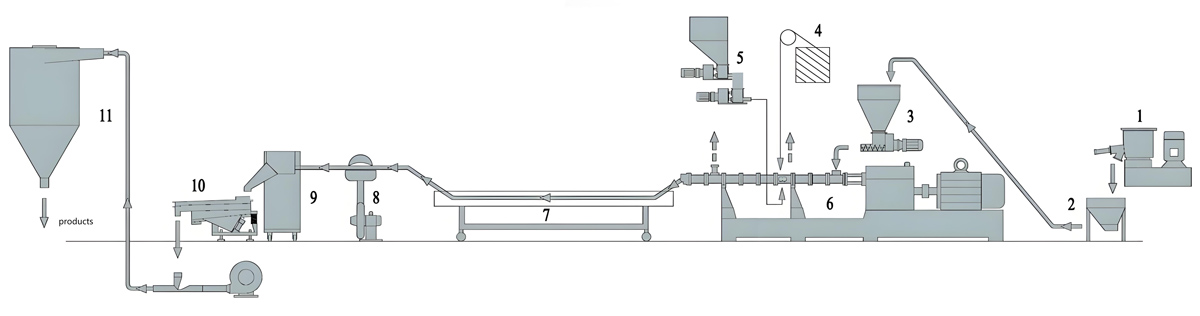
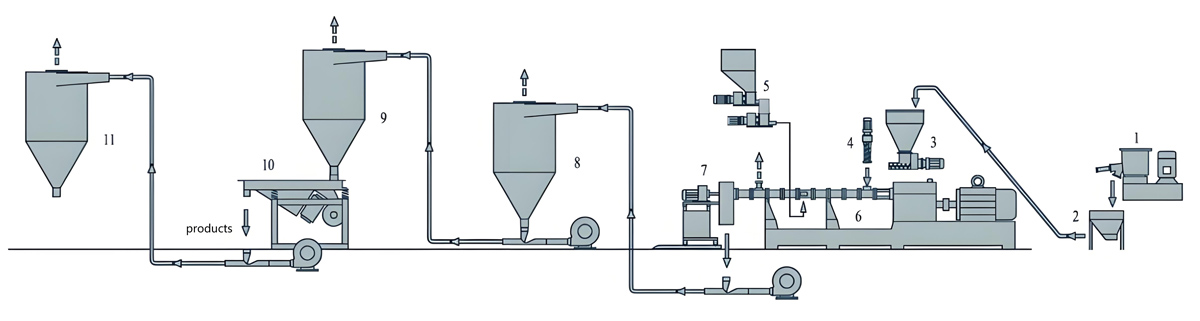
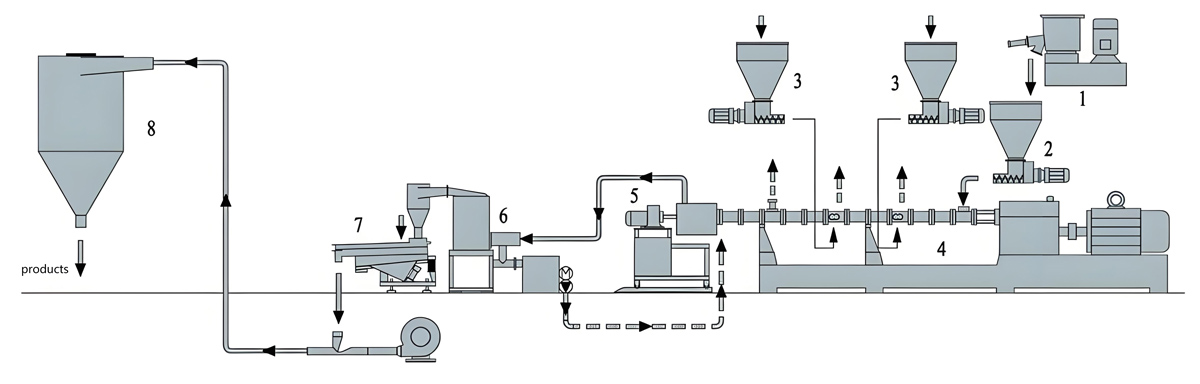
The twin screw extrusion process transforms the pre mixed formulation into uniformly dispersed masterbatch granules. The extrusion system consists of multiple functional zones designed to accomplish specific processing objectives including feeding, melting, mixing, devolatilization, and pumping operations.
The feeding zone receives the pre mixed formulation and initiates the conveying and heating process. Proper feeding zone design ensures consistent material introduction without bridging or surging phenomena. The length and configuration of the feeding zone should be selected based on the bulk density and flow characteristics of the formulation components.
Melting and plastification occur as the formulation progresses through the compression zone of the twin screw assembly. The screw design must provide adequate compression ratio to consolidate the material while avoiding excessive pressure fluctuations that could lead to uneven melting. The transition from solid to melt state represents a critical processing point where proper temperature control and shear energy input determine the subsequent mixing efficiency.
Dispersive and distributive mixing sections incorporate specialized screw elements designed to break up agglomerates and distribute filler particles uniformly throughout the polymer matrix. The intensity of mixing should be carefully controlled to achieve complete dispersion of wollastonite particles without excessive degradation of the polymer matrix or the filler particles themselves. Excessive shear forces can cause breakage of the needle like wollastonite particles, reducing the aspect ratio and compromising the reinforcement efficiency.
Granulation and Cooling
The melt exiting the extrusion system requires conversion into granular form suitable for subsequent handling and processing operations. Underwater pelletizing systems provide excellent size control and cooling efficiency for high output masterbatch production. The pelletizing head maintains precise temperature control to achieve clean cutting of the molten extrudate without creating fines or irregular particle shapes.
Water temperature in the pelletizing system typically ranges from 30 to 50 degrees Celsius, providing sufficient cooling to solidify the masterbatch granules while avoiding thermal shock that could cause cracking or internal stresses. The water flow rate must be optimized to remove heat efficiently without causing particle deformation or agglomeration.
Alternative strand pelletizing systems offer advantages for certain formulation types or production scales. These systems employ chilled water baths or air cooling conveyors to solidify extruded strands before cutting into granules. The selection between underwater pelletizing and strand pelletizing depends on factors including production rate, formulation characteristics, and final product quality requirements.
Post processing handling of the finished granules includes drying to remove residual moisture, screening to remove fines and oversized particles, and packaging for storage or shipment. Proper storage conditions maintain product quality by preventing moisture absorption and contamination. Masterbatch products should be stored in sealed containers or bags with appropriate desiccant protection to ensure long term stability.
Production Equipment Introduction
Twin Screw Extruder Fundamentals
Co rotating twin screw extruders represent the industry standard equipment for masterbatch production due to their superior mixing efficiency, flexible configuration options, and excellent temperature control capabilities. The parallel arrangement of two intermeshing screws rotating in the same direction creates a positive displacement pumping action combined with intensive mixing characteristics essential for uniform filler dispersion.
The modular construction of modern twin screw extrusion systems allows customized configuration of screw elements, barrel sections, and process openings to optimize performance for specific formulation requirements. Screw elements are available in various geometries including forward conveying elements, reverse acting elements for mixing and pressure buildup, kneading blocks for intensive mixing, and specialty elements for specific processing objectives.
Barrel sections incorporate heating and cooling systems to maintain precise temperature profiles throughout the extrusion process. Liquid heating systems using thermal oil or pressurized water provide uniform temperature control, while forced air cooling systems enable rapid temperature reduction when required. The number and arrangement of barrel heating zones typically ranges from 6 to 12 depending on the extruder size and processing requirements.
Feed system design significantly impacts the consistency and quality of the extrusion process. Gravimetric or loss in weight feeding systems provide accurate and consistent material introduction, enabling precise control of formulation composition and throughput rate. Side feeder configurations allow introduction of additional components at intermediate points along the extrusion axis, providing flexibility for multi stage mixing or additive incorporation processes.
Kerke KTE Series Equipment Specifications
The Kerke KTE series represents a comprehensive range of twin screw extrusion equipment designed to address various production capacity requirements for wollastonite filled masterbatch manufacturing. Each model in the series offers specific performance characteristics suited to different production scales and application requirements.
The KTE 36B extruder features a screw diameter of 35.6mm and achieves production rates of 20 to 100kg per hour. This compact yet capable machine provides an excellent entry point for masterbatch production or specialized small batch applications. The moderate throughput range allows detailed process optimization while maintaining economical production economics. Equipment pricing for the KTE 36B model ranges from 25,000 to 35,000 USD, positioning it competitively for laboratory scale and pilot production operations.
The KTE 50B extruder offers increased capacity with a 50.5mm screw diameter and production rates between 80 and 200kg per hour. This mid range equipment addresses the requirements of medium scale commercial production with excellent flexibility and process capability. The enhanced throughput capacity reduces per unit production costs while maintaining the quality standards required for premium masterbatch products. Pricing for the KTE 50B model ranges from 40,000 to 60,000 USD depending on configuration options and accessories.
The KTE 65B extruder features a 62.4mm screw diameter and production capacity of 200 to 450kg per hour. This high capacity model serves demanding commercial production requirements with excellent processing efficiency and product quality consistency. The robust construction and advanced control systems enable continuous production operations with minimal downtime and maintenance requirements. Equipment pricing ranges from 50,000 to 80,000 USD for the KTE 65B configuration.
The KTE 75B extruder provides substantial production capacity with a 71mm screw diameter and throughput rates of 300 to 800kg per hour. This industrial scale machine addresses high volume production requirements while maintaining the processing flexibility required for diverse formulation types. Advanced temperature control systems and mixing configurations enable production of premium quality masterbatch products at competitive cost points. Pricing for the KTE 75B model ranges from 70,000 to 100,000 USD.
The KTE 95D extruder represents the highest capacity option in the Kerke KTE series with a 93mm screw diameter and production rates of 1000 to 2000kg per hour. This large scale industrial machine enables efficient high volume production of wollastonite filled masterbatch with excellent product quality and consistency. The sophisticated control systems and extensive process zone configuration options provide maximum flexibility for complex formulations and demanding quality requirements. Equipment pricing ranges from 120,000 to 200,000 USD for this premium industrial configuration.
Parameter Settings
Temperature Profile Optimization
Temperature profile configuration significantly influences the processing characteristics and final product quality of wollastonite filled masterbatch. The optimal temperature profile balances melt viscosity, filler dispersion efficiency, and thermal stability requirements to achieve consistent high quality production.
The feeding zone temperature should be maintained at relatively moderate levels between 160 and 180 degrees Celsius to ensure proper feeding behavior without premature melting that could cause bridging or surging issues. This zone provides initial heating of the formulation components and establishes the foundation for subsequent melting and mixing operations.
Compression zone temperatures typically range from 180 to 200 degrees Celsius, providing sufficient thermal energy to accomplish complete melting of the carrier resin while initiating the softening process for wollastonite particles. The temperature in this zone should be carefully controlled to achieve uniform melt formation without creating hot spots that could cause polymer degradation or uneven processing conditions.
Mixing zone temperatures require careful optimization to achieve the balance between melt viscosity and mixing intensity required for effective filler dispersion. Typical mixing zone temperatures range from 190 to 220 degrees Celsius depending on the carrier resin type and formulation composition. Higher temperatures reduce melt viscosity, improving filler distribution, but may compromise thermal stability and increase energy consumption.
Die zone temperatures should be maintained at levels sufficient to ensure complete melt flow through the die openings without causing thermal degradation. Typical die temperatures range from 200 to 230 degrees Celsius, depending on the specific formulation and processing conditions. Temperature uniformity across the die plate is essential to ensure consistent pellet quality and production rates.
Screw Speed and Throughput Configuration
Screw speed directly influences the shear energy input, mixing intensity, and production rate of the twin screw extrusion process. The optimal screw speed depends on factors including formulation characteristics, equipment specifications, and quality requirements.
For wollastonite filled masterbatch production, screw speeds typically range from 200 to 500 rpm depending on the extruder size and specific formulation requirements. Lower screw speeds provide extended residence time and more gentle mixing conditions, beneficial for formulations containing thermally sensitive components or requiring minimal filler particle degradation.
Higher screw speeds increase shear energy input and mixing intensity, enabling faster production rates and improved filler dispersion. However, excessive screw speeds can generate excessive heat through viscous dissipation, cause mechanical degradation of the polymer matrix, and potentially damage the needle like structure of wollastonite particles.
Throughput rate configuration should be optimized in conjunction with screw speed to achieve the desired specific mechanical energy input. The ratio of throughput to screw speed determines the filling degree of the screw channels and the residence time distribution of the formulation within the extrusion system. Optimal throughput configuration ensures adequate mixing while maintaining efficient production rates.
Specific Mechanical Energy Considerations
Specific mechanical energy represents the mechanical energy input per unit mass of material processed, serving as a key parameter for process optimization and quality control. For wollastonite filled masterbatch production, specific mechanical energy values typically range from 0.15 to 0.35 kWh per kg depending on formulation characteristics and quality requirements.
Higher specific mechanical energy values correlate with improved filler dispersion and more uniform distribution of wollastonite particles within the polymer matrix. However, excessive mechanical energy input can cause polymer degradation, filler particle damage, and increased operating costs.
Process monitoring systems enable real time tracking of specific mechanical energy consumption, providing valuable feedback for process optimization and quality control. Integration of energy monitoring with production data management systems enables comprehensive process analysis and continuous improvement initiatives.
Equipment Price
Investment in twin screw extrusion equipment for wollastonite filled masterbatch production requires careful evaluation of production capacity requirements, quality specifications, and economic factors. The Kerke KTE series provides a comprehensive range of equipment options to address diverse production scale requirements.
The KTE 36B model represents an economical entry point for small scale production and process development activities. The investment range of 25,000 to 35,000 USD provides access to professional grade twin screw extrusion capabilities suitable for pilot production, custom formulation development, and market evaluation activities. This equipment offers excellent value for businesses establishing wollastonite masterbatch production capabilities or requiring flexible small batch production options.
The KTE 50B model at 40,000 to 60,000 USD provides expanded production capacity for commercial operations requiring moderate throughput rates. This equipment tier offers an attractive balance between production efficiency and capital investment, making it suitable for growing businesses or established producers seeking additional capacity.
The KTE 65B equipment at 50,000 to 80,000 USD addresses higher volume commercial production requirements with robust processing capabilities and reliability. This investment level provides access to industrial scale production capabilities with the quality and consistency required for competitive market participation.
The KTE 75B at 70,000 to 100,000 USD delivers substantial production capacity for established commercial operations. The enhanced throughput capabilities reduce per unit production costs while maintaining the quality standards required for premium product positioning.
The KTE 95D represents the premium industrial investment at 120,000 to 200,000 USD for high volume production operations. This equipment tier provides maximum production capacity and processing flexibility for large scale commercial operations or specialized high performance product manufacturing.
Beyond the base equipment investment, total capital requirements should include ancillary equipment such as material handling systems, drying equipment, pelletizing systems, and quality control instrumentation. Installation, commissioning, and operator training costs should also be factored into the total investment analysis.
Problems in Production Process and Solutions
Dispersion Quality Issues
Inadequate dispersion of wollastonite particles represents one of the most common quality problems in masterbatch production. Poor dispersion manifests as visible agglomerates, color variations, or inconsistent mechanical properties in the final product. The root causes of dispersion problems typically include insufficient shear energy, inadequate mixing element configuration, or improper surface treatment of the wollastonite filler.
Solutions for dispersion quality issues involve multiple corrective actions targeting the underlying causes. Increasing the intensity or extent of dispersive mixing sections within the screw configuration can significantly improve agglomerate breakup. The addition of specialized kneading block elements or high shear mixing sections provides enhanced dispersion capability for challenging formulations.
Optimization of screw speed and throughput configuration may be necessary to achieve the specific mechanical energy input required for adequate dispersion. Process parameter studies can identify the optimal operating window for specific formulation requirements. Investment in process monitoring and control systems enables real time tracking of key parameters to maintain consistent dispersion quality.
In cases where surface chemistry incompatibility contributes to dispersion problems, reformulation with improved coupling agents or dispersants can address the underlying issues. Surface treatment of wollastonite with silane coupling agents improves compatibility with the polymer matrix and facilitates more uniform dispersion. Collaboration with wollastonite suppliers can provide guidance on optimal surface treatment approaches for specific polymer systems.
Prevention of dispersion quality issues requires systematic approaches to process design and quality control. Regular monitoring of product quality through standardized testing protocols enables early detection of dispersion problems before they result in significant production losses. Process documentation and standard operating procedures ensure consistent execution of optimized processing conditions. Preventive maintenance programs maintain equipment performance and prevent degradation of mixing capabilities over time.
Processing Stability Problems
Processing instability in wollastonite masterbatch production can manifest as pressure fluctuations, surging output, or inconsistent pellet quality. These issues often result from feeding problems, inadequate melting, or improper screw configuration for the specific formulation characteristics.
Addressing processing stability issues requires systematic diagnosis of the underlying causes. Feeding system inspection and optimization can resolve issues related to material handling or feed rate consistency. Gravimetric feeding systems provide improved accuracy and consistency compared to volumetric alternatives. Feed throat design modifications may be necessary for formulations with challenging flow characteristics.
Screw configuration optimization can address melting and pumping instability issues. The compression ratio and feed zone geometry should be selected to ensure consistent feeding and melting behavior. Adequate melting capacity prevents solid material carryover that can cause pressure instability and quality variations.
Temperature profile adjustments may resolve processing stability issues related to melt viscosity variations or incomplete melting. Increasing temperatures in the melting zone can improve melting efficiency and consistency. Conversely, reducing temperatures may be necessary if excessive melt viscosity causes pumping difficulties.
Preventive measures for processing stability include regular equipment maintenance to ensure consistent performance, process monitoring to detect deviations from normal operating conditions, and systematic troubleshooting protocols to efficiently identify and resolve emerging issues.
Thermal Degradation Problems
Thermal degradation of the polymer matrix during processing can result in discoloration, odor generation, and reduced mechanical properties in the final masterbatch product. Wollastonite filled masterbatch formulations containing thermally sensitive polymers require careful temperature management to prevent degradation reactions.
Solutions for thermal degradation focus on reducing thermal exposure and improving thermal stability of the formulation. Temperature profile reduction lowers the maximum processing temperature while maintaining adequate melt flow for successful processing. However, temperature reductions must be balanced against potential impacts on melt viscosity and dispersion quality.
Residence time reduction through increased throughput rates or optimized screw configuration decreases the duration of thermal exposure. Screw designs that minimize dead spots and ensure plug flow characteristics reduce localized overheating and thermal degradation risks.
Formulation modifications can improve thermal stability through antioxidant addition or polymer grade selection. Higher thermal stability polymer grades may be necessary for challenging processing conditions. Antioxidant package optimization can provide both processing stability and long term thermal aging resistance in the final product.
Prevention of thermal degradation requires careful process design and operating discipline. Temperature monitoring throughout the extrusion system enables early detection of overheating conditions. Regular maintenance of heating and cooling systems ensures accurate temperature control. Process validation studies can establish safe operating limits for specific formulations.
Maintenance
Screw and Barrel Maintenance
Regular maintenance of screw elements and barrel surfaces ensures consistent processing performance and product quality in wollastonite masterbatch production. The abrasive nature of wollastonite filler accelerates wear of processing surfaces, requiring scheduled inspection and replacement of worn components.
Screw element inspection should be conducted at regular intervals depending on production volume and formulation characteristics. Visual inspection can identify obvious wear patterns, surface damage, or material buildup. Dimensional measurement of screw elements enables quantitative assessment of wear progression and remaining service life. Specialized gauging tools measure critical dimensions including flight width, root diameter, and flight clearances.
Barrel inspection focuses on wear patterns in high stress regions including feeding, compression, and mixing zones. Bimetallic barrel liners provide enhanced wear resistance compared to standard nitrided surfaces. Inspection of barrel temperature zones identifies potential issues with heating systems or temperature sensor accuracy.
Replacement scheduling should be based on wear measurements rather than fixed time intervals, as actual wear rates depend on specific operating conditions. Maintaining an inventory of critical spare parts enables timely replacement when wear limits are reached. Spare screw elements and barrel sections allow rapid equipment turnaround to minimize production downtime.
Feed System and Instrumentation Maintenance
Feed system maintenance ensures consistent and accurate material introduction throughout the production process. Regular calibration of feeding equipment maintains formulation accuracy and prevents quality variations related to composition fluctuations.
Gravimetric feeding systems require periodic calibration verification using reference weights or check standards. Calibration records should be maintained as part of the quality management system. Hopper inspection and cleaning prevents material contamination and ensures proper flow characteristics.
Temperature sensor maintenance ensures accurate temperature measurement and control throughout the extrusion process. Regular verification of thermocouple accuracy through comparison with calibrated reference instruments identifies sensors requiring replacement. Temperature controller calibration maintains accurate display and control functions.
Pressure monitoring systems provide essential process information for optimization and troubleshooting. Pressure transducer calibration ensures accurate pressure measurement and enables reliable pressure based control functions. Regular inspection of pressure sensor installations identifies potential issues with signal transmission or mounting integrity.
Preventive Maintenance Programs
Comprehensive preventive maintenance programs minimize unexpected equipment failures and maintain consistent production quality over time. Scheduled maintenance activities should be documented and tracked to ensure consistent execution.
Daily maintenance activities include equipment inspection, cleaning of die faces and pelletizing systems, and verification of operating parameters. Operator training ensures consistent execution of daily maintenance activities and early identification of emerging issues.
Weekly maintenance activities include more thorough inspection of critical components, lubrication of mechanical systems, and verification of safety systems. Documentation of weekly maintenance activities supports trending analysis and predictive maintenance planning.
Monthly and quarterly maintenance activities include comprehensive equipment inspection, calibration verification, and replacement of wear components as needed. Statistical analysis of maintenance records can identify patterns indicating emerging issues or optimizing maintenance intervals.
Annual maintenance programs should include comprehensive equipment evaluation, rebuilding of critical components, and system optimization based on accumulated operating experience. Major maintenance activities may require production scheduling adjustments to accommodate extended downtime.
FAQ
What is the recommended wollastonite loading level for general purpose masterbatch?
General purpose wollastonite filled masterbatch typically utilizes loading levels between 60% and 75% depending on the carrier resin and target application requirements. Higher loading levels provide greater cost reduction benefits but require careful attention to dispersion quality and flow characteristics. Surface treated wollastonite grades enable higher loading levels while maintaining adequate processing stability and product quality. Selection of the optimal loading level should consider the balance between cost performance and processing capability for the specific conversion process.
How does wollastonite particle morphology affect reinforcement efficiency?
Wollastonite needle like particle morphology creates effective stress transfer mechanisms within the polymer matrix when properly dispersed and oriented. Higher aspect ratio particles provide greater reinforcement efficiency through improved stress transfer and crack bridging mechanisms. However, high aspect ratio particles are more susceptible to damage during processing, potentially reducing the effective reinforcement in the final product. Optimization of processing conditions to preserve particle morphology while achieving adequate dispersion is essential for maximizing reinforcement efficiency.
What surface treatment is recommended for wollastonite in polymer applications?
Silane coupling agents represent the most common surface treatment approach for wollastonite in polymer reinforcement applications. Aminopropyltriethoxysilane and similar amino functional silanes provide effective coupling with polyolefin matrices when properly applied. For polypropylene applications, maleic anhydride grafted polypropylene can serve as an effective coupling agent. Surface treatment selection should consider the specific polymer matrix, processing conditions, and target application requirements.
What is the typical output rate for wollastonite masterbatch production?
Production output rates for wollastonite filled masterbatch vary significantly based on equipment selection and formulation characteristics. Standard production rates range from 20 to 100kg per hour for compact extrusion systems up to 1000 to 2000kg per hour for large scale industrial equipment. Formulation factors including filler loading, carrier resin type, and viscosity characteristics influence achievable production rates. Optimization of screw configuration and process parameters enables throughput maximization while maintaining product quality standards.
How do I prevent discoloration in wollastonite masterbatch?
Discoloration in wollastonite masterbatch can result from thermal degradation, contamination, or chemical reactions during processing. Prevention approaches include optimizing temperature profiles to minimize thermal exposure, ensuring adequate antioxidant addition, and maintaining clean material handling systems. Selection of high brightness wollastonite grades and appropriate carrier resins can minimize baseline coloration. Process monitoring for color consistency enables early detection of discoloration issues before they result in significant production losses.
What are the storage requirements for wollastonite filled masterbatch?
Proper storage conditions maintain product quality and prevent degradation during storage periods. Wollastonite filled masterbatch should be stored in sealed containers or bags to prevent moisture absorption and contamination. Desiccant protection is recommended for extended storage periods or in humid environments. Storage temperature should be maintained below 40 degrees Celsius to prevent softening or sticking of granules. Typical shelf life under proper storage conditions ranges from 6 to 12 months depending on formulation composition and storage conditions.
Conclusion
The production of high quality wollastonite filled masterbatch using twin screw extrusion technology offers significant opportunities for manufacturers seeking to develop mineral reinforced polymer composites. The unique needle like morphology of wollastonite provides effective reinforcement characteristics when properly processed and dispersed within appropriate polymer matrices. Successful implementation of wollastonite masterbatch production requires systematic attention to formulation design, equipment selection, process optimization, and quality control.
Equipment selection from the Kerke KTE series provides options addressing various production capacity requirements from pilot scale through industrial production volumes. Investment levels ranging from 25,000 to 200,000 USD enable access to professional grade twin screw extrusion capabilities suitable for diverse market positions. The modular design and flexible configuration options of these systems support optimization for specific formulation requirements and quality objectives.
Process optimization focusing on temperature profile, screw speed, and mixing configuration enables achievement of consistent product quality while maximizing production efficiency. Understanding of the relationships between processing parameters and product characteristics supports continuous improvement initiatives and quality optimization programs.
Maintenance programs ensure long term equipment reliability and consistent production quality. Systematic preventive maintenance approaches minimize unexpected downtime while maximizing equipment service life and return on investment. Investment in operator training and process monitoring capabilities supports sustainable production excellence.
Wollastonite filled masterbatch represents a valuable product category serving diverse application requirements across automotive, construction, packaging, and industrial markets. The combination of cost reduction benefits, mechanical property improvements, and processing advantages makes wollastonite an attractive reinforcement option for polymer composite applications. Successful market participation requires commitment to quality excellence, process optimization, and continuous improvement in all aspects of production operations.