Introduction to TPO/TPV Blend Masterbatch Production
Thermoplastic polyolefin and thermoplastic vulcanizate blend masterbatch production represents a sophisticated segment of the polymer additives industry requiring processing equipment capable of handling both the thermoplastic and vulcanized rubber components while removing volatiles, moisture, and degradation byproducts generated during the complex blending process. TPO/TPV blend masterbatches enable efficient incorporation of processing aids, coupling agents, reinforcing fillers, UV stabilizers, and various functional additives into TPO/TPV polymer matrices while maintaining the exceptional balance of flexibility, chemical resistance, weatherability, and processing characteristics that make these materials valuable for automotive, construction, consumer products, and industrial applications. The production process demands processing equipment with vacuum exhaust capability to remove moisture and volatiles that can cause defects in the final product.
Vacuum exhaust twin screw extruders have become essential equipment for TPO/TPV blend masterbatch manufacturing, providing the degassing capability required for consistent production of these complex materials. Unlike conventional extruders that may struggle with moisture removal and volatile byproduct elimination, vacuum exhaust extruders incorporate specialized vent zones, vacuum pumps, and vacuum control systems that can remove up to 99.5 percent of moisture, volatiles, and other gases from the polymer melt. This degassing capability enables production consistency that reduces defects such as bubbles, voids, and surface imperfections by 80 to 95 percent compared to conventional extruders while allowing processing of materials with higher moisture content that would be unacceptable in conventional processing.
Market demand for TPO/TPV blend masterbatches continues expanding as applications for these versatile materials grow in automotive, construction, consumer products, and industrial markets. The global TPO/TPV masterbatch market has experienced compound annual growth of 9 to 11 percent over the past decade, with TPO/TPV blend-based masterbatches representing approximately 30 percent of this market segment. Manufacturers investing in vacuum exhaust twin screw extrusion technology position themselves to capture this market growth while achieving competitive advantages through superior product quality, reduced defect rates, and enhanced processing capability that justify the capital investment required for vacuum exhaust systems.
Formulation Ratios for TPO/TPV Blend Masterbatch Production
Processing aid masterbatches for TPO/TPV blend applications incorporate various processing aids including lubricants, flow enhancers, and viscosity modifiers designed to improve processability and surface finish while maintaining the mechanical properties of the blend. Processing aid concentrations typically range from 5 to 25 percent by weight depending on the specific processing aid and required improvement. Internal lubricant masterbatches typically contain 10 to 20 percent processing aid depending on the required lubrication level and application requirements, while external lubricant masterbatches for surface slip enhancement typically contain 5 to 15 percent active lubricant.
Coupling agent masterbatches for TPO/TPV blends incorporate maleic anhydride grafted polyolefins, silanes, and other coupling systems designed to improve adhesion between the polyolefin matrix and fillers or reinforcements. Coupling agent concentrations typically range from 10 to 40 percent by weight depending on the specific coupling agent and required improvement in filler-polymer adhesion. Maleic anhydride grafted polyolefin masterbatches typically contain 20 to 35 percent coupling agent depending on the required coupling efficiency and filler type, while silane-based coupling systems typically require 15 to 30 percent concentration depending on the specific silane chemistry and application requirements.
Filler and reinforcement masterbatches for TPO/TPV blends incorporate talc, calcium carbonate, glass fiber, and other reinforcing materials designed to improve stiffness, dimensional stability, and reduce material cost. Filler concentrations typically range from 40 to 70 percent by weight depending on the specific filler and target property improvements. Talc reinforcement masterbatches for stiffness enhancement typically contain 50 to 65 percent talc depending on the required stiffness improvement and impact retention, while calcium carbonate masterbatches for cost reduction applications typically contain 60 to 70 percent filler to achieve maximum cost savings while maintaining adequate properties.
UV stabilizer masterbatches for TPO/TPV blends incorporate hindered amine light stabilizers, UV absorbers, and combinations of multiple stabilizers depending on the required UV resistance level and application environment. UV stabilizer concentrations typically range from 10 to 30 percent by weight depending on the specific stabilizer system and required protection level. HALS-based stabilizers typically require concentrations of 15 to 25 percent to provide adequate long-term protection for outdoor applications, while UV absorbers may require higher concentrations of 20 to 30 percent to achieve equivalent protection levels in demanding applications.
Production Process for TPO/TPV Blend Masterbatch
The TPO/TPV blend masterbatch production process begins with material preparation procedures that are critical for achieving consistent product quality and effective vacuum degassing. TPO and TPV materials typically require drying at 80 to 90 degrees Celsius for 2 to 4 hours to reduce moisture content below 0.01 percent, which is essential for effective vacuum degassing during processing. Fillers and other additives may also require drying depending on their hygroscopicity and the sensitivity of the formulation to moisture. Proper material preparation ensures that the vacuum exhaust system can operate efficiently and that minimal moisture remains in the material before entering the vacuum zones.
Precise material feeding represents a critical stage in TPO/TPV blend masterbatch production, where accurate dosing of base TPO/TPV materials and additives according to formulation requirements must be maintained within tight tolerances. Gravimetric feeding systems with accuracy capabilities of plus or minus 0.3 percent are recommended for TPO/TPV blend masterbatch production, where formulations typically require precise ratios of thermoplastic and vulcanized components for optimal properties. The feeding systems must be capable of handling diverse material forms including free-flowing pellets, granular fillers, and other additives that can be challenging to feed accurately due to flow characteristics.
Melting and initial homogenization occur in the initial zones of the twin screw extruder where the TPO/TPV materials are brought to processing temperature and begin mixing with additives. The vacuum exhaust extruder maintains precise thermal control throughout the melting process, closely monitoring screw torque, melt pressure, and zone temperatures to ensure that the melting process proceeds smoothly without thermal degradation that could generate volatile byproducts. The control system automatically adjusts zone temperatures and screw speed in response to process variations, maintaining optimal melting conditions despite material variations.
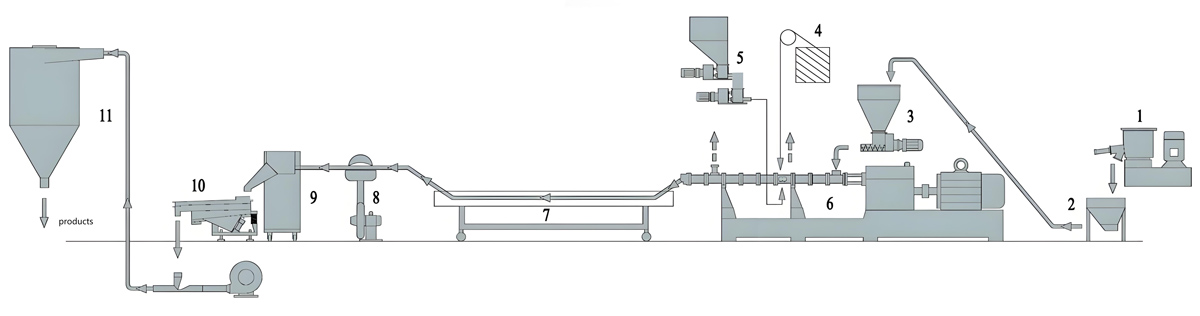
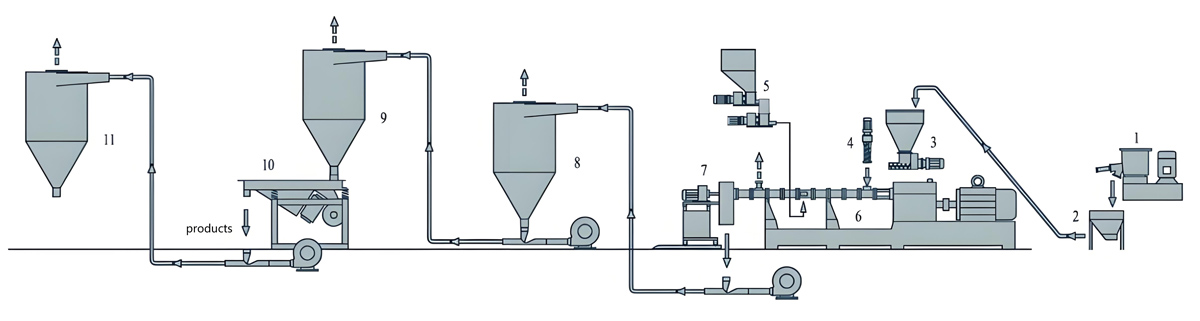
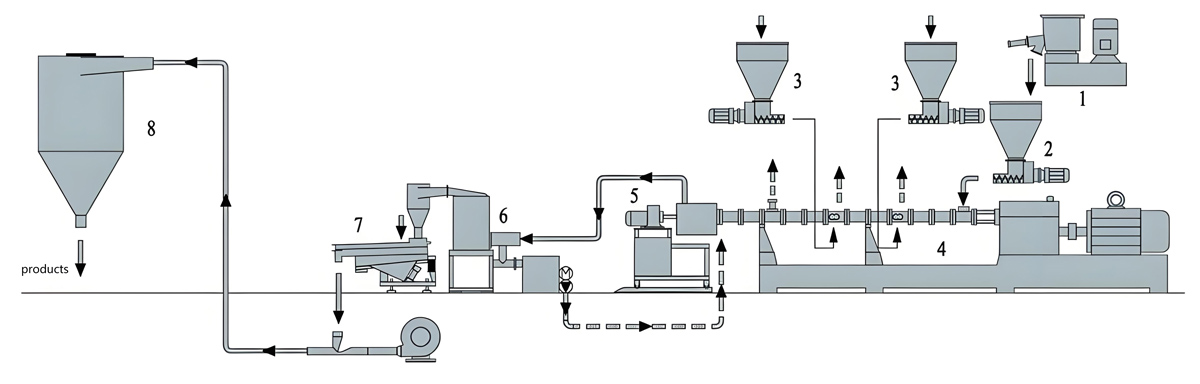
Vacuum degassing occurs in specialized vent zones located along the extruder barrel where vacuum is applied to remove moisture, volatiles, and other gases from the polymer melt. The vacuum exhaust system typically includes 1 to 3 vent zones depending on the formulation degassing requirements, with vacuum levels typically maintained at 100 to 700 mbar absolute pressure depending on the specific application. The vacuum system removes moisture, low molecular weight volatiles, and any gases generated during processing, preventing bubble formation, voids, and other defects in the final product.
Production Equipment Introduction
The KTE Series vacuum exhaust twin screw extruder from Nanjing Kerke Extrusion Equipment Company represents the technological forefront of TPO/TPV blend masterbatch production equipment, incorporating advanced vacuum exhaust systems and degassing technology specifically engineered for volatile removal and moisture elimination. The KTE Series vacuum exhaust model provides comprehensive degassing capability while maintaining the performance and product consistency required for demanding applications. This exceptional vacuum exhaust capability enables production with minimal defects while allowing processing of materials with higher moisture content than would be acceptable in conventional extrusion.
Vacuum exhaust system design in the KTE Series extruder incorporates multiple vent zones with specialized vent port configurations that maximize degassing efficiency while preventing material entrainment in the vacuum stream. The vent zones typically include flooded vent designs that allow the melt to form a seal, preventing material loss through the vacuum system while allowing gases to escape. The vacuum system includes high-capacity vacuum pumps capable of maintaining vacuum levels from 100 to 700 mbar absolute pressure depending on the specific degassing requirements, with automatic vacuum control maintaining optimal vacuum conditions throughout processing.
Screw design for TPO/TPV blend processing in the KTE Series vacuum exhaust extruder incorporates optimized geometries that provide excellent mixing while enabling effective vacuum degassing. The screw profile typically includes efficient melting sections, multiple mixing zones with kneading blocks arranged to provide dispersive mixing while allowing gases to migrate toward the vent zones, and special seal sections that form melt seals around vent ports to prevent material loss. The modular screw design enables custom configuration based on specific formulation degassing requirements and mixing needs while maintaining the vacuum exhaust characteristics essential for TPO/TPV blend processing.
Heating and cooling systems for TPO/TPV blend processing in the KTE Series vacuum exhaust extruder employ advanced heating elements and temperature sensors that maintain precise control despite the presence of vacuum zones. The barrel is divided into 8 to 14 independently controlled heating zones, with special heating and cooling arrangements around vent zones to maintain temperature control in these critical areas. The vent zone heating is carefully controlled to prevent temperature drops that could cause viscosity changes and affect degassing efficiency. Active cooling systems provide the thermal management capability required to maintain appropriate processing temperatures throughout the extruder.
Parameter Settings for TPO/TPV Blend Masterbatch Production
Temperature profile management for TPO/TPV blend masterbatch production requires careful optimization to achieve efficient processing while maintaining material properties. A typical temperature profile begins at 180 to 200 degrees Celsius in the feed zone to initiate gradual softening of the TPO/TPV materials. The temperature gradually increases through the transition zones to 190 to 210 degrees Celsius in the main mixing sections, then peaks at 200 to 220 degrees Celsius in the final zones before the die, ensuring the material maintains appropriate viscosity for extrusion while staying below the degradation thresholds of the components. The thermal management system automatically maintains these temperatures despite process variations.
Screw speed selection for TPO/TPV blend processing balances mixing requirements against residence time and degassing effectiveness. Typical screw speeds range from 150 to 350 RPM depending on the specific TPO/TPV grade, formulation viscosity, and required mixing intensity. Higher viscosity formulations typically require lower screw speeds of 150 to 250 RPM to ensure adequate residence time for mixing and degassing, while lower viscosity formulations may be processed at higher speeds of 200 to 350 RPM. The vacuum exhaust extruder’s control system continuously monitors vacuum levels and melt quality, automatically adjusting screw speed to maintain optimal degassing conditions while ensuring adequate mixing.
Vacuum level settings are critical for effective degassing while preventing material entrainment or excessive melt foaming. Typical vacuum levels range from 100 to 700 mbar absolute pressure depending on the formulation and degassing requirements. For moisture removal applications, vacuum levels of 300 to 500 mbar are typically adequate, while removal of low molecular weight volatiles may require higher vacuum levels of 100 to 300 mbar. The control system automatically maintains vacuum levels within plus or minus 20 mbar of the setpoint, making micro-adjustments throughout the production run to compensate for variations in volatile content or processing conditions.
Residence time distribution in TPO/TPV blend processing influences mixing quality and degassing effectiveness, with adequate residence time being essential for volatile removal. Total residence times typically range from 1.5 to 3 minutes depending on screw configuration, mixing requirements, and degassing needs. The vacuum exhaust system is designed to provide sufficient residence time in vent zones to allow effective degassing while maintaining overall throughput. The control system monitors residence time through material flow modeling and can adjust processing parameters to maintain optimal residence time distribution when processing different formulations.
Equipment Pricing
Investment in vacuum exhaust twin screw extrusion equipment for TPO/TPV blend masterbatch production represents a substantial capital commitment reflecting the advanced vacuum exhaust system and degassing capability required for volatile removal. Complete production lines including the vacuum exhaust extruder, feeding systems, vacuum pumps and controls, pelletizing equipment, and auxiliary systems typically range from $500,000 to $2,500,000 depending on production capacity and vacuum system capability. Small-capacity systems processing 100 to 300 kilograms per hour typically cost $500,000 to $900,000, while medium-capacity systems processing 300 to 800 kilograms per hour range from $900,000 to $1,600,000. Large-capacity systems processing 800 to 2,500 kilograms per hour require investments of $1,600,000 to $2,500,000.
The KTE Series vacuum exhaust twin screw extruder itself typically represents approximately 55 to 65 percent of the total system cost, reflecting the advanced vacuum exhaust system and specialized construction involved. KTE Series vacuum exhaust extruders for TPO/TPV blend processing range from $280,000 for 50mm diameter systems to $1,500,000 for 120mm diameter systems, depending on screw length, number of vent zones, and vacuum system capacity. The vacuum exhaust system adds approximately 20 to 30 percent to the base extruder cost compared to conventional extruders of equivalent capacity, but provides substantial returns through reduced defects and enhanced processing capability.
Additional equipment costs include vacuum pumps and control systems, typically costing $40,000 to $120,000 depending on vacuum capacity and control sophistication. Feeding systems for TPO/TPV blends typically cost $40,000 to $100,000 depending on the number of components and required accuracy. Pelletizing equipment typically costs $30,000 to $80,000 depending on pellet type and capacity. Auxiliary systems including material handling and control systems add $90,000 to $220,000 depending on throughput requirements and automation level.
Production Problems and Solutions
Inadequate degassing represents one of the most serious production problems that can occur during TPO/TPV blend masterbatch manufacturing, causing bubbles, voids, surface defects, and reduced mechanical properties in the final product. Inadequate degassing typically results from insufficient vacuum level, inadequate vent zone configuration, excessive throughput rate that limits residence time in vent zones, or excessive melt viscosity that prevents gas migration to vent ports. Even minor degassing deficiencies can cause significant product quality issues that may render the material unsuitable for demanding applications.
Solution and prevention of inadequate degassing begin with the vacuum exhaust system design that provides comprehensive degassing capability. The vent zone configuration is optimized for the specific formulation characteristics, ensuring adequate melt surface renewal and gas migration to vent ports. The vacuum system provides sufficient capacity to maintain required vacuum levels throughout production. The control system monitors vacuum levels and melt quality continuously, automatically adjusting processing parameters to maintain optimal degassing. For particularly challenging formulations requiring extensive degassing, the system can recommend multiple vent zone configurations or adjustments to screw speed and throughput to enhance degassing effectiveness.
Material entrainment in the vacuum system manifests as material loss, vacuum system contamination, and potential equipment damage. Material entrainment typically results from improper vent zone seal formation, excessive vacuum levels that pull material through vent ports, or melt viscosity too low to maintain seal formation around vent ports. Even minor material entrainment can cause significant material loss and vacuum system contamination, potentially requiring extensive cleaning and system downtime.
Solution and prevention of material entrainment involve careful vent zone design and vacuum level optimization. The vent zones incorporate flooded vent designs with specialized screw geometries that create melt seals preventing material loss while allowing gases to escape. The control system monitors vacuum levels and can automatically adjust vacuum to optimal levels for the specific formulation. For formulations prone to entrainment, the system can recommend specific screw configuration modifications that enhance seal formation or suggest processing parameter adjustments such as increased screw speed to improve melt seal characteristics.
Vacuum system contamination and fouling manifest as reduced vacuum pump efficiency, increased maintenance requirements, and potential system failure. Contamination results from entrainment of volatiles, degradation products, or fine particulates in the vacuum stream, which can accumulate in vacuum pumps and control valves. Gradual contamination reduces vacuum system performance, eventually leading to degassing deficiencies and product quality problems if not addressed through regular maintenance.
Solution and prevention of vacuum system contamination begin with vent zone designs that minimize entrainment of fine particulates and volatiles. The vacuum system includes filters and traps that capture entrained materials before they reach vacuum pumps, protecting pump components from contamination. Regular maintenance of filters and traps ensures they continue to provide effective protection. The control system monitors vacuum pump performance parameters such as power consumption and oil quality, detecting signs of contamination before they cause system failure and scheduling preventive maintenance to prevent downtime.
Inconsistent vacuum levels manifest as variations in degassing effectiveness, resulting in inconsistent product quality and occasional defect formation. Inconsistent vacuum typically results from vacuum pump capacity limitations during volatile spikes, leakage in the vacuum system, or control system malfunctions that prevent proper vacuum regulation. Vacuum level variations of just 50 to 100 mbar can significantly affect degassing effectiveness, particularly for formulations requiring precise vacuum control.
Solution for inconsistent vacuum levels involves vacuum system optimization and control system enhancement. The vacuum exhaust system includes high-capacity pumps capable of handling volatile spikes while maintaining stable vacuum levels. The control system employs advanced vacuum regulation algorithms that compensate for variations in volatile content and processing conditions. For applications requiring extremely tight vacuum control, the system can be configured with redundant vacuum pumps and enhanced control systems to maintain vacuum stability within plus or minus 10 mbar throughout the production run.
Maintenance and Maintenance
Regular maintenance of vacuum exhaust twin screw extruders for TPO/TPV blend processing is essential for maintaining the degassing capability and product quality required for consistent production. Temperature control system maintenance includes quarterly calibration of all temperature sensors against traceable standards to ensure accuracy within plus or minus 1 degree. Heater elements should be tested for proper operation and replaced if any zones show signs of degraded performance or inconsistent heating. Cooling system maintenance includes verification of airflow or coolant flow rates, cleaning of cooling passages, and calibration of cooling control systems.
Vacuum system maintenance is particularly important for vacuum exhaust extruders to ensure consistent degassing performance. Vacuum pump maintenance includes regular oil analysis and oil changes at intervals specified by the pump manufacturer, typically every 3 to 6 months depending on operating conditions. Vacuum filters and traps should be inspected weekly and cleaned or replaced as needed to maintain effective filtration of entrained materials. Vacuum seals and gaskets should be inspected monthly for wear or damage and replaced as needed to prevent vacuum leaks that could degrade system performance.
Screw and barrel maintenance requires regular inspection for wear and degradation product buildup that can affect mixing efficiency and vent zone performance. Monthly visual inspection of screw and barrel should be performed, with particular attention to vent zone areas where degradation products may accumulate. Measurements of screw and barrel dimensions should be performed quarterly to detect wear before it affects product quality or degassing performance. The control system can track wear patterns and predict when maintenance will be required based on historical wear rates.
Drive system maintenance includes regular oil analysis of the gearbox, inspection of coupling alignment, and verification of motor performance. Gearbox oil should be analyzed monthly for signs of wear particles or thermal degradation, with oil changes performed every 6 to 12 months depending on operating conditions. Coupling alignment should be checked quarterly to prevent vibration that could affect vacuum system performance. The control system monitors drive system parameters and can detect early signs of problems before they affect product quality or system reliability.
Frequently Asked Questions
What degassing capability is provided by vacuum exhaust twin screw extruders? The KTE Series vacuum exhaust twin screw extruder provides comprehensive degassing capability for moisture, volatiles, and other gases typically found in TPO/TPV blend masterbatch formulations. The vacuum system can remove up to 99.5 percent of moisture and volatile components, with vacuum levels adjustable from 100 to 700 mbar absolute pressure to optimize degassing for specific formulations. The system includes multiple vent zones that can be configured for the specific degassing requirements of each formulation, providing flexibility to handle materials with widely varying volatile content.
How does vacuum exhaust capability benefit TPO/TPV blend masterbatch quality compared to conventional extruders? Vacuum exhaust capability provides significant benefits for TPO/TPV blend masterbatch product quality by eliminating bubbles, voids, and other defects caused by moisture and volatiles. The removal of volatiles prevents surface defects that can affect appearance and performance. The degassing process also removes low molecular weight components that could migrate to the surface and cause property changes during service. Overall, vacuum exhaust technology typically reduces defect rates by 80 to 95 percent compared to conventional extruders while enabling processing of materials with higher moisture content.
What are the maintenance requirements for vacuum exhaust systems compared to conventional extruders? Vacuum exhaust systems require additional maintenance for vacuum pumps, filters, and traps that are not present in conventional extruders. However, the enhanced product quality and reduced defect rates typically justify the additional maintenance requirements. Vacuum pump maintenance typically includes regular oil changes and filter replacement. Vacuum filters and traps require regular inspection and cleaning or replacement. Despite the additional components, the overall maintenance requirements are manageable and the extended intervals between major screw and barrel maintenance due to reduced degradation product accumulation can offset some of the additional vacuum system maintenance.
Can vacuum exhaust extruders process materials other than TPO/TPV blends without performance issues? Yes, vacuum exhaust twin screw extruders can process a wide range of polymers and formulations without performance issues, as the vacuum exhaust system provides benefits for many materials containing moisture or volatiles. The vacuum exhaust capability provides particular advantages for hygroscopic materials, materials containing residual monomers, or formulations requiring removal of processing byproducts. For materials that do not require vacuum degassing, the vacuum system can be operated at reduced levels or disabled, with the equipment providing performance equivalent to conventional extruders.
What is the return on investment for vacuum exhaust twin screw extruders compared to conventional equipment? The return on investment for vacuum exhaust twin screw extruders typically ranges from 24 to 48 months depending on production volume, formulation characteristics, and specific application requirements. Key factors contributing to ROI include defect reduction of 80 to 95 percent compared to conventional extruders, improved product quality enabling premium pricing, reduced material waste from defect reduction, and the ability to process a broader range of materials including those with higher moisture content. The enhanced product quality also provides strategic benefits in customer satisfaction and market position.
Conclusion
Vacuum exhaust twin screw extruder technology provides the enabling technology for consistent, high-quality TPO/TPV blend masterbatch production through effective removal of moisture, volatiles, and processing byproducts. The KTE Series from Nanjing Kerke Extrusion Equipment Company provides the comprehensive vacuum exhaust capability and processing performance required for producing TPO/TPV blend masterbatches with exceptional product consistency and minimal defects. The vacuum exhaust system provides the level of degassing that makes TPO/TPV blend masterbatch production more reliable and quality-consistent while enabling processing of materials that would be challenging or impossible with conventional extrusion equipment.
Successful TPO/TPV blend masterbatch production with vacuum exhaust technology requires attention to formulation design, appropriate processing parameter selection, regular vacuum system maintenance, and careful management of volatile content to optimize degassing effectiveness. The investment in vacuum exhaust technology provides compelling returns through superior product quality, reduced defect rates, enhanced processing capability, and the ability to serve markets with stringent quality requirements. As demand for TPO/TPV blend materials continues growing in automotive and industrial applications, manufacturers equipped with vacuum exhaust twin screw extruders will be well-positioned to capture market opportunities and achieve sustainable competitive advantages.