Introduction
Polybutylene succinate PBS and polybutylene adipate terephthalate PBAT are widely used biodegradable polymers that offer excellent flexibility and processability. The production of PBS/PBAT masterbatch requires flexible processing equipment capable of adapting to varying formulation requirements and production conditions. Variable frequency twin screw extruders provide the precise speed control necessary for optimizing granulation quality while maintaining high productivity in biodegradable polymer processing.
The expanding market for compostable packaging and agricultural films has increased demand for PBS/PBAT masterbatches with tailored properties. Variable frequency drive systems enable manufacturers to adjust processing parameters dynamically to accommodate different blend ratios and additive packages. This flexibility is essential for maintaining product quality while optimizing production efficiency across diverse formulations and production schedules.
Formulation Ratios for PBS/PBAT Masterbatch
PBS/PBAT blend formulations vary based on desired mechanical properties degradation rates and processing characteristics. Different ratio combinations enable customization for specific applications from flexible films to rigid packaging.
PBS/PBAT 80/20 Blend
This formulation emphasizes the mechanical strength and temperature resistance of PBS while incorporating PBAT for flexibility. Typical composition includes 75-85 percent PBS and 15-25 percent PBAT with 2-7 percent total additives. The blend exhibits higher melting point and better stiffness compared to higher PBAT content formulations. Additives include processing aids nucleating agents and thermal stabilizers to enhance processability and final product properties.
PBS/PBAT 60/40 Blend
The 60/40 ratio provides balanced properties suitable for a wide range of applications. Formulation typically contains 55-65 percent PBS and 35-45 percent PBAT with 2-7 percent additives. This blend offers good stiffness combined with flexibility making it versatile for various packaging applications. Additives may include UV stabilizers for outdoor use and slip agents for film applications. Variable frequency control enables optimization of mixing intensity for this balanced formulation.
PBS/PBAT 50/50 Blend
Equal ratio formulations provide a balance between PBS strength and PBAT flexibility. Typical composition ranges from 45-55 percent each polymer with 2-7 percent additives. The blend exhibits moderate melting point and balanced mechanical properties suitable for general purpose applications. Compatibilizers may be required to ensure adequate interface adhesion between the two polymers. Variable frequency drives allow precise adjustment of screw speed to achieve optimal blend morphology.
PBS/PBAT 40/60 Blend
This formulation emphasizes PBAT flexibility with PBS providing stiffness and temperature resistance. Typical composition includes 35-45 percent PBS and 55-65 percent PBAT with 2-7 percent additives. The blend offers excellent flexibility and good elongation suitable for film applications. Additives include anti-blocking agents and processing aids for film production. Variable frequency control enables processing at lower screw speeds to minimize shear heating of the PBAT dominant formulation.
PBS/PBAT 20/80 Blend
This formulation primarily uses PBAT for flexibility with PBS providing stiffness and cost reduction. Typical composition ranges from 15-25 percent PBS and 75-85 percent PBAT with 2-7 percent additives. The blend exhibits excellent elongation and low temperature flexibility suitable for stretch films and agricultural applications. Additives include thermal stabilizers and UV absorbers for outdoor applications. Variable frequency drives allow operation at optimized speeds for energy efficiency with this PBAT rich formulation.
Production Process
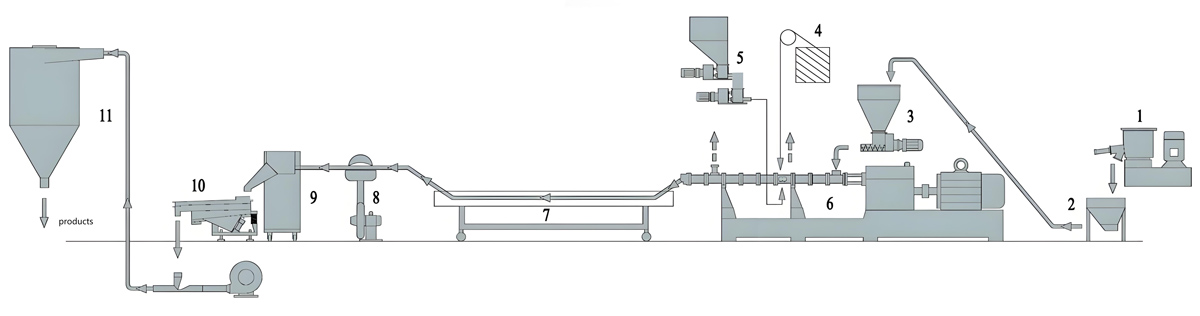
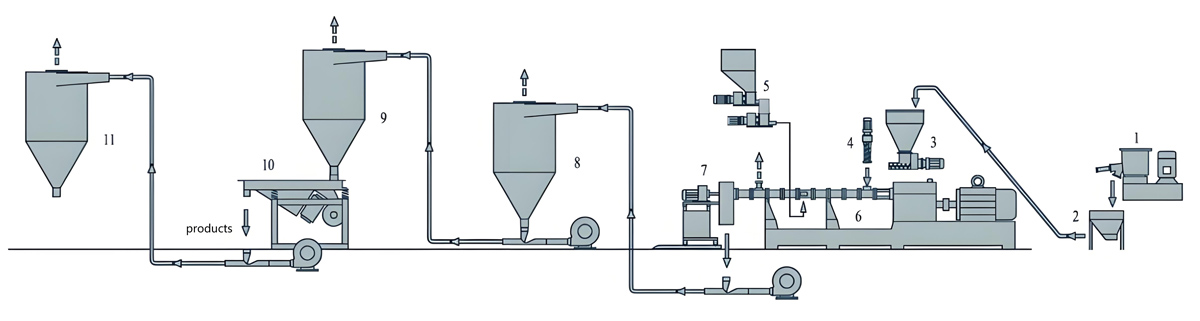
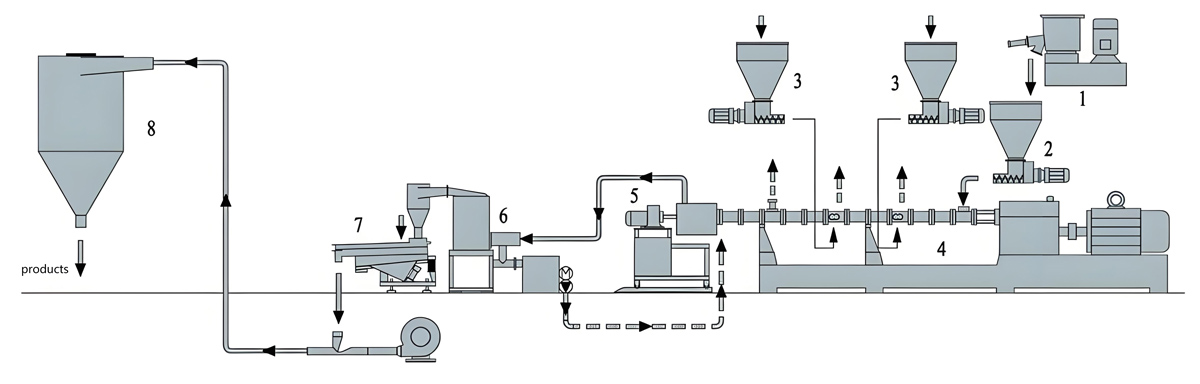
The PBS/PBAT masterbatch production process involves multiple stages that benefit from variable frequency control for optimal processing flexibility and product quality.
Material Drying
PBS and PBAT require thorough drying before processing to prevent hydrolytic degradation during extrusion. PBS typically requires drying at 70-80°C for 4-6 hours to reduce moisture below 0.05 percent while PBAT requires 70-80°C for 3-5 hours for moisture below 0.1 percent. The variable frequency controlled dryer fans optimize air circulation for efficient drying while minimizing energy consumption. Proper drying is essential for maintaining molecular weight and mechanical properties of the final masterbatch.
Feeding System
Gravimetric feeders deliver precise quantities of PBS and PBAT to the extruder maintaining accurate blend ratios. Variable frequency drives on feeder motors enable precise control of feed rates and rapid adjustment between formulations. The feeding system must accommodate the different bulk densities and flow characteristics of PBS and PBAT. Liquid additives can be injected downstream through metered systems with variable speed pumps for accurate dosing.
Melting and Compounding
The melting zone applies thermal and mechanical energy to melt both polymers and begin the blending process. Temperature progression typically starts at 120-130°C for PBAT melting then increases to 140-160°C for PBS melting. Variable frequency screw speed control enables optimization of melting efficiency based on formulation and throughput requirements. The adjustable screw speed allows balancing of residence time and shear intensity for optimal polymer melting without degradation.
Blend Homogenization
The mixing zone ensures thorough distribution of PBS and PBAT components throughout the masterbatch. Kneading blocks and mixing elements create dispersive mixing to achieve homogeneous blend morphology. Variable frequency control allows adjustment of mixing intensity based on blend requirements. Higher shear rates improve mixing but may generate excessive heat particularly for PBAT dominant formulations. The adjustable speed enables finding the optimal balance between mixing quality and thermal management.
Additive Incorporation
Additives are injected at appropriate locations along the extruder based on their function and thermal stability. Processing aids are typically added early in the process while slip agents and anti-blocking compounds are added closer to the die. Variable frequency drives on additive pumps enable precise control of addition rates. The timing and rate of additive injection can be synchronized with screw speed changes to maintain consistent additive concentrations throughout production runs.
Degassing Zone
Vent zones remove any residual moisture or volatile components from the melt. Vacuum vents maintain pressures between 30-80 mbar to extract volatiles without polymer loss. Variable frequency vacuum pumps enable optimization of vacuum level based on formulation requirements. The number of vent zones and their operating conditions can be adjusted based on the moisture sensitivity of specific PBS/PBAT formulations. Proper venting ensures final product quality and prevents defects in downstream processing.
Granulation Process
The extruded strand is cooled through water baths or air cooling systems before granulation. Variable frequency conveyors control strand handling speed for optimal cooling and tension management. Strand diameter is monitored and controlled through die design and take-up speed. Granulators with variable speed cutters produce uniform pellets suitable for downstream processing. The adjustable speeds throughout the system enable coordination of all process components for consistent product quality.
Production Equipment Introduction
Variable frequency twin screw extruders offer precise speed control and processing flexibility for PBS/PBAT masterbatch production. The KTE Series from Kerke provides advanced features optimized for biodegradable polymer processing.
Variable Frequency Drive System
The main drive system utilizes high performance variable frequency drives for precise screw speed control. The drives provide wide speed range capability typically 5:1 to 10:1 enabling operation at optimal speeds for different formulations. Soft start capabilities reduce mechanical stress during startup extending equipment life. The drives automatically adjust motor speed to maintain setpoint under varying load conditions. Real-time torque monitoring enables automatic speed adjustment to protect equipment from overload.
High Efficiency Motor
Premium efficiency induction motors provide reliable operation with minimal energy consumption. The motors are specifically sized for biodegradable polymer processing with adequate torque at low speeds for viscous formulations. Enclosed design prevents contamination of motor windings from processing environment. The motors are rated for continuous operation at variable speeds without overheating. Thermal protection systems prevent motor damage under abnormal operating conditions.
Advanced Screw Design
Screw elements are designed for optimal performance across the wide speed range enabled by variable frequency drives. Flight profiles and mixing elements maintain adequate conveying and mixing at low speeds for gentle processing of PBAT rich formulations. At higher speeds the design provides efficient melting and dispersion for PBS dominant formulations. Modular element configuration allows optimization for specific blend ratios and production requirements. The screw design enables efficient processing across the complete speed range.
Precision Temperature Control
Temperature zones are individually controlled with rapid response to setpoint changes. The control system coordinates temperature profiles with screw speed changes to maintain consistent melt quality. Multiple heating zones along the barrel enable precise thermal management of materials with different melting characteristics. Temperature sensors provide feedback for accurate control within plus or minus 1°C. The control system implements temperature ramping during speed changes to prevent thermal shock.
Integrated Feeder Control
The variable frequency drive system is integrated with gravimetric feeders for coordinated operation. Feed rates are synchronized with screw speed to maintain optimal filling degree in the extruder. The system automatically adjusts feeder speeds based on throughput changes to maintain consistent blend ratios. Touch screen interface displays real-time feeder performance and enables manual override when needed. The integrated control ensures consistent formulation regardless of production speed variations.
Granulation System Integration
The extruder drive system is coordinated with downstream granulation equipment. Variable speed conveyors handle strand tension control for consistent pellet size. Granulator cutters synchronize with extrusion rate to maintain consistent pellet length. The system automatically adjusts downstream speeds based on extruder throughput changes. Touch screen monitoring provides real-time feedback of all process speeds. Integration ensures consistent granulation quality across varying production rates.
Process Monitoring System
Comprehensive monitoring systems track all variable frequency controlled components. Real-time display of speeds torques and power consumption for all driven components. Trend graphs show historical performance data for process optimization. Alarm systems alert operators to abnormal conditions such as motor overload or speed deviation. Data logging capabilities support quality control and process improvement initiatives. The monitoring system enables operators to optimize processing conditions for different formulations.
Parameter Settings
Optimal parameter settings for PBS/PBAT masterbatch production leverage variable frequency control for flexibility and quality. Adjustable parameters enable optimization for different formulations and production requirements.
Screw Speed Range
Screw speed settings vary based on formulation and desired throughput. Low speeds of 50-150 RPM are suitable for PBAT rich formulations requiring gentle processing. Medium speeds of 150-250 RPM are typical for balanced PBS/PBAT blends. High speeds of 250-400 RPM enable high throughput processing of PBS dominant formulations. Variable frequency drives enable operation across this entire range with consistent torque delivery. Speed selection balances mixing quality residence time and energy efficiency.
Temperature Profile
Temperature profiles must accommodate the different melting points of PBS and PBAT. Feed zones typically set at 120-130°C for PBAT melting then increase to 140-160°C for PBS melting. Die temperatures maintained at 130-150°C ensure proper flow without degradation. Variable frequency speed changes are coordinated with temperature adjustments to maintain melt quality. The control system implements temperature ramps synchronized with speed changes during production adjustments.
Feeder Synchronization
Feeder rates are synchronized with screw speed to maintain optimal filling degree. The system automatically calculates required feeder speeds based on screw speed and formulation. Filling degree typically maintained between 70-85 percent for optimal processing. Variable frequency feeders provide rapid response to speed changes during production startup and shutdown. The integrated control ensures consistent formulation regardless of processing speed variations.
Vent Zone Operation
Vent zone pressures typically range from 30-80 mbar depending on formulation requirements. Variable frequency vacuum pumps enable adjustment of vacuum level based on processing conditions. Higher vacuum levels improve moisture removal but increase energy consumption. The system automatically adjusts pump speed to maintain setpoint vacuum levels. Number of active vent zones can be varied based on formulation requirements.
Granulation Speeds
Granulation equipment speeds are synchronized with extruder output. Conveyor speeds adjusted to maintain proper strand tension and cooling time. Granulator cutter speed set to achieve desired pellet size typically 2-5mm length. Variable frequency drives enable automatic speed adjustment based on extrusion rate changes. The system maintains consistent pellet quality across varying production rates.
Throughput Optimization
Production throughput varies based on formulation and machine size. Throughput ranges from 50-500 kg per hour depending on screw diameter and formulation. Variable frequency drives enable operation at optimal efficiency points rather than fixed speeds. The system can adjust throughput quickly to meet production schedule changes. Energy efficiency is optimized by operating at speeds that balance productivity and power consumption.
Equipment Price
Variable frequency twin screw extruder prices reflect the advanced drive technology and flexibility benefits. Investment considerations include production flexibility and operating cost reduction over equipment lifetime.
Base Extruder Pricing
Entry-level variable frequency extruders with 25mm screw diameter start at approximately 50000 to 70000 US dollars. Mid-range models with 35-45mm screw diameter range from 90000 to 140000 US dollars. Large capacity systems with 65mm or larger screw diameters exceed 220000 US dollars. These prices include the variable frequency drive system and main extruder components but exclude auxiliary equipment.
Variable Frequency Drive Costs
Advanced variable frequency drive systems add 15000 to 35000 US dollars to base extruder cost depending on power rating and features. High performance drives with vector control capabilities cost more than basic models. The drives include motor protection features and communication interfaces for system integration. Premium drives offer advanced features such as energy monitoring and regenerative braking capabilities.
Feeder System Costs
Variable frequency controlled gravimetric feeders cost 12000 to 20000 US dollars each. Complete feeding systems with multiple feeders and integrated control range from 40000 to 100000 US dollars. The feeders synchronize with extruder speed for consistent formulation control. Advanced feeding systems with automatic refill and bulk handling capabilities add additional cost. Investment in accurate feeding is essential for quality PBS/PBAT masterbatch production.
Granulation Equipment Costs
Variable frequency controlled granulation systems range from 25000 to 60000 US dollars. Systems include variable speed conveyors and granulators with synchronized operation. Advanced systems with automatic size sorting and reject handling cost 45000 to 80000 US dollars. Integration with extruder drive system requires additional programming and control hardware. Granulation system selection should match production requirements and quality standards.
Operational Benefits
Variable frequency drives provide operational benefits that offset initial investment. Energy savings of 10-25 percent compared to fixed speed operation through optimized speed selection. Reduced maintenance costs due to soft start capabilities reducing mechanical stress. Production flexibility enables fast changeover between formulations reducing downtime. Consistent product quality across varying production conditions improves customer satisfaction. Energy monitoring capabilities identify additional efficiency opportunities.
Total Investment Analysis
A complete variable frequency controlled PBS/PBAT masterbatch production line typically requires investment between 250000 and 600000 US dollars for medium capacity production. Large capacity fully integrated systems may exceed 1200000 US dollars. The flexibility and efficiency benefits provide attractive return on investment through reduced operating costs and improved production capability. Total cost of ownership analysis over 10 years shows significant savings compared to fixed speed systems due to energy efficiency and production flexibility.
Production Problems and Solutions
PBS/PBAT masterbatch production may encounter various processing challenges. Variable frequency control provides solutions to many common problems while maintaining product quality and production efficiency.
Inconsistent Blend Ratio
Problem Analysis: Variations in blend ratio between PBS and PBAT affect mechanical properties and processing characteristics. Causes include feeder calibration errors material flow variations or synchronization issues between feeders and extruder. Variable frequency control enables automatic adjustment to maintain consistent ratios. Inconsistent blending leads to product quality variations and customer dissatisfaction.
Solutions: Recalibrate gravimetric feeders according to manufacturer procedures. Verify material flow characteristics and adjust feeder parameters accordingly. Check variable frequency drive settings and ensure proper synchronization with extruder speed. Implement regular feeder performance validation routines. Use touch screen monitoring to detect ratio deviations in real time. Replace worn feeder components such as screws and weigh cells.
Prevention Methods: Establish scheduled calibration intervals for all feeders. Implement routine feeder maintenance including cleaning and inspection. Use loss-in-weight feeders for highest accuracy and consistency. Maintain spare parts inventory for critical feeder components. Train operators on feeder operation and troubleshooting. Develop standard procedures for feeder changeover between different materials.
Thermal Degradation
Problem Analysis: Thermal degradation of PBS and PBAT results in molecular weight loss and impaired properties. Symptoms include yellowing reduced viscosity and increased brittleness. Causes include excessive temperatures prolonged residence time or high shear rates. Variable frequency control allows reduction of screw speed to decrease shear heating while maintaining throughput through longer residence time.
Solutions: Reduce barrel temperatures to minimum required levels while maintaining proper melt viscosity. Decrease screw speed through variable frequency control to reduce shear heating. Increase feed rate to reduce residence time without compromising mixing. Add thermal stabilizers to the formulation compatible with end use requirements. Optimize screw configuration to minimize high shear zones. Monitor melt viscosity regularly to detect degradation early.
Prevention Methods: Establish maximum temperature and residence time limits for different formulations. Use polymer grades with appropriate thermal stability for intended processing conditions. Monitor energy consumption patterns that may indicate degradation. Train operators on proper temperature profile settings. Implement statistical process control based on torque and pressure data to detect processing variations.
Pellet Size Variations
Problem Analysis: Non-uniform pellet size affects downstream processing and customer quality requirements. Causes include extrusion rate variations inconsistent strand diameter or granulator speed fluctuations. Variable frequency control enables synchronization of all system components to maintain consistent pellet size. Size variations may cause feeding problems in customer processing equipment.
Solutions: Implement closed-loop control of granulator speed based on extrusion rate. Install automatic strand diameter monitoring with feedback control. Ensure uniform die temperature to prevent flow variations. Calibrate variable frequency drives for consistent speed regulation. Implement automatic cut length control systems. Regularly maintain cutting knives and replace as needed.
Prevention Methods: Establish standard operating procedures for pelletizing equipment. Regularly maintain cutting knives and replace according to schedule. Monitor strand diameter and granulator performance continuously. Implement quality control sampling to detect size variations early. Train operators on proper pelletizing equipment adjustment and troubleshooting.
Vent Blockage Issues
Problem Analysis: Vent ports can become blocked by material carryover reducing moisture removal efficiency. This leads to excessive moisture content causing bubbles and reduced properties. Causes include excessive feed rate insufficient vent port diameter or material bridging. Variable frequency control allows adjustment of processing conditions to prevent blockage.
Solutions: Increase vent port diameter or add multiple vent ports to improve capacity. Adjust feed rate and screw speed through variable frequency control to reduce material carryover. Implement vent stuffer screws to prevent material blockage. Use atmospheric vents before vacuum vents to remove bulk material. Optimize vent zone temperature to prevent material solidification. Adjust vacuum pump speed for optimal vent operation.
Prevention Methods: Establish regular vent port cleaning schedules based on operating hours. Monitor vacuum levels continuously and track trends. Implement automated vent cleaning systems for continuous operation. Design screw configuration to minimize material carryover into vent zones. Train operators to recognize symptoms of vent blockage such as increased die pressure.
Melt Viscosity Fluctuations
Problem Analysis: Variations in melt viscosity affect processing and final product properties. Causes include inconsistent blend ratio temperature fluctuations or polymer degradation. Variable frequency drive systems maintain consistent processing conditions through precise speed control. Viscosity fluctuations may cause granulation problems and product quality variations.
Solutions: Verify gravimetric feeder calibration and operation for consistent blend ratio. Implement strict drying procedures to maintain consistent moisture content. Optimize temperature control to minimize fluctuations through variable frequency coordination. Monitor energy consumption patterns to detect changes in material behavior. Use torque monitoring to detect viscosity changes in real time.
Prevention Methods: Establish incoming material testing for moisture and viscosity. Implement regular calibration of all feeders and temperature sensors. Use statistical process control based on torque and pressure data. Maintain detailed records of processing conditions for each production run. Train operators to recognize symptoms of viscosity variations through equipment behavior changes.
Maintenance and Care
Proper maintenance ensures reliable operation and extends equipment life. Variable frequency drive systems require specific maintenance procedures to maintain optimal performance.
Daily Maintenance
Daily maintenance includes checking oil levels in gearboxes and lubrication points. Monitor variable frequency drive displays for fault codes or warnings. Inspect all temperature sensors for proper operation. Check cooling systems for motors and variable frequency drives. Verify that all cooling fans are operating properly. Document any unusual observations or fault codes in the maintenance log.
Weekly Maintenance
Weekly maintenance involves inspecting electrical connections on variable frequency drives for tightness and security. Check all seals and gaskets for leaks that could affect performance. Test safety interlocks and emergency stop systems. Clean or replace air filters on control cabinets and drive enclosures to maintain proper cooling. Verify accuracy of feeder calibrations. Inspect granulation equipment for wear and proper operation.
Monthly Maintenance
Monthly maintenance includes changing gearbox oil according to manufacturer recommendations. Inspect heater bands and thermocouples for proper function. Check alignment of drive system components. Test all alarm and safety systems. Review variable frequency drive parameter settings to ensure they match current operating requirements. Inspect all driven components for abnormal wear or vibration.
Quarterly Maintenance
Quarterly maintenance involves removing and inspecting screw elements for wear patterns. Measure screw and barrel dimensions to monitor wear rates. Inspect motor bearings and replace if necessary. Check variable frequency drive cooling systems for proper operation. Test emergency stop circuits and safety systems thoroughly. Review maintenance records to identify developing trends.
Annual Maintenance
Annual maintenance includes comprehensive inspection of all major components by qualified technicians. Replace worn parts according to manufacturer recommendations and maintenance history. Realign drive system if necessary. Test and calibrate all variable frequency drives according to manufacturer procedures. Review and update maintenance procedures based on operating experience. Conduct thorough safety inspection and testing of all safety interlocks.
Variable Frequency Drive Maintenance
Variable frequency drives require specific maintenance to ensure reliable operation. Regularly check cooling fans and heat sinks for proper operation and cleanliness. Verify that all electrical connections remain tight and secure. Monitor drive operating temperatures to ensure proper cooling. Back up drive parameter settings regularly. Update drive firmware according to manufacturer recommendations. Implement scheduled cleaning of drive enclosures to prevent dust accumulation.
FAQ
What are the main advantages of variable frequency control for PBS/PBAT processing?
Variable frequency control provides precise speed adjustment enabling optimization for different PBS/PBAT formulations. The ability to reduce screw speed minimizes shear heating for PBAT rich formulations preventing degradation. Higher speeds enable efficient processing of PBS dominant formulations. Synchronized control of feeders and granulation equipment maintains consistent product quality. Energy efficiency is improved by operating at optimal speeds rather than fixed settings. Production flexibility allows rapid changeover between different formulations.
How do I optimize screw speed for different PBS/PBAT blend ratios?
Screw speed optimization depends on blend composition and desired product properties. PBAT rich formulations typically require lower speeds of 50-150 RPM to minimize shear heating. Balanced blends work well at medium speeds of 150-250 RPM for adequate mixing. PBS dominant formulations can use higher speeds of 250-400 RPM for efficient melting and dispersion. The variable frequency drive enables quick adjustment between these ranges. Start with manufacturer recommendations and fine-tune based on product quality and energy consumption.
What is the typical energy savings with variable frequency drives?
Variable frequency drives typically provide 10-25 percent energy savings compared to fixed speed operation. Soft start capabilities reduce inrush current saving energy during startup. Operating at optimal speeds rather than maximum reduces energy consumption during normal operation. Regenerative braking capabilities in some drives recover energy during deceleration. Energy monitoring features identify additional optimization opportunities. Actual savings depend on operating conditions formulation requirements and production schedule.
How do I troubleshoot variable frequency drive fault codes?
Variable frequency drives display fault codes indicating specific problems. Common codes include over temperature overload over current and under voltage conditions. Check the drive manual for specific code meanings and recommended actions. Verify that cooling systems are operating properly for over temperature faults. Reduce load or speed for overload and over current conditions. Check power supply for under voltage problems. Document all fault codes and corrective actions for trend analysis. Contact technical support for persistent or unclear fault conditions.
What maintenance is required for variable frequency drives?
Variable frequency drives require regular maintenance for reliable operation. Clean cooling fans and heat sinks periodically to ensure proper heat dissipation. Check all electrical connections for tightness and security at scheduled intervals. Monitor drive operating temperatures and investigate any increases. Back up parameter settings regularly to prevent loss during failures. Update firmware according to manufacturer recommendations to access performance improvements and bug fixes. Inspect drive enclosures for proper sealing to prevent dust and moisture ingress.
How can I synchronize feeder speeds with extruder operation?
Feeder synchronization is typically achieved through integrated control systems. Gravimetric feeders with variable frequency drives communicate with the extruder control system. The control system automatically calculates required feeder speeds based on screw speed and formulation. Touch screen interfaces display real-time feeder performance and enable manual adjustment. Setpoint ratios between feeder speeds and screw speed are maintained by the control system. Regular calibration ensures accurate feeding across the operating speed range.
What is the typical payback period for variable frequency drive investment?
The payback period for variable frequency drive investment typically ranges from 2 to 5 years depending on operating conditions and energy costs. Energy savings of 10-25 percent provide annual savings of 5000 to 20000 US dollars depending on equipment size. Production flexibility benefits reduce changeover time and improve capacity utilization. Reduced maintenance costs due to soft start capabilities contribute additional savings. High utilization operations above 5000 hours annually achieve faster payback periods. Life cycle cost analysis shows significant savings over 10 years despite higher initial investment.
How does variable frequency control affect product quality?
Variable frequency control improves product quality through better process control and consistency. Precise speed control enables optimization of mixing and residence time for each formulation. Synchronized operation of all system components maintains consistent product dimensions. Reduced shear heating for sensitive formulations prevents thermal degradation. Stable operating conditions reduce quality variations between batches. The flexibility to adjust processing conditions quickly helps maintain quality during formulation changes or raw material variations.
Conclusion
Variable frequency twin screw extruders provide the processing flexibility and precision required for PBS/PBAT masterbatch production. The KTE Series from Kerke offers advanced features including high performance variable frequency drives integrated feeder control and synchronized granulation systems. The ability to adjust processing parameters dynamically enables optimization of different blend ratios and additive packages while maintaining consistent product quality.
The growing demand for biodegradable packaging and agricultural films continues to drive market growth for PBS/PBAT masterbatches. Variable frequency control technology enables manufacturers to meet this demand efficiently while reducing energy consumption and operating costs. Proper equipment selection parameter optimization and comprehensive maintenance programs ensure reliable operation and optimal productivity in biodegradable polymer masterbatch manufacturing.