Introduction
TPU soft masterbatch represents a specialized category of color and additive concentrates designed for thermoplastic polyurethane applications. TPU materials are known for their exceptional elasticity, abrasion resistance, and flexibility properties across a wide temperature range. The production of TPU masterbatch requires specialized processing equipment and careful consideration of formulation to maintain the inherent flexibility and performance characteristics of the base polymer. Variable speed twin screw extruders have become the preferred equipment for TPU masterbatch manufacturing due to their ability to provide precise control over shear rates, mixing efficiency, and residence time.
The masterbatch concept involves concentrating pigments, additives, or functional ingredients into a carrier resin that can be later diluted during the final product manufacturing process. This approach offers significant advantages in handling, dispersion quality, and cost-effectiveness compared to direct addition of pigments or additives. TPU soft masterbatch must be formulated to maintain compatibility with the host TPU resin while providing the desired coloration or functional properties without compromising the material’s unique mechanical properties.
Variable speed twin screw extruders provide the necessary flexibility for TPU masterbatch production by allowing operators to adjust screw speed independently from output rate. This capability is particularly important for TPU materials, which are sensitive to excessive shear and temperature. The ability to optimize screw speed enables precise control over melt temperature, residence time, and dispersion quality, all of which are critical factors in producing high-quality TPU masterbatch. Modern twin screw extruders with advanced control systems can maintain consistent processing conditions even when formulation variations occur.
The market for TPU masterbatch continues to expand as TPU materials find applications in footwear, automotive components, consumer electronics, medical devices, and industrial products. Each application category may have specific requirements for color, UV stability, flame retardancy, or other functional properties. Masterbatch manufacturers must be capable of producing specialized concentrates that meet these varied requirements while maintaining the flexibility and performance characteristics that make TPU materials valuable. Variable speed processing equipment provides the versatility needed to serve this diverse market effectively.
Formulation Ratios for Different TPU Masterbatch Types
Color masterbatch formulations for TPU applications typically contain pigment concentrations between 15 to 50 percent by weight, depending on the pigment type, desired color strength, and let-down ratio in the final application. Organic pigments generally require higher loading levels than inorganic pigments due to their lower tinting strength. For example, a typical red organic pigment masterbatch might contain 30 to 40 percent pigment, while a titanium dioxide white masterbatch might reach 50 percent loading. The carrier resin selection must ensure compatibility with the host TPU material, typically using the same TPU grade or a compatible TPU variant with similar hardness and chemical composition.
UV stabilizer masterbatch for TPU applications usually contains hindered amine light stabilizers and UV absorbers at concentrations ranging from 10 to 25 percent. These additives protect TPU materials from degradation caused by UV exposure, which is particularly important for outdoor applications. The formulation must ensure that the stabilizers remain effective throughout the expected service life of the final product. Higher stabilizer loadings may be necessary for applications with intense UV exposure, such as automotive exterior components or outdoor sporting goods. The dispersion quality achieved during masterbatch production directly affects the protective performance of the final product.
Flame retardant masterbatch for TPU requires careful formulation to achieve the required fire resistance ratings without significantly compromising the material’s flexibility and mechanical properties. Halogenated flame retardants typically contain 20 to 40 percent active ingredient, while phosphorus-based systems may require 30 to 50 percent loading. The selection of flame retardant chemistry depends on the required fire rating, environmental regulations, and end-use application. The masterbatch must ensure homogeneous distribution of flame retardant particles to achieve consistent fire protection throughout the final product.
Antimicrobial masterbatch formulations for TPU contain silver ions, zinc pyrithione, or other antimicrobial agents at concentrations of 1 to 5 percent. Despite the low active ingredient loading, achieving uniform dispersion is critical to ensure consistent antimicrobial performance across the final product surface. The carrier resin must be compatible with both the antimicrobial agent and the host TPU material. These masterbatches are particularly important for medical devices, footwear, and consumer products where antimicrobial protection provides added value and product differentiation.
Soft feel masterbatch for TPU incorporates silicone oils, modified polysiloxanes, or other slip agents at concentrations of 5 to 20 percent to enhance the tactile properties of the final product. The formulation must maintain the soft feel effect throughout the product lifecycle without causing migration issues or affecting other material properties. The dispersion quality of the soft feel additives directly impacts the consistency of the tactile sensation across the product surface. Higher loadings may be required for applications where an exceptionally soft feel is desired, such as in premium consumer electronics or automotive interior components.
Conductive masterbatch for TPU contains carbon black, carbon fibers, or metallic fillers at concentrations ranging from 5 to 30 percent depending on the required conductivity level. The formulation must balance electrical conductivity with mechanical properties, as high filler loadings can affect flexibility and elongation. The dispersion quality of conductive fillers is critical to ensure consistent conductivity throughout the final product. Applications include electrostatic discharge protection, electromagnetic interference shielding, and conductive components for electronic devices.
Production Process for TPU Soft Masterbatch
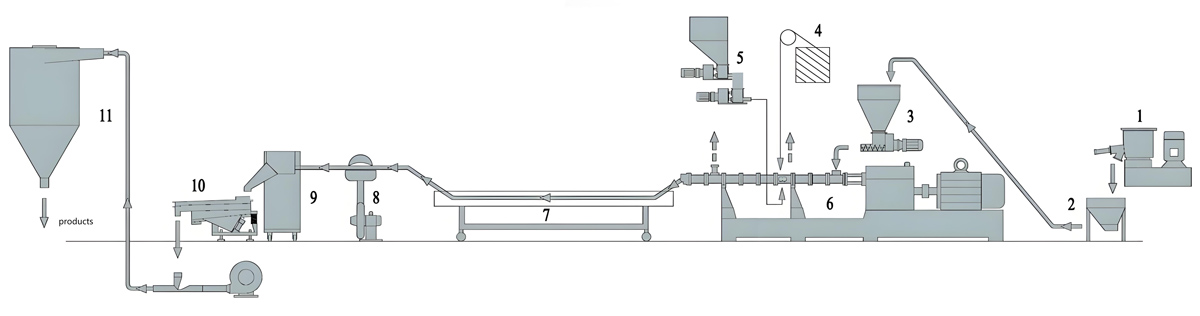
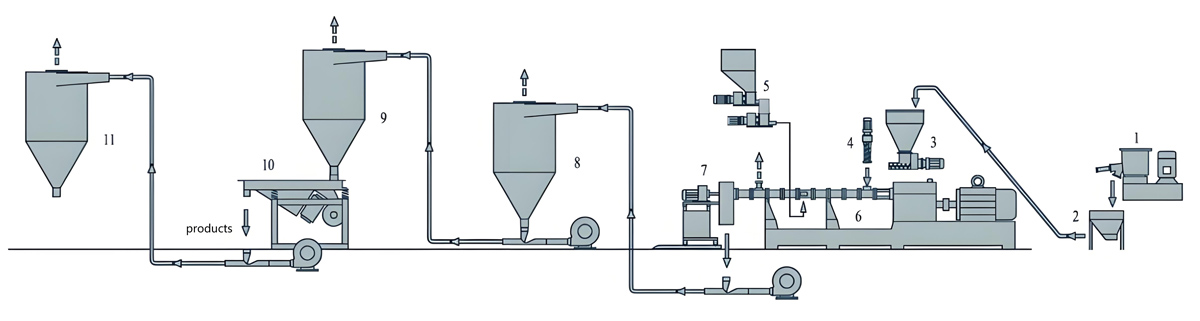
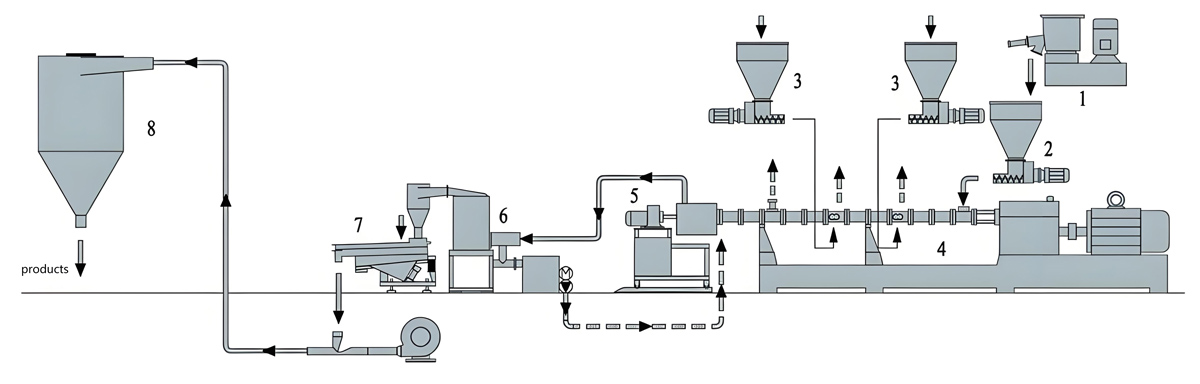
The production process begins with raw material preparation and weighing of all components according to the precise formulation. TPU resin typically arrives in pellet form and may require drying before processing to remove moisture that could cause defects during extrusion. Pigments, additives, and other ingredients must be accurately weighed and pre-mixed to ensure homogeneous distribution before feeding into the extruder. Modern facilities use automated weighing and dosing systems to improve accuracy and reduce batch-to-batch variation. The quality of raw materials, particularly pigment particle size and additive purity, significantly impacts the final masterbatch quality.
Feeding systems for TPU masterbatch production typically employ gravimetric feeders for the main TPU carrier resin and volumetric or gravimetric feeders for pigments and additives. Separate feeding points for different components can improve dispersion quality by controlling when and where each ingredient enters the extrusion process. Some formulations benefit from side feeding of sensitive additives that should not be exposed to the full residence time in the extruder. The feeding system design must ensure consistent material flow and prevent bridging or segregation, particularly when handling fine powders or additives with poor flow characteristics.
The melting and mixing phase occurs in the extruder barrel where the TPU carrier resin is melted and combined with pigments and additives. Variable speed twin screw extruders provide excellent melting efficiency through the intermeshing screw configuration that creates intense distributive and dispersive mixing. The screw configuration must be optimized for TPU materials, typically using elements that provide gentle yet thorough mixing to avoid excessive shear that could degrade the polymer. The barrel temperature profile is carefully controlled, starting lower in the feed zone to prevent premature melting that could cause feeding problems, then increasing through the transition and metering zones to achieve optimal melt viscosity.
Dispersion of pigments and additives is one of the most critical aspects of TPU masterbatch production. The twin screw configuration creates elongational and shear flows that break down pigment agglomerates and distribute additives uniformly throughout the polymer matrix. Variable speed operation allows operators to optimize shear intensity, increasing screw speed for more intensive mixing when processing poorly dispersing pigments, and reducing speed for sensitive additives that could degrade under high shear conditions. The dispersion quality directly affects color strength, additive performance, and final product appearance.
Degassing and venting removes volatile compounds, moisture, and entrapped air from the melt. TPU materials are particularly susceptible to hydrolytic degradation if moisture is present, making effective venting essential. Vent ports are typically located after the melting zone where most volatiles have been released but before the final mixing elements. Vacuum venting may be employed for formulations containing volatile additives or when extremely low moisture levels are required. The vent zone must be designed to prevent polymer melt from being drawn out with the vented gases while still providing adequate surface area for devolatilization.
Filtration removes oversized particles, contaminant materials, and undispersed pigment agglomerates from the melt stream. Screen packs are typically placed after venting but before the die to protect downstream equipment and ensure product purity. The screen mesh size is selected based on the application requirements, typically ranging from 60 to 200 mesh for most masterbatch products. Regular screen changes are necessary as screens can become clogged with contaminants, causing pressure increases and potential quality issues. Some advanced systems use continuous filtration with self-cleaning mechanisms to maintain consistent operation.
Pelletizing converts the continuous melt stream into discrete pellets suitable for storage and subsequent use. Strand pelletizing is commonly employed for TPU masterbatch, where the extrudate is cooled in a water bath and then cut into pellets by rotary knives. Underwater pelletizing provides better temperature control and produces more uniform pellets but requires more complex equipment. Water ring pelletizing represents an intermediate option that can work well for many TPU masterbatch formulations. The pelletizing system must be optimized to prevent pellet deformation or agglomeration, which could affect downstream processing.
Post-processing operations may include drying of pellets, sieving to remove fines and oversized particles, and packaging for shipment or storage. TPU masterbatch pellets are typically dried to remove surface moisture absorbed during water cooling, which can prevent processing issues in subsequent applications. Sieving ensures consistent pellet size distribution, which is important for automated feeding systems in downstream processing. Proper packaging in moisture-barrier materials protects the masterbatch from moisture absorption during storage and maintains product quality over extended shelf life.
Production Equipment Introduction
Twin screw extruders designed for TPU masterbatch production feature several specialized characteristics that optimize performance for this demanding application. The screw design typically incorporates a combination of conveying elements for material transport, kneading blocks for mixing, and special elements for devolatilization and pressure build-up. The L/D ratio, or length-to-diameter ratio, typically ranges from 40:1 to 48:1 for masterbatch applications, providing sufficient barrel length for multiple processing zones while maintaining reasonable capital cost. The screw diameter is selected based on required throughput, with common sizes ranging from 30mm to 100mm for production-scale equipment.
The barrel construction includes multiple independent heating zones with precise temperature control, typically using electric resistance heaters with water cooling for temperature stability. Each zone can be individually controlled to establish the desired temperature profile along the barrel length. Barrel materials must withstand the processing temperatures and corrosive effects of certain additives while providing good heat transfer characteristics. Bimetallic barrels combine wear resistance in the processing zones with corrosion resistance in the vent zones. Advanced barrel designs may include internal channels for improved temperature uniformity.
Variable speed drive systems provide the flexibility to optimize screw speed independently from other processing parameters. Modern extruders use AC or DC vector drives with feedback from torque sensors to maintain consistent operation even when processing conditions vary. The drive system must be sized to provide adequate torque across the operating speed range, particularly important when processing high-viscosity formulations or when high pigment loadings increase melt viscosity. The ability to adjust screw speed enables operators to fine-tune mixing intensity, residence time, and shear history for optimal product quality.
Feeding systems for TPU masterbatch production range from simple gravimetric hoppers to sophisticated multi-component feeding stations. Gravimetric feeders provide the highest accuracy by directly measuring the mass flow rate of each component. Loss-in-weight feeders are commonly used for the main TPU carrier resin, while smaller components may use volumetric feeders calibrated for accuracy. Some systems incorporate gravimetric feeders for all major components to achieve the highest possible formulation accuracy. The feeding system must maintain consistent material flow even when handling fine powders or materials with poor flow characteristics.
The die assembly forms the final shape of the extrudate before pelletizing and must be designed to provide uniform flow distribution across the die opening. Dies for strand pelletizing typically have multiple circular openings arranged to produce the required number of strands. The die land length and approach angle are optimized to balance pressure drop and melt homogeneity. Die materials must resist wear and corrosion while providing good thermal stability. Heating the die prevents premature freezing of the melt and ensures consistent strand dimensions. Some dies incorporate static mixing elements to improve homogeneity before pelletizing.
Pelletizing systems convert the extruded strands into discrete pellets for easy handling and use. Strand pelletizing systems consist of a water cooling bath, haul-off unit, strand guide, and pelletizer with rotary knives. The cooling bath temperature is controlled to achieve the desired strand temperature and properties before cutting. The haul-off unit maintains consistent strand tension, while the pelletizer cuts strands into uniform pellets at the desired length. Underwater pelletizing systems cut the melt directly under water, producing more spherical pellets with better heat transfer characteristics but requiring more complex equipment.
Control systems provide the interface for operators to monitor and adjust all processing parameters. Modern extruders feature programmable logic controllers with touch screen interfaces that display real-time data on temperature, pressure, motor load, and throughput. Recipe systems allow rapid changeover between different formulations with minimal operator intervention. Advanced systems may incorporate statistical process control, automatic temperature profile optimization, and alarm systems that alert operators to deviations from setpoints. The control system architecture determines the level of automation and integration possible with upstream and downstream equipment.
Downstream equipment completes the production line and may include cooling systems, pelletizers, dryers, sieves, and packaging equipment. Cooling systems for strand pelletizing include water baths with temperature control, water filtration, and recirculation pumps. Dryers remove surface moisture from pellets after water cooling, typically using heated air or desiccant systems. Sieving equipment removes fines and oversized particles to ensure consistent pellet size. Packaging equipment may include baggers, bulk bag stations, or automated palletizing systems depending on production volume and customer requirements.
Parameter Settings for TPU Masterbatch Production
Temperature profiles for TPU masterbatch production must be carefully optimized to achieve proper melting without degrading the polymer. Typical processing temperatures for TPU materials range from 180 to 220 degrees Celsius, though the exact range depends on the specific TPU grade and formulation. The temperature profile usually starts lower in the feed zone, between 160 and 180 degrees, to prevent premature melting that could cause feeding problems. The temperature increases through the transition zone to 190 to 200 degrees, then reaches maximum in the mixing zone between 200 and 220 degrees. The die and adapter zones are maintained at temperatures similar to the mixing zone or slightly lower to ensure proper melt flow without degradation.
Screw speed affects mixing intensity, residence time, and melt temperature through shear heating. For TPU masterbatch production, screw speeds typically range from 200 to 400 revolutions per minute depending on extruder size and formulation requirements. Higher screw speeds provide more intensive mixing and shorter residence time, which can be beneficial for dispersing poorly wetting pigments but may increase melt temperature due to shear heating. Lower screw speeds provide gentler processing with less shear heating but longer residence time that could cause thermal degradation of sensitive additives. Variable speed operation allows operators to find the optimal balance for each specific formulation.
Feeder settings determine the formulation accuracy and throughput of the production process. The main TPU carrier resin feeder is typically set to deliver 60 to 80 percent of the total formulation, with the remaining percentage coming from pigments and additives. Gravimetric feeders should be calibrated regularly to maintain accuracy within 0.5 percent of setpoint. Volumetric feeders require more frequent calibration and may need adjustment based on material density variations. Side feeders for sensitive additives must be synchronized with the main feeder to maintain the correct overall formulation ratio.
Vacuum venting parameters include vent port location, vacuum level, and vent port design. For most TPU masterbatch applications, vacuum levels between 500 and 700 millimeters of mercury provide adequate devolatilization without excessive polymer loss. The vent port should be positioned after the melting zone where most volatiles have been released but before the final mixing elements. Vent port diameter must be large enough to provide adequate surface area for devolatilization without creating excessive dead zones where polymer could stagnate and degrade. Some applications benefit from multiple vent ports when dealing with formulations containing significant amounts of volatiles.
Pelletizing parameters include water bath temperature, strand tension, and knife speed. Water bath temperature for strand pelletizing typically ranges from 15 to 30 degrees Celsius, depending on the TPU grade and pellet properties desired. Lower temperatures produce harder, more brittle pellets that may be easier to cut but could fracture during handling. Higher temperatures produce softer pellets that may be more prone to deformation but have better impact resistance. Strand tension must be controlled to maintain consistent dimensions without causing excessive stretching that could affect pellet shape. Knife speed is synchronized with haul-off speed to achieve the desired pellet length.
Throughput settings balance production efficiency with product quality. The optimal throughput depends on extruder size, formulation complexity, and required dispersion quality. For a given extruder, higher throughput typically reduces residence time and may limit dispersion quality, while lower throughput provides more time for mixing but reduces production efficiency. Throughput is often limited by the maximum sustainable melt viscosity, which increases with pigment loading and decreases with temperature. Finding the optimal throughput requires balancing production requirements with the dispersion quality needed for the specific application.
Equipment Pricing
Entry-level twin screw extruders suitable for pilot-scale TPU masterbatch production typically range from 50,000 to 80,000 dollars for 30mm diameter systems with basic automation. These smaller extruders are ideal for product development, small batch production, and testing new formulations before scaling to full production. The lower capital cost must be balanced against limited throughput capacity, typically 50 to 150 kilograms per hour depending on formulation and operating conditions. For companies starting TPU masterbatch production or requiring flexibility to produce many different formulations, these smaller systems provide an accessible entry point.
Mid-range production extruders with diameters from 40mm to 60mm represent the sweet spot for many TPU masterbatch manufacturing operations. These systems typically cost between 80,000 and 150,000 dollars depending on configuration and included features. Throughput capacity ranges from 150 to 500 kilograms per hour, making them suitable for most commercial production requirements. The larger diameter provides greater output while still maintaining good mixing efficiency for masterbatch applications. These systems typically include more advanced control systems, better feeding options, and improved energy efficiency compared to entry-level equipment.
High-capacity production extruders with diameters from 75mm to 100mm represent significant capital investments ranging from 150,000 to 300,000 dollars or more. These systems can achieve throughputs from 500 to 2,000 kilograms per hour, making them suitable for large-scale dedicated production facilities. The higher capital cost is justified by superior production efficiency, lower per-unit operating costs, and the ability to serve high-volume customers. These systems often include advanced features such as direct drive motors, multi-zone temperature control, sophisticated feeding systems, and comprehensive automation that reduces labor requirements.
Additional equipment costs beyond the base extruder must be considered when budgeting for TPU masterbatch production. Feeding systems can add 10,000 to 30,000 dollars depending on the number of components and level of automation. Pelletizing systems add another 15,000 to 40,000 dollars depending on capacity and sophistication. Downstream drying, sieving, and packaging equipment can add 20,000 to 50,000 dollars depending on the level of automation and production requirements. Ancillary equipment such as water treatment systems, material handling systems, and quality control equipment can add significant additional cost but may be necessary for full-scale production facilities.
Installation and commissioning costs typically add 10 to 15 percent to the base equipment cost. These costs include freight, equipment installation, utility connections, system integration, and startup support. Professional installation ensures the equipment is properly set up and optimized for the specific production environment. Commissioning activities include training operators, testing different formulations, and fine-tuning processing parameters for optimal performance. Investing in proper installation and commissioning helps prevent startup problems and accelerates the time to achieve full production capacity.
Operating costs must be considered alongside capital investment when evaluating the total cost of TPU masterbatch production. Energy consumption represents a significant ongoing cost, with larger extruders consuming 100 to 300 kilowatts depending on size and operating conditions. Labor costs depend on the level of automation, with highly automated systems requiring fewer operators but more skilled maintenance personnel. Maintenance costs include regular replacement of wear parts such as screws, barrels, and dies, which can amount to 5 to 10 percent of equipment value annually depending on operating conditions. Consumable costs include screen packs, filtration media, and other regularly replaced items.
Production Problems and Solutions
Pigment dispersion problems represent one of the most common quality issues in TPU masterbatch production. Poor dispersion can result in color streaks, specks, or inconsistent color strength in the final product. The primary causes include insufficient mixing intensity, inappropriate screw configuration, inadequate residence time, or pigment agglomerates that are too difficult to break down. Solutions include optimizing the screw configuration to increase dispersive mixing elements, adjusting screw speed to provide more shear, or reducing pigment particle size through pre-milling. Prevention strategies include selecting pigments with appropriate particle size distributions, using pre-dispersed pigment preparations when necessary, and regularly monitoring dispersion quality through microscope analysis or color strength testing.
TPU degradation during processing can cause yellowing, reduced mechanical properties, or poor performance in the final application. Degradation can result from excessive temperatures, too long residence time, excessive shear, or moisture-induced hydrolysis. Solutions include reducing processing temperatures, shortening residence time through screw configuration or throughput adjustments, reducing screw speed to decrease shear heating, or improving drying before processing. Prevention strategies include maintaining proper temperature profiles, avoiding unnecessary heating zones, implementing adequate venting to remove moisture, and monitoring melt viscosity or molecular weight as indicators of degradation.
Feeding inconsistencies lead to formulation variations and batch-to-batch quality differences. Feeding problems can be caused by material bridging in hoppers, feeder calibration drift, vibration or other environmental factors affecting feeder accuracy, or inconsistent material properties such as bulk density variations. Solutions include installing flow aids in hoppers, implementing more frequent feeder calibration, isolating feeders from vibration, or using gravimetric rather than volumetric feeders for critical components. Prevention strategies include regular feeder maintenance and calibration, using materials with consistent properties, implementing automated feeder monitoring with alarms for deviations, and designing feeding systems with adequate capacity to handle material property variations.
Pellet quality issues such as inconsistent size, shape, or surface defects can affect downstream processing. Common pellet defects include tails, wings, fused pellets, or excessive fines. Causes include improper water bath temperature, incorrect knife speed or sharpness, inconsistent strand dimensions, or inadequate strand cooling. Solutions include adjusting water bath temperature to optimize pellet hardness, sharpening or replacing pelletizer knives, adjusting die design or processing conditions to achieve consistent strand dimensions, or improving cooling system design. Prevention strategies include regular pelletizer maintenance, monitoring pellet quality throughout production runs, maintaining consistent processing conditions, and implementing automated quality inspection with feedback to adjust parameters.
Color inconsistency between batches represents a serious quality issue for TPU masterbatch manufacturers. Causes include raw material variations between pigment suppliers, feeding accuracy problems, processing condition variations, or differences in pigment dispersion. Solutions include implementing strict raw material quality control, using gravimetric feeding for all components, maintaining consistent processing parameters through recipe-controlled operation, and standardizing mixing conditions through screw configuration and speed settings. Prevention strategies include maintaining raw material specifications across suppliers, implementing batch-to-batch color monitoring with spectrophotometers, establishing standard operating procedures for each formulation, and maintaining comprehensive records of processing conditions for each production batch.
Excessive die buildup and degradation can cause frequent screen changes, reduced output, or quality defects. Die buildup occurs when low molecular weight materials, additives, or degraded polymer accumulate on the die surfaces. Causes include excessive temperatures, inadequate venting, incompatible additives, or excessive residence time. Solutions include reducing processing temperatures, improving venting efficiency, reformulating to eliminate problematic additives, or reducing residence time. Prevention strategies include maintaining proper venting, using die designs that promote flow and minimize stagnation, regular die cleaning, and monitoring pressure increases that indicate die buildup.
Maintenance and Service
Daily maintenance activities ensure reliable operation and prevent unexpected downtime. These activities include visual inspection of the extruder for unusual vibrations or sounds, checking temperature sensors for proper operation, verifying that all safety guards and interlocks are in place, and monitoring processing parameters for any deviations from normal ranges. Operators should also check feeding systems for proper operation, ensure that cooling water systems are functioning correctly, and verify that pelletizing equipment is operating smoothly. Keeping detailed maintenance logs helps track the performance of equipment components and identify trends that may indicate developing problems.
Weekly maintenance tasks address more detailed inspection and preventive measures. These tasks include checking all electrical connections for tightness and signs of overheating, inspecting drive belts or couplings for wear, lubricating bearings and other moving parts according to manufacturer recommendations, and checking heater bands for proper operation. Weekly maintenance should also include cleaning vent ports and examining screens for signs of unusual wear or contamination. Checking and cleaning pelletizer knives helps maintain pellet quality and extends knife life. Inspecting water bath systems for proper operation and water quality prevents scaling and corrosion that could affect cooling performance.
Monthly maintenance activities involve more extensive inspection and potential component replacement. Monthly tasks include checking and replacing worn seals and gaskets, inspecting screw and barrel wear, checking feeder calibration and accuracy, and examining control system wiring and connections. Thermal couples should be checked for accuracy and replaced if necessary. Gearboxes and drive systems should be inspected for oil level, leaks, or unusual noise. Pelletizer knife assemblies should be disassembled for thorough inspection and replacement of worn components. Monthly maintenance also provides an opportunity to review maintenance records and identify components that are approaching end of life.
Quarterly maintenance involves major component inspection and potential replacement. These activities include detailed inspection of screw and barrel wear patterns, checking gearbox oil condition and replacing if necessary, inspecting electrical panels and control systems for signs of overheating or component aging, and calibrating all temperature and pressure sensors. Cooling water systems should be inspected for scale buildup, heat exchangers cleaned if necessary, and pumps checked for proper operation. Drive systems including motors, couplings, and gearboxes should be thoroughly inspected and bearings replaced if showing wear. Quarterly maintenance also provides an opportunity to review spare parts inventory and order replacements as needed.
Annual maintenance represents the most comprehensive maintenance activity and may involve equipment shutdown for several days. Annual maintenance includes complete disassembly and inspection of the screw and barrel assembly, replacement of all seals and gaskets regardless of apparent condition, thorough inspection of drive systems including gearbox rebuilding or replacement if necessary, and complete control system calibration and testing. Electrical systems should be inspected for proper grounding, connections tightened, and any aging components replaced. Cooling systems should be thoroughly cleaned and inspected. Annual maintenance also provides an opportunity to review and update maintenance procedures based on experience gained over the previous year.
Predictive maintenance strategies use condition monitoring to anticipate component failures before they occur. This approach can significantly reduce unplanned downtime and extend equipment life. Techniques include monitoring vibration signatures on bearings and rotating components, tracking temperature trends on motors and gearboxes, monitoring energy consumption patterns that may indicate increasing friction or wear, and using oil analysis to detect bearing or gearbox wear before failure. Implementing predictive maintenance requires investment in monitoring equipment and analysis capabilities but can provide significant return through reduced downtime and more efficient maintenance scheduling. Many modern extruders include built-in monitoring capabilities that facilitate predictive maintenance strategies.
Frequently Asked Questions
Q: What is the typical let-down ratio for TPU color masterbatch?
A: The let-down ratio, or dilution ratio, for TPU color masterbatch typically ranges from 20:1 to 100:1 depending on the pigment loading and desired color strength. Higher pigment loadings in the masterbatch allow higher let-down ratios, reducing the amount of masterbatch needed in the final formulation. However, higher let-down ratios require better dispersion quality to ensure consistent color distribution in the final product. The optimal let-down ratio balances masterbatch cost, dispersion quality requirements, and processing considerations in the final application.
Q: Can TPU masterbatch be used with other polyurethane types?
A: TPU masterbatch is formulated specifically for thermoplastic polyurethane and may not be compatible with other polyurethane types such as cast polyurethane or thermoset polyurethane. The carrier resin and additive selection are optimized for TPU’s specific chemical structure and processing characteristics. Using TPU masterbatch with other polyurethane types could result in poor compatibility, migration issues, or reduced performance. For non-TPU polyurethane applications, masterbatch specifically formulated for those materials should be used.
Q: How does moisture affect TPU masterbatch production?
A: Moisture is particularly problematic for TPU materials due to their susceptibility to hydrolytic degradation. Even small amounts of moisture can cause processing problems including bubbles, surface defects, reduced mechanical properties, or complete degradation. TPU masterbatch production requires thorough drying of the TPU carrier resin before processing, typically at 80 to 100 degrees Celsius for 2 to 4 hours depending on resin grade and initial moisture content. Effective venting in the extruder removes moisture released during processing. Proper storage of finished masterbatch in moisture-barrier packaging prevents moisture absorption during storage.
Q: What is the shelf life of TPU masterbatch?
A: The shelf life of TPU masterbatch typically ranges from 6 to 12 months when stored properly in cool, dry conditions. The exact shelf life depends on the specific formulation, particularly the stability of pigments and additives used. UV stabilizers and other additives may degrade over time, reducing effectiveness. TPU masterbatch should be protected from direct sunlight and stored at temperatures below 30 degrees Celsius. Resealing opened containers and using first-in-first-out inventory practices help maximize shelf life. Regular testing of aged masterbatch for color strength and additive effectiveness ensures consistent final product quality.
Q: Can TPU masterbatch be used for medical applications?
A: Medical-grade TPU masterbatch must be formulated using raw materials that meet applicable biocompatibility standards such as ISO 10993 or USP Class VI requirements. The masterbatch manufacturer must provide documentation demonstrating compliance with relevant medical device regulations. Pigments and additives must be suitable for medical use and must not contain restricted substances such as heavy metals or phthalates. Processing must be conducted in facilities with appropriate quality systems and controlled environments to prevent contamination. Medical applications typically require additional testing and validation beyond standard masterbatch requirements.
Conclusion
TPU soft masterbatch production using variable speed twin screw extruders represents a specialized manufacturing process that combines advanced processing technology with careful formulation science. The flexibility provided by variable speed operation enables manufacturers to optimize processing conditions for the wide range of TPU materials and masterbatch formulations required by diverse applications. Understanding the interactions between formulation, processing parameters, and equipment design is essential for producing high-quality TPU masterbatch consistently and efficiently.
Successful TPU masterbatch manufacturers must balance competing requirements for dispersion quality, additive effectiveness, preservation of TPU properties, and production efficiency. The complexity of this balance is reflected in the detailed process control, specialized equipment, and rigorous quality systems required for commercial production. Variable speed twin screw extruders provide the processing flexibility needed to navigate these competing requirements, allowing optimization for each specific formulation and application.
The market for TPU masterbatch continues to expand as TPU materials find new applications across diverse industries. This growth creates both opportunities and challenges for masterbatch manufacturers, who must continually develop new formulations and improve production efficiency to remain competitive. Investment in advanced processing equipment, particularly variable speed twin screw extruders with sophisticated control systems, provides the technical foundation needed to serve this evolving market effectively.
Kerke Extrusion Equipment offers KTE Series twin screw extruders specifically designed for TPU masterbatch production, with features optimized for the unique requirements of flexible materials and masterbatch formulations. The variable speed capability, precise temperature control, and advanced mixing elements of KTE Series extruders provide the processing flexibility needed for high-quality TPU masterbatch production. For more information about equipment selection, pricing, and technical support, please contact Kerke Extrusion Equipment for expert guidance on your specific TPU masterbatch production requirements.