Understanding Carbon Black Based Black Masterbatch
Black masterbatch represents the foundation of plastic coloration, with carbon black serving as the most widely used pigment due to its exceptional properties and cost-effectiveness. Carbon black based black masterbatch typically contains carbon black concentrations ranging from 20% to 50%, though specialty formulations may reach up to 70% for high-pigment applications. The unique structure and properties of carbon black provide superior light absorption, UV protection, and conductivity benefits that extend beyond simple coloration. Understanding the fundamental characteristics of carbon black enables manufacturers to optimize black masterbatch formulations for specific applications and performance requirements.
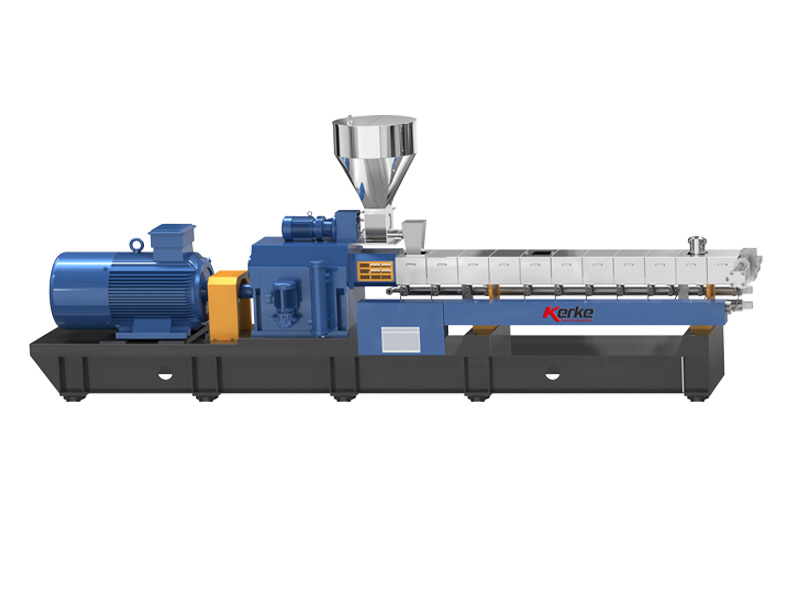
Carbon black consists of nearly pure elemental carbon with particle sizes typically ranging from 10 to 500 nanometers. The primary structural parameters influencing black masterbatch performance include particle size, surface area, structure, and porosity. Smaller particle sizes (10-30 nm) provide higher jetness but increased dispersion challenges. Larger particle sizes (50-100 nm) offer easier dispersion and better UV protection at equivalent concentrations. Kerke Twin Screw Extruder systems are specifically engineered to achieve optimal dispersion of carbon black across the entire particle size spectrum, ensuring uniform coloration and consistent performance. The investment in quality dispersion equipment typically ranges from $15,000 to $35,000 for specialized mixing elements designed for carbon black processing.
The manufacturing process of black masterbatch involves compounding carbon black with carrier resins and dispersing agents using advanced extrusion technology. High-quality black masterbatch production requires precise temperature control, thorough mixing, and proper dispersion to prevent carbon black agglomeration. Kerke Masterbatch Extruder models, particularly the KSE-90 and KSE-110 series, provide the necessary shear energy and thermal uniformity for achieving superior carbon black dispersion. The production cost of standard black masterbatch ranges from $1,800 to $3,500 per ton, with specialty formulations reaching $4,500 to $7,500 per ton depending on carbon black quality and concentration. Premium grade black masterbatch with enhanced UV protection typically commands prices between $2,800 and $5,200 per ton in the market.
Carrier resin selection significantly impacts black masterbatch performance and processing characteristics. Common carrier resins include polyethylene (LDPE, LLDPE, HDPE), polypropylene, polystyrene, and engineering thermoplastics. The carrier resin must be compatible with both the carbon black and the final application resin to ensure proper incorporation and color development. Kerke Compounding Extruder equipment accommodates various carrier resin types, offering formulation flexibility for different application requirements. The cost of premium carrier resins adds approximately $200 to $600 per ton to masterbatch production costs, depending on resin quality and performance characteristics.
Carbon Black Concentrations and Jetness
The concentration of carbon black in masterbatch directly influences the ultimate jetness, opacity, and UV protection provided to the final product. Selecting the appropriate concentration involves balancing performance requirements, processing characteristics, and cost considerations. Different applications demand different carbon black loadings, with optimal concentrations varying based on final product thickness, desired opacity, and functional requirements.
Low concentration black masterbatch (20-30% carbon black) serves applications where cost-effectiveness is prioritized over maximum jetness. These formulations provide adequate black coloration for non-critical applications and are typically used at addition rates of 3-8% depending on desired shade depth. The lower viscosity of low concentration masterbatch facilitates processing and reduces potential equipment wear. Kerke Twin Screw Extruder systems can efficiently produce low concentration black masterbatch with excellent carbon black distribution. The market price for 20-30% black masterbatch typically ranges from $1,500 to $2,800 per ton, making it the most economical option for many applications.
Medium concentration black masterbatch (30-40% carbon black) represents the most widely used category, offering an optimal balance of performance, processability, and cost. These formulations provide excellent jetness for most applications and are typically used at addition rates of 2-6%. The moderate viscosity facilitates processing while still providing strong black coloration. Kerke Masterbatch Extruder lines achieve exceptional dispersion at these concentrations, preventing streak formation and ensuring uniform color development. The market price for medium concentration black masterbatch ranges from $2,000 to $4,200 per ton, with UV-stabilized versions commanding $2,500 to $5,800 per ton.
High concentration black masterbatch (40-50% carbon black) is designed for applications requiring maximum jetness and UV protection. These formulations enable lower addition rates (1-4%) while achieving superior black coloration, making them cost-effective despite higher per-ton prices. The higher carbon black content provides enhanced UV protection and conductivity benefits. Kerke Compounding Extruder technology can process high carbon black concentrations while maintaining excellent dispersion quality. The production cost of high concentration black masterbatch ranges from $3,200 to $6,500 per ton, with market prices reaching $4,000 to $8,000 per ton for premium grades.
Ultra-high concentration black masterbatch (50-70% carbon black) serves specialized applications requiring maximum pigment loading with minimal carrier resin. These formulations enable addition rates below 1% while still achieving deep black coloration. The extremely high carbon black content provides superior UV protection, conductivity, and thermal stability. Processing ultra-high concentrations requires specialized equipment such as Kerke Twin Screw Extruder systems with high-shear screw configurations. The investment in specialized equipment for ultra-high concentration processing typically adds $25,000 to $50,000 to standard extrusion line cost. The market price for ultra-high concentration black masterbatch ranges from $5,000 to $10,000 per ton.
Jetness measurement and optimization represent critical quality parameters for black masterbatch. Jetness is typically measured using MYR (Mitsubishi Yellow Red) values, with higher values indicating deeper black coloration. Standard commercial applications typically target MYR values between 200-250. Premium automotive applications may require MYR values above 270. Achieving target jetness requires optimization of carbon black concentration, particle size, and dispersion quality. Kerke Extruder application engineers provide jetness optimization recommendations based on specific application requirements. The cost of jetness optimization testing averages $400 to $900 per formulation.
UV Resistance Properties
One of the most valuable properties of carbon black based black masterbatch is its exceptional UV resistance capability. Carbon black provides superior protection against UV radiation, significantly extending the service life of plastic products exposed to outdoor conditions. The UV resistance effectiveness depends on carbon black type, concentration, dispersion quality, and application conditions. Understanding these factors enables manufacturers to optimize black masterbatch formulations for maximum UV protection.
Carbon black provides UV protection through two primary mechanisms: absorption and scattering. Carbon black particles absorb UV radiation across a broad spectrum, converting it to harmless thermal energy. Additionally, carbon black particles scatter UV radiation, reducing its penetration depth into the polymer matrix. The combination of these mechanisms provides comprehensive UV protection that prevents polymer degradation, color fading, and mechanical property loss. Kerke Twin Screw Extruder systems achieve the dispersion quality necessary for optimal UV protection performance. The UV protection provided by carbon black is so effective that many outdoor applications specify black masterbatch as the preferred UV protection method.
The concentration of carbon black significantly impacts UV resistance effectiveness. Higher concentrations provide enhanced UV protection, though with diminishing returns above certain thresholds. For most applications, final carbon black concentrations between 1.5% to 3% in the finished product provide adequate UV protection for outdoor exposure. More demanding applications, such as agricultural films exposed to intense sunlight, may require concentrations up to 5%. Kerke Masterbatch Extruder systems can produce black masterbatch formulations that enable precise control of final carbon black concentrations for optimal UV protection. The additional cost for UV-optimized formulations typically adds $300 to $800 per ton to masterbatch production costs.
Particle size and structure influence UV protection efficiency. Smaller carbon black particles provide higher surface area for UV absorption, enhancing protection effectiveness. However, extremely small particles below 20 nm may aggregate and reduce dispersion quality. Structured carbon black with high porosity provides enhanced UV absorption and scattering compared to non-structured types. Kerke Compounding Extruder technology can accommodate various carbon black types while maintaining dispersion quality. The cost of premium UV-optimized carbon black typically adds $500 to $1,200 per ton to masterbatch production costs.
Dispersion quality significantly impacts UV protection uniformity. Poor dispersion creates areas with insufficient carbon black concentration, resulting in localized UV damage and accelerated degradation. Excellent dispersion ensures uniform carbon black distribution and consistent UV protection throughout the product. Kerke Twin Screw Extruder systems incorporate advanced mixing elements that achieve superior carbon black dispersion, ensuring uniform UV protection. The investment in dispersion optimization equipment typically ranges from $20,000 to $45,000 for a complete mixing system upgrade.
UV resistance testing validates black masterbatch performance under accelerated weathering conditions. Standard tests include QUV weathering, xenon arc weathering, and natural outdoor exposure tests. Performance metrics include color retention, mechanical property retention, and surface appearance evaluation. Kerke Extruder quality control systems include UV resistance testing capabilities for product validation. The cost of UV resistance testing averages $600 to $1,500 per formulation depending on test duration and requirements. UV-stabilized black masterbatch typically commands market price premiums of 20-40% over standard grades.
End Use Industries and Applications
Black masterbatch finds extensive applications across diverse industries due to its versatility, functionality, and cost-effectiveness. The primary application industries include packaging, automotive, construction, agriculture, and consumer goods. Each industry presents unique requirements regarding jetness, UV protection, processing conditions, and mechanical properties that influence black masterbatch selection and formulation.
The packaging industry represents the largest application segment for black masterbatch, with applications ranging from film to rigid containers. Black packaging films provide UV protection for light-sensitive contents, offer premium aesthetics, and enable recycling through color coding. Typical addition rates for film applications range from 2-8% depending on film thickness and desired opacity. Kerke Masterbatch Extruder equipment produces film-grade black masterbatch with excellent dispersion, preventing fish-eye defects and ensuring uniform opacity. The market price for packaging film grade black masterbatch ranges from $1,800 to $4,200 per ton, with UV-stabilized versions reaching $2,500 to $5,500 per ton.
Rigid packaging applications including bottles, containers, and caps utilize black masterbatch for UV protection, product differentiation, and premium appearance. These applications require black masterbatch with excellent thermal stability and minimal effect on mechanical properties. Addition rates typically range from 1.5-5% depending on wall thickness and opacity requirements. Kerke Compounding Extruder systems can produce packaging grade black masterbatch with carrier resins optimized for specific packaging polymers. The cost of packaging grade black masterbatch typically ranges from $2,200 to $4,800 per ton.
The automotive industry represents a significant and demanding application for black masterbatch, with requirements for jetness, UV resistance, thermal stability, and surface appearance. Automotive applications include interior and exterior trim, under-the-hood components, and protective covers. These applications demand premium black masterbatch with MYR values above 270 and exceptional weather resistance. Kerke Twin Screw Extruder lines produce automotive-grade black masterbatch that meets the stringent requirements of automotive manufacturers. The market price for automotive grade black masterbatch ranges from $3,500 to $7,000 per ton, reflecting the premium quality requirements.
Construction industry applications including pipes, profiles, geomembranes, and roofing materials frequently employ black masterbatch for UV protection, weather resistance, and aesthetic purposes. These applications require black masterbatch with excellent long-term weather resistance and minimal property degradation. Addition rates typically range from 3-10% depending on product thickness and exposure conditions. Kerke Extruder black masterbatch for construction applications incorporates enhanced UV stabilizers and weather-resistant carrier resins. The cost of construction grade black masterbatch with enhanced weather resistance ranges from $2,800 to $5,500 per ton.
Agricultural applications including greenhouse films, mulch films, and irrigation tubing rely heavily on black masterbatch for UV protection and weed control. These applications require black masterbatch with exceptional UV resistance to withstand prolonged sun exposure. Agricultural films typically require carbon black concentrations between 2-4% to provide adequate protection for 6-18 month exposure periods. Kerke Masterbatch Extruder systems produce agricultural grade black masterbatch with optimized dispersion and UV protection. The market price for agricultural grade black masterbatch ranges from $2,500 to $5,200 per ton.
Consumer goods applications including toys, appliances, electronics, and household products utilize black masterbatch for aesthetic purposes and UV protection. These applications require black masterbatch with consistent color, good processability, and regulatory compliance for food contact where applicable. Addition rates typically range from 2-6% depending on product design and opacity requirements. Kerke Compounding Extruder technology can produce consumer goods grade black masterbatch meeting various regulatory requirements. The cost of consumer goods grade black masterbatch typically ranges from $2,000 to $4,500 per ton.
Quality Control and Testing
Comprehensive quality control systems are essential for producing consistent black masterbatch that meets industry standards and customer specifications. Quality control parameters cover raw material inspection, in-process monitoring, and finished product testing. Each control point ensures that the final black masterbatch delivers consistent color, UV protection, and application performance.
Raw material quality control begins with carbon black analysis. Key parameters include carbon black type, particle size, surface area, structure, and moisture content. Premium carbon black should meet manufacturer specifications for structural parameters and maintain consistent quality between batches. Moisture content should not exceed 0.1% to prevent processing defects. Kerke Extruder quality control systems include comprehensive raw material testing capabilities. The cost of carbon black quality analysis averages $200 to $400 per batch, representing a necessary investment for ensuring consistent masterbatch quality.
In-process quality monitoring tracks critical parameters during black masterbatch production. Key monitoring points include melt temperature, screw speed, torque, pressure, and throughput rate. Maintaining consistent processing conditions ensures uniform dispersion and reproducible product quality. Kerke Twin Screw Extruder systems incorporate advanced process control and monitoring capabilities, enabling real-time parameter adjustment and quality assurance. The investment in process control technology typically ranges from $60,000 to $180,000 for a complete black masterbatch production line.
Finished product testing evaluates jetness, dispersion quality, UV resistance, and thermal stability. Jetness is typically measured using MYR values, with premium black masterbatch achieving MYR values above 250. Dispersion quality assessment involves microscopic examination and particle size analysis. UV resistance is evaluated through accelerated weathering testing. Kerke Masterbatch Extruder production lines include integrated quality testing stations for comprehensive product evaluation. The cost of quality testing equipment ranges from $30,000 to $85,000 for a complete testing laboratory.
Consistency testing across multiple production batches ensures reproducible performance. Critical consistency parameters include color difference (Delta E), rheological properties, and carbon black content. Color differences should be maintained below Delta E 1.0 for most applications. Rheological properties measured by melt flow index should vary by less than 15% between batches. Carbon black content should maintain accuracy within plus or minus 2% of specification. Kerke Compounding Extruder systems produce black masterbatch with exceptional batch-to-batch consistency, reducing customer rejection rates. The cost of consistency testing averages $250 to $600 per batch.
Application-specific testing validates black masterbatch performance in end-use conditions. These tests may include weathering resistance, mechanical property retention, migration properties, and regulatory compliance testing. Kerke Extruder production capabilities support custom black masterbatch formulations optimized for specific application requirements. The cost of application testing varies significantly based on test requirements but typically ranges from $600 to $2,500 per formulation. Regulatory compliance testing for food contact applications typically adds $1,000 to $3,000 to formulation development costs.
Processing Guidelines and Best Practices
Proper processing of black masterbatch is essential for achieving optimal performance and preventing defects. Processing guidelines cover masterbatch addition rates, mixing procedures, temperature profiles, and equipment considerations. Following these guidelines ensures consistent color development, prevents processing issues, and maximizes the value of black masterbatch investment.
Addition rates should be carefully calculated based on desired jetness, film thickness, or part wall thickness. For standard applications, increasing black masterbatch addition by 1% typically increases jetness by 5-15%, depending on formulation. However, the relationship is not linear and should be determined through testing. Kerke Extruder application engineers provide addition rate recommendations based on specific application requirements. The cost of addition rate optimization testing averages $400 to $1,000 per application.
Masterbatch addition methods include volumetric dosing, gravimetric dosing, and pre-mixing with base resin. Gravimetric dosing provides the highest accuracy, typically achieving plus or minus 1% dosing accuracy. Volumetric dosing offers lower cost but reduced accuracy, with typical accuracy of plus or minus 3-5%. Pre-mixing with base resin using tumble blenders can improve distribution but requires additional handling. Kerke Twin Screw Extruder black masterbatch can be processed using any of these addition methods, providing flexibility for different production setups. The cost of gravimetric dosing systems ranges from $10,000 to $30,000 per station.
Processing temperatures should be optimized based on carrier resin type and carbon black content. For polyethylene-based black masterbatch, typical processing temperatures range from 180°C to 230°C. For polypropylene-based systems, temperatures between 190°C and 250°C are appropriate. Excessive temperatures can cause carrier resin degradation and color changes. Insufficient temperatures can lead to poor dispersion and processing difficulties. Kerke Masterbatch Extruder systems maintain precise temperature control across multiple barrel zones, ensuring optimal processing conditions. The investment in temperature control systems typically adds $18,000 to $45,000 to extrusion line cost.
Screw speed and shear rate influence dispersion quality and color development. Higher shear rates improve carbon black dispersion but may cause polymer degradation if excessive. Optimal screw speed depends on equipment design and masterbatch formulation. For carbon black applications, moderate to high shear rates are typically beneficial. Kerke Compounding Extruder screw designs are optimized for carbon black dispersion while maintaining polymer integrity. The cost of screw design customization typically ranges from $12,000 to $35,000 for specific applications.
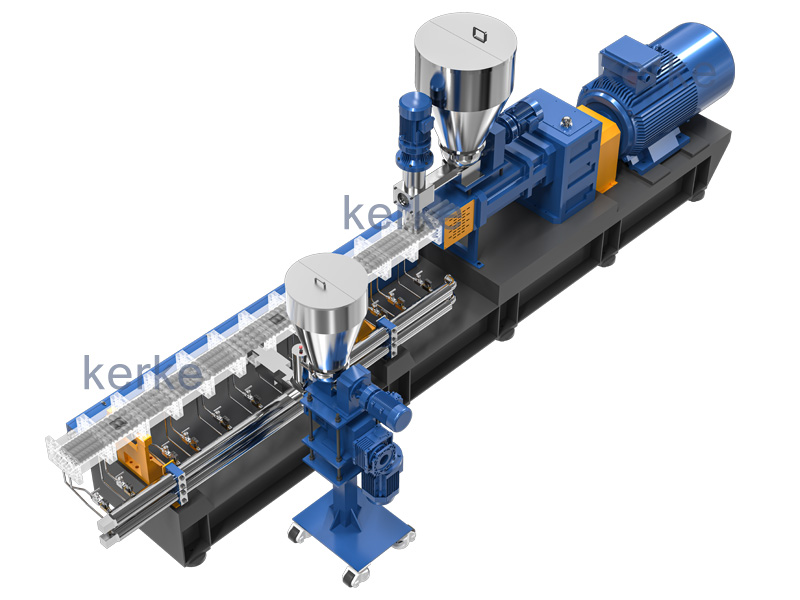
Equipment considerations for processing black masterbatch include screw geometry, barrel configuration, and die design. Co-rotating twin screw extruders provide superior dispersion compared to single screw systems, particularly for high carbon black concentrations. Specialized screw configurations with high-shear mixing elements enhance carbon black distribution. Wear-resistant barrel materials extend service life when processing abrasive carbon black. Kerke Twin Screw Extruder lines can be configured with customized screw designs and barrel materials optimized for black masterbatch applications. The investment in a complete black masterbatch production line from Kerke Extruder ranges from $280,000 to $900,000 depending on capacity and configuration.
Cost Analysis and Market Pricing
Understanding the cost structure of black masterbatch production enables manufacturers to optimize their operations and make informed investment decisions. The cost analysis covers raw material costs, processing costs, equipment investment, and operational expenses. This comprehensive view helps manufacturers evaluate the economics of black masterbatch production and pricing strategies.
Carbon black represents the largest cost component in black masterbatch production, accounting for 50-70% of raw material costs depending on concentration. Standard carbon black typically costs $1,200 to $2,500 per ton depending on grade and quality. Specialty carbon black with enhanced UV resistance or structure commands prices between $2,500 and $4,500 per ton. For 40% carbon black masterbatch, the carbon black component costs approximately $480 to $1,800 per ton. Bulk purchasing contracts can reduce carbon black costs by 8-12% compared to spot market prices. Kerke Extruder can provide sourcing recommendations for carbon black suppliers offering competitive pricing and consistent quality.
Carrier resins and additives constitute the remaining raw material costs. Polyethylene carrier resins typically cost $1,200 to $1,800 per ton. Polypropylene carrier resins range from $1,300 to $2,000 per ton. Dispersing agents and processing aids add $200 to $500 per ton. UV stabilizers for enhanced protection add $300 to $700 per ton. Additional additives such as antioxidants or antistatic agents can add $200 to $600 per ton depending on formulation. Total raw material costs for standard black masterbatch typically range from $1,500 to $3,200 per ton, with premium formulations reaching $3,500 to $6,500 per ton.
Processing costs include energy consumption, labor, equipment depreciation, and maintenance. Energy costs typically range from $70 to $130 per ton of black masterbatch produced. Labor costs average $40 to $90 per ton. Equipment depreciation represents a significant cost component, typically $180 to $350 per ton based on a 10-year equipment life. Maintenance costs average $35 to $75 per ton. Total processing costs typically range from $325 to $645 per ton. Kerke Masterbatch Extruder systems minimize processing costs through energy-efficient design and low maintenance requirements.
Equipment investment varies significantly based on production capacity and technology level. Small capacity lines (500-1,000 kg/hr) typically cost $280,000 to $420,000. Medium capacity lines (1,000-2,000 kg/hr) cost $420,000 to $680,000. High capacity lines (2,000-5,000 kg/hr) require investment of $680,000 to $1,150,000. Kerke Extruder offers a complete range of black masterbatch production lines with competitive pricing and advanced technology. The payback period for black masterbatch production equipment typically ranges from 2 to 3.5 years based on market demand and profit margins.
Operational expenses include quality control, warehousing, logistics, and administrative costs. Quality control costs average $40 to $120 per ton. Warehousing and storage add $15 to $40 per ton. Logistics and transportation vary by region but average $25 to $70 per ton. Administrative overhead adds $35 to $90 per ton. Total operational expenses typically range from $115 to $320 per ton. Kerke Compounding Extruder systems minimize operational expenses through efficient design and automation.
Total production costs for black masterbatch typically range from $1,940 to $4,165 per ton for standard formulations, with premium formulations reaching $4,875 to $7,465 per ton. Profit margins in the black masterbatch market typically range from 12-22% depending on market conditions and product differentiation. Market prices for black masterbatch range from $2,200 to $5,200 per ton for standard grades, with premium grades commanding $4,500 to $9,500 per ton. Kerke Extruder equipment enables production of high-quality black masterbatch that can command premium pricing in the market.
Kerke Equipment for Black Masterbatch Production
Kerke Extruder offers specialized equipment specifically designed for black masterbatch production, addressing the unique challenges of carbon black processing. The KSE series twin screw extruders provide superior dispersion, high throughput capacity, and excellent product consistency. Selecting the appropriate equipment depends on production requirements, product specifications, and budget considerations.
The KSE-90 Twin Screw Extruder represents an excellent choice for medium capacity black masterbatch production. With a 90mm screw diameter and L/D ratio of 44:1, this model provides throughput capacity of 600-1,500 kg/hr for black masterbatch applications. The advanced screw configuration with high-shear mixing elements ensures optimal carbon black dispersion while maintaining product quality. The KSE-90 includes 12 heating zones for precise temperature control and features wear-resistant barrel materials for extended service life when processing abrasive carbon black. The base price for the KSE-90 black masterbatch system is approximately $380,000 to $520,000 depending on configuration.
For larger production requirements, the KSE-110 Twin Screw Extruder offers increased capacity and enhanced performance. With 110mm screw diameter and L/D ratio of 48:1, this model achieves throughput of 1,200-3,000 kg/hr for black masterbatch. The KSE-110 features 14 heating zones, advanced mixing elements, and integrated process control system. This model is ideal for manufacturers producing black masterbatch for multiple applications and markets. The KSE-110 system typically costs $520,000 to $780,000 depending on options and automation level.
The KSE-65 Twin Screw Extruder provides an efficient solution for smaller capacity black masterbatch production. With 65mm screw diameter and L/D ratio of 40:1, this model delivers throughput of 300-700 kg/hr. The KSE-65 features 8 heating zones and modular screw design for easy maintenance and customization. This model is suitable for specialty black masterbatch production or as a pilot line for formulation development. The base price for the KSE-65 system is approximately $220,000 to $320,000 depending on configuration.
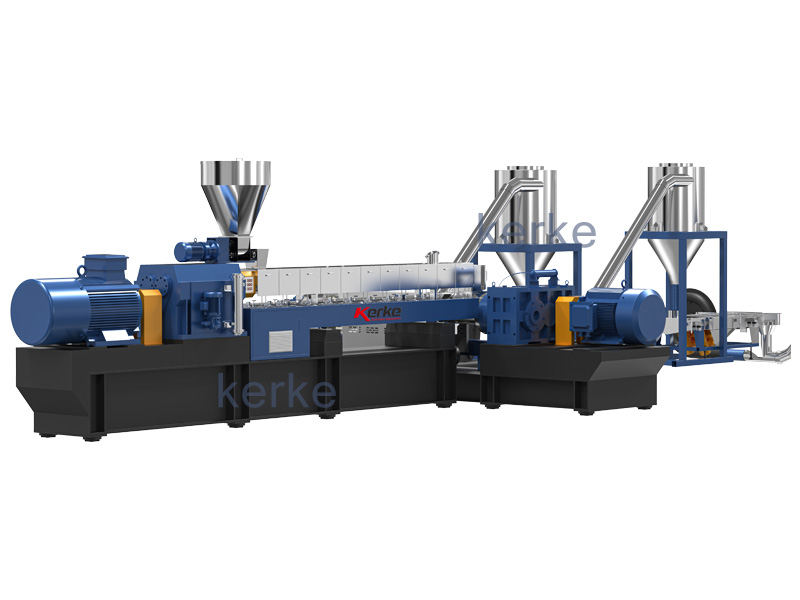
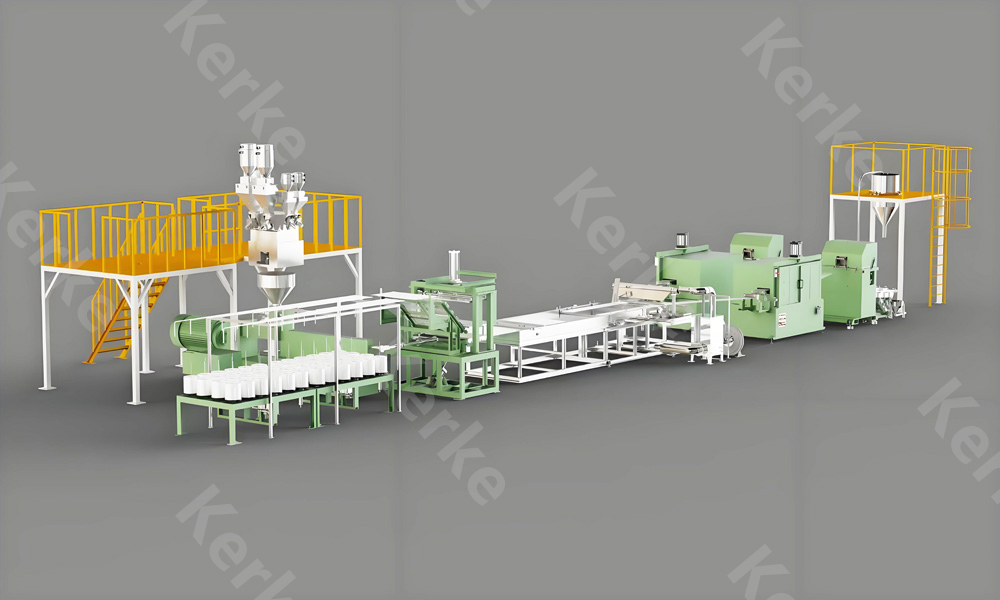
Kerke Masterbatch Compounding Systems include complete turnkey solutions for black masterbatch production. These systems integrate twin screw extruder, material handling equipment, cooling system, pelletizer, and quality control equipment into a cohesive production line. The systems are designed for high carbon black concentrations, excellent dispersion, and maximum uptime. Turnkey system costs range from $320,000 for small capacity systems to $1,100,000 for high capacity, fully automated lines. Kerke Compounding Extruder technology ensures superior product quality and production efficiency for black masterbatch.
Kerke Extruder also offers specialized components and accessories for black masterbatch production. These include gravimetric feeding systems for carbon black, high shear mixers, pelletizing equipment, and quality testing instruments. Gravimetric feeding systems for carbon black addition cost $15,000 to $30,000. High shear mixers for pre-dispersion range from $18,000 to $40,000. Water ring pelletizing systems cost $35,000 to $70,000. Quality testing laboratories cost $35,000 to $85,000 depending on equipment configuration. Kerke Twin Screw Extruder systems integrate seamlessly with these components for complete production solutions.
Technical Specifications and Performance
Understanding the technical specifications and performance characteristics of black masterbatch enables manufacturers to select the optimal product for their applications and achieve consistent results. Key technical parameters include carbon black content, melt flow index, density, thermal stability, and dispersion quality. These specifications determine processing behavior and final product performance.
Carbon black content specifications typically range from 20% to 50% for standard black masterbatch, with specialty formulations reaching up to 70%. The carbon black content directly influences the addition rate required for target jetness and UV protection. Higher concentrations enable lower addition rates but may present processing challenges due to increased viscosity. Kerke Masterbatch Extruder systems can process the full range of carbon black concentrations while maintaining excellent dispersion quality. The cost of testing carbon black content accuracy averages $150 to $350 per sample.
Melt flow index (MFI) is a critical processing parameter that indicates the viscosity and flow characteristics of black masterbatch. MFI should be compatible with the processing characteristics of the base resin to ensure proper mixing and processing. Typical MFI values for black masterbatch range from 5 to 50 g/10min depending on carrier resin type and carbon black content. Kerke Compounding Extruder technology enables precise control of MFI through carrier resin selection and processing parameter optimization. The cost of MFI testing averages $50 to $120 per sample.
Density specifications for black masterbatch typically range from 1.10 to 1.30 g/cm³ depending on carrier resin type and carbon black content. Density affects dosing accuracy and addition calculations. Consistent density ensures predictable dosing behavior and color development. Kerke Twin Screw Extruder systems produce black masterbatch with tight density tolerances, typically plus or minus 0.02 g/cm³. The cost of density testing averages $30 to $80 per sample.
Thermal stability testing evaluates black masterbatch resistance to color change and property degradation during processing and end-use exposure. Standard tests include thermogravimetric analysis (TGA) and color measurement after thermal exposure. Premium black masterbatch maintains color and properties after processing temperatures up to 300°C for extended periods. Kerke Extruder quality control systems include thermal stability testing capabilities. The cost of thermal stability testing averages $200 to $500 per sample.
Dispersion quality assessment involves microscopic examination and particle size distribution analysis. Excellent dispersion is characterized by uniform carbon black distribution with minimal agglomerates. Dispersion quality significantly impacts final product appearance, jetness, and UV protection uniformity. Kerke Masterbatch Extruder technology achieves superior dispersion quality through advanced screw design and processing control. The cost of dispersion quality assessment averages $150 to $400 per sample.
Environmental and Regulatory Considerations
Environmental and regulatory compliance represents an increasingly important consideration in black masterbatch production and application. Manufacturers must address concerns regarding worker safety, environmental impact, and regulatory requirements across different markets and applications. Understanding these considerations enables manufacturers to ensure compliance and maintain market access.
Worker safety considerations primarily focus on carbon black dust exposure during masterbatch production and handling. Carbon black dust can be respiratory irritant and requires appropriate dust control measures including ventilation, dust collection systems, and personal protective equipment. Regulatory limits for occupational exposure to carbon black vary by jurisdiction but typically range from 2-5 mg/m³. Kerke Twin Screw Extruder systems incorporate closed material handling systems that minimize dust exposure and enhance worker safety. The investment in dust control systems typically ranges from $25,000 to $60,000 for a complete installation.
Environmental impact considerations include carbon black production sustainability, recycling of masterbatch-containing products, and end-of-life considerations. Carbon black production is energy-intensive but the material is highly stable and does not degrade in the environment. Products containing black masterbatch are typically recyclable, with the color providing UV protection that extends product life and reduces waste. Kerke Compounding Extruder technology supports sustainable production practices through energy-efficient design and material optimization. The cost of environmental compliance certification typically ranges from $5,000 to $15,000 per facility.
Food contact regulations require specific testing and certification for black masterbatch used in food packaging applications. Key regulatory frameworks include FDA 21 CFR for the United States, EU Regulation 10/2011 for Europe, and various national regulations in other markets. Compliance requires migration testing, toxicity assessment, and documentation. Kerke Extruder can provide food contact grade black masterbatch formulations that meet global regulatory requirements. The cost of food contact compliance certification typically ranges from $15,000 to $40,000 per formulation and market region.
Automotive industry regulations require black masterbatch to meet specific standards for interior and exterior applications. Key standards include REACH compliance, RoHS restrictions, and OEM-specific specifications. Automotive applications also require consistent color quality and weather resistance. Kerke Masterbatch Extruder systems produce automotive-grade black masterbatch meeting all major automotive standards. The cost of automotive compliance testing typically ranges from $20,000 to $50,000 per application.
Future regulatory trends include increasing restrictions on hazardous substances, requirements for sustainable materials, and enhanced labeling requirements. Staying ahead of regulatory changes through proactive testing and certification provides competitive advantages in the marketplace. Kerke Extruder maintains awareness of regulatory developments and can assist customers with compliance requirements. The annual cost of regulatory monitoring and compliance typically ranges from $10,000 to $30,000 for black masterbatch producers.
Future Trends and Market Opportunities
The black masterbatch market continues to evolve with advancing technology, changing market demands, and emerging applications. Understanding future trends helps manufacturers identify growth opportunities and make strategic investment decisions. The global black masterbatch market is projected to grow at 3-5% annually through 2030, with regional variations and application-specific dynamics.
Technology trends emphasize automation, energy efficiency, and advanced process control. Industry 4.0 integration enables real-time monitoring of carbon black dispersion, predictive quality assessment, and automated parameter optimization. Energy-efficient extrusion systems reduce operating costs and environmental impact. Kerke Compounding Extruder systems incorporate the latest technology trends, offering advanced features for modern black masterbatch production facilities. The investment in advanced process control technology typically ranges from $40,000 to $120,000 for a complete system.
Product development trends include conductive black masterbatch for EMI shielding, antistatic black masterbatch for electronic applications, and sustainable black masterbatch formulations using bio-based carriers or recycled content. These specialty products command premium prices and serve growing market segments. Kerke Twin Screw Extruder technology supports formulation innovations through flexible processing capabilities and customizable screw configurations. The development cost for specialty black masterbatch formulations typically ranges from $30,000 to $80,000 per product.
Market growth is particularly strong in Asia Pacific, driven by expanding automotive and packaging industries. China and India represent the largest and fastest growing markets for black masterbatch in the region. North America and Europe show moderate growth rates of 2-4% annually, with emphasis on high-value specialty black masterbatch products. Kerke Extruder has established presence in key growth markets, providing local support and service for black masterbatch production equipment.
Sustainability trends drive demand for recyclable black masterbatch formulations that do not interfere with plastic recycling processes. This includes masterbatch compatible with mechanical and chemical recycling technologies. Sustainable carrier resins derived from renewable sources are gaining market acceptance. Kerke Masterbatch Extruder systems can process both conventional and sustainable carrier resins, enabling manufacturers to adapt to changing market preferences. The cost premium for sustainable formulations typically ranges from 10-25% over conventional products.
Future market opportunities include black masterbatch for 3D printing applications, smart masterbatch with sensing capabilities, and black masterbatch with enhanced functionality such as flame retardancy or antimicrobial properties. Investment in R&D and equipment flexibility enables manufacturers to capture emerging market segments. Kerke Compounding Extruder modular design allows rapid adaptation to new formulations and product innovations as market requirements evolve. The investment in R&D capabilities typically ranges from $100,000 to $300,000 annually for competitive black masterbatch manufacturers.
Conclusion
Black masterbatch based on carbon black represents a fundamental component in the plastic colorant industry, providing exceptional color, UV protection, and functionality across diverse applications. Success in black masterbatch production and application requires understanding of carbon black properties, dispersion technology, quality control, and processing optimization. Investment in quality equipment from Kerke Extruder enables manufacturers to produce consistent, high-quality black masterbatch that meets demanding market requirements.
The comprehensive approach to black masterbatch production, from raw material selection through quality control to market delivery, ensures product excellence and customer satisfaction. Kerke Twin Screw Extruder technology provides the foundation for achieving superior carbon black dispersion, batch consistency, and operational efficiency. Manufacturers investing in Kerke Extruder equipment benefit from competitive advantages in product quality, production efficiency, and market responsiveness.
The future of black masterbatch production continues to evolve with advancing technology, changing market demands, and emerging applications. Companies maintaining technological leadership through equipment investment and process innovation will capture growth opportunities in this dynamic market. Kerke Extruder remains committed to advancing black masterbatch production technology, supporting manufacturers in achieving excellence in this critical industry segment.