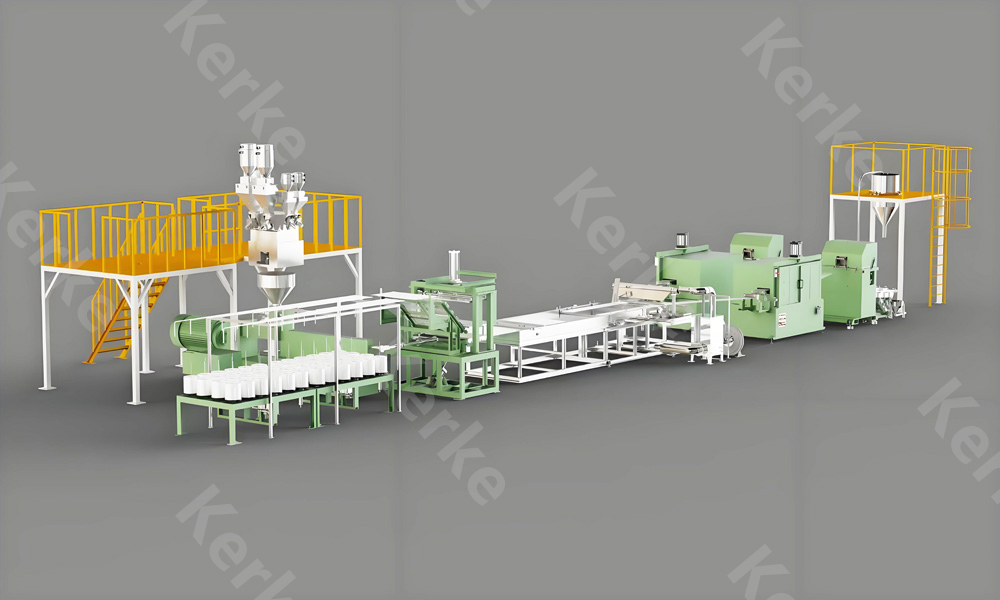
In 2026, halogen-free flame retardant (HFFR) masterbatch has become the fastest-growing and most regulated functional masterbatch in the global plastic industry. Driven by strict environmental regulations including EU REACH, RoHS 2023, U.S. EPA standards, and UL94 certification requirements, traditional halogenated flame retardants are being phased out globally. HFFR masterbatch, mainly based on phosphorus-nitrogen synergistic system, aluminum hydroxide (ATH), magnesium hydroxide (MDH), and nano composite materials, is widely used in new energy vehicles, photovoltaic materials, electronic and electrical appliances, building wires and cables, packaging, and home appliances. The global HFFR masterbatch market is projected to reach USD 2.72 billion by 2032, growing at a CAGR of 6.73%, with high-concentration, low-precipitation, and high-dispersion products accounting for more than 68% of market demand. However, the production of HFFR masterbatch faces multiple technical bottlenecks: high filler loading (50%–80%), easy decomposition of flame retardant agents, poor dispersion uniformity, serious precipitation, unstable mechanical properties, and difficulty in meeting certification standards. Most common twin screw extruders cannot balance shear force, temperature control, dispersion effect, and continuous operation stability, resulting in high scrap rates and substandard products.
Nanjing Kerke Extrusion Equipment Co., Ltd. focuses on parallel co-rotating twin screw extrusion technology for more than 12 years. Based on the official KTE series twin screw extruders (KTE-35, KTE-50, KTE-65, KTE-75, KTE-135), Kerke launches a full set of customized production solutions for halogen-free flame retardant masterbatch. Combined with 2026 global regulatory trends and production pain points, Kerke optimizes screw structure, feeding system, temperature control module, pelletizing system, and electrical configuration to realize stable, efficient, and compliant production of HFFR masterbatch with high filling, high dispersion, low precipitation, and low energy consumption. All solutions are independently developed based on Kerke’s core technology, matching the official product parameters and service scope of kerkeextruder.com, providing professional, reliable, and scalable equipment support for global HFFR masterbatch manufacturers{insert_element_0_}.
This 5000-word professional article focuses on independent analysis of halogen-free flame retardant masterbatch production. It systematically interprets 2026 global industry dynamics, core certification standards, production technical pain points, targeted solutions based on Kerke KTE extruders, process optimization, equipment configuration, quality control, and cost analysis. It does not involve commercial cases, focuses on technical solutions and production logic, and provides a complete technical guide for global plastic masterbatch manufacturers to upgrade HFFR production lines.
1. 2026 Global HFFR Masterbatch Industry Dynamics & Core Regulatory Standards
1.1 Comprehensive Ban on Halogenated Flame Retardants: Irreversible Industry Trend
Since 2026, the global restriction on halogenated flame retardants has been fully implemented. The European Chemicals Agency (ECHA) has added six brominated flame retardants to the SVHC candidate list and restricted the use of decabromodiphenyl ethers (DBDPE) and hexabromocyclododecane (HBCD) in electronic appliances, wires and cables, and automotive materials. The United States, Canada, Japan, and South Korea have also updated relevant regulations, clearly requiring that plastic products for civilian and industrial use must use halogen-free flame retardant systems. This regulatory shift has directly led to a 35% year-on-year growth in demand for HFFR masterbatch, especially for phosphorus-nitrogen synergistic and inorganic hydroxide flame retardant systems.
At the same time, the rapid development of new energy vehicles (NEV), photovoltaic junction boxes, energy storage batteries, and 5G base stations has further raised the performance requirements for HFFR masterbatch. These fields require masterbatch to achieve UL94 V-0 certification at 1.6mm or 3.0mm, with low smoke density, no corrosive gas release during combustion, and no impact on the mechanical properties and aging resistance of base materials. Traditional production equipment cannot meet these comprehensive requirements, making professional twin screw extrusion solutions a core competitive advantage.
1.2 Core Certification Standards for HFFR Masterbatch in 2026
To enter major global markets, HFFR masterbatch must meet the following mandatory certification standards, which also determine the design direction of extrusion equipment:
- UL94: The most widely used flame retardant grade standard, with V-0 as the highest level for electronic and electrical products;
- EU REACH & RoHS 2023: Restrict hazardous substances, require halogen-free (<900ppm Cl, <900ppm Br, total halogen <1500ppm);
- IPC-4101: For electronic circuit board and connector materials, requiring high heat resistance and low precipitation;
- ISO 4589: Limit oxygen index test, requiring LOI ≥28% for general industrial products;
- Automotive LV-312: For automotive interior and electronic parts, requiring halogen-free and low volatile organic compounds (VOC).
These standards impose strict constraints on raw material compatibility, extrusion temperature, shear dispersion, mixing uniformity, and precipitation control. Kerke’s HFFR solutions take these certification indexes as design objectives to ensure stable production of qualified products.
1.3 Core Production Pain Points of HFFR Masterbatch in 2026
Halogen-free flame retardant masterbatch has high technical thresholds, and common production lines generally face the following pain points:
- High filling difficulty: Inorganic flame retardants such as ATH/MDH need a loading rate of 50%–80%, which is prone to bridging, poor feeding, and unstable extrusion;
- Temperature sensitivity: Phosphorus-nitrogen flame retardants decompose easily at high temperatures, requiring precise temperature control (±1°C);
- Poor dispersion: Agglomeration of flame retardant particles leads to color spots, poor flame retardant effect, and failed UL94 certification;
- Precipitation problem: Migration of small molecular additives results in surface precipitation of masterbatch, affecting product performance;
- High energy consumption: High torque and high load operation lead to increased energy consumption and reduced equipment life;
- Continuous production instability: Easy to cause strand breakage, high scrap rate, and low production efficiency.
All the above pain points can be solved by Kerke KTE twin screw extruder’s targeted solutions, which are independently developed and optimized based on the core structure of Kerke’s official products.
2. Kerke KTE Series Twin Screw Extruder: Core Equipment for HFFR Masterbatch
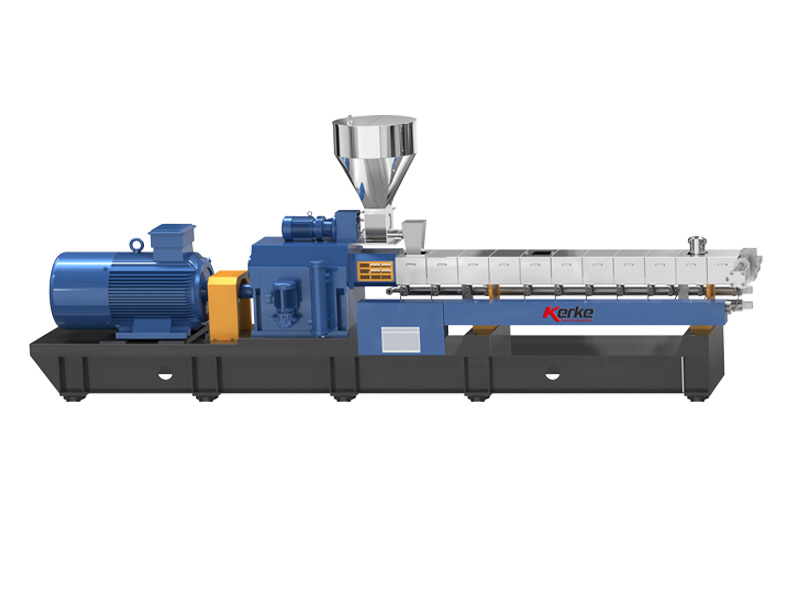
Kerke KTE series parallel co-rotating twin screw extruder is the core equipment of HFFR masterbatch production line, covering laboratory, medium output, and high-volume industrial models, all of which are designed for high dispersion, high torque, and precise temperature control, fully matching the characteristics of halogen-free flame retardant formulations.
2.1 Core Models & Output Configuration
- KTE-35: Laboratory & small-batch production, output 100–200 kg/h, suitable for formula R&D and small-batch trial production;
- KTE-50: Medium model, mainstream model for SMEs, output 300–500 kg/h, balanced cost and efficiency;
- KTE-65: High-output model, output 500–800 kg/h, suitable for large-scale production of electronic and automotive grade HFFR;
- KTE-75: Heavy-duty industrial model, output 800–1200 kg/h, supports 24/7 continuous operation;
- KTE-135: Ultra-large capacity model, output 1500–4000 kg/h, for super-large new energy and cable material factories.
2.2 Core Structure Matching HFFR Production
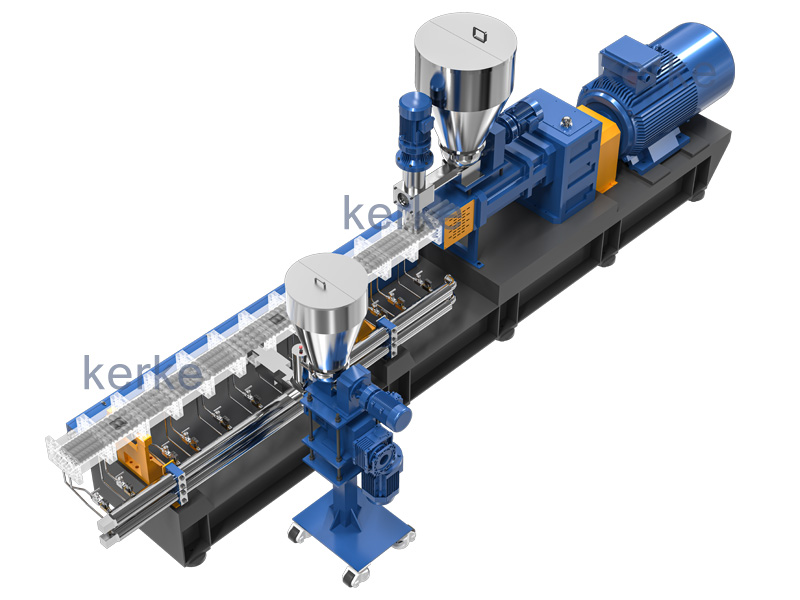
All Kerke KTE extruders adopt modular design, which can be customized with screw length-diameter ratio, barrel structure, feeding mode, and temperature control module according to HFFR formulations{insert_element_2_}. The key structures include:
- High-torque gearbox: Supports high-load operation under high filling rate, with strong bearing capacity and stable transmission;
- Modular screw assembly: Customizable shear block and mixing element for uniform dispersion of flame retardant particles;
- Precision temperature control system: Independent heating and cooling in each zone, temperature control accuracy ±1°C, avoiding thermal decomposition;
- Digital control system: 10-inch touch screen, storing hundreds of HFFR process formulas, one-key switching;
- Wear-resistant barrel & screw: Nitriding treatment + alloy coating, suitable for long-term production of high-filling and abrasive materials;
- Multi-stage feeding system: Side feeder and forced feeder are optional to solve bridging of powder flame retardants.
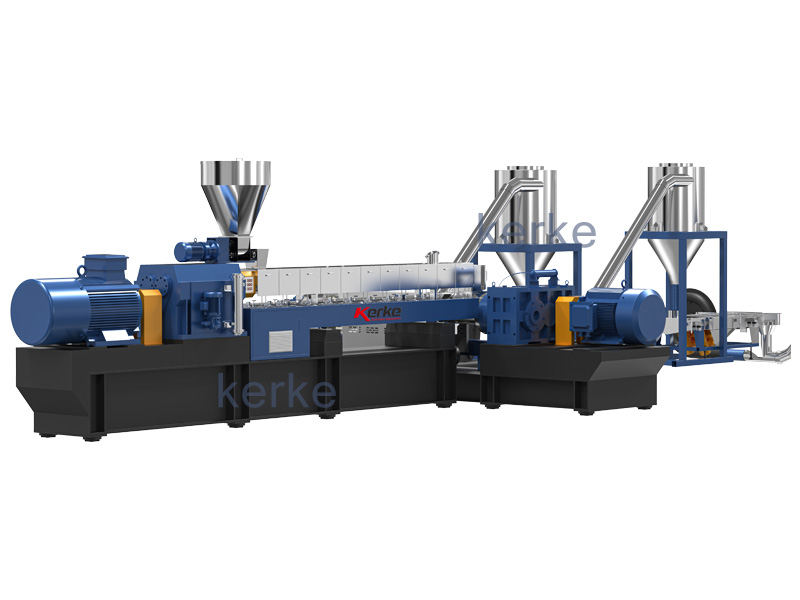
2.3 Matching Pelletizing System for HFFR Masterbatch
For halogen-free flame retardant masterbatch with different formulations, Kerke provides three pelletizing solutions:
- Water-cooled strand pelletizing: Standard configuration, suitable for most polyolefin-based HFFR masterbatch;
- Air-cooled die-face pelletizing: For temperature-sensitive formulas, low temperature pelletizing, reducing precipitation risk;
- Underwater pelletizing: For high-output and high-performance products, smooth particles, high automation, suitable for new energy materials.
3. Kerke Professional Production Solutions for HFFR Masterbatch (Independent Analysis)
Combined with 2026 industry pain points and regulatory requirements, Kerke launches six targeted production solutions for halogen-free flame retardant masterbatch, all independently developed based on KTE extruders, focusing on improving dispersion, stability, certification pass rate, and reducing costs.
3.1 High-Filling HFFR Masterbatch Stable Feeding Solution
Aiming at the problems of bridging, poor feeding, and unstable extrusion of ATH/MDH powder with 50%–80% loading rate, Kerke adopts a forced feeding system + multi-stage side feeding + anti-bridging mixing bin. The forced feeder applies mechanical pressure to send powder into the barrel stably, and the side feeder adds flame retardant powder in sections to reduce the burden of the main feeder. The screw is equipped with a strong conveying element to ensure smooth feeding without interruption. This solution can increase the filling rate by 20%–30% on the original basis, and the feeding stability reaches 99.5%.
3.2 Ultra-Precise Temperature Control Solution for Temperature-Sensitive Formulations
Phosphorus-nitrogen synergistic flame retardants decompose easily at high temperatures, and the processing window is narrow (usually 160–210°C). Kerke adopts an independent precision temperature control system: each barrel zone is equipped with independent ceramic heating + air cooling/water cooling, temperature control accuracy ±1°C, real-time monitoring and automatic adjustment. The screw is designed with low shear and medium mixing to avoid excessive shear heat generation. This solution completely avoids thermal decomposition of flame retardants, ensures stable chemical properties, and improves the pass rate of REACH/RoHS certification.
3.3 High-Dispersion Solution for UL94 V-0 Grade HFFR Masterbatch
The core of flame retardant effect lies in uniform dispersion of particles. Kerke optimizes the screw arrangement: using high-shear kneading blocks + multi-stage mixing elements + self-cleaning screw structure, which can break up agglomerates of flame retardant particles to 1–2 microns, and realize 100% uniform dispersion under high filling rate. The modular screw can be adjusted according to different formulations (polyethylene, polypropylene, EVA, TPE). This solution ensures that the masterbatch meets UL94 V-0 grade at 1.6mm, with no color spots, no white spots, and stable flame retardant performance.
3.4 Low-Precipitation HFFR Masterbatch Production Solution
Aiming at the precipitation problem of small molecular additives and flame retardant fragments, Kerke optimizes the shear force and temperature curve, enhances the binding force between flame retardant particles and carrier resin, reduces free small molecules. The pelletizing system adopts low-temperature cooling and rapid drying to avoid migration and precipitation. The production line is equipped with an online monitoring module to detect dispersion uniformity and precipitation risk in real time. This solution can reduce the precipitation rate by more than 90%, meeting the requirements of electronic and automotive materials.
3.5 Energy-Saving & High-Efficiency Continuous Production Solution
Combined with the trend of energy conservation and emission reduction in 2026, Kerke adopts IE5 high-efficiency motor + frequency conversion control + ceramic heating system, which reduces energy consumption by 30% compared with ordinary extruders. The wear-resistant barrel and screw extend the service life to 8–10 years, and the stable operation reduces the scrap rate to below 1.5%. The whole line supports 24/7 continuous production, with output fluctuation controlled within ±2%, greatly improving production efficiency and reducing comprehensive costs.
3.6 Global Certification Compliance Solution
Kerke’s HFFR solutions are designed according to global certification standards: the production process is traceable, the equipment has CE certification, and the process parameters are preset to meet UL94, REACH, RoHS, and automotive material standards. The equipment does not introduce heavy metals or harmful substances, and the masterbatch produced fully meets the halogen-free limit requirements. Manufacturers can directly use Kerke’s process formulas and equipment parameters to pass third-party certification smoothly.
4. Process Optimization & Quality Control of HFFR Masterbatch Production
4.1 Core Process Parameters
For most polyolefin-based halogen-free flame retardant masterbatch formulations, Kerke’s recommended process parameters are as follows:
- Processing temperature: 160–205°C (adjusted according to flame retardant type, strictly controlled within ±1°C);
- Screw speed: 300–550 rpm (medium shear, avoiding over-shear decomposition);
- Feeding ratio: Main machine 55%–70%, side feeder 30%–45% (for high filling);
- Vacuum venting: 1 stage vacuum, remove moisture and small molecular volatile substances;
- Cooling temperature: 30–50°C (rapid cooling, prevent precipitation and adhesion).
4.2 Online Quality Control System
Kerke’s HFFR production line can be equipped with an online quality control module to monitor key indicators in real time:
- Online dispersion detection: Judge dispersion uniformity by image recognition;
- Temperature and torque monitoring: Early warning of abnormal conditions to avoid decomposition and blockage;
- Pellet size screening: Automatic screening of unqualified particles to ensure stability;
- Moisture detection: Control moisture content below 0.05% to avoid bubbling and performance degradation.
4.3 Adaptation to Different Carriers & Formulations
Kerke solutions are compatible with all mainstream carriers for HFFR masterbatch:
- Polypropylene (PP): For automotive, home appliance parts;
- Polyethylene (PE): For wires, cables, packaging materials;
- EVA: For photovoltaic materials, hot melt adhesives;
- TPE/TPR: For soft electronic accessories;
- ABS/PC: For electronic and electrical housings.
The screw structure and process parameters can be quickly adjusted according to different carriers to ensure universality and stability.
5. Global Adaptation & Customization of Kerke HFFR Solutions
Kerke provides global adaptive customization for HFFR production lines to adapt to different regional voltages, climates, raw materials, and production environments:
- Voltage adaptation: 220V/380V/415V/480V, 50Hz/60Hz, suitable for global industrial power;
- Climate adaptation: High-temperature resistance, dust-proof, and moisture-proof design, suitable for high-temperature and high-humidity areas;
- Raw material adaptation: Optimized for local flame retardant powders and carrier resins in different regions;
- Space adaptation: Compact layout for small factories, extended layout for large industrial plants;
- Control system adaptation: Multi-language interface, easy to operate and maintain.
6. Cost Analysis & ROI of Kerke HFFR Production Solutions
Taking the mainstream KTE-65 model (output 600 kg/h) as an example, the cost and benefit analysis of HFFR masterbatch production is as follows:
- Annual output: 1200 tons (8 hours/day, 250 working days);
- Energy saving: 30% lower than ordinary extruders, annual energy cost saving about USD 8,000–12,000;
- Scrap rate: ≤1.5%, annual material cost saving about USD 10,000–15,000;
- Maintenance cost: Wear-resistant parts extend service life, annual maintenance cost reduced by 40%;
- Comprehensive cost reduction: 20%–28% lower than traditional production lines;
- ROI cycle: 12–18 months, much shorter than the industry average of 24–36 months.
7. FAQ: HFFR Masterbatch Production with Kerke KTE Extruder
7.1 What is the maximum flame retardant filling rate of your solution?
Our solution can stably achieve 50%–80% filling rate of ATH/MDH and phosphorus-nitrogen flame retardants, with uniform dispersion and stable extrusion.
7.2 Can your extruder ensure that HFFR masterbatch meets UL94 V-0?
Yes. Our high-dispersion screw structure and precise temperature control can ensure uniform dispersion of flame retardant particles, and the masterbatch can stably pass UL94 V-0 certification at 1.6mm.
7.3 Does your solution solve the precipitation problem of HFFR masterbatch?
Yes. Our low-precipitation solution optimizes shear force, cooling system, and binding force between resin and filler, reducing precipitation rate by more than 90%.
7.4 What is the temperature control accuracy of KTE extruder?
The temperature control accuracy is ±1°C, which can effectively avoid thermal decomposition of temperature-sensitive halogen-free flame retardants.
7.5 Does your equipment meet EU REACH and RoHS standards?
Yes. Our equipment and process solutions are designed according to EU standards, and the produced masterbatch fully meets halogen-free and hazardous substance restrictions.
7.6 Can you customize solutions for special HFFR formulations?
Yes. We provide full customization including screw structure, feeding system, temperature control, and pelletizing method according to customer formulations.
7.7 What is the service life of screw and barrel?
After nitriding and alloy coating treatment, the service life is 8–10 years under normal production conditions.
8. Conclusion
2026 is a critical year for the full popularity of halogen-free flame retardant masterbatch. The global ban on halogenated flame retardants, the booming demand of new energy, electronics, automotive and other industries, and strict certification standards have put forward higher requirements for production equipment. Common twin screw extruders cannot solve the pain points of high filling, high dispersion, temperature sensitivity, precipitation, and certification compliance, while Kerke KTE series twin screw extruder, with professional customized solutions, becomes the best choice for HFFR masterbatch production.
Kerke’s six core solutions cover stable feeding, precise temperature control, high dispersion, low precipitation, energy-saving continuous production, and global certification compliance, all independently developed based on the official KTE series products. The solutions can adapt to different formulations, carriers, output requirements, and regional environments, helping global manufacturers produce high-quality, compliant, and high-profit halogen-free flame retardant masterbatch stably and efficiently.
With professional technology, reliable equipment, and customized services, Kerke continues to lead the development of global functional masterbatch extrusion technology, providing solid equipment support for the transformation and upgrading of the plastic industry to environmental protection, high performance, and compliance.
For more technical parameters and customized solutions, please visit the official website: https://www.kerkeextruder.com