Introduction to Foaming Masterbatch
Foaming masterbatch represents a revolutionary technology in the plastics industry, enabling significant weight reduction through the creation of cellular structures within polymer matrices. These specialized additive formulations introduce gas-generating agents that create fine, uniform cell structures throughout the plastic, resulting in substantial density reduction while maintaining material properties. The growing emphasis on material efficiency, cost reduction, and sustainability has driven widespread adoption of foaming masterbatch technology across diverse applications from packaging and construction to automotive and consumer goods.
The global market for foaming masterbatch has experienced remarkable growth as manufacturers seek to reduce material usage, lower shipping costs, and enhance product performance through weight reduction. Foamed plastics offer multiple advantages including improved thermal insulation, acoustic damping, and specific mechanical properties that can be tailored through cell structure control. The technology has evolved from simple chemical blowing agent formulations to sophisticated systems incorporating nucleating agents, stabilizers, and modifiers that enable precise control over cell size, distribution, and overall foam morphology.
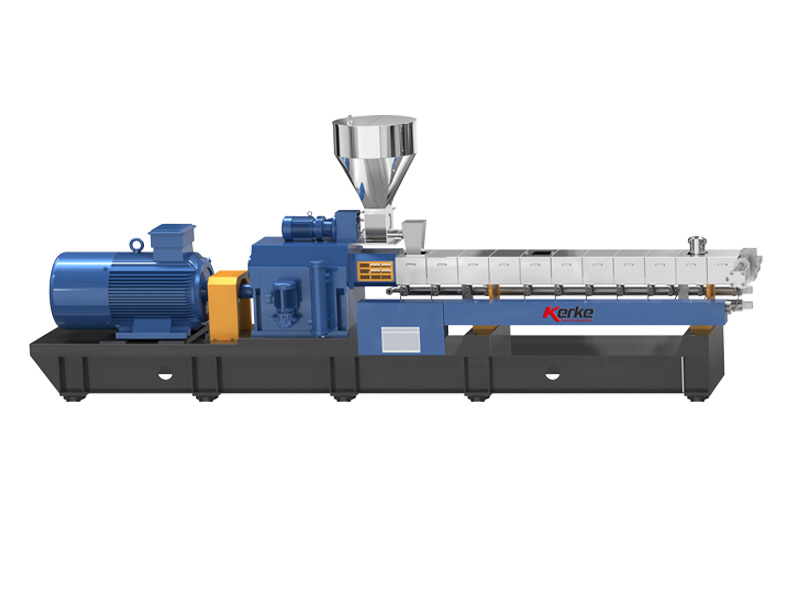
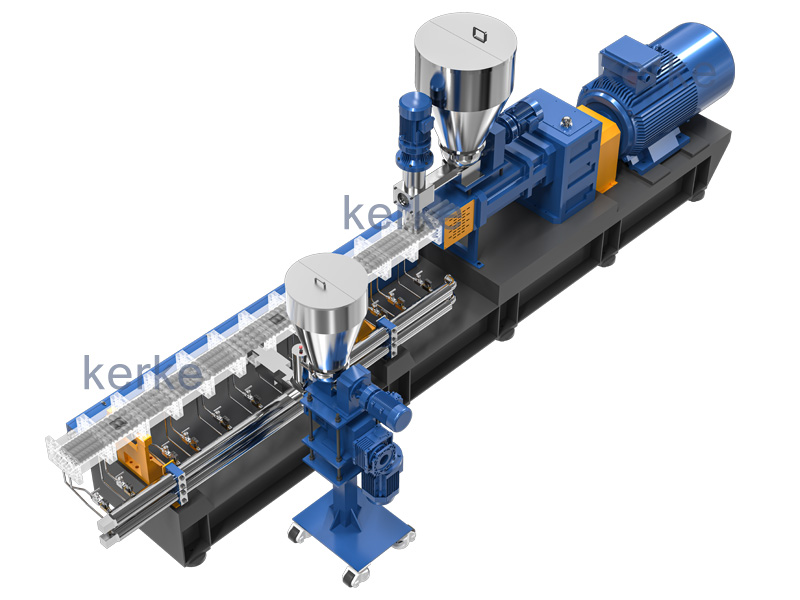
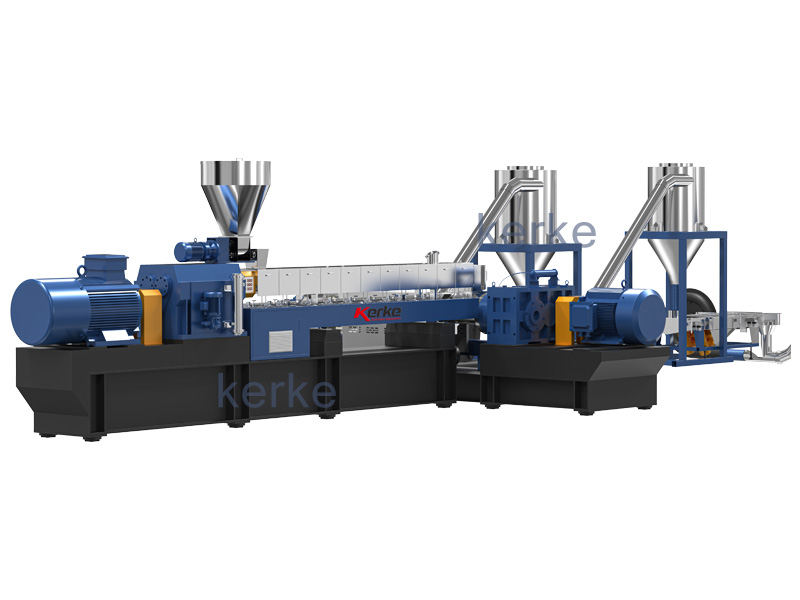
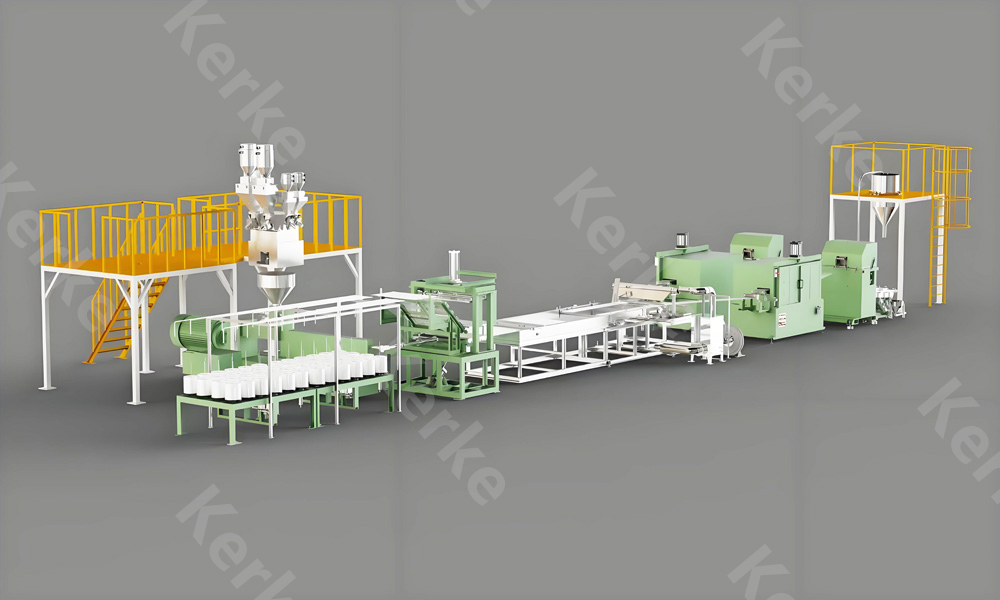
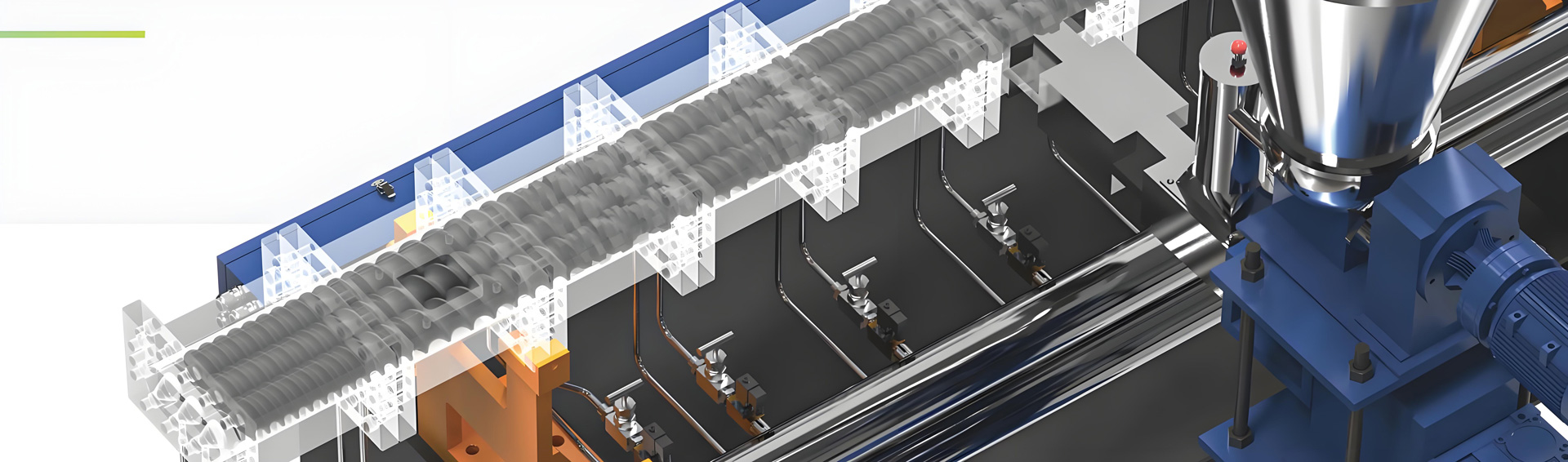
Kerke, as a leading manufacturer of twin screw extruders and masterbatch compounding equipment, understands the unique requirements of foaming masterbatch production. The company’s KTE Series twin screw extruders provide the precise control and mixing capabilities necessary for achieving uniform dispersion of foaming agents and nucleating agents throughout the polymer matrix. Proper compounding is essential for ensuring consistent cell structure formation while maintaining the mechanical properties of the base polymer. Kerke’s equipment is designed to handle the specific challenges associated with processing foaming masterbatch, including temperature-sensitive blowing agents and the need for thorough distributive mixing.
Understanding Foaming Mechanisms
Foaming in plastics occurs through the generation of gas within the polymer matrix, creating a cellular structure composed of polymer walls surrounding gas-filled cells. The foaming process involves several critical stages including gas generation, cell nucleation, cell growth, and cell stabilization. Understanding these mechanisms is essential for designing effective foaming masterbatch formulations that achieve the desired cell structure and density reduction. Different foaming agents work through various mechanisms, each with specific thermal decomposition characteristics and gas generation profiles.
Chemical blowing agents represent the most widely used technology for foaming masterbatch, relying on thermal decomposition to release gas at processing temperatures. These compounds decompose at specific temperature ranges, releasing nitrogen, carbon dioxide, or other gases that create cellular structures. The decomposition temperature must be carefully matched to the processing conditions and polymer melt viscosity to achieve proper cell formation. Chemical blowing agents offer the advantage of controlled gas release kinetics that can be tailored through selection of appropriate compounds and concentrations.
Endothermic chemical blowing agents absorb heat during decomposition, creating a cooling effect that can be beneficial for heat-sensitive polymers or thick-section applications where internal cooling is desired. These blowing agents, including azodicarbonamide derivatives and certain sodium bicarbonate-based formulations, decompose with net heat absorption that helps control cell growth and stabilize the foam structure. The endothermic nature of these agents can improve processing windows and reduce the risk of cell collapse in thick sections. However, the heat absorption may require adjustments to processing temperatures.
Exothermic chemical blowing agents release heat during decomposition, providing energy that can aid in cell expansion and polymer flow. These blowing agents, including modified azodicarbonamide and certain organic compounds, decompose with net heat release that accelerates cell growth. The exothermic nature can be beneficial for achieving higher expansion ratios and finer cell structures in thin-wall applications. However, the heat release must be carefully controlled to prevent overheating and cell collapse, particularly in thick sections.
Chemical Blowing Agent Types
Azodicarbonamide represents one of the most widely used chemical blowing agents in foaming masterbatch formulations due to its balanced properties and versatility. This compound decomposes at approximately 200 degrees Celsius, releasing nitrogen gas and generating cellular structures. The decomposition temperature can be modified through the addition of activators or inhibitors to match specific processing requirements. Azodicarbonamide offers excellent gas yield and compatibility with a wide range of polymers, making it suitable for many foaming applications from packaging to construction materials.
Sodium bicarbonate-based blowing agents are particularly useful for applications requiring lower processing temperatures or where endothermic behavior is desired. Sodium bicarbonate decomposes at temperatures between 150 and 200 degrees Celsius, releasing carbon dioxide and water vapor. The lower decomposition temperature makes these agents suitable for heat-sensitive polymers or applications where early gas generation is beneficial. The endothermic nature of sodium bicarbonate decomposition helps control cell growth and reduce the risk of thermal degradation in heat-sensitive applications.
P-Toluene sulfonyl hydrazide represents a specialized blowing agent that decomposes at approximately 230 degrees Celsius, making it suitable for higher temperature applications. This compound releases nitrogen gas upon decomposition and provides controlled gas generation kinetics. The higher decomposition temperature of P-Toluene sulfonyl hydrazide makes it suitable for engineering polymers and applications requiring higher processing temperatures. The compound offers good compatibility with many polymer systems and can be combined with other blowing agents to achieve specific gas release profiles.
Modified azodicarbonamide formulations represent advanced blowing agents with tailored decomposition characteristics. These modified compounds offer precise control over decomposition temperature, gas yield, and decomposition kinetics through chemical modification of the azodicarbonamide molecule. Modified formulations can provide activation at lower temperatures, faster decomposition rates, or improved compatibility with specific polymer systems. These tailored blowing agents enable foaming of polymers that were previously difficult to foam and provide improved control over cell structure and density reduction.
Nucleating Agents in Foaming
Nucleating agents play a critical role in foaming masterbatch by providing sites for cell nucleation, ensuring fine and uniform cell structure. Without proper nucleation, foaming results in large, irregular cells that compromise mechanical properties and surface quality. Nucleating agents create numerous nucleation sites throughout the polymer melt, resulting in many small cells rather than fewer large cells. The uniform cell structure achieved through proper nucleation leads to consistent material properties and improved performance characteristics.
Inorganic nucleating agents including talc, silica, and various mineral-based compounds are widely used in foaming masterbatch formulations. These materials provide numerous nucleation sites due to their fine particle size and surface characteristics. Talc is particularly effective as a nucleating agent due to its plate-like structure and compatibility with many polymer systems. Silica-based nucleating agents offer high surface area and can be surface-modified to optimize compatibility with specific polymers. The concentration of inorganic nucleating agents typically ranges from 0.1 to 2 percent by weight.
Organic nucleating agents including certain organic salts and specialized compounds offer advantages in some polymer systems. Sodium benzoate and other organic salts can be effective nucleating agents for specific polymers, particularly polyolefins. These organic nucleating agents often provide compatibility advantages and can be used at lower concentrations than inorganic alternatives. However, their thermal stability may be limited compared to inorganic nucleating agents, restricting their use in high-temperature applications.
Polymer-based nucleating agents including high-melting-point polymers can provide nucleation while maintaining compatibility with the base polymer. These nucleating agents are often selected based on their crystallization behavior and compatibility with the foaming polymer. Polymer-based nucleating agents can be particularly effective in semi-crystalline polymers where they can affect crystallization behavior and cell nucleation simultaneously. The concentration and molecular weight of polymer nucleating agents affect their effectiveness.
Cell Structure Control
Controlling cell structure is essential for achieving the desired balance of density reduction and material properties in foamed plastics. Cell structure parameters including cell size, cell size distribution, cell density, and cell wall thickness all influence the final material properties. Proper control of these parameters enables tailoring of foamed materials for specific applications, from lightweight packaging with good insulation properties to structural foams with enhanced mechanical strength.
Cell size directly affects mechanical properties, thermal insulation, and acoustic performance of foamed plastics. Smaller cells generally provide better mechanical properties, improved thermal insulation, and finer surface finish. Larger cells can be acceptable in applications where mechanical properties are less critical and cost is a primary concern. Cell size is controlled through nucleation density, gas generation rate, and processing conditions. Higher nucleation density and controlled gas generation kinetics typically lead to smaller cell sizes.
Cell size distribution should be as uniform as possible to achieve consistent material properties. Non-uniform cell size distribution can lead to weak points and inconsistent performance. Uniform cell size distribution is achieved through proper dispersion of nucleating agents, uniform temperature distribution, and controlled gas generation throughout the polymer melt. Twin screw extruders with good mixing capabilities are essential for achieving uniform cell size distribution in foamed products.
Cell density, or the number of cells per unit volume, affects mechanical properties and density reduction. Higher cell density generally leads to better mechanical properties at a given density reduction, as stress is distributed across many small cell walls rather than fewer large walls. Cell density is controlled primarily by nucleating agent concentration and effectiveness. Higher nucleating agent concentrations typically lead to higher cell density, up to a point of diminishing returns.
Density Reduction Levels
Density reduction levels achievable with foaming masterbatch vary depending on the polymer system, processing conditions, and application requirements. The degree of density reduction must be balanced against the impact on material properties and processing requirements. Different applications require different density reduction levels, from slight weight reduction for packaging to substantial density reduction for insulation materials. Understanding achievable density reduction ranges helps in selecting appropriate formulations and processing conditions.
Low density reduction, typically 5 to 15 percent, provides modest weight reduction while maintaining mechanical properties similar to the solid polymer. This level of density reduction is suitable for applications where material properties must closely match the solid polymer but some weight reduction is desired. Low density reduction foams often have fine cell structures that minimally affect mechanical properties. This level of reduction is commonly used in packaging applications where cost and performance balance is critical.
Medium density reduction, typically 15 to 40 percent, provides substantial weight reduction with modified mechanical properties that can be advantageous for many applications. This density reduction range is widely used in applications including packaging, construction materials, and consumer goods. The cell structure becomes more pronounced at these reduction levels, affecting properties such as stiffness, impact strength, and thermal insulation. Proper formulation and processing enable maintenance of adequate mechanical properties for many applications.
High density reduction, typically 40 to 70 percent, provides substantial weight and material savings but requires careful formulation to maintain adequate mechanical properties. This level of reduction is used in applications where weight reduction is critical and mechanical requirements can be met through design modifications. Applications include insulation materials, lightweight structural components, and certain packaging applications. High density reduction foams often require specialized formulations and processing conditions.
Polymer-Specific Considerations
Different polymer systems have unique characteristics that affect foaming masterbatch formulation and processing requirements. The crystalline or amorphous nature, melt strength, thermal stability, and processing temperature range of the polymer all influence foaming behavior. Understanding polymer-specific requirements is essential for developing effective foaming masterbatch formulations for each polymer system. Kerke’s experience with various polymer systems enables optimization of formulations for specific applications.
Polyethylene foaming requires attention to melt strength and crystallization behavior. Low-density polyethylene typically provides good melt strength for foaming, while linear low-density polyethylene may require formulation adjustments to achieve adequate cell structure. High-density polyethylene can be challenging to foam due to its higher crystallinity and melt characteristics. Proper selection of blowing agents and nucleating agents is essential for achieving desired cell structure in different polyethylene grades. Processing conditions must be optimized for each specific polyethylene type.
Polypropylene foaming presents different challenges due to the polymer’s different melt characteristics and crystallization behavior. Polypropylene’s higher melting point compared to polyethylene requires blowing agents with appropriate decomposition temperatures. The crystalline nature of polypropylene affects cell nucleation and growth, often requiring different nucleating agent concentrations compared to polyethylene. Biaxially oriented polypropylene foams require special attention to cell structure control to maintain orientation properties.
Polystyrene foaming has a long history, particularly in expanded polystyrene insulation and packaging applications. However, traditional polystyrene foaming uses expandable beads rather than foaming masterbatch. Foaming masterbatch can be used in polystyrene for specific applications, but requires different approaches compared to polyolefins due to polystyrene’s different thermal characteristics and amorphous nature. The glass transition temperature of polystyrene affects cell stabilization and must be considered in formulation.
Processing Parameters and Equipment
Processing parameters significantly affect foaming behavior and must be carefully controlled to achieve desired cell structure and density reduction. Temperature profiles, pressure conditions, residence time, and cooling rates all influence cell formation and stability. Proper control of these parameters is essential for consistent foamed product quality. Kerke KTE Series twin screw extruders provide the precise control needed for foaming masterbatch production and processing.
Temperature profiles must be carefully optimized for each foaming masterbatch formulation and polymer system. The melt temperature affects blowing agent decomposition kinetics, polymer melt viscosity, and cell growth rate. Temperature must be high enough to ensure proper polymer flow and blowing agent decomposition but not so high as to cause excessive cell growth or cell collapse. Different temperature zones in the extruder can be optimized for different processing stages, with higher temperatures in melting zones and controlled temperatures in foaming zones.
Pressure conditions during processing affect cell formation and growth. Processing under pressure prevents premature foaming and allows gas to remain dissolved in the polymer melt until pressure is released at the die. The pressure drop at the die initiates cell nucleation and growth. The rate of pressure release affects cell size and distribution. Rapid pressure release typically leads to larger cells, while controlled release can achieve finer cell structures. Processing equipment must maintain appropriate pressure throughout the process.
Residence time affects both mixing quality and blowing agent decomposition. Insufficient residence time can result in poor dispersion of blowing agents and nucleating agents, leading to non-uniform cell structure. Excessive residence time may cause premature blowing agent decomposition or degradation of the polymer. Optimal residence time depends on the specific formulation, polymer system, and equipment design. Kerke KTE Series twin screw extruders allow precise control over residence time through screw configuration and speed adjustment.
Applications and Markets
Foaming masterbatch technology serves diverse applications across multiple markets, each with specific requirements for density reduction, mechanical properties, and performance characteristics. Understanding market-specific requirements enables development of optimized formulations for each application. The major application areas include packaging, construction, automotive, consumer goods, and industrial applications.
Packaging applications represent one of the largest markets for foaming masterbatch, driven by material cost savings, weight reduction, and enhanced product performance. Foamed packaging materials offer improved insulation properties, cushioning characteristics, and stiffness-to-weight ratios compared to solid materials. Food packaging, protective packaging, and specialty packaging all benefit from foaming technology. The packaging industry demands consistent quality and appearance, requiring precise control over cell structure and surface finish.
Construction materials including insulation, siding, and structural components benefit from foaming masterbatch technology. Foam insulation provides superior thermal insulation characteristics due to the cellular structure, reducing energy consumption in buildings. Foamed construction materials offer improved stiffness-to-weight ratios and can reduce material and installation costs. The construction industry requires consistent material properties and often demands compliance with building codes and standards.
Automotive applications increasingly utilize foamed plastics for weight reduction, which improves fuel efficiency and reduces emissions. Interior components, under-hood parts, and structural components can all benefit from foaming technology. Automotive applications require consistent material properties, often with specific mechanical performance requirements. The industry also demands compliance with automotive standards and regulations. Foaming masterbatch for automotive applications must be formulated to meet these specific requirements.
Consumer goods applications including furniture, appliances, and recreational products benefit from foaming technology through weight reduction and improved performance characteristics. Foamed consumer goods can offer improved ergonomics, reduced shipping costs, and enhanced product performance. The consumer goods market often emphasizes appearance and tactile feel, requiring careful control over surface finish and cell structure. Marketing advantages can be gained through the use of lightweight, environmentally friendly materials.
Cost Analysis and Pricing
The cost of foaming masterbatch varies significantly depending on the specific blowing agents, nucleating agents, and base polymers used. Chemical blowing agent masterbatch typically costs between 8 and 20 dollars per kilogram, depending on the blowing agent type and concentration. Specialized blowing agents or high-concentration formulations can cost up to 30 dollars per kilogram. The actual cost depends on the specific formulation, blowing agent purity, and volume purchased. Masterbatch manufacturers must optimize formulations to achieve required density reduction at acceptable cost levels.
Blowing agent raw material costs vary depending on the specific chemistry and purity requirements. Azodicarbonamide typically costs between 4 and 8 dollars per kilogram in bulk quantities. Modified azodicarbonamide formulations with tailored decomposition characteristics can cost between 8 and 15 dollars per kilogram. Sodium bicarbonate is relatively inexpensive at 1 to 3 dollars per kilogram but may require higher concentrations to achieve equivalent foaming effect. Specialized blowing agents for high-temperature applications or specific gas generation profiles can cost significantly more.
Nucleating agent costs vary widely depending on the type and particle characteristics. Talc-based nucleating agents typically cost between 2 and 5 dollars per kilogram. Surface-modified silica or specialized nucleating agents can cost between 5 and 15 dollars per kilogram. Polymer-based nucleating agents may cost between 8 and 20 dollars per kilogram depending on the specific polymer and molecular weight. The concentration of nucleating agents required is typically lower than blowing agent concentrations, but their cost can still be significant in overall formulation economics.
Volume discounts are commonly available for foaming masterbatch purchases, with prices decreasing as order quantities increase. Large volume purchases may receive discounts of 10 to 30 percent compared to small volume purchases. Contract pricing arrangements are available for customers with consistent high-volume requirements. The economics of foaming masterbatch use must consider not only the masterbatch cost but also the value provided through material savings, weight reduction, and enhanced product performance.
Kerke Equipment for Foaming Masterbatch
Kerke KTE Series twin screw extruders provide the ideal platform for producing high-quality foaming masterbatch. The KTE Series features advanced screw geometry optimized for dispersive and distributive mixing, ensuring uniform dispersion of blowing agents and nucleating agents throughout the polymer matrix. Precise temperature control across multiple barrel zones allows processors to maintain optimal processing conditions while controlling blowing agent decomposition. The modular design of KTE Series extruders enables customization for specific foaming masterbatch formulations.
KTE Series twin screw extruders offer L/D ratios from 40:1 to 72:1, providing sufficient residence time for thorough mixing while minimizing premature blowing agent decomposition. The available processing widths from 20mm to 150mm accommodate production volumes from laboratory scale to full-scale manufacturing. Kerke’s patented screw configuration technology enables optimization of mixing intensity and residence time for each foaming masterbatch formulation. This flexibility allows processors to achieve the optimal balance between mixing quality and blowing agent control.
Pricing for Kerke KTE Series twin screw extruders ranges from 25,000 dollars for laboratory-scale models to over 500,000 dollars for large-scale production equipment, depending on size, configuration, and automation level. This investment provides the capability to produce high-quality foaming masterbatch with consistent performance. The return on investment can be achieved through improved product quality, reduced processing costs, and the ability to command premium prices for high-performance foaming materials. Kerke offers flexible financing options to help customers acquire the equipment they need.
Kerke provides comprehensive support for foaming masterbatch production, including process development, formulation assistance, and ongoing technical support. The company’s experience with various blowing agents, nucleating agents, and polymer systems enables them to provide valuable guidance for optimizing processing conditions. Kerke’s quality systems ensure that produced equipment meets the highest standards for consistency and reliability. The company’s commitment to innovation ensures that customers receive equipment capable of meeting evolving market requirements.
Quality Control and Testing
Quality control for foaming masterbatch production involves comprehensive testing to ensure consistent performance and compliance with specifications. Testing protocols include measurement of additive concentration, dispersion quality assessment, and foaming performance evaluation. Consistent masterbatch quality is essential for ensuring reliable foamed product quality. Masterbatch manufacturers must maintain rigorous quality control systems to ensure batch-to-batch uniformity and compliance with specifications.
Blowing agent concentration analysis verifies that blowing agents are present at the specified concentrations. Analytical techniques including thermogravimetric analysis, gas chromatography, and thermal analysis can be used to quantify blowing agent content. Accurate concentration control is essential for achieving consistent density reduction and meeting customer specifications. Concentration analysis should be performed on production batches to verify compliance with specifications.
Dispersion quality assessment ensures that blowing agents and nucleating agents are uniformly distributed throughout the polymer matrix. Microscopic examination can identify agglomeration or uneven distribution of additive particles. Poor dispersion can lead to non-uniform cell structure and inconsistent material properties. Scanning electron microscopy with energy-dispersive X-ray spectroscopy can provide detailed information about particle distribution. Kerke’s quality systems include dispersion quality assessment as a critical control point in masterbatch production.
Foaming performance testing verifies that the masterbatch provides the required level of density reduction and cell structure. Testing should include measurement of density reduction, cell size analysis, and evaluation of mechanical properties. Density reduction should be measured to verify that it meets specification. Cell structure analysis including cell size distribution and cell density should be performed to ensure consistent foam morphology. Mechanical properties should be evaluated to verify that they meet application requirements.
Environmental Considerations
Environmental considerations are increasingly important in the development and use of foaming masterbatch technology. While foaming reduces material usage through density reduction, the environmental impact of blowing agents and overall life cycle of foamed products must be considered. Environmental regulations and market demands for more sustainable materials are influencing foaming technology development.
Blowing agent environmental impact varies significantly depending on the specific chemistry. Chemical blowing agents that release nitrogen or carbon dioxide generally have lower environmental impact compared to older blowing agents that released ozone-depleting substances. However, the decomposition products and any residual blowing agent must be considered in environmental impact assessment. Some blowing agents may produce decomposition products with environmental or health concerns that must be evaluated.
Material reduction through foaming provides environmental benefits by reducing raw material consumption. Lower density products require less polymer material per unit, reducing the environmental impact associated with polymer production. The weight reduction also reduces transportation energy and associated emissions. However, these benefits must be balanced against any environmental impacts of the blowing agents themselves. Life cycle assessment can provide comprehensive evaluation of overall environmental impact.
Recyclability of foamed products presents challenges that must be considered in material selection and application development. Foamed products may be more difficult to recycle due to the cellular structure and the presence of blowing agents. Some blowing agents may decompose or degrade during recycling processes, affecting recycled material quality. Development of recyclable foaming formulations that maintain properties through multiple recycling cycles is an area of ongoing research and development.
Future Trends and Innovations
The foaming masterbatch market continues to evolve as new technologies emerge and performance requirements advance. The growing demand for lightweight materials, improved performance characteristics, and environmental sustainability drives innovation in foaming technology. Future trends in foaming masterbatch include new blowing agent chemistries, improved cell structure control, and enhanced sustainability profiles.
New blowing agent chemistries are being developed to address specific application requirements and overcome limitations of current agents. Physical blowing agents that vaporize rather than decompose offer different gas release characteristics and may have different environmental profiles. Super-critical fluid blowing agents including carbon dioxide represent an emerging area with potential for fine cell structure control. Development continues on blowing agents with tailored decomposition temperatures and gas release kinetics.
Advanced nucleation technologies provide improved control over cell structure and distribution. Nano-particle nucleating agents offer extremely high nucleation density at very low concentrations, enabling fine cell structures with minimal impact on material properties. Surface-modified nucleating agents provide improved compatibility with specific polymer systems. Multi-functional nucleating agents that combine nucleation with other performance benefits represent another area of development.
Microcellular foaming represents an advanced foaming technology that creates extremely fine cell structures with cell sizes below 10 micrometers. This technology provides enhanced mechanical properties and surface finish compared to conventional foaming. Microcellular foaming requires specialized processing equipment and formulations but offers superior performance characteristics. Kerke’s advanced equipment platforms are suitable for processing microcellular foaming formulations that require precise control over processing conditions.
Regulatory Considerations
Regulatory compliance is a critical consideration for foaming masterbatch used in various applications. Food contact applications require compliance with food contact regulations such as FDA requirements in the United States or EU regulations for plastic materials in contact with food. Automotive applications must meet automotive industry standards and regulations. Construction materials may need to comply with building codes and standards for fire resistance, thermal performance, and other characteristics.
FDA compliance for food contact applications requires that blowing agents and other additives in foaming masterbatch be approved for food contact use. Many chemical blowing agents have FDA approval at specified usage levels. Masterbatch manufacturers must maintain appropriate documentation to demonstrate compliance with FDA requirements. Compliance requires ongoing monitoring as regulations evolve and new applications emerge. Kerke’s quality systems help ensure that produced masterbatch meets regulatory requirements.
Automotive industry standards including those from the International Organization for Standardization and automotive manufacturers establish requirements for materials used in automotive applications. Foamed plastics used in automotive applications must meet requirements for mechanical properties, flame resistance, low emissions, and other characteristics. Masterbatch manufacturers must ensure that their formulations meet these automotive standards. Kerke provides support for automotive industry compliance through material testing and documentation.
Construction material regulations vary by region but generally include requirements for thermal performance, fire resistance, and structural characteristics. Foamed insulation materials must meet thermal resistance requirements specified by building codes. Fire resistance requirements may limit the use of certain blowing agents or require addition of flame retardants to the formulation. Masterbatch manufacturers must understand the requirements for each target market and ensure compliance.
Conclusion
Foaming masterbatch for lightweight plastics represents a valuable technology that enables significant weight reduction while maintaining or enhancing material properties. The technology has evolved significantly from simple chemical blowing agent formulations to sophisticated systems incorporating nucleating agents, stabilizers, and modifiers that enable precise control over cell structure and density reduction. Proper formulation and processing are essential for achieving consistent foamed product quality while maintaining material properties and meeting application requirements. Kerke KTE Series twin screw extruders provide the mixing capabilities and process control needed for producing high-quality foaming masterbatch.
The selection of appropriate blowing agents, nucleating agents, and processing parameters requires careful consideration of application requirements, density reduction targets, and material property specifications. Different blowing agent chemistries offer different gas release characteristics and processing requirements. Nucleating agent selection significantly affects cell structure and final material properties. Masterbatch manufacturers must work closely with customers to optimize formulations for each specific application.
As the market for lightweight materials continues to grow, innovation in foaming agent technologies and processing methods will expand capabilities and application possibilities. New blowing agent chemistries, improved cell structure control technologies, and enhanced sustainability profiles will continue to advance the technology. Kerke remains committed to providing the advanced equipment and technical support needed to produce foaming masterbatch that meets evolving market requirements.
Investment in proper compounding equipment, such as Kerke KTE Series twin screw extruders, is essential for producing foaming masterbatch with consistent quality and performance. The precise control and mixing capabilities of Kerke equipment enable manufacturers to optimize processing conditions for each formulation. This investment pays dividends through improved product quality, reduced material costs through density reduction, and the ability to meet the growing market demand for lightweight foamed materials.