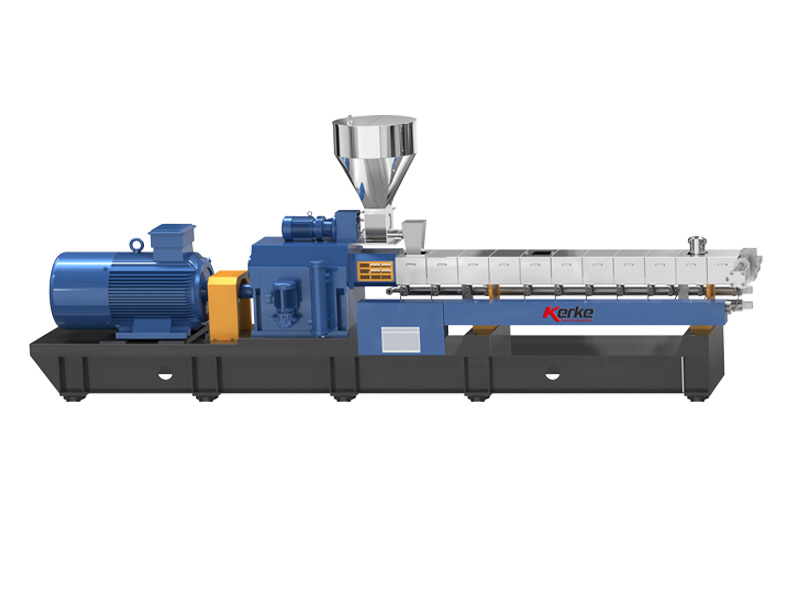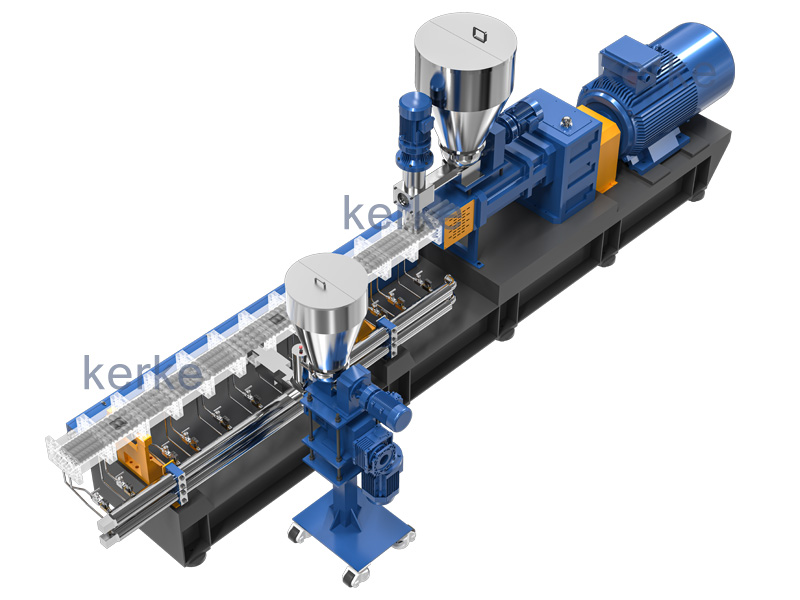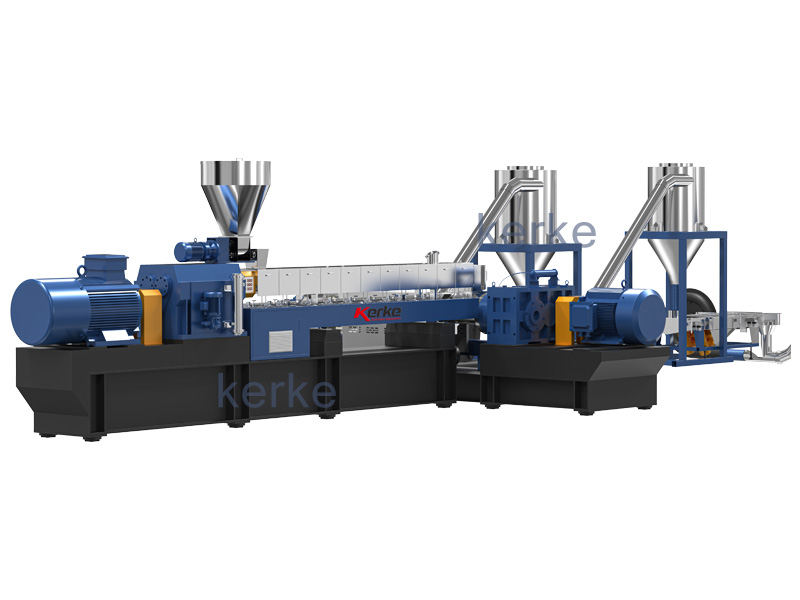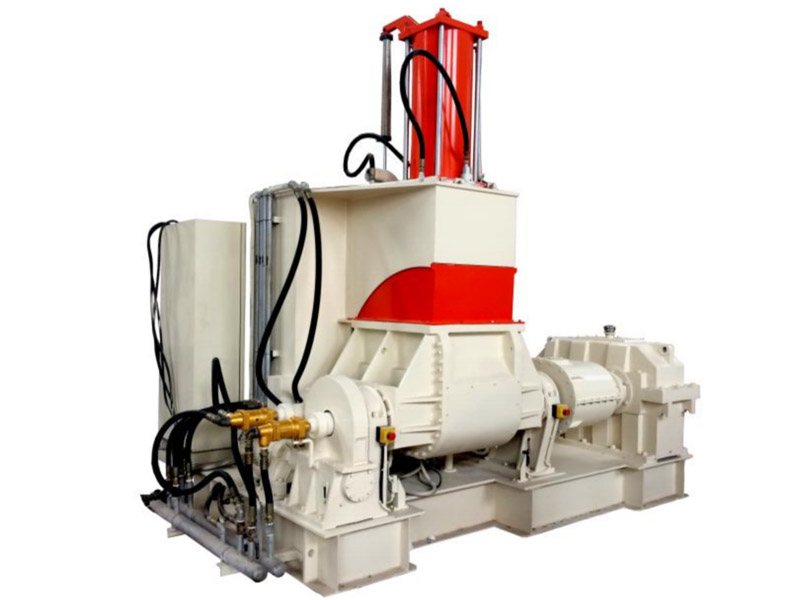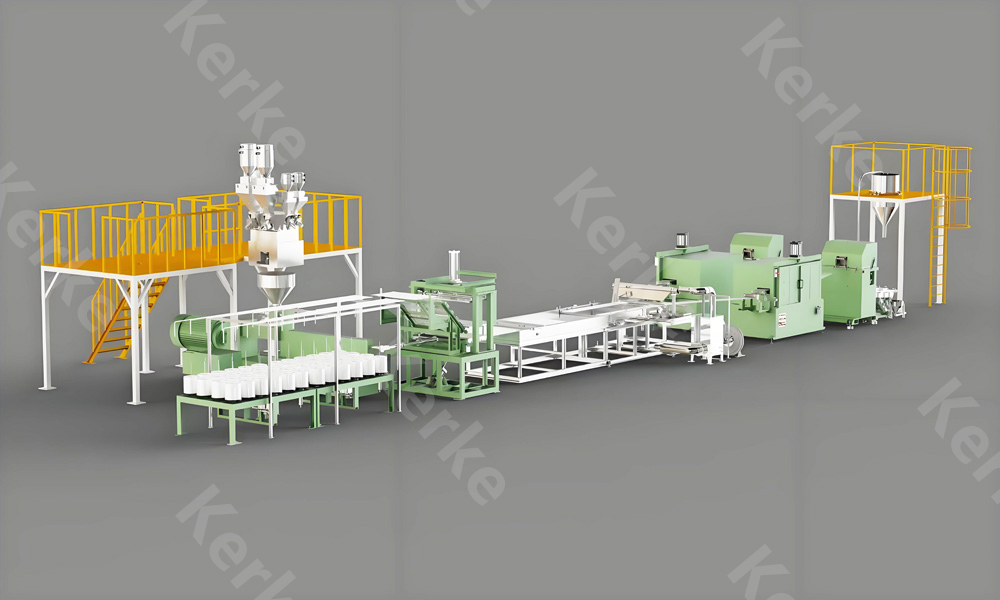
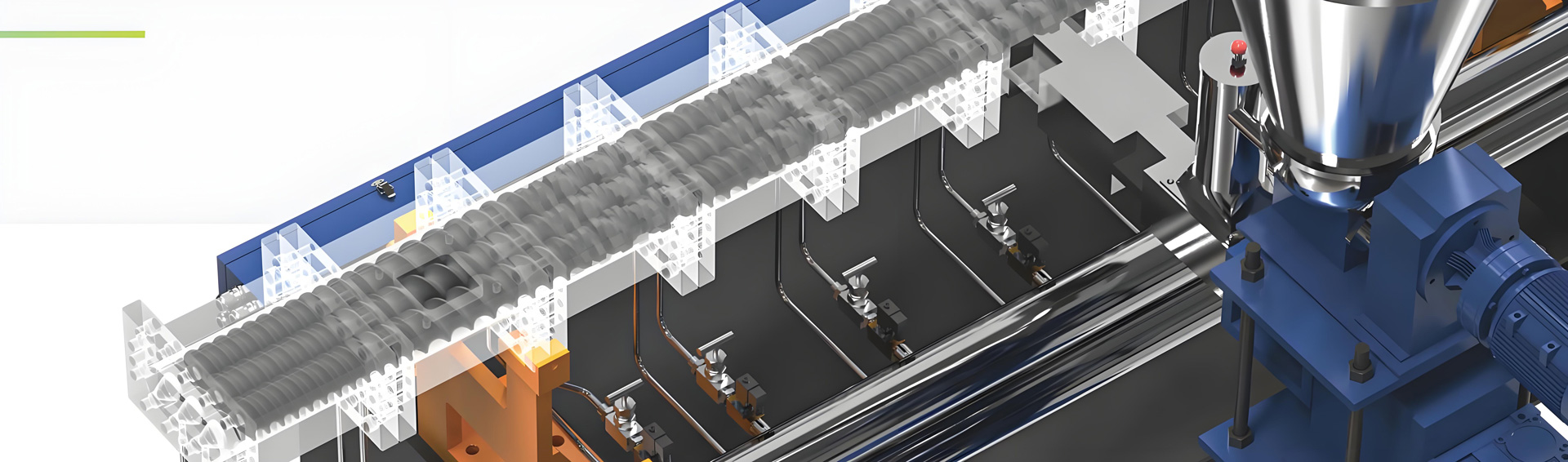
Engineering plastics like Nylon (PA), ABS, Polycarbonate (PC), and PBT are essential for automotive and electronics applications due to their high strength, heat resistance, and dimensional stability. However, they are challenging to process. Nylon is hygroscopic and prone to hydrolysis; ABS is shear-sensitive and can degrade easily; PC requires very high temperatures and pressures. A standard single-screw extruder often fails to provide the necessary mixing and pressure, making the Compounding Extruder (specifically co-rotating twin-screw) the industry standard. This article provides a deep dive into the technical requirements for processing these materials and how Kerke Extruder machines are engineered to meet these challenges.
Chapter 1: Challenges of Engineering Plastics
Hygroscopic Nature and Hydrolysis
The most significant challenge with Nylon (PA6 and PA66) is moisture. Nylon can absorb up to 9% of its weight in water. If this moisture is not removed before processing, it causes hydrolysis at high temperatures, breaking the polymer chains and reducing molecular weight. This leads to brittle pellets and a drop in intrinsic viscosity (IV). For bottle-grade Nylon, maintaining IV is critical. A Compounding Extruder must have a robust vacuum system to remove water vapor. Additionally, the residence time in the barrel must be minimized to limit exposure to heat. Kerke Extruder machines often feature a crystallizer/dryer upstream and a high-efficiency vacuum venting system with a large surface area for degassing.
Shear Sensitivity and Thermal Degradation
ABS is a terpolymer of acrylonitrile, butadiene, and styrene. The butadiene rubber phase is sensitive to excessive shear, which can cause the rubber to degrade, reducing impact strength. The styrene monomer can also degrade, causing yellowing. Therefore, the mixing section of the extruder must use milder kneading blocks. For Polycarbonate (PC), high viscosity is the main challenge. It requires high-torque gearboxes (often with a torque rating of 11-13 Nm/cm³) and specialized screws with high-pressure generating elements. Venting is also crucial for PC to remove styrene monomers or other volatiles that cause splay. The temperature profile must be precise to avoid thermal degradation.
Chapter 2: Processing Nylon (Polyamide)
Moisture Control and Crystallization
When processing Nylon, moisture control is paramount. Even 0.1% moisture can cause molecular weight reduction. The Compounding Extruder must have a robust vacuum system to remove water vapor. Additionally, glass fibers are often added to Nylon for reinforcement. The screws must be designed to convey long glass fibers without breaking them excessively, as fiber length directly correlates with impact strength in the final product. Kerke uses special low-compression screw elements for glass-filled nylon to minimize fiber attrition. The barrel must be corrosion-resistant because Nylon can release acidic byproducts at high temperatures.
Glass Fiber Reinforcement
Adding glass fibers (typically 10% to 40%) increases the viscosity dramatically and introduces abrasive wear. The screw elements in the feeding and melting zone must be made of wear-resistant tool steel or bimetallic liners. The mixing section needs to distribute the fibers evenly without breaking them. Kerke uses a “fiber lock” mixing element that gently encapsulates the fibers into the polymer matrix. For long-glass-fiber (LGF) applications, the side-stuffer is used to inject fibers directly into the melt, minimizing residence time and fiber breakage. The torque requirement for glass-filled Nylon can be 2 to 3 times higher than for unfilled Nylon, necessitating a heavy-duty gearbox.
Temperature Profile and Corrosion
Nylon processes at high temperatures (260-290°C). At these temperatures, the polymer can release acetic acid or other corrosive compounds. Standard steel barrels will rust and contaminate the product. Kerke Extruder offers barrels made of nitrided steel (resistant to mild corrosion) or duplex stainless steel (for high corrosion resistance). The temperature control must be uniform; cold spots can cause the nylon to solidify and plug the screw, while hot spots cause degradation. Water cooling is often used on the barrel jackets to provide precise control.
Chapter 3: Processing ABS and PC
ABS: Balancing Shear and Dispersion
ABS is processed at lower temperatures (220-250°C) than Nylon, but it is more shear-sensitive. High screw speeds can generate too much heat, degrading the rubber phase. The screw configuration should focus on distributive mixing rather than intensive dispersive mixing. For ABS masterbatch, the pigment must be added in a low-shear zone. Kerke uses wide-pitch conveying elements and interrupted kneading blocks to provide gentle mixing. The venting port must be efficient to remove any volatiles from the rubber phase, which can cause bubbles or odor in the final product.
Polycarbonate (PC): High Viscosity and High Heat
PC has a very high melt viscosity, requiring significant force to push it through the die. A co-rotating twin-screw extruder is ideal because the intermeshing screws provide positive displacement. The screw design must have a gradual compression ratio to build pressure without overloading the motor. The mixing section often uses toothed kneading blocks to break down agglomerates of additives (like PTFE or silicone). PC is also prone to splay if moisture is present, so a vacuum vent is mandatory. Kerke PC extruders often feature a double-stage venting system and a high-torque gearbox capable of 13 Nm/cm³ to handle the high back-pressure.
PBT and PET Engineering Plastics
PBT (Polybutylene Terephthalate) is similar to PET but crystallizes faster, making it easier to process. However, it still requires drying and high torque. It is often used with glass fibers in electrical connectors. The processing window is narrow; too hot and it degrades, too cold and it doesn’t melt. Precise temperature control is key. PET compounding is similar to Nylon but requires even stricter IV control. Solid-state polycondensation (SSP) is often used downstream, but the extruder’s role is to filter out contaminants and mix in stabilizers at the lowest possible temperature.
Chapter 4: Equipment Costs and Configuration
Heavy-Duty Gearboxes and Drives
Processing engineering plastics requires a heavy-duty Compounding Extruder. The machinery cost is higher due to the need for high-grade materials (bimetallic barrels, nitrided steel screws) and specialized drives. A twin-screw extruder capable of processing 30% glass-filled Nylon might cost between $150,000 and $300,000. The price is driven by the torque requirement; higher torque allows processing of higher viscosity polymers at lower temperatures, preserving material properties. For ABS compounding, the cost is slightly lower, around $100,000 to $200,000, but requires excellent temperature control systems.
Screw and Barrel Specifications
The screws for engineering plastics are not standard. They require specific geometries:
- Nylon Screws: Low compression, wide flights in the feed zone to handle fluffy regrind, intense kneading in the melting zone, and low-shear mixing in the metering zone. Often made of HIP steel.
- PC Screws: High compression, toothed kneading blocks for high shear, and a long metering zone for pressure generation. Made of tool steel with high chrome content.
- Corrosion Resistant Barrels: For Nylon and PBT, barrels are often nitrided (38CrMoAlA) which creates a hard, corrosion-resistant surface. For PVC or fluoropolymers, full stainless steel liners are used.
The cost of a specialized screw set can be $10,000 to $20,000, and a bimetallic barrel can add $15,000 to the machine price. However, these components last 2-3 times longer than standard ones in abrasive or corrosive environments.
Filtration Systems for High-Viscosity Melts
Engineering plastics often contain gels or unmelted additive agglomerates. A continuous screen changer is essential. For high-viscosity PC, a back-flush filter is preferred because it doesn’t create pressure spikes that could stall the screws. Kerke’s non-stop screen changers allow for filter changes without stopping the line, which is critical for engineering plastics that can “freeze” in the barrel if the flow stops. The cost of a hydraulic screen changer for high-pressure applications is approximately $8,000 to $12,000.
Chapter 5: Quality Control and Testing
Melt Flow Index (MFI) and Viscosity Monitoring
For engineering plastics, the Melt Flow Index (MFI) is a critical quality parameter. Degradation during extrusion changes the MFI. Online viscometers can measure the melt viscosity in real-time. If the viscosity drops, it indicates degradation, and the temperature or screw speed can be adjusted immediately. Kerke integrates these sensors into the control panel. Additionally, periodic lab testing of the pellets for MFI, tensile strength, and impact strength is required to certify the material for automotive use.
Glass Fiber Length Distribution
For glass-filled compounds, the length of the fibers after extrusion is critical. If the fibers are too short, the mechanical properties are poor. A specialized test involves dissolving the polymer and measuring the remaining fiber length. Kerke’s screw designs are optimized to maintain a weight-average fiber length of 0.3mm to 0.5mm for injection molding applications. Shorter fibers are used for extrusion profiles. The cost of fiber length analysis equipment is high, so most compounders rely on correlation with mechanical testing (Izod impact, tensile modulus).
Color and Thermal Stability
Engineering plastics are often used in light colors (white, beige, black). Yellowing is a common defect, especially in ABS and PC. This is caused by oxidation or degradation. The extruder must be purged with nitrogen during start-up and shut-down to prevent oxidation. Anti-oxidants must be added in the compounding process. Testing involves heat aging the pellets in an oven and measuring the color change (Delta E). A good compounding extruder should produce pellets with a Delta E of less than 1.0 after heat aging.
Chapter 6: Cost-Benefit Analysis of Processing Engineering Plastics
High Value of Engineered Compounds
The cost of producing engineered compounds is typically 30% to 50% lower than buying virgin polymer pellets. For example, if virgin PA66 costs $3,500/ton, recycled or compounded PA66 can be produced at a cost of around $2,000-$2,500/ton including energy and labor. This margin allows recyclers to be competitive while diverting tons of plastic from landfills. Furthermore, energy-efficient designs in modern extruders reduce specific energy consumption (SEC) to less than 0.25 kWh/kg, significantly lowering the carbon footprint of the recycling process.
ROI on Heavy-Duty Equipment
Investing in a heavy-duty Compounding Extruder for engineering plastics requires a higher capital expenditure. A machine capable of processing 30% glass-filled Nylon might cost between $150,000 and $300,000. This is driven by the torque requirement (11-13 Nm/cm³) and the need for corrosion-resistant materials. However, the profit margin for engineering compounds is significantly higher than for commodity plastics. A glass-filled Nylon compound can sell for $4,000 to $6,000 per ton, compared to $1,500 for PP. The higher torque allows processing of higher viscosity polymers at lower temperatures, preserving material properties. For ABS compounding, the cost is slightly lower, around $100,000 to $200,000, but requires excellent temperature control systems. Investing in a Kerke extruder with these specifications ensures that you can process a wide range of engineering plastics without frequent screw changes, maximizing equipment utilization and profitability.
Cost of Wear and Maintenance
Processing glass-filled or mineral-filled engineering plastics causes rapid wear. The cost of replacing screws and barrels can be high. However, using wear-resistant alloys extends the life of the components. Kerke offers refurbishment services where worn screws are re-tipped with wear-resistant alloy, extending their life by 50% compared to buying new ones. This refurbishment costs approximately 40% of a new screw set. For a machine running 24/7, this can save $20,000 to $30,000 per year in replacement costs. The initial investment in a high-quality machine with wear-resistant components pays off by reducing downtime for maintenance.
Chapter 7: Kerke Extruder Solutions for Engineering Plastics
The KTE-E Series (Engineering)
Kerke’s KTE-E series is specifically designed for engineering plastics. These machines feature high-torque gearboxes (up to 13 Nm/cm³), corrosion-resistant barrels (nitrided or bimetallic), and specialized screw designs for Nylon, PC, and PBT. The control system includes advanced temperature monitoring and torque overload protection. The price range for this series is $180,000 to $350,000 depending on size and configuration. Options include side stuffers for fibers, liquid injection for additives, and underwater pelletizing for heat-sensitive materials.
Case Study: Glass-Filled Nylon for Automotive Intake Manifold
An automotive supplier needed to compound 30% glass-filled Nylon 66 for intake manifolds. They were using a single-screw extruder but faced issues with fiber breakage and inconsistent mechanical properties. Kerke installed a co-rotating twin-screw extruder with a specialized low-shear screw section for the glass fiber side-stuffer. The machine featured a double-vacuum system to remove moisture. The result was a compound with a tensile strength of 150 MPa and an Izod impact strength of 80 J/m, meeting the strict automotive specifications. The line produced 500 kg/h, and the high torque ensured that the material was melted uniformly without degrading. The customer reported a 20% increase in productivity and a 15% reduction in scrap rates.
Case Study: Flame-Retardant ABS for Electronics
A manufacturer of electronic housings needed a flame-retardant ABS compound (UL94 V-0 rating). The challenge was to mix the flame retardant (often brominated or phosphorus-based) without degrading the ABS. Kerke provided a twin-screw extruder with a temperature-controlled side-stuffer for the liquid flame retardant and a high-efficiency venting system to remove decomposition gases. The screw design used interrupted kneading blocks to provide high dispersion at low shear. The final product passed the UL94 V-0 test and had excellent surface finish. The compound sold at a 40% premium over standard ABS, justifying the cost of the specialized extrusion line.
Conclusion
Processing engineering plastics like Nylon, ABS, and PC requires a deep understanding of material science and extrusion technology. The Compounding Extruder must provide high torque, precise temperature control, and corrosion resistance to handle the demanding processing conditions. Kerke Extruder offers a range of heavy-duty solutions tailored to the specific needs of engineering polymers, ensuring that manufacturers can produce high-performance compounds with consistent quality. By investing in the right machinery, companies can tap into the high-value engineering plastics market and achieve significant profitability. For technical consultation on your engineering plastic compounding needs, visit www.kerkeextruder.com.