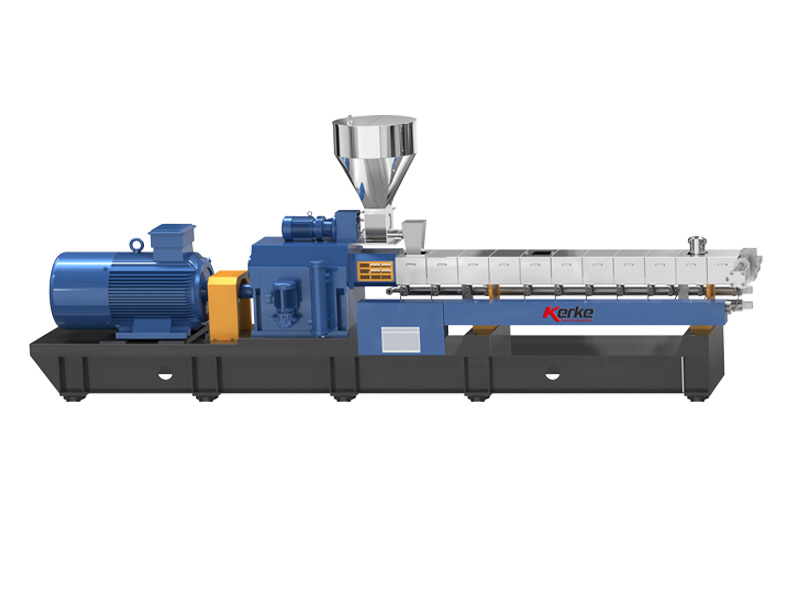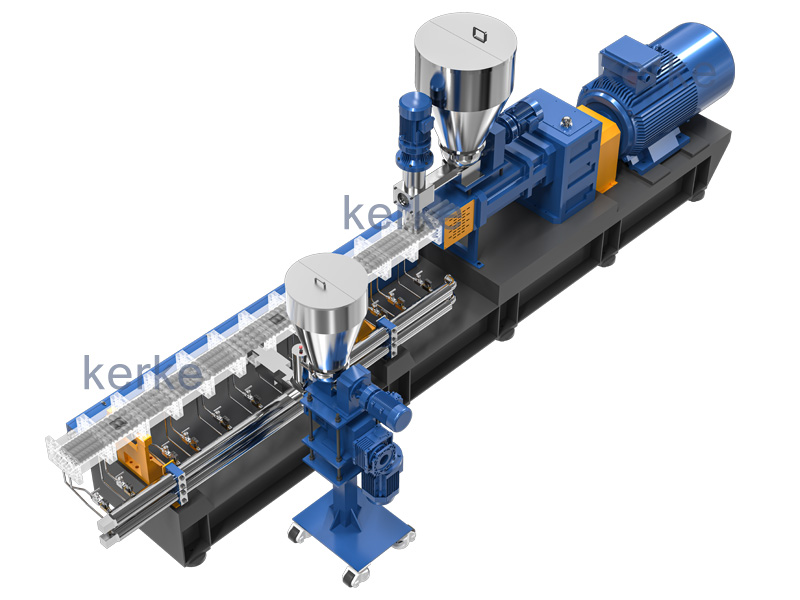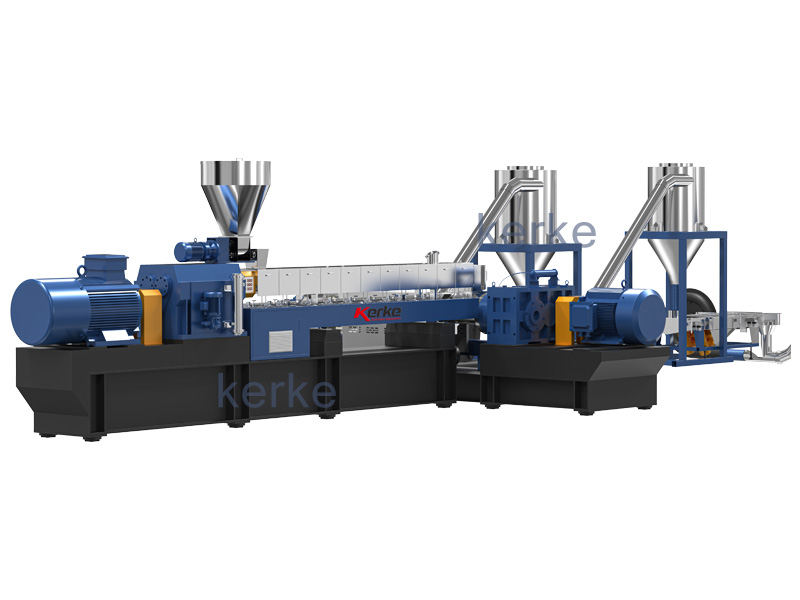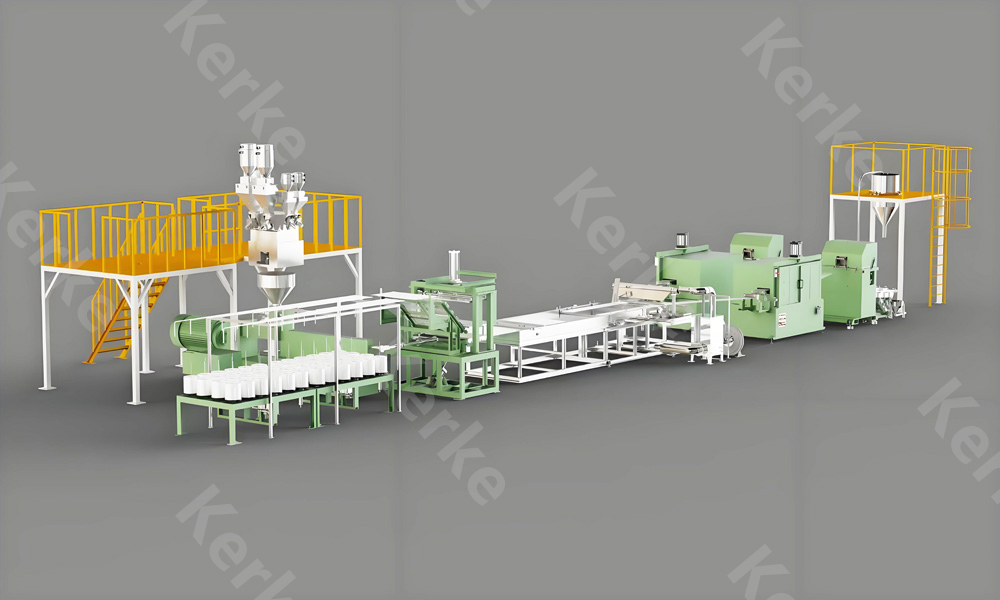
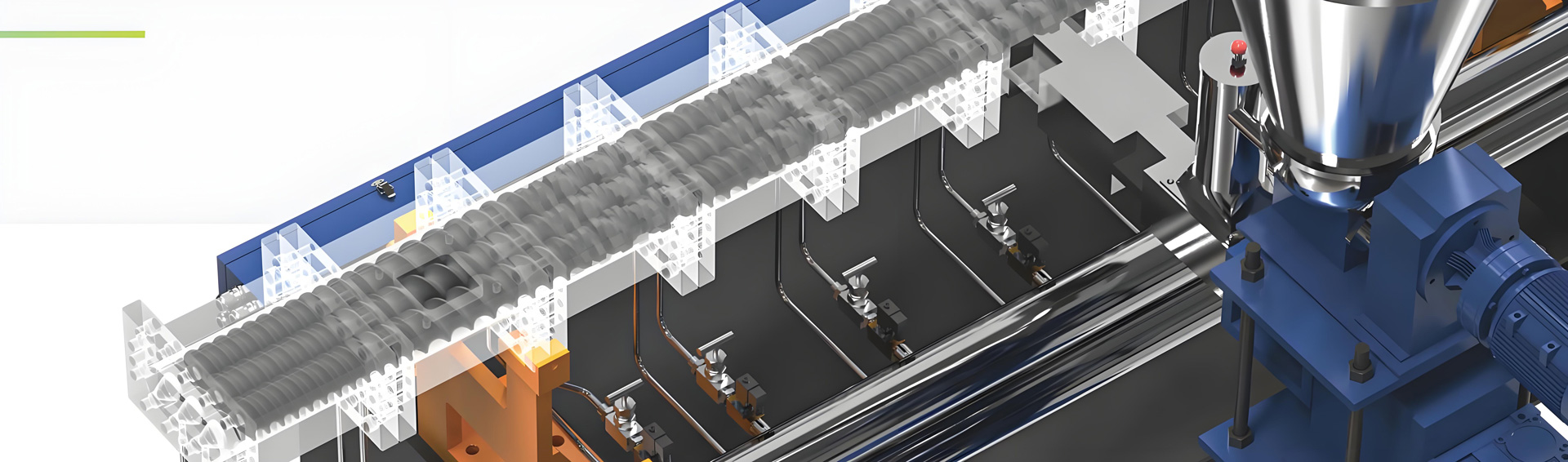
I. Price Analysis of Twin-Screw Extruder-Specific Hoppers
The price of twin-screw extruder hoppers varies significantly depending on material, structural type, capacity specification, precision configuration, brand customization and other factors. Based on mainstream market quotes (data sourced from platforms such as Alibaba and Made-in-China, as of January 2026), the price ranges by type are as follows:
(I) Basic Hoppers (No Metering Function, for Material Storage and Conveyance Only)
Such hoppers are mainly made of carbon steel, with stainless steel as an optional material. They are suitable for small and medium-sized extruders, used for basic feeding of ordinary plastic particles, powders and other materials, featuring a simple structure without additional control modules.
- Carbon Steel: Price range $500 – $1250 per unit, with a minimum order quantity of 1 unit in most cases and a usual warranty period of 1 year. For example, factory-direct carbon steel twin-screw extruder hoppers, suitable for PE and PP materials, are quoted as low as $573 – $588 per unit, ideal for bulk procurement to meet basic production needs.
- Stainless Steel: Price range $800 – $2000 per unit. Due to its corrosion resistance, it is suitable for materials containing acid-base components or food-grade production scenarios. Some customized specifications can be quoted up to $2500 per unit.
(II) Metering Hoppers (Including Loss-in-Weight/Volumetric Metering Modules)
Integrated with metering functions, they can precisely control the feeding amount, suitable for production scenarios with high proportioning precision requirements (such as masterbatch mixing and additive proportioning). The price rises significantly with the upgrade of metering precision and control methods.
- Volumetric Metering Hoppers: Price range $520 – $1700 per unit, with medium precision, suitable for ordinary proportioning needs. For example, volumetric twin-screw hoppers for PVC powder are quoted $520 – $570 per unit with a 1-year warranty.
- Loss-in-Weight Metering Hoppers: The price range is extremely wide, with ordinary models ranging from $3500 to $15800 per unit, and high-end models (suitable for carbon fiber, high-precision chemical materials) reaching $20000 – $50000 per unit. For instance, high-precision twin-screw loss-in-weight feeding hoppers, equipped with servo motors and precision weighing modules, are quoted $13000 – $50000 per unit, with a warranty period of 1 to 18 months.
(III) Special-Function Hoppers (Tapered Forced Feeding, Customized Structure)
Designed for high-specific-gravity materials, bridging-prone materials or special extrusion processes, they have a complex structure and are mostly customized, resulting in a higher price.
- Tapered Twin-Screw Forced Feeding Hoppers: Suitable for heavy materials or high-viscosity materials, priced at $18900 – $20000 per unit. Equipped with a forced feeding device to ensure stable material conveyance, they are commonly used in PVC pipe and profile extrusion production lines.
- Customized Hoppers (e.g., anti-corrosion, high-temperature resistance, multi-inlet design): Prices fluctuate according to customization requirements, ranging from $1000 – $3500 per unit (basic customization). Complex working condition customization (such as chemical anti-corrosion, laboratory-specific small hoppers) can exceed $10000 per unit.
(IV) Key Factors Affecting Price
- Material: Carbon Steel < Stainless Steel < Bimetallic Material. Bimetallic hoppers are 30% – 50% more expensive than ordinary stainless steel due to their wear resistance and high-temperature resistance.
- Capacity and Specification: Hopper volume ranges from 50L to over 500L. Larger capacity and interface size adapted to large extruders (such as 65/75-type twin-screws) increase the price by 20% – 100%.
- Brand and Origin: The price of domestic basic hoppers is generally 30% – 50% lower than that of imported brands. Imported brands (such as Coperion-matched hoppers) are mostly quoted above $10000 per unit.
- Additional Configurations: Equipping with level gauges, stirring devices, anti-bridging devices and other accessories will increase the basic price by 10% – 30%.
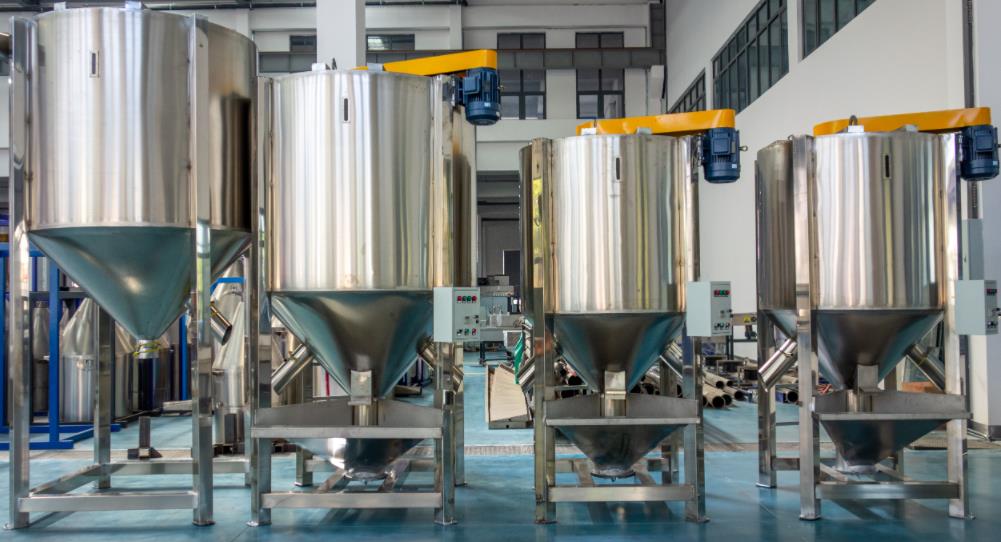
II. Replacement Precautions for Twin-Screw Extruder Hoppers
(I) Pre-Replacement Safety and Preparation
- Shutdown and Power Off Operation: Strictly follow the equipment operation procedures. First stop the extruder, cut off the main power supply and hang a “Under Maintenance” sign. Conduct replacement work only after the equipment has completely cooled down (the temperature of the hopper and feed inlet drops to room temperature). It is prohibited to disassemble the hopper when the equipment is running or at high temperature to avoid scalding and mechanical damage risks.
- Residual Material Cleaning: Before disassembly, empty the residual materials in the old hopper and clean the inner wall with a brush. If materials adhere or agglomerate, wipe with alcohol (avoid corrosive solvents). Meanwhile, clean the residual materials at the feed inlet and screw feed end to prevent mixing of new and old materials affecting production quality and avoid equipment failure caused by material jamming after replacement.
- New Hopper Inspection: Verify the compatibility of the new hopper’s material, volume and interface size with the extruder model, ensuring that the hopper interface is consistent with the feed inlet flange size and the fixing holes are aligned. Check that the inner wall of the hopper is free of damage and burrs; for metering hoppers, confirm that the metering module and sensor are intact and the terminal blocks are not loose.
- Tool and Protection Preparation: Prepare suitable tools such as wrenches, screwdrivers and gaskets, and wear protective equipment such as high-temperature resistant gloves and safety goggles to avoid injury from falling parts or splashing materials during disassembly.
(II) Key Points of Disassembly and Installation Operations
- Old Hopper Disassembly: First remove the fixing bolts between the hopper and the feed inlet, and separate the hopper from the feed pipe (if there are metering modules and level gauges, disconnect the wires first and make line marks to avoid wrong connection during reassembly). Move the hopper slowly during disassembly to prevent collision with precision components such as the extruder body and screws. For severely adhered parts, tap gently (avoid excessive force damaging the interface).
- Interface Treatment: Clean the gasket residue on the flange surface of the feed inlet, check the flatness of the flange surface. If there are scratches or deformations, repair them in time to avoid material leakage after installation. Replace with a new gasket to ensure sealing performance. For hoppers adapted to high-temperature materials, select high-temperature resistant gaskets (such as silicone and PTFE materials).
- New Hopper Installation: Slowly place the new hopper above the feed inlet, align the fixing holes, and tighten the bolts evenly (avoid interface deformation caused by excessive force on one side). For metering hoppers, connect the wires according to the marks during reassembly to ensure smooth signal transmission between the metering module, sensor and extruder control system.
- Angle Adjustment: The installation angle of the hopper must be greater than the material repose angle (usually ≥60°) to prevent material bridging and hanging in the hopper, which affects feeding stability. Especially for powders and easy-to-agglomerate materials, the installation angle must be strictly controlled.
(III) Post-Replacement Commissioning and Inspection
- No-Load Commissioning: Connect the power supply, start the equipment for no-load operation, and observe the tightness between the hopper and the feed inlet; no material leakage or abnormal noise is considered qualified. For metering hoppers, calibrate the metering precision, set the feeding amount through the control system, and check the deviation between the actual feeding amount and the set value. The deviation must be controlled within ±1% before putting into use.
- Load Testing: Add production materials for small-batch load operation, check the stability of material conveyance, ensure no bridging or blocking, uniform screw feeding, and stable extruder discharge. Meanwhile, observe whether the fixed part of the hopper is loose and whether the metering module data is transmitted normally.
- Detailed Inspection: For hoppers with stirring devices and anti-bridging devices, check that the devices operate flexibly without jamming. Clean up debris generated during replacement, ensure no obstacles around the equipment, and comply with production safety specifications.
(IV) Subsequent Maintenance and Precautions
- Regular Cleaning: According to the characteristics of production materials, clean the inner wall of the hopper regularly to avoid material residue agglomeration affecting feeding. For corrosive materials, clean them in time after each production to prevent damage to the hopper material.
- Accessory Maintenance: Regularly calibrate the sensors and metering modules of metering hoppers to avoid precision drift. Check gaskets regularly and replace them in time if they are aged or damaged to prevent material leakage.
- Working Condition Adaptation: It is prohibited to put materials exceeding the material tolerance range of the hopper (such as high-temperature and strong corrosive materials) into use to avoid hopper damage. If it is necessary to change the material type, especially from high-temperature materials to low-temperature materials or reinforced materials to non-reinforced materials, thoroughly clean the hopper and feeding system, and disassemble for cleaning if necessary.