Introduction
Customized masterbatch production requires precise control over every stage of the manufacturing process to ensure consistent quality and meet specific customer requirements. PLC (Programmable Logic Controller) controlled twin screw extruders have emerged as the gold standard in this industry, offering unmatched precision, flexibility, and reliability. This article explores how PLC technology is revolutionizing customized masterbatch production, with a focus on Nanjing Kerke Extrusion Equipment’s KTE Series twin screw extruders.
In today’s competitive market, manufacturers need to respond quickly to changing customer demands while maintaining strict quality standards. PLC controlled systems provide the necessary automation and data collection capabilities to optimize production processes, reduce waste, and improve overall efficiency. When paired with high-performance twin screw extruders like the KTE Series from Kerke, manufacturers can achieve exceptional results in customized masterbatch production.
Formula Ratios (Different Types)
Customized masterbatch formulations vary widely depending on the intended application, base polymer, and desired properties. PLC controlled systems allow for precise dosing and mixing of ingredients, ensuring consistent ratios batch after batch. Some common formula types include:
Color Masterbatch Formulations
Color masterbatches typically consist of pigments (20-60%), carrier resin (30-70%), and dispersants (1-10%). The exact ratio depends on the desired color intensity, base polymer compatibility, and application requirements. For example, a high-concentration red color masterbatch for PE film might include 50% red pigment, 45% LDPE carrier, and 5% dispersant package.
Additive Masterbatch Formulations
Additive masterbatches contain functional additives such as UV stabilizers, flame retardants, or anti-static agents. Ratios can range from 10-80% additive content depending on the specific additive and desired performance level. A UV stabilizer masterbatch for PP fibers might include 30% UV absorber, 65% PP carrier, and 5% processing aids.
Fillers and Reinforcement Masterbatch Formulations
Fillers like calcium carbonate or talc are often used to reduce cost or improve mechanical properties. Formulations can include up to 85% filler content, with the remaining 15% consisting of carrier resin and processing aids. A high-fill calcium carbonate masterbatch for PVC pipes might contain 80% CaCO3, 15% PVC carrier, and 5% processing aids.
Production Process
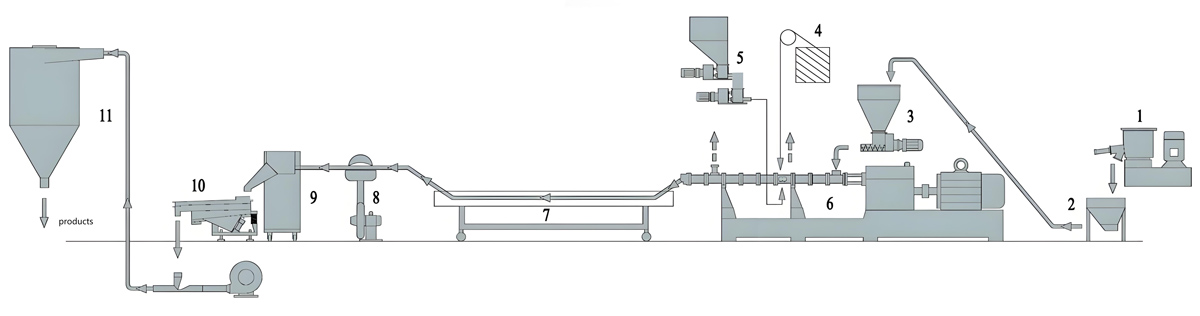
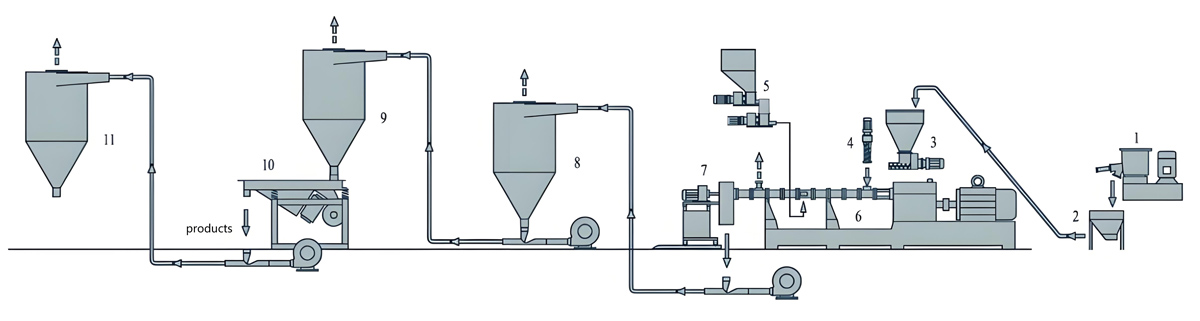
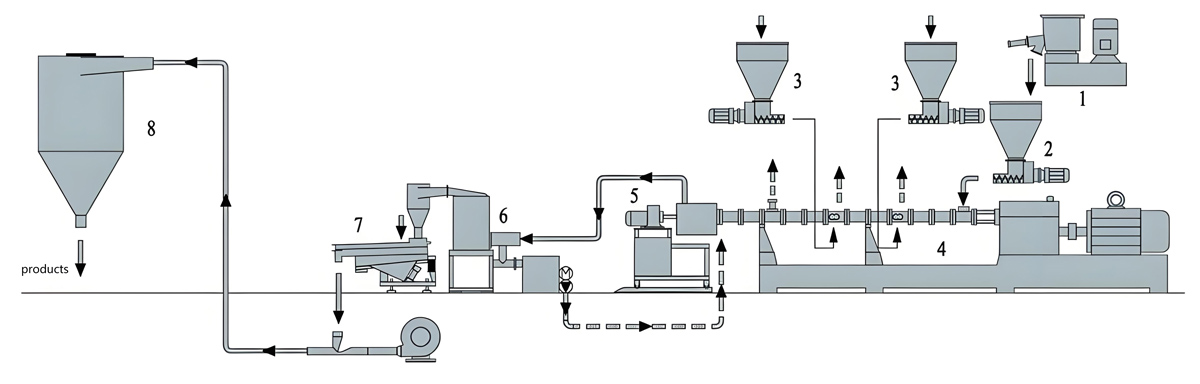
The production process for customized masterbatch using PLC controlled twin screw extruders involves several key stages, each carefully monitored and controlled by the PLC system:
Raw Material Preparation
Raw materials including pigments, carrier resins, additives, and processing aids are carefully measured and pre-mixed according to the specific formula. The PLC system ensures accurate dosing of each component, minimizing variation between batches.
Feeding and Extrusion
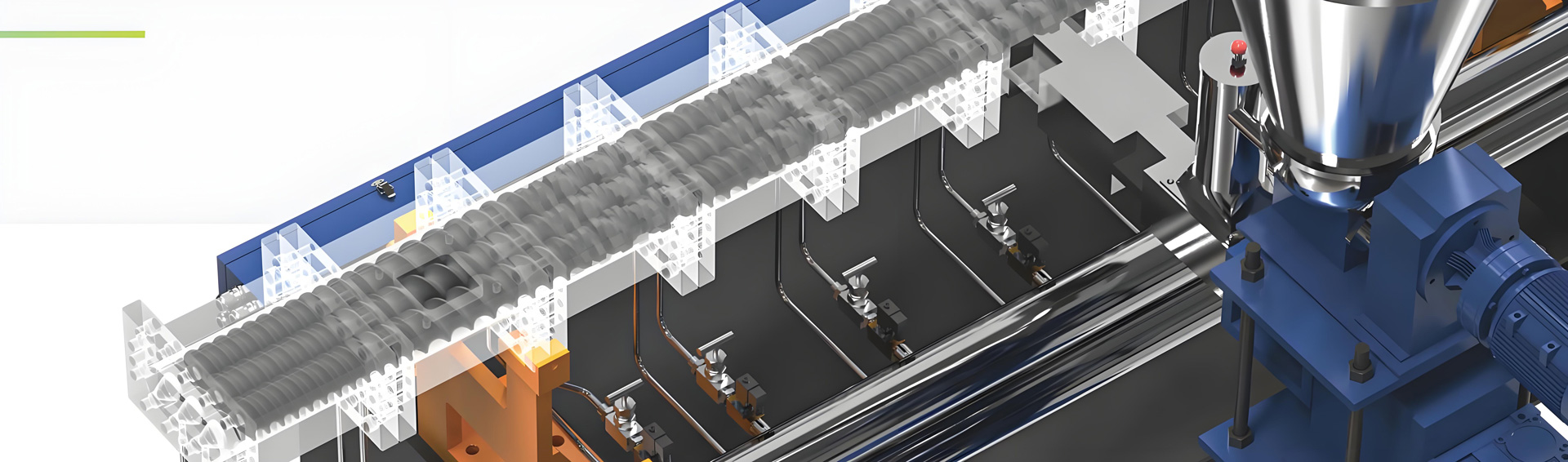
Pre-mixed materials are fed into the twin screw extruder through precise gravimetric or volumetric feeding systems controlled by the PLC. The extruder’s screw design and operating parameters are optimized for the specific formulation, ensuring proper melting, mixing, and dispersion of ingredients.
Melting and Mixing
Inside the extruder barrel, the material is heated and melted by a combination of external heaters and friction generated by the rotating screws. The twin screw design provides excellent mixing efficiency, ensuring uniform dispersion of pigments and additives throughout the carrier resin matrix.
Pelletizing
After thorough mixing, the molten polymer is extruded through a die and cut into uniform pellets using a pelletizer. The PLC system controls the pelletizer speed and blade configuration to ensure consistent pellet size and shape.
Cooling and Drying
Freshly cut pellets are cooled using either water baths or air cooling systems, then dried to remove excess moisture. The PLC system monitors temperature and humidity levels throughout this process to ensure optimal product quality.
Quality Control and Packaging
Finished masterbatch pellets undergo rigorous quality control testing to ensure they meet all specifications. The PLC system records critical process data throughout production, providing complete traceability and facilitating continuous improvement efforts. Approved product is then packaged according to customer requirements.