In the modern plastic processing industry, color masterbatch production stands as one of the most important links that determines the appearance and performance of final plastic products. Among all the equipment used in this process, the masterbatch extruder is the core equipment that directly affects dispersion uniformity, color consistency, output stability and production cost. For manufacturers who specialize in color masterbatch, functional masterbatch and filler masterbatch, mastering the ideal parameters of a masterbatch extruder is the key to improving product quality and market competitiveness. Kerke Extruder, a professional manufacturer focusing on twin screw extruder, masterbatch extruder and compounding extruder with years of R&D and production experience, has been committed to providing customers with optimized parameter schemes and high-performance extrusion equipment through its official website www.kerkeextruder.com. This article will comprehensively explain the ideal parameters of a masterbatch extruder in color master production from multiple dimensions such as structural design parameters, process control parameters, material matching parameters, quality control parameters and fault troubleshooting parameters, so as to provide a complete reference for masterbatch production enterprises.
1. Basic Overview of Masterbatch Extruder for Color Master Production
1.1 Definition and Application Scope of Masterbatch Extruder
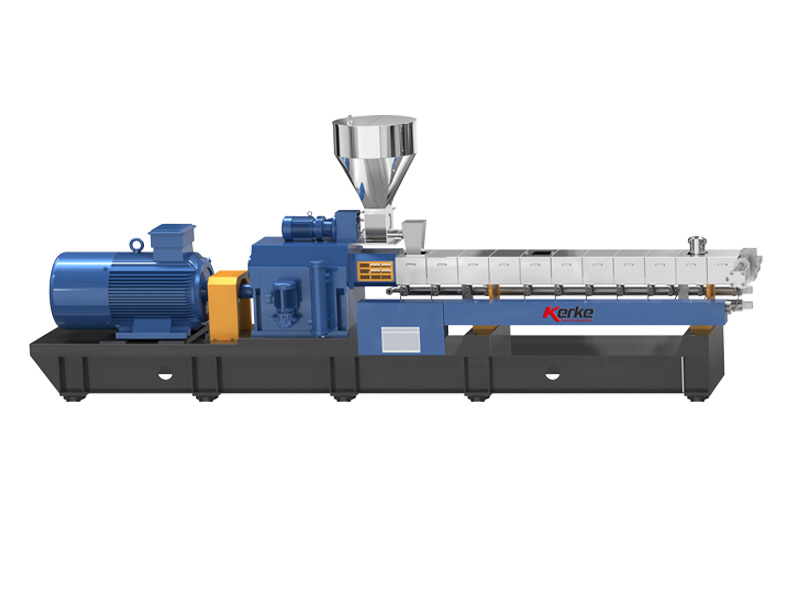
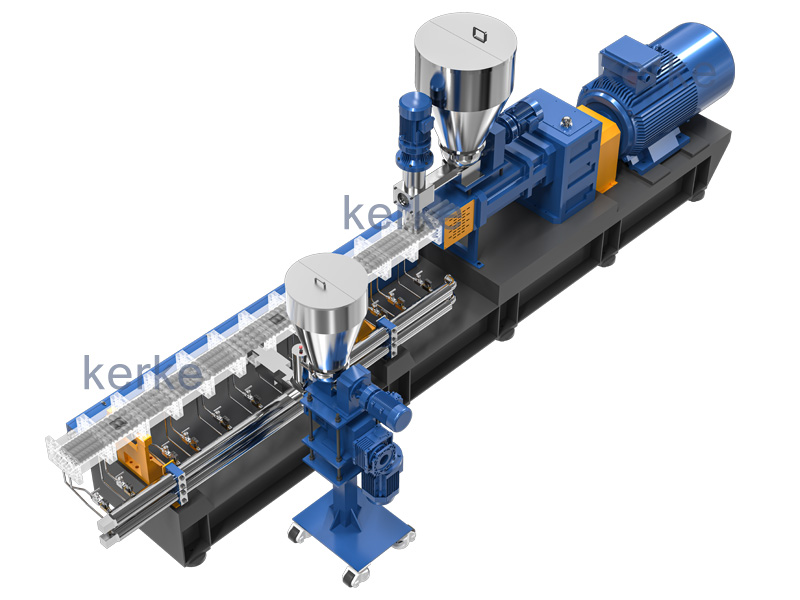
A masterbatch extruder is a special plastic processing equipment specially used for mixing, melting, shearing, dispersing and granulating carrier resin, pigment, additive and filler. Different from ordinary single screw extruder, the masterbatch extruder mostly adopts twin screw structure, which has stronger dispersing ability and more stable conveying performance. In color master production, this kind of extruder can evenly disperse high concentration pigment into carrier resin, so that the masterbatch has excellent coloring effect and dilution stability when used in injection molding, film blowing, sheet extrusion and other processes. With the expansion of plastic application scenarios, masterbatch extruders are widely used in PE color masterbatch, PP color masterbatch, ABS color masterbatch, PA color masterbatch and other product production, and have become indispensable core equipment in the plastic additive industry.
1.2 Advantages of Twin Screw Extruder in Color Master Production
When it comes to masterbatch production, twin screw extruder has obvious advantages over single screw extruder, which is also the reason why most high-quality color master manufacturers choose twin screw structure. First of all, the intermeshing and co-rotating structure of the twin screw can produce strong shearing and folding effect, which can quickly break up pigment agglomerates and improve dispersion efficiency. Secondly, the modular screw and barrel design of the twin screw extruder can be adjusted according to different formula requirements, which is suitable for high concentration pigment, functional additive and filler system. In addition, the twin screw extruder has a short material residence time and small temperature fluctuation, which can effectively avoid thermal degradation of heat-sensitive pigments and resins. Kerke twin screw extruder, as a high-end product in the masterbatch extruder industry, integrates the above advantages, and optimizes the screw configuration and temperature control system to adapt to various color master production processes.
1.3 Position of Compounding Extruder in Color Master Production Line
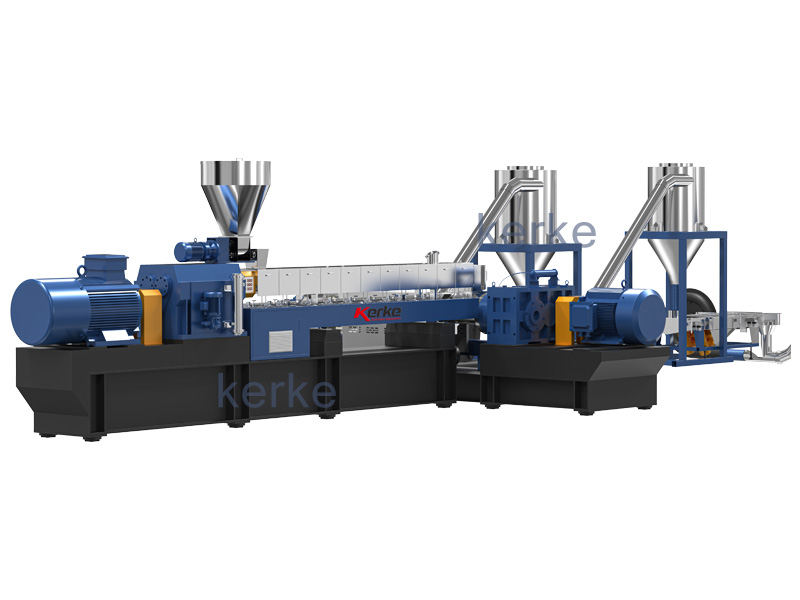
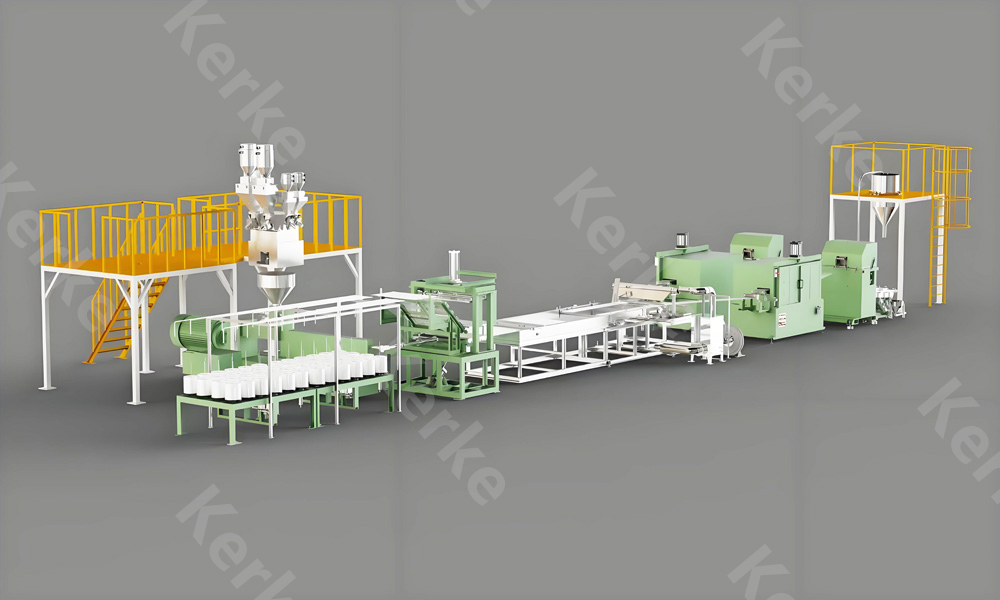
Compounding extruder is an important branch of masterbatch extruder, which undertakes the core compounding function in color master production line. The compounding process includes material feeding, melting, shearing, dispersion, homogenization and extrusion, and each link needs to be completed under the action of a compounding extruder. In the whole production line, the compounding extruder is connected with the feeding system, temperature control system, pelletizing system and cooling system, and its parameter setting directly determines the operation effect of the whole line. For color master production, the compounding extruder must realize the balance between high dispersion and low shear, so as to ensure that the pigment is fully dispersed without damaging the molecular structure of the resin. Kerke compounding extruder adopts high-torque transmission system and precise temperature control module, which can provide stable compounding environment for color master production and meet the strict requirements of high-quality masterbatch.
2. Core Structural Parameters of Masterbatch Extruder
2.1 Screw Diameter and L/D Ratio Parameters
Screw diameter and length-diameter (L/D) ratio are the most basic structural parameters of a masterbatch extruder, which determine the output range and mixing effect of the equipment. For color master production, the common screw diameters of twin screw extruder are 20mm, 35mm, 50mm, 65mm, 75mm and 95mm. Among them, 50mm and 65mm screws are the most widely used in medium and large-scale color master production, with an output range of 80-500kg/h, which can meet the needs of mass production. The L/D ratio is a key parameter affecting the mixing effect and residence time. The ideal L/D ratio of masterbatch extruder for color master production is 36:1 to 48:1. A too small L/D ratio will lead to insufficient mixing and poor dispersion, while a too large L/D ratio will increase the residence time and cause thermal degradation of materials. Kerke masterbatch extruder provides a variety of L/D ratio options, and the conventional 40:1 configuration can balance the mixing effect and production efficiency, which is suitable for most color master formulas.
2.2 Screw Structure and Configuration Parameters
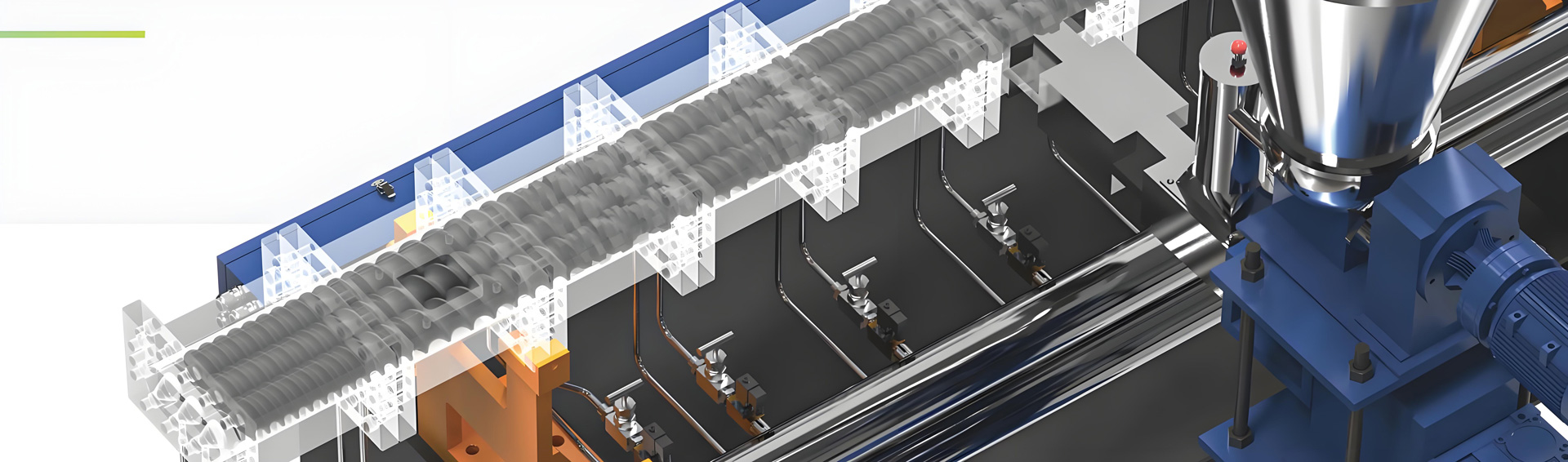
The screw structure and configuration parameters directly determine the shearing and dispersing capacity of the masterbatch extruder. The screw of a high-quality twin screw extruder for color master production adopts a modular combined design, which is composed of conveying elements, kneading blocks, reverse elements and other parts. For color master production, the number and arrangement of kneading blocks are particularly critical. High concentration pigment masterbatch needs to be configured with 4-6 groups of kneading blocks to enhance the shearing effect, while low concentration masterbatch can reduce the number of kneading blocks appropriately to reduce shear heat. In addition, the screw direction adopts co-rotating parallel structure, which has better self-cleaning effect and avoids material residue. Kerke screw elements are made of high-speed tool steel with surface nitriding and spraying treatment, which have excellent wear resistance and corrosion resistance, and can maintain stable structural parameters for a long time in the production of pigment and filler masterbatch.
2.3 Barrel Structure and Temperature Zone Parameters
The barrel of the masterbatch extruder is the main place for material melting and mixing, and its structural parameters and temperature zone division directly affect the temperature control accuracy. The barrel of Kerke masterbatch extruder is made of high-quality alloy steel with nitrided inner wall, which has high hardness and good heat conduction effect. The barrel is divided into multiple temperature zones according to the L/D ratio, and the ideal number of temperature zones for color master production is 8-12 zones. Each temperature zone is equipped with an independent heating coil and cooling fan, which can realize precise temperature adjustment. The feeding zone, melting zone, mixing zone, exhaust zone and extrusion zone have different temperature requirements, and the segmented temperature control can ensure that the material is heated evenly in each process stage. For color master production, the temperature control accuracy of the barrel should be controlled within ±1℃ to avoid color difference caused by local overheating.
2.4 Transmission System and Torque Parameters
The transmission system is the power source of the masterbatch extruder, and its torque and speed parameters determine the equipment’s ability to handle high concentration formulas. The ideal torque range of twin screw extruder for color master production is 800-1500N·m. High torque can ensure stable screw operation under high shear conditions, and avoid screw slipping or insufficient output caused by high pigment concentration. Kerke compounding extruder adopts a high-torque gearbox with hardened tooth surface, which has large bearing capacity and low noise, and can maintain stable torque output for a long time. The motor adopts variable frequency speed regulation motor, with a power range of 15-160kW matching the screw diameter, which can realize stepless speed regulation and meet the speed requirements of different color master formulas.
2.5 Feeding System Parameters
The feeding system parameters of the masterbatch extruder include feeding method, feeding accuracy and feeding speed, which are the key to ensuring the stability of color master formula. For color master production, gravimetric feeding is the ideal feeding method, with an accuracy of ±0.5%, which can accurately control the ratio of resin, pigment and additive. The feeding system is usually composed of main feeder and side feeder, the main feeder is used for conveying carrier resin, and the side feeder is used for adding pigment powder and additives. The feeding speed should be matched with the screw speed, and the ideal feeding speed range is 20-500kg/h according to different equipment models. Kerke masterbatch extruder is equipped with a precision gravimetric feeding system as standard, which can realize automatic ratio adjustment and ensure the color consistency of masterbatch batches.
3. Key Process Parameters in Color Master Production
3.1 Temperature Control Parameters
Temperature is the most critical process parameter in color master production, which directly affects resin melting, pigment dispersion and thermal stability. The ideal temperature setting of masterbatch extruder for color master production follows the gradient heating principle: the feeding zone temperature is 80-120℃, the melting zone temperature is 150-180℃, the mixing zone temperature is 180-210℃, the exhaust zone temperature is 190-200℃, and the die head temperature is 190-210℃. For PE and PP carrier resins, the temperature can be controlled at a low level, while for engineering plastics such as ABS and PA, the temperature needs to be increased by 20-30℃. Heat-sensitive pigments need to reduce the mixing zone temperature appropriately to avoid decomposition and discoloration. Kerke twin screw extruder is equipped with an intelligent temperature control system, which can monitor and adjust the temperature of each zone in real time to ensure the stability of process parameters.
3.2 Screw Speed Parameters
Screw speed affects the shear strength, residence time and output of the material, and the ideal speed range for color master production is 200-500r/min. For high concentration pigment masterbatch, the screw speed should be controlled at 200-300r/min to prolong the mixing time and improve dispersion; for low concentration masterbatch, the speed can be increased to 300-500r/min to improve production efficiency. Excessive screw speed will lead to excessive shear heat and material degradation, while too low speed will reduce output and cause poor dispersion. Kerke masterbatch extruder realizes stepless speed regulation through frequency converter, and operators can adjust the speed in real time according to formula and product requirements to achieve the best process effect.
3.3 Feeding Speed and Ratio Parameters
Feeding speed and ratio parameters determine the formula accuracy and output stability of color masterbatch. The feeding speed should be matched with the screw speed, and the ideal feed ratio is that the filling rate of the screw is 60%-80%. The pigment ratio in color master production ranges from 10% to 50%, and high concentration masterbatch needs to control the feeding speed of pigment strictly to avoid agglomeration. Gravimetric feeding system can automatically adjust the feeding speed according to the set ratio, ensuring that the ratio of each component is stable. In actual production, operators should check the feeding accuracy regularly to avoid color difference caused by inaccurate ratio.
3.4 Exhaust System Parameters
The exhaust system parameters of the masterbatch extruder are used to remove moisture, low molecular volatile matter and air from the material, which is crucial to improve the quality of color masterbatch. The ideal vacuum degree of the exhaust system is -0.06 to -0.08MPa. Excessive vacuum will suck out the material, while insufficient vacuum will lead to bubbles and poor appearance of the masterbatch. For color master production with high moisture pigment, the vacuum degree can be appropriately increased, and the exhaust port can be equipped with a material retaining device to prevent material leakage. Kerke compounding extruder is equipped with a dual-stage exhaust system as standard, which can effectively remove volatile matter and ensure the compactness and surface smoothness of masterbatch particles.
3.5 Die Head and Pelletizing Parameters
Die head and pelletizing parameters affect the appearance and particle size uniformity of color masterbatch. The ideal die head temperature is 190-210℃, and the number of die holes is determined according to the output, with a diameter of 2-3mm. The pelletizing method adopts strand cutting or underwater cutting, and the strand cutting is suitable for most color master production. The pelletizing speed should be matched with the extrusion speed, and the ideal particle size is 2-4mm. Uniform particle size can improve the fluidity and dilution stability of masterbatch. Kerke masterbatch extruder is equipped with a precision die head and pelletizing system, which can produce masterbatch particles with uniform size and smooth surface.
4. Parameter Matching for Different Color Master Formulas
4.1 Parameter Settings for High Concentration Pigment Masterbatch
High concentration pigment masterbatch (pigment content 30%-50%) has high requirements for dispersion, and the parameter settings need to enhance shear and mixing. Screw L/D ratio is 40:1-48:1, equipped with 5-6 groups of kneading blocks; screw speed is 200-280r/min; mixing zone temperature is 180-200℃; vacuum degree is -0.07 to -0.08MPa; feeding speed is reduced appropriately to ensure sufficient mixing time. Kerke twin screw extruder can achieve excellent dispersion effect for high concentration carbon black, titanium dioxide and organic pigment masterbatch through optimized parameter matching.
4.2 Parameter Settings for Functional Additive Masterbatch
Functional additive masterbatch (UV stabilizer, antioxidant, lubricant) has heat-sensitive additives, and the parameter settings need to reduce shear and residence time. Screw L/D ratio is 36:1-40:1, reduce the number of kneading blocks; screw speed is 300-400r/min; mixing zone temperature is reduced by 10-15℃; vacuum degree is -0.06 to -0.07MPa. This parameter scheme can avoid thermal degradation of additives and ensure the functional stability of masterbatch.
4.3 Parameter Settings for Filler Masterbatch
Filler masterbatch (calcium carbonate, talcum powder) has high abrasiveness, and the parameter settings need to balance dispersion and equipment wear. Screw and barrel adopt wear-resistant coating; screw speed is 250-350r/min; temperature is slightly increased to reduce melt viscosity; feeding speed is matched with output to avoid excessive abrasion. Kerke compounding extruder with wear-resistant structural parameters is suitable for long-term production of high filler content masterbatch.
5. Quality Control Parameters of Color Masterbatch
5.1 Dispersion Uniformity Parameters
Dispersion uniformity is the core quality parameter of color masterbatch, and the ideal standard is no pigment agglomeration observed under 100 times microscope. The dispersion effect is mainly affected by screw configuration, temperature and screw speed. By adjusting the number of kneading blocks and screw speed, the dispersion uniformity can be effectively improved. Kerke masterbatch extruder can achieve more than 99% dispersion uniformity through precise parameter control, meeting the high-quality requirements of color master production.
3.2 Color Difference Control Parameters
Color difference is an important index to measure the quality of color masterbatch, and the ideal color difference value ΔE is less than 1.0. The main factors affecting color difference are feeding accuracy, temperature stability and formula ratio. Gravimetric feeding system and precise temperature control system can effectively reduce color difference between batches. Kerke extruder’s intelligent control system can monitor and adjust parameters in real time to ensure color consistency.
5.3 Melt Flow Rate Parameters
Melt flow rate (MFR) affects the processing performance of masterbatch, and the ideal MFR range is 10-50g/10min according to different carrier resins. MFR is mainly adjusted by temperature and screw speed, increasing temperature or screw speed can increase MFR, and vice versa. Stable MFR parameters can ensure the good dilution effect of masterbatch in downstream processing.
5.4 Particle Appearance and Uniformity Parameters
The ideal color masterbatch particles are cylindrical, with smooth surface, uniform size, no bubbles and no broken particles. These parameters are controlled by die head temperature, pelletizing speed and cooling system. Kerke pelletizing system can produce high-quality masterbatch particles with stable parameters, improving the product grade.
6. Common Faults and Parameter Adjustment Methods
6.1 Poor Pigment Dispersion
Poor dispersion is usually caused by insufficient shear, low temperature or fast feeding speed. Solutions: increase the number of kneading blocks, increase screw speed appropriately, increase mixing zone temperature by 5-10℃, reduce feeding speed.
6.2 Masterbatch Color Difference
Color difference is caused by inaccurate feeding ratio or unstable temperature. Solutions: calibrate gravimetric feeder, check temperature control system, stabilize feeding speed and screw speed parameters.
6.3 Material Overheating and Degradation
Overheating is caused by high screw speed, high temperature or long residence time. Solutions: reduce screw speed, reduce temperature by 10-15℃, shorten L/D ratio appropriately.
6.4 Low Output and Instability
Low output is caused by low screw speed, insufficient feeding or high melt viscosity. Solutions: increase screw speed, check feeding system, adjust temperature to reduce melt viscosity.
7. Advantages of Kerke Twin Screw Extruder in Color Master Production
Kerke Extruder, as a professional manufacturer of twin screw extruder, masterbatch extruder and compounding extruder, has obvious advantages in color master production. The company’s products adopt modular design, high-torque transmission, precise temperature control and intelligent operation system, which can realize the ideal parameter setting for different color master formulas. All equipment is manufactured in accordance with international standards, with long service life, low energy consumption and easy maintenance. Through www.kerkeextruder.com, customers can obtain customized parameter schemes, equipment selection guidance and after-sales service. Kerke extruder helps color master production enterprises improve product quality, reduce production costs and enhance market competitiveness.
8. Conclusion
The ideal parameters of a masterbatch extruder in color master production involve structural parameters, process parameters, formula matching parameters and quality control parameters. Only by comprehensively optimizing these parameters can we produce color masterbatch with high dispersion, uniform color, stable performance and high quality. Twin screw extruder and compounding extruder are the ideal equipment for color master production, and their parameter setting needs to be adjusted according to different resin types, pigment concentrations and production requirements. Kerke Extruder relies on its professional R&D strength and rich industry experience to provide customers with high-performance masterbatch extruder and optimized parameter solutions. For color master production enterprises, choosing suitable extruder equipment and mastering ideal parameter settings are the key to achieving efficient and high-quality production. With the continuous development of plastic processing industry, masterbatch extruder technology will continue to innovate, and parameter optimization will become more refined, providing stronger support for the upgrading of color master products.