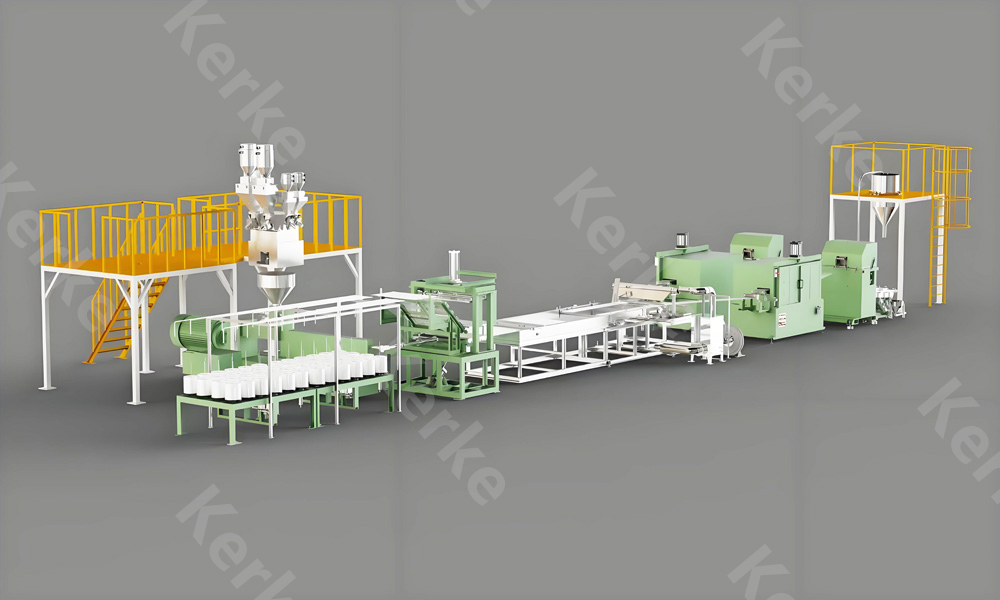
Mixing efficiency stands as a fundamental performance determinant in twin screw extruders, directly affecting product quality, throughput, and energy consumption. Kerke Compounding Extruder, with over 12 years of experience in parallel co-rotating compounding extruder technology, understands that maximizing mixing efficiency requires comprehensive optimization of screw design, processing parameters, and operating conditions. This detailed guide explores proven strategies for enhancing mixing efficiency in twin screw extruders, from fundamental design principles through advanced operational techniques, enabling manufacturers to achieve superior compounding performance with their Kerke KTE series twin screw extruders.
Fundamentals of Twin Screw Extruder Mixing
Twin screw extruder mixing encompasses two fundamental mechanisms: dispersive mixing and distributive mixing. Dispersive mixing involves the breakdown of agglomerates and particles through intensive shear forces, essential for achieving uniform dispersion of pigments, fillers, and additives. Distributive mixing refers to the spatial distribution of components throughout the melt, ensuring that all material receives similar processing history. Kerke parallel co-rotating twin screw extruders excel in both mixing mechanisms through optimized screw configurations that balance dispersive and distributive mixing for superior overall mixing efficiency.
The co-rotating configuration of Kerke twin screw extruders creates a figure-eight intermeshing region between the screws where material is subjected to intense mixing action. This intermeshing region generates high shear rates that effectively break down agglomerates while simultaneously dividing and recombining material streams for thorough distributive mixing. The KTE series extruders from KTE-16B to KTE-135D are designed with carefully calculated screw geometry that optimizes this intermeshing action for maximum mixing efficiency across different material types and processing requirements.
Mixing efficiency in twin screw extruders depends on multiple factors including screw geometry, operating conditions, material characteristics, and machine configuration. Screw elements including conveying elements, kneading blocks, and special mixing elements each contribute differently to overall mixing performance. Operating parameters including screw speed, feed rate, and temperature profile affect mixing effectiveness through their influence on residence time, shear rate, and material viscosity. Material characteristics such as viscosity, shear sensitivity, and particle size determine mixing requirements and appropriate processing strategies. Kerke’s comprehensive understanding of these interrelated factors enables customized extruder configurations optimized for specific compounding applications.
Screw Design Optimization for Mixing Efficiency
Screw design represents the most significant factor affecting mixing efficiency in twin screw extruders. Kerke computer-aided designed screw assemblies provide excellent self-cleaning function and good interchangeability, enabling optimization for specific mixing requirements. The modular nature of Kerke screw assemblies allows flexible configuration of conveying elements, kneading blocks, and special mixing sections along the screw length. Through appropriate and reasonable combination of these elements, the extruder can realize material transportation, plasticization, shearing, dispersion, homogenization, exhaust, and pressure building efficiently.
Conveying elements provide the primary function of material transport along the barrel while generating distributive mixing through the splitting and recombining of material streams. The geometry of conveying elements including flight width, depth, and pitch angle affects the balance between transport efficiency and distributive mixing. Narrow flight angles with multiple starts enhance distributive mixing at the expense of increased wear and power consumption. Kerke offers various conveying element configurations optimized for different mixing requirements, from high-capacity transport to intensive distributive mixing.
Kneading blocks generate dispersive mixing through the intensive shear created by intermeshing paddle elements. The staggering angle between paddles, number of blocks, and block width determine dispersive mixing intensity. Wider staggering angles create higher shear rates for more intensive dispersive mixing but also generate higher temperatures and power consumption. Kerke extruders feature customizable kneading block configurations that can be optimized for specific dispersion requirements, whether processing fine pigments requiring high shear or temperature-sensitive materials requiring gentle mixing.
Special mixing elements provide enhanced mixing capabilities beyond standard conveying elements and kneading blocks. These elements include toothed mixing sections, blister rings, and other specialized geometries designed for specific mixing challenges. Kerke offers various special mixing elements for applications requiring exceptional dispersive or distributive mixing performance. The selection and placement of these elements along the screw length significantly affects overall mixing efficiency and product quality.
Optimizing Screw Configuration for Different Applications
Different compounding applications require different mixing strategies, necessitating customized screw configurations optimized for specific material systems and process objectives. Kerke provides extensive application experience across diverse industries including masterbatch production, plastic compounding, cable compounding, PVC compounding, thermoplastic elastomers, and WPC composites. This broad experience enables Kerke to recommend optimal screw configurations for virtually any compounding application requiring enhanced mixing efficiency.
Masterbatch production requires exceptional dispersive mixing to achieve uniform pigment or additive dispersion while maintaining carrier resin quality. For color masterbatch, screw configuration must provide sufficient shear to break down pigment agglomerates without excessive thermal degradation of organic pigments. For filler masterbatch, high shear kneading blocks are necessary to achieve proper wetting and dispersion of fillers. Kerke offers screw configurations specifically optimized for different masterbatch types including color masterbatch, filler masterbatch, additives masterbatch, black masterbatch, and textile masterbatch.
Engineering plastic compounding often requires balancing dispersive mixing for filler or additive dispersion with gentle processing for temperature-sensitive polymers. Glass fiber reinforced polymers require specialized mixing strategies that achieve uniform fiber distribution without excessive fiber breakage. Flame-retardant compounds require uniform dispersion of flame retardant additives while maintaining polymer integrity. Kerke screw configurations for engineering plastic applications are designed to achieve the optimal balance between mixing intensity and thermal protection for specific polymer systems.
Biodegradable plastic compounding presents unique mixing challenges due to the thermal sensitivity of many biodegradable polymers and the need for uniform dispersion of additives including nucleating agents, processing aids, and reinforcing fillers. Kerke twin screw extruders are particularly well-suited for biodegradable plastic compounding, offering screw configurations that provide uniform mixing with minimal thermal exposure. The company’s experience with biodegradable plastic applications enables optimal screw design for maintaining polymer properties while achieving uniform additive dispersion.
Operating Parameter Optimization for Enhanced Mixing
Operating parameters significantly influence mixing efficiency and should be optimized for each application to achieve maximum mixing performance. Critical operating parameters include screw speed, feed rate, temperature profile, and die pressure. These parameters interact in complex ways that affect residence time, shear history, and ultimately mixing quality. Kerke provides process engineering support to help customers optimize operating parameters for their specific compounding applications and mixing requirements.
Screw speed affects mixing efficiency through its influence on shear rate and residence time. Higher screw speeds increase shear rates, enhancing dispersive mixing capability but reducing residence time. Lower screw speeds increase residence time but may reduce shear intensity. The optimal screw speed balances dispersive mixing requirements with residence time needed for complete material processing. Kerke twin screw extruders feature variable speed drive systems that enable precise control of screw speed across a wide operating range, facilitating optimization for specific mixing requirements.
Feed rate influences mixing efficiency through its effect on fill level and residence time distribution in the extruder. Higher feed rates increase fill level, potentially enhancing dispersive mixing in filled sections but may reduce mixing uniformity if the extruder becomes overloaded. Lower feed rates reduce fill level and residence time, potentially reducing mixing effectiveness. Kerke extruders are equipped with advanced feeding systems including gravimetric feeders that maintain consistent feed rates essential for reproducible mixing performance. The company offers various feeding system configurations to match different material characteristics and feeding requirements.
Temperature profile optimization is critical for achieving proper mixing while maintaining material quality. Appropriate temperatures ensure proper melting and flow characteristics necessary for effective mixing. Excessive temperatures can cause thermal degradation, particularly problematic for temperature-sensitive polymers. Insufficient temperatures may result in incomplete melting and poor mixing. Kerke twin screw extruders feature multiple independently controlled temperature zones enabling precise temperature profiling for optimal mixing performance across different material systems.
Material Characterization and Mixing Requirements
Understanding material characteristics is essential for optimizing mixing efficiency in twin screw extruders. Different materials present different mixing challenges and require tailored processing strategies. Kerke provides expertise in material characterization and processing recommendations across diverse polymer systems, additives, and fillers, enabling customers to achieve optimal mixing performance for their specific materials.
Polymer viscosity significantly affects mixing requirements. High viscosity polymers generate higher shear stresses for a given screw geometry, enhancing dispersive mixing but also requiring higher torque and generating more heat. Low viscosity polymers provide less dispersive mixing for a given screw geometry but are more susceptible to thermal degradation. Kerke screw configurations can be optimized for different viscosity ranges, providing appropriate mixing intensity while managing power consumption and heat generation effectively.
Polymer thermal sensitivity determines acceptable temperature limits and influences processing strategy. Thermally sensitive polymers require careful temperature control and limited residence time to prevent degradation. These materials often benefit from screw configurations that achieve efficient mixing with minimal shear heating. Kerke twin screw extruders offer excellent temperature control capabilities and screw configurations optimized for temperature-sensitive materials, enabling uniform mixing without thermal degradation.
Additive and filler characteristics including particle size, hardness, surface chemistry, and loading level significantly affect mixing requirements. Fine pigments require dispersive mixing to break down agglomerates but are often shear sensitive. Hard fillers require intensive dispersive mixing for wetting and dispersion. High additive loadings create challenges for uniform distribution. Kerke provides extensive experience with diverse additive and filler systems, offering screw configurations optimized for specific mixing challenges presented by different material types.
Advanced Mixing Elements and Configurations
Advanced mixing elements and screw configurations provide enhanced mixing capabilities beyond standard designs, enabling superior mixing performance for demanding applications. Kerke continuously develops and incorporates advanced mixing technologies into twin screw extruder designs, providing customers with state-of-the-art mixing solutions for challenging compounding applications.
Toothed mixing elements feature interlocking tooth designs that create intense distributive mixing while generating minimal dispersive shear. These elements are particularly effective for achieving uniform distribution of temperature-sensitive additives without excessive shear heating. Kerke offers various toothed mixing element designs optimized for different material types and mixing requirements. The placement of toothed mixing sections along the screw length affects their effectiveness in achieving uniform distribution while protecting temperature-sensitive components.
Blister rings and similar surface enhancement elements create additional mixing through increased surface area and material flow disruption. These elements are particularly effective for applications requiring enhanced distributive mixing with minimal impact on dispersive mixing intensity. Kerke offers blister ring configurations designed for specific material systems, providing enhanced mixing efficiency without excessive shear heating or power consumption.
Reverse conveying elements and pressure-generating sections create backmixing that enhances distributive mixing. These elements force material to flow opposite the normal transport direction, creating additional mixing through material recirculation. Kerke incorporates reverse elements in screw configurations for applications requiring exceptional distributive mixing, particularly for achieving uniform temperature and composition across the melt stream.
Residence Time Distribution Optimization
Residence time distribution significantly affects mixing efficiency and product quality uniformity. Narrow residence time distribution ensures that all material receives similar processing history, improving mixing consistency and product uniformity. Broad residence time distribution creates material portions with different shear and thermal histories, potentially causing quality variations. Kerke twin screw extruders are designed to optimize residence time distribution for specific mixing requirements.
Screw configuration significantly affects residence time distribution through its influence on flow patterns within the extruder. Conveying elements with different flight geometries create different flow characteristics. Kneading blocks with different staggering angles generate different levels of backmixing. Special mixing elements create additional flow complexity. Kerke optimizes screw configurations to achieve appropriate residence time distribution for specific applications, balancing mixing requirements with product quality objectives.
Operating conditions including screw speed, feed rate, and barrel fill level affect residence time distribution. Higher screw speeds typically reduce mean residence time and may narrow distribution width. Higher feed rates increase fill level, potentially broadening residence time distribution. Kerke provides guidance on optimizing operating conditions to achieve desired residence time characteristics while meeting production throughput requirements.
Die configuration and pressure influence residence time distribution near the extruder outlet. Restrictive dies increase back pressure, potentially broadening residence time distribution. Open dies reduce back pressure but may reduce mixing intensity near the die. Kerke assists customers in selecting appropriate die configurations that maintain required back pressure for mixing while minimizing residence time distribution effects on product quality.
Shear Rate Distribution and Control
Shear rate distribution throughout the extruder significantly affects mixing efficiency and product quality. Appropriate shear rates are necessary for effective dispersive mixing, but excessive shear can cause thermal degradation, polymer chain scission, or additive degradation. Kerke twin screw extruders are designed to optimize shear rate distribution for specific material requirements, achieving effective mixing while protecting material quality.
Kneading block configuration is the primary factor affecting shear rate distribution in twin screw extruders. Wider staggering angles generate higher shear rates for more intensive dispersive mixing. More kneading blocks increase total shear exposure. Kneading block width affects local shear intensity. Kerke optimizes kneading block configuration to achieve required dispersive mixing while managing total shear exposure for material protection.
Screw speed significantly affects shear rate magnitude throughout the extruder. Higher screw speeds generate higher shear rates, enhancing dispersive mixing but increasing thermal degradation risk. Lower screw speeds reduce shear rates, protecting thermally sensitive materials but potentially reducing mixing effectiveness. Kerke provides guidance on selecting optimal screw speeds that achieve required dispersive mixing while protecting material properties.
Barrel temperature profile affects shear rate through its influence on material viscosity. Lower temperatures increase viscosity, generating higher shear stresses for a given shear rate. Higher temperatures reduce viscosity, reducing shear stresses but potentially increasing thermal degradation risk. Kerke optimizes temperature profiles to achieve appropriate viscosity for effective mixing while managing thermal exposure for material protection.
Ventilation and Degassing Effects on Mixing
Ventilation and degassing systems significantly affect mixing efficiency and product quality. Removal of volatiles through vent ports eliminates bubbles and gas that could interfere with mixing and create quality defects. Kerke twin screw extruders feature optimized venting systems with configurable vent quantity and position according to material system requirements.
Vent port location affects both degassing efficiency and mixing characteristics. Vent ports positioned where melt viscosity is low enable effective bubble removal and escape of volatiles. Vent ports positioned too far upstream may not provide sufficient mixing for volatile generation. Vent ports positioned too far downstream may trap volatiles in the finished product. Kerke optimizes vent port placement based on material characteristics and processing requirements, achieving effective degassing without compromising mixing performance.
Vacuum level at vent ports affects both degassing effectiveness and material stability. Higher vacuum improves volatile removal but may pull material from the vent port, causing processing problems. Lower vacuum may not provide sufficient volatile removal. Kerke extruders feature precise vacuum control that maintains optimal vacuum levels for effective degassing while maintaining stable operation.
Multiple vent ports can be beneficial for materials requiring staged venting or handling multiple volatile components. Kerke extruders can be configured with multiple vent ports at strategic locations along the barrel, enabling staged removal of different volatiles or enhanced degassing for materials with high volatile content. The vent port configuration is optimized based on material volatility profiles and processing requirements.
Feeding System Impact on Mixing Efficiency
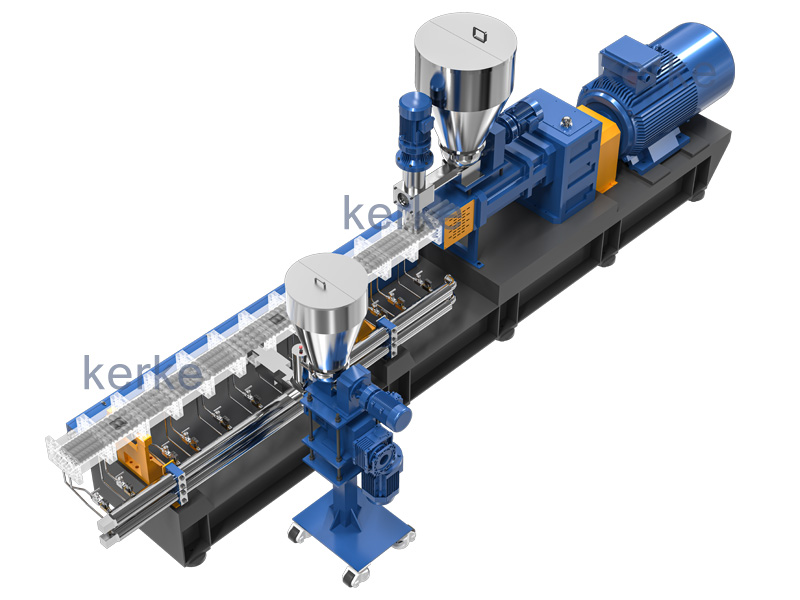
Feeding systems significantly affect mixing efficiency through their influence on feed uniformity, component distribution, and initial mixing. Kerke offers various feeding system configurations including single screw, twin screw, twin screw non-meshing type, hollow spring type, two-stage type, and metering pump volumetric metering feeding. For applications requiring higher precision, loss-in-weight metering can be equipped to meet stringent accuracy requirements.
Component feeding location affects initial mixing and distribution. Side feeders enable injection of additives or fillers at optimal locations along the screw length for improved mixing. Main throat feeding introduces all components at the upstream end, providing maximum mixing time but potentially exposing sensitive components to extended thermal exposure. Kerke provides guidance on optimal feeding strategy for specific applications, balancing mixing requirements with material protection needs.
Feed uniformity significantly affects mixing consistency. Inconsistent feed rates cause variations in composition and mixing effectiveness, leading to product quality variations. Kerke feeding systems feature gravimetric control that maintains precise feed rates, ensuring consistent mixing conditions throughout production runs. The systems are designed to handle various material forms including powders, granules, pellets, and liquids while maintaining feed uniformity.
Multiple component feeding systems enable separate feeding of components with different characteristics or processing requirements. For example, temperature-sensitive additives can be fed downstream to reduce thermal exposure. Fillers can be fed through side feeders to optimize dispersion. Kerke provides comprehensive feeding solutions that enable optimal feeding strategies for diverse compounding applications, enhancing mixing efficiency while protecting material properties.
Pelletizing System Effects on Mixing Quality
Pelletizing systems affect final mixing quality through their influence on melt cooling and solidification. Kerke offers multiple granulation system options to meet various material and processing requirements, including water-cooled strand pelletizing, air-cooled strand pelletizing, air-cooled die face hot cutting, water ring die face hot cutting, eccentric water mist hot cutting, and underwater granulation systems. The choice of pelletizing system affects final product quality and mixing characteristics.
Cooling rate during pelletizing affects crystallization, phase separation, and additive migration that can affect color uniformity and mechanical properties. Rapid cooling through water-cooled systems can trap melt structure, preserving mixing characteristics. Slower cooling through air-cooled systems allows phase separation and additive migration that may affect uniformity. Kerke provides guidance on selecting appropriate cooling rates for specific materials and quality requirements.
Pellet size and shape influence downstream processing and final product properties. Uniform pellets with consistent size and shape feed more consistently in downstream equipment, maintaining uniform composition and mixing characteristics. Kerke pelletizing systems are designed to produce uniform pellets with tight size distribution, ensuring consistent downstream processing and final product properties.
Pelletizing system integration with extruder affects melt stability and mixing near the die. Proper die design and coupling between extruder and pelletizing system maintain stable melt flow, preserving mixing characteristics achieved in the extruder. Kerke provides integrated solutions that ensure compatibility between extruder and pelletizing systems, maintaining mixing quality through the complete process.
Process Monitoring and Control for Consistent Mixing
Process monitoring and control systems are essential for maintaining consistent mixing performance over time. Kerke twin screw extruders feature advanced control systems that enable precise monitoring and control of critical process parameters affecting mixing efficiency. These systems enable consistent operation and rapid detection of deviations that could affect mixing quality.
Temperature monitoring at multiple barrel locations enables precise temperature profile control and detection of temperature deviations that could affect mixing. Kerke extruders feature multiple temperature zones with independent control and monitoring, ensuring consistent thermal conditions essential for reproducible mixing performance. Temperature deviations are detected quickly, enabling corrective action before mixing quality is affected.
Pressure monitoring at key locations provides information about fill level and processing conditions that affect mixing. Pressure sensors at barrel sections and die provide insights into processing state and enable detection of blockages or processing anomalies that could affect mixing. Kerke extruders feature pressure monitoring at strategic locations, enabling comprehensive process control and early detection of problems affecting mixing efficiency.
Motor load monitoring provides information about torque requirements, indicating changes in mixing conditions. Increases in motor load may indicate increased viscosity due to temperature drops or material variations. Decreases in motor load may indicate processing problems or changes in material properties. Kerke extruders feature motor load monitoring that enables detection of processing changes affecting mixing performance.
Troubleshooting Mixing Problems
Despite careful design and optimization, mixing problems can occur during twin screw extruder operation. Systematic troubleshooting approaches identify root causes and enable corrective actions. Common mixing problems include poor dispersion, non-uniform color, temperature degradation, and product inconsistencies. Kerke provides comprehensive troubleshooting support to help customers identify and resolve mixing problems quickly.
Poor dispersion of additives or fillers typically manifests as streaks, specks, or non-uniform properties in the final product. Causes may include insufficient kneading block intensity, inadequate kneading block quantity, inappropriate operating conditions, or material incompatibility. Kerke troubleshooting approaches involve examining screw configuration, verifying operating parameters, and evaluating material compatibility. Corrections may include screw reconfiguration, parameter adjustment, or material formulation changes.
Non-uniform color or composition indicates insufficient distributive mixing or feed rate variations. Causes may include inadequate conveying elements, inappropriate operating conditions, or feeding system problems. Kerke troubleshooting involves evaluating distributive mixing elements, verifying operating parameters, and checking feeding system operation. Corrections may include addition of mixing elements, parameter adjustment, or feeding system maintenance.
Thermal degradation表现为变色、气味或性能下降。原因可能包括剪切过高、温度过高或停留时间过长。Kerke故障排除涉及评估剪切强度、检查温度曲线和测量停留时间。纠正措施可能包括螺丝重新配置、温度调整或螺杆速度调整。
Advanced Mixing Technologies
Advanced mixing technologies provide opportunities for enhanced mixing performance beyond conventional approaches. Kerke continuously researches and develops new mixing technologies, incorporating innovations into twin screw extruder designs to provide customers with state-of-the-art mixing capabilities.
Pulsed flow mixing technologies introduce intentional flow pulsations that enhance distributive mixing through material recirculation. These technologies can achieve enhanced mixing with minimal additional energy input. Kerke researches pulsed flow applications for various material systems, providing enhanced mixing capabilities where traditional approaches reach performance limits.
Ultrasonic mixing technologies apply ultrasonic energy to enhance dispersive mixing for challenging applications. These technologies can achieve superior dispersion of fine particles with minimal thermal exposure. Kerke explores ultrasonic mixing applications for materials where conventional dispersive mixing causes excessive thermal degradation or where exceptional dispersion is required.
Reactive mixing technologies combine mixing with chemical reactions, enabling in-line compounding and modification. These technologies can achieve property enhancement during extrusion, reducing post-processing requirements. Kerke provides solutions for reactive compounding applications, combining advanced mixing with controlled reaction conditions for optimal property development.
Kerke Solutions for Enhanced Mixing Efficiency
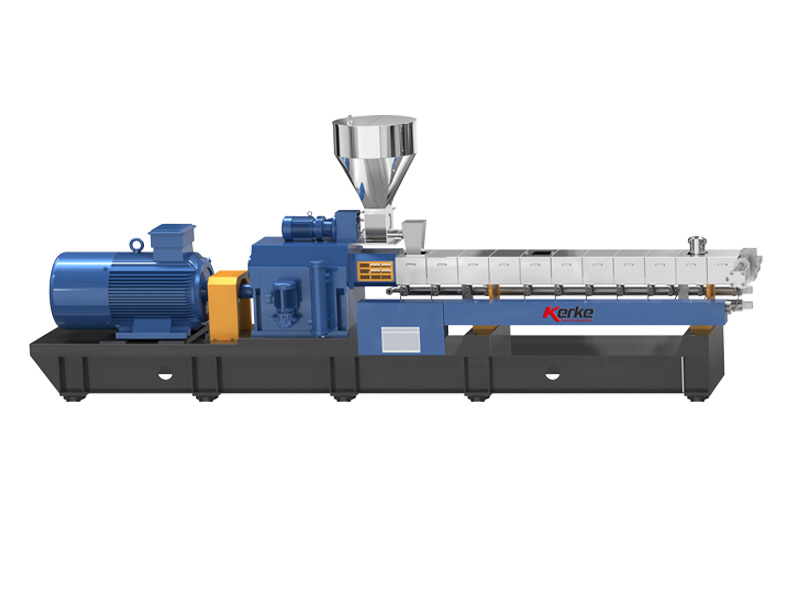
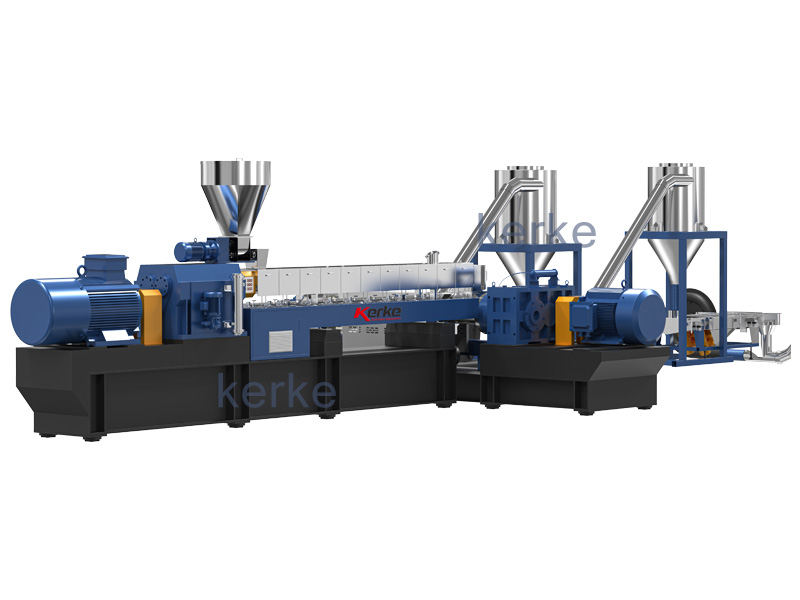
Kerke offers comprehensive solutions for enhanced mixing efficiency backed by over 12 years of experience in parallel co-rotating compounding extruder technology. The KTE series twin screw extruders, ranging from laboratory scale KTE-16B to high-capacity KTE-135D, provide optimal performance for various compounding applications requiring superior mixing efficiency. Kerke production series contain single screw extruder, co-rotating twin-screw compounding extruder KTE series from KTE-16B to KTE-135D, KTE/SE two-stage compounding line, KUW underwater pelletizing system, SE series single screw extruder, auxiliary equipment, etc.
Kerke computer-aided designed screw assembly is a kneading co-type with excellent self-cleaning function and good interchangeability. Through appropriate and reasonable combination, it can realize material transportation, plasticization, shearing, dispersion, homogenization, exhaust, and pressure building. The granulation system can be used in a variety of ways to meet requirements, including water-cooled strand pelletizing, air-cooled strand pelletizing, air-cooled die face hot cutting, water ring die face hot cutting, eccentric water mist hot cutting, and underwater granulation system.
Kerke serves customers in over 70 countries with over 2000 machines running worldwide, providing deep experience with diverse compounding applications and mixing challenges. The company’s high-tech team with well-experienced R&D design, manufacturing technique, and sales service personnel ensures that customers receive comprehensive support from initial equipment selection through installation, startup, and ongoing operation. Kerke’s commitment to providing the best price and service makes them an ideal partner for compounders seeking to enhance mixing efficiency.
Conclusion
Improving mixing efficiency in twin screw extruders requires comprehensive understanding of mixing mechanisms, screw design principles, operating parameter optimization, and material characteristics. Kerke parallel co-rotating twin screw extruders provide advanced mixing capabilities through optimized screw configurations, precise process control, and flexible customization options. The integration of dispersive and distributive mixing elements, appropriate operating conditions, and comprehensive process control creates the foundation for superior mixing efficiency.
Kerke Compounding Extruder, with extensive experience in diverse compounding applications and a complete range of twin screw extruder solutions, stands ready to support compounders in achieving their mixing efficiency goals. Whether producing masterbatches, engineering plastics, biodegradable plastics, cable compounds, or other compounded materials, Kerke provides the technology, expertise, and support needed to achieve optimal mixing performance. The company’s focus on parallel co-rotating compounding extruder technology, backed by over 12 years of experience, ensures that customers receive equipment optimized for their specific mixing requirements.
For compounders seeking to enhance mixing efficiency, improve product quality, reduce energy consumption, and increase production throughput, Kerke offers comprehensive solutions backed by global experience and local support. The combination of advanced twin screw extruder technology, customized screw configurations, precise process control, and expert guidance positions Kerke as the ideal partner for achieving superior mixing efficiency. Contact Kerke to discuss your compounding requirements and discover how their extruder technology can enhance your mixing efficiency.