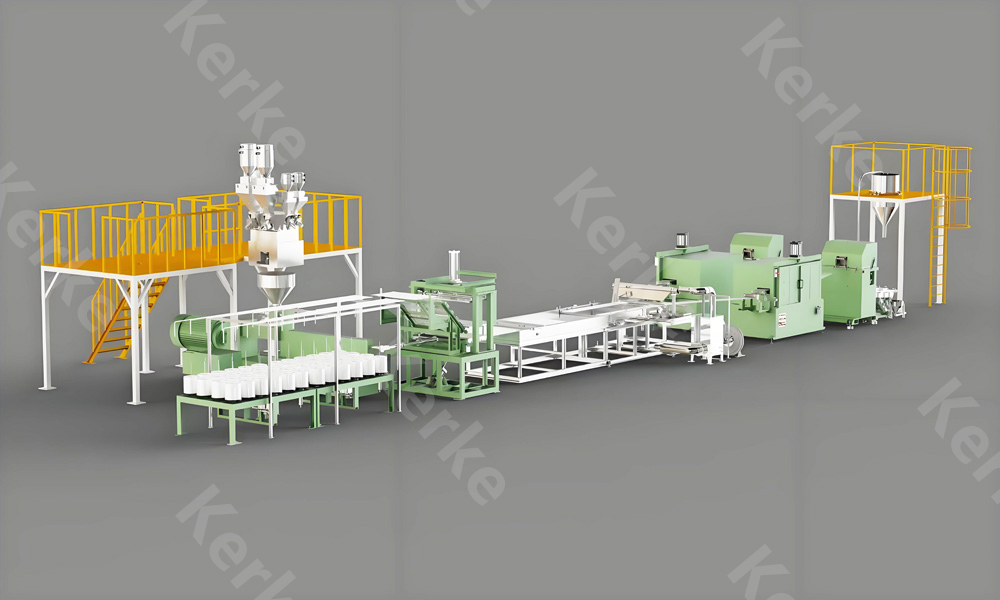
Calculating production capacity accurately is crucial for twin screw masterbatch extruder operations, enabling proper equipment selection, production planning, and performance optimization. Kerke Compounding Extruder, with over 12 years of experience in parallel co-rotating compounding extruder technology, understands that production capacity depends on multiple interrelated factors including machine specifications, material characteristics, processing parameters, and operational conditions. This comprehensive guide provides detailed methodologies for calculating and optimizing production capacity of twin screw masterbatch extruders, helping manufacturers achieve maximum throughput with Kerke KTE series twin screw extruders.
Fundamental Principles of Production Capacity
Production capacity of twin screw masterbatch extruders refers to the maximum throughput rate achievable while maintaining product quality and stable processing conditions. Capacity is typically expressed in kilograms per hour or pounds per hour, representing the mass flow rate of finished masterbatch exiting the extruder. Kerke parallel co-rotating twin screw extruders, ranging from KTE-16B to KTE-135D, offer production capacities from 30 kg/h to several thousand kg/h depending on machine size and application requirements. Understanding fundamental principles of capacity calculation enables accurate estimation of achievable throughput for specific applications.
Theoretical capacity calculation begins with volumetric displacement of the screw. Each screw revolution displaces a specific volume of material determined by the channel volume between screw flights. Multiplying displacement volume by screw speed gives volumetric throughput. Converting volumetric throughput to mass throughput requires material density. However, theoretical capacity rarely equals actual capacity due to multiple factors including pressure flow losses, material compressibility, and processing constraints. Kerke extruders are designed with optimized screw geometry that maximizes actual capacity relative to theoretical capacity.
Actual production capacity depends on multiple operational constraints beyond simple volumetric displacement. Thermal limitations including maximum safe barrel temperatures limit capacity by determining maximum screw speed without causing thermal degradation. Mechanical limitations including maximum screw torque limit capacity by constraining the force that can be applied to the material. Pressure limitations at the die create back pressure that reduces effective capacity. Quality requirements including acceptable residence time and shear history may limit capacity beyond thermal and mechanical constraints. Kerke twin screw extruders are engineered to balance these constraints for optimal capacity across different applications.
Capacity optimization requires understanding the limiting constraint for specific applications. For thermally sensitive materials, thermal constraints typically limit capacity through maximum safe temperature limits. For high-viscosity materials, mechanical torque constraints often limit capacity. For applications requiring precise color or additive dispersion, quality constraints may limit capacity despite higher theoretical capacity potential. Identifying the limiting constraint enables targeted optimization strategies to increase capacity. Kerke provides application engineering support to identify capacity-limiting constraints and recommend optimization approaches.
Machine Specifications Affecting Capacity
Twin screw extruder machine specifications directly influence production capacity through multiple design parameters. Kerke KTE series co-rotating parallel twin screw extruders feature specifications optimized for different capacity requirements, enabling selection of appropriate equipment for specific production needs. Key machine specifications affecting capacity include screw diameter, length-to-diameter ratio, drive system capacity, barrel design, and feeding system capability.
Screw diameter is the primary determinant of extruder capacity capacity, with capacity roughly proportional to the square of screw diameter. Larger screw diameters provide greater volumetric displacement per revolution, enabling higher throughput rates. Kerke extruders range from KTE-16B with 16mm screw diameter for laboratory applications up to KTE-135D with 135mm screw diameter for high-capacity production. The relationship between screw diameter and capacity makes screw diameter selection the primary consideration when matching extruder capacity to production requirements.
Length-to-diameter ratio affects capacity through its influence on residence time, mixing capability, and pressure generation capability. Longer L/D ratios provide longer residence times and more mixing elements, beneficial for challenging applications but potentially limiting capacity due to increased residence time. Shorter L/D ratios reduce residence time and pressure generation, potentially enabling higher capacity but possibly compromising mixing quality. Kerke extruders offer various L/D ratios optimized for different application requirements, enabling capacity optimization while maintaining necessary mixing and processing performance.
Drive system capacity including motor power and torque transmission capability determines maximum mechanical energy input, directly limiting capacity for high-viscosity materials. Higher drive capacity enables processing of higher viscosity materials at higher screw speeds, potentially increasing capacity. Kerke drive systems are sized appropriately for each extruder model, providing sufficient power and torque to achieve rated capacity across the range of materials for which the extruder is designed. Motor selection, gearbox design, and drive coupling all contribute to overall drive system capacity.
Barrel design including heating capacity and cooling capability affects capacity through thermal management capability. Higher heating capacity enables faster temperature rise and maintenance of temperature during high-throughput operation. Enhanced cooling capability removes heat generated by viscous dissipation at high throughput, preventing thermal limitations on capacity. Kerke barrel designs feature optimized heating and cooling systems that maintain required thermal profiles even at maximum rated capacity, enabling stable operation throughout the capacity range.
Material Characteristics and Capacity
Material characteristics significantly influence achievable production capacity in twin screw masterbatch extruders. Different materials present different processing challenges that affect capacity through thermal, mechanical, and rheological effects. Kerke twin screw extruders are designed to accommodate a wide range of material characteristics, enabling optimized capacity across diverse masterbatch applications including color masterbatch, filler masterbatch, additives masterbatch, black masterbatch, and textile masterbatch.
Material viscosity affects capacity through its influence on pressure generation and torque requirements. Higher viscosity materials generate higher pressure for a given flow rate and require higher torque to process, potentially limiting capacity through mechanical torque constraints. Lower viscosity materials generate lower pressure and torque, potentially enabling higher capacity but requiring careful control to prevent insufficient mixing and quality issues. Kerke extruders are designed with drive systems sized to process materials across a range of viscosities while maintaining capacity targets.
Material thermal sensitivity determines maximum safe processing temperature, affecting capacity through thermal constraints. Thermally sensitive materials cannot be processed at high screw speeds without risking thermal degradation, limiting capacity through temperature constraints. Materials with higher thermal stability can be processed at higher screw speeds and temperatures, potentially enabling higher capacity. Kerke extruders feature precise temperature control and optimized barrel designs that maintain safe thermal conditions while maximizing capacity for thermally sensitive materials.
Material rheological behavior affects capacity through its influence on flow characteristics and processing stability. Non-Newtonian materials with shear-thinning behavior experience viscosity reduction at high shear rates, potentially enabling higher capacity but requiring careful control to maintain quality. Materials with yield stress or plastic flow behavior present special processing challenges affecting capacity. Kerke provides expertise in processing materials with diverse rheological behaviors, optimizing capacity while maintaining product quality.
Additive and filler loading significantly affects capacity through changes in viscosity, thermal properties, and flow behavior. High additive or filler loadings increase viscosity and may increase thermal conductivity, affecting capacity through both mechanical and thermal constraints. Particle size and surface characteristics of additives affect dispersion requirements, potentially limiting capacity through quality constraints. Kerke offers screw configurations optimized for various additive loading levels, enabling capacity optimization while achieving required dispersion quality.
Processing Parameters and Capacity
Processing parameters significantly influence achievable production capacity in twin screw masterbatch extruders. Operators can adjust processing parameters to optimize capacity for specific materials and applications, understanding the complex interactions between parameters and capacity. Key processing parameters affecting capacity include screw speed, temperature profile, feed rate, and die configuration. Kerke provides guidance on optimizing processing parameters to maximize capacity while maintaining product quality.
Screw speed directly affects volumetric throughput, with capacity generally proportional to screw speed up to limiting constraints. Higher screw speeds increase displacement rate, potentially increasing capacity. However, higher speeds also increase viscous dissipation heat generation, shear rate, and residence time reduction, affecting thermal constraints, mechanical constraints, and quality constraints. Kerke extruders are designed with variable speed drive systems enabling precise screw speed control across a wide operating range, facilitating capacity optimization.
Temperature profile affects capacity through its influence on material viscosity and thermal degradation. Higher temperatures reduce viscosity, potentially enabling higher capacity by reducing mechanical torque requirements and pressure generation. However, excessive temperatures may cause thermal degradation, limiting capacity through quality constraints. Optimal temperature profile balances viscosity reduction against thermal degradation risk. Kerke extruders feature multiple independently controlled temperature zones enabling precise temperature profile optimization for capacity enhancement.
Feed rate directly determines throughput rate but must be matched to screw speed and other processing parameters to achieve stable processing. Insufficient feed rate causes low fill levels, reducing mixing effectiveness and potentially causing quality issues. Excessive feed rate causes overfilling, increasing pressure and torque beyond safe limits, potentially limiting capacity. Kerke extruders feature advanced feeding systems including gravimetric feeders that maintain precise feed rates, enabling capacity optimization through coordinated control of feed rate and other parameters.
Die configuration affects capacity through its influence on back pressure and flow resistance. Larger die openings reduce pressure and flow resistance, potentially enabling higher capacity. Smaller die openings increase pressure and flow resistance, potentially limiting capacity but improving melt homogeneity. Die land length affects pressure generation and residence time near the die. Kerke assists customers in selecting appropriate die configurations that balance capacity requirements with quality objectives.
Screw Configuration and Capacity
Screw configuration significantly affects production capacity through its influence on material transport, mixing, and pressure generation. Kerke computer-aided designed screw assemblies provide excellent self-cleaning function and good interchangeability, enabling optimization for specific capacity and quality requirements. Screw configuration options include conveying element selection, kneading block placement, and special mixing element incorporation.
Conveying elements with different flight depths, pitches, and numbers affect pumping capacity and backpressure generation. Deeper flight elements provide greater volumetric displacement, potentially increasing capacity. Shallower flight elements generate higher pressure for a given flow rate, potentially limiting capacity but improving melt quality. Different pitch angles affect transport efficiency and residence time. Kerke offers various conveying element configurations optimized for different capacity requirements while maintaining necessary processing performance.
Kneading block configuration affects capacity through its influence on dispersive mixing and pressure generation. Kneading blocks with wider staggering angles generate higher pressure and dispersive mixing intensity, potentially limiting capacity but improving dispersion quality. More kneading blocks increase overall mixing and pressure generation, potentially limiting capacity but improving homogeneity. Kerke offers kneading block configurations optimized for specific dispersion requirements, enabling capacity optimization while achieving required mixing quality.
Special mixing elements including toothed mixing sections, blister rings, and other geometries affect capacity through their influence on flow characteristics and mixing efficiency. Some mixing elements increase back pressure, potentially limiting capacity. Other elements enhance distributive mixing with minimal pressure increase. Kerke offers various special mixing elements for applications requiring enhanced mixing with minimal capacity reduction.
Screw configuration must balance capacity requirements with processing performance needs. Applications requiring high capacity with modest mixing requirements may use screw configurations emphasizing transport efficiency. Applications requiring excellent dispersion with moderate capacity requirements may use configurations with extensive kneading blocks. Kerke provides screw configuration expertise to optimize capacity for specific application requirements while achieving necessary product quality.
Capacity Calculation Methods
Multiple methods exist for calculating production capacity of twin screw masterbatch extruders, ranging from simplified estimation techniques to detailed analytical methods. Appropriate calculation method depends on available data, required accuracy, and application purpose. Kerke provides capacity calculation support using various methods to help customers accurately estimate achievable throughput.
Volumetric displacement method provides theoretical capacity based on screw geometry and speed. Channel volume between screw flights is calculated based on screw dimensions. Displacement per revolution equals channel volume. Volumetric throughput equals displacement multiplied by screw speed. Mass throughput equals volumetric throughput multiplied by material density. This method provides theoretical upper bound capacity but does not account for pressure losses, fill factors, or processing constraints. Kerke provides screw geometry data for volumetric displacement calculations.
Empirical capacity method uses actual operating data from similar materials and conditions to estimate capacity. Historical data from production runs provides empirical relationship between screw speed and throughput. Scaling factors account for differences in material, machine size, or processing conditions. This method provides practical capacity estimates based on actual performance but requires appropriate reference data. Kerke provides extensive application data to support empirical capacity estimation.
Process simulation method uses computational modeling to predict capacity based on material properties, machine geometry, and processing parameters. Computational fluid dynamics models simulate flow patterns and pressure drops. Finite element analysis predicts thermal behavior and viscous dissipation. Process simulation provides detailed capacity prediction and identifies limiting constraints but requires significant computational resources and material property data. Kerke provides process simulation support for critical capacity calculations.
Experimental method involves actual capacity testing under controlled conditions. Test runs with target materials and processing conditions measure achievable throughput. Capacity limits are identified by increasing throughput until limiting constraints are reached. This method provides most accurate capacity measurement but requires equipment availability and material consumption. Kerke provides capacity testing services for customers requiring precise capacity determination.
Capacity Optimization Strategies
Multiple strategies exist for optimizing production capacity of twin screw masterbatch extruders, ranging from simple parameter adjustments to equipment modifications. Appropriate optimization strategy depends on the limiting constraint and application requirements. Kerke provides comprehensive capacity optimization support to help customers maximize throughput while maintaining product quality.
Screw configuration optimization adjusts screw element selection and arrangement to enhance capacity while maintaining required processing performance. Reducing excessive kneading blocks can increase capacity by reducing backpressure and viscous dissipation. Optimizing conveying elements can improve transport efficiency and reduce fill factor losses. Adding specialized mixing elements may enhance mixing capacity without excessive pressure increase. Kerke offers screw configuration expertise to optimize capacity for specific applications.
Processing parameter optimization adjusts screw speed, temperature profile, and feed rate to maximize capacity within processing constraints. Screw speed optimization finds highest speed without exceeding thermal or mechanical limits. Temperature profile optimization reduces viscosity to minimize torque and pressure while preventing thermal degradation. Feed rate optimization matches feed to screw speed for optimal fill level. Kerke provides process engineering support for parameter optimization.
Equipment upgrade strategies include increasing drive system capacity, enhancing heating and cooling capability, or modifying feeding systems. Upgrading motor and gearbox can increase torque capacity for higher viscosity materials. Enhanced heating and cooling systems can raise thermal limits for higher capacity. Advanced feeding systems can provide more accurate feed control at higher rates. Kerke can provide upgrade recommendations and support for existing equipment capacity enhancement.
Material modification approaches alter formulation to improve processability and capacity. Lowering viscosity through plasticizer addition or resin selection can reduce torque and pressure requirements. Optimizing additive dispersion reduces kneading requirements, potentially increasing capacity. Thermal stabilizer addition can increase maximum safe processing temperature. Kerke provides formulation optimization support to enhance processability and capacity.
Quality Constraints on Capacity
Quality requirements often limit achievable production capacity in masterbatch applications. Achieving required product quality may necessitate operating below maximum theoretical capacity determined by thermal and mechanical constraints. Understanding quality constraints and their influence on capacity enables realistic capacity expectations and optimization strategies. Kerke provides expertise in balancing capacity and quality requirements.
Color consistency requirements affect capacity through residence time and mixing requirements. Consistent color development requires sufficient residence time and dispersive mixing to achieve uniform pigment dispersion. Insufficient mixing at high capacity can cause color variations or streaks. Kerke twin screw extruders are designed to achieve excellent color consistency while maintaining high capacity, particularly for color masterbatch applications where uniform color is critical.
Additive dispersion quality affects capacity through required mixing intensity. Uniform dispersion of additives, particularly fillers and reinforcing agents, requires sufficient dispersive mixing that may limit capacity. High filler loadings increase viscosity and require extensive mixing, creating both mechanical and quality constraints on capacity. Kerke offers screw configurations optimized for various dispersion requirements, enabling capacity optimization while achieving required dispersion quality.
Thermal degradation resistance determines maximum safe processing temperature, affecting capacity through thermal constraints. Materials susceptible to thermal degradation require careful temperature control and potentially lower screw speeds, limiting capacity. Adding thermal stabilizers can increase degradation resistance, potentially enabling higher capacity. Kerke provides expertise in processing thermally sensitive materials while achieving reasonable capacity.
Product property requirements including mechanical properties, optical properties, or processing characteristics may affect capacity. Some properties require specific thermal histories or shear conditions that may limit capacity. Kerke assists customers in identifying property-related capacity constraints and developing optimization strategies.
Capacity Monitoring and Control
Effective capacity monitoring and control enables consistent operation at optimal throughput while maintaining product quality. Real-time monitoring of capacity-related parameters provides early warning of developing problems and enables rapid corrective action. Kerke twin screw extruders feature advanced monitoring and control systems that facilitate capacity optimization.
Throughput monitoring provides real-time feedback on actual production rate. Load cells on feeders measure material input rate. Product collection scales measure output rate. Comparing input and output rates identifies losses or blockages. Kerke feeding systems can be equipped with throughput monitoring that provides continuous capacity feedback.
Torque monitoring identifies approaching mechanical limits. Motor torque measurement indicates processing difficulty and proximity to capacity limits. Torque trends can identify material property changes or equipment wear affecting capacity. Kerke extruders feature torque monitoring that provides early warning of capacity-limiting torque increases.
Temperature monitoring prevents thermal capacity limits. Multiple barrel zone temperatures ensure processing within safe thermal limits. Temperature trends identify approaching thermal limits. Kerke extruders feature comprehensive temperature monitoring with automatic capacity adjustment when approaching thermal limits.
Pressure monitoring identifies approaching flow limits. Die pressure and barrel section pressures indicate flow resistance and proximity to capacity limits. Pressure trends identify developing blockages or material changes. Kerke extruders feature pressure monitoring that provides early warning of capacity-limiting pressure increases.
Capacity for Different Masterbatch Types
Different masterbatch types present different capacity challenges and optimization strategies. Understanding capacity characteristics for various masterbatch types enables realistic capacity expectations and appropriate equipment selection. Kerke provides extensive experience across diverse masterbatch applications, enabling optimized capacity for different masterbatch types.
Color masterbatch capacity depends on pigment type, loading level, and carrier resin. Organic pigments typically require moderate shear and may have thermal sensitivity affecting capacity. Inorganic pigments including titanium dioxide and carbon black require extensive dispersive mixing that may limit capacity. High pigment loadings increase viscosity and mixing requirements, affecting capacity. Kerke offers screw configurations optimized for various color masterbatch requirements, balancing capacity and dispersion quality.
Filler masterbatch capacity is strongly affected by filler type, loading level, and particle size. High filler loadings significantly increase viscosity and require extensive mixing, limiting capacity through both mechanical and quality constraints. Fine fillers require extensive dispersive mixing, potentially limiting capacity. Kerke offers solutions for high filler loading applications including specialized screw configurations and processing strategies.
Additives masterbatch capacity depends on additive type, concentration, and processing characteristics. Some additives affect viscosity significantly, affecting capacity through mechanical constraints. Others may be thermally sensitive, affecting capacity through thermal constraints. Kerke provides expertise in processing various additive masterbatch types with optimized capacity.
Black masterbatch typically requires high carbon black loading with extensive dispersive mixing, creating significant capacity challenges. Carbon black’s high pigment strength enables lower loadings than black pigments, partially offsetting processing challenges. Kerke offers specialized solutions for black masterbatch including screw configurations and processing strategies optimized for capacity while achieving required dispersion.
Scale-Up Considerations
Scaling masterbatch production from laboratory or pilot scale to full production requires careful consideration of capacity scaling relationships. Understanding scaling principles enables accurate capacity prediction during equipment scale-up. Kerke provides scale-up expertise to help customers transition from laboratory equipment to production equipment with accurate capacity expectations.
Screw diameter scaling typically follows quadratic scaling laws, with capacity roughly proportional to screw diameter squared. However, scaling is not purely geometric due to changes in surface-to-volume ratio, heat transfer characteristics, and residence time distribution. Kerke provides scale-up factors based on extensive experience scaling between KTE extruder models from laboratory KTE-16B to production KTE-135D.
Thermal management changes significantly during scale-up, affecting capacity through thermal constraints. Surface-to-volume ratio decreases with increasing scale, reducing heat dissipation capability relative to heat generation. This may reduce achievable capacity at larger scales unless heating and cooling systems are appropriately scaled. Kerke barrel designs are optimized for thermal management across all machine sizes, enabling consistent capacity scaling.
Mixing characteristics change during scale-up, affecting capacity through quality constraints. Residence time distribution changes with scale, potentially affecting mixing quality. Shear rate distribution changes, affecting dispersive mixing. Kerke provides screw configuration scaling strategies that maintain mixing quality across scales while optimizing capacity.
Process parameter adjustment is typically required during scale-up to maintain product quality and optimize capacity. Screw speed, temperature profile, and feed rate may need adjustment to account for scaling effects. Kerke provides scale-up parameter recommendations based on extensive scale-up experience across diverse applications.
Kerke Capacity Solutions
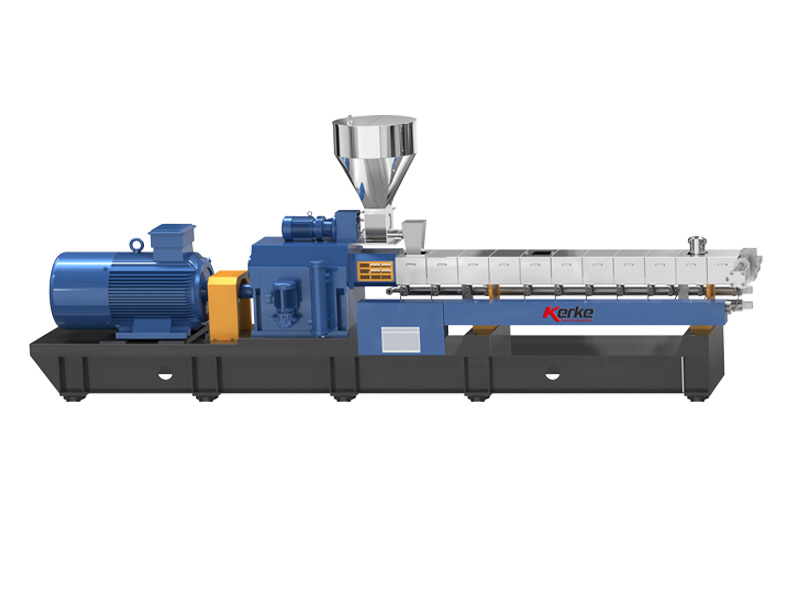
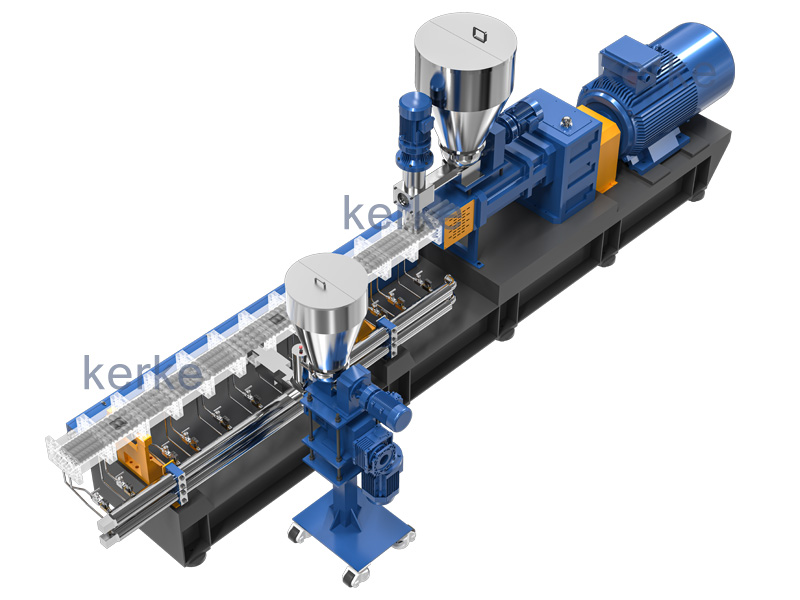
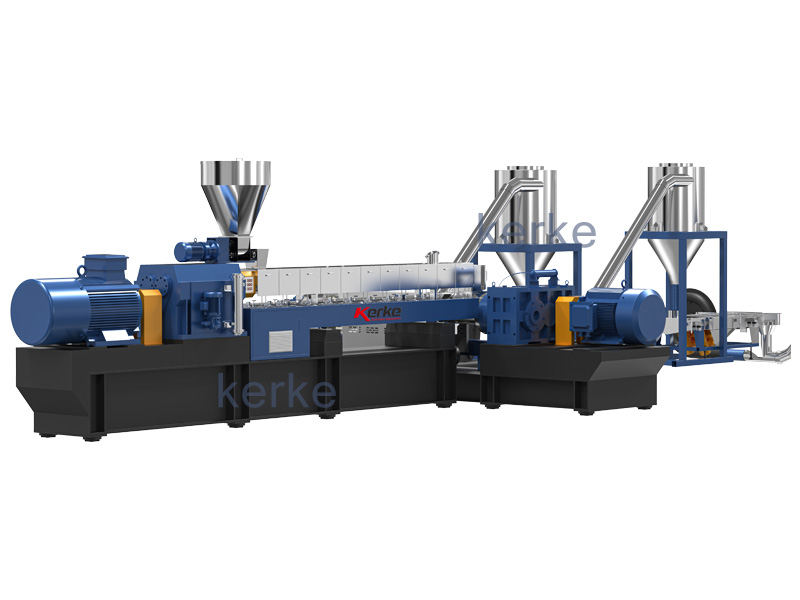
Kerke offers comprehensive capacity solutions for twin screw masterbatch extruders backed by over 12 years of experience in parallel co-rotating compounding extruder technology. The KTE series twin screw extruders, ranging from laboratory scale KTE-16B to high-capacity KTE-135D, provide optimal performance for various masterbatch production requirements. Kerke production series contain single screw extruder, co-rotating twin-screw compounding extruder KTE series from KTE-16B to KTE-135D, KTE/SE two-stage compounding line, KUW underwater pelletizing system, SE series single screw extruder, auxiliary equipment, etc.
Kerke computer-aided designed screw assembly is a kneading co-type with excellent self-cleaning function and good interchangeability. Through appropriate and reasonable combination, it can realize material transportation, plasticization, shearing, dispersion, homogenization, exhaust, and pressure building. The granulation system can be used in a variety of ways to meet requirements, including water-cooled strand pelletizing, air-cooled strand pelletizing, air-cooled die face hot cutting, water ring die face hot cutting, eccentric water mist hot cutting, and underwater granulation system.
Kerke serves customers in over 70 countries with over 2000 machines running worldwide, providing deep experience with diverse masterbatch applications and capacity requirements. The company’s high-tech team with well-experienced R&D design, manufacturing technique, and sales service personnel ensures that customers receive comprehensive support from initial equipment selection through installation, startup, and ongoing operation. Kerke’s commitment to providing the best price and service makes them an ideal partner for masterbatch producers seeking to optimize production capacity.
Conclusion
Calculating and optimizing production capacity of twin screw masterbatch extruders requires comprehensive understanding of machine specifications, material characteristics, processing parameters, and quality requirements. Kerke parallel co-rotating twin screw extruders provide advanced capacity optimization through optimized screw configurations, precise process control, and flexible customization options. The integration of theoretical calculation methods, empirical experience, and advanced monitoring systems creates the foundation for accurate capacity determination and optimization.
Kerke Compounding Extruder, with extensive experience in masterbatch production and a complete range of twin screw extruder solutions, stands ready to support masterbatch producers in achieving their capacity goals. Whether producing color masterbatch, filler masterbatch, additives masterbatch, black masterbatch, or textile masterbatch, Kerke provides the technology, expertise, and support needed to achieve optimal production capacity. The company’s focus on parallel co-rotating compounding extruder technology, backed by over 12 years of experience, ensures that customers receive equipment optimized for their specific capacity requirements.
For masterbatch producers seeking to optimize production capacity, maximize throughput, and enhance production efficiency, Kerke offers comprehensive solutions backed by global experience and local support. The combination of advanced twin screw extruder technology, customized screw configurations, precise process control, and expert guidance positions Kerke as the ideal partner for achieving optimal production capacity. Contact Kerke to discuss your masterbatch production requirements and discover how their extruder technology can optimize your production capacity.