Introduction
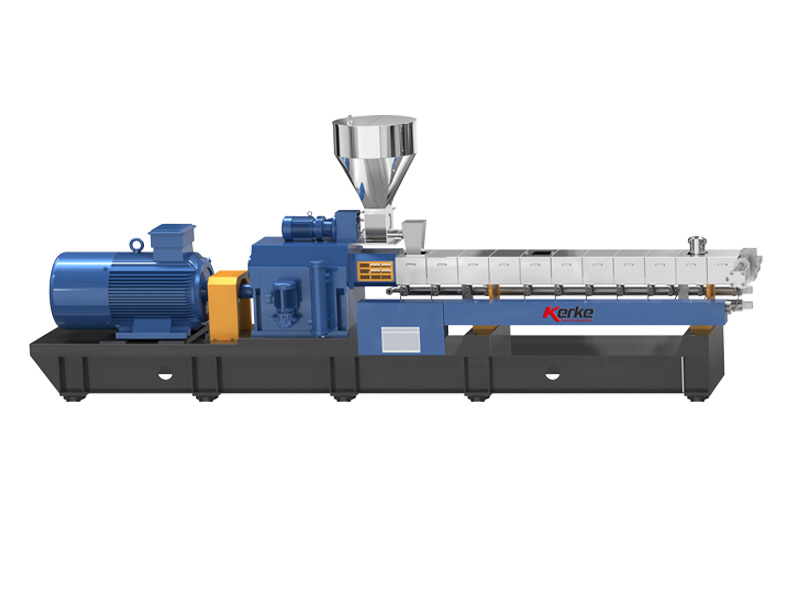
Understanding fundamental differences between compounding extruders and regular extruders is essential for selecting appropriate equipment for specific plastic processing applications. While both equipment types melt and process plastic materials, they serve different primary functions and exhibit significantly different performance characteristics. Regular extruders focus primarily on melting and shaping plastic into products, while compounding extruders are specifically designed to mix multiple components, incorporate additives, and create homogeneous materials with consistent properties. Kerke extruder offers both regular extruders and specialized compounding extruders, enabling customers to select appropriate equipment for specific application requirements.
The distinction between regular extruders and compounding extruders originates from their primary functions in plastic processing operations. Regular extruders, whether single screw or twin screw designs, primarily serve to melt plastic and shape it into continuous profiles, sheets, films, or other forms. Their primary function is thermal processing and shaping rather than intensive mixing or compounding. Compounding extruders, by contrast, are specifically engineered to achieve thorough mixing of multiple components, ensure uniform dispersion of additives and fillers, and create homogeneous materials with consistent properties throughout the batch. These functional differences necessitate different screw designs, processing capabilities, and operational approaches.
Market applications for regular extruders versus compounding extruders demonstrate clear differentiation based on processing requirements. Regular extruders serve applications including pipe production, profile extrusion, sheet production, film making, and wire coating where the primary requirement is melting and shaping polymer. Compounding extruders serve applications including masterbatch production, polymer blending, additive incorporation, filler loading, and material modification where the primary requirement is mixing and homogenization of components. Understanding these application differences enables proper equipment selection for specific production requirements. Kerke extruder provides both equipment types with engineering expertise supporting appropriate selection for each application.
Fundamental Design Differences
Core design differences between regular extruders and compounding extruders reflect their different functional requirements. These design differences affect performance characteristics, processing capabilities, and appropriate applications.
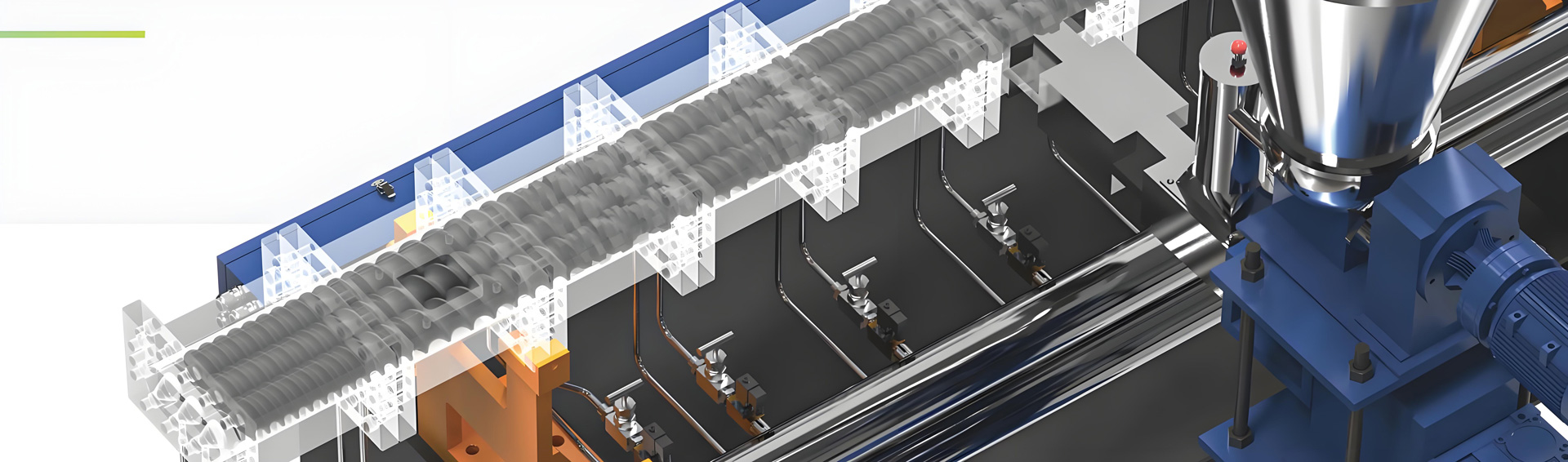
Screw configuration represents the most significant design difference between regular extruders and compounding extruders. Regular extruder screws typically have continuous flight designs optimized for material conveying, melting, and pressure development. The screw geometry prioritizes forward material transport and melting efficiency. Compounding extruder screws incorporate multiple mixing elements, kneading blocks, and distributive mixing features specifically designed to achieve thorough mixing. Kerke twin screw compounding extruders utilize modular screw elements that can be configured for specific mixing requirements, including various kneading block angles, reverse mixing elements, and special mixing geometries optimized for different materials and mixing requirements.
Length-to-diameter ratios differ substantially between regular extruders and compounding extruders. Regular extruders typically have length-to-diameter ratios ranging from 20:1 to 30:1 for single screw designs and 24:1 to 36:1 for twin screw designs. These ratios provide sufficient length for material melting and pressure development without excessive material residence time. Compounding extruders typically require longer length-to-diameter ratios ranging from 30:1 to 40:1 for twin screw designs. The longer length provides additional mixing sections and sufficient residence time for complete compounding. Kerke compounding extruders offer various length-to-diameter ratios optimized for specific compounding applications and material requirements.
Screw rotation and intermeshing characteristics create fundamental operational differences. Regular twin screw extruders often utilize co-rotating designs with slight clearances between screws optimized for material conveying and melting efficiency. Some regular applications utilize counter-rotating designs providing positive displacement characteristics for specific applications. Compounding twin screw extruders predominantly utilize co-rotating designs with tight intermeshing and precisely controlled clearances optimized for intensive mixing. The tight intermeshing creates material exchange between screws multiple times per revolution, enhancing mixing effectiveness. Kerke compounding extruders incorporate optimized intermeshing characteristics balancing mixing effectiveness with material conveying efficiency.
Processing zones differ in configuration and purpose between regular extruders and compounding extruders. Regular extruders typically have feed zone, transition zone, melting zone, and metering zone designed primarily for melting and pressure development. Additional zones may include venting for volatiles or special heating sections for temperature-sensitive materials. Compounding extruders incorporate multiple dedicated mixing zones interspersed with conveying zones. Each mixing zone may have specific characteristics optimized for particular mixing functions, including distributive mixing, dispersive mixing, or special mixing requirements. Kerke compounding extruders feature multiple mixing zones with configurable characteristics for different materials and applications.
Functional Performance Differences
Performance characteristics differ significantly between regular extruders and compounding extruders based on their different functional requirements. Understanding these differences enables proper equipment selection for specific application requirements.
Mixing intensity represents the primary performance difference between regular extruders and compounding extruders. Regular extruders provide limited mixing, primarily sufficient for melting homogenization and achieving temperature uniformity. Mixing intensity is generally low, with distributive mixing occurring primarily through material shear and residence time. Compounding extruders provide intensive mixing through specifically designed mixing elements, kneading blocks, and optimized screw geometries. Mixing intensity can be varied significantly through screw configuration, enabling processing of materials requiring light mixing to materials requiring intensive mixing. Kerke compounding extruders achieve mixing intensities 5 to 10 times greater than regular extruders, enabling thorough dispersion of additives and fillers.
Material residence time distribution affects processing capabilities and product quality. Regular extruders typically have relatively narrow residence time distribution with most material experiencing similar processing conditions. This narrow distribution benefits applications requiring consistent thermal history and minimal product variation. Compounding extruders may have broader residence time distribution due to material exchange between screws and mixing zones. While broader distribution can increase material variation, it is often necessary for achieving complete mixing. Kerke compounding extruders are designed to balance residence time distribution with mixing requirements, achieving thorough mixing while maintaining reasonable material uniformity.
Throughput capacity differs between regular extruders and compounding extruders due to different functional requirements. Regular extruders typically achieve higher throughput rates for given screw diameter because their primary function is material conveying and melting rather than intensive mixing. Throughput is limited primarily by melting capacity and pressure generation. Compounding extruders typically have lower throughput capacity for given screw diameter because intensive mixing requires longer residence time and creates additional resistance to material flow. Kerke compounding extruders are engineered to maximize throughput while achieving required mixing, with throughput typically 30 to 50 percent lower than equivalent diameter regular extruders for similar materials.
Energy consumption characteristics differ based on functional requirements. Regular extruders consume energy primarily for melting and pressure development, with specific energy consumption typically ranging from 0.15 to 0.30 kilowatt hours per kilogram depending on material and application. Compounding extruders consume energy for both melting and intensive mixing, with specific energy consumption typically ranging from 0.25 to 0.45 kilowatt hours per kilogram. The additional energy for mixing typically represents 20 to 40 percent of total energy consumption. Kerke compounding extruders incorporate energy-efficient designs that minimize energy consumption while achieving required mixing, with specific energy consumption typically 10 to 20 percent lower than industry averages for similar compounding applications.
Material and Application Differences
Different materials and applications favor regular extruders versus compounding extruders based on processing requirements. Understanding these differences enables proper equipment selection for specific materials and products.
Simple polymer processing applications typically utilize regular extruders. Applications including pipe extrusion, profile production, sheet making, film casting, and wire coating typically involve processing single polymer materials where the primary requirement is melting and shaping. These applications do not require intensive mixing or multiple component incorporation. Regular single screw or twin screw extruders provide adequate processing capabilities for these applications with lower capital investment and operating costs than compounding extruders. Kerke regular extruders offer cost-effective solutions for simple polymer processing applications.
Masterbatch production requires compounding extruders for proper pigment and additive dispersion. Masterbatch production involves incorporating high loadings of pigments, additives, or other materials into carrier polymers at concentrations typically ranging from 10 to 50 percent. Achieving uniform dispersion of these high-concentration components requires intensive mixing that regular extruders cannot provide. Compounding extruders provide the mixing intensity and residence time necessary for proper masterbatch production. Kerke masterbatch compounding extruders are specifically designed for masterbatch applications, achieving excellent dispersion at high pigment and additive loadings.
Polymer blending applications require compounding extruders for achieving proper compatibility between different polymers. Polymer blending involves combining two or more polymers to create materials with combined characteristics. Achieving proper compatibility and homogeneity between different polymers requires intensive mixing to ensure intimate contact between polymer phases. Compounding extruders provide the mixing capabilities necessary for achieving proper polymer blends. Kerke compounding extruders are particularly effective for polymer blending applications, with screw configurations optimized for specific polymer combinations and blend requirements.
Filled material processing requires compounding extruders for achieving uniform filler dispersion. Filled materials incorporate mineral fillers, glass fibers, or other additives at loadings typically ranging from 10 to 60 percent. Achieving uniform filler dispersion and maintaining filler integrity requires careful mixing that combines dispersive and distributive mixing. Compounding extruders provide the mixing capabilities necessary for filled material processing while regular extruders would either fail to achieve adequate dispersion or damage fillers through excessive shear. Kerke compounding extruders incorporate gentle yet effective mixing elements suitable for filled material processing with various filler types.
Kerke Regular Extruder Capabilities
Kerke regular extruders provide excellent performance for applications requiring melting and shaping without intensive mixing. Understanding regular extruder capabilities enables proper selection for appropriate applications.
Kerke single screw regular extruders offer cost-effective solutions for simple polymer processing applications. Single screw designs provide excellent melting efficiency, consistent throughput, and reliable operation for applications including pipe production, profile extrusion, and sheet production. Screw diameters range from 20 to 200 millimeters with length-to-diameter ratios from 20:1 to 30:1. Throughput capacities range from 10 to 2,000 kilograms per hour depending on material and application. Kerke single screw extruders incorporate optimized screw geometries for different material types including general-purpose screws for polyolefins, mixing screws requiring enhanced homogenization, and barrier screws for improved melting efficiency.
Kerke twin screw regular extruders provide enhanced melting and mixing for applications requiring more intensive processing than single screw designs. Twin screw regular extruders offer improved thermal efficiency, better temperature control, and enhanced mixing compared to single screw designs while still optimized for melting and shaping rather than intensive compounding. Screw diameters range from 25 to 150 millimeters with length-to-diameter ratios from 24:1 to 36:1. Throughput capacities range from 50 to 3,000 kilograms per hour. Kerke twin screw regular extruders are particularly effective for applications requiring good homogenization or processing of materials with melting difficulties that single screw extruders struggle with.
Kerke regular extruder drive systems provide reliable power delivery with energy efficiency. AC vector drives with high-efficiency motors reduce energy consumption by 15 to 30 percent compared to older drive technologies. Drive capacities range from 15 to 800 kilowatts to match various extruder sizes. Speed control provides precise adjustment capabilities with accuracy better than 0.1 percent of setpoint. Kerke drive systems are designed for long service life with minimal maintenance requirements.
Kerke regular extruder temperature control systems provide precise thermal management. Multi-zone electric heating systems provide uniform heating across barrel length. Cooling systems incorporating air or water cooling maintain precise temperature control during processing. Control accuracy better than plus or minus1 degree Celsius ensures consistent product quality. Kerke temperature control systems incorporate advanced PID control algorithms with autotuning capabilities, ensuring optimal performance across different operating conditions.
Kerke Compounding Extruder Capabilities
Kerke compounding extruders provide intensive mixing capabilities essential for masterbatch production, polymer blending, filled material processing, and material modification. Understanding compounding extruder capabilities enables proper selection for compounding applications.
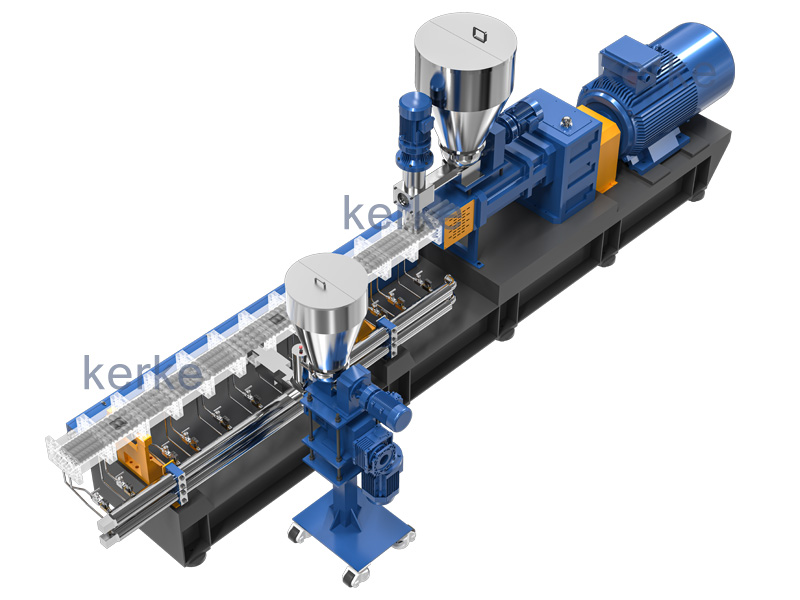
Kerke co-rotating twin screw compounding extruders provide excellent mixing for various compounding applications. Co-rotating designs excel at dispersive mixing making them ideal for masterbatch production, additive compounding, and polymer blends. Screw diameters range from 20 to 150 millimeters with length-to-diameter ratios from 25:1 to 40:1. Throughput capacities range from 50 to 3,000 kilograms per hour depending on material and application. Kerke co-rotating compounding extruders incorporate modular screw elements enabling customization for specific processing requirements, including various kneading block angles, reverse mixing elements, and special mixing geometries.
Kerke counter-rotating twin screw compounding extruders provide superior pumping characteristics ideal for certain filled material applications. Counter-rotating designs excel at processing filled materials, rigid PVC, and applications requiring high pressure development. Screw diameters range from 25 to 180 millimeters with length-to-diameter ratios from 20:1 to 35:1. Throughput capacities range from 100 to 5,000 kilograms per hour depending on application. Kerke counter-rotating compounding extruders are particularly effective for processing materials requiring high shear energy or involving substantial filler loading.
Kerke compounding extruder screw configurations provide flexibility for different applications. Modular screw elements enable various configurations optimized for specific materials and mixing requirements. Kneading blocks provide dispersive mixing essential for breaking down agglomerates and achieving uniform particle dispersion. Reverse mixing elements create material backflow enhancing distributive mixing. Special mixing elements including Maddock mixers, pineapple mixers, and other designs provide additional mixing capabilities. Kerke screw configuration expertise enables optimal configuration for each application.
Kerke compounding extruder venting capabilities remove volatiles and moisture during processing. Multiple vent ports positioned along barrel length enable removal of volatiles at appropriate processing stages. Vacuum venting systems provide effective removal of moisture, solvents, or other volatiles. Venting zone designs prevent material carryover between vent ports and maintain proper pressure profile. Kerke venting systems are particularly effective for materials requiring volatile removal during compounding.
Economic Considerations and Cost Comparison
Economic factors significantly influence equipment selection between regular extruders and compounding extruders. Understanding cost factors enables informed decision making based on application requirements and budget constraints.
Initial investment costs differ between regular extruders and compounding extruders. Regular single screw extruders typically cost USD 15,000 to USD 80,000 depending on size and configuration. Regular twin screw extruders typically cost USD 40,000 to USD 200,000. Compounding twin screw extruders typically cost USD 60,000 to USD 350,000 due to more complex designs, longer barrels, and enhanced mixing capabilities. The cost premium for compounding extruders ranges from 30 to 75 percent compared to equivalent capacity regular extruders. Kerke provides competitive pricing for both regular extruders and compounding extruders, with pricing reflecting complexity and capabilities of each equipment type.
Operating costs differ based on energy consumption, maintenance requirements, and component wear. Regular extruders typically consume 0.15 to 0.30 kilowatt hours per kilogram of processed material, while compounding extruders typically consume 0.25 to 0.45 kilowatt hours per kilogram. For an extruder operating at 500 kilograms per hour with electricity costs of USD 0.20 per kilowatt hour, annual energy costs would be approximately USD 87,600 for a regular extruder versus USD 131,400 to USD 236,520 for a compounding extruder depending on material. Maintenance costs for regular extruders typically range from 3 to 6 percent of initial investment annually, while compounding extruders typically require 5 to 10 percent due to more complex designs and additional wear on mixing elements.
Productivity considerations affect total cost effectiveness. Regular extruders typically achieve higher throughput rates for given screw diameter, potentially reducing required equipment size for given production capacity. Compounding extruders may require larger equipment or multiple lines to achieve equivalent throughput rates, increasing capital investment and operating costs. However, compounding extruders enable production of value-added products with higher profit margins that can justify higher production costs. Kerke provides productivity analysis comparing total cost effectiveness for regular versus compounding extruders for specific applications.
Application-specific economic analysis determines optimal equipment selection. For applications requiring only melting and shaping, regular extruders provide lower capital and operating costs with adequate performance. For applications requiring compounding capabilities, compounding extruders provide necessary functionality despite higher costs, with the value-added product potential justifying the additional investment. Kerke economic analysis considers total cost of ownership including initial investment, operating costs, and product value to determine optimal equipment selection for each application.
Selection Criteria and Decision Process
Systematic selection process ensures optimal equipment selection for specific application requirements. Understanding selection criteria enables informed decisions between regular extruders and compounding extruders.
Application analysis defines primary processing requirements. Analysis should identify whether the application requires simple melting and shaping, intensive mixing of multiple components, or something in between. Applications including pipe production, profile extrusion, sheet making, film casting, and wire coating typically require regular extruders. Applications including masterbatch production, polymer blending, filled material processing, and material modification typically require compounding extruders. Kerke application specialists assist with application analysis to ensure proper equipment selection.
Material complexity analysis determines mixing requirements. Simple single-material applications with no additives or fillers typically require regular extruders. Applications incorporating multiple components, additives, or fillers typically require compounding extruders. Material complexity increases with number of components, component loading levels, and dispersion requirements. Kerke material specialists analyze material requirements to determine appropriate equipment selection.
Product specification analysis determines required performance characteristics. Product requirements including consistency, uniformity, dispersion quality, and material homogeneity influence equipment selection. Products requiring high dispersion quality, excellent color uniformity, or precise property control typically require compounding extruders. Products with less stringent requirements may be adequately processed with regular extruders. Kerke product analysis ensures equipment selection meets product specification requirements.
Production volume and economic considerations affect selection process. High-volume production of standard products may justify regular extruders for capital efficiency. Production of value-added specialty products often justifies compounding extruder investment despite higher costs. Kerke economic analysis considers production volumes, product values, and market conditions to recommend optimal equipment selection.
Integration and Installation Considerations
Installation and integration considerations differ between regular extruders and compounding extruders based on their different characteristics. Understanding these considerations facilitates proper facility planning and installation.
Space requirements differ due to different equipment dimensions. Regular extruders typically require less floor space due to shorter barrels and simpler designs. Compounding extruders typically require longer barrels creating larger equipment footprint. Space requirements for compounding extruders may be 20 to 40 percent larger than equivalent capacity regular extruders. Kerke provides detailed layout drawings for both equipment types enabling proper facility planning.
Foundation requirements differ based on equipment weight and vibration characteristics. Compounding extruders typically weigh 20 to 50 percent more than equivalent capacity regular extruders due to longer barrels and more complex designs. Compounding extruder mixing operations may create different vibration characteristics requiring specific foundation considerations. Kerke provides foundation specifications ensuring proper support for both equipment types.
Utility requirements differ based on processing capabilities. Compounding extruders typically require higher electrical capacity due to higher energy consumption for mixing. Drive motor capacities for compounding extruders may be 20 to 50 percent larger than equivalent regular extruders. Heating and cooling requirements may differ based on material processing requirements. Kerke provides utility specifications for both equipment types enabling proper facility preparation.
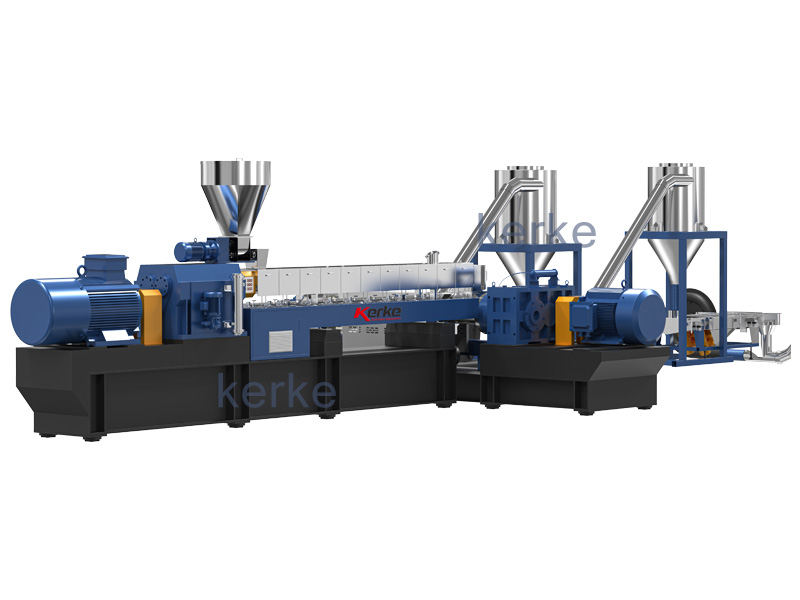
Downstream equipment integration considerations differ based on output characteristics. Regular extruders typically deliver material directly to downstream shaping equipment including dies, calibrators, or take-up equipment. Compounding extruders may require intermediate processing including water cooling, pelletizing, or material handling before downstream processing. Kerke assists with integration planning ensuring smooth material flow from extruder through complete processing line.
Maintenance and Reliability Considerations
Maintenance requirements and reliability characteristics differ between regular extruders and compounding extruders. Understanding these differences enables appropriate maintenance planning and expectations.
Maintenance requirements differ based on equipment complexity. Regular extruders typically require less frequent maintenance due to simpler designs with fewer components subject to wear. Maintenance intervals for critical components including screws, barrels, and drives typically range from 8,000 to 15,000 operating hours. Compounding extruders typically require more frequent maintenance due to mixing elements and complex geometries creating additional wear points. Maintenance intervals for critical components typically range from 4,000 to 8,000 operating hours. Kerke provides detailed maintenance schedules and recommendations for both equipment types.
Component wear patterns differ based on processing characteristics. Regular extruder screws typically exhibit wear primarily at screw tip and barrel exit where shear rates are highest. Compounding extruder screws exhibit wear across multiple mixing elements and kneading blocks, creating more complex wear patterns. Component life for compounding extruder screws may be 30 to 50 percent shorter than equivalent regular extruder screws depending on material and operating conditions. Kerke provides wear-resistant component options for both equipment types extending component life.
Spare parts requirements differ based on equipment complexity and component life. Regular extruders typically require fewer spare parts due to simpler designs and longer component life. Compounding extruders typically require more extensive spare parts inventories due to more numerous components and shorter component life. Spare parts inventory cost for compounding extruders may be 2 to 3 times higher than equivalent regular extruders. Kerke provides recommended spare parts lists for both equipment types ensuring appropriate inventory levels.
Reliability characteristics differ based on design complexity. Regular extruders typically achieve reliability levels exceeding 99 percent availability due to simpler designs with fewer potential failure points. Compounding extruders typically achieve reliability levels of 97 to 98 percent availability due to more complex designs and additional components. Kerke designs both equipment types for maximum reliability, with compounding extruders achieving reliability levels comparable to industry standards for complex compounding equipment.
Future Trends and Technology Developments
Future developments in extruder technology continue to blur lines between regular extruders and compounding extruders while enhancing capabilities for both types. Understanding future trends enables informed equipment selection and technology adoption planning.
Enhanced mixing in regular extruders provides some compounding-like capabilities while maintaining regular extruder efficiency. Advanced screw geometries including improved mixing sections and distributive mixing elements provide enhanced mixing capabilities in regular extruders. These enhancements enable regular extruders to handle some compounding applications while maintaining throughput and energy advantages. Kerke incorporates advanced mixing technologies into regular extruders, expanding their application range.
Energy efficiency improvements reduce cost differences between regular extruders and compounding extruders. Advanced drive systems, improved screw geometries, and optimized thermal management reduce energy consumption for both equipment types. Energy efficiency improvements of 15 to 25 percent are achievable through advanced technologies. Kerke incorporates energy-efficient technologies into both regular and compounding extruders, reducing operating costs and environmental impact.
Digital technologies enhance control and optimization for both equipment types. IoT sensors provide real-time monitoring of operating conditions and component health. Advanced control systems optimize processing parameters automatically based on material properties and product requirements. Digital twins enable simulation and optimization before actual processing. Kerke incorporates digital technologies across both regular and compounding extruder products, enhancing control and optimization capabilities.
Advanced materials require specialized processing capabilities in both regular extruders and compounding extruders. Biodegradable polymers, recycled materials, and engineering plastics present unique processing challenges requiring specialized equipment designs. Regular extruders require enhanced capabilities for processing these materials while maintaining melting and shaping functions. Compounding extruders require specialized mixing configurations for incorporating these materials into blends or filled systems. Kerke develops specialized processing capabilities for advanced materials across both equipment types.
Conclusion
Fundamental differences between regular extruders and compounding extruders originate from their different primary functions. Regular extruders focus on melting and shaping plastic materials, while compounding extruders are specifically designed for intensive mixing of multiple components. These functional differences drive design differences, performance characteristics, and appropriate applications. Understanding these differences enables proper equipment selection for specific processing requirements.
Kerke extruder offers comprehensive range of regular extruders and compounding extruders engineered for specific applications. Regular extruders provide cost-effective solutions for applications requiring melting and shaping without intensive mixing. Compounding extruders provide intensive mixing capabilities essential for masterbatch production, polymer blending, filled material processing, and material modification. Kerke application expertise ensures customers select optimal equipment for their specific requirements.
Selecting between regular extruders and compounding extruders requires careful analysis of application requirements, material complexity, product specifications, and economic considerations. Kerke provides comprehensive application analysis, economic evaluation, and technical support to ensure customers select appropriate equipment delivering optimal performance and economic returns. By understanding fundamental differences between equipment types and leveraging Kerke application expertise, customers make informed equipment decisions supporting production success and business profitability.