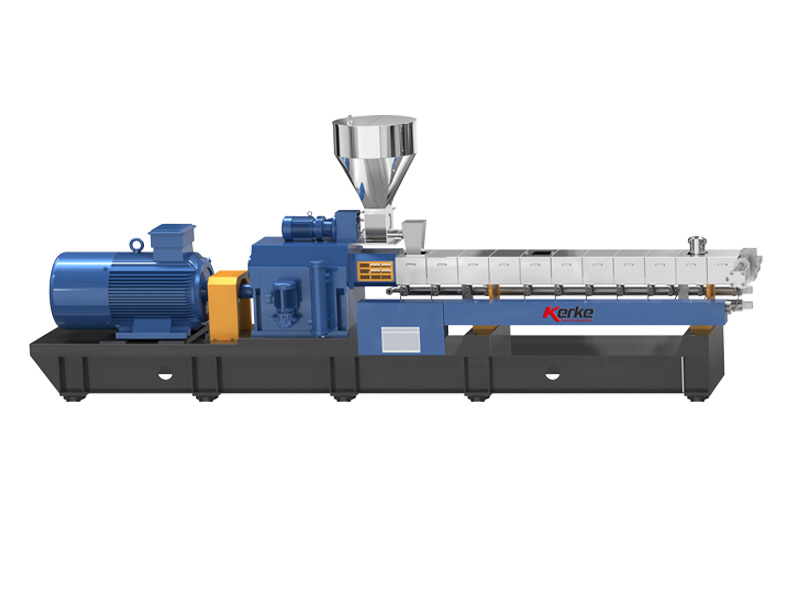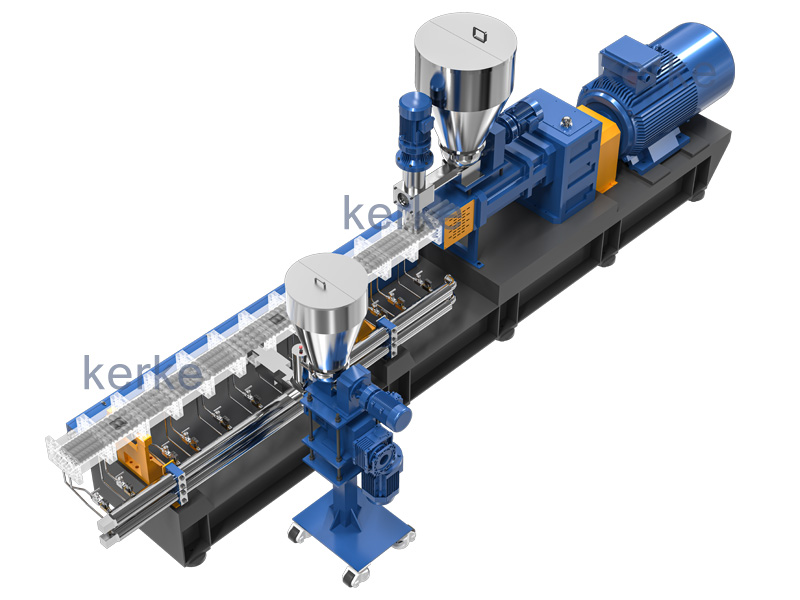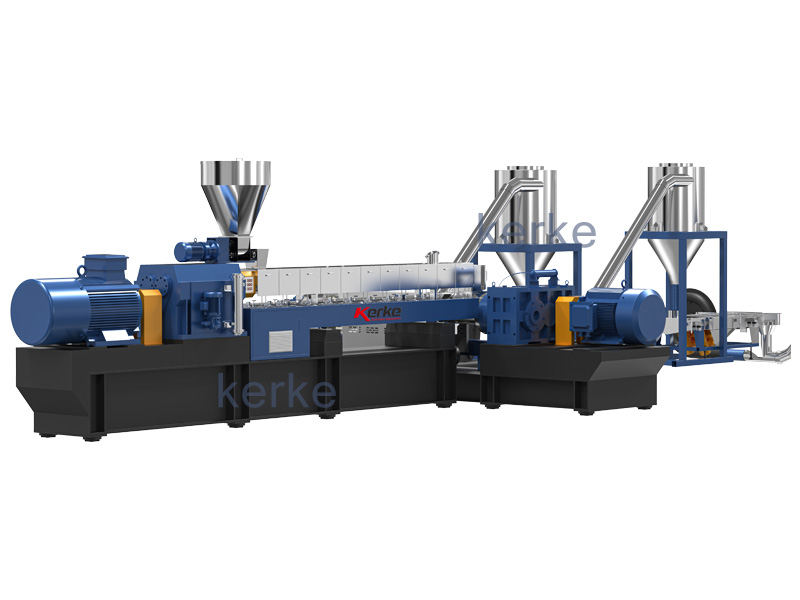
Extrusion is an energy-intensive process. The specific energy consumption (SEC) for a Twin Screw Extruder can range from 0.25 to 0.45 kWh/kg depending on the application. With rising global energy costs and stricter environmental regulations, energy efficiency is no longer optional—it is a competitive necessity. This article explores the advanced technologies used in modern extruders to reduce energy consumption, focusing on the innovations implemented in Kerke Extruder machinery. We will analyze the financial impact of these technologies and provide a detailed cost-benefit analysis.
Chapter 1: The Energy Challenge in Extrusion
Where Does the Energy Go?
In a typical twin-screw extrusion line, energy is consumed by three main components: the drive motor (50-60%), the barrel heating system (20-30%), and the cooling system and auxiliaries (10-20%). The drive motor energy is used to overcome the torque required to rotate the screws and shear the polymer. The heating system compensates for heat loss to the environment and provides the initial melt energy. Inefficient designs waste energy through friction, heat loss, and motor inefficiency.
For a medium-sized compounding plant running a 75kW extruder 24 hours a day, 300 days a year, the annual electricity consumption is approximately 540,000 kWh. At an electricity cost of $0.10/kWh, this amounts to $54,000 per year in electricity alone. A 20% reduction in energy consumption would save $10,800 annually. Over a 10-year lifespan, this is $108,000, which can cover a significant portion of the machine’s purchase price. Therefore, investing in energy-efficient technology has a rapid payback period.
Chapter 2: Advanced Motor and Drive Technologies
IE4 and IE5 Permanent Magnet Synchronous Motors
The most significant leap in energy efficiency comes from the drive motor. Traditional extruders use IE2 or IE3 induction motors, which have efficiency ratings of 90-95%. Modern extruders employ IE4 (Super Premium) or IE5 (Ultra Premium) permanent magnet synchronous motors (PMSM). These motors eliminate rotor losses, achieving efficiencies of 97-98.5%. While the motor itself is more expensive (20-30% higher cost), the energy savings are substantial.
Kerke Extruder utilizes IE5 PMSM motors in its latest generation of twin-screw extruders. These motors also have a higher power density, meaning they are smaller and lighter for the same power output. This reduces the load on the gearbox and foundations. Furthermore, PMSM motors maintain high efficiency across a wide range of loads and speeds, unlike induction motors which lose efficiency at partial loads. Since extruders rarely run at 100% load continuously, this is a major advantage.
Variable Frequency Drives (VFD) and Inverter Technology
To further optimize energy use, the motor must be paired with a high-performance Variable Frequency Drive (VFD). The VFD controls the motor speed and torque based on the real-time load. If the material viscosity drops due to ambient temperature changes, the VFD automatically reduces the torque to save power without affecting output. Kerke uses vector-control VFDs that provide precise speed regulation (±0.1 RPM), which is essential for maintaining product quality while minimizing energy waste.
Soft starters are no longer sufficient. Modern VFDs include “sleep mode” features where the motor shuts down or idles at very low power during long changeovers or cleaning cycles, rather than running at full speed. This can save significant energy in batch operations. Additionally, regenerative braking can feed energy back into the factory grid when the screws are decelerating, although this requires a special inverter and is more common in large-scale applications.
Chapter 3: Thermal Management and Insulation
Nano-Insulation Heaters
Traditional cast aluminum or mica band heaters lose a significant amount of heat to the environment. The surface temperature of these heaters can be 100°C higher than the set point, radiating heat into the factory. Nano-insulation ceramic heaters use advanced thermal insulation materials to direct 100% of the heat inward into the barrel. These heaters reach set temperatures faster and maintain them with less power. Kerke Extruder offers nano-insulation heater bands as an option, which can reduce heating energy consumption by 30% to 40%.
Liquid Cooling and Heat Recovery
Cooling is necessary to remove excess shear heat. However, this heat is often wasted. Advanced systems capture the heat from the cooling water (which can reach 60-80°C) and use it for pre-heating the feed material, wash water, or facility hot water. Kerke has implemented heat exchangers on its extruders that can recover up to 50% of the thermal energy removed by the cooling system. This recovered energy can reduce the total plant energy demand by 5-10%.
Water-cooled barrels are more efficient than air-cooled barrels because water has a higher heat capacity. However, they require a chilled water supply. To minimize water usage, closed-loop chillers with variable speed pumps are used. The pump speed adjusts based on the actual cooling demand, rather than running at full speed constantly. This can reduce water pump energy by 40%.
Chapter 4: Screw Design and Process Optimization
CFD-Optimized Screw Geometry
The screw design has a direct impact on energy efficiency. Screws that generate excessive pressure or turbulence require more torque to turn. Kerke Extruder uses Computational Fluid Dynamics (CFD) to simulate the polymer flow inside the barrel. By optimizing the flight depth, pitch, and kneading block angle, we can reduce the specific mechanical energy (SME) required to melt and mix the polymer. A well-designed screw can reduce torque requirements by 10-15% without compromising mixing quality.
For example, in a typical PP compounding application, a standard screw might require 0.35 kWh/kg. A CFD-optimized Kerke screw can reduce this to 0.28 kWh/kg. For a 1000 kg/h line, this is a saving of 70 kW. Over a year, this is 504,000 kWh saved, worth over $50,000. The optimization also reduces melt temperature, which lowers the cooling load, creating a compounding effect on energy savings.
starve-Feeding and Torque Control
Operating the extruder in “starve-fed” mode (where the feed rate is slightly less than the melting capacity) can improve energy efficiency. It ensures the screws are always full but not over-pressurized, reducing the back-pressure and torque required. Kerke’s control systems use torque as the primary control variable. If the torque exceeds a set limit (indicating the material is too viscous or the feed rate is too high), the system automatically slows the screw speed to maintain optimal energy efficiency while preventing motor overload.
Chapter 5: Auxiliary Energy Savings
High-Efficiency Gearboxes
The gearbox transmits power from the motor to the screws. Mechanical losses in the gearbox (friction, churning of oil) can account for 3-5% of energy loss. High-precision, ground gears with forced lubrication systems minimize these losses. Kerke uses gearboxes with an efficiency rating of 98% or higher. While these gearboxes are more expensive to manufacture, they pay for themselves through reduced energy bills and lower oil operating temperatures (extending oil life).
Energy-Efficient Pelletizing and Conveying
The downstream equipment also consumes energy. Water-ring pelletizers use water pumps and cutters. Kerke uses high-efficiency cutter motors and optimized water pump designs. For conveying, dense-phase pneumatic conveying uses less air than dilute-phase conveying. Additionally, using gravity feed wherever possible instead of pneumatic lifts saves energy. Integrated systems where the extruder drives the downstream equipment mechanically (e.g., the cutter is synchronized to the screw speed) are more efficient than using separate motors with slip.
Chapter 6: Financial Impact and ROI Analysis
Initial Investment vs. Operational Savings
Upgrading to an energy-saving Twin Screw Extruder involves a higher capital expenditure, typically 10% to 20% more than standard models. For a machine consuming 100 kW (main drive), running 24 hours a day, 300 days a year, at an electricity cost of $0.10/kWh, the annual energy cost is $72,000. An energy-efficient model reducing consumption by 20% saves $14,400 annually. This means the payback period for the premium price is approximately 3 to 5 years. Given that extruders have a lifespan of 15+ years, the long-term savings are substantial, often exceeding the initial investment by a factor of 3 or 4.
Carbon Tax and Sustainability Credits
In many regions, there is a carbon tax or cap-and-trade system. Reducing energy consumption directly reduces the carbon footprint (CO2 emissions). For a machine saving 100,000 kWh/year, this is approximately 50 tons of CO2 saved (depending on the grid mix). If the carbon tax is $50/ton, this is an additional saving of $2,500 per year. Furthermore, using energy-efficient machinery helps companies meet ESG (Environmental, Social, and Governance) goals, which can improve access to green financing and attract environmentally conscious investors.
Total Cost of Ownership (TCO) Calculation
When calculating TCO, consider:
- Purchase Price: Base cost + Energy Efficient Premium
- Installation Cost: Standard
- Energy Cost: (kW * Hours * Cost/kWh) * Efficiency Factor
- Maintenance Cost: Lower for high-quality components
- Downtime Cost: Reduced by reliable components
- Residual Value: Higher for modern, efficient machines
A Kerke energy-saving extruder might have a purchase price of $200,000 versus $170,000 for a standard unit. However, over 10 years, the energy savings alone ($14,400/year) total $144,000, effectively making the efficient machine cheaper in the long run. Add maintenance savings and higher resale value, and the TCO advantage is clear.
Chapter 7: Kerke’s Commitment to Green Extrusion
Smart Control Systems (AI and IoT)
Kerke Extruder is integrating AI-driven optimization systems that monitor power draw and adjust screw speed and feed rate to keep the extruder operating at its most efficient point. For example, if the material viscosity drops due to ambient temperature changes, the system automatically reduces torque to save power without affecting output. These systems also predict maintenance needs, preventing energy waste from inefficient operation due to wear (e.g., worn screws require more torque).
The “Green” Series Extruders
Kerke has launched a “Green Series” of twin-screw extruders specifically designed for sustainability. These machines feature IE5 motors, nano-insulation, heat recovery, and CFD-optimized screws as standard. They are capable of processing bio-plastics and recycled materials with minimal energy input. For example, the Green Series can process PLA (Polylactic Acid) at lower temperatures to prevent degradation, saving energy compared to standard machines that might require higher temperatures to overcome poor heat transfer.
Case Study: Energy Savings in PVC Compounding
A PVC compounder was facing high electricity bills with their old twin-screw extruder. They upgraded to a Kerke energy-saving model with IE5 motor and optimized screws. The specific energy consumption dropped from 0.38 kWh/kg to 0.29 kWh/kg. With a throughput of 800 kg/h, this saved 72 kW. Running 24/7 for 300 days, they saved 518,400 kWh/year. At $0.12/kWh, the annual saving was $62,208. The machine cost $180,000 more than their previous one, but the payback was less than 3 years. Additionally, the lower melt temperature improved product stability and reduced scrap rates by 5%.
Conclusion
Energy saving is no longer just about reducing costs; it is about regulatory compliance and corporate responsibility. The technologies used in modern Twin Screw Extruders—IE5 motors, nano-insulation, CFD-optimized screws, and heat recovery—offer substantial benefits. Kerke Extruder is at the forefront of this innovation, providing machines that deliver high performance while minimizing environmental impact. By choosing an energy-efficient Kerke extruder, manufacturers can significantly reduce their operational costs, lower their carbon footprint, and gain a competitive edge in a market that increasingly values sustainability. For a detailed energy audit and quotation, contact Kerke Extruder or visit www.kerkeextruder.com.