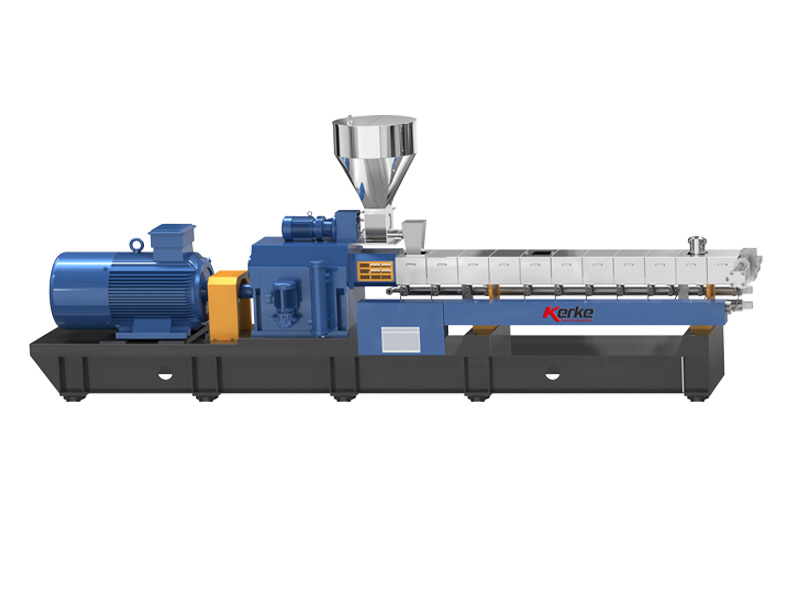
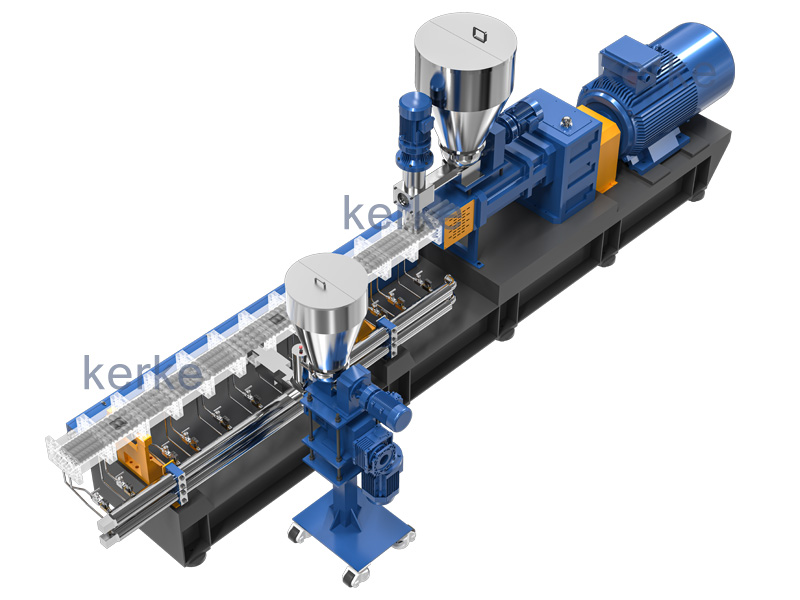
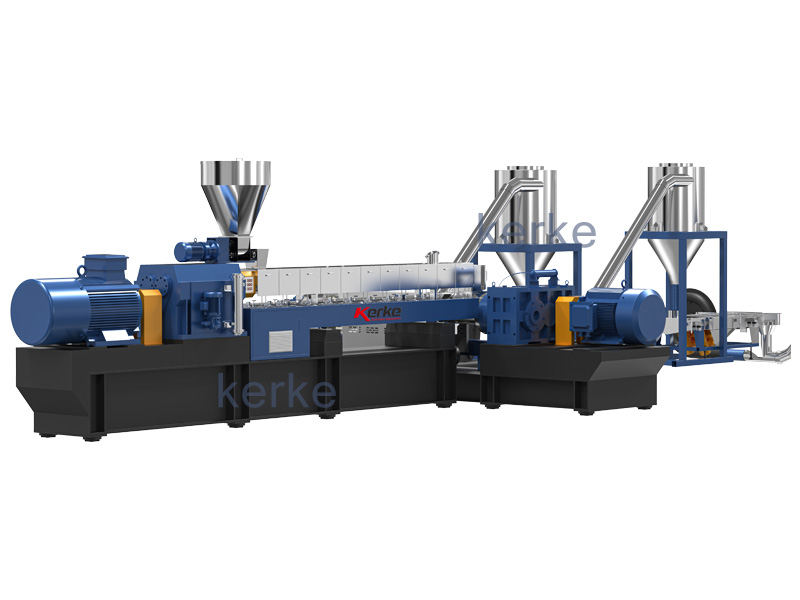
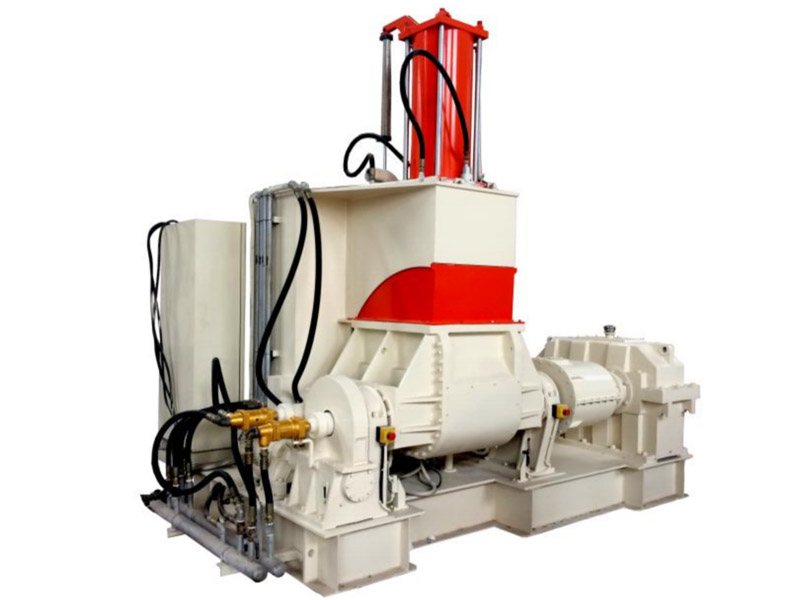
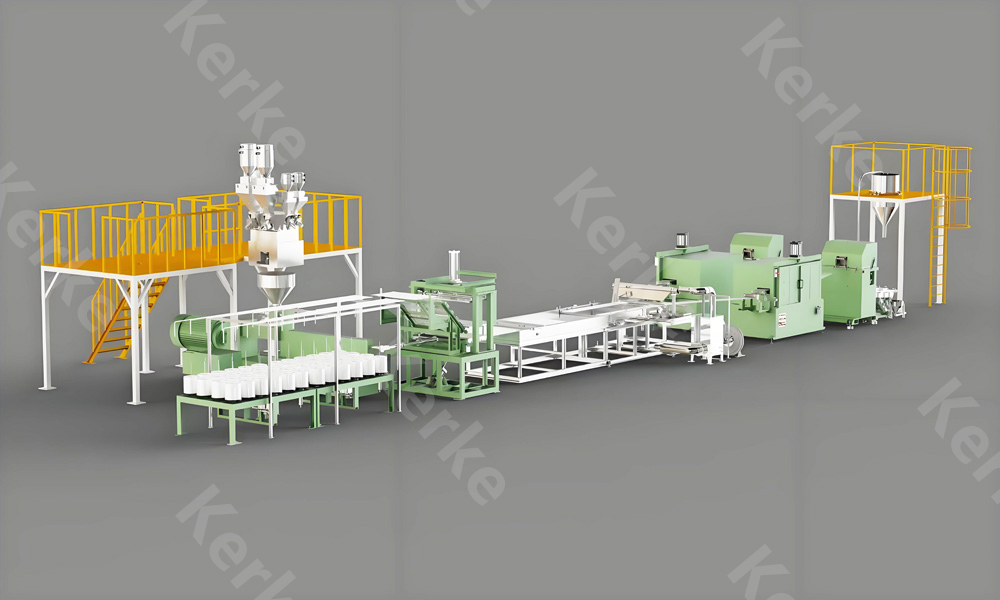
Color Masterbatch is a concentrated mixture of pigments and additives encapsulated in a carrier resin. The primary function of a Masterbatch Extruder is to disperse the pigment agglomerates into individual particles and distribute them uniformly throughout the carrier. High precision in color matching requires not only accurate dosing of pigments but also consistent shear and temperature history to prevent color shift or fading. This article delves into the technical aspects of achieving laboratory-level color consistency in high-volume production, focusing on the capabilities of Kerke Masterbatch Extruders.
Chapter 1: The Science of Color Matching and Dispersion
Dispersion vs. Distribution
Achieving perfect color involves two distinct processes: distribution and dispersion. Distribution refers to the uniform spacing of pigment particles throughout the polymer matrix. Dispersion refers to the breaking down of pigment agglomerates into primary particles. For most applications, a pigment particle size of less than 1 micron is required for optimal color strength and gloss. A Masterbatch Extruder must provide enough shear stress to break these agglomerates without degrading the pigment or the carrier resin.
The quality of dispersion is often measured by the filter pressure value (FPV). A lower FPV indicates better dispersion because there are fewer large particles clogging the screen. Kerke Masterbatch Extruders are designed to achieve FPV levels below 10 bar (and often below 5 bar) even at high throughput rates, indicating superior dispersion quality. This directly correlates to the final product’s color consistency, measured by Delta E values (color difference). A Delta E of less than 0.3 is generally imperceptible to the human eye and is the target for high-end applications like automotive paints and cosmetics packaging.
The Role of Shear and Elongational Flow
Simple shear flow (created by the rotating screws) is not always sufficient for difficult-to-disperse pigments like Carbon Black or Phthalocyanine Blue. Elongational flow, where the melt is stretched and pulled apart, is more effective at breaking agglomerates. Kerke Masterbatch Extruders utilize specialized mixing elements like “pineapple” mixers or toothed kneading blocks that create a combination of shear and elongational flow. This ensures that even the most stubborn pigments are fully dispersed, resulting in high color strength and excellent transparency in clear masterbatches.
Chapter 2: Critical Factors for Precision
Temperature Control Accuracy
Temperature control is the most critical variable in color stability. Many organic pigments are heat-sensitive; exceeding their decomposition temperature by even 10°C can cause a color shift (e.g., red turning brown). Conversely, insufficient heat leads to poor dispersion. A Masterbatch Extruder must have precise temperature control, typically within ±1°C. Kerke machines feature water-cooled barrel jackets with high-flow valves and PID controllers that react instantly to temperature fluctuations. The barrel is often divided into 8 to 10 zones for a 40:1 L/D machine, allowing for a very specific temperature profile—low at the feed zone to prevent bridging, high in the melting zone, and controlled in the mixing zone to prevent degradation.
Residence Time Control
Residence time must be consistent for every pellet. If some pellets stay in the barrel longer than others, they may be over-heated, leading to color variation. Twin Screw Extruders have a narrower residence time distribution (RTD) than single-screw machines. However, to further tighten the RTD, Kerke uses starve-feeding techniques and optimized screw geometry that minimizes dead spots. For ultra-sensitive colors, a liquid injection system can be used to add the pigment directly into the melt at the end of the barrel, minimizing residence time at high temperatures. This technique is essential for heat-sensitive fluorescent pigments.
Gravimetric Dosing Systems
The extruder is only as good as the feed. High precision requires gravimetric feeders that weigh the pigment, carrier, and additives in real-time with an accuracy of ±0.1%. Volumetric feeders are insufficient for masterbatch as pigment bulk density can vary. Kerke integrates high-speed gravimetric feeders directly onto the extruder hopper. These feeders communicate with the main PLC, adjusting the feed rate based on the extruder’s torque and speed to maintain a consistent formulation. This closed-loop control ensures that even if the pigment density changes, the final color remains consistent.
Chapter 3: Advanced Mixing Technologies in Kerke Extruders
Co-Kneaders and Distributive Mixers
The heart of the masterbatch extruder is the mixing section. Kerke utilizes co-rotating kneading blocks (co-kneaders) that can be arranged in various configurations (staggered, intermeshing, neutral). For high-concentration black masterbatch, intense kneading is required. For additive masterbatch (e.g., anti-static), distributive mixing is more important to avoid damaging the additive. The modular design allows operators to change the screw configuration to suit the specific masterbatch type. This flexibility is a major advantage, as one machine can produce a wide range of products from 10% to 80% pigment loading.
Side Stuffing for Fibers and Special Additives
For special masterbatches containing glass fibers or carbon fibers, a side-stuffer is used. This device forces the fibers into the melt without breaking them. The length of the fibers is critical for mechanical reinforcement. A masterbatch extruder with a side-stuffer must have a venting port upstream to remove air trapped in the fibers. Kerke’s side-stuffer design uses a co-rotating screw that matches the main screw speed, ensuring smooth integration of the fibers into the matrix without causing surging or pressure fluctuations.
Melt Temperature Uniformity
Non-uniform melt temperature leads to color streaks. To ensure uniformity, the screws must be designed to promote heat transfer. Kerke uses barrier flight screws that separate the solid bed from the melt pool, ensuring that the solid polymer melts uniformly before entering the high-shear zone. Additionally, static mixers can be installed in the die adapter to homogenize the melt further just before it exits. This final “polishing” step ensures that any minor temperature or concentration gradients are eliminated, resulting in perfectly consistent pellets.
Chapter 4: Quality Control and Testing Protocols
Online Spectrophotometry
Modern masterbatch lines use online spectrophotometers to measure the color of the melt or the pellets in real-time. If the color deviates from the standard, the system can automatically adjust the pigment feeder rate. Kerke Extruder offers integration with major brand spectrophotometers (e.g., X-Rite, Datacolor). This level of automation reduces the need for off-line lab testing, which can take hours. Real-time control ensures that off-spec material is detected immediately, minimizing waste.
Laboratory to Production Scale-Up
A common problem is that a color looks perfect in the lab but shifts in production. This is due to differences in shear and residence time. Kerke provides laboratory-scale masterbatch extruders (16mm or 20mm) that mimic the shear profile and residence time of the production machines. By developing the formulation on a lab unit that has the same torque/volume ratio as the production unit, scale-up issues are minimized. This “geometric similarity” approach ensures that the color data developed in the lab translates perfectly to the production floor, saving weeks of trial-and-error time.
Pellet Quality and Shape
The physical quality of the pellet affects the color perception. Uniform cylindrical pellets with a smooth surface reflect light consistently. Irregular pellets or “angel hair” (fine strands) can cause dusting and color variation in the final product. The die face design and cutter speed must be optimized. Kerke’s water-ring or strand pelletizers are designed to produce uniform pellets. For masterbatch, a longer cooling time is often required to prevent pellets from sticking together (blocking), which can trap moisture and cause color shifts later.
Chapter 5: Economic Analysis of Precision Masterbatch
Cost of High Precision vs. Let-Down Ratio
High-precision masterbatch commands a premium price in the market. A well-dispersed masterbatch can be used at lower let-down ratios (e.g., 1% instead of 3%), saving costs for the end-user. For example, if a processor needs a specific shade of blue, using a high-strength masterbatch at 1% loading is cheaper than using a low-strength batch at 4% loading, even if the high-strength batch costs twice as much per kg. The total cost to the processor is lower. Therefore, investing in a high-precision Masterbatch Extruder is justified by the ability to produce “difficult” colors (like metallics or fluorescents) and high-strength batches.
Capital and Operational Costs
The cost of a dedicated Masterbatch Extruder varies based on configuration. A basic unit might cost $40,000, but a high-precision system with gravimetric feeders, side stuffers for liquid additives, and underwater pelletizing can range from $100,000 to $180,000. Despite the higher initial cost, the profit margin for specialty masterbatch is significantly higher than for black or white standard batches, often yielding a gross margin of 20% to 30%. The ROI is driven by the ability to sell high-value specialty colors and the reduction in waste from off-spec batches.
Waste Reduction through Precision
In a standard extruder, if a batch is off-color, it often has to be re-compounded or sold as a lower-grade product at a discount. With a precision Kerke extruder, the first-pass yield (the percentage of product that meets spec on the first run) can exceed 98%. For a plant producing 1,000 tons per year, a 2% increase in yield is 20 tons of saleable product. At $2,000 per ton, that is $40,000 in additional revenue annually. This alone can pay for the extruder’s maintenance costs.
Chapter 6: Handling Difficult Pigments and Carriers
Processing PVC and Heat-Sensitive Carriers
PVC masterbatch requires careful temperature management to avoid dehydrochlorination. The extruder must have a large cooling surface area and efficient torque transmission at lower speeds. Kerke offers PVC-specific masterbatch extruders with bimetallic barrels to resist corrosion from HCl gas. The screw design uses wide-pitch conveying elements to minimize shear heat generation, relying more on distributive mixing than dispersive mixing.
High-Filling and Functional Masterbatch
Functional masterbatches (anti-block, anti-static, UV stabilizers) often have low pigment loading but require perfect distribution. If the additive is not evenly distributed, the final film might have “fish eyes” or uneven slip properties. These formulations often use LLDPE or LDPE carriers, which have low melt strength. The extruder must operate at high speed to build pressure without causing melt fracture. Kerke’s high-speed gearboxes (up to 1000 RPM) are ideal for these applications, ensuring high throughput with minimal residence time.
Metallic and Pearlescent Pigments
Metallic pigments (aluminum flakes) are fragile and can be destroyed by high shear. The extruder must use gentle mixing elements and operate at lower speeds. However, the carrier must still encapsulate the flake to prevent oxidation. A special venting system is needed to remove air without pulling the volatile carriers out. Kerke has developed low-shear screw profiles specifically for metallic masterbatches that maintain the aspect ratio of the flakes, ensuring a high-gloss, mirror-like finish in the final plastic product.
Chapter 7: Kerke Masterbatch Solutions and Case Studies
Case Study: Automotive Color Matching
An automotive supplier needed a grey masterbatch that matched a specific RAL code with a Delta E of less than 0.2. They were experiencing color drift between batches. Kerke installed a co-rotating twin-screw extruder with a 44:1 L/D and a specialized mixing section containing toothed kneading blocks. A gravimetric feeder with loss-in-weight control was used for the titanium dioxide pigment. The system included an online colorimeter that adjusted the feeder in real-time. The result was a consistent Delta E of 0.15 across 50 batches, meeting the strict automotive standards (e.g., BMW or Mercedes specifications). The customer was able to reduce their safety stock of masterbatch by 30% due to the high confidence in batch-to-batch consistency.
Case Study: High-Concentration Black Masterbatch
A cable compounder needed a 50% carbon black masterbatch in a PE carrier. High loading creates extremely high viscosity and heat. A single-screw extruder was failing to disperse the black, resulting in gels and specks. Kerke provided a heavy-duty twin-screw extruder with a high-torque gearbox (12 Nm/cm³). The screw design included intensive kneading zones and a dual-stage venting system to remove volatiles from the carbon black. The melt temperature was controlled precisely using high-capacity water cooling. The final masterbatch had a filter pressure of only 80 bar (very low for 50% loading) and excellent dispersion, allowing the cable maker to increase their line speed by 20% due to better melt flow.
Conclusion
Achieving high precision in color matching is a complex interplay of machinery, process control, and material science. The Masterbatch Extruder is the critical link that transforms raw pigments into a consistent, high-performance product. Kerke Extruder provides the advanced mixing technology, precise temperature control, and integrated automation necessary to meet the most demanding color standards. By investing in a Kerke Masterbatch Extruder, manufacturers can produce high-value specialty batches, reduce waste, and secure long-term contracts with premium customers. For more information on our masterbatch solutions, visit www.kerkeextruder.com.