Functional masterbatch manufacturing represents one of the most demanding applications for compounding extrusion technology. Unlike standard color masterbatches that primarily deliver aesthetic properties, functional masterbatches incorporate additives that impart specific performance characteristics to plastic materials. Selecting the appropriate twin screw extruder for functional masterbatch production requires understanding both the technical requirements of functional additives and the processing capabilities of available equipment.
The growing demand for functional plastics across industries including automotive, electronics, healthcare, and construction drives continuous expansion of the functional masterbatch market. Manufacturers producing flame retardants, UV stabilizers, antimicrobial agents, and other functional additives require equipment that can incorporate these materials effectively while maintaining their functional integrity during processing.
This comprehensive guide provides the information necessary to evaluate and select a masterbatch extruder that meets your functional masterbatch production requirements. From technical specifications to economic considerations, you will gain insights that enable confident equipment selection decisions.
Understanding Functional Masterbatch Requirements and Challenges
Functional masterbatches differ fundamentally from color masterbatches in their processing requirements and quality criteria. While color masterbatch success depends primarily on achieving uniform pigment dispersion, functional masterbatch quality depends on preserving the chemical and physical integrity of functional additives throughout the compounding process.
Many functional additives are sensitive to the high temperatures, shear forces, and processing conditions encountered in extrusion compounding. Additives that degrade during processing lose their effectiveness, resulting in masterbatches that fail to deliver the intended functional properties. Equipment selection must consider the processing sensitivity of specific functional additives being incorporated.
The concentration levels of functional additives in masterbatch formulations often exceed those used in standard compounding applications. These high loadings create processing challenges that require specialized equipment capabilities. Understanding these challenges enables appropriate equipment configuration that addresses specific functional masterbatch requirements.
Types of Functional Masterbatches and Their Processing Requirements
Flame retardant masterbatches contain chemical compounds that inhibit or suppress combustion in plastic materials. These additives often require careful temperature control to prevent premature decomposition during processing. Halogen-free flame retardants, increasingly preferred for environmental reasons, present particular processing challenges due to their sensitivity to shear and temperature conditions.
UV stabilizer masterbatches incorporate compounds that protect plastics from ultraviolet light degradation. These additives include hindered amine light stabilizers and ultraviolet absorbers that can degrade if exposed to excessive processing temperatures or shear. Equipment selection must enable gentle processing that preserves these heat-sensitive compounds.
Antimicrobial masterbatches contain silver-based, organic, or other antimicrobial agents that inhibit bacterial and fungal growth on plastic surfaces. These additives often have specific thermal stability ranges that must be maintained during processing. The effectiveness of antimicrobial additives depends on maintaining adequate dispersion while avoiding degradation.
Performance Specifications for Functional Masterbatch Equipment
Functional masterbatch production requires equipment with precise temperature control capabilities. The narrow processing windows characteristic of many functional additives demand temperature control accuracy within tight tolerances throughout the barrel length. Modern compounding extruders with advanced control systems provide this precision when properly configured.
Screw design flexibility enables optimization of processing conditions for specific functional masterbatch formulations. Equipment that allows easy reconfiguration of screw elements supports processing development for diverse functional additive types. This flexibility proves essential for manufacturers producing multiple functional masterbatch product lines.
Vacuum venting capability enables removal of volatiles and reaction byproducts that might affect functional masterbatch quality. For some formulations, vacuum processing prevents moisture-related degradation or removes reaction products that would compromise functional performance.
Technical Evaluation Criteria for Masterbatch Extruder Selection
Evaluating compounding extruders for functional masterbatch production requires systematic assessment of multiple technical criteria. Each criterion contributes to the overall suitability of equipment for specific functional masterbatch applications.
Temperature Control and Profile Flexibility
The temperature control system of a twin screw extruder determines the precision with which processing conditions can be maintained. For functional masterbatch production, temperature control accuracy directly impacts product quality and functional additive preservation.
Modern extrusion control systems employ PID algorithms and solid-state heating and cooling systems that maintain temperature accuracy within plus or minus one degree Celsius. This precision enables consistent processing conditions that preserve functional additive integrity across production runs.
Temperature profile flexibility enables optimization of thermal conditions along the barrel length for specific formulations. Zone-based temperature control allows independent adjustment of each barrel section, enabling graduated temperature profiles that match formulation requirements. The number of controllable zones and the precision of temperature adjustment differentiate equipment capabilities.
Screw Design and Configuration Options
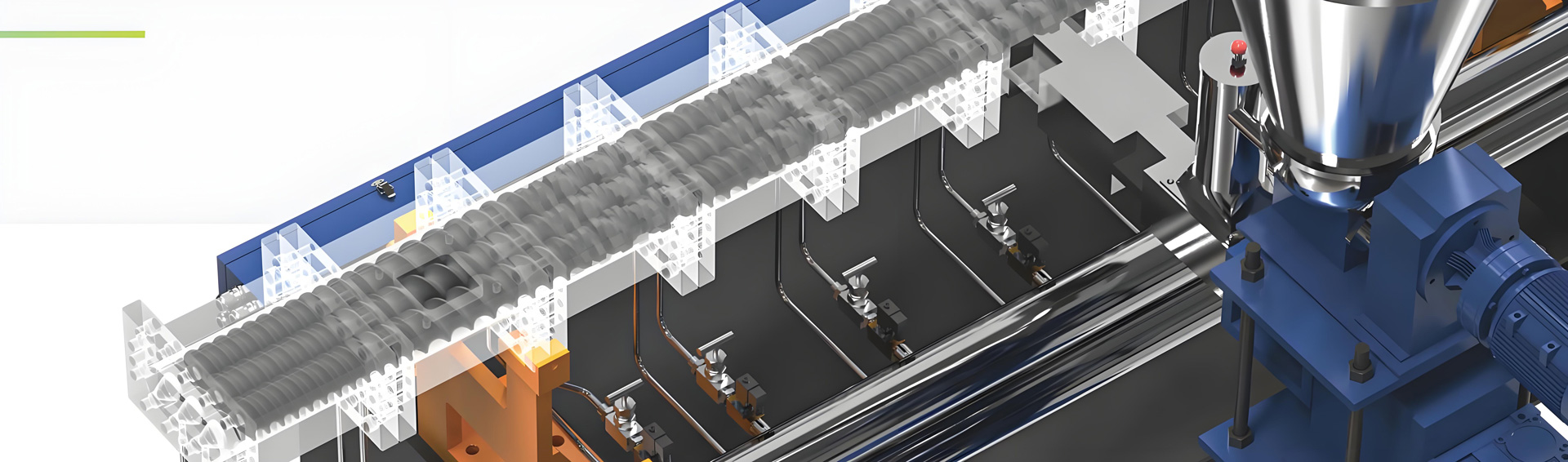
The screw configuration determines the mixing, conveying, and processing characteristics of the compounding extruder. For functional masterbatch production, screw design must balance processing intensity with the need for gentle handling of sensitive functional additives.
Modular screw element designs enable customization of screw configurations for specific functional masterbatch requirements. Kneading blocks provide dispersive mixing for difficult-to-incorporate additives, while运输 elements ensure proper material flow and residence time distribution. The ability to reconfigure screw elements supports formulation development and process optimization.
Screw compression ratio influences the melting behavior and shear conditions experienced by materials during processing. Formulations with heat-sensitive functional additives often benefit from lower compression ratios that reduce shear heating and provide more gentle processing conditions.
Throughput Range and Flexibility
The throughput range of available equipment determines the production volumes achievable and the flexibility to operate efficiently at different production rates. Functional masterbatch production often involves smaller batches than commodity color masterbatches, making equipment flexibility particularly important.
Wide throughput ranges enable efficient production across different batch sizes, from development quantities through full-scale production runs. Equipment with turndown ratios of ten to one or greater provides maximum production flexibility for diverse functional masterbatch requirements.
The relationship between throughput and quality must be understood for specific formulations. Some functional masterbatches require lower throughput rates to achieve adequate mixing and functional additive incorporation. Equipment must provide acceptable quality across the throughput range needed for production operations.
Equipment Selection by Functional Masterbatch Type
Different functional masterbatch types present distinct processing requirements that influence equipment selection. Understanding these requirements enables targeted equipment configuration that optimizes functional masterbatch quality and production efficiency.
Flame Retardant Masterbatch Production Equipment
Flame retardant masterbatch production requires equipment with excellent temperature control and the ability to process at higher temperatures when necessary for certain flame retardant systems. The processing requirements vary significantly between halogenated and halogen-free flame retardant technologies.
Equipment selection for halogenated flame retardant masterbatches must consider corrosion resistance requirements. Some halogenated flame retardants can accelerate corrosion of metal components during processing. Equipment with appropriate material compatibility ensures reliable production over extended equipment life.
Halogen-free flame retardant masterbatches require gentler processing conditions that preserve the chemical integrity of nitrogen-based, phosphorus-based, or mineral-based flame retardant systems. Equipment selection should emphasize temperature control precision and screw configurations that minimize shear heating.
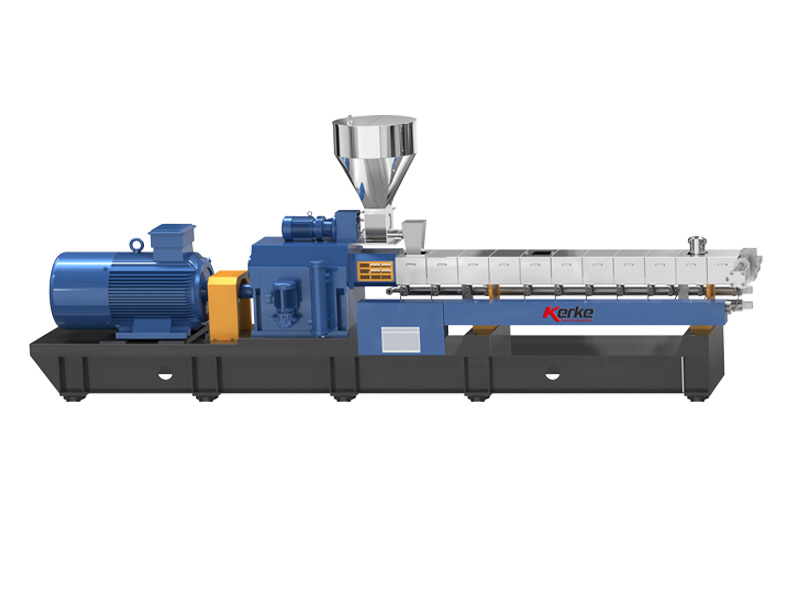
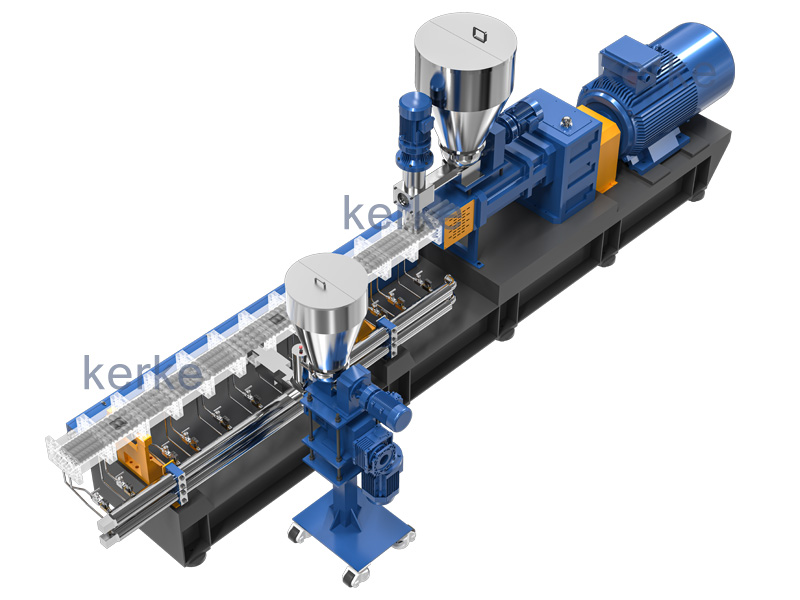
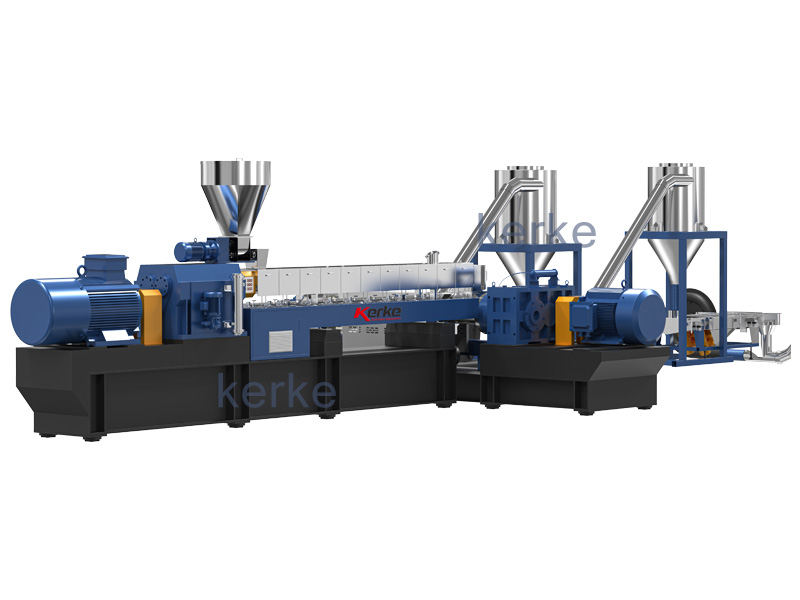
The Kerke KTE series provides equipment options suitable for flame retardant masterbatch production across the performance range. Equipment selection should consider the specific flame retardant chemistry and loading levels required for target applications.
UV Stabilizer Masterbatch Production Equipment
UV stabilizer masterbatch production demands careful attention to thermal conditions that preserve heat-sensitive stabilizer compounds. Equipment with superior temperature control enables processing at lower temperatures while achieving adequate mixing and dispersion.
The screw configuration for UV stabilizer masterbatch should emphasize distributive mixing over dispersive mixing to minimize shear-related degradation. Screw designs with extensive mixing sections and gentle kneading elements distribute stabilizers effectively while limiting thermal and shear exposure.
Vacuum venting can benefit UV stabilizer masterbatch production by removing trace moisture and volatile impurities that might accelerate degradation. Equipment with vacuum capability provides processing flexibility that supports optimization for specific stabilizer systems.
Antimicrobial Masterbatch Production Equipment
Antimicrobial masterbatch production must balance effective incorporation of antimicrobial agents with preservation of their functional activity. Many antimicrobial compounds have specific thermal stability limits that constrain processing conditions.
Equipment with precise temperature control enables processing at the lowest temperatures necessary for adequate mixing and dispersion. This capability proves essential for maintaining antimicrobial effectiveness in finished masterbatches.
The screw configuration should provide sufficient mixing intensity for uniform distribution of antimicrobial agents without creating excessive shear heating. Testing different screw configurations identifies optimal processing conditions for specific antimicrobial systems.
Sizing and Capacity Planning for Functional Masterbatch Operations
Appropriate equipment sizing ensures that selected equipment matches production requirements while maintaining quality standards. Oversized equipment creates efficiency problems, while undersized equipment limits production capability.
Capacity Requirements Assessment
Production capacity requirements should be based on market analysis, customer commitments, and growth projections. Equipment should be sized to meet current requirements while providing capability for reasonable growth expectations.
Functional masterbatch production often involves smaller batch sizes than commodity products, requiring equipment that maintains quality at lower throughput rates. This consideration affects equipment selection differently than for high-volume color masterbatch operations.
Kerke KTE-36B equipment, priced at $25,000-$35,000, provides suitable capability for initial functional masterbatch production with throughput of 20-100kg/h. This entry-level option enables market entry and product development before committing to larger equipment investments.
Scale-Up Considerations
Successful functional masterbatch operations typically require scale-up as market position develops. Planning for scale-up during initial equipment selection enables efficient growth without requiring complete equipment replacement.
Selecting equipment within a product family that includes larger models enables straightforward scale-up to higher-capacity equipment when production volumes justify the investment. Kerke’s KTE series provides this family continuity from entry-level through high-volume production equipment.
The KTE-50B, at $40,000-$60,000 with 80-200kg/h capacity, provides meaningful scale-up capability for growing functional masterbatch operations. This equipment enables medium-scale production that supports expanded customer relationships and market development.
High-Volume Functional Masterbatch Production
Established functional masterbatch operations with significant production volumes require equipment capable of high throughput while maintaining quality standards. The KTE-65B and KTE-75B provide production capabilities in the 200-450kg/h and 300-800kg/h ranges respectively.
The KTE-65B, priced at $50,000-$80,000, represents an excellent platform for high-volume functional masterbatch production requiring equipment flexibility and quality consistency. This machine balances throughput capability with the process control necessary for functional masterbatch quality.
The KTE-75B, at $70,000-$100,000, enables large-scale functional masterbatch production with throughput up to 800kg/h. This equipment serves operations focused on high-volume functional masterbatch markets where production economics justify significant equipment investment.
Process Development and Optimization for Functional Masterbatch
Developing functional masterbatch formulations requires systematic process development that optimizes quality, throughput, and functional performance. The compounding extruder capabilities must support this development activity while enabling efficient production once formulations are optimized.
Formulation Development Considerations
Functional masterbatch formulation development requires balancing multiple factors including functional performance, processing compatibility, and cost effectiveness. The interactions between functional additives, carriers, and processing aids must be understood to achieve optimal results.
Equipment with flexible configuration options supports systematic formulation development activities. The ability to modify screw configurations, temperature profiles, and processing parameters enables exploration of the formulation space necessary to identify optimal combinations.
Kerke provides technical support and application guidance that assists functional masterbatch development activities. This support helps customers optimize their formulations and processing conditions for specific functional masterbatch requirements.
Process Parameter Optimization
Process parameter optimization for functional masterbatch focuses on achieving functional additive preservation while maintaining adequate mixing and dispersion. The optimal parameter set differs for each formulation based on the specific functional additives and carrier systems involved.
Temperature profile optimization typically begins with lower temperatures that protect functional additives, then increases temperatures as needed to achieve adequate melting and mixing. The minimum temperature that produces acceptable quality minimizes functional additive degradation.
Screw speed optimization balances throughput requirements with processing intensity needs. Lower speeds provide more gentle processing but reduce production efficiency. The optimal speed depends on formulation characteristics and quality requirements.
Quality Verification and Validation
Functional masterbatch quality verification requires testing methods appropriate for the specific functional properties being incorporated. Standard polymer testing methods combined with functional-specific testing verify that masterbatch products meet performance specifications.
Accelerated aging tests assess functional performance retention after processing, verifying that functional additives survive the compounding process with adequate effectiveness. These tests validate process conditions and identify potential problems before full-scale production.
Kerke equipment documentation supports quality validation activities by providing process data and equipment specifications necessary for regulatory compliance and customer requirements.
Investment Analysis and Economic Considerations
Equipment investment decisions must consider not only initial acquisition costs but also operating costs, maintenance requirements, and the revenue potential associated with different equipment capabilities. Comprehensive economic analysis ensures appropriate investment decisions.
Total Cost of Ownership Analysis
Total cost of ownership analysis considers all costs associated with equipment acquisition and operation over its expected service life. This analysis enables comparison of equipment options that accounts for differences in operating costs and equipment life.
Energy consumption represents a significant operating cost component that varies between equipment options. More efficient equipment may justify higher initial investment through lower operating costs over time.
Maintenance costs depend on equipment design, build quality, and the operating conditions associated with specific formulations. Equipment with higher-quality components may provide longer service life and lower maintenance costs despite higher initial prices.
Revenue Potential and Market Positioning
Equipment capabilities influence the revenue potential and market positioning achievable for functional masterbatch operations. Equipment that enables higher quality products or broader formulation capability supports premium market positioning.
Functional masterbatch markets often command premium pricing based on performance and quality levels. Equipment that enables achievement of higher performance standards supports capturing these premium prices.
The flexibility to produce diverse functional masterbatch products expands market opportunities. Equipment that handles multiple formulation types efficiently enables broader market participation.
Return on Investment Expectations
Return on investment expectations for functional masterbatch equipment depend on market conditions, pricing levels, and production volumes achievable. Typical payback periods range from one to three years depending on specific circumstances.
High-volume production operations typically achieve faster payback due to the economies of scale in functional masterbatch production. Lower-volume operations may experience longer payback periods but can still achieve attractive returns through premium pricing and focused market positioning.
Kerke equipment pricing provides accessible entry points that enable market participation without excessive capital commitment. The range of equipment options supports operations at different scales and development stages.
Supplier Evaluation and Support Capabilities
Equipment supplier selection significantly influences the success of functional masterbatch operations. Suppliers with strong technical support capabilities and application expertise provide valuable resources for product development and production optimization.
Technical Support and Application Engineering
Technical support capabilities vary significantly between equipment suppliers. Suppliers with strong application engineering resources can assist with formulation development, process optimization, and troubleshooting activities that improve production outcomes.
Kerke provides comprehensive technical support for customers selecting and operating KTE series compounding extruders. This support includes application guidance, process development assistance, and troubleshooting support that helps customers achieve their production objectives.
Training programs for equipment operators ensure that personnel can effectively utilize equipment capabilities for functional masterbatch production. Proper training maximizes the benefits of equipment investment through optimized operating practices.
Warranty and Service Agreements
Warranty coverage and service agreement options influence the total cost and risk profile of equipment acquisition. Comprehensive warranty coverage provides protection against manufacturing defects and premature failures.
Service agreements that include preventive maintenance, priority response, and technical support provide predictable operating costs and access to expert assistance when needed. These agreements prove particularly valuable for production operations where downtime creates significant costs.
Kerke offers warranty and service options that address different customer requirements and risk preferences. These options enable customers to select the protection level appropriate for their circumstances.
Spare Parts and Component Availability
Spare parts availability affects the speed and cost of equipment repairs when maintenance or repairs become necessary. Suppliers with comprehensive parts inventories and efficient distribution systems minimize equipment downtime following failures.
Kerke maintains parts inventory and distribution capabilities that support timely repair of equipment worldwide. This parts support ensures that customers can maintain equipment operation and minimize production losses from downtime.
The design of equipment components influences their service life and replacement frequency. Quality components with extended service life reduce ongoing maintenance costs and support consistent production performance.
Future-Proofing Considerations for Functional Masterbatch Operations
Equipment investments should consider not only current requirements but also future needs and market evolution. Equipment that accommodates future requirements provides longer useful life and better return on investment.
Technology Evolution and Equipment Adaptability
Functional masterbatch technology continues to evolve with new additive systems and formulation approaches. Equipment selected today should accommodate anticipated future developments that might require different processing capabilities.
Flexible equipment configurations that support diverse formulations provide adaptability that protects against market changes. Equipment with extensive configuration options enables responding to new functional masterbatch opportunities without requiring complete equipment replacement.
Kerke equipment designs incorporate engineering features that support future capability expansion and technology evolution. This forward-looking design approach protects customer investments over extended equipment service lives.
Regulatory and Compliance Considerations
Functional masterbatch production increasingly requires compliance with regulatory requirements related to product safety and environmental protection. Equipment selection should consider the capabilities necessary to meet current and anticipated regulatory requirements.
Food contact, medical, and other regulated applications require equipment and processes that support compliance with specific standards. Equipment documentation and traceability capabilities must meet these requirements for relevant market segments.
Kerke equipment is designed and manufactured to support compliance with relevant regulatory requirements. Documentation and quality systems provide the transparency necessary for customer regulatory compliance activities.
Conclusion
Choosing a masterbatch extruder for functional masterbatch manufacturing requires careful evaluation of technical capabilities, economic factors, and supplier support services. The compounding extruder must provide the precise temperature control, screw configuration flexibility, and processing capabilities necessary to preserve functional additive integrity while achieving adequate mixing and dispersion.
Functional masterbatch production equipment from Kerke provides the capabilities necessary for successful production across diverse functional masterbatch types. From entry-level development equipment through high-volume production machines, the KTE series offers options that address requirements at different scales and development stages.
The investment in appropriate functional masterbatch equipment enables participation in growing markets that reward quality and performance. By selecting equipment that matches your specific requirements and by utilizing available technical support resources, you can establish and grow successful functional masterbatch production operations.