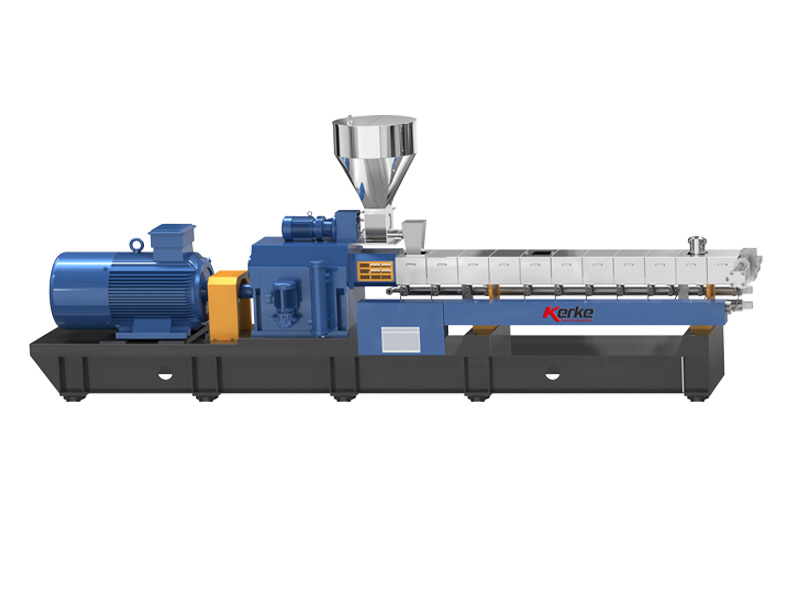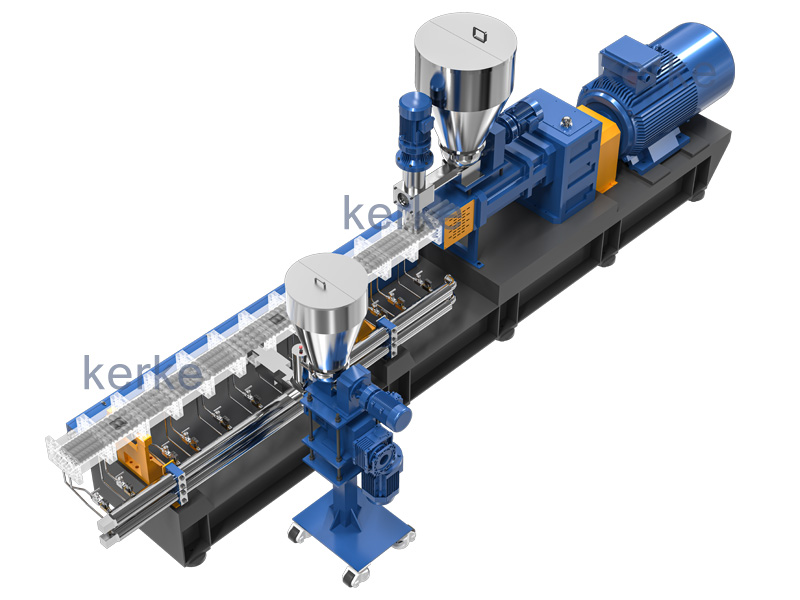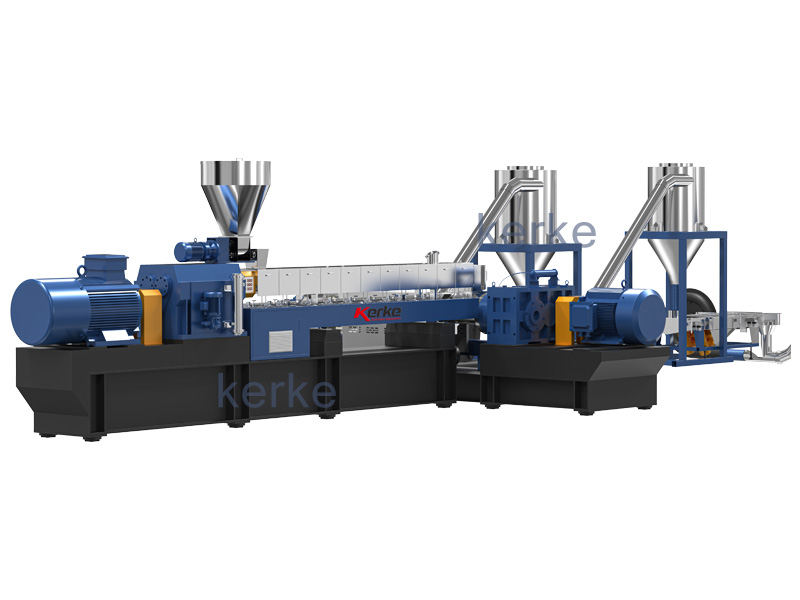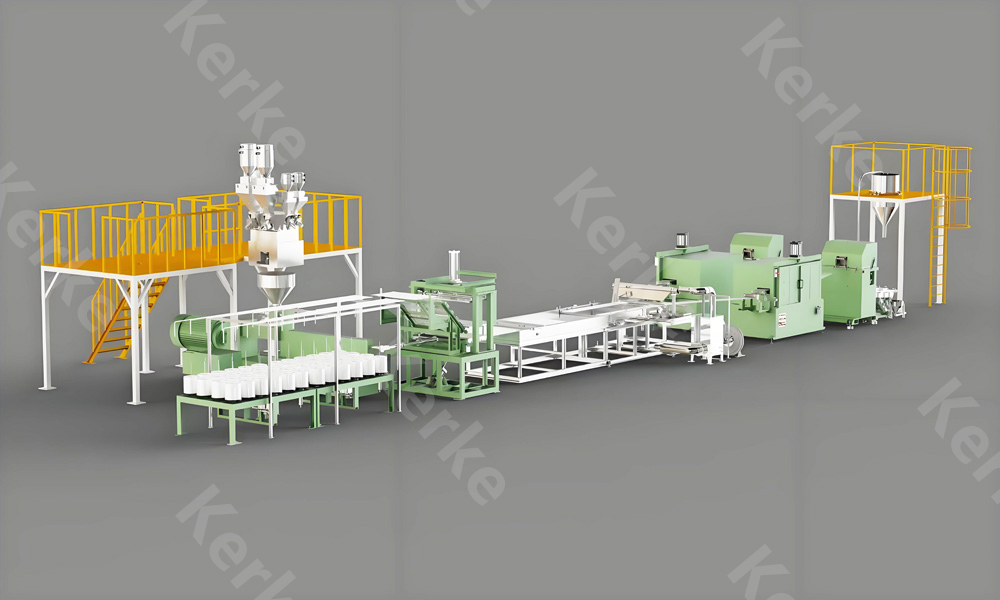
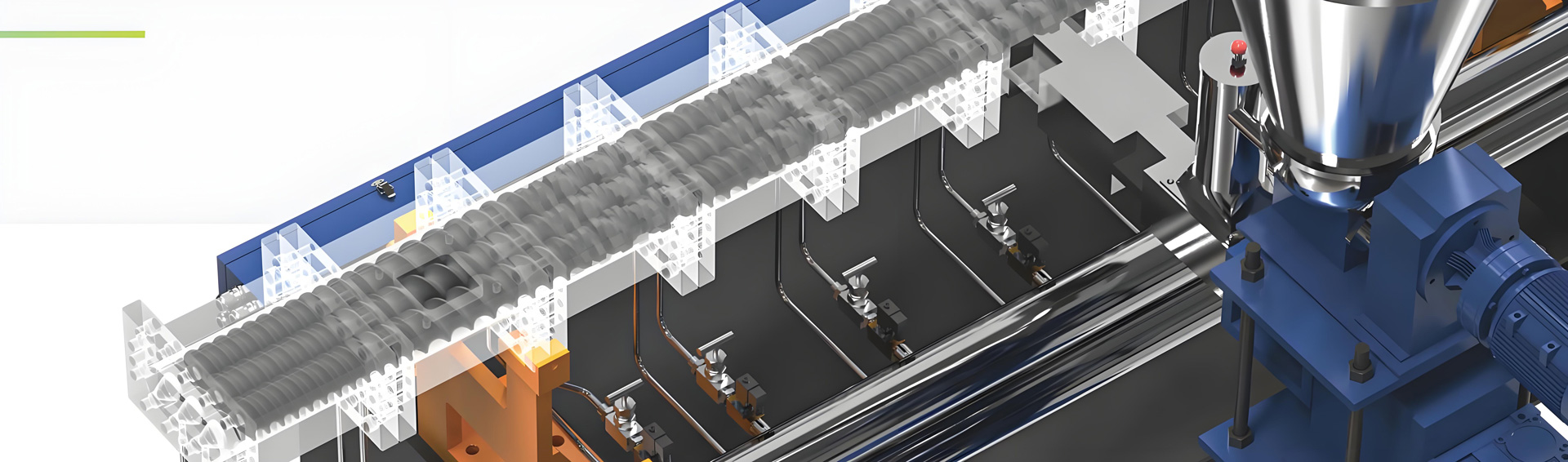
Masterbatch production relies heavily on the matching performance of twin screw extruder auxiliary systems, among which the die head and pelletizing system are two core components that directly determine particle appearance, dimensional uniformity, dispersion quality, production efficiency and long-term operating cost. A mismatched die head or pelletizing solution will cause common production defects including strand breakage, uneven particle size, surface bubbles, poor color consistency and high waste rate, even if the main compounding extruder and screw configuration are fully optimized.
As a professional manufacturer of twin screw extruder, masterbatch extruder and compounding extruder equipment, Kerke Extruder focuses on customized masterbatch compounding solutions for high-color-concentration masterbatch, filler masterbatch, functional masterbatch and biodegradable masterbatch production. Kerke KTE series twin screw extruders and supporting auxiliary systems are widely recognized in the global plastic modification industry for stable compounding performance, precise structural design and cost-effective operation. This article systematically explains the core selection principles, classification characteristics, applicable scenarios, cost budget and matching skills of masterbatch line die heads and pelletizing systems, helping global buyers select the most suitable configuration to maximize production yield and economic benefits.
Reasonable selection of die head and pelletizing system can reduce the defective rate of masterbatch production by 5% to 12%, improve continuous production stability, lower energy consumption and maintenance cost, and effectively enhance the market competitiveness of finished masterbatch products. This guide covers all key selection dimensions for new line construction, old line renovation and process upgrading, fully meeting the technical reference needs of masterbatch manufacturers.
1. Core Functions and Industrial Importance of Die Head and Pelletizing System
1.1 Working Principle of Masterbatch Extrusion Die Head
The die head is the final molding component of the masterbatch compounding extruder, undertaking the key tasks of melt homogenization, pressure stabilization, shunt molding and material output. After high shear mixing, plasticizing and dispersion by the twin screw extruder barrel and screw elements, the masterbatch melt enters the die head flow channel. Through the streamlined shunt structure of the die head, the turbulent melt is converted into stable laminar flow, ensuring uniform pressure and temperature of the melt at each discharge hole.
For masterbatch production, the die head must eliminate material retention dead corners to prevent high-temperature carbonization of high-concentration pigments and fillers, which avoids black spots, color spots and particle contamination. At the same time, the die head accurately controls the discharge speed and flow rate of each strand, ensuring consistent strand thickness, which lays a foundation for uniform particle size in the subsequent pelletizing process. Different from ordinary plastic extrusion die heads, masterbatch-specific die heads have higher requirements for wear resistance, pressure resistance and self-cleaning performance due to the high filler and high pigment characteristics of masterbatch materials.
1.2 Core Value of Pelletizing System for Masterbatch Production
The pelletizing system is the final molding link of the masterbatch line, which cuts continuous molten strands into uniform solid particles through mechanical cutting and cooling shaping. The quality of the pelletizing system directly affects the particle roundness, length uniformity, bulk density and surface finish of the finished masterbatch, and further determines the dispersion effect and coloring performance of the masterbatch in downstream plastic processing.
Different masterbatch types require matched pelletizing processes. High-concentration carbon black masterbatch, white filler masterbatch and functional additive masterbatch have different viscosity, melt strength and thermal sensitivity, putting forward differentiated requirements for cutting speed, cooling mode and cutting tool configuration of the pelletizing system. A suitable pelletizing system can realize continuous and stable production, reduce strand breakage and wire drawing defects, lower manual intervention frequency, and greatly improve the automation level and production capacity of the masterbatch line.
1.3 Losses Caused by Improper Configuration Matching
Most masterbatch production quality problems and cost wastes are caused by mismatched die head and pelletizing system configuration. If the die head flow channel design is unreasonable, melt pressure fluctuation will occur, resulting in uneven strand thickness, and the particle size deviation will exceed the industry standard by more than 15%, leading to downstream customer rejection. Die head dead corners will cause material carbonization, increasing the defective rate by 8% to 15% and causing a large amount of raw material waste.
Mismatched pelletizing systems will lead to frequent strand breakage, discontinuous production, increased downtime and debugging time, reducing the effective production capacity of the twin screw extruder by 10% to 20%. In addition, unreasonable configuration will increase equipment wear speed, shorten the service life of die holes and cutting blades, and raise daily maintenance and replacement costs. For medium and large-scale masterbatch manufacturers, the comprehensive economic loss caused by improper configuration can reach tens of thousands of dollars every year. Therefore, scientific selection of die head and pelletizing system is a key link to control production quality and comprehensive cost.
2. Classification, Structural Characteristics and Selection Criteria of Masterbatch Die Heads
2.1 Common Types of Masterbatch Die Heads and Applicable Materials
According to structural design and applicable process, masterbatch die heads are mainly divided into straight-through die head, cross-type die head and self-cleaning special die head, which are matched with different Kerke KTE series twin screw extruder models and masterbatch types. The straight-through die head is the most widely used basic type, featuring simple structure, smooth flow channel and low material residual. It is suitable for conventional color masterbatch, PE/PP filler masterbatch and general-purpose plastic masterbatch production, and matches Kerke KTE-35, KTE-52 and other small and medium-sized compounding extruders.
The cross-type die head adopts three-dimensional shunt structure, which can effectively balance melt pressure and temperature, and is suitable for high-viscosity, high-concentration masterbatch such as carbon black masterbatch, titanium dioxide white masterbatch and flame retardant masterbatch. This die head can avoid melt deflection and ensure consistent discharge of each strand, solving the problem of uneven particle size of high-filler masterbatch.
The self-cleaning special die head is an upgraded customized model of Kerke, adopting full streamline dead-corner-free flow channel design and high-precision mirror polishing treatment. It is specially developed for high-end masterbatch such as medical-grade masterbatch, food-contact grade masterbatch and high-transparency functional masterbatch. It has excellent self-cleaning performance, no material carbonization during long-term operation, and can realize rapid material change and color change, greatly reducing material waste and color cross-contamination rate.
2.2 Key Die Head Parameter Selection Indicators
The first core selection indicator is die hole specification and arrangement. The number, aperture and spacing of die holes determine the maximum output of the masterbatch line and strand stability. Small-aperture die holes (2.0mm to 3.0mm) are suitable for fine particle masterbatch with high appearance requirements, while large-aperture die holes (3.0mm to 5.0mm) are applied to high-output conventional masterbatch production. Kerke adopts optimized dense arrangement design to ensure maximum output without strand adhesion, and the die hole spacing is scientifically calculated according to melt fluidity.
The second indicator is die head material and wear resistance. Masterbatch contains a large number of inorganic fillers and abrasive pigments, which cause serious wear to the die head. Kerke standard die heads are made of high-quality alloy steel, and high-end customized die heads adopt hard alloy inlay treatment, with wear resistance improved by 3 times than ordinary die heads, effectively extending the service life of die holes and reducing replacement frequency.
The third indicator is pressure and temperature resistance. The masterbatch compounding process requires stable high-pressure extrusion. Kerke die heads support long-term stable operation under 15 to 35MPa melt pressure, with a temperature resistance range of 0 to 350℃, fully adapting to the processing temperature requirements of various plastic substrates such as PE, PP, ABS, PET and biodegradable PLA/PBAT.
2.3 Matching Rules Between Die Head and Extruder Model
Kerke die heads are fully customized for KTE series twin screw extruders to ensure optimal matching of screw diameter, barrel length-diameter ratio and extrusion output. For KTE-35 small twin screw extruder with hourly output of 50 to 150kg, it is matched with 24 to 36 hole straight-through die heads, suitable for small-batch and multi-variety masterbatch production. For KTE-52 medium compounding extruder with hourly output of 200 to 400kg, it is equipped with 48 to 72 hole optimized shunt die heads, which is the mainstream configuration for medium-sized masterbatch factories.
For KTE-65 and KTE-75 large twin screw extruders with hourly output of 500 to 750kg, high-pressure cross-type die heads or self-cleaning die heads with more than 96 holes are adopted to meet high-capacity and high-stability production requirements. The professional model matching design avoids the problems of insufficient die head discharge capacity limiting extruder output or excessive die hole leading to thin strand and easy breakage, ensuring that the extruder exerts the maximum compounding efficiency.
3. Classification, Advantages and Selection of Masterbatch Pelletizing Systems
3.1 Strand Water Cooling Pelletizing System
Strand water cooling pelletizing is the most traditional and widely applicable pelletizing process for masterbatch lines. The working principle is that the melt is extruded into continuous strands through the die head, cooled and shaped through the water tank, and then cut into uniform particles by a high-speed rotary cutter. This system is suitable for almost all conventional masterbatch types, including color masterbatch, filler masterbatch, antistatic masterbatch and toughening masterbatch, and has the advantages of wide material adaptability, simple operation and low failure rate.
Kerke supporting strand pelletizing system is equipped with adjustable-speed traction machine and high-precision alloy cutter, with adjustable particle length range of 2mm to 4mm, and the particle size uniformity can reach more than 98%. The water circulation cooling system adopts closed-loop filtration design, which ensures clean cooling water quality, avoids particle surface adhesion impurities, and meets the production requirements of ordinary and medium-high grade masterbatch. The equipment has low maintenance cost and is suitable for stable mass production of most masterbatch manufacturers.
The disadvantage of this system is that the production speed is limited by cooling water temperature and strand traction speed, and the production efficiency is slightly lower than underwater pelletizing. In addition, the finished particles have certain moisture content and need subsequent drying treatment, increasing a small amount of process cost.
3.2 Water Ring Hot Cutting Pelletizing System
Water ring hot cutting pelletizing is an efficient integrated pelletizing process, which installs the cutting tool directly at the die head outlet. The molten material is cut into particles immediately after extrusion from the die hole, and the particles are cooled and shaped through the water ring circulation system. This system cancels the traditional strand traction and long-distance water cooling links, realizing integrated extrusion cutting and cooling, with high production efficiency and small floor area.
This pelletizing system is very suitable for high-fluidity masterbatch such as low-viscosity color masterbatch and dispersible functional masterbatch, and is matched with Kerke medium and high-speed twin screw extruders. The finished particles are round and uniform, with no tailing defects, and do not need long-time drying, which simplifies the production process and improves production efficiency by 20% to 30% compared with strand pelletizing.
The selection limitation of water ring hot cutting is that it is not suitable for high-viscosity, low-fluidity masterbatch and heat-sensitive masterbatch, which are prone to material sticking and particle adhesion, resulting in unqualified products. It is mostly used for high-volume single-variety masterbatch continuous production.
3.3 Underwater Pelletizing System
Underwater pelletizing is a high-end precision pelletizing process for high-grade masterbatch production. The whole cutting and cooling process is completed in the underwater sealed environment, with no air contact in the whole process, which completely avoids particle oxidation, surface bubbles and dust pollution. The finished masterbatch particles have smooth surface, uniform size, high bulk density and excellent appearance, which fully meets the production standards of high-end medical grade, food grade and automotive special masterbatch.
Kerke high-end underwater pelletizing system is specially customized for high-performance masterbatch lines, supporting stable production of high-concentration carbon black masterbatch, high-temperature resistant masterbatch and superfine filler masterbatch. It is matched with KTE-65 and above large twin screw compounding extruders, with hourly output up to 750kg. The system has the advantages of high automation, low defective rate and ultra-stable operation, and is the preferred configuration for high-end masterbatch manufacturers to improve product grade.
The only shortcoming of underwater pelletizing system is the high initial procurement cost and higher daily maintenance technical requirements, which is suitable for large-scale enterprises focusing on high-end masterbatch market, not for small-batch trial production.
4. Matching Selection Strategy Based on Masterbatch Material Characteristics
4.1 High-Concentration Color Masterbatch Matching Scheme
High-concentration color masterbatch represented by carbon black masterbatch and titanium dioxide masterbatch has high filler content, high melt viscosity and poor fluidity, and is prone to die head blockage and strand breakage during extrusion. In terms of die head selection, it is necessary to prioritize cross-type pressure-stabilizing die heads or self-cleaning die heads to ensure uniform melt pressure and avoid local material retention and carbonization. The die hole aperture should be appropriately increased to reduce extrusion resistance and ensure smooth discharge.
In terms of pelletizing system, strand water cooling pelletizing system is the most stable choice, which can avoid particle adhesion caused by high temperature and high viscosity. For large-scale high-output production, matched Kerke optimized water ring hot cutting system can be selected after process debugging to balance efficiency and quality. This matching scheme can control the defective rate of high-concentration color masterbatch below 3%, far lower than the industry average level.
4.2 Functional and Flame Retardant Masterbatch Matching Scheme
Flame retardant masterbatch, antistatic masterbatch and weather-resistant functional masterbatch contain heat-sensitive additives, which are easy to decompose and fail under high temperature and long-term residence. The die head must adopt full streamline dead-corner-free self-cleaning structure to shorten material residence time and avoid additive failure. The die head temperature control system needs to support precise temperature adjustment to adapt to the thermal sensitivity of functional additives.
For functional masterbatch with general heat sensitivity, strand water cooling pelletizing system is matched to ensure sufficient cooling and shaping and avoid additive thermal degradation. For high-end functional masterbatch with strict appearance and performance requirements, underwater pelletizing system is recommended to realize oxygen-free cooling, ensure the stability of functional components and improve product qualification rate.
4.3 Biodegradable Masterbatch Matching Scheme
PLA, PBAT and other biodegradable masterbatch materials have poor thermal stability and are easy to hydrolyze and decompose. The die head needs to adopt low-resistance rapid discharge structure and high-precision constant temperature control system to avoid material degradation. The surface of the die head is polished to prevent material adhesion and residual deterioration.
In terms of pelletizing system, low-temperature rapid cooling strand pelletizing system is the best choice, which can quickly reduce the particle temperature, lock the material performance, and avoid the performance attenuation of biodegradable materials caused by high temperature retention. This matching scheme can effectively ensure the degradation performance and mechanical properties of biodegradable masterbatch products.
5. Equipment Price, Cost Budget and Investment Benefit Analysis
5.1 Price Reference of Different Grade Die Heads
Kerke provides die head configurations of different grades to match various production budgets. The standard straight-through ordinary die head for small and medium-sized masterbatch lines (matching KTE-35/KTE-52 extruders) is priced at 3,800 to 6,500 US dollars, with stable performance and low cost, suitable for conventional general-purpose masterbatch production and start-up enterprises with limited budget.
The optimized cross-type pressure-stabilizing die head is priced at 7,200 to 11,800 US dollars, adopting alloy wear-resistant treatment, suitable for high-filler and high-concentration masterbatch production, with longer service life and lower failure rate. The high-end self-cleaning customized die head is priced at 12,500 to 18,000 US dollars, with dead-corner-free flow channel and mirror polishing process, suitable for high-end medical and food-grade masterbatch, greatly reducing color change and material loss cost.
5.2 Price Reference of Pelletizing Systems
The conventional strand water cooling pelletizing system matched with small and medium twin screw extruders has a complete set price of 5,500 to 9,800 US dollars, including traction machine, water tank, cutting machine and finished product conveying device, with low initial investment and simple maintenance, which is the most cost-effective mainstream configuration.
The water ring hot cutting pelletizing system is priced at 13,000 to 19,500 US dollars, with high automation and high production efficiency, suitable for large-volume single-variety continuous production, which can save labor and time costs in long-term operation. The high-end underwater pelletizing system has a complete set price of 28,000 to 45,000 US dollars, with high precision and low defective rate, suitable for high-end masterbatch high-value-added production projects.
5.3 Comprehensive Operating Cost Comparison of Different Configurations
In terms of daily maintenance cost, the annual maintenance cost of standard die head + strand pelletizing configuration is about 800 to 1,500 US dollars, mainly including cutter replacement and die hole cleaning maintenance. The optimized die head + water ring pelletizing configuration has an annual maintenance cost of 1,800 to 2,800 US dollars, with slightly higher accessory loss but lower labor cost.
The high-end self-cleaning die head + underwater pelletizing configuration has high initial investment, but the annual defective rate loss is reduced by more than 10,000 US dollars compared with ordinary configuration, and the material change waste is reduced by 80%, which has obvious cost advantages in long-term large-scale production. For small-batch multi-variety production, ordinary configuration has higher cost performance; for large-scale standardized production, high-end configuration can realize faster investment return.
5.4 Investment Payback Benefit Analysis
Taking a medium-sized masterbatch line equipped with Kerke KTE-52 twin screw extruder as an example, the total investment of optimized die head + strand pelletizing system is about 15,000 US dollars. After configuration optimization, the defective rate is reduced by 8%, the annual raw material waste loss is saved by more than 12,000 US dollars, and the effective production capacity is increased by 12%. The static investment payback period is only 12 to 15 months.
For large-scale production lines adopting high-end configuration, although the initial investment increases by about 30,000 US dollars, the product qualification rate and product added value are significantly improved, and the annual comprehensive profit increase can exceed 40,000 US dollars, realizing full investment recovery within 18 months. Scientific die head and pelletizing system selection is an effective low-investment and high-return optimization measure for masterbatch production enterprises.
6. Installation, Commissioning and Daily Maintenance Specifications
6.1 Professional Installation and Matching Debugging Points
After the die head is installed, it is necessary to calibrate the coaxiality with the extruder barrel to avoid melt leakage and pressure instability caused by deviation. The die head heating temperature needs to be graded and debugged according to the masterbatch material formula to ensure uniform temperature of each die hole. Kerke professional engineers provide one-on-one on-site debugging services to match the optimal temperature parameters, melt pressure and discharge speed for different configurations.
The pelletizing system needs to adjust the traction speed, cutting speed and water temperature in linkage with the extruder output. Realize the matching of strand discharge speed and traction speed to avoid strand stretching deformation or accumulation extrusion. After commissioning, continuous trial production for more than 8 hours is required to verify the stability of particle quality and equipment operation, and complete parameter optimization and locking.
6.2 Daily Maintenance and Regular Maintenance Standards
Daily maintenance of the die head includes regular cleaning of die hole residual materials to prevent carbonization blockage, checking the sealing performance of the die head flange to avoid melt leakage, and observing the temperature and pressure operation data to ensure stable processing parameters. Regularly polish the die hole every month to keep the discharge smooth, and replace severely worn die holes in time to ensure particle uniformity.
Daily maintenance of the pelletizing system includes cleaning cooling water impurities, checking the sharpness of the cutting blade, calibrating the cutting balance, and lubricating the transmission parts. Regularly replace the circulating filter element and worn accessories every quarter to ensure the stable operation of the equipment. Standardized maintenance can extend the service life of die head and pelletizing system by more than 30% and reduce the failure downtime rate.
6.3 Common Faults and Quick Solutions
Common die head faults include uneven discharge, die hole blockage and melt leakage. Uneven discharge is solved by adjusting die head temperature and shunt balance; die hole blockage is eliminated by high-temperature cleaning and mechanical dredging; melt leakage is solved by replacing sealing gaskets and calibrating installation coaxiality.
Common pelletizing system faults include uneven particle length, particle adhesion and strand breakage. Uneven particle length is adjusted by calibrating cutting speed and traction synchronization; particle adhesion is solved by optimizing cooling water temperature and increasing air-drying equipment; frequent strand breakage is improved by adjusting extruder melt pressure and die head discharge stability. Kerke provides lifelong remote technical guidance to quickly solve various configuration matching faults.
7. Why Choose Kerke Customized Die Head and Pelletizing System Solution
7.1 Professional Customized Matching Capability
As a professional twin screw extruder and masterbatch extruder manufacturer, Kerke has in-depth research on the processing characteristics of various masterbatch materials. All die heads and pelletizing systems are independently developed and customized according to different extruder models and material formulas, avoiding the one-size-fits-all defect of universal accessories. The professional matching design ensures that each set of configuration can give full play to the maximum production efficiency of the compounding extruder.
7.2 High-Quality Accessories and Stable Performance
Kerke supporting die heads and pelletizing system accessories adopt high-standard raw materials and precision processing technology, with excellent wear resistance, pressure resistance and temperature resistance. Compared with ordinary accessories in the market, the service life is increased by 2 to 3 times, the failure rate is reduced by more than 60%, and the long-term operation stability of the masterbatch line is effectively guaranteed.
7.3 Full-Process Technical Support and Cost-Effective Service
Kerke provides full-process services including pre-sales formula matching consultation, configuration scheme customization, on-site installation and commissioning, technical training and after-sales lifelong maintenance. The professional technical team summarizes mature matching schemes for various masterbatch production scenarios, helping customers quickly complete equipment commissioning and stable mass production. With transparent pricing and high cost performance, Kerke customized solutions help global masterbatch manufacturers reduce comprehensive production costs and improve product market competitiveness.
Conclusion
The die head and pelletizing system are key auxiliary components that determine the production quality, efficiency and operating cost of the masterbatch compounding line. Scientific and targeted configuration matching according to masterbatch material type, production capacity demand and product grade is the core premise to realize high-yield and high-quality masterbatch production. Blindly pursuing high-end configuration or low-cost ordinary configuration will lead to unbalanced production performance and waste of investment costs.
Kerke Extruder relies on rich experience in twin screw extruder manufacturing and masterbatch process research, providing targeted die head and pelletizing system selection schemes for different production scenarios. Whether it is small-batch multi-variety trial production or large-scale high-end masterbatch mass production, Kerke can provide accurate, cost-effective and stable supporting solutions, helping global customers optimize production processes, control investment costs and maximize production benefits.