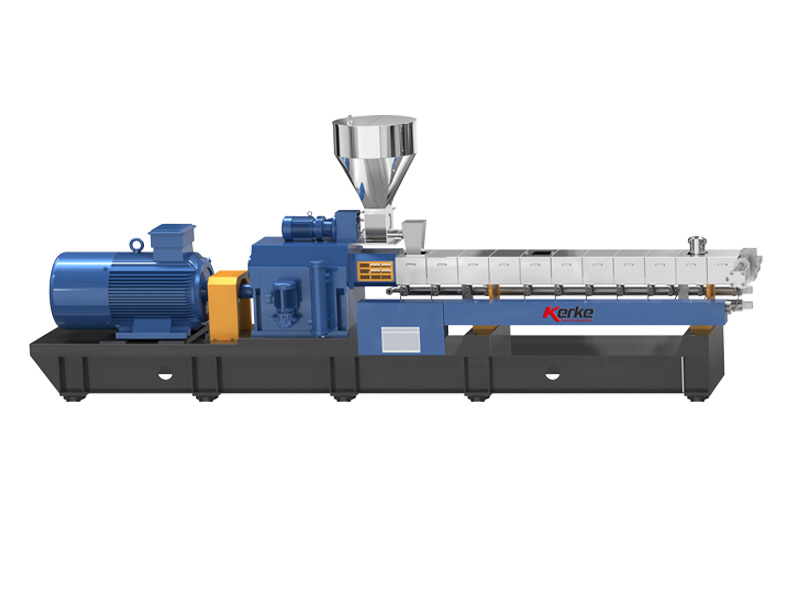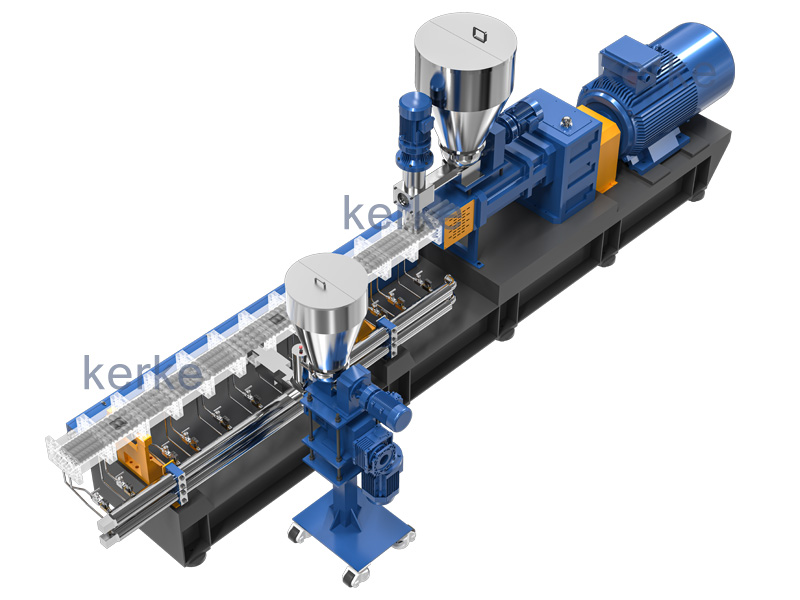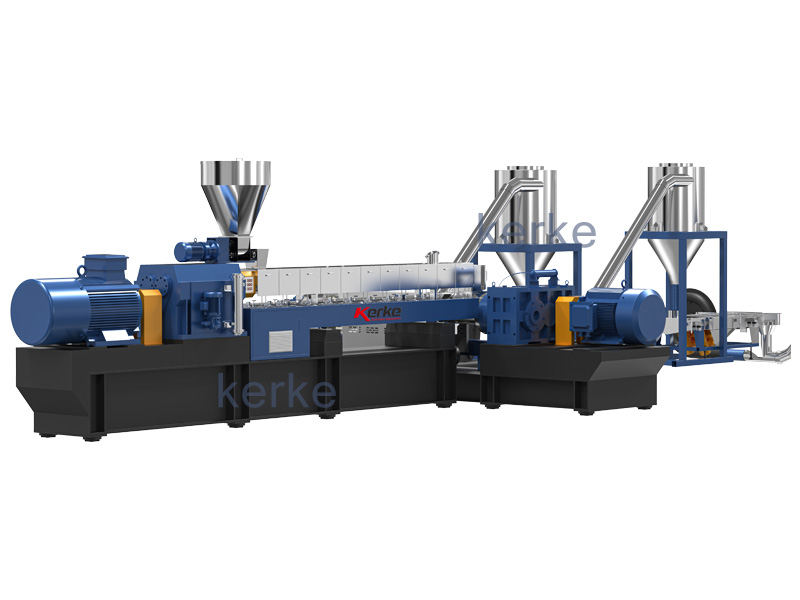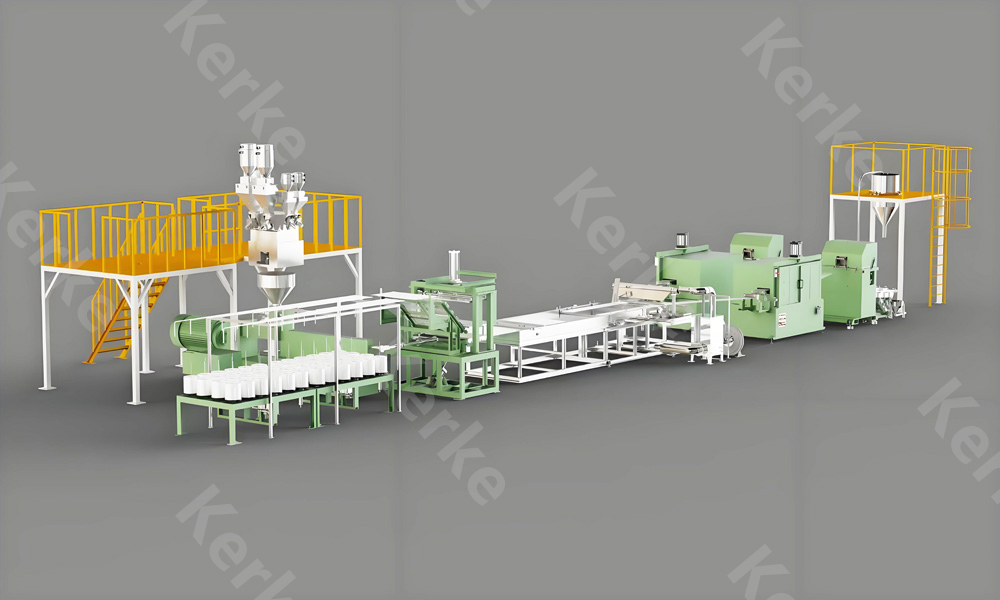
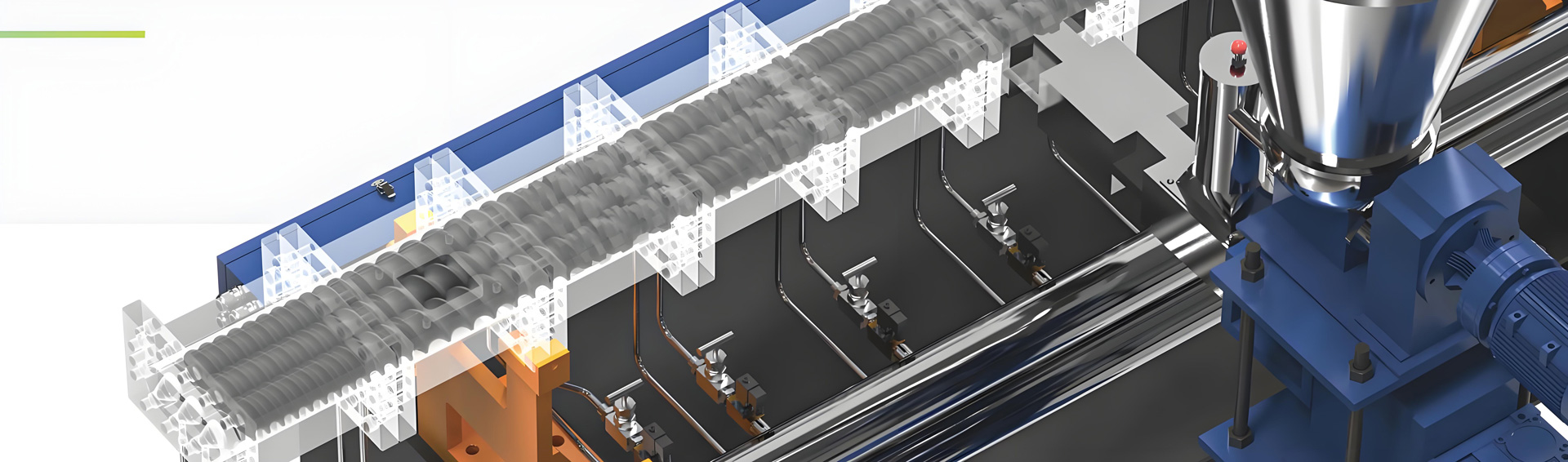
Masterbatch dispersion quality is the core technical index that determines the final performance, appearance and market qualification of color masterbatch, functional masterbatch and filled masterbatch. As the core production equipment, twin screw extruders, also known as masterbatch extruders and compounding extruders, complete pigment crushing, filler dispersion, resin fusion and uniform compounding through high-efficiency shearing and mixing. Unreasonable extrusion parameters, mismatched screw combination and unstable equipment operation will lead to pigment agglomeration, uneven filler distribution and poor dispersion, resulting in product color difference, surface spots, decreased mechanical properties and unqualified processing performance.
Accurate and standardized dispersion quality testing is an essential part of masterbatch production quality control. A complete set of testing systems can effectively identify subtle dispersion defects that cannot be observed by naked eyes, judge the rationality of twin screw extrusion process parameters, guide equipment parameter optimization and screw configuration adjustment, and ensure batch stability of masterbatch products. Most masterbatch manufacturers only rely on simple visual inspection for quality judgment, lacking systematic quantitative testing methods, resulting in unstable product quality and high defective rate.
As a professional manufacturer of high-performance twin screw compounding extruders, Kerke Extrusion has accumulated rich practical experience in masterbatch dispersion optimization and quality testing. Kerke twin screw extruders adopt optimized screw mixing structure and precise process control system to achieve ultra-fine dispersion of pigments and fillers. This article comprehensively introduces the full-range testing methods, standard specifications, judgment standards, error control schemes and cost-benefit analysis of masterbatch dispersion quality, providing systematic quality control guidelines for masterbatch production enterprises.
1. Basic Overview of Masterbatch Dispersion Quality Testing
1.1 Core Significance of Dispersion Testing for Twin Screw Extruder Products
Masterbatch dispersion refers to the uniform distribution state of solid pigments, functional fillers and additives in the carrier resin after twin screw extrusion compounding. Excellent dispersion means no large pigment agglomerates, uniform particle distribution and stable fusion between materials, which ensures consistent color difference, stable mechanical properties and good processing fluidity of downstream plastic products. Poor dispersion will directly cause a series of quality problems such as color spots, streaks, rough product surface, decreased tensile strength and poor weather resistance.
Dispersion quality testing runs through the whole process of twin screw extruder production. Pre-production testing can verify the rationality of formula and process parameters, on-line sampling testing can monitor real-time production stability, and finished product testing can confirm batch qualification. Standardized testing can effectively avoid large-scale defective product output, reduce raw material waste and production loss, and help enterprises form standardized production quality control systems.
1.2 Key Dispersion Defects Detected by Testing
In the production process of masterbatch twin screw extruders, common dispersion defects include pigment agglomeration, uneven filler dispersion, local material segregation and residual large particles. Pigment agglomeration is the most frequent defect, which is formed by insufficient shear and dispersion of twin screw extruder, resulting in pigment particle accumulation larger than the standard size. Uneven filler dispersion often occurs in high-filler masterbatch production, with local excessive filler or insufficient filler distribution.
In addition, unreasonable temperature control and unstable screw speed of the twin screw extruder will cause inconsistent plasticization degree of materials, leading to material fusion segregation and poor dispersion uniformity. Professional testing methods can accurately capture the above subtle defects, classify defect grades, and provide targeted adjustment basis for twin screw extrusion process and equipment configuration.
1.3 International Testing Standards and Industry Specifications
The mainstream international standard for masterbatch dispersion detection is ISO 23900-5:2015, which clearly specifies the testing methods, equipment parameters and judgment standards for colorant dispersion degree in thermoplastic polymers. This standard is applicable to all extrusion and spinning grade masterbatch products and is the core basis for industrial quantitative detection. At the same time, the plastic industry has formed unified industry judgment standards for microscopic particle size, filter pressure value and color difference dispersion, forming a complete set of standardized testing systems from qualitative observation to quantitative data.
2. Classification and Principle of Mainstream Masterbatch Dispersion Testing Methods
2.1 Visual Inspection Method: Rapid Qualitative Detection
Visual inspection is the most basic and efficient preliminary dispersion testing method, widely used in daily rapid sampling inspection of twin screw extruder production lines. The testing principle is to observe the surface state of masterbatch particles and downstream molded products with naked eyes to quickly judge obvious dispersion defects. The operation process is simple and efficient, suitable for real-time monitoring of continuous production of masterbatch extruders.
The standard operation process is to randomly sample masterbatch particles from the twin screw extruder pelletizing outlet, melt and press them into uniform thin sheets through a flat vulcanizing machine, or inject them into standard sample plates through injection molding equipment. Under uniform light source conditions, observe whether there are color spots, black spots, streaks, fog points and uneven color areas on the surface of the sample. Uniform and flawless sample surface indicates qualified preliminary dispersion; obvious particle agglomeration and color difference areas indicate unqualified dispersion.
This method has the advantages of low cost, fast speed and no need for professional testing equipment, which can quickly eliminate batches with serious dispersion defects. However, it is highly subjective and can only identify large-area obvious defects, unable to detect micron-level subtle agglomerations, so it is only used for preliminary screening and cannot be used as a final quantitative evaluation standard.
2.2 Microscopic Observation Method: High-Precision Quantitative Detection
Microscopic observation method is the most authoritative and widely used high-precision dispersion testing method in the masterbatch industry, which can accurately detect micron-level pigment and filler agglomerations and realize quantitative grading of dispersion quality. It is the core testing method for finished product delivery and high-end masterbatch quality inspection.
The testing principle is to prepare the masterbatch into ultra-thin sections with a thickness of 5 to 10 microns through a microtome, observe the particle distribution state under an optical microscope or electron microscope, and use professional image analysis software to count the size, quantity and distribution density of agglomerated particles. According to industry standards, qualified masterbatch dispersion requires no agglomerated particles larger than 10 microns, and high-end precision masterbatch requires no particles larger than 5 microns.
The standard operation steps include sample sampling, thin-section preparation, microscope imaging, image analysis and data statistics. Random sampling is carried out at different time periods of twin screw extruder production to ensure sample representativeness. After imaging, the software automatically identifies particle agglomerations, calculates dispersion uniformity index, and forms objective and accurate dispersion quality data reports. This method can accurately judge the subtle dispersion differences caused by twin screw extruder parameter drift and screw wear, providing accurate basis for equipment process optimization.
2.3 Filter Pressure Value (FPV) Testing Method: Industrial Standard Quantitative Detection
Filter Pressure Value testing, based on ISO 23900-5:2015 standard, is the most important quantitative detection method for masterbatch dispersion quality, which can directly reflect the content of undispersed pigment and filler agglomerates in masterbatch and is widely used in batch quality inspection of twin screw extruder products.
The testing principle is to mix the masterbatch with the standard carrier resin according to the fixed proportion, melt and extrude through a single screw testing machine, and make the molten material pass through a standard precision filter screen. Undispersed large particle agglomerates will block the filter screen, resulting in continuous rise of melt pressure. The pressure change value within the unit extrusion time is the filter pressure value. The higher the FPV value, the more serious the pigment agglomeration and the worse the dispersion quality.
Industry unified judgment standards are clear and intuitive: FPV value below 3.0 bar indicates excellent dispersion quality, fully meeting the production requirements of film blowing, spinning and high-precision injection molding products; FPV value between 3.0 bar and 5.0 bar indicates general dispersion, suitable for ordinary low-demand plastic products; FPV value higher than 5.0 bar indicates unqualified dispersion, with a large number of undispersed agglomerates, which needs to adjust twin screw extruder shear parameters and screw combination for re-production.
2.4 Color Difference Testing Method: Dispersion Consistency Verification
Color difference testing is a targeted detection method for color masterbatch dispersion quality, which judges the dispersion uniformity by detecting the color consistency of masterbatch molded samples. Uniform pigment dispersion ensures stable color absorption and reflection effect, while uneven dispersion will lead to obvious batch color difference and local color deviation.
The testing process uses a professional color difference meter to test the L, a, b color parameters of standard samples prepared from twin screw extruder produced masterbatch, compares them with standard sample data, and calculates the color difference value. The smaller the color difference value, the higher the pigment dispersion uniformity and the more stable the production process of the masterbatch extruder. This method is mainly used for batch consistency detection of color masterbatch, effectively identifying slight dispersion fluctuations caused by long-term operation of twin screw extruders.
2.5 Mechanical Property Indirect Testing Method
Good masterbatch dispersion can ensure the stability of mechanical properties of modified plastics, while poor dispersion will cause stress concentration at particle agglomerations, resulting in decreased tensile strength, impact strength and elongation at break of products. The mechanical property testing method indirectly evaluates the dispersion quality by detecting the mechanical indexes of downstream products.
By testing the tensile, impact and bending properties of standard test strips prepared from masterbatch modified materials, the dispersion quality is comprehensively judged. If the mechanical properties are stable and meet the standard, it proves that the internal filler and pigment are uniformly dispersed without obvious defects; if the mechanical properties fluctuate greatly and the data is low, it indicates poor dispersion of the twin screw extruder compounding process, which needs process debugging and optimization.
3. Standard Complete Dispersion Testing Operation Process
3.1 Sampling Standard and Sample Preparation
Standard sampling is the premise of accurate testing results. In the continuous production process of twin screw extruders, sampling is carried out every 30 minutes, and 3 to 5 groups of samples are taken from the pelletizing outlet of the masterbatch extruder each time to ensure the comprehensiveness and representativeness of samples. For batch production, sampling is carried out at the initial, middle and final stages of production respectively to avoid missing periodic dispersion defects.
The sampled masterbatch particles need to be dried to remove surface moisture, and then prepared into standard test samples according to different testing methods. Visual inspection and color difference test samples need to be pressed into smooth standard sheets; microscopic test samples need to be made into ultra-thin uniform sections; FPV test samples need to be evenly mixed with standard resin according to fixed proportion to ensure consistent sample pretreatment conditions and eliminate test errors caused by manual operation.
3.2 Step-by-Step Testing Operation Specification
First, complete rapid visual screening to eliminate batches with obvious surface defects and avoid invalid advanced testing. Then carry out microscopic detection for qualified preliminary samples, count particle agglomeration size and quantity, and grade dispersion quality. For products requiring factory inspection and customer certification, carry out FPV quantitative testing according to ISO standards to obtain accurate dispersion data. Finally, match color difference and mechanical property testing according to product type to complete full-index dispersion quality evaluation.
All testing processes need to keep consistent environmental temperature, humidity and equipment parameters, strictly abide by international standard operation specifications, and record testing data in real time to form traceable quality files, which is convenient for subsequent twin screw extruder process optimization and batch quality tracking.
3.3 Test Result Grading and Qualification Judgment Standard
Combined with international standards and industry practical specifications, masterbatch dispersion quality is divided into three grades. Premium grade: no agglomerated particles larger than 5 microns, FPV value less than 2.0 bar, extremely uniform dispersion, suitable for high-end spinning, medical packaging and optical film products. Qualified grade: no agglomerated particles larger than 10 microns, FPV value between 2.0 and 3.0 bar, stable dispersion, suitable for conventional injection molding and film blowing products. Unqualified grade: agglomerated particles larger than 10 microns appear or FPV value higher than 3.0 bar, with obvious dispersion defects, requiring process adjustment and reprocessing.
4. Analysis of Dispersion Defect Causes and Extruder Optimization Solutions
4.1 Common Causes of Poor Dispersion in Twin Screw Extruders
Poor masterbatch dispersion is mostly caused by unreasonable operation parameters and structural configuration of twin screw compounding extruders. Insufficient screw shear force is the main factor. If the proportion of kneading and shearing elements in the screw combination is too low, the pigment aggregates cannot be fully crushed and dispersed. Excessively high or low processing temperature will also affect dispersion effect: too low temperature leads to high resin viscosity and insufficient material mixing; too high temperature causes pigment decomposition and particle agglomeration.
Unreasonable feeding speed and screw speed matching will lead to unstable material residence time in the barrel, insufficient shear mixing time of partial materials and incomplete dispersion. In addition, wear of screw and barrel of the masterbatch extruder, unstable feeding proportion and poor raw material pretreatment will also induce dispersion quality defects.
4.2 Targeted Extruder Adjustment and Optimization Strategy
Aiming at different dispersion defects detected by testing, targeted optimization of twin screw extruder parameters and structure can be carried out. For excessive particle agglomeration, increase the number of kneading and shearing modules in the screw combination, appropriately improve screw speed, and extend material shear mixing time. For uneven overall dispersion, optimize barrel segmented temperature parameters to ensure gradient plasticization and uniform mixing of materials.
For high-filler masterbatch dispersion defects, adjust the side feeding position and feeding speed to realize staged feeding and layered mixing of fillers and resin, avoiding excessive local filler accumulation. Regularly inspect and replace worn screw elements of the compounding extruder to ensure stable shear and mixing performance of the equipment and long-term consistent dispersion quality.
5. Kerke High-Precision Twin Screw Extruder for Stable Dispersion Production
The stability of masterbatch dispersion quality fundamentally depends on the performance of twin screw compounding extruders. Ordinary traditional extruders have insufficient shear accuracy and unstable mixing effect, which are prone to dispersion fluctuation and defective batches. Kerke independently developed KTE series twin screw extruders are specially optimized for masterbatch dispersion production, which can stably produce high-dispersion masterbatch products with FPV value far lower than the industry standard, effectively reducing enterprise quality testing and rework costs.
5.1 Structural Advantages of Kerke Masterbatch Extruder for Dispersion Control
Kerke KTE series twin screw extruder adopts modular screw combination design, which can freely match high-strength shearing, fine kneading and uniform mixing elements according to different masterbatch formulas. It can fully crush pigment aggregates and realize nano-level uniform dispersion of fillers, effectively avoiding particle agglomeration defects. The segmented independent temperature control system accurately controls the plasticization temperature of each processing section, ensuring stable material viscosity and consistent mixing effect.
The equipment is equipped with intelligent constant-speed feeding and stable transmission system, which ensures uniform material conveying and fixed residence time in the barrel, completely solving the problem of inconsistent dispersion caused by unstable feeding of traditional masterbatch extruders. The optimized vacuum devolatilization structure eliminates bubbles and volatile impurities in materials, further improving masterbatch compactness and dispersion uniformity.
5.2 Applicable Models and Price Estimation
Kerke KTE series twin screw compounding extruders cover full-range models for masterbatch production, with clear price gradient and high cost performance. The small KTE20 laboratory twin screw extruder, priced at 26,000 to 32,000 US dollars, is suitable for formula research and development, process testing and small-batch high-precision masterbatch production, which can meet the high-standard dispersion testing requirements of new products.
The medium-sized KTE35 and KTE50 mass-production twin screw extruders are priced at 46,000 to 60,000 US dollars, which are mainstream models for large-scale production of color masterbatch and functional masterbatch. The equipment runs stably for a long time, and the dispersion qualification rate of finished products is as high as 99.8%, greatly reducing the enterprise's post-testing rework cost.
The large-scale KTE65 and above high-yield twin screw extruders are priced at 68,000 to 82,000 US dollars, suitable for high-filler masterbatch and high-concentration color masterbatch mass production. With super strong shear and mixing capacity, the FPV value of finished products is stably controlled below 2.0 bar, reaching the international high-end dispersion standard.
6. Testing Cost and Production Benefit Analysis
6.1 Daily Dispersion Testing Cost Accounting
The daily quality testing cost of masterbatch enterprises mainly includes equipment depreciation, labor cost and consumable cost. The visual inspection and color difference testing have low cost, only relying on manual operation and conventional instruments, with daily average cost less than 20 US dollars. Microscopic detection and FPV quantitative testing require professional equipment and standardized operation, with single-batch testing cost about 50 to 80 US dollars.
Enterprises equipped with complete testing laboratories have annual total testing cost of about 8,000 to 12,000 US dollars. Although there is certain testing investment, it can effectively avoid batch defective product loss. The unqualified rate of masterbatch without standardized testing is as high as 5% to 8%, while the defective rate after full testing control is reduced to below 0.2%, with extremely significant cost-saving benefits.
6.2 Economic Benefits of Standardized Dispersion Testing and Equipment Optimization
Enterprises adopting Kerke high-precision twin screw extruders and standardized dispersion testing systems can achieve dual improvement of quality and efficiency. The product qualification rate is increased by more than 7%, and the annual waste loss of raw materials is reduced by 30,000 to 50,000 US dollars. Stable high-dispersion quality improves product market competitiveness, supports high-end customer order matching, and increases product unit profit margin.
The investment return cycle of testing system construction and equipment upgrading is 9 to 12 months. Long-term standardized testing and stable extrusion equipment operation can realize zero-defect batch production, greatly reduce after-sales customer complaints and return losses, and create stable and sustainable economic benefits for enterprises.
7. Common Testing Errors and Standardized Avoidance Measures
In the daily dispersion testing process of twin screw extruder masterbatch products, non-standard operation is easy to cause inaccurate test data and misjudgment of product quality. Common errors include non-standard sample preparation, inconsistent testing environment temperature and humidity, overdue calibration of testing instruments, and inconsistent testing parameters.
To ensure test accuracy, enterprises need to establish unified testing operation SOP, regularly calibrate professional testing instruments, standardize sample sampling and pretreatment processes, and arrange special personnel for testing training. At the same time, establish data comparison mechanism, regularly compare test data with international standard values and industry benchmark values, timely correct system errors, and ensure the objectivity and accuracy of dispersion quality test results.
8. Kerke Professional Testing and Technical Service Support
As a professional twin screw extruder manufacturer focusing on masterbatch compounding field, Kerke Extrusion not only provides high-performance compounding extruder equipment, but also supports customers with full-process dispersion quality testing technical services. Kerke has a professional material testing laboratory, which can provide customers with free masterbatch dispersion testing, data analysis and process optimization guidance.
For customers with unstable dispersion quality and unqualified test data, Kerke technical team can quickly locate the root causes of problems such as unreasonable screw configuration, mismatched process parameters and unstable equipment operation, and provide targeted equipment optimization and process adjustment schemes. At the same time, provide customers with standardized testing operation training, help enterprises establish perfect internal quality control system, and realize long-term stable high-quality production of masterbatch.
Conclusion
Dispersion quality is the core lifeline of masterbatch products produced by twin screw extruders, and standardized testing technology is the key means to control product quality and optimize extrusion process. A complete set of testing systems including visual inspection, microscopic analysis, FPV quantitative detection and color difference verification can comprehensively evaluate the dispersion uniformity of masterbatch pigments and fillers, accurately identify production defects of masterbatch extruders, and guide equipment parameter debugging and structural optimization.
Adopting Kerke high-precision twin screw compounding extruders and matching standardized dispersion testing processes can fundamentally solve common dispersion problems such as particle agglomeration and uneven distribution, realize stable output of high-quality masterbatch products, reduce enterprise production costs and defective product loss, and effectively improve market core competitiveness. For modern masterbatch manufacturing enterprises, the combination of high-performance extrusion equipment and scientific testing system is an inevitable choice to achieve high-efficiency, low-cost and high-quality sustainable production.