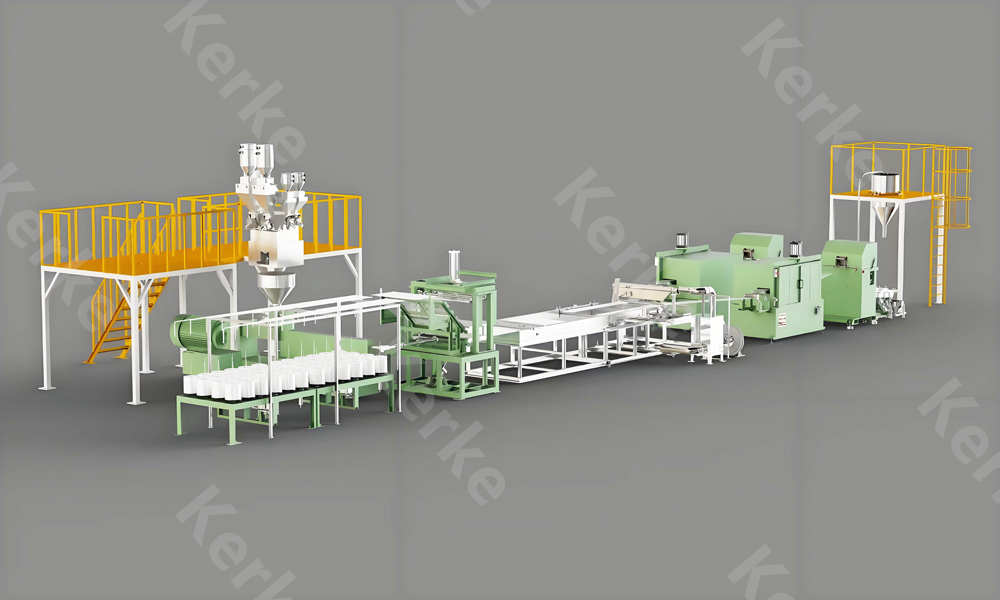
All operation and fixed cost details of twin screw masterbatch production factory
Why cost structure matters more than a single number
Kerke, a Wanplas factory, has spent more than 12 years building parallel co-rotating twin-screw compounding extruders for masterbatch producers around the world. With a 19,997+ square meter plant, more than 2,000 machines running in over 70 countries, a team of 100+ specialists, and recognition as a top-five supplier of twin-screw extruders in China, Kerke works from a simple belief stated in its slogan: “We Know Compounding Extruder.” That experience shows one recurring truth among factory owners who plan a color masterbatch, filler masterbatch, black masterbatch, or additive masterbatch line: the question is almost never “how much does the line cost” in a single figure, but “what does it cost to run, and which cost items move when output, formula, or shift pattern change.”
This article breaks a twin-screw masterbatch production factory into its operating cost parts and fixed cost parts. It explains, item by item, what drives each cost, what share of total running cost it normally represents, and which levers lower it. The goal is not to quote a price or to model a payback period. A separate companion discussion covers capacity-utilization and payback modeling. Here the focus stays on the cost anatomy itself: the fixed versus variable split, the composition of unit cost per kilogram, the cost drivers that shift the numbers, and the engineering actions that pull the numbers down.
Every figure in this article is expressed as a relative level, a percentage share, a multiple, an index referenced to a baseline of 100 index points, or a physical quantity such as kilowatt-hours per kilogram, kilograms per hour, running hours, shift staffing, or wear-part life in running hours. No currency amount is used, because the real planning value of a cost model is in the structure and the ratios, not in a number that changes with region, utility tariff, and exchange rate. A reader in any market can take the structure, apply local rates, and build a defensible budget.
The remainder of this guide walks through the cost framework, each variable and fixed cost item, the unit-cost composition, a cost-driver matrix, the difference between masterbatch types, the relevant Kerke machine families with specification tables, application industries, a selection and operating-cost recommendation table, the scale effect of capacity utilization, a prioritized list of cost-reduction levers, and the service package that supports a low-risk startup. Eight frequently asked questions close the article with concrete planning guidance.
Fixed, variable, and semi-variable cost framework
Before any number is assigned, a masterbatch factory must separate its costs by behavior. The behavior tells the owner what happens to that cost when monthly output rises or falls. A cost that stays flat across a wide output band is fixed. A cost that moves in near-direct proportion to output is variable. A cost with a fixed base plus a usage-linked part is semi-variable. Misclassifying these is the most common reason a budget looks fine on paper and breaks in the workshop.
In a twin-screw masterbatch plant, the fixed block is dominated by equipment depreciation, building and facility amortization, the fixed portion of labor (management, process engineering, quality, administration), the fixed base of maintenance contracts, and the standing cost of environmental and compliance systems. The variable block is dominated by energy, wear parts and consumables, the variable portion of line labor, auxiliary materials such as purging compound and packaging, and quality cost from rework and downgraded material. The semi-variable block sits between them: power capacity charges that have a demand base plus a consumption part, and preventive maintenance that has a planned base plus repair spikes.
The single most useful habit in masterbatch cost planning is to label every cost as fixed, variable, or semi-variable before estimating its size. The label predicts behavior; the size only describes one moment in time.
The table below gives the typical share of each major block in total operating cost for a mid-scale masterbatch factory running a co-rotating twin-screw line near design load. Shares are ranges because formula abrasiveness, automation level, and local utility structure shift them. Use the ranges as a planning skeleton, then tighten them with plant data.
Typical cost-block share of total operating cost
| Cost block | Typical share of total operating cost | Behavior class | Main cost driver |
|---|---|---|---|
| Energy and power | Medium to High (roughly 25% to 40%) | Variable | Specific energy (kWh/kg), throughput, running hours |
| Wear parts and consumables | Low to High (roughly 8% to 22%) | Variable | Formula abrasiveness, processed tonnage, liner type |
| Direct line labor (variable part) | Low to Medium (roughly 6% to 15%) | Variable / semi-variable | Automation level, shift pattern, man-hours per tonne |
| Auxiliary materials | Low (roughly 3% to 8%) | Variable | Purging compound, packaging, screen packs |
| Quality cost (rework, downgrade) | Low to Medium (roughly 2% to 10%) | Variable | First-pass yield, changeover control |
| Equipment depreciation | Medium (roughly 10% to 18%) | Fixed | Depreciation term, utilization |
| Building and facility | Low to Medium (roughly 5% to 12%) | Fixed | Plant size, capacity connection fee |
| Fixed labor (management, engineering) | Low to Medium (roughly 5% to 12%) | Fixed | Org structure, headcount |
| Maintenance and compliance base | Low to Medium (roughly 4% to 10%) | Semi-variable | Planned base plus repair spikes |
| Insurance, certification, software | Low (roughly 2% to 6%) | Fixed | Coverage level, system count |
Note that raw material, the carrier resin, pigment, filler, and additive, is deliberately excluded from this processing-cost view. Material is by far the largest item in a masterbatch commercial budget, but it is a purchased input, not a cost of operating the factory. This article isolates the conversion or processing cost, which is what the factory owner controls through machine selection, formula engineering, and operating discipline. Mixing material cost into the operating-cost discussion hides the levers that this article is built to expose.
Variable cost breakdown: energy, wear parts, labor, auxiliaries, quality
Variable cost is the part that scales with what the line actually produces. In a masterbatch plant it is where most of the controllable saving lives, because it responds directly to machine configuration, formula design, and shift practice. The five sub-items below each behave differently and reward different levers.
Energy and power
Energy is usually the largest variable cost item in a twin-screw masterbatch line. It covers the main extruder motor, barrel heating and cooling, the vacuum pump, the pelletizing and drying systems, auxiliaries such as feeding and conveying, and the workshop lighting and air handling. The practical metric is specific energy consumption, or SEC, measured in kilowatt-hours per kilogram of masterbatch. SEC rises with formula viscosity, filler and pigment loading, dispersion effort, and the tightness of the screw configuration; it falls with higher throughput at the same power and with efficient heating control.
The table below shows typical SEC ranges by masterbatch family. These are processing-side ranges for the extrusion and pelletizing step, not material totals, and they assume a reasonably matched co-rotating twin-screw line running near its design point.
Typical specific energy consumption by masterbatch type
| Masterbatch type | Typical SEC (kWh/kg) | Energy share of variable cost | Key energy driver |
|---|---|---|---|
| Standard color masterbatch | 0.20 to 0.35 | Medium to High | Dispersion shear, pigment wet-out |
| Filler masterbatch (high loading) | 0.28 to 0.45 | High | High solids loading, melt transport |
| Black masterbatch (carbon black) | 0.30 to 0.48 | High | Agglomerate breakdown, high load |
| Additive masterbatch (low volume) | 0.22 to 0.38 | Medium | Frequent changeover, small lots |
| Textile masterbatch | 0.24 to 0.40 | Medium to High | Fine dispersion, filtration |
Energy reduction levers are well understood but often underused. Optimizing the screw configuration to the exact formula reduces shear waste and lowers SEC by a meaningful double-digit percentage in many plants. Running the line at high load spreads the same motor input over more kilograms, lowering SEC per kilogram. Variable-frequency drives on auxiliaries, heat recovery from cooling water, and shifting heavy running to off-peak tariff windows each trim the effective energy cost. A baseline of 100 index points for SEC on a reference formula gives a simple way to track improvement: a tuned configuration that reaches 82 index points is an 18 percent saving against the baseline, independent of the local tariff.
Wear parts and consumables
Twin-screw compounding is a wear-intensive process. Screw elements, barrel liners, screen-changer filters, pelletizing knives, die plates, and seals all wear with processed tonnage, and the rate depends heavily on abrasiveness. A high-filler or high-glass-fiber formula can accelerate screw and liner wear by a multiple of two to four compared with a non-abrasive color masterbatch. Nitrided barrel liners cost less up front but wear faster; bimetallic liners cost more but last longer, so the right choice is a lifecycle decision, not a purchase-price decision.
The practical planning unit is wear-part life expressed in running hours or processed tonnes, plus replacement frequency. Tracking the wear index against a baseline of 100 index points lets a plant compare formulas and liner choices without quoting a price. A bimetallic liner that lifts the life index from 100 to 180 effectively halves the replacement frequency for the same output.
Direct labor, variable portion
The variable part of labor tracks the number of people actually tending the running line: feeding, changeover and cleaning, packaging and palletizing, and in-line quality checks. A fully automated line with central feeding, automatic weighing, and robotic palletizing runs with a small crew per shift, measured in low man-hours per tonne. A semi-automatic line with manual bagging and manual changeover needs a larger crew and a higher man-hours-per-tonne figure. Because labor is often billed at a fixed monthly rate, the variable effect shows up as man-hours per tonne: the same crew produces more tonnes per hour at higher throughput, lowering the labor portion of unit cost.
Auxiliary materials
Auxiliary materials are the small but persistent items: purging compound used to clean the barrel during changeover, packaging such as bags and bulk containers, grease and oil top-ups, cooling-water treatment chemicals, and screen-pack consumption. Purging compound deserves special attention because frequent grade changes multiply its use; a fast-cleaning screw geometry and a disciplined changeover routine cut purge volume by a large fraction. Packaging scales with output tonnage, so it is a true variable item.
Quality cost
Quality cost is the hidden variable. It includes rework, downgraded material sold at lower value, screen rejects, and start-up transition material produced during grade changes before the line stabilizes. First-pass yield is the dominant driver: a plant running at 99 percent first-pass yield carries a fraction of the quality cost of a plant running at 92 percent. Because quality cost recurs on every kilogram and compounds with low yield, improving yield is one of the highest-leverage actions available, and it is counted here as variable because it scales with production volume and changeover frequency.
Fixed cost breakdown: depreciation, facility, fixed labor, maintenance, compliance
Fixed cost does not disappear when the line stops, and it does not scale linearly with output. Its defining feature is that the total stays roughly constant across the normal operating range, so the per-kilogram burden falls as output rises. This is why capacity utilization is the master lever on the fixed side.
Equipment depreciation
The twin-screw extruder, feeders, pelletizing system, and auxiliaries are depreciated over a term that depends on accounting policy and expected service life. A straight-line method spreads the capitalized value evenly, so the annual depreciation is a fixed amount regardless of how many kilograms were made. For planning, express the depreciation term as a number of years and an annual depreciation rate as a percentage of capitalized value. The key planning insight is that depreciation per kilogram equals total annual depreciation divided by annual output; at low utilization the same depreciation sits on fewer kilograms and the per-kilogram figure rises sharply.
Using an index view: set depreciation per kilogram at a utilization index of 100 equal to 100 index points. At 60 percent utilization the same fixed depreciation lands on 60 percent of the output, so the index rises to about 167 index points. At 120 percent utilization (overtime running) it falls to about 83 index points. The machine itself did not change; only the spread changed.
Building and facility
Building cost covers either rent or the amortized construction cost of the plant, plus the capacity connection fee for power and utilities, fire protection, and environmental infrastructure. For a masterbatch plant the power capacity connection is often a meaningful fixed base because the line draws substantial instantaneous load. Facility cost is typically a Low to Medium share of total operating cost and behaves as fixed, though a capacity fee may carry a small demand-charge component that makes it partly semi-variable.
Fixed labor
Fixed labor is the salaried backbone: plant management, process engineers, maintenance leads, quality staff, and administration. This headcount is set by organization design, not by the day’s output, so it is fixed in the short term. The variable part discussed earlier is the crew tending the line. A common mistake is to treat all labor as variable; doing so understates the saving from higher utilization and overstates the risk of a temporary output dip.
Maintenance and compliance base
Preventive maintenance has a planned fixed base: scheduled inspections, planned liner and seal changes, lubrication programs, and calibration. This base trades against unplanned repair spikes. A plant that underfunds the fixed preventive base tends to see higher variable repair cost and more downtime, which indirectly raises unit cost through lost output. The two move in opposite directions, so the right view is semi-variable: a stable base plus a variable repair tail that shrinks as the base grows.
Environmental and compliance
Masterbatch plants handle pigments, fillers, and additives that generate dust and, in some formulas, volatile organic compounds during devolatilization. Dust collection, VOC treatment, hazardous-waste handling for purge scrap and spent screen packs, and emission monitoring are fixed running commitments. They do not scale with output in the short term and are best planned as a Medium fixed block. Underestimating them is a frequent source of budget overrun, because the systems must run whether the line makes ten tonnes or one hundred tonnes that month.
Insurance, certification, software
The remaining fixed items are insurance, certification maintenance such as management-system audits, and software and control-system licenses for production management and remote monitoring. These are Low relative shares and behave as fixed. They are worth listing separately because they are easy to forget in a quick budget and because they recur whether or not the line is busy.
Unit cost composition per kilogram
The unit cost per kilogram is the number that ultimately decides margin, and it is best read as a composition of the items above rather than a single value. The table below shows the typical share of each component in the processing cost per kilogram for a representative twin-screw masterbatch line near design load. Shares shift with formula and utilization, so treat them as a structure to be localized, not as absolute values.
Processing cost composition per kilogram
| Cost component | Typical share of processing unit cost | Primary cost driver | Fixed or variable |
|---|---|---|---|
| Energy | 25% to 38% | SEC (kWh/kg), tariff, running hours | Variable |
| Wear parts | 8% to 20% | Abrasiveness, liner type, tonnage | Variable |
| Direct labor | 6% to 14% | Automation, man-hours per tonne | Variable / semi-variable |
| Depreciation | 10% to 18% | Utilization, depreciation term | Fixed |
| Building and facility | 5% to 12% | Plant size, capacity fee | Fixed |
| Fixed labor | 5% to 11% | Org structure | Fixed |
| Auxiliary materials | 3% to 8% | Purge, packaging, screens | Variable |
| Quality cost | 2% to 9% | First-pass yield | Variable |
| Maintenance and compliance base | 4% to 9% | Planned base plus repair tail | Semi-variable |
| Insurance, certification, software | 2% to 6% | Coverage, system count | Fixed |
Reading this composition, an owner can see where a given formula pushes cost. A black masterbatch heavy in carbon black lifts both the energy and wear-part shares. A small-batch additive masterbatch lifts the quality-cost and auxiliary-material shares because of frequent changeovers. A plant running at low utilization lifts the depreciation, building, and fixed-labor shares simultaneously. The composition table is therefore the bridge between the cost framework and the action list.
Cost driver matrix
A cost driver is any factor that, when changed, moves one or more cost items. The matrix below maps the main drivers found in a twin-screw masterbatch plant to the cost items they affect, the direction of the effect, and a relative magnitude. Use it to prioritize: a driver that affects many items with High magnitude deserves attention before a driver that nudges one item slightly.
Masterbatch plant cost driver matrix
| Cost driver | Affected cost items | Direction | Relative magnitude |
|---|---|---|---|
| Capacity utilization | Depreciation, building, fixed labor, fixed insurance | Higher utilization lowers unit fixed cost | Very High |
| First-pass yield | Quality cost, energy, wear parts, labor | Higher yield lowers variable unit cost | High |
| Specific energy (SEC) | Energy, partly wear parts | Lower SEC lowers energy unit cost | High |
| Formula abrasiveness | Wear parts, energy | Higher abrasiveness raises wear and energy | High |
| Automation level | Direct labor, quality cost, auxiliary materials | Higher automation lowers labor and improves yield | Medium to High |
| Shift pattern | Depreciation spread, direct labor, energy tariff | More shifts spread fixed cost, may use off-peak tariff | Medium |
| Torque class of machine | Throughput per kW, SEC, depreciation | Higher torque raises output per power unit | Medium to High |
| Changeover frequency | Auxiliary materials, quality cost, labor | More changeovers raise purge and transition cost | Medium |
| Preventive maintenance depth | Wear parts, unplanned repair, downtime | Deeper prevention lowers repair spikes | Medium |
| Feeding accuracy | Auxiliary materials, quality cost, material overuse | Higher accuracy lowers overuse and rework | Medium |
Two drivers stand out. Capacity utilization moves the entire fixed block at once, which is why underloaded plants report stubbornly high unit cost even after cutting energy. First-pass yield moves several variable items together, which is why quality discipline pays back across energy, wear, and labor, not just in scrapped material. An owner who improves only one driver will see limited results; the matrix shows why the biggest saving comes from attacking utilization and yield together.
Cost structure by masterbatch type
Not all masterbatches cost the same to make. The carrier, the active loading, and the dispersion requirement change the energy, wear, and quality shares. The comparison below uses relative levels so that it holds across markets and tariff regimes.
Relative cost profile by masterbatch type
| Masterbatch type | Energy level | Wear level | Quality cost level | Automation benefit | Cost-structure note |
|---|---|---|---|---|---|
| Color masterbatch | Medium | Medium | Medium | High | High pigment dispersion need; color accuracy drives quality cost |
| Filler masterbatch | High | High | Low to Medium | Medium | High loading raises both energy and wear; lower value added per kg |
| Black masterbatch | High | High to Very High | Low to Medium | Medium | Carbon black agglomerates demand shear; strong barrel and knife wear |
| Additive masterbatch | Medium | Low to Medium | High | Medium | Small lots, frequent changeover raise quality and purge cost |
| Textile masterbatch | Medium to High | Medium | Medium to High | High | Fine filtration and dispersion raise both energy and quality cost |
The practical takeaway is that a plant planning a product mix should not apply one cost rate to every grade. A filler masterbatch line should budget a High wear and High energy share and a lower value added per kilogram, which means it depends more on volume and utilization to stay profitable. A color or textile masterbatch carries a higher quality-cost share, so first-pass yield and feeding accuracy matter more. An additive masterbatch lives or dies on changeover discipline, because purge and transition loss repeat with every small lot.
KTE Series twin screw extruder specification
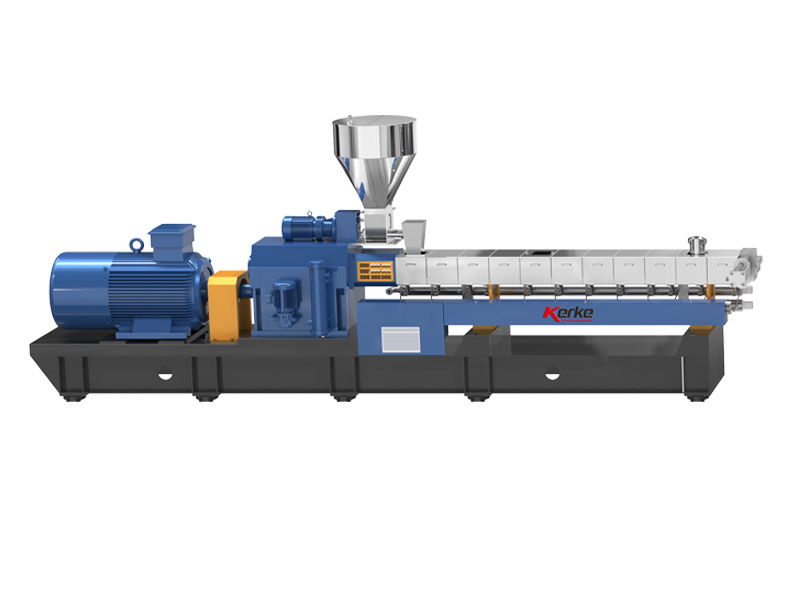
Kerke, a Wanplas factory, builds the KTE Series of parallel co-rotating twin-screw extruders for exactly this kind of work. The range spans laboratory and pilot units through large production machines, from KTE-16B to KTE-135D, and each machine is configurable in aspect ratio, barrel structure, screw arrangement, venting, feeding, and electrical control. The table below lists representative specification ranges for selected models. Values are typical engineering ranges, not fixed guarantees, and the exact configuration is matched to the formula and target output.
KTE Series specification ranges
| Model | Screw diameter (mm) | L/D ratio | Max screw speed (rpm) | Main motor (kW) | Torque class | Typical output (kg/h) | Heating zones | Vent sections | Installed power |
|---|---|---|---|---|---|---|---|---|---|
| KTE-16B | 16 | 24 to 40 | 600 to 900 | 1.5 to 4 | Standard / High | 0.5 to 5 | 3 to 6 | 1 to 2 | Low |
| KTE-36 | 36 | 32 to 48 | 400 to 600 | 15 to 45 | Standard / High | 40 to 180 | 6 to 10 | 1 to 2 | Medium |
| KTE-52 | 52 | 32 to 52 | 300 to 500 | 55 to 160 | Standard / High | 150 to 600 | 8 to 12 | 1 to 3 | Medium to High |
| KTE-75 | 75 | 32 to 56 | 250 to 400 | 160 to 400 | High | 500 to 1,500 | 10 to 14 | 1 to 3 | High |
| KTE-95 | 95 | 32 to 56 | 200 to 350 | 315 to 800 | High | 1,200 to 3,000 | 12 to 16 | 2 to 4 | High to Very High |
| KTE-135D | 135 | 32 to 56 | 150 to 300 | 800 to 2,000 | High | 3,500 to 8,000 | 14 to 20 | 2 to 4 | Very High |
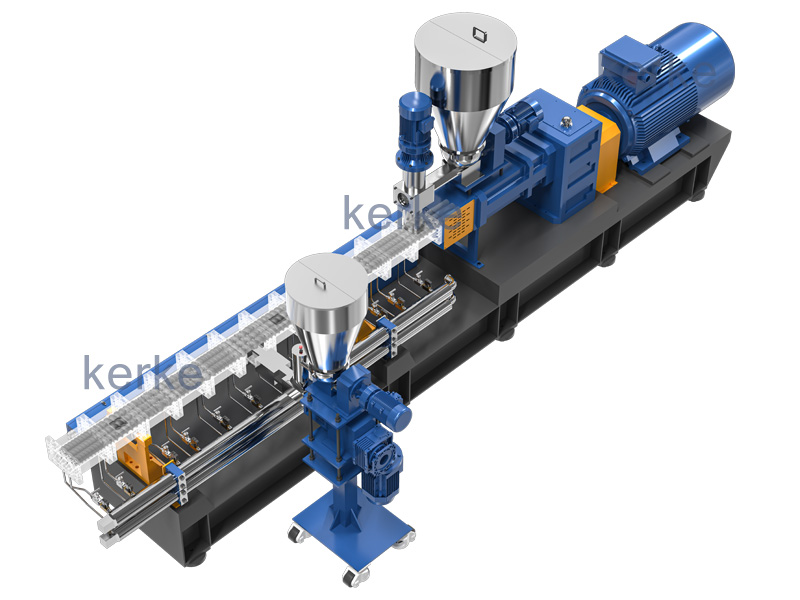
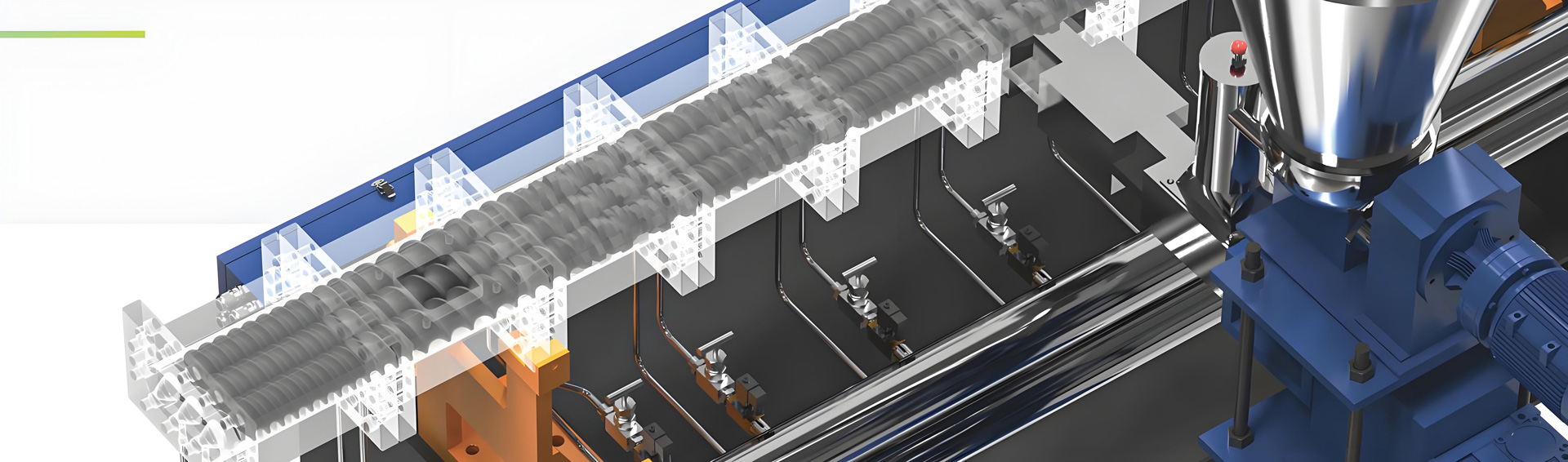
The torque class matters for cost because higher torque at a given screw diameter allows more throughput per kilowatt of motor power, lowering SEC and lifting the output that spreads the fixed depreciation. Kerke designs screw assemblies with computer-aided layout, kneading blocks with strong self-cleaning, and good interchangeability, which supports both dispersion quality and fast changeover. For a masterbatch producer, the combination of configurable L/D, multiple vent sections, and side-feeding options lets the line be tuned to a specific formula rather than forced into a generic configuration that wastes energy and wear life.
SE Series single screw extruder and KTE-SE double-stage system
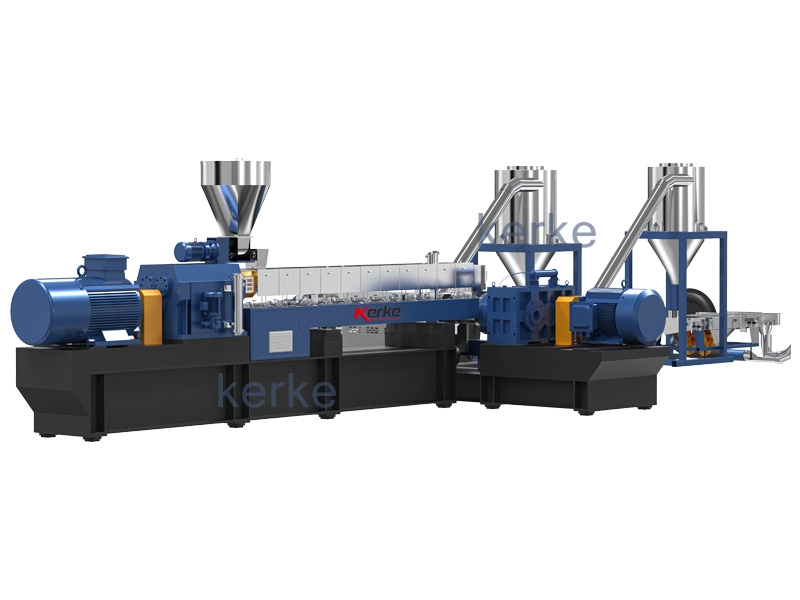
For recycling and re-compounding duties that feed a masterbatch operation, Kerke offers the SE Series single screw extruder, with output from 30 kg/h up to 800 kg/h, mainly applied to plastic recycling and re-pelletizing. Where a formula cannot be processed comfortably in one stage, the KTE-SE double-stage system combines a twin-screw mother extruder with a single-screw baby extruder, separating intense mixing from gentle melt discharge. This split can lower specific energy and improve devolatilization for heat-sensitive or highly filled systems.
SE Series and KTE-SE specification ranges
| Model / system | Screw diameter (mm) | L/D ratio | Max screw speed (rpm) | Main motor (kW) | Typical output (kg/h) | Heating zones | Vent sections | Primary use |
|---|---|---|---|---|---|---|---|---|
| SE-65 | 65 | 20 to 33 | 60 to 120 | 15 to 45 | 30 to 150 | 3 to 5 | 0 to 1 | Recycling, re-pelletizing |
| SE-100 | 100 | 20 to 33 | 50 to 100 | 45 to 110 | 150 to 400 | 4 to 6 | 0 to 1 | Recycling, re-pelletizing |
| SE-150 | 150 | 20 to 33 | 40 to 90 | 110 to 315 | 400 to 800 | 5 to 7 | 0 to 2 | Recycling, re-pelletizing |
| KTE-SE double-stage | Twin + single | 32 to 52 + 8 to 12 | 250 to 500 | 55 to 400 | 150 to 1,500 | 8 to 14 | 1 to 3 | Heat-sensitive, highly filled |
Kerke also supplies a full pelletizing portfolio so the cutting method can be matched to the product: water-cooled strand pelletizing, air-cooled strand pelletizing, air-cooled die-face hot cutting, water-ring die-face hot cutting, eccentric water-mist hot cutting, and underwater pelletizing. The cutting method influences wear-part life, cooling energy, and pellet quality, so it belongs in the cost discussion rather than as a separate afterthought. A brittle or dust-prone grade may favor a strand or underwater system; a heat-sensitive grade may favor die-face cutting with short melt residence.
Application industries and their cost differences
Kerke twin-screw lines serve masterbatch production across color masterbatch, filler masterbatch, additive masterbatch, black masterbatch, and textile masterbatch, and extend into plastic compounding such as engineering plastics, biodegradable plastics, cable compounds, PVC compounding, thermoplastic elastomers, and wood-plastic composites, plus R-PET flake recycling. Each end use shifts the cost structure in a predictable way.
- Color masterbatch for film, injection molding, and blow molding demands tight dispersion and color accuracy, so the quality-cost share is Medium and feeding accuracy is important to avoid off-spec lots.
- Filler masterbatch based on calcium carbonate or talc runs at high loading, raising the energy and wear shares and lowering value added per kilogram, which makes it the most utilization-sensitive product.
- Black masterbatch built on carbon black is the most wear-intensive, with a High to Very High wear level and a High energy level from agglomerate breakdown.
- Additive masterbatch for antioxidants, UV stabilizers, flame retardants, and lubricants is made in smaller lots with frequent changeovers, so purge and transition cost dominate the variable side.
- Textile masterbatch for fibers needs fine dispersion and filtration, lifting both energy and quality cost.
- Engineering plastic modification and biodegradable compounds often run at lower volume with stricter process control, where automation and yield protect margin.
- Cable compounds, PVC, TPE, and WPC span a wide output range and benefit from configurable venting and side feeding to manage fillers and volatiles.
- R-PET recycling links to the SE Series and double-stage systems, where the recycling front-end lowers material cost but adds washing and filtration steps.
Understanding these differences lets an owner set a realistic cost rate per product family instead of averaging everything into one number that fits no grade well. A plant that makes both filler masterbatch and color masterbatch should budget them as two different cost structures sharing one fixed block.
Selection and operating-cost recommendation table
The table below links a typical requirement to a recommended Kerke configuration and an expected operating-cost level. The level is relative because it depends on local tariff, labor rate, and utilization; it is meant to rank options, not to state a price. The operating-cost level blends energy, wear, labor, and fixed spread at a stated utilization assumption.
Requirement to configuration and operating-cost level
| Masterbatch type | Target output | Shift pattern | Recommended KTE model | Feeding and pelletizing | Operating-cost level |
|---|---|---|---|---|---|
| Color masterbatch | 150 to 600 kg/h | 2 shifts | KTE-52 | Loss-in-weight + strand or water-ring | Medium |
| Filler masterbatch | 500 to 1,500 kg/h | 3 shifts | KTE-75 high torque | Side feeder + water-ring or underwater | Medium to High (wear heavy) |
| Black masterbatch | 500 to 2,000 kg/h | 3 shifts | KTE-75 / KTE-95 | Loss-in-weight + underwater | High (wear and energy heavy) |
| Additive masterbatch | 40 to 300 kg/h | 1 to 2 shifts | KTE-36 / KTE-52 | Fast-change + strand | Medium (changeover heavy) |
| Textile masterbatch | 150 to 800 kg/h | 2 shifts | KTE-52 / KTE-75 | Fine filtration + water-ring | Medium to High |
| Large-scale filler or black | 3,500 to 8,000 kg/h | 3 shifts continuous | KTE-135D | Multiple side feeders + underwater | Low to Medium per kg (scale effect) |
The pattern is clear: large machines run near full load show the lowest operating cost per kilogram because the fixed block spreads over the most output, even when the wear and energy shares are individually High. Small machines running one shift for specialty grades show a higher per-kilogram cost because the same fixed block sits on fewer kilograms, even when the variable shares are modest. Selection should follow both the formula and the realistic utilization, not just the peak output.
Scale effect and capacity utilization
The scale effect is the single most powerful fixed-cost lever in a masterbatch plant. Because depreciation, building, and fixed labor are roughly constant in total, the unit cost of these items falls as output rises. Expressing it through an index makes the effect easy to compare without a currency figure.
Set the fixed-cost portion of unit cost at full design utilization equal to a baseline of 100 index points. As utilization drops, the index climbs in inverse proportion; as utilization rises above design through overtime, the index falls. The table below shows the fixed-unit-cost index at several utilization levels, assuming the fixed total stays constant.
Fixed unit-cost index versus utilization
| Utilization vs design | Fixed unit-cost index (baseline 100) | Interpretation |
|---|---|---|
| 50% | 200 | Fixed cost doubled per kg versus baseline |
| 60% | 167 | Fixed cost up by two-thirds per kg |
| 80% | 125 | Fixed cost up by one-quarter per kg |
| 100% (baseline) | 100 | Reference design point |
| 120% | 83 | Fixed cost down by one-sixth per kg |
This is why “buy the biggest machine you can fill” is sound advice for volume grades, and “buy the smallest machine that meets peak need” is sound advice for specialty grades. A large machine running at 60 percent utilization carries a fixed-unit-cost index of 167, worse than a smaller machine running at 100 percent with an index of 100, even though the large machine has lower variable cost per kilogram. The optimal choice balances the variable saving against the fixed penalty, and that balance depends entirely on realistic utilization, not on nameplate capacity.
The same logic explains the difference between a big machine at full load and a small machine underloaded. The big machine spreads its fixed block over more kilograms and often runs at lower SEC because it operates near its efficient point. The small machine may be cheaper to buy but, if underloaded, spreads the same class of fixed cost over fewer kilograms and can sit in a less efficient part of its speed range. The cost model should always test the underload case, because that is where budgets fail.
Cost reduction levers
The levers below are ordered by engineering practicality. Each lists a speed of effect and a relative benefit level so an owner can build a sequence: quick wins first, structural changes next. None requires a currency figure to evaluate; all can be tracked with indices, percentages, or physical quantities.
Prioritized cost-reduction levers
| Lever | Targeted cost items | Speed of effect | Relative benefit |
|---|---|---|---|
| Full-load scheduling to raise utilization | Depreciation, building, fixed labor | Fast | Very High |
| Formula-matched screw configuration to cut SEC | Energy, partly wear | Medium | High |
| Loss-in-weight feeding to stop material overuse | Auxiliary materials, quality cost | Medium | Medium to High |
| Preventive maintenance to extend wear-part life | Wear parts, unplanned repair | Medium to Slow | Medium to High |
| Venting and devolatilization to cut rework | Quality cost, energy | Medium | Medium |
| Fast-changeover design to shorten switch time | Auxiliary materials, quality cost, labor | Medium | Medium |
| Off-peak energy scheduling | Energy | Fast | Low to Medium |
| Localized spare parts and sensible stock | Wear parts, downtime | Medium | Medium |
| Automation of feeding, packing, palletizing | Direct labor, quality cost | Slow | Medium to High |
A practical sequence is to start with scheduling and off-peak running for a Fast, Low-risk gain, then move to screw-configuration tuning and feeding accuracy for a Medium-speed, High-benefit gain, and finally invest in automation and deeper maintenance for structural improvement. Tracking each lever against the baseline of 100 index points keeps the program honest: if the SEC index moves from 100 to 85, the energy lever worked; if the wear-life index moves from 100 to 160, the maintenance lever worked.
Wear-part planning deserves a dedicated note. Instead of budgeting by price, plan by expected running hours and processed tonnage, and express the budget as a consumption ratio per tonne. A baseline of 100 index points for screw-element life on a reference formula lets the plant compare a nitrided liner against a bimetallic liner, or one filler loading against another, using only the life index and the replacement frequency. This keeps the planning language consistent with the rest of the cost model and avoids any currency figure.
Service and support from Kerke
Kerke, a Wanplas factory, supports a masterbatch line across its full life so that the cost model stays realistic after startup, not just on paper. The support package reduces risk on the fixed and variable sides at once.
- Material trial run and inspection before shipment. The line is run with the customer’s actual formula where possible, so the configured output, energy, and wear expectations are verified before the machine leaves the plant.
- On-site installation and commissioning. Kerke engineers bring the line to stable production at the customer site, which shortens the costly start-up transition period that otherwise inflates early quality cost.
- USD 500 free parts per year. Under the Wanplas group policy, the factory receives USD 500 of free spare parts each year, lowering the recurring consumable burden without a currency-heavy budget line.
- Free replacement of damaged parts within warranty. Warranty-covered failures do not add to the unplanned repair spike, protecting the semi-variable maintenance block.
- Screw element, barrel liner, and cutting-tool spare plans. Kerke advises on wear-part life expectations and stock levels so the plant avoids both stockout downtime and excess inventory.
- Formula and process training. Operator and process training improves first-pass yield, which is one of the highest-leverage variable-cost drivers in the matrix above.
- Remote operation and maintenance support. Remote monitoring helps catch drift before it becomes scrap or breakdown, protecting both quality cost and unplanned repair.
- Open-factory visits. Customers are welcome to visit the plant to verify capacity, quality systems, and process discipline before committing.
- Transport, capacity, and quality guarantees. The Wanplas group promises transport guarantee, production-capacity meeting, and quality standards with refund plus 10 percent compensation if quality requirements are not met.
This support structure matters for cost because the biggest budget risks after startup are unplanned downtime, poor early yield, and unclear wear-part planning. Addressing those directly protects the variable block and keeps the fixed block spreading over real output rather than over stoppages.
Frequently Asked Questions
What is the biggest cost driver in a twin screw masterbatch production factory?
Energy consumption is normally the largest single variable cost item, typically a High share of total running cost, followed by wear-part consumption for abrasive formulas. Capacity utilization is the strongest lever on the fixed side because it spreads depreciation and fixed labor over more output. A cost model that watches only energy will miss the larger fixed penalty of an underloaded line.
How does capacity utilization change the unit cost of masterbatch?
Fixed costs such as depreciation, building amortization, and management labor are constant in total. At a utilization index of 100 a given cost base applies; at 60 utilization the same fixed base is spread over 60 percent of output, lifting the fixed portion of unit cost by roughly 67 percent. Running a larger machine near full load therefore lowers unit cost versus a small machine running under capacity.
Why do filled and black masterbatches cost more to produce than standard color masterbatch?
High filler loadings and carbon black are strongly abrasive, which accelerates wear of screw elements, barrel liners, and cutting tools by a multiple of two to four compared with a non-abrasive formula. They also demand higher specific energy. The result is a Medium-to-High wear and energy share and a shorter wear-part life, raising the variable cost per kilogram even before material cost is considered.
Which machine configuration lowers the operating cost of a masterbatch line?
A co-rotating parallel twin-screw extruder with a screw configuration tuned to the formula, paired with loss-in-weight feeders and an efficient pelletizing system, lowers specific energy and material overuse. A high torque class allows higher throughput at similar motor power, improving the output per kilowatt-hour and lifting the output that spreads the fixed depreciation.
How should wear-part cost be planned without quoting a currency amount?
Plan wear parts by expected running hours and processed tonnage rather than price. Express the budget as a ratio of wear-part consumption to throughput, for example the index of screw-element life relative to a baseline of 100 index points, and track replacement frequency against planned maintenance intervals. This keeps planning consistent across markets and tariff regimes.
What is the difference between fixed cost and semi-variable cost in a masterbatch plant?
Fixed cost stays the same across a wide output range, such as depreciation and management salaries. Semi-variable cost has a fixed base plus a usage-linked part, such as power capacity charges and preventive maintenance contracts that scale partly with running hours. Both must be separated from purely variable cost to model unit cost correctly and to predict how the budget reacts to an output change.
How can a new masterbatch factory reduce cost during the first year?
Prioritize full-load scheduling to spread fixed cost, optimize the screw configuration for lower specific energy, install loss-in-weight feeding to stop material overuse, and run preventive maintenance to extend wear-part life. A fast-changeover design shortens changeover downtime that otherwise raises unit cost, and operator training improves first-pass yield, which protects the variable block from rework loss.
Does Kerke provide support for cost planning and line configuration?
Kerke, a Wanplas factory, offers material trial runs and inspection before shipment, on-site installation and commissioning, formula and process training, and a policy of USD 500 free parts per year plus free replacement of damaged parts within warranty. The team can help evaluate configuration and operating-cost structure for a given masterbatch type, and customers are welcome to visit the plant to verify process discipline.
Conclusion
The operating and fixed cost of a twin-screw masterbatch production factory is best understood as a structure, not a single number. Fixed cost covers depreciation, building, fixed labor, the maintenance and compliance base, and insurance or certification; it stays constant in total and therefore falls per kilogram as utilization rises. Variable cost covers energy, wear parts, direct labor, auxiliary materials, and quality cost; it moves with output and with formula abrasiveness. Semi-variable cost sits between, with a planned base plus a repair tail that shrinks as prevention deepens.
For a masterbatch producer, the highest-leverage actions are raising realistic utilization to spread the fixed block, tuning the screw configuration and feeding to lower specific energy and material overuse, lifting first-pass yield to cut quality cost, and planning wear parts by life index rather than price. The cost differs by product family: filler and black masterbatches are wear- and energy-heavy, color and textile masterbatches are quality-heavy, and additive masterbatches are changeover-heavy. Selecting the right KTE model, pelletizing method, and shift pattern for the realistic utilization keeps the per-kilogram cost where the margin lives.
Kerke, a Wanplas factory with more than 12 years of twin-screw compounding experience, a 19,997+ square meter plant, and over 2,000 machines running in 70+ countries, builds the KTE Series, SE Series, KTE-SE double-stage systems, and a full pelletizing portfolio to match these cost structures. If you are planning a color masterbatch, filler masterbatch, black masterbatch, additive masterbatch, or textile masterbatch line, share your masterbatch type, carrier resin, filler or pigment loading, and target output, and the Kerke team will help you evaluate a tailored configuration and its operating-cost structure. You are also welcome to bring your material to the plant for a trial run and to inspect the factory before you decide.