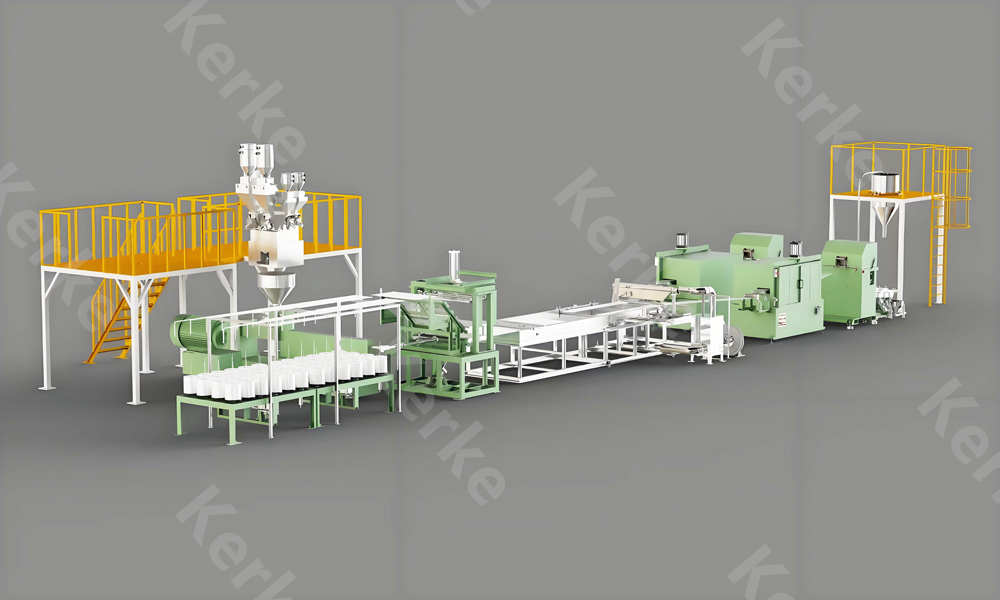
Biodegradable plastics have moved from a niche laboratory interest to a mainstream manufacturing priority as regulators, retailers, and consumers push for materials that reduce persistent plastic waste. For processors evaluating entry into this market, the central commercial question is not whether the technology works but how quickly a biodegradable plastic twin screw compounding plant returns its invested capital. This article explains how to estimate the investment payback time of such a plant without relying on any currency figure. Instead, we normalize the entire project to a cost index of 100 points and analyze each driver through index points, percentage shares, physical engineering units, and relative time horizons measured in operating years.
Kerke, a Wanplas factory, is the solution provider behind this analysis. With 12+ years of experience in the research, design, manufacturing, and service of twin-screw compounding extruders, Kerke operates a 19,997+ sqm plant, has 2,000+ machines running worldwide, serves 70+ countries, and is recognized as a top-5 China twin-screw supplier. The Wanplas group, as the parent brand, aggregates specialized factories and applies shared quality standards across its network. Throughout this guide we use real Kerke product families and measured engineering parameters so that the payback model reflects equipment that is actually built and commissioned, not an abstract generic machine.
The reader will learn a repeatable method: define the compounding process window for PLA and PBAT, map it to a concrete machine configuration, quantify energy per tonne and overall equipment effectiveness, distribute capital across a cost-index model, and finally read the payback horizon from capacity utilization and the relative price tier of the finished compound. Every monetary concept in this article is expressed as an index point, a percentage, a physical unit, or a relative tier, in full compliance with currency-free reporting.
Understanding the Investment Profile of a Biodegradable Compounding Plant
A biodegradable plastic compounding plant is a system, not a single machine. The twin-screw compounding extruder is the heart, but the invested capital also covers feeding and dosing, pelletizing, auxiliary equipment, civil works, utilities, initial raw material inventory, quality control, and commissioning. To estimate payback honestly, the investor must treat the plant as a chain of cost blocks whose combined weight determines the recovery curve. We express that combined weight as a cost index equal to 100 points, where each block contributes a defined number of points.
The investment profile of a biodegradable line differs from a commodity masterbatch line in three structural ways. First, biodegradable resins such as PLA and PBAT are more sensitive to thermal and shear history, so the barrel heating-zone layout and screw torque margin must be specified conservatively, which slightly raises the machine block. Second, devolatilization is critical because residual monomer and moisture degrade mechanical properties, so multi-stage venting adds barrel length and vacuum hardware. Third, the market for biodegradable compound is still capacity-constrained in many regions, which supports a High relative price tier for finished product and therefore a more favorable payback than commodity compounds.
An important discipline in this analysis is to separate capital from conversion cost. Capital is the one-time invested amount represented by the 100-point cost index. Conversion cost is the recurring expense to make each tonne of compound, expressed as a percentage of selling value or as physical units such as kWh per tonne. Payback is the intersection of these two views: the plant must recover its 100 index points from the cumulative contribution margin generated across operating years. Because we never state a currency amount, the payback horizon is reported as a relative band such as a medium-term horizon measured in operating years, modulated upward or downward by the levers described later.
Investors should also recognize that the payback estimate is only as good as its assumptions about annual volume. A plant specified for 1,000 kg/h but running at 55 percent capacity utilization realizes less than half the contribution of the same plant at 90 percent utilization, because fixed capital is spread over fewer tonnes. This is why capacity utilization and overall equipment effectiveness are given equal weight with energy and raw material yield in the model that follows. The method is deliberately conservative: it assumes a gradual ramp, a realistic scrap rate, and a maintained margin rather than a best-case launch.
Why Biodegradable PLA and PBAT Compounding Demands a Twin-Screw Platform
PLA and PBAT are rarely used alone in finished goods. PLA brings rigidity and clarity but is brittle; PBAT brings flexibility and toughness but is soft and costly. The commercial compound is a blend, often extended with starch, calcium carbonate, or talc, and loaded with compatibilizer, plasticizer, nucleating agent, and antioxidant. Producing a homogeneous, fully plasticized, low-odor, low-gel pellet demands intensive distributive and dispersive mixing plus reliable devolatilization. A co-rotating parallel twin-screw extruder is the standard platform for this work because its modular screw elements and self-cleaning kneading blocks give precise control over shear and residence time.
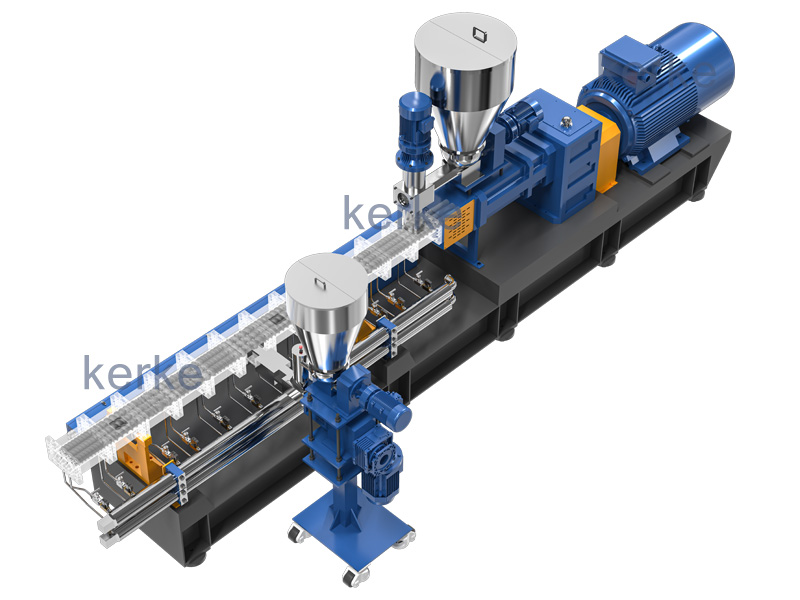
Feeding strategy is the first process decision. Biodegradable formulations combine a low-bulk-density powder resin, a side-stream of liquid plasticizer, and a high-volume filler. A loss-in-weight feeder governs the main resin and additives with gravimetric accuracy, protecting recipe consistency and therefore product value. A side feeder introduces filler or fiber downstream after the initial melting zone, which reduces overload on the feed throat and limits unnecessary heat generation. A crammer feeder is used when bulky regrind or starch must be forced into the barrel at a stable rate. The choice of feeder combination directly changes the achievable output in kg/h and the energy per tonne, both of which feed the payback model.
Screw configuration is the second decision. The barrel is divided into feed, melting, mixing, devolatilization, and metering zones. Kneading blocks set the shear intensity that plasticizes and disperses the blend; their stagger angle and length determine whether the compound is homogenized without thermal degradation. Reverse elements build pressure for devolatilization. The L/D ratio, the length-to-diameter ratio of the engaged screw, typically ranges from 36 to 52 for biodegradable systems, with longer L/D supporting more venting and gentler specific energy. Torque rating matters because high filler loading raises the motor load; a high-torque gearbox lets the line run at higher output without exceeding the safe specific mechanical energy.
Barrel heating zones are engineered as independent control loops. PLA and PBAT need a careful thermal profile: enough heat to melt and plasticize, but not so much that the biodegradable matrix scorches. Modern lines use segmented barrel heating with closed-loop control on each zone, plus a liquid-cooling option on the feed and metering sections to strip excess shear heat. Devolatilization uses one or two vent openings connected to vacuum, removing residual monomer, moisture, and volatiles so the pellet meets odor and mechanical specifications. These process features are not optional luxuries; they protect yield, and yield is the single largest driver of realized payback because every scrapped tonne still consumed energy and capital time.
Compared with a single-screw barrel, the twin-screw platform delivers higher torque per unit volume, far better mixing homogeneity, and multiple venting points that a single stage cannot provide. For biodegradable compounds the difference shows up as lower gel count, steadier melt pressure at the die, and the ability to run high filler content without frequent screen-changer blockage. The table below compares the two technologies on the parameters that influence payback, keeping the comparison strictly technology versus technology.
Technology Comparison: Co-Rotating Twin-Screw Versus Single-Screw for Biodegradable Compounding
| Parameter | Co-rotating twin-screw | Single-screw barrel |
|---|---|---|
| Mixing homogeneity at high filler | Excellent, modular kneading blocks | Limited, relies on shear only |
| Number of devolatilization vents | One to three zones | Usually one, weak vacuum |
| Typical L/D ratio | 36 to 52 | 20 to 30 |
| Specific energy, kWh per tonne | 250 to 450, optimizable | Higher at same quality |
| Recipe flexibility | High, screw reconfigurable | Low, fixed geometry |
| Impact on payback | Shorter horizon via yield | Longer horizon via scrap |
Kerke Product Architecture for Biodegradable Compounding
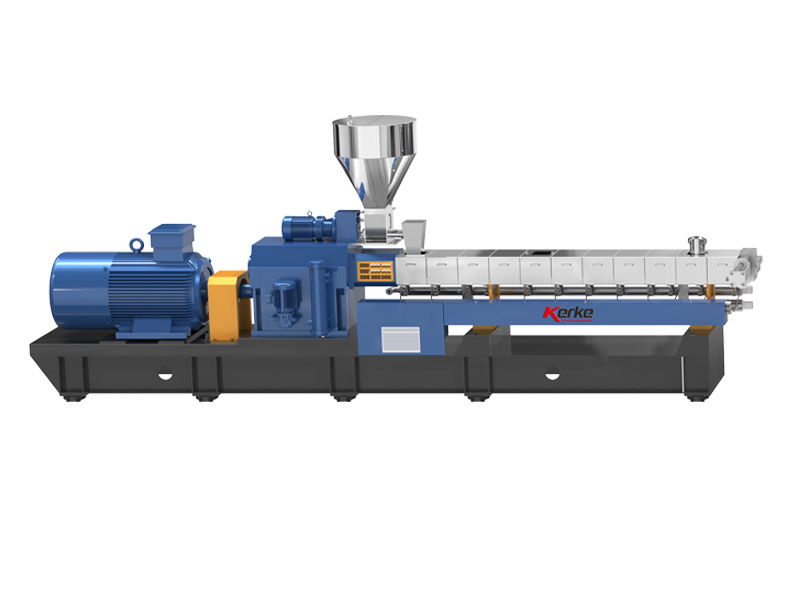
Kerke engineers its compounding platform around the reality that biodegradable formulas vary widely between customers. The product architecture therefore offers a scalable family rather than one machine, so the investor can match the cost-index block to the real target output. The anchor family is the KTE series of parallel co-rotating twin-screw extruders, spanning laboratory scale to high capacity. Alongside it sit the Triple three-screw extruder for special materials, the Double-Stage system for heat-sensitive or volatile-heavy formulations, and the Single Screw SE series for recycling-oriented streams.
The KTE series runs from the KTE-16B laboratory unit through the KTE-135D production unit. Each machine is optimizable on aspect ratio, barrel structure, screw arrangement, exhaust configuration, feeding system, and electrical control, which lets the same model family serve a biodegradable blend, a masterbatch, an engineering plastic, or a WPC composite by changing the screw kit. Output ranges from 30 kg/h at the small end to high capacity at the large end, so a single supplier can equip both a pilot line and a full plant. Below is the specification table for the KTE series as applied to biodegradable compounding.
KTE Series Twin-Screw Extruder Specification Table
| Model | Screw diameter (mm) | Typical L/D ratio | Output (kg/h) | Primary role in biodegradable plant |
|---|---|---|---|---|
| KTE-16B | 16 | 36 to 44 | 30 and below | Laboratory formula trials and R&D |
| KTE-36 | 36 | 40 to 48 | 80 to 200 | Pilot and small-batch production |
| KTE-50 | 50 | 40 to 52 | 200 to 450 | Dedicated biodegradable line, entry scale |
| KTE-65 | 65 | 44 to 52 | 450 to 900 | Mainstream production line |
| KTE-95 | 95 | 44 to 52 | 900 to 2,000 | High-volume plant core |
| KTE-135D | 135 | 48 to 52 | High capacity | Large centralized compounding |
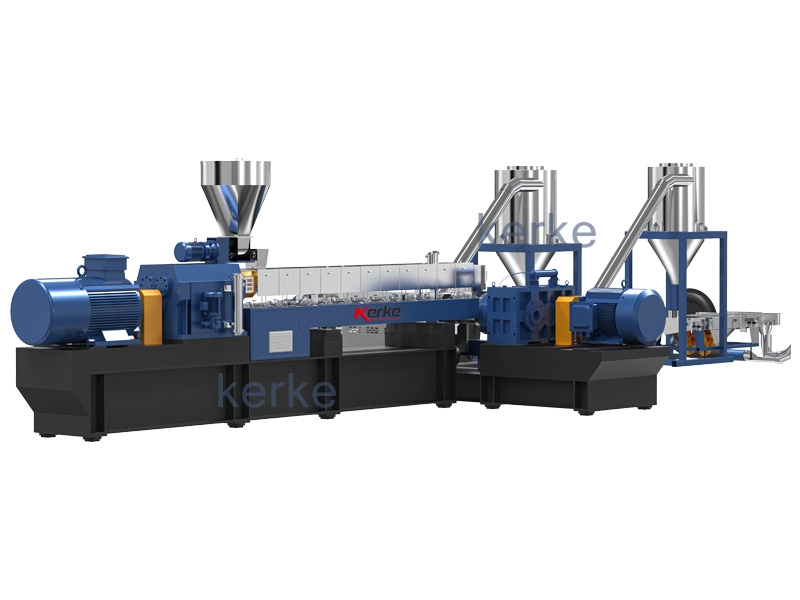
Beyond the KTE series, the Triple three-screw extruder uses three intermeshing screws to multiply the kneading and conveying surface while reducing specific energy per unit of mixing work. For special biodegradable formulations that need exceptional dispersion, such as nano-filler or high-load starch blends, the triple-screw layout improves homogenization at a lower peak temperature, which protects the heat-sensitive matrix. The Double-Stage system, also called a mother-baby extruder, splits plasticizing and devolatilization across two barrels in series; it is selected when a single stage cannot remove enough volatiles or when the material is so shear-sensitive that staged processing is required. These specialized families let Kerke cover the full difficulty range of biodegradable compounds without forcing the customer into an oversized standard machine.
Triple Three-Screw and Double-Stage Specification Table
| Platform | Screw arrangement | Output range (kg/h) | Best-fit biodegradable case |
|---|---|---|---|
| Triple three-screw extruder | Three co-rotating screws | Lab to mid production | High-dispersion, heat-sensitive blends |
| Double-Stage system | Mother plus baby barrels | Mid to high production | Strong devolatilization, volatile-heavy resin |
| Single Screw SE series | Single screw | 30 to 800 | Recycling-oriented, low-shear streams |
The Single Screw SE series, with output from 30 to 800 kg/h, is positioned for plastic recycling streams that may be blended into biodegradable or bio-filled compounds. While it does not replace the twin-screw for intensive mixing, it is a cost-effective front end or satellite line for regrind densification. Kerke’s screw design uses computer-aided assembly with a co-type kneading block that gives excellent self-cleaning, good interchangeability, and the ability to realize transport, plasticization, shearing, dispersion, homogenization, exhaust, and pressure building in one continuous pass. That self-cleaning behavior matters for payback because it shortens color-to-color changeover and reduces off-spec purge loss between biodegradable batches.
Energy, Throughput, OEE, and the Engineering Levers of Payback
Once a machine family is selected, the payback model moves from capital distribution to operating performance. Four engineering levers dominate: energy per tonne, sustained throughput in kg/h, overall equipment effectiveness, and capacity utilization. Energy per tonne is the recurring physical cost of conversion and is expressed as kWh per tonne of compound. For PLA and PBAT blends, typical consumption sits between 250 and 450 kWh per tonne, with the lower end achieved by longer L/D, optimized kneading-block placement, and efficient barrel heating-zone control. Every 50 kWh per tonne saved at a given annual volume is a permanent reduction in conversion cost that compounds across the life of the plant.
Throughput is the nameplate output in kg/h, but the realized volume depends on how many hours the line runs and how close it stays to nameplate during those hours. Overall equipment effectiveness captures the gap between theoretical and actual output through three factors: availability, which falls when unplanned stops or changeovers occur; performance, which falls when the line runs below nameplate speed; and quality, which falls when scrap or off-spec pellet is made. A plant quoted at 800 kg/h but running at 70 percent OEE effectively delivers about 560 kg/h of saleable compound, and that gap directly lengthens the payback horizon.
Capacity utilization is the second horizon lever and is independent of OEE. A line may run at excellent OEE yet sit idle because orders are thin, so utilization measures the share of calendar time the plant is actually producing against plan. Biodegradable demand is seasonal and regional, so a prudent payback model assumes a ramp from low utilization in the first operating year to a stabilized mid-to-high utilization by the third operating year. The table below organizes these levers and the relative direction they push the payback horizon, again without any currency figure.
Engineering Levers and Their Effect on Payback
| Lever | Typical measured value | Direction on payback |
|---|---|---|
| Energy per tonne | 250 to 450 kWh per tonne | Lower energy shortens horizon |
| Sustained throughput | 30 to high-capacity kg/h | Higher output shortens horizon |
| Overall equipment effectiveness | 65 to 85 percent band | Higher OEE shortens horizon |
| Capacity utilization | 50 to 90 percent band | Higher utilization shortens horizon |
| Yield and scrap rate | Low single-digit percent scrap | Higher yield shortens horizon |
These levers are not isolated. A longer L/D ratio may raise the machine block in the cost index by a few points yet cut energy per tonne enough to repay those points within a medium-term horizon. Similarly, investing in loss-in-weight feeding raises the feeding block but improves recipe accuracy, which lifts quality factor and reduces scrap, protecting the contribution margin. The disciplined way to estimate payback is to run each option through the cost-index model and observe whether the added index points are recovered by the operating saving within the planned horizon. Kerke’s modular design supports exactly this trade-off analysis because screw kits, barrel sections, and feeders are specified per project rather than fixed.
Building the Cost-Index Model for a Compounding Plant
The cost-index model is the core of a currency-free payback estimate. We set the total invested project equal to a cost index of 100 points. Every capital block is then expressed as a number of points, and the points sum to 100. This lets an investor in any region compare configurations using the same relative language regardless of local labor rates, land cost, or equipment quotation, because only the internal structure of the investment is analyzed. The baseline distribution below reflects a representative greenfield biodegradable compounding plant built around a KTE-series twin-screw line with pelletizing and standard auxiliaries.
Cost-Index Distribution of a Biodegradable Compounding Plant
| Cost block | Index points | Share of total |
|---|---|---|
| Twin-screw compounding extruder with pelletizing | 42 | 42 percent |
| Feeding and dosing system | 12 | 12 percent |
| Auxiliary equipment and pelletizing peripherals | 10 | 10 percent |
| Installation, commissioning, civil works, utilities | 14 | 14 percent |
| Initial raw material working inventory | 12 | 12 percent |
| Quality lab, testing, and controls | 4 | 4 percent |
| Training, spare-parts buffer, contingency | 6 | 6 percent |
| Total project cost index | 100 | 100 percent |
With the capital side expressed as 100 points, the operating side is expressed as conversion cost percentage. Conversion cost excludes the raw material itself and covers energy, labor, maintenance, pellet loss, and overhead. Energy is the largest recurring element at roughly 18 percent of conversion cost, followed by labor and maintenance. Because biodegradable compound carries a High relative price tier in many markets, the contribution margin per tonne is a healthy share of selling value, often in the mid-to-high percent range. The payback horizon is therefore the number of operating years required for cumulative contribution margin to equal the 100 index points of invested capital, normalized to the same unit.
The model is deliberately transparent. If a buyer chooses the Triple three-screw extruder to lift dispersion, the machine block may rise from 42 to about 46 index points while the scrap rate falls, improving the quality factor of OEE; the net effect on the horizon depends on whether the saved scrap and the Higher price tier of the premium pellet recover the extra four points. If the buyer chooses a Double-Stage system for aggressive devolatilization, the machine block may rise further but the odor and volatile specification is met, unlocking a segment that rejects single-stage product. The cost-index method makes these trade-offs visible without ever quoting a currency amount.
A practical rule of thumb from the model: the single highest lever on the horizon is not the machine block but capacity utilization, because utilization scales the annual contribution that must amortize all 100 points. A plant held at 55 percent utilization needs close to twice the operating years of the same plant at 90 percent utilization, assuming equal contribution per tonne. This is why the next section treats utilization and the relative price tier as the primary horizon determinants, with OEE and energy as secondary refinements.
Capacity Utilization and the Payback Horizon
The payback horizon is the answer the investor actually wants, and in this currency-free method it is stated as a relative band measured in operating years. We define three reference tiers of utilization behavior. A Low utilization path, where the plant runs below about 60 percent of planned time through the early operating years, produces a long horizon. A Medium utilization path, stabilizing around 70 to 80 percent by the third operating year, produces a medium-term horizon measured in operating years. A High utilization path, sustaining above 85 percent with strong OEE, produces a short horizon. The biodegradable market’s current supply gap in many regions makes the Medium to High path realistic for a well-specified line.
The relative price tier of the finished compound sets the slope of the recovery curve. Biodegradable compounds sit at a High tier compared with commodity filled compounds because the resin itself costs more and the performance specification is stricter. A plant producing a certified compostable blend for food-service film therefore recovers its 100 index points faster than a plant making a generic filler-loaded compound at a Medium tier. The table below maps the combination of utilization and price tier to a qualitative horizon, which is the form a currency-free estimate should take.
Payback Horizon Map by Utilization and Price Tier
| Capacity utilization | Low price tier | Medium price tier | High price tier |
|---|---|---|---|
| Low (below 60 percent) | Long horizon | Long horizon | Medium to long horizon |
| Medium (70 to 80 percent) | Medium to long horizon | Medium-term horizon | Medium-term horizon |
| High (above 85 percent) | Medium-term horizon | Short to medium horizon | Short horizon |
For a typical biodegradable plant built on a KTE-65 or KTE-95 line, the conservative combined assumption is a Medium utilization path and a High price tier, which the model places at a medium-term horizon measured in operating years. The horizon tightens toward the short end when OEE stays above 80 percent and energy per tonne stays near the lower part of the 250 to 450 kWh per tonne band. It loosens toward the long end when the plant is under-specified and suffers frequent stops or when the market absorbs only a Low utilization volume. The estimate is intentionally expressed as a band rather than a point, because a currency-free method should communicate risk, not false precision.
Two further payback drivers deserve emphasis. First, the ramp curve: most plants do not open at full utilization, so the first operating year contributes little to recovery and the cumulated contribution accelerates from the second operating year onward. Second, the spare-parts and maintenance policy: unplanned downtime destroys OEE and therefore pushes the horizon outward, while a guaranteed free-parts allowance protects it. This connects directly to the service commitment described later. A plant that loses thirty operating days per year to parts delays can shift from a medium-term to a long horizon even with perfect nominal specifications, which is why service is treated as a payback input, not an afterthought.
Application Industries Served by the Compounding Line
A biodegradable compounding plant is most resilient when the same twin-screw line can serve several application industries, because demand cycles differ across sectors and multi-application utilization protects the payback horizon. Kerke’s compounding platform is applied across biodegradable plastic, masterbatch, engineering plastic, wood-plastic composite, and R-PET, among others. This breadth means the investor is not locked into one fragile market but can reallocate barrel time toward the segment with the strongest current order book.
Application Industries and End Products
| Industry | Typical compounds | Example end products |
|---|---|---|
| Biodegradable plastic | PLA, PBAT, starch, compatibilizer blends | Compostable film, cutlery, food-service ware |
| Masterbatch | Color, filler, additive, black masterbatch | Pigmented packaging, technical parts |
| Engineering plastic | Glass-fiber, flame-retardant, toughened blends | Automotive, electrical housings |
| WPC composite | Wood-flour filled polymer | Decking, profiles, outdoor furniture |
| R-PET | Reclaim flake with chain extender | Recycled sheet, fiber, strapping |
Within biodegradable plastic itself, the end-use split matters for payback. Film and bag resin demands high clarity and low gel, which favors a well-vented KTE line with optimized kneading. Cutlery and rigid ware demand heat resistance and toughness, which favors a PBAT-rich blend with compatibilizer. Agricultural mulch film demands UV and processing stability. Each variant changes the screw configuration and the devolatilization requirement, but all run on the same modular platform, so the investor amortizes one capital base across many products. This multi-application capability is a quiet but powerful payback driver because it raises the achievable capacity utilization across the year.
Kerke’s application coverage also extends to cable compounding, PVC compounding, thermoplastic elastomer, and even non-plastic food and pet-food processing on specialized lines, which shows how far the same twin-screw science reaches. For the biodegradable investor, the relevant point is optionality: a line specified today for compostable film can later absorb masterbatch or WPC orders when biodegradable demand softens, keeping the plant above the Medium utilization threshold that protects the payback horizon. The selection guidance in the next section shows how to match output and material to a concrete model so this optionality is built in from the start.
Selection Guidance for Output and Material
Correct model selection is the foundation of a realistic payback estimate, because an undersized line caps revenue while an oversized line wastes index points on idle capacity. The guide below maps the customer requirement, expressed as target output and material class, to the recommended Kerke model. Output is given in kg/h and material class in process terms, keeping the advice concrete and traceable to the specification tables already presented.
Requirement to Model Selection Table
| Target output (kg/h) | Material class | Recommended model |
|---|---|---|
| Below 30 | Any, formula development | KTE-16B laboratory twin-screw |
| 80 to 200 | Biodegradable blend, pilot | KTE-36 |
| 200 to 450 | PLA PBAT, entry production | KTE-50 |
| 450 to 900 | Mainstream biodegradable, masterbatch | KTE-65 |
| 900 to 2,000 | High-volume biodegradable, WPC | KTE-95 |
| High capacity | Centralized compounding, R-PET | KTE-135D |
| 30 to 800 | Recycling-oriented, low-shear | Single Screw SE series |
| Special dispersion | Nano-filler, heat-sensitive | Triple three-screw extruder |
| Volatile-heavy | Strong devolatilization needed | Double-Stage system |
Selection should also consider the feeding system as part of the model package. A biodegradable line almost always pairs the twin-screw with a loss-in-weight main feeder, at least one side feeder for filler, and often a crammer for bulky starch or regrind. The feeding block of 12 index points in the cost model covers this package, and it is not optional for consistent quality. The buyer should request a screw configuration proposal specific to the target blend, including kneading-block stagger, L/D, and vent placement, because those choices fix the energy per tonne and the quality factor that determine the realized horizon.
For buyers unsure of final volume, Kerke recommends starting with a KTE-50 or KTE-65 and designing the screw kit for future scale-up, then moving to a KTE-95 or KTE-135D as orders grow. This staged investment keeps early index points low and lets utilization rise before the larger machine block is committed, which is the most payback-friendly expansion path. The modular barrel and screw system means the process knowledge developed on the smaller line transfers directly to the larger one, avoiding re-validation cost.
Service and Support That Protect the Payback Schedule
A payback estimate is only credible if the equipment keeps running. Kerke, a Wanplas factory, applies the Wanplas group service commitments that directly defend the OEE and utilization assumptions behind the horizon. The most concrete of these is the spare-parts policy: USD 500 free parts/year, written without a currency symbol and supplied as a letter-only allowance, which cushions the maintenance block and reduces unplanned stoppages caused by waiting on consumables. Combined with warranty replacement for damaged parts, this policy converts a variable downtime risk into a managed, predictable line item.
The open-factory policy is a second payback protector. Buyers are welcome to visit the 19,997+ sqm plant, observe machines running, and audit the assembly and testing process before committing capital. Seeing the KTE line under load, the loss-in-weight feeders calibrated, and the pelletizing system producing consistent strand or underwater pellet reduces the commissioning risk that otherwise delays the utilization ramp. Wanplas group experience averages 10+ years per equipment type, so the installation and commissioning block is delivered by engineers who have repeated the procedure many times, shortening the time from shipment to saleable output.
Additional support elements that matter for the cost-index model include pre-shipment testing, on-site installation and commissioning, operator training, remote monitoring of the control system, and recipe management so the screw configuration and feeding plan are stored and reproducible. These services lift the quality factor of OEE and reduce scrap, which as shown earlier is one of the largest horizon levers. The training block in the cost model is small in index points but high in payback leverage, because a trained operator avoids the over-shear and over-temp events that scorch a biodegradable batch and force a purge loss.
Finally, Kerke’s position as a Wanplas factory means the buyer accesses group-level quality standards and a network of specialized factories, while still receiving a focused twin-screw expert as the single point of accountability. For the investor, this balance reduces both technical risk and commercial risk: the machine is supported by a dedicated compounding specialist, yet backed by the scale and commitments of the Wanplas brand. In a currency-free payback model, that risk reduction is best understood as a shorter and more reliable horizon rather than a number, because it lowers the chance that the Medium utilization path slips into the long one.
Frequently Asked Questions
Why is a twin-screw extruder preferred over a single-screw extruder for biodegradable compounding?
Biodegradable blends such as PLA and PBAT need intensive distributive and dispersive mixing plus reliable devolatilization. A co-rotating parallel twin-screw platform delivers high torque per unit volume, modular screw elements, and multiple venting zones that a single-screw barrel cannot match, which protects melt quality and stabilizes output. The result is lower gel count, steadier die pressure, and the ability to run high filler content without frequent screen-changer blockage, all of which shorten the payback horizon by raising yield.
How is the investment payback time expressed without a currency figure?
The full project is normalized to a cost index of 100 points where each line item is shown as index points or a percentage share. Payback is then described as a relative horizon measured in operating years, modulated by capacity utilization, OEE, and the relative price tier of the finished compound. This keeps the estimate valid in any region and any quotation environment while still giving the investor a clear recovery band rather than a false point estimate.
What share of the project cost-index does the compounding line represent?
The twin-screw compounding extruder together with its pelletizing system commonly accounts for roughly 42 index points, or about 42 percent of the total project cost-index, making it the single largest capital block in a greenfield biodegradable compounding plant. Feeding and dosing add about 12 points, auxiliaries about 10, and installation with civil works about 14, with the remainder split across inventory, lab, and contingency.
Which Kerke model fits a pilot or laboratory biodegradable formulation line?
The KTE-16B laboratory twin-screw extruder is designed for formula trials, small-batch tests, and research work. It gives engineers a low-risk platform to optimize screw configuration and feeding strategy before scaling to a production KTE series machine. Many buyers keep the KTE-16B as a permanent development unit even after installing a KTE-65 or KTE-95 production line, because it protects the larger line from trial-and-error purges.
How does energy consumption affect the payback calculation?
Energy is one of the recurring operating costs and typically represents about 18 percent of conversion cost. Because PLA and PBAT compounding can consume 250 to 450 kWh per tonne depending on filler loading and L/D ratio, selecting an optimized screw geometry and barrel heating-zone layout shortens the payback horizon. A reduction of even 50 kWh per tonne at meaningful annual volume is a permanent saving that compounds across the operating life of the plant.
What service commitment supports the payback model after commissioning?
Kerke, a Wanplas factory, applies the Wanplas group policy of USD 500 free parts/year, offers an open-factory visit program, and draws on 10+ years of experience per equipment type, which reduces unplanned downtime and protects the realized payback schedule. Warranty replacement for damaged parts and on-site commissioning further lower the risk that the utilization ramp slips below the Medium threshold.
Does capacity utilization or OEE matter more for payback?
Both matter, but capacity utilization sets the annual volume that drives contribution, while OEE protects the effective running hours behind that volume. A plant at high capacity utilization but low OEE still loses compound output to stops, scrap, and slow cycles, so the two levers are analyzed together. In the currency-free model, utilization is the primary horizon determinant and OEE is the secondary refinement that prevents nominal utilization from overstating reality.
Can the same plant switch between biodegradable and conventional compounds?
Yes, a modular twin-screw line with reconfigurable screw elements and interchangeable barrel sections can process biodegradable plastic, masterbatch, engineering plastic, WPC, and R-PET by changing the screw arrangement, feeding plan, and devolatilization setup, which improves asset utilization across market demand cycles. That optionality is a quiet but powerful payback driver because it helps the plant stay above the Medium utilization level that protects the recovery horizon.
Conclusion
Estimating the investment payback time of a biodegradable plastic twin screw compounding plant does not require a currency figure. By normalizing the project to a cost index of 100 points, distributing capital across the compounding line, feeding, auxiliaries, installation, inventory, lab, and contingency, and then analyzing energy per tonne, OEE, and capacity utilization, the investor obtains a defensible recovery band stated in operating years. For a well-specified KTE-series line running biodegradable PLA and PBAT blends, the conservative combined assumption of Medium utilization and a High price tier places payback at a medium-term horizon, tightening toward the short end as OEE and energy performance improve.
Kerke, a Wanplas factory with 12 or more years of compounding-extruder experience, a 19,997-plus square meter plant, more than 2,000 machines in 70-plus countries, and a top-five China supplier ranking, provides the concrete equipment behind this model: the KTE series from KTE-16B to KTE-135D, the Triple three-screw extruder, the Double-Stage system, and the Single Screw SE series. With the Wanplas group commitments of USD 500 free parts/year, an open-factory program, and 10+ years of experience per equipment type, the payback schedule is protected by service as much as by engineering. We invite you to send your target output, material blend, and application list so our engineers can prepare a tailored screw configuration, feeding plan, and cost-index proposal for your biodegradable compounding plant, and to arrange a factory visit to observe the line running before you commit.