Running a PLA twin-screw modified plastic factory is a discipline of controlling many small expense streams before they compound into a margin problem. Kerke, a Wanplas factory with 12 plus years of experience in co-rotating parallel twin-screw compounding technology, operates from a 19,997 plus square meter production base, has placed 2,000 plus machines into service worldwide, and supplies customers across 70 plus countries. This article breaks the full operating expense of a PLA modified plastic plant into a transparent structure so a production manager, a plant financier, or a new investor can see exactly where every cost point lands. We use a single normalized framework: the total operating cost index equals 100 points, and each expense line is reported as index points and as a percentage of the total. All energy figures use kWh per tonne, all labor figures use labor-hours per shift, and all equipment figures use OEE and maintenance hours per year. No currency symbol or specific price number is used anywhere in this analysis.
The scale of the PLA opportunity makes this discipline urgent. Bio-based and biodegradable polymers are moving from niche packaging into rigid consumer goods, agricultural film, and food service ware, and each new application demands a different modification recipe. A plant that can only quote a resin price is blind to the real economics of running the line, because the modification step is where margin is made or lost. By treating every expense as a point on a 100 point index, the plant manager gains a common language that connects the purchasing desk, the production floor, and the finance office. This article is written to be that common language.
Why a PLA modified plastic plant needs a structured expense breakdown
Polylactic acid, or PLA, is a bio-based and biodegradable thermoplastic derived from renewable feedstock such as corn starch or sugarcane. In its neat form PLA is stiff and brittle, with a glass transition temperature near 55 to 60 degrees Celsius and a melting range around 150 to 180 degrees Celsius depending on the optical isomer ratio. To make PLA useful for films, rigid packaging, fibers, and durable goods, it must be modified by twin-screw compounding: toughened with an elastomer or a biodegradable polyester, nucleated for faster crystallization, plasticized for flexibility, filled for cost reduction, or loaded with masterbatch for color and function. Each of these modification routes changes the expense structure of the plant.
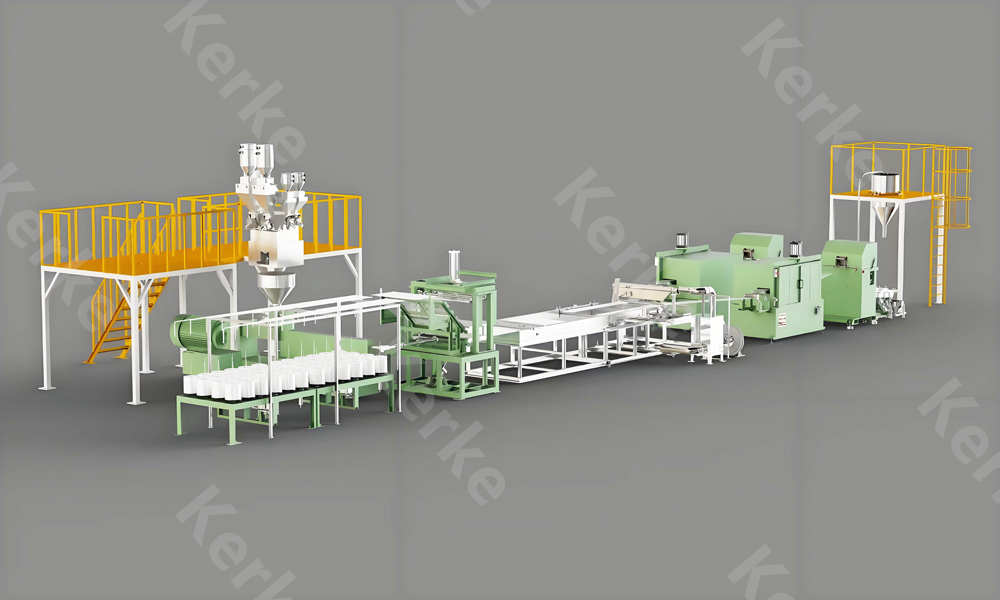
A modified plastic factory is not a single machine. It is a continuous system of feeding, plasticizing, mixing, devolatilizing, pelletizing, cooling, screening, and packaging, plus the labor, energy, maintenance, and overhead that keep it running. When an operator only watches the resin invoice, the plant appears cheap to run. When the same operator measures kWh per tonne, labor-hours per shift, and maintenance hours per year, the real cost picture appears. The operating cost index described here is designed to make that picture comparable across different plant sizes, different output targets, and different product mixes.
The framework is deliberately normalized. By assigning the total operating cost index a value of 100 points, we remove the effect of local currency, local wages, and local electricity tariffs. A plant in one region and a plant in another can be compared on structure rather than on accounting. Raw material that represents 55 index points in one factory represents the same structural burden at 55 index points in another, even if the underlying resin cost differs. This is the core method of the analysis that follows.
The operating cost index: total operating cost index equals 100 points
The operating cost index is a normalized accounting tool. We define total operating cost index equals 100 points for a fully built, fully staffed PLA modified plastic production line at steady state. Every expense category is then expressed as a fraction of that 100 point total. The advantage over a conventional financial statement is that the index exposes structure: a category that looks small in absolute terms can be large relative to the total once idle capacity is removed from the denominator.
The index covers only operating expense, not capital expenditure for the building or the machine purchase. Capital is treated separately as an equipment depreciation or lease line inside the index, because a plant financed with a heavy upfront payment and a plant run on a leased line show very different monthly cash profiles even when the underlying process is identical. The index also excludes one-time startup cost such as commissioning, trial runs, and operator training, which are captured under service and support rather than recurring operating cost.
It is important to understand how the index responds to capacity utilization, because this single variable reshapes the apparent ranking of expense lines. At low utilization, the plant still pays the same depreciation, the same base labor, and the same standby energy, but it produces fewer tonnes, so those fixed lines swell as a share of the 100 point total and can briefly exceed the energy line. As utilization climbs toward nameplate, the fixed lines shrink as a share and raw material reasserts its dominance. A plant manager who reads the index at only one utilization point will misjudge where to invest; the index must be read across the expected operating band, not at a single snapshot.
For a typical PLA modification line producing 600 to 2500 kg/h of compounded pellet, the structural split of the 100 point index is dominated by material, followed by energy, labor, equipment depreciation, and maintenance. The exact position of each line moves with capacity utilization: when the plant runs at low utilization, the fixed lines such as depreciation and labor rise as a share of the index, because the same fixed burden is spread over fewer tonnes. When the plant runs near nameplate, the material line dominates even more strongly. The next sections quantify each line.
Raw material expense and the largest cost share
Raw material is the largest single expense in any PLA modified plastic factory. In the operating cost index, raw material typically represents the largest share at about 55 index points, or 55 percent of the total. This line includes the base PLA resin, the modification additives such as toughener, nucleating agent, plasticizer, chain extender, filler, and the masterbatch or colorant that gives the final pellet its properties. Because PLA itself is a premium bio-based polymer, the resin portion alone can approach 45 index points before any additive is added.
The material line is also the most variable. A toughened PLA grade that blends PLA with a biodegradable polyester raises the additive portion. A filled grade that uses calcium carbonate or talc lowers the resin portion but raises the feeding and wear burden, because mineral filler accelerates screw and barrel wear. A masterbatch route concentrates the additive in a carrier so the base compound stays cleaner, but adds a second material stream to manage. The index method keeps all of these inside the same 55 point envelope so the trade-offs stay visible.
The filler trade-off deserves a closer look because it is the most common way plants try to reduce the 55 point material line, and it often backfires. Adding calcium carbonate or talc lowers the resin portion of the material cost, but mineral filler is abrasive and accelerates screw and barrel wear, which pushes cost from the material line into the maintenance line and raises kWh per tonne in the energy line. The net effect can be neutral or even negative if the filler loading is set without measuring wear rate and energy penalty. The disciplined approach is to quantify the wear and energy cost of each filler point and compare it against the resin saving, using the index rather than intuition.
Material loss is the hidden leak in this line. Every kilogram of dust, every kilogram of start-up purge, and every kilogram of off-spec pellet that is reground and re-fed reduces material yield. A plant that improves material yield by a few points can shift the index by more than two full points without touching energy or labor. This is why feeding accuracy, discussed later, is treated as a cost-control lever rather than a convenience feature.
| Expense line | Index points (of 100) | Share of total | Primary driver |
|---|---|---|---|
| Raw material (PLA resin plus additives) | 55 | 55 percent | Resin grade and filler loading |
| Energy and power | 15 | 15 percent | kWh per tonne of compound |
| Labor | 10 | 10 percent | Labor-hours per shift |
| Equipment depreciation or lease | 8 | 8 percent | Financing structure |
| Maintenance, wear, spare parts | 6 | 6 percent | Maintenance hours per year |
| Auxiliary utilities | 3 | 3 percent | Water and compressed air |
| Pelletizing and downstream | 3 | 3 percent | Cutting and screening method |
| Total operating cost index | 100 | 100 percent | Steady-state operation |
Energy and power expense measured in kWh per tonne
Energy is the second largest recurring line, sitting at about 15 index points. The honest way to measure it is specific energy consumption: kWh per tonne of finished compound. Twin-screw compounding is an energy-intensive process because the screws must convey, plasticize, knead, disperse, and pump the melt while overcoming viscous drag. For PLA modification the specific mechanical energy typically lands in a medium to high tier, higher than simple filled polyethylene and lower than heavily filled engineering compounds.
The extruder drive is the dominant energy consumer, but it is not the only one. Feeders, side feeders, the liquid feeder pump, the pelletizer, the cooling water pump, the chiller, and plant lighting all add kWh per tonne. A plant that optimizes only the extruder motor but ignores the chiller may recover only part of the available saving. The index treats energy as one line precisely so these sub-consumers are weighed together.
Energy per tonne is strongly affected by screw configuration and by throughput. A poorly tuned kneading block section forces the motor to work harder for the same mixing quality, pushing kWh per tonne into the high tier. Raising capacity utilization toward nameplate usually lowers kWh per tonne, because the fixed parasitic loads of feeders and cooling are spread over more output. The table below breaks the energy line into process stages using kWh per tonne.
| Process stage | kWh per tonne (typical range) | Relative tier |
|---|---|---|
| Twin-screw extrusion drive | 200 to 400 | High |
| Feeding and side feeding | 10 to 30 | Low |
| Pelletizing (strand or underwater) | 40 to 90 | Medium |
| Cooling water and chiller | 30 to 70 | Medium |
| Plant auxiliaries and lighting | 20 to 50 | Low to Medium |
Labor expense measured in labor-hours per shift
Labor contributes about 10 index points. The practical unit is labor-hours per shift, because compounding is a supervised continuous process rather than a manual one. A single-shift operation running eight hours typically needs two to three operators covering material handling, line supervision, quality checks, and pellet packing, which equals 16 to 24 labor-hours per shift. A double-shift pattern roughly doubles that, and a continuous three-shift pattern with handover coverage reaches 6 to 9 operators per shift window.
Labor cost is sensitive to automation. A line equipped with loss-in-weight feeding, automatic strand or underwater pelletizing, and centralized control reduces the operator count toward the low end of the range. A line that relies on manual bag tipping, manual screen changes, and manual packing sits at the high end. Because labor is a partly fixed line, raising capacity utilization lowers its share of the index without reducing headcount, simply by spreading the same labor-hours per shift over more tonnes.
Training also belongs in this line. Operators who understand screw element arrangement and devolatilization settings reduce scrap and unplanned stops, which protects the quality component of OEE. Wanplas, as the parent brand, emphasizes average 10 plus years of experience per equipment type across its network, and that accumulated knowledge transfers into shorter commissioning and fewer operator errors on site.
| Shift model | Operators per shift | Labor-hours per shift | Automation level |
|---|---|---|---|
| Single shift, 8 hours | 2 to 3 | 16 to 24 | Manual to semi-auto |
| Double shift | 4 to 6 | 32 to 48 | Semi-auto |
| Continuous three shift | 6 to 9 | 48 to 72 | Auto to fully auto |
Equipment, screw and barrel wear, maintenance and spare parts
Equipment depreciation or lease uses about 8 index points, while maintenance, screw and barrel wear, and spare parts together use about 6 index points. The two lines are linked: a plant that under-invests in maintenance shifts cost from the maintenance line into the wear line, because worn screw elements and barrel liners raise kWh per tonne and lower output, indirectly inflating the energy and material lines as well.
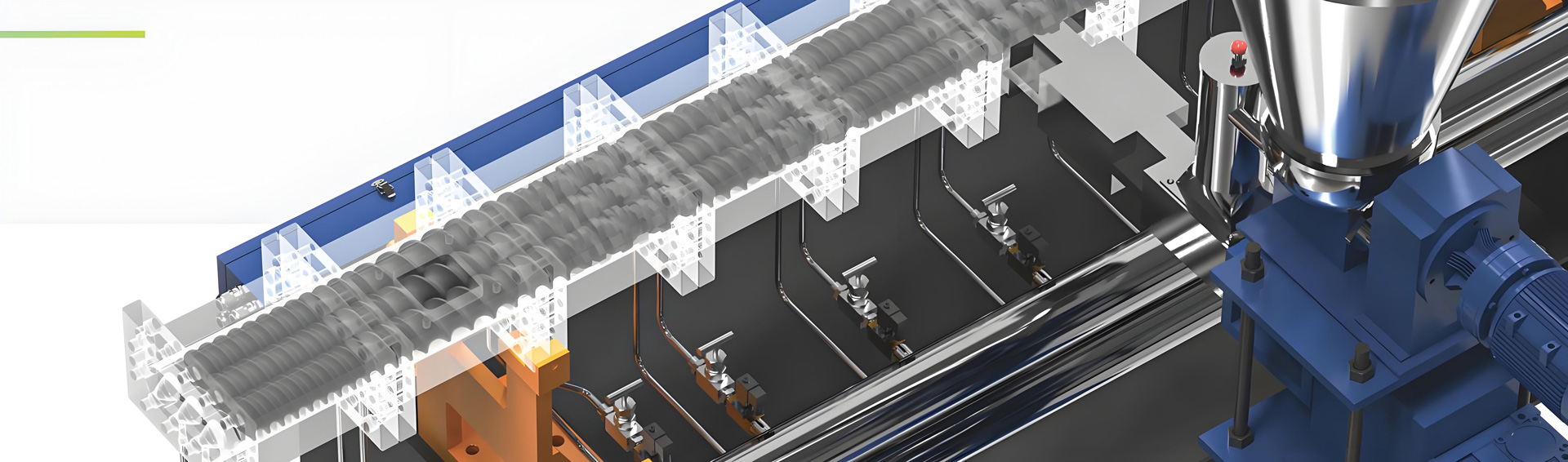
The twin-screw extruder lives or dies by its wear parts. Co-rotating parallel screws and the barrel are subject to abrasive wear from filled compounds and corrosive wear from some additives. The computer-aided screw assembly used by Kerke is designed with a kneading co-type geometry that provides excellent self-cleaning, which reduces residue build-up and the aggressive cleaning cycles that accelerate wear. Even so, a planned maintenance hours per year budget must be set, covering screw element inspection, barrel liner measurement, gearbox oil analysis, and feeder calibration.
Spare parts policy is a direct cost-control instrument. Kerke, a Wanplas factory, provides USD 500 free parts per year as part of the Wanplas group service promise, alongside free replacement for damaged parts within warranty and an open-factory policy that welcomes customer visits. A predictable spare parts program converts an unpredictable breakdown expense into a planned line, which stabilizes the maintenance portion of the index and protects OEE. The sanctioned phrasing is letters only: USD 500 free parts per year.
Kerke twin-screw and pelletizing product modules
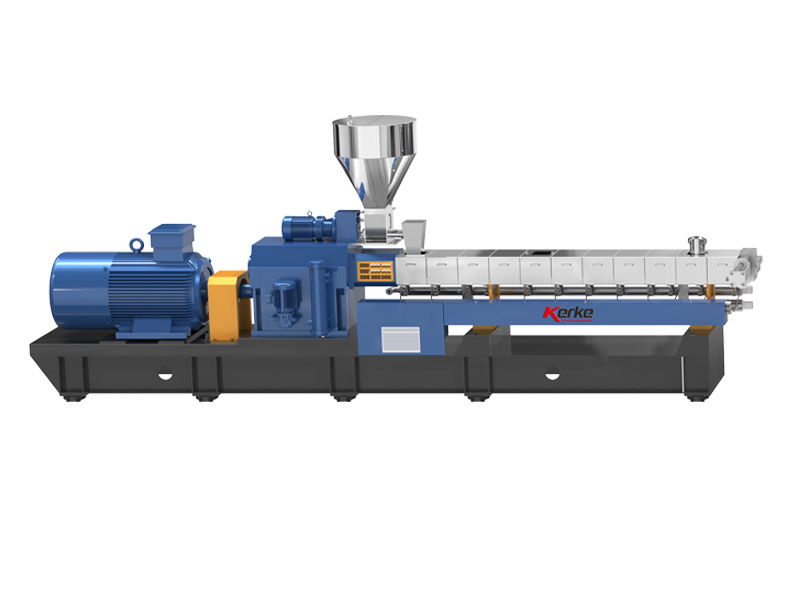
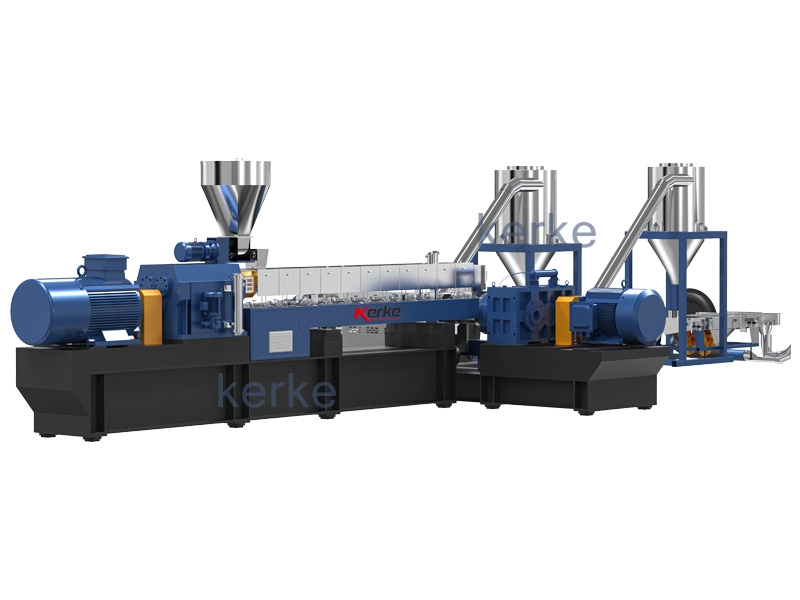
When the expense analysis reaches the question of which machine to install, the answer must be concrete. Kerke, a Wanplas factory, builds co-rotating parallel twin-screw compounding extruders in the KTE series, single-screw extruders in the SE series for recycling-oriented duty, and a full range of cutting and pelletizing systems. Each is optimized for aspect ratio, barrel structure, screw arrangement, exhaust, feeding, and electrical control.
KTE Series twin-screw extruder
The KTE series spans KTE-16B through KTE-135D, covering laboratory trials, pilot lines, and high-capacity production. The parallel co-rotating design gives strong self-cleaning and uniform shear, which is essential for heat-sensitive PLA. The table below lists representative specifications; exact values are confirmed against the project recipe and target output.
| Model | Screw diameter (mm) | L/D ratio | Output (kg/h) | Torque class |
|---|---|---|---|---|
| KTE-16B | 16 | 40 | 30 to 60 | Laboratory or R&D |
| KTE-25 | 25 | 40 to 48 | 60 to 150 | Pilot |
| KTE-36 | 36 | 40 to 52 | 150 to 400 | Production, Medium |
| KTE-50 | 50 | 40 to 52 | 300 to 800 | Production, Medium |
| KTE-65 | 65 | 40 to 52 | 600 to 1500 | Production, Medium-High |
| KTE-75 | 75 | 40 to 52 | 1000 to 2500 | Production, High |
| KTE-95 | 95 | 40 to 52 | 2000 to 5000 | Production, High |
| KTE-135D | 135 | 32 to 44 | 6000 to 12000 | Heavy duty, Very High |
Single Screw SE series extruder
The SE series single-screw extruder covers 30 to 800 kg/h and is mainly applied to plastic recycling and to carrier duties where a single-screw plasticizing unit is sufficient. It pairs with the twin-screw line for regrind recovery, closing the material loop and recovering off-spec pellet back into the index rather than writing it off.
| Model | Screw diameter (mm) | L/D ratio | Output (kg/h) | Typical application |
|---|---|---|---|---|
| SE-45 | 45 | 28 to 33 | 30 to 120 | Recycling, masterbatch carrier |
| SE-65 | 65 | 28 to 33 | 120 to 300 | Compounding, recycling |
| SE-90 | 90 | 28 to 33 | 250 to 500 | Recycling, pelletizing |
| SE-120 | 120 | 28 to 33 | 400 to 700 | Heavy recycling |
| SE-150 | 150 | 28 to 33 | 600 to 800 | High-output recycling |
Cutting and pelletizing systems
Kerke supplies multiple pelletizing routes: water-cooled strand pelletizing, air-cooled strand pelletizing, air-cooled die-face hot cutting, water-ring die-face hot cutting, eccentric water-mist hot cutting, and underwater pelletizing. The choice changes the pelletizing portion of the index and the product quality. Water-cooled and air-cooled strand routes suit general PLA compounding; underwater pelletizing reaches the very high throughput tier with uniform spherical pellets ideal for automated handling.
| System | Cooling method | Throughput tier | Best for |
|---|---|---|---|
| Water-cooled strand pelletizing | Water bath plus strand cutter | Medium | General compounding, PLA |
| Air-cooled strand pelletizing | Air cooling plus cutter | Medium | Heat-sensitive, low dust |
| Air-cooled die-face hot cutting | Air plus die-face | Medium-High | Masterbatch, filler |
| Water-ring die-face hot cutting | Water ring | High | Commodity, recycling |
| Eccentric water-mist hot cutting | Water mist | Medium-High | Filled, engineered |
| Underwater pelletizing | Water, closed loop | Very High | Continuous, high-volume PLA |
Feeding systems for PLA twin-screw modification
Feeding accuracy is where the material line is won or lost. Kerke supports several feeding systems: volumetric metering, loss-in-weight feeding, side feeding, and liquid feeding. Volumetric feeders are the entry tier and suit uniform free-flowing powders at a stable bulk density. Loss-in-weight feeders are the precision tier: they weigh the material as it leaves the hopper and modulate the screw speed to hold a target rate, which directly improves material yield and lowers the raw material index points.
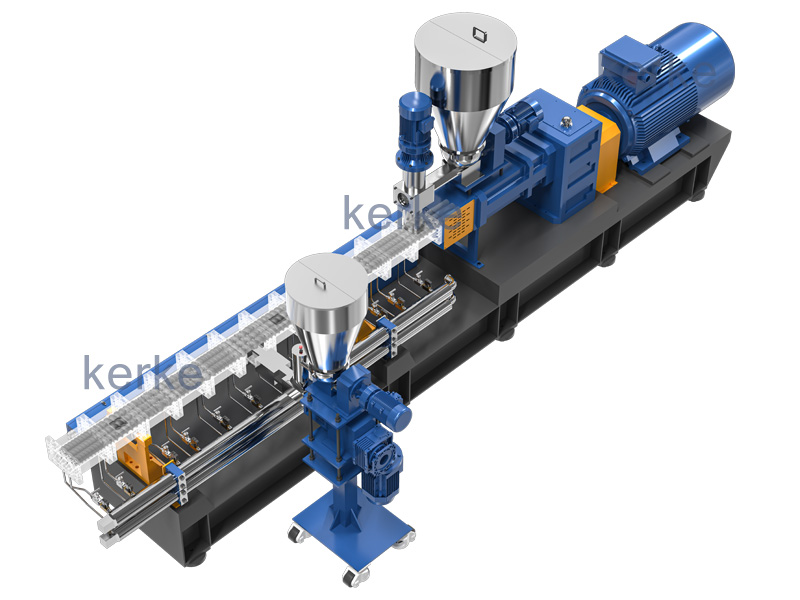
Side feeders extend the twin-screw barrel at a downstream location so high-load fillers such as talc or calcium carbonate can be introduced after the polymer has already melted and is less viscous. This protects the feed throat, improves dispersion, and reduces the torque spike that would occur if all filler entered at the main feed. For PLA modification with high filler content, a side feeder is not optional equipment; it is a structural part of the cost model because it determines how much filler the line can accept before wear and energy penalties appear.
Liquid feeders handle low-viscosity additives: chain extenders, peroxides, lubricants, and some plasticizers. Metering a liquid into the melt through a properly placed port gives more uniform distribution than pre-blending and avoids premature reaction in the feed zone. The combination of loss-in-weight main feeding, side feeding for solids, and liquid feeding for reactive additives is the standard architecture for a controlled PLA modification expense profile.
Screw element arrangement and barrel zones
The screw is the heart of the cost model. A co-rotating parallel twin-screw is built from interchangeable elements: conveying elements that transport and build pressure, kneading blocks that generate shear and mixing, and specialized mixing elements such as toothed or S-elements that promote distributive mixing without excessive temperature rise. The arrangement is computer-aided and tuned to the recipe, because the same barrel can produce a gentle color masterbatch or an aggressive filled compound depending on how the elements are sequenced.
The barrel is divided into zones. The feed zone receives solids and begins conveying. The plasticizing zone melts the PLA and begins incorporation of additives. The kneading and mixing zone develops dispersion and homogeneity. The devolatilization zone, typically under vacuum through a vent port, removes moisture, residual monomer, and reaction volatiles; this protects the quality component of OEE and prevents surface defects in the pellet. The metering zone builds pressure for the die and the pelletizing system.
Barrel length is expressed as the L/D ratio, commonly in the 36 to 52 range for PLA modification so there is enough residence time for thorough mixing yet not so much that heat-sensitive PLA degrades. The self-cleaning co-type geometry means residue transfers cleanly from one element to the next, which shortens product-changeover time and reduces the purge loss that would otherwise inflate the material line. Correct screw arrangement is therefore a direct expense lever, not merely a process detail.
The mechanical side of this lever is torque and specific mechanical energy. Co-rotating twin-screw extruders are rated by torque per unit volume, and a high-torque gearbox lets the line do more mixing work at a given screw speed, which lowers the residence time needed and reduces thermal degradation of heat-sensitive PLA. Specific mechanical energy, measured in kWh per tonne, is the bridge between screw design and the energy line of the index: a well-arranged kneading section reaches target dispersion at lower specific mechanical energy than a poorly arranged one. Tracking specific mechanical energy per recipe turns screw design from craft into a measurable cost parameter that can be trended across campaigns.
Application industries for PLA modified plastic compounding
Kerke lines serve a broad set of modified plastic applications. For PLA modified plastic the goal is usually toughening, nucleation, or plasticization to reach usable impact and cycle-time performance. For masterbatch the line concentrates color, filler, or additive into a carrier at high loading. For biodegradable compounds the line blends PLA with other biodegradable polyesters and manages the lower processing temperature window. For wood-plastic composite, or WPC, the line incorporates wood flour via side feeder to make a bio-composite with reduced petroleum content.
| Industry or product | Material or example | Process note |
|---|---|---|
| PLA modified plastic | Toughened, nucleated PLA | Chain extender and toughener via side feeder |
| Masterbatch | Color, filler, additive | High filler loading, liquid feeder for additives |
| Biodegradable | PLA and polyester blends | Co-rotating, lower temperature window |
| WPC composite | Wood-flour PLA composite | Side feeder for wood flour, wear-resistant barrel |
Selection table: output and material to model
The correct model follows directly from the target output and the material class. The table maps a requirement to a recommended Kerke model. For recycling-oriented duty the SE single-screw series covers 30 to 800 kg/h. For twin-screw modification the KTE series spans laboratory scale to very high capacity. Wanplas, as the parent brand, aggregates these specialized lines so a customer with multiple product families can standardize service and spare parts.
| Requirement (output or material) | Recommended model |
|---|---|
| Laboratory trial, 30 to 60 kg/h, PLA formula | KTE-16B |
| Pilot line, 60 to 150 kg/h, biodegradable | KTE-25 |
| 150 to 400 kg/h PLA modification | KTE-36 |
| 300 to 800 kg/h engineering plastic | KTE-50 |
| 600 to 1500 kg/h masterbatch | KTE-65 |
| 1000 to 2500 kg/h WPC or composite | KTE-75 |
| 2000 to 5000 kg/h biodegradable bulk | KTE-95 |
| High-capacity PLA plant | KTE-135D |
| 30 to 800 kg/h recycling single-screw | SE series |
Capacity utilization, OEE and optimization levers
Overall equipment effectiveness, or OEE, multiplies availability, performance, and quality. For a compounding line, availability is lost to planned maintenance hours per year and unplanned screw or gearbox stops; performance is lost to running below nameplate; quality is lost to off-spec pellet and excessive purge. A plant at 85 percent OEE spends far fewer index points on fixed labor and depreciation than a plant at 55 percent OEE, because the same fixed burden is spread over many more good tonnes.
The optimization levers are concrete. Raising capacity utilization lowers the fixed share of the index. Optimizing screw configuration lowers kWh per tonne. Switching to loss-in-weight feeding lowers material waste. Adding vacuum devolatilization improves quality and reduces scrap. A disciplined preventative maintenance plan lowers unplanned downtime. Each lever maps to a specific index movement, which makes the expense breakdown an action plan rather than a post-mortem.
Capacity utilization itself moves through recognizable tiers that change which lever matters most. At a low utilization tier the plant should first attack the fixed lines by raising throughput, because every extra tonne dilutes depreciation and labor. At a medium utilization tier the energy and material lines become the priority, so feeding accuracy and screw tuning dominate. At a high utilization tier the constraint shifts to reliability, and the maintenance and spare parts line becomes the lever that protects the gains already made. Reading the index against the current utilization tier prevents the common mistake of optimizing the wrong line at the wrong time.
| Lever | Impact on cost index | Measured metric |
|---|---|---|
| Raise capacity utilization | Lowers fixed cost points | OEE percent |
| Optimize screw configuration | Lowers energy per tonne | kWh per tonne |
| Loss-in-weight feeding | Lowers material waste | Material yield percent |
| Vacuum devolatilization | Improves quality, less scrap | Quality percent |
| Preventative maintenance plan | Lowers downtime | Maintenance hours per year |
Service and support for the production line
A credible expense plan assumes the machine is supported for its whole life. Kerke, a Wanplas factory, delivers the Wanplas group service promises: USD 500 free parts per year, free replacement for damaged parts within warranty, an open-factory policy that welcomes customer visits, and an average of 10 plus years of experience per equipment type. Before shipment the line is tested, and on-site installation and commissioning, operator training, and remote support keep OEE high after handover.
Spare parts are the quiet determinant of the maintenance index. A predictable program that includes the annual free parts allowance converts breakdown cost into planned cost and protects the six index points assigned to maintenance and wear. The open-factory policy also lets a buyer audit build quality and discuss screw and barrel material choices before committing, which de-risks the equipment depreciation line.
A phased expense reduction roadmap
The breakdown is only useful if it becomes a plan. The roadmap below moves a plant from an unknown baseline to a controlled index through five phases. Each phase targets a specific portion of the 100 point total, so progress is measurable rather than hoped for.
| Phase | Action | Expected index shift |
|---|---|---|
| Phase 1 audit | Map kWh per tonne and OEE | Establish baseline |
| Phase 2 feeding | Loss-in-weight plus side feeder | Material minus about 3 points |
| Phase 3 screw | Re-tune kneading block arrangement | Energy minus about 2 points |
| Phase 4 OEE | Maintenance plan and training | Labor minus about 1 point |
| Phase 5 lifecycle | Spare parts program | Maintenance held stable |
Frequently Asked Questions
What is the largest expense in a PLA twin-screw modified plastic factory?
Raw material is the largest expense, representing about 55 index points of the 100 point total operating cost index, or roughly 55 percent. This includes the base PLA resin plus all modification additives such as toughener, filler, nucleating agent, and masterbatch. Energy and labor follow at about 15 and 10 index points respectively.
How much energy does PLA twin-screw compounding consume per tonne?
Specific energy consumption typically ranges from 200 to 400 kWh per tonne at the extruder drive alone, with feeders, pelletizing, and cooling adding further kWh per tonne. The total line often reaches the medium to high tier. Optimizing the screw kneading arrangement and raising capacity utilization are the two main ways to lower kWh per tonne.
Why use a loss-in-weight feeder and a side feeder for PLA modification?
A loss-in-weight feeder holds the additive and filler rates with high accuracy, which improves material yield and reduces waste inside the 55 point raw material line. A side feeder introduces high-load fillers downstream after the polymer has melted, protecting the feed zone and allowing higher filler content without excessive torque or wear.
Which Kerke model fits a pilot PLA line at 60 to 150 kg/h?
The KTE-25, part of the KTE series that runs from KTE-16B to KTE-135D, covers 60 to 150 kg/h and is suited to pilot-scale biodegradable and PLA modification work. For a laboratory trial at 30 to 60 kg/h, the smaller KTE-16B is the natural choice.
How does OEE affect the operating cost index?
Overall equipment effectiveness multiplies availability, performance, and quality. A higher OEE spreads the fixed labor and equipment depreciation lines over more good tonnes, lowering their share of the 100 point index. A disciplined maintenance hours per year plan and accurate feeding both protect OEE.
What spare parts support does Kerke provide?
Kerke, a Wanplas factory, provides USD 500 free parts per year as part of the Wanplas group promise, with free replacement for damaged parts within warranty and an open-factory policy welcoming visits. This converts unpredictable breakdown cost into a planned maintenance line and stabilizes the index.
Can the same line produce masterbatch and biodegradable compounds?
Yes. The co-rotating parallel twin-screw is reconfigured through screw element arrangement and barrel zone settings. Masterbatch uses high filler loading and a liquid feeder for additives, while biodegradable blends use a lower temperature window. Both are standard Kerke application families.
How should I plan labor for a continuous operation?
A continuous three-shift pattern typically needs 6 to 9 operators across the shift window, equal to 48 to 72 labor-hours per shift. Automation such as loss-in-weight feeding and automatic pelletizing moves the count toward the low end. Training protects the quality component of OEE and reduces scrap.
Material yield, purge loss, and the hidden index leak
The most underestimated expense in a PLA modified plastic factory is not a line on the index at all; it is the material that never becomes saleable pellet. Start-up purge, product-changeover purge, screen-pack rejects, and off-spec regrind all leave the process as non-product, and because the raw material line sits at about 55 index points, even a small yield loss removes a disproportionate amount of margin. A plant that measures material yield as a percentage of resin and additive received will usually find several index points hidden in this leak.
Closing the leak is mostly engineering, not purchasing. Self-cleaning screw geometry shortens changeover purge. Loss-in-weight feeding removes the over-dosing that conventional volumetric feeding tolerates. Vacuum devolatilization reduces the scrap caused by trapped volatiles and surface defects. And a paired single-screw recovery line, such as the Kerke SE series, brings off-spec regrind back into the index as usable material instead of writing it off. Treating material yield as a first-class metric is the fastest route to recovering lost index points without touching energy tariffs or wage rates.
Conclusion
The expense structure of a PLA twin-screw modified plastic factory is predictable once it is normalized to a total operating cost index of 100 points. Raw material dominates at about 55 index points, energy follows at about 15, labor at about 10, equipment depreciation at about 8, and maintenance with spare parts at about 6, with utilities and pelletizing completing the total. The levers that move these points are concrete: accurate feeding lowers material waste, tuned screw arrangement lowers kWh per tonne, and a maintenance plan protects OEE.
Kerke, a Wanplas factory with 12 plus years of twin-screw compounding expertise, a 19,997 plus square meter base, 2,000 plus machines in service, and customers in 70 plus countries, builds the KTE series from KTE-16B to KTE-135D, the SE single-screw series from 30 to 800 kg/h, and a full range of water-cooled strand, air-cooled strand, and underwater pelletizing systems to match every requirement in this breakdown. If you are planning or optimizing a PLA modified plastic line, send your target output, material recipe, and product goals so our engineering team can prepare a tailored configuration, arrange a factory audit, and run a sample trial on the recommended model. We welcome you to visit the factory and review the build quality in person.