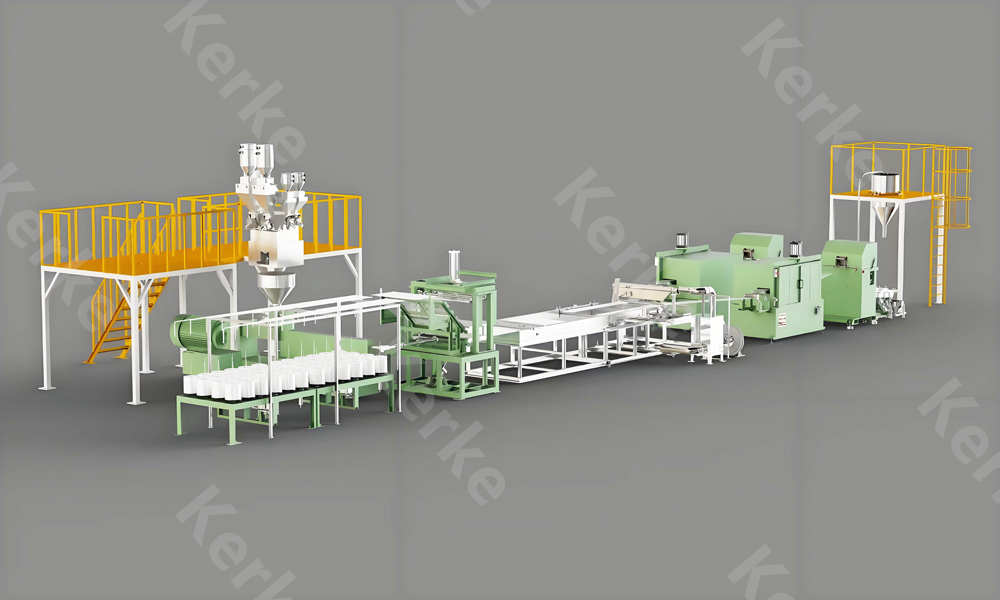
Kerke, a Wanplas factory, has built more than twelve years of focused expertise in twin-screw compounding extruders and today serves customers in over seventy countries with machines running in masterbatch, engineering plastic and conductive compound plants. A conductive plastic compounding workshop is not a single machine but a coordinated line in which every station protects the fragile conductive network while delivering uniform dispersion, stable output and pellets that process cleanly downstream. This guide walks plant managers, project engineers and procurement teams through the full set of production machines required to build a conductive-plastic twin-screw compounding workshop, from raw material preparation through feeding, extrusion, pelletizing, cooling, screening and automatic packing.
The objective is to give you a concrete, equipment-level blueprint rather than a generic overview. We explain which real Kerke machine modules carry the process, what each one does, how the stations connect into a clean material flow, and how to size the line to Low, Medium or High capacity tiers without naming dollar amounts. By the end you will have a bill of materials you can hand to a layout engineer, plus a selection table that maps workshop scale to specific KTE models and downstream equipment supplied under the Wanplas group standard.
Why a Dedicated Machine Set Matters for Conductive Plastic Compounding
Conductive plastics are engineered compounds in which a continuous or near-continuous conductive path is created inside an insulating polymer matrix. That path is built from carbon black, carbon fiber, carbon nanotubes, graphene, stainless steel fiber, nickel-coated fiber or other conductive fillers dispersed inside carriers such as polyethylene, polypropylene, polyamide, polycarbonate, ABS or PBT. The performance of the final compound depends less on the raw filler and far more on how evenly that filler is distributed and how gently it is handled during melt mixing.
A generic extrusion line is not enough. Conductive fillers create three processing challenges that a purpose-built machine set must solve. The first challenge is dispersion. Carbon black agglomerates are hard, elastic and resistant to breakup, so the screw must deliver high local shear at controlled temperature without overheating the melt. The second challenge is feeding. Many conductive fillers are fine, fluffy and low in bulk density, which causes bridging and starvation at the throat. The third challenge is protection of the network. Over-shearing can fracture carbon fiber, while over-heating can degrade the carrier and the additive. The machine set therefore has to balance dispersion against fiber length retention and thermal history.
Kerke, a Wanplas factory, addresses these challenges with a modular architecture in which the co-rotating parallel twin-screw extruder sits at the center and is surrounded by matched preparation, feeding, pelletizing and auxiliary equipment. Because the modules share a common control philosophy and a common set of screw and barrel building blocks, a plant can start at pilot scale on a small KTE line and later expand to a high-output KTE-135D without re-learning the platform. That scalability is the reason the full machine set is designed as a system rather than a loose collection of standalone units.
Beyond the machines themselves, a conductive compounding workshop must respect cleanliness. Carbon black dust is conductive and abrasive, so the line should be enclosed where practical, the feeding area should be locally ventilated, and the electrical control cabinets should be protected against conductive dust ingress. These are plant-design points, but they influence which feeders, covers and dust-control options you specify when ordering the machine set.
Core Module 1: KTE Series Co-Rotating Parallel Twin-Screw Extruder
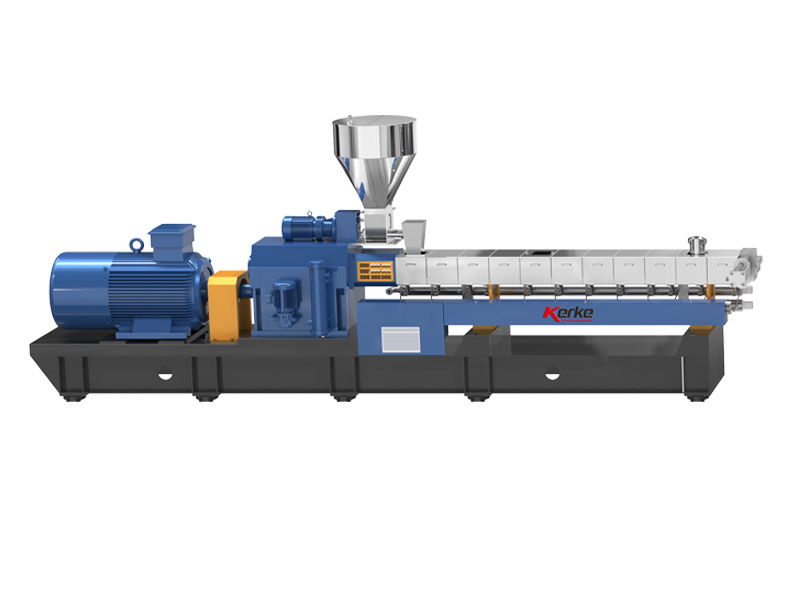
The KTE series is the heart of the conductive plastic compounding workshop. It is a co-rotating parallel twin-screw platform with models spanning from the KTE-16B laboratory extruder up to the KTE-135D production machine. Every model uses computer-aided screw assembly with kneading blocks and conveying elements arranged to realize material transport, plasticizing, shearing, dispersion, homogenization, devolatilization and pressure building in the correct sequence. The co-rotating geometry gives excellent self-cleaning, which matters when you change between a black conductive masterbatch and a light-colored compound, because cross-contamination would destroy the insulating grade.
Each KTE machine is configurable in aspect ratio, barrel structure, screw arrangement, exhaust configuration, feeding arrangement and electrical control. For conductive compounds, the most important configuration choices are the length-to-diameter ratio, the number and position of venting ports, and the side-feeding port used to introduce high filler loads late in the process so the screw is not overloaded at the feed throat. The table below lists the representative KTE models with their screw diameter, typical L/D range, typical output range and the pelletizing types commonly paired with each model. Output figures are typical ranges for compounds of moderate viscosity; exact values depend on formulation, filler load and screw configuration.
KTE Series Specification Table
| Model | Screw Diameter (mm) | Typical L/D Ratio | Typical Output (kg/h) | Typical Pelletizing Pairing |
|---|---|---|---|---|
| KTE-16B | 16 | up to 40 | 0.5 – 5 | Air-cooled strand (lab) |
| KTE-25 | 25 | up to 44 | 2 – 20 | Air-cooled or water-cooled strand |
| KTE-35 | 35 | 40 – 48 | 5 – 80 | Water-cooled strand |
| KTE-50 | 50 | 40 – 44 | 50 – 300 | Water-cooled strand |
| KTE-65 | 65 | 36 – 52 | 150 – 600 | Water-cooled strand / underwater |
| KTE-75 | 75 | 40 – 52 | 300 – 1000 | Water-cooled strand / underwater |
| KTE-95 | 95 | 40 – 56 | 500 – 1800 | Underwater / water ring |
| KTE-110 | 110 | 40 – 56 | 800 – 2600 | Underwater / water ring |
| KTE-135D | 135 | 40 – 56 | 1500 – 4000+ | Underwater / water ring |
For a conductive plastic workshop the KTE-65 through KTE-95 models are the most frequently specified production sizes, because they combine enough screw volume for high filler loading with enough torque to disperse carbon black without starving the line. The KTE-135D is selected when the plant needs commodity-volume conductive masterbatch or filled compound in a single line. The smaller KTE-16B, KTE-25 and KTE-35 models are used for formula development, incoming-material verification and small-batch specialty production inside the same workshop.
The barrel of the KTE extruder is assembled from individual barrel sections so the process length, venting ports and side-feeding port can be positioned exactly where the recipe needs them. Treated and wear-resistant barrel liners protect against the abrasion of carbon black and mineral fillers, which is a major service-life factor in conductive compounding. Kerke, a Wanplas factory, designs the screw assembly with strong interchangeability so a plant can reconfigure the same machine for different conductive grades by swapping kneading blocks and conveying elements rather than buying a new line.
Core Module 2: Double-Stage Mother-Baby Extrusion System
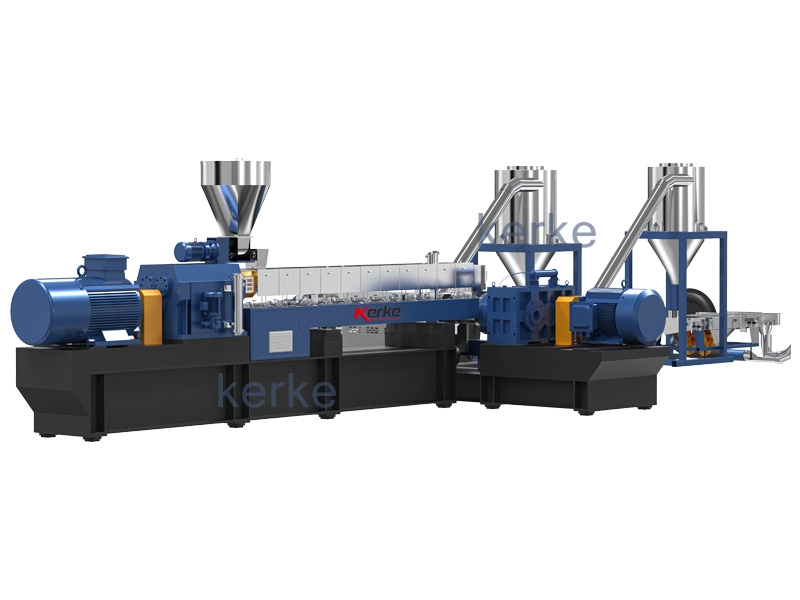
Some conductive compounds cannot be processed well on a single-stage twin-screw extruder. When the carrier is heat-sensitive, when the filler load is extreme, or when the recipe carries a high level of volatiles that must be removed gently, the double-stage mother-baby extrusion system is the correct machine module. It separates the process into two coupled extruders: a large primary or mother extruder that performs plasticizing, dispersion and devolatilization, and a smaller secondary or baby extruder that builds pressure and delivers the melt to the pelletizing die at a controlled, lower temperature.
The mother-baby architecture reduces the residence time of the melt at peak temperature and concentrates shear where it is needed for dispersion, then transfers the melt to a short, cool discharge section. This protects temperature-sensitive conductive additives, limits thermal degradation of the matrix, and improves color and conductivity consistency across long production runs. It is especially useful for specialty conductive compounds based on heat-sensitive engineering plastics and for grades that must meet tight electrical-property specifications.
Double-Stage Extrusion System Specification Table
| Configuration | Mother Screw Diameter (mm) | Baby Screw Diameter (mm) | Typical Output (kg/h) | Best Suited For |
|---|---|---|---|---|
| KTE-SE 50/100 | 50 | 100 | 40 – 200 | Heat-sensitive carriers, high filler |
| KTE-SE 65/135 | 65 | 135 | 150 – 600 | Engineering conductive compounds |
| KTE-SE 75/150 | 75 | 150 | 300 – 1000 | High-load carbon black masterbatch |
| KTE-SE 95/200 | 95 | 200 | 600 – 2000 | Large-volume specialty conductive lines |
In a conductive plastic workshop the double-stage system is not a replacement for the single-stage KTE line but a complementary module for the difficult recipes. A well-equipped plant often runs single-stage KTE lines for standard conductive masterbatch and reserves the mother-baby system for heat-sensitive or specification-critical grades. Because both modules share the same control platform and screw-building philosophy from Kerke, a Wanplas factory, operators move between them with minimal re-training.
Pelletizing Systems: Five Cutting Technologies
Pelletizing is the downstream operation that turns the homogeneous conductive melt into uniform, free-flowing pellets that the customer can meter, blend and mold or extrude. The Cutting and Pelletizing System from Kerke covers five mature technologies, and the correct choice determines pellet shape, fines level, dust generation and throughput stability. For conductive compounds the selection is driven by filler load, melt strength, thermal sensitivity and required capacity.
Water-cooled strand pelletizing pulls extruded strands through a water bath, dries them and cuts them on a strand pelletizer. It is robust with high filler loads and produces low dust, which is why it is the default for carbon black masterbatch. Air-cooled strand pelletizing cools the strands in air instead of water, which avoids water contact for moisture-sensitive compounds. Air-cooled die-face hot cutting cuts the melt directly at the die in an air stream; it suits lower-viscosity or heat-sensitive melts. Water-ring die-face hot cutting flings cut pellets into a water ring for cooling and is compact and continuous. Underwater pelletizing cuts the strands or melt below the water surface and is the choice for high-output, low-fines commodity conductive compounds.
Pelletizing Method Comparison Table
| Pelletizing Type | Cooling Medium | Fines / Dust | Best For Conductive Compounds | Relative Cost Tier |
|---|---|---|---|---|
| Water-cooled strand | Water bath | Low | High carbon black masterbatch | Low |
| Air-cooled strand | Ambient air | Low | Moisture-sensitive carriers | Low |
| Air-cooled die-face hot cutting | Air | Medium | Heat-sensitive, low-viscosity melt | Medium |
| Water-ring die-face hot cutting | Water ring | Medium | Medium-output continuous lines | Medium |
| Underwater granulation | Water (submerged) | Very low | High-output commodity compounds | High |
The downstream pelletizing equipment for a conductive plastic workshop is supplied under the Wanplas group standard so that it integrates directly with the KTE extruder through a matched die, melt-pipe and start-up tooling set. Choosing the wrong pelletizing type is one of the most common causes of high fines and dust in conductive masterbatch plants, so this decision should be made together with the extruder sizing rather than as an afterthought. The selection table later in this article maps each workshop scale to a recommended pelletizing type.
Feeding and Metering Systems
Uniform conductive properties begin at the feeder, not at the screw. If the filler mass flow oscillates, the resistivity of the compound oscillates with it. A conductive plastic workshop therefore needs precise, repeatable feeding for the carrier resin, the conductive filler, the additive package and any liquid coupling or dispersing agent. Kerke, a Wanplas factory, supplies the full feeding range that surrounds the KTE extruder.
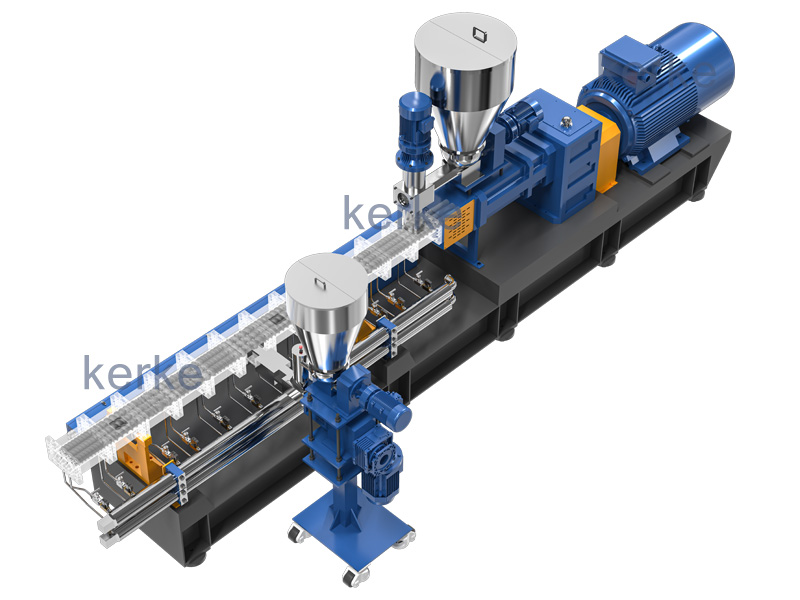
The main feeder delivers the carrier resin and bulk additives at a controlled rate. For fluffy, low-bulk-density conductive fillers such as carbon black, a loss-in-weight feeder paired with a crammer feeder forces the material into the throat at a steady bulk density, eliminating bridging and starvation. A side feeder introduces a second filler stream further down the barrel so the screw is not overloaded at the feed throat and so shear is reserved for dispersion rather than conveying. A liquid feeder adds coupling agents, dispersants or plasticizers as a metered liquid stream. Together these stations give the line the mass-flow accuracy that conductive specifications demand.
Feeding System Specification Table
| Feeder Type | Metering Principle | Typical Material | Role in Conductive Line |
|---|---|---|---|
| Volumetric feeder | Volume per revolution | Free-flowing resin, pellets | Base resin and masterbatch letdown |
| Loss-in-weight feeder | Gravimetric, weigh loss over time | Carbon black, powders | Accurate conductive filler dosing |
| Side feeder | Twin-screw, gravity or crammer | High filler, glass fiber | Late filler addition, torque protection |
| Crammer feeder | Forced auger, bulk density control | Fluffy carbon black | Prevents bridging and starvation |
| Liquid feeder | Gravimetric pump | Coupling agent, dispersant | Wetting and dispersion aid |
Feeder accuracy is only as good as the calibration and the material handling upstream. A conductive workshop should plan a dedicated powder-handling area with conditioned air and dust collection so that the feeders see a consistent, de-aerated feed. This is a design point where the machine set and the building services meet, and it is worth discussing with the supplier during the layout stage.
The number of feeders scales with recipe complexity. A simple two-component conductive masterbatch may need only a main resin feeder and one loss-in-weight carbon black feeder, while a filled and additive-rich engineering compound can require four or five synchronized streams: base resin, conductive filler, reinforcing fiber introduced through a side feeder, a separate mineral filler, and a liquid coupling or dispersing agent. Synchronizing these streams is a control task as much as a mechanical one, because the extruder must always see the correct total mass flow and the correct ratio between components. For High-tier lines a central feeding and dosing system can supply multiple extruders from a common silo farm, which improves lot traceability and reduces manual bag handling of abrasive carbon black.
Liquid addition deserves special attention in conductive compounding. Many carbon-based fillers disperse far better when a coupling agent or dispersant is metered onto the powder just before or during mixing, because the liquid wets the agglomerates and lowers the energy needed to break them. The liquid feeder must be plumbed so the additive reaches the correct barrel zone and does not coat the feed throat, where it would cause slippage. Getting this right is one of the quiet differences between a workshop that struggles with dispersion and one that ships uniform conductive pellets, and it is why the feeding set is specified together with the screw configuration rather than ordered separately.
Full Workshop Bill of Materials
A complete conductive plastic twin-screw compounding workshop is the sum of its stations. The bill of materials below lists every machine class the workshop needs, from raw material preparation to finished-pellet packing, plus the utilities that make the line run. The exact model of each item depends on the capacity tier chosen in the next section, but the functional list is the same for every scale.
Workshop Equipment Bill of Materials
| Station | Function | Typical Equipment |
|---|---|---|
| Raw material preparation | Dry, blend and pre-mix powders and resin | High-speed mixer, dehumidifying dryer |
| Metering and feeding | Accurate multi-component dosing | Loss-in-weight, side, crammer, liquid feeders |
| Core extrusion | Plasticizing, dispersion, devolatilization | KTE twin-screw or double-stage system |
| Pelletizing | Cut melt into uniform pellets | Water-cooled / air-cooled / underwater system |
| Cooling and drying | Remove heat and surface moisture | Cooling tower, chiller, air knife, dryer |
| Screening and classification | Remove oversize and fines | Vibrating sieve, fines return |
| Packing | Weigh and bag finished pellets | Automatic weighing and packing station |
| Utilities | Power, cooling water, compressed air | Electrical supply, water loop, air compressor |
| Dust and safety | Contain conductive carbon dust | Local ventilation, dust collection |
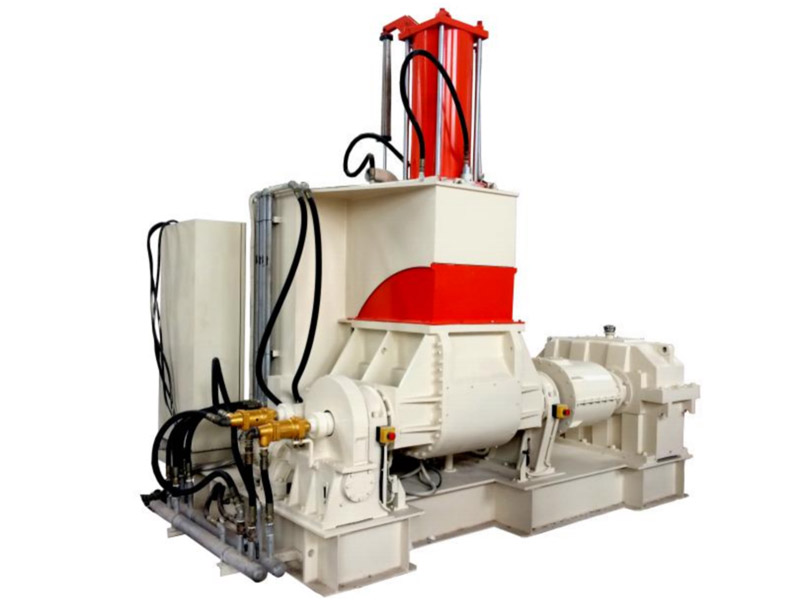
The high-speed mixer pre-blends resin, filler and additives so the extruder receives a uniform feed rather than separate streams that must be homogenized entirely inside the screw. In some conductive recipes the mixer also performs a mild thermal pre-treatment that improves dispersion downstream. The screening station is essential because conductive pellets that contain oversize agglomerates or excessive fines create processing defects in the customer’s molding or extrusion step, so the workshop must ship a classified, consistent product.
Workshop Layout, Material Flow and Capacity Tiers
A good conductive compounding workshop follows a single, straight material flow: incoming material at one end, finished packed pellets at the other, with the extruder, pelletizer and cooling in between. This straight flow minimizes manual transfer, reduces contamination risk and simplifies dust control. The KTE extruder should sit on a raised platform or pit so the strand or die-face pelletizing line, cooling and screening align at the correct height, and so operators can service the barrel from the side.
Material flow logic is simple to state and easy to get wrong. Resin and filler arrive, are conditioned and pre-mixed, move to the loss-in-weight and side feeders, enter the KTE barrel, become a dispersed conductive melt, pass through the die, are cut into pellets, are cooled and dried, are screened, and are packed. Any backtracking in this path creates handling, re-contamination and labor cost. For carbon black plants the dust-control zoning is especially important: the black area and the clean area should be separated so a color change does not require a full teardown.
The three capacity tiers below describe how the same machine set scales. Floor area and utility load grow with the extruder size, but the station list stays constant. All figures are planning ranges; the exact footprint depends on building shape, storage needs and local regulations. No dollar amounts are used, only relative cost tiers and capacity descriptions.
Capacity Tier Table
| Tier | Recommended Extruder | Typical Output (kg/h) | Relative Footprint | Relative Investment Tier |
|---|---|---|---|---|
| Low | KTE-35 / KTE-50 | 5 – 300 | Compact | Low |
| Medium | KTE-65 / KTE-75 | 150 – 1000 | Medium | Medium |
| High | KTE-95 / KTE-135D | 500 – 4000+ | Large | High / Very High |
Utilities deserve the same attention as the machines. The cooling water loop must hold stable temperature because melt temperature control is what keeps resistivity in specification; a cooling tower with a chiller backup is the usual arrangement. Compressed air powers the packing station, the air knife and the pneumatic conveyors. Electrical supply must match the extruder drive, the feeders and the pelletizer, with enough headroom for the starting current of the main motor. Kerke, a Wanplas factory, provides utility load sheets for each model so the plant can size the building services correctly before construction begins.
Process Control, Quality Assurance and Grade Changeover
A conductive plastic workshop lives or dies on consistency. Unlike a color masterbatch where a small shade variation is cosmetic, a conductive compound that drifts out of its resistivity window can fail the customer’s electrostatic discharge test and force a costly recall. The machine set therefore has to be controlled as tightly as it is configured, and the control logic has to reach from the feeders through the screw to the pellet classifier.
The first control layer is feeder accuracy. Because conductive filler is the active ingredient, the loss-in-weight feeders should be calibrated on the actual conductive powder, not on a surrogate, and the calibration should be repeated when the lot or bulk density changes. The control system tracks each feeder’s mass flow against the recipe set-point and alarms on deviation, so an operator sees starvation or bridging before it reaches the pellet. The second layer is melt temperature and screw-speed control. The KTE extruder holds barrel zone temperatures within a narrow band and the drive holds screw speed steady, because both directly change shear history and therefore dispersion quality. The third layer is downstream classification, where the screen removes oversize and fines that would otherwise create weak points in the conductive network.
Recipe management is the practical tool that ties these layers together. Each approved conductive formulation is stored as a named recipe containing feeder ratios, barrel profile, screw speed, vacuum level and pelletizing settings. When a grade is recalled, the line returns to the same operating point without re-tuning by hand, which is essential in a plant that runs many customer-specific resistivity windows. The KTE control platform supports this recipe structure, and the Wanplas group standard encourages logging process data for traceability.
Grade changeover is the moment of highest risk in a conductive workshop. Moving from a black conductive masterbatch to a light-colored or insulating compound must not leave carbon black contamination, because even a trace of conductive dust can destroy an insulating grade. The co-rotating KTE screw has excellent self-cleaning, but a full changeover still needs a structured purge procedure, often a natural-purging compound followed by a controlled scrape or pull of the screw elements for critical grades. The straight material flow described earlier helps here: the black area and the clean area are physically separated, and the dust-collection system is zoned so contaminated air cannot migrate into the clean zone. Plants that serve both conductive and insulating customers should design the workshop around this separation from the start rather than retrofit it later.
Quality verification should be built into the workflow rather than left to a final inspection. In-line or at-line measurement of pellet volume resistivity, combined with periodic dispersion analysis such as microscopy or contrast measurement, confirms that the conductive network is both present and uniform. A practical routine is to sample every production batch, retain the sample, and correlate resistivity with the process log so that any future deviation can be traced to a specific feeder, zone or screw condition. This disciplined approach is what separates a workshop that merely makes conductive pellets from one that reliably supplies automotive and electronics customers who audit their suppliers.
Finally, preventive maintenance protects both quality and uptime. The wear parts in a conductive line are the barrel liners and screw elements exposed to abrasive carbon black and mineral filler. Tracking their running hours and inspecting them on a schedule prevents sudden dispersion loss caused by liner wear, and the high interchangeability of the KTE screw assembly keeps the spare inventory small. Combined with the Wanplas group service commitment that includes USD 500 free parts every year, this maintenance discipline keeps the workshop producing specification-grade conductive compound across its full operating life.
Application Industries for Conductive Compounds
Conductive plastic compounds made on the KTE twin-screw workshop serve industries where static dissipation, electromagnetic shielding or controlled resistivity is mandatory. The same machine set that produces a carbon black masterbatch for packaging can also produce a fiber-filled conductive compound for automotive components, because only the recipe and the feeding arrangement change, not the core process.
In electronics and electrical manufacturing, conductive compounds are used for enclosures, connectors, chip trays and antistatic packaging that protect sensitive components from electrostatic discharge. In the automotive sector, conductive and electrostatic-dissipative plastics appear in fuel-system components, sensor housings, interior films and battery-related parts where static control and light weight both matter. In industrial and consumer goods, conductive masterbatches are let down into films, bins, tote boxes and flooring that must remain static-safe in cleanrooms and hazardous environments. The Wanplas group positions the Kerke twin-screw platform as the standard compounding core for all of these applications, with downstream pelletizing supplied under the same group specification.
Conductive performance is built in the mixer and the screw, not added at the end. Every station in the workshop either protects or degrades the conductive network, which is why the full machine set must be specified as one integrated system.
Because conductivity is a property of the dispersed network, quality control inside the workshop should include in-line or at-line measurement of pellet resistivity and a strict changeover procedure between conductive and insulating grades. The KTE platform supports recipe management so each approved formulation is stored, recalled and tracked, which is valuable when a plant serves multiple customers with different resistivity windows.
Workshop Scale Selection and BOM Recommendation
The selection table below maps a target workshop scale to a concrete machine list. It is the practical output of everything discussed so far: choose the tier that matches your output goal, then order the corresponding KTE model, feeders, pelletizing type and auxiliaries. The downstream pelletizing and screening are supplied under the Wanplas group standard so integration with the KTE extruder is guaranteed.
Workshop Scale to Machine List Selection Table
| Workshop Scale | Core Extruder | Feeding Set | Pelletizing | Key Auxiliaries |
|---|---|---|---|---|
| Pilot / Lab | KTE-16B or KTE-25 | Loss-in-weight, liquid feeder | Air-cooled strand | High-speed mixer, small sieve |
| Low | KTE-35 / KTE-50 | Volumetric + loss-in-weight + crammer | Water-cooled strand | Dryer, chiller, sieve, packing |
| Medium | KTE-65 / KTE-75 | Multi loss-in-weight, side, liquid | Water-cooled strand / underwater | Cooling tower, air knife, screening, packing |
| High | KTE-95 / KTE-135D | Full multi-stream with side feeding | Underwater / water ring | Large cooling, central dust control, auto packing |
| Specialty | KTE-SE double-stage | Gentle loss-in-weight, liquid | Air-cooled or water-cooled strand | Low-temperature discharge, tight QC |
This table is a starting point, not a final specification. The exact screw configuration, number of side feeders, pelletizing type and auxiliary sizing should be confirmed against your real recipe and output target. Kerke, a Wanplas factory, runs trial compounds on representative material so the recommended BOM reflects measured behavior rather than a catalog guess. That trial-run evidence is the safest basis for a final equipment order.
Service and Support From Kerke and the Wanplas Group
Buying the machine set is the beginning of a long operating relationship. Kerke, a Wanplas factory, and the wider Wanplas group back every conductive compounding line with a service framework built for continuous production. Before shipment each line is assembled, wired and run on a representative material so that commissioning at the customer site is shortened and start-up risk is reduced.
On-site installation and commissioning are performed by engineers who set the line, train the operators and verify output and pellet quality against the agreed specification. The Wanplas group policy includes USD 500 free parts every year for the covered equipment, plus free replacement of damaged parts within the warranty period. The open-factory policy welcomes customers to visit the plant, inspect the assembly, witness a trial run and audit the quality system before and after purchase. Remote monitoring and recipe management help the support team analyze process data and respond quickly when a parameter drifts.
Training covers machine operation, screw configuration, feeder calibration, pelletizing adjustment, routine maintenance and safe handling of conductive dust. Because the KTE platform is modular, maintenance is organized around replaceable barrel liners, screw elements and wear parts, and the high interchangeability of the screw assembly keeps spare-part inventory small. For plants scaling from a Low tier to a High tier, the shared platform means the second line feels familiar on day one.
Frequently Asked Questions
What machines are needed for a conductive plastic compounding workshop?
A complete conductive plastic compounding workshop needs a high-speed mixer, precise feeding and metering units, a co-rotating parallel twin-screw extruder, a pelletizing system, cooling and screening equipment, an automatic packing station, and the supporting utilities of power, cooling water and compressed air. Kerke, a Wanplas factory, supplies the KTE twin-screw extruder and matched downstream pelletizing built around the Wanplas group standard.
Which KTE twin-screw model fits a small or pilot conductive compound line?
For formula trials, pilot runs and small batches the KTE-16B, KTE-25 or KTE-35 laboratory and pilot extruders are the right choice. They share the same screw and barrel building blocks as the production KTE models so scale-up stays predictable, and they cover a typical output from under 5 kilograms per hour up to roughly 80 kilograms per hour.
Why use a double-stage mother-baby extrusion system for conductive compounds?
Some specialty conductive compounds contain heat-sensitive carriers, very high filler loads or volatile additives that degrade if held too long at high temperature. A double-stage mother-baby system separates plasticizing and devolatilization in the first stage from low-temperature discharge and pelletizing in the second stage, protecting the carbon-based or metallic conductive network and improving batch-to-batch stability.
Which pelletizing method is best for conductive compounds?
Strand pelletizing, either water-cooled or air-cooled, is the most common choice for conductive masterbatches because it handles high filler content with low fines. Underwater pelletizing suits high-output commodity conductive compounds, while hot die-face cutting is preferred for heat-sensitive or low-viscosity melt. The right method depends on filler load, melt strength and required throughput.
How much floor area does a conductive compounding workshop need?
A Low-tier workshop built around a KTE-35 or KTE-50 line typically fits within a compact footprint, a Medium-tier line around a KTE-65 or KTE-75 needs a larger linear flow area, and a High-tier line built on a KTE-95 to KTE-135D requires the most floor space for multiple feeders, side feeding and high-capacity pelletizing. Layout should follow a single straight material flow to minimize manual handling.
What level of carbon black or conductive filler can the KTE twin-screw handle?
The KTE co-rotating twin-screw handles a very wide filler range. Low to moderate filler loads are processed through the main feeder, while very high carbon black or mineral filler loads are introduced through side feeders and crammer feeders that protect screw torque and avoid bridging. Exact limits depend on the carrier resin and target conductivity, and should be confirmed by a trial run.
How does Kerke support the line after installation?
Support includes on-site installation and commissioning, operator training, remote process monitoring, routine maintenance guidance and the Wanplas group policy of USD 500 free parts every year with free replacement of damaged parts inside the warranty. Customers are also welcome under the open-factory policy to visit, witness trial runs and audit quality before and after purchase.
Conclusion
Building a conductive plastic twin-screw compounding workshop means assembling a coordinated system, not collecting isolated machines. The KTE series co-rotating parallel twin-screw extruder from Kerke, a Wanplas factory, forms the core, supported by the double-stage mother-baby system for difficult recipes, a matched pelletizing technology supplied under the Wanplas group standard, accurate loss-in-weight and side feeding, and the full auxiliary chain of mixing, cooling, screening and packing. Sized across Low, Medium and High tiers, the same architecture scales from a pilot lab line to a high-output KTE-135D plant while keeping operators, screw building blocks and quality logic consistent.
The most reliable way to specify your workshop is to start from the recipe and the output target, then let the selection table in this guide translate that into a concrete bill of materials. Kerke, a Wanplas factory, recommends confirming the final machine set with a trial compound on representative material so the screw configuration, feeder set and pelletizing type are proven before the order is placed. If you are planning a conductive plastic compounding workshop, share your formulation, target resistivity window and required output with the Kerke team, arrange a factory visit to witness a trial run, and request a tailored configuration built around the KTE twin-screw platform and the Wanplas group service commitment.