Introduction and Kerke Positioning
Anti static plastic pellets are a specialized compounding category in which electrical surface behavior is engineered directly into the resin during twin-screw extrusion and pelletizing. The commercial value of these materials is tied less to raw resin price and more to consistent surface resistivity, batch stability, and the ability to run a co-rotating twin-screw line at high overall equipment effectiveness without excessive loss. For a compounding plant, the monthly profit of an anti static pellet line is therefore an operating question as much as a formulation question.
Kerke, a Wanplas factory, is a Nanjing-based manufacturer with more than 12 years of experience in parallel co-rotating twin-screw compounding extruders, operating from a 19,997-plus square meter production base, with over 2,000 machines running in more than 70 countries and a team of more than 100 specialists. The Wanplas group consolidates several specialized machinery factories under one brand, and Kerke focuses exclusively on the twin-screw compounding and pelletizing segment. This article analyzes the monthly operating economics of anti static pellet production on a Kerke co-rotating line using an index-based method: the base formulation is normalized to a cost index of 100 points and a price index of 100 points, and all other systems, margins, and sensitivities are expressed relative to those points or as percentages. No currency amount is used anywhere in this analysis.
The goal of this article is to give plant managers, process engineers, and compounding business owners a repeatable framework for estimating monthly tons, cost structure share, gross margin band, and the sensitivity of that margin to base resin, functional additive, power, good rate, and capacity utilization. Every claim is expressed in physical quantities, percentages, or index points so that the logic transfers across regions and resin price environments.
A monthly profit view differs from a capital-budget view in one important way: the one-time investment in the line is already sunk, so the monthly question is purely about how many good tons can be produced, at what unit cost index, and at what price index. That reframing removes the temptation to justify poor operations by pointing at a low equipment price. On a co-rotating twin-screw line, the monthly result is decided by dispersion quality, scheduling discipline, and energy per ton, not by the purchase invoice. The framework below keeps all three visible at once.
Throughout this analysis the phrase “cost index” always means a relative point score normalized to the reference PP plus carbon black formulation at 100 points, and “price index” always means the realized selling level for a given grade normalized to the same reference at 100 points. A grade can have a cost index above 100 and still earn a healthy margin if its price index is higher by an even larger gap; conversely a low cost index grade can destroy margin if it is sold at a discounted price index that fails to cover the quality and qualification burden. The discipline is to manage the index gap, not the absolute number.
Technical Classification of Anti Static Plastic Pellets
Anti static and static-dissipative behavior is defined by surface resistivity, measured in ohm. The lower the resistivity, the faster static charge leaks away. Three technical families dominate commercial production, and each places a different demand on the twin-screw process, the dispersion hardware, and the cost index.
Migration-Type Antistatic Pellets
Migration-type grades use a migratory additive such as a quaternary ammonium antistatic agent or glycerol fatty acid ester that slowly blooms from the bulk to the surface, forming a thin conductive film sustained by ambient moisture. These systems typically reach surface resistivity of 10^10 to 10^12 ohm. Their weakness is time decay: the surface concentration falls after the initial bloom, and performance is strongly humidity dependent. They are the lowest cost index option but the least stable for long-shelf-life or low-humidity applications.
Permanent Antistatic Pellets
Permanent grades embed a hydrophilic polymer alloy, most commonly polyether-block-amide (PEBA) permanent antistat, distributed through the matrix. Because the conductive phase stays in the bulk rather than migrating, the resistivity band of 10^9 to 10^11 ohm is far less sensitive to humidity and does not decay with storage time. The trade-off is a higher additive cost index and more careful melt temperature control to avoid phase degradation.
Conductive Filler Pellets
Conductive systems rely on a percolation network of carbon black at 15 to 25 phr, carbon nanotube (CNT) at 0.5 to 5 percent, carbon fiber, or metal oxide. These reach 10^2 to 10^6 ohm and are used where electrostatic discharge protection must be robust. The defining concept is the percolation threshold: below a critical loading the particles are isolated and resistivity stays high; above it a connected network forms and resistivity collapses by several decades. Dispersion quality decides whether the actual loading needed to cross the threshold is economical or wasteful. Shear that is too high can break CNTs and cause resistivity to rebound, so the screw element combination must be tuned rather than maximized.
Resistivity Grade Reference
The table below maps the common resistivity bands to application severity. It is the backbone of both formulation choice and price index differentiation.
| Grade | Surface Resistivity Band (ohm) | Typical System | Humidity Dependence | Relative Cost Index |
|---|---|---|---|---|
| General anti static | 10^10 to 10^12 | Quaternary ammonium / ester migration | High | 92 to 104 |
| Permanent anti static | 10^9 to 10^11 | Polyether-block-amide alloy | Low | 118 to 132 |
| Static dissipative | 10^6 to 10^9 | Carbon black moderate loading | Medium | 108 to 124 |
| Conductive | 10^2 to 10^6 | Carbon black high / CNT / fiber | Very low | 125 to 145 |
Relevant test standards are referenced here as plain text only: ASTM D257 for DC resistance measurement, IEC 61340-5-1 for electrostatic protection of devices, ANSI/ESD S20.20 for facility ESD control programs, and GB/T 1410 for volume and surface resistivity of insulating materials. No currency or certification claim is implied.
Selecting the right family is the first margin decision, because it fixes both the cost index band and the achievable price index. A migration-type grade is appropriate only where humidity is controlled and service life is short, such as disposable packaging film masterbatch. Permanent antistats earn their higher cost index in electronic handling and cleanroom parts where a decaying surface film would cause failures. Conductive filler grades are reserved for environments with flammable dust or gas, or for applications that must meet a hard resistivity ceiling regardless of climate. Matching the grade to the true duty avoids paying for performance the customer cannot use and, just as importantly, avoids under-specifying a grade that will be returned.
A further subtlety is the interaction between base resin and additive. Polar bases such as PA or PC/ABS accept permanent antistat alloys more readily and hold lower resistivity at lower loading, while non-polar PP needs either higher additive loading or a coupling strategy. This means the cost index of an apparently identical “permanent antistatic” grade can vary by more than ten points purely from the chosen base, which is why the index method must always be stated together with the base resin, not as a stand-alone number.
Process Window and Equipment Matching
The twin-screw extruder is the single most influential variable in both resistivity consistency and unit energy. For carbon black and CNT systems the central challenge is building a uniform percolation network without over-shearing. The screw must combine a dispersive mixing zone, where agglomerates are broken by high local stress, with a distributive mixing zone, where the broken particles are spread evenly. Too much dispersive stress fractures CNTs and raises resistivity; too little leaves agglomerates that waste additive and create weak spots.
Specific Energy Input and Dispersion
Specific energy input (SEI) for anti static compounding typically falls in the 0.15 to 0.35 kWh/kg range. Lower SEI generally means lower unit power cost but risks poor dispersion; higher SEI improves network uniformity at the cost of more electricity and thermal load. The constraint is the melt temperature ceiling of the base resin: PP should stay at or below 240 degree C, PC/ABS at or below 270 degree C, and PA at or below 290 degree C to avoid degradation that would hurt mechanical retention and color.
Side Feeding, Venting, and Pelletizing
High-loading carbon black is usually introduced through a side feeder to protect the main feed throat and improve homogeneity. Dual vacuum vents remove volatiles and moisture that would otherwise cause voids and resistivity scatter. Die pressure must be stable because pressure swings change residence time and therefore dispersion. Pelletizing method is chosen by material: water-cooled strand pelletizing and underwater pelletizing both suit most anti static compounds, while air-cooled die-face cutting is preferred for heat-sensitive or moisture-sensitive grades.
Representative High-Capacity Line: KTE-135D Class
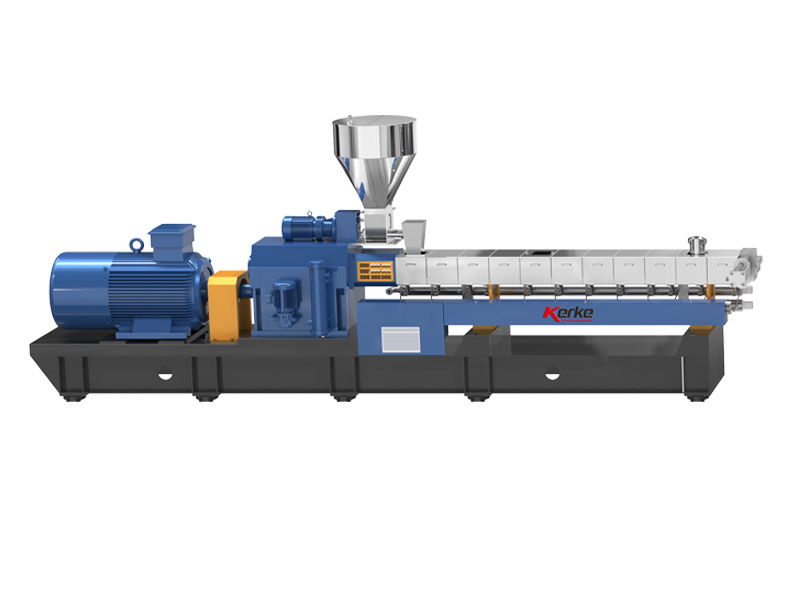
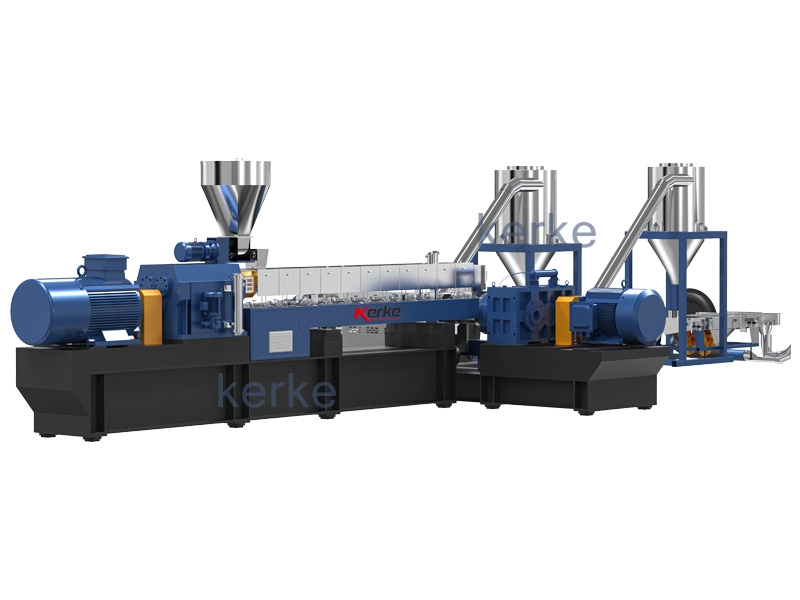
The KTE series from Kerke spans co-rotating parallel twin-screw extruders from the KTE-16B class up to the KTE-135D class. The KTE-135D class is the workhorse for high-volume anti static masterbatch and compound. The values below are representative typical configurations for planning; exact specifications are confirmed against the ordered configuration.
| Parameter | KTE-135D Class (typical) | Note for Anti Static Grades |
|---|---|---|
| Screw diameter | 133 mm | Co-rotating parallel |
| L/D ratio | 40 to 52 | Longer L/D helps dispersion |
| Screw rotation speed | Up to 600 rpm | Tune down for CNT to avoid breakage |
| Specific torque | 11 to 13 Nm/cm3 | High torque supports filled systems |
| Installed main power | 355 to 450 kW | Main motor is 60 to 70 percent of total draw |
| Throughput | 900 to 1500 kg/h | Depends on loading and base resin |
| Vacuum stages | 2 (dual vent) | Needed for low moisture and void-free pellets |
Machine-to-material matching is the first lever on monthly margin: a line that disperses carbon black at lower SEI with stable die pressure will always beat a bigger line that wastes additive and electricity to reach the same resistivity.
The screw element combination deserves more attention than it usually receives in anti static compounding. A dispersive zone built from kneading blocks and reverse elements creates the local stress that fractures agglomerates, but if that zone is too long or runs too hot the polymer degrades and the additive can be damaged, particularly CNT which loses aspect ratio under aggressive shear. A distributive zone built from mixing teeth then redistributes the broken particles so the network is continuous rather than clustered. The practical optimization is to find the shortest dispersive zone that still breaks agglomerates, then let the distributive zone do the spreading. This minimizes SEI, protects heat-sensitive additives, and keeps the main motor load in the efficient band.
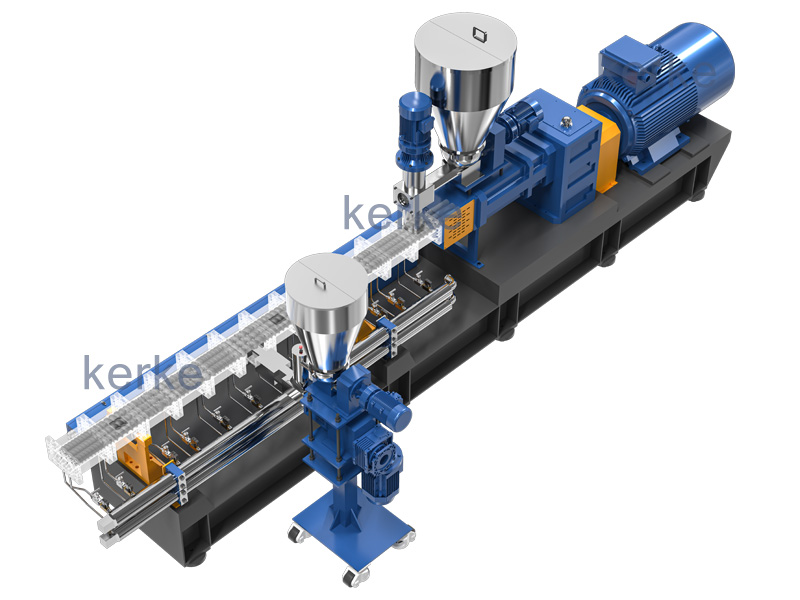
Side feeder placement is a second process lever. Carbon black is bulky and low in bulk density, so metering it at the main throat limits total throughput and worsens mixing. Feeding it through a side feeder partway down the barrel lets the resin plasticize first, which improves wetting of the filler and raises the effective loading that can be dispersed. The penalty is that the side feed zone must have enough free volume and the downstream vacuum must remove the air carried in with the powder; otherwise voids and resistivity scatter appear. On a KTE-series line the side feeder is a twin-screw unit matched to the main screw diameter, and its position is chosen during process development rather than left to default.
Melt temperature management ties the whole window together. Every base resin has a ceiling above which molecular weight drops and mechanical retention falls; for anti static compounds the ceiling also governs additive stability. Running close to the ceiling to maximize throughput is risky because a small screw speed or feed fluctuation pushes the melt over the limit. A safer operating rule is to set the target melt temperature fifteen to twenty degree C below the ceiling and absorb throughput variation through screw configuration and feed rate instead of temperature. This protects both the resistivity and the mechanical properties that the customer also measures.
Quality Control System for Resistance Stability
Because anti static performance is a surface property, quality control must target both the bulk and the surface. The minimum viable system for a commercial line includes the following controls.
- Resistivity measurement: Surface and volume resistivity are measured after a 24-hour humidity equilibrium at 23 degree C and 50 percent relative humidity, the standard conditioning before any ASTM D257-style reading is valid.
- Batch consistency: Same-batch variation should stay within one order of magnitude of resistivity. A batch that spans two decades is a process alarm, not a saleable lot.
- Dispersion inspection: SEM imaging, optical slice of a microtomed section, or pressed-film optical review reveals agglomerate size and network continuity far earlier than resistivity alone.
- Process fingerprint: Melt flow rate, ash content, mechanical retention (tensile and impact versus base), color shift delta E, and moisture in parts per million are tracked per lot to separate formulation drift from processing drift.
A practical rule is to set a resistivity acceptance window per grade and to reject any lot whose delta E or moisture exceeds the control limit even if the mean resistivity passes, because both correlate with field complaints in cleanroom and electronic packaging use.
A useful upgrade is to move from lot-by-lot inspection to statistical process control on the line itself. By plotting resistivity and moisture as running charts with control limits, the team can see a trend toward the edge of the window hours before a lot would fail. This converts quality control from a pass-or-fail gate into an early-warning system, which is exactly what protects the good-rate percentage that drives monthly margin. The sampling plan should weigh the first and last material of each changeover more heavily, because startup and shutdown are where dispersion and moisture are least stable.
Mechanical retention deserves a separate mention. Anti static compounds, especially highly filled carbon black grades, can lose tensile strength and impact resistance as loading rises. A customer who specifies a resistivity ceiling may still reject the lot if the part cracks in assembly. Tracking mechanical retention per lot, even as a simple pass band, prevents the common failure mode where the line hits the resistivity target but ships a brittle pellet. The cost of that extra test is a fraction of the cost of a returned truckload.
Monthly Output Calculation Chain
Monthly tons are derived entirely from physical quantities, which keeps the analysis transferable and free of currency. The chain is:
single-line kg/h × effective running hours × shifts × operating days × OEE percent = tons per month raw, then × good-product rate = sellable tons per month.
Effective running hours already subtract planned changeover, cleaning, and minor stops; OEE captures speed loss, availability loss, and quality loss together. The three-tier table below uses representative assumptions and shows why capacity utilization and good rate dominate the sellable tonnage.
| Tier / Model Class | kg/h | Shifts | Days / month | OEE percent | Good rate percent | Sellable tons / month |
|---|---|---|---|---|---|---|
| Pilot, small KTE class | 40 | 1 | 22 | 78 | 97 | ~25 to 45 |
| Mid, KTE-75B class | 350 | 2 | 25 | 85 | 98 | ~280 to 420 |
| High, KTE-135D class | 1200 | 2 | 26 | 90 | 98 | ~900 to 1400 |
Two insights stand out. First, the jump from one shift to two shifts nearly doubles sellable tons without any extra machine. Second, lifting OEE from 78 to 90 percent on the same hardware adds roughly 15 percent more sellable tons before any throughput change, which flows straight to margin because fixed cost is spread over more good product.
A bottleneck analysis changes how the output chain should be read. In many plants the extruder is not the limiting unit; the loss-in-weight feeders, the side feeder, or the pelletizing and drying downstream set the real ceiling. If the feeder cannot hold accurate rate on a low-bulk-density additive, the line is forced to run below its mechanical throughput, and the OEE calculation hides a feeder-limited operation. The remedy is to size feeding and pelletizing to at least 110 percent of the extruder’s nominal rate so the screw is always the bottleneck and the planned kg/h is real rather than theoretical.
Seasonal and contract effects also enter the chain. A plant serving electronic packaging may see demand swing with consumer electronics cycles, while a plant serving coal mine and powder conveying pipe may see steadier but project-based orders. Planning the operating days and shift count around a rolling demand forecast, rather than a fixed schedule, keeps utilization in the profitable band instead of oscillating between over-staffed low-utilization months and frantic over-time months that raise labor cost and defect rate together.
Cost Structure Percentage and Index System
All economics in this section use an index system with no currency. The reference formulation, a PP base with a carbon black anti static system, is set to a cost index of 100 points and a price index of 100 points. Every other system is expressed relative to those points, and every cost component is shown as a share of total unit manufacturing cost.
Cost Structure Percentage Table
The shares below are typical for a co-rotating twin-screw anti static line and should be read as a planning template rather than a fixed law. A carbon black conductive grade shifts weight toward the functional additive and electricity blocks, while a migration-type masterbatch shifts weight toward the resin base and away from additive. The value of the table is that it forces every cost conversation into the same eight buckets, so improvements are visible and additive rather than lost in a single blended number.
| Cost Component | Share of Unit Cost (percent) | Main Lever |
|---|---|---|
| Resin base material | 58 to 70 | Grade selection, regrind policy |
| Anti static functional additive | 12 to 22 | Loading, dispersion efficiency |
| Other additives | 3 to 6 | Stabilizer, carrier, color |
| Electricity | 4 to 8 | SEI, OEE, power recovery |
| Labor | 3 to 6 | Automation, shift plan |
| Depreciation | 4 to 7 | Capacity utilization |
| Packaging and logistics | 2 to 4 | Bag size, fill rate, routing |
| Loss (startup, purge, screen) | 1 to 3 | Changeover discipline |
Key Cost Drivers
Resin base is the largest block. At 58 to 70 percent of unit cost, the base material dominates the index. This means formulation cost reduction should come from lowering functional additive loading through better dispersion, not from downgrading the base resin, because a cheaper base often raises the additive needed to hold the resistivity grade and can also cut the achievable price index.
The base block also interacts with regrind policy. A controlled return of clean in-house scrap, reblended within the defined upper limit, lowers the effective resin purchase without changing the resistivity grade, because the material is the same polymer. The mistake is to push regrind beyond the dispersion and consistency limit to chase a lower cost index, which then appears as resistivity scatter and raises the loss block through rework. The correct approach treats the regrind cap as a hard process limit, not a monthly cost target.
Additive efficiency differs by chemistry. CNT systems use low mass loading but each point of loading carries high unit contribution to performance, so their cost index is sensitive to small dosing errors. Carbon black uses high phr loading and is cheaper per kilogram but demands more dispersion energy, pushing electricity and SEI up. On a relative basis, a well-dispersed carbon black system can match a CNT system’s resistivity at a lower cost index, while a poorly dispersed CNT system wastes expensive additive and still fails the band.
Electricity scales with SEI. The main motor accounts for roughly 60 to 70 percent of total line power, with vacuum pump, cooling, and material conveying making up the rest. A 10 percent drop in SEI typically lowers unit power consumption by a comparable single-digit percentage, which is meaningful because electricity is 4 to 8 percent of cost and compounds across every ton.
Capacity Utilization Effect on Unit Cost Index
Depreciation and fixed overhead are largely fixed per month, so spreading them over more good tons lowers the unit cost index. The table uses the reference 100-point base as the 95 percent utilization anchor.
| Capacity Utilization | Relative Unit Cost Index (points) | Comment |
|---|---|---|
| 60 percent | 112 | Fixed cost spread thin |
| 80 percent | 104 | Healthy operating band |
| 95 percent | 100 | Reference anchor |
Loss control. Startup changeover loss, purge material, screen undersize, and returned-material blending each eat into good tons. Returned material can be reblended but should be capped at a defined upper limit to protect resistivity consistency; beyond that limit it should be downgraded rather than sold into ESD-grade channels.
Gross Margin Bands and Sensitivity Analysis
Across the anti static pellet portfolio, the recurring gross margin band observed in efficient operations is 14 to 22 percent, while the contribution margin band is 26 to 34 percent, both expressed as percentage of selling price. The contribution margin is wider because it excludes allocated fixed overhead that the gross margin absorbs.
These bands are deliberately stated as ranges because the realized margin depends on product mix. A month heavy in high-volume commodity masterbatch will sit near the lower end of the gross margin band but can still be profitable through volume, while a month heavy in low-volume conductive ESD-grade will sit near the upper end thanks to the higher price index. The planning mistake is to judge a single month against the wrong end of the band; the correct practice is to track the band by grade family and to watch the trend, because a drifting margin within a family signals a process or purchasing problem long before the blended number moves.
Sensitivity to Input Changes
The table shows how a 10 percent move in each major driver shifts the gross margin, holding selling price index constant. All values are percentage points of margin, with no currency.
| Driver | Change Applied | Gross Margin Shift (pp) | Why |
|---|---|---|---|
| Resin base index | +10 percent | -6.0 to -8.0 | Largest cost share |
| Functional additive index | +10 percent | -1.5 to -3.0 | 12 to 22 percent of cost |
| Electricity price index | +10 percent | -0.5 to -0.9 | 4 to 8 percent of cost |
| Good-product rate | +3 pp | +1.5 to +2.5 | More sellable tons per hour |
| Capacity utilization | +15 pp | +2.0 to +3.0 | Fixed cost dilution |
The pattern is clear: the resin base is the dominant swing factor, good rate and utilization are the most controllable upside levers, and electricity is a small but persistent drag that rewards SEI optimization. Pricing should use the price index framework: ESD-grade conductive lots carry a higher price index than general anti static lots of equal cost index, because the customer value and qualification burden are higher.
The contribution margin band of 26 to 34 percent deserves a separate comment, because it is the number that should guide expansion decisions. Gross margin absorbs allocated fixed overhead, so it looks weaker in low-utilization months; contribution margin strips that out and reveals whether each additional ton actually covers its variable cost and contributes to fixed cost recovery. A grade with a positive contribution margin but a thin gross margin is still worth running during a demand trough to keep utilization up, whereas a grade with negative contribution margin should be quoted at a higher price index or declined. Reading both margins together prevents the two classic errors: shutting a line that is still contributing, and accepting orders that lose money on every ton.
A second pricing discipline is index laddering across the grade portfolio. Rather than setting one price index for “anti static,” the plant should maintain a ladder where general anti static sits near the 100 reference, permanent antistatic carries a moderate premium, static dissipative a higher step, and conductive ESD-grade the highest step. The ladder reflects both the cost index gap and the qualification work each grade requires. Plants that fail to ladder effectively subsidize their hardest grades with their easiest ones, which is invisible until the product mix shifts toward the difficult grades and the monthly gross margin collapses despite stable volume.
Eight Actions to Improve Monthly Profit
The following eight actions are sequenced from lowest capital to highest impact, and each can be measured in index points or percentage points rather than currency.
- Standardize formulas to cut changeover. Fewer approved formulations reduce purge volume and startup loss, directly lifting good rate and utilization.
- Batch-schedule by color and system. Running same-color, same-system lots back to back minimizes cleaning and screen change, protecting the 1 to 3 percent loss block.
- Manage screw element life. Track kneading block wear; a worn dispersive zone raises SEI and scatters resistivity, forcing rework that destroys margin.
- Install online resistance and moisture monitoring. Catching a resistivity drift at the die saves an entire off-spec lot versus discovering it in final QC.
- Automate packaging to cut labor. Labor is 3 to 6 percent of cost; automated filling and palletizing also reduces contamination risk for cleanroom grades.
- Meter electricity by subsystem. Sub-metering the main motor, vacuum, and cooling exposes where SEI reduction pays back fastest.
- Manage inventory and turnover days. Anti static grades can age, especially migration types; keeping inventory turnover days low protects both quality and working capital.
- Grade the customer specification. Sell ESD-grade and general anti static-grade at differentiated price index levels instead of discounting conductive lots to commodity pricing.
These eight actions are not independent. Standardizing formulas enables batch scheduling, which reduces loss, which improves good rate, which lifts both gross and contribution margin without touching the equipment. Conversely, neglecting screw element life forces more frequent changeover and lowers utilization, dragging the whole chain down. The highest-return sequence for most plants is to attack utilization and good rate first through scheduling and QC, because those levers are nearly free, and to attack SEI and additive loading second through screw and formulation work that needs more engineering time.
Application Industries for Anti Static Pellets
Anti static pellets produced on Kerke co-rotating lines serve a wide set of end industries that the factory already covers through its masterbatch and plastic compound programs. The most representative end uses are:
- Electronic packaging trays and turnover boxes: permanent or dissipative grades protect components during handling and shipping.
- IC carrier tape: carbon black conductive grades with tight resistivity bands for embossed and press-formed tape.
- Cleanroom components: low-outgassing, low-sloughing permanent antistatic housings and fixtures.
- Fuel lines and automotive fuel tank liners: dissipative compounds that prevent static ignition risk in flammable service.
- Coal mine and powder conveying pipe: conductive grades that bleed charge in dust-laden environments.
- Textile and film masterbatch: anti static additive masterbatch for fibers and packaging film to reduce cling and dust pickup.
Each end use maps to a resistivity grade from the classification table and therefore to a distinct cost index and price index pair, which is the practical link between application and monthly margin.
The electronic packaging and IC carrier segments are the most demanding in terms of consistency, because a single out-of-window lot can cause static damage to sensitive devices that is discovered only at the customer’s assembly line. These segments reward the permanent antistatic and tightly controlled carbon black dissipative grades, and they tolerate a higher price index in exchange for documented lot traceability. The coal mine, powder conveying, and fuel-line segments are less sensitive to cosmetic consistency but require a hard resistivity ceiling for safety, so the cost focus shifts to reliably crossing the percolation threshold without over-loading. Textile and film masterbatch sit at the high-volume, lower-margin end where throughput and utilization dominate the monthly result more than formulation sophistication.
Matching the line to the segment also matters for scheduling. High-consistency electronic grades should be concentrated into dedicated, well-controlled runs with thorough cleaning between them, while high-volume commodity masterbatch can be batched aggressively to maximize utilization. Mixing the two on the same uncontrolled schedule is a frequent cause of both resistivity complaints and wasted changeover time, which is why the selection table pairs each monthly target with a model and a system rather than with a generic “anti static line.”
Demand to Model Selection Recommendation
The table below connects a customer requirement, expressed as monthly capacity, antistatic system, and surface resistivity target, to a recommended Kerke model from the real KTE series. Recommendations assume two-shift operation and the OEE bands already discussed.
| Monthly Target (tons) | Antistatic System | Surface Resistivity Target | Recommended Model |
|---|---|---|---|
| Under 50 | Pilot / migration | 10^10 to 10^12 | Small KTE class (lab to pilot) |
| 280 to 420 | Carbon black / permanent | 10^6 to 10^11 | KTE-75B class |
| 900 to 1400 | Carbon black high / CNT | 10^2 to 10^9 | KTE-135D class |
| Mixed low-volume | All systems, frequent change | 10^6 to 10^12 | KTE-75B class with side feeder |
Representative Mid-Capacity Line: KTE-75B Class
For steady contract compounding in the few-hundred tons per month band, the KTE-75B class offers the same co-rotating architecture as the larger line with a footprint suited to most factories. Values are representative typical configurations.
| Parameter | KTE-75B Class (typical) | Note for Anti Static Grades |
|---|---|---|
| Screw diameter | 71 mm | Co-rotating parallel |
| L/D ratio | 40 to 48 | Configurable to dispersion need |
| Screw rotation speed | Up to 600 rpm | Lower for CNT protection |
| Specific torque | 11 to 12 Nm/cm3 | Supports filled masterbatch |
| Installed main power | 110 to 160 kW | About 60 to 70 percent of line draw |
| Throughput | 250 to 450 kg/h | Varies with loading |
| Vacuum stages | 1 to 2 | Dual vent for low moisture |
Service and Support Commitments
Kerke, as a Wanplas factory, backs its compounding lines with a service package built for continuous monthly operation rather than one-time commissioning.
- Pre-shipment testing: each line is run and verified against the agreed process window before departure, reducing startup loss in the first production month.
- Installation and commissioning: engineers support on-site setup, first-article trials, and process tuning for the specific anti static system.
- Spare parts policy: the Wanplas group provides USD 500 free parts per year as a baseline coverage, with warranty replacement for defective components.
- Formula and process training: operators receive hands-on training in screw configuration, side feeder dosing, and resistivity QC so the line holds its margin levers.
- Remote operation and maintenance: PLC and process data can be reviewed remotely to diagnose drift before it becomes an off-spec lot.
- Open factory visits: customers are welcome to audit the production base and witness a running line before ordering.
Risks and Compliance Considerations
Anti static pellet production carries risks that are process-related rather than currency-related, and they must be designed out rather than corrected after the fact.
- Humidity dependence complaints: migration-type grades that pass at 50 percent relative humidity can fail at low humidity at the customer site. Grade selection must match the customer’s real environment.
- Migration blooming and contamination: migratory additives can fog surfaces or contaminate adjacent parts, a critical issue for optical and cleanroom components.
- Halogen and substance compliance: RoHS and REACH set limits on certain substances; formulations must be documented and screened, with plain-text reference to the applicable directives only.
- Cleanroom packaging: cleanroom customers impose falling-dust and packaging cleanliness requirements that affect both the pelletizing method and the bagging environment.
Compliance is not only about substance restrictions; it is also about documentation continuity. Each anti static grade should carry a formulation record that links the base resin, the additive chemistry expressed by type rather than brand, the processing window, and the lot test results. When a customer audits the material against RoHS or REACH, the answer must come from a traceable record, not from memory. The Wanplas group’s shared quality framework supports this discipline, and it is especially important for grades that enter electronic or automotive supply chains where a single undocumented substance can block an entire shipment.
Another underrated risk is the mismatch between quoted resistivity and measured field condition. A grade validated at 23 degree C and 50 percent relative humidity may be specified into a dry winter warehouse or a tropical port, and the migration-type chemistry will behave differently in each. The protective step is to agree the test condition with the customer at quotation time and to state it on the certificate, so that a complaint arising from an unstated climate is resolved by specification rather than by concession. This simple practice removes a large share of recurring anti static disputes.
Common Operating Mistakes
Four recurring mistakes erode monthly profit even on a capable twin-screw line.
- Using the cheapest base material: a low-cost resin that needs more additive to hit the resistivity grade raises the functional additive share and can lower the achievable price index, eroding the very margin it was meant to protect.
- Over-relying on migration types: choosing migratory systems for applications that need permanent performance creates returns and rework that dwarf the small additive saving.
- Ignoring dispersion testing: skipping SEM or pressed-film checks hides agglomerates until resistivity fails, turning a controllable process into a lot-rejection event.
- Running at full load with no changeover window: packing the schedule removes the buffer needed for cleaning and maintenance, which then triggers unplanned stops that cost far more utilization than a planned slot.
- Skipping formulation documentation: failing to record the exact additive type, loading, and process window makes every later complaint undiagnosable and turns continuous improvement into guesswork.
Frequently Asked Questions
What is the difference between migration-type and permanent antistatic pellets?
Migration-type pellets rely on a migratory ionic or nonionic additive that blooms to the surface to form a conductive film, giving surface resistivity around 10^10 to 10^12 ohm under humid conditions but decaying over time. Permanent antistats use a hydrophilic polymer alloy such as polyether-block-amide that stays distributed in the bulk, holding 10^9 to 10^11 ohm with low humidity dependence.
Why is dispersion quality more important than additive dosage for conductive filler systems?
For carbon black and carbon nanotube systems the electrical path is built through a percolation network. A single order-of-magnitude change in dispersion quality can shift surface resistivity by several decades, so uniform agglomerate breakdown on the twin-screw line matters more than simply increasing loading above the percolation threshold.
How is monthly output calculated for a twin-screw pelletizing line?
Multiply single-line hourly throughput in kg/h by effective running hours, shifts, operating days and OEE percentage to obtain tons per month, then apply the good-product rate. A representative high-capacity co-rotating line running two shifts at 90 percent OEE and 98 percent good rate can deliver well over one thousand tons per month.
What drives the unit manufacturing cost index most in antistatic compounding?
The resin base material dominates the cost index at 58 to 70 points of the structure. The most reliable way to lower the index without sacrificing the resistance grade is to optimize the functional additive loading and dispersion rather than downgrading the base resin, because the base share is too large to offset through small additive savings alone.
Which Kerke model fits a small ESD masterbatch trial line?
For pilot runs, formula development and low-volume specialty antistatic grades a compact KTE-series co-rotating unit in the small diameter class is appropriate, while a mid-size KTE-75B class line serves steady contract compounding in the few-hundred tons per month band and a KTE-135D class line serves high-volume commodity antistatic masterbatch.
How does capacity utilization affect unit cost and monthly margin?
Depreciation and fixed overhead spread over more good tons as utilization rises. Moving utilization from 60 percent to 80 percent and then to 95 percent progressively lowers the unit cost index and lifts gross margin by several percentage points even when selling price index is held constant.
What quality checks confirm a stable antistatic pellet batch?
Measure surface and volume resistivity after 24-hour humidity equilibrium at 23 degree C and 50 percent relative humidity, verify same-batch consistency within one order of magnitude, inspect dispersion by SEM or pressed-film optical slice, and track melt flow rate, ash, mechanical retention, color shift and moisture in parts per million.
Conclusion
Monthly profit for anti static plastic pellets on a co-rotating twin-screw line is an operating discipline expressed in physical quantities and index points rather than currency. The resin base sets the floor of the cost index, dispersion quality decides whether expensive additive is actually converted into resistivity, and good rate plus capacity utilization are the most controllable margin levers. Kerke, a Wanplas factory, supplies the KTE-series co-rotating twin-screw extruders, from the small pilot class through the KTE-75B and KTE-135D classes, with side feeding, dual venting, and the process support needed to hold these margins month after month. If you are planning or optimizing an anti static pellet line, send your target monthly tons, base resin, and required surface resistivity band, and the engineering team will propose a matched configuration, run a trial on your formulation, and welcome you to the factory to verify the process before commitment.